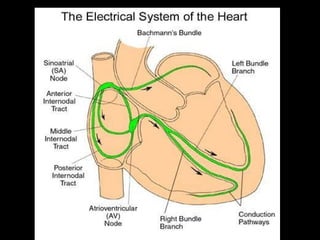
Bundle Branch Blocks

Dr.W A P S R Weerarathna
Blood supply
• RCA (proximal)  Sinus nodal artery
• LAD  Septal branch to proximal RBB
  and anterior LBB.
• LAD (septal) & RCA (terminal) 
  Posterior fascicle of LBB
• PDA  AV nodal branch and bundle of
  HIS supply
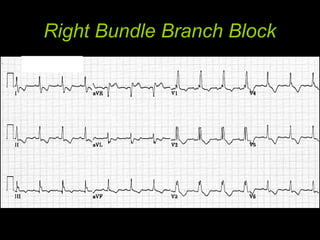
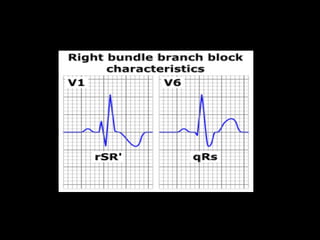
Right Bundle Branch Block (RBBB)

• QRS duration ≥ 120ms
• rSR’ pattern or notched R wave in V1
• Wide S wave in I and V6
Causes
• Normal variant in 0.2% of adults.
• CAD  Acute anterior MI (occlusion of proximal
  LAD)
• Pulmonary hypertension (COPD)
• Acute pulmonary embolism
• Congenital heart disease e.g. ASD, Ebstein’s
  anomaly
• Rate dependent RBBB
• Rare: Brugada syndrome
Clinical significance
• RBBB is commonly seen and is usually
  benign
• RBBB in the setting of an acute MI
  worsens the prognosis (indicates proximal
  LAD occlusion)
• Presence of RBBB on ECG is not a
  contraindication for TMT
Right Bundle Branch Block
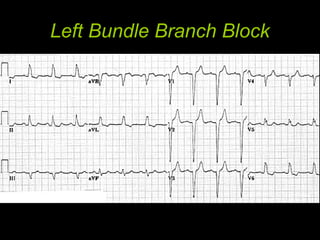
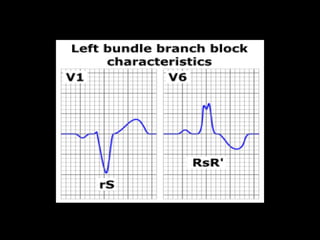
Left Bundle Branch Block (LBBB)

• QRS duration ≥ 120ms
• Broad R wave in I and V6
• Prominent QS wave in V1
• Absence of q waves (including physiologic
  q waves) in I and V6
Causes
•   CAD  Acute AWMI (new onset LBBB)
•   Dilated Cardiomyopathy
•   Aortic stenosis
•   Long-standing hypertension
•   Rate dependent LBBB
•   RV paced rhythm
Clinical significance
• New onset LBBB is an indication for thrombolytic
  therapy
• LBBB in the setting of an acute MI worsens the
  prognosis
• Standard LVH criteria are not valid in presence
  of LBBB
• LBBB may mask signs of myocardial infarction
• LBBB on ECG is a contraindication for TMT
• Presence of LBBB in heart failure indicates
  ventricular dyssynchrony
Left Bundle Branch Block
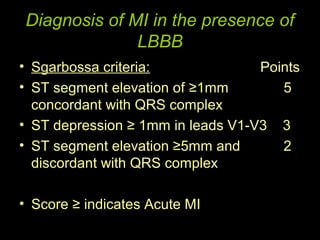
Diagnosis of MI in the presence of
              LBBB
• Sgarbossa criteria:              Points
• ST segment elevation of ≥1mm        5
  concordant with QRS complex
• ST depression ≥ 1mm in leads V1-V3 3
• ST segment elevation ≥5mm and       2
  discordant with QRS complex

• Score ≥ indicates Acute MI
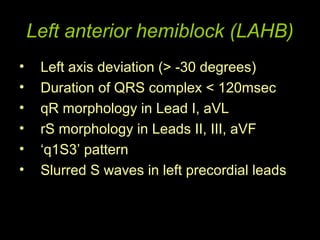
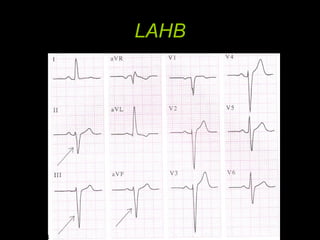
Left anterior hemiblock (LAHB)
•    Left axis deviation (> -30 degrees)
•    Duration of QRS complex < 120msec
•    qR morphology in Lead I, aVL
•    rS morphology in Leads II, III, aVF
•    ‘q1S3’ pattern
•    Slurred S waves in left precordial leads
LAHB
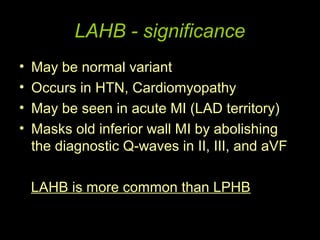
LAHB - significance
•   May be normal variant
•   Occurs in HTN, Cardiomyopathy
•   May be seen in acute MI (LAD territory)
•   Masks old inferior wall MI by abolishing
    the diagnostic Q-waves in II, III, and aVF

    LAHB is more common than LPHB
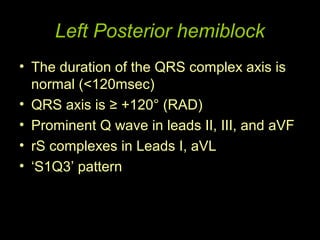
Left Posterior hemiblock
• The duration of the QRS complex axis is
  normal (<120msec)
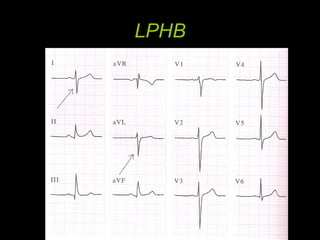
• QRS axis is ≥ +120° (RAD)
• Prominent Q wave in leads II, III, and aVF
• rS complexes in Leads I, aVL
• ‘S1Q3’ pattern
LPHB
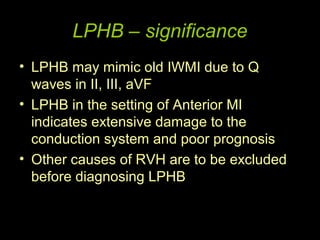
LPHB – significance
• LPHB may mimic old IWMI due to Q
  waves in II, III, aVF
• LPHB in the setting of Anterior MI
  indicates extensive damage to the
  conduction system and poor prognosis
• Other causes of RVH are to be excluded
  before diagnosing LPHB

Bundlebranchblocks

  • 1.
    Bundle Branch Blocks Dr.WA P S R Weerarathna
  • 3.
    Blood supply • RCA(proximal)  Sinus nodal artery • LAD  Septal branch to proximal RBB and anterior LBB. • LAD (septal) & RCA (terminal)  Posterior fascicle of LBB • PDA  AV nodal branch and bundle of HIS supply
  • 4.
    Right Bundle BranchBlock (RBBB) • QRS duration ≥ 120ms • rSR’ pattern or notched R wave in V1 • Wide S wave in I and V6
  • 5.
    Causes • Normal variantin 0.2% of adults. • CAD  Acute anterior MI (occlusion of proximal LAD) • Pulmonary hypertension (COPD) • Acute pulmonary embolism • Congenital heart disease e.g. ASD, Ebstein’s anomaly • Rate dependent RBBB • Rare: Brugada syndrome
  • 6.
    Clinical significance • RBBBis commonly seen and is usually benign • RBBB in the setting of an acute MI worsens the prognosis (indicates proximal LAD occlusion) • Presence of RBBB on ECG is not a contraindication for TMT
  • 7.
  • 9.
    Left Bundle BranchBlock (LBBB) • QRS duration ≥ 120ms • Broad R wave in I and V6 • Prominent QS wave in V1 • Absence of q waves (including physiologic q waves) in I and V6
  • 10.
    Causes • CAD  Acute AWMI (new onset LBBB) • Dilated Cardiomyopathy • Aortic stenosis • Long-standing hypertension • Rate dependent LBBB • RV paced rhythm
  • 11.
    Clinical significance • Newonset LBBB is an indication for thrombolytic therapy • LBBB in the setting of an acute MI worsens the prognosis • Standard LVH criteria are not valid in presence of LBBB • LBBB may mask signs of myocardial infarction • LBBB on ECG is a contraindication for TMT • Presence of LBBB in heart failure indicates ventricular dyssynchrony
  • 12.
  • 14.
    Diagnosis of MIin the presence of LBBB • Sgarbossa criteria: Points • ST segment elevation of ≥1mm 5 concordant with QRS complex • ST depression ≥ 1mm in leads V1-V3 3 • ST segment elevation ≥5mm and 2 discordant with QRS complex • Score ≥ indicates Acute MI
  • 15.
    Left anterior hemiblock(LAHB) • Left axis deviation (> -30 degrees) • Duration of QRS complex < 120msec • qR morphology in Lead I, aVL • rS morphology in Leads II, III, aVF • ‘q1S3’ pattern • Slurred S waves in left precordial leads
  • 16.
  • 17.
    LAHB - significance • May be normal variant • Occurs in HTN, Cardiomyopathy • May be seen in acute MI (LAD territory) • Masks old inferior wall MI by abolishing the diagnostic Q-waves in II, III, and aVF LAHB is more common than LPHB
  • 18.
    Left Posterior hemiblock •The duration of the QRS complex axis is normal (<120msec) • QRS axis is ≥ +120° (RAD) • Prominent Q wave in leads II, III, and aVF • rS complexes in Leads I, aVL • ‘S1Q3’ pattern
  • 19.
  • 20.
    LPHB – significance •LPHB may mimic old IWMI due to Q waves in II, III, aVF • LPHB in the setting of Anterior MI indicates extensive damage to the conduction system and poor prognosis • Other causes of RVH are to be excluded before diagnosing LPHB