Dr .W.A.P.S.R.Weerarathna
Registrar in Medicine
Ward 10/02
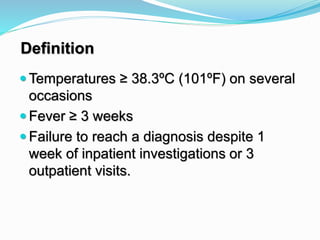
Definition
 Temperatures ≥ 38.3ºC (101ºF) on several
occasions
 Fever ≥ 3 weeks
 Failure to reach a diagnosis despite 1
week of inpatient investigations or 3
outpatient visits.
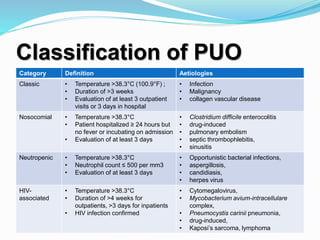
Classification of PUO
Category Definition Aetiologies
Classic • Temperature >38.3°C (100.9°F) ;
• Duration of >3 weeks
• Evaluation of at least 3 outpatient
visits or 3 days in hospital
• Infection
• Malignancy
• collagen vascular disease
Nosocomial • Temperature >38.3°C
• Patient hospitalized ≥ 24 hours but
no fever or incubating on admission
• Evaluation of at least 3 days
• Clostridium difficile enterocolitis
• drug-induced
• pulmonary embolism
• septic thrombophlebitis,
• sinusitis
Neutropenic • Temperature >38.3°C
• Neutrophil count ≤ 500 per mm3
• Evaluation of at least 3 days
• Opportunistic bacterial infections,
• aspergillosis,
• candidiasis,
• herpes virus
HIV-
associated
• Temperature >38.3°C
• Duration of >4 weeks for
outpatients, >3 days for inpatients
• HIV infection confirmed
• Cytomegalovirus,
• Mycobacterium avium-intracellulare
complex,
• Pneumocystis carinii pneumonia,
• drug-induced,
• Kaposi’s sarcoma, lymphoma
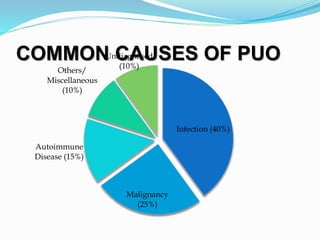
COMMON CAUSES OF PUO
Infection (40%)
Malignancy
(25%)
Autoimmune
Disease (15%)
Others/
Miscellaneous
(10%)
Undiagnosed
(10%)
Classic PUO
3 common etiologies which account for the
majority of classic PUO:
Infections
Malignancies
Collagen Vascular Disease
Others/Miscellaneous which includes drug-induced
fever.
Infections
 Bacterial: abscesses, TB, complicated UTI,
endocarditis, osteomyelitis, sinusitis, Lyme
disease, prostatitis, cholecystitis, empyema,
biliary tract infection, brucellosis, typhoid,
leptospirosis,
 Q fever, borreliosis, etc.
 Parasite: Malaria, toxoplamosis, leishmaniasis,
etc.
 Fungal: histoplasmosis, etc.
 Viral: CMV, infectious mononucleosis, HIV, etc.
Infections
 As duration of fever increases, infectious etiology
decreases
 Malignancy and factitious fevers are more common
in patients with prolonged FUO.
Malignancies
 Haematological
 Lymphoma
 Chronic leukemia
 Non-haematological
 Renal cell cancer
 Hepatocellular carcinoma
 Pancreatic cancer
 Colon cancer
 Hepatoma
 Myelodysplastic Syndrome
 Sarcomas
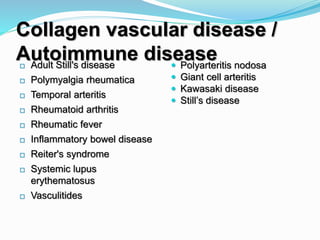
Collagen vascular disease /
Autoimmune disease Polyarteritis nodosa
 Giant cell arteritis
 Kawasaki disease
 Still’s disease
 Adult Still's disease
 Polymyalgia rheumatica
 Temporal arteritis
 Rheumatoid arthritis
 Rheumatic fever
 Inflammatory bowel disease
 Reiter's syndrome
 Systemic lupus
erythematosus
 Vasculitides
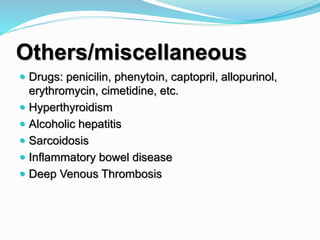
Others/miscellaneous
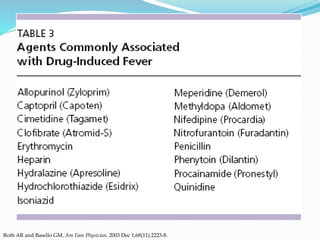
 Drugs: penicilin, phenytoin, captopril, allopurinol,
erythromycin, cimetidine, etc.
 Hyperthyroidism
 Alcoholic hepatitis
 Sarcoidosis
 Inflammatory bowel disease
 Deep Venous Thrombosis
Roth AR and Basello GM. Am Fam Physician. 2003 Dec 1;68(11):2223-8.
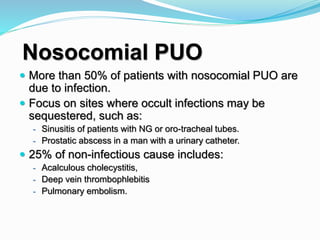
Nosocomial PUO
 More than 50% of patients with nosocomial PUO are
due to infection.
 Focus on sites where occult infections may be
sequestered, such as:
- Sinusitis of patients with NG or oro-tracheal tubes.
- Prostatic abscess in a man with a urinary catheter.
 25% of non-infectious cause includes:
- Acalculous cholecystitis,
- Deep vein thrombophlebitis
- Pulmonary embolism.
Neutropenic PUO
 Patients on chemotherapy or immune deficiencies
are susceptible to:
- Opportunistic bacterial infection
- Fungal infections such as candidiasis
- Bacteremic infections
- Infections involving catheters
- Perianal infections.
 Examples of aetiological agent:
- aspergillus
- Candida
- CMV
- Herpes simplex
HIV-associated PUO
 HIV infection alone may be a cause of fever.
 Common secondary causes include:
- Tuberculosis
- Toxoplasmosis
- CMV infection
- P. carinii infection
- Salmonellosis
- Cryptococcosis
- Histoplasmosis
- Non-Hodgkin's lymphoma
- Drug-induced fever
A Clinical Approach
History Taking
History of Presenting Complaint- (HPC)
1。Onset
 - acute: Malaria, pyogenic infection
 - gradual: TB, thyphoid fever
2。Character
 high grade fever: UTI, TB, malaria, drug
3。Pattern
 sustained/persistent: Thyphoid fever, drugs
 intermittent fever:
 Daily spikes: Abscess, TB, Schistosomiasis
 Twice-daily spikes: Leishmaniasis
 Saddleback fever: Leptospirosis, dengue,borrelia
 -relapsing/ recurrent fever: Non-falciparum malaria,
Brucellosis, Hodgkin’s lymphoma
4。Antecedents
- prior to onset of fever:
 dental extraction: Infective endocarditis
 Urinary catherization: UTI, bacteremia.
5。Associated symptoms
 Chills & rigors
 bacterial, rickettsial and protozoal disease,
 influenza, lymphoma, leukaemia, drug-induced
 Night sweats
 TB, Hodgkin’s lymphoma
 Loss of weight
 Malignancy, TB
 Cough and Dyspnoea
 Miliary TB, multiple pulmonary emboli, AIDS patient with PCP, CMV.
 Headache
 Giant cell arteritis, typhoid fever, sinusitis
 Joint pain
 RA, SLE, vasculitis
 Abd. Pain
 Cholangitis, biliary obstruction, perinephric abscess, Crohn’s
disease, dissecting aneuryms, gynaecological infection
 Bone pain
 Osteomyelitis, lymphoma
 Sorethroat
 IM, retropharyngeal abscess, post-Streptococcal infection
 Dysuria, rectal pain
 Prostatic abscess, UTI
 Altered bowel habit
 IBD, thyphoid fever, schistosomiasis, amoebiasis
 Skin rash
 Gonococcal infection, PAN,NHL, dengue fever
 Past Medical History
 Malignancy = leukemia, lymphoma, hepatocellular ca
 HIV infection
 DM
 IBD
 collagen vascular disease-SLE, RA, giant cell arteritis
 TB
 Heart disease: valvular heart disease
Past Surgical History
 Post splenectomy/ post- transplantation
 Prosthetic heart valve
 Catheter, AV fistula
 Recent surgery/ operation
 Drug History
 Immunosuppressive drug/ corticosteroid
 Anticoagulants: accumulation of old blood in closed space e.g.
retroperitoneal, perisplenic
 Before fever: drug fever occur within 3 months after starting taking
drugs
 may cause hypersensitivity and low grade fever, usually associated with
rash
 Due to the allergic reaction, direct effect of drug which impair temperature
regulation (e.g. phenothiazine)
 E.g. Antiarrhythmic drug: procainamide, quinidine; Antimicrobacterial
agent: penicillin, cephalosporin, hydralazine
 After fever: may modify clinical pictures, mask certain infection e.g.
SBE, antibiotic allergy
 Family History
 Anyone in family has similar problem: TB, familial Mediterranian
fever
 Social History
 Travel
 amoebiasis, typhoid fever, malaria, Schistosomiasis
 Residental area
 malaria, leptospirosis, brucellosis
 Occupation
 farmers, veterinarian, slaughter-house workers = Brucellosis
 workers in the plastic industries = polymer-fume fever
 Contact with domestic / wild animal / birds :
 Brucellosis, psittacosis (pigeons), Leptospirosis, Q fever, Toxoplasmosis
 Diet history
 unpasteurized milk/cheese = Brucellosis
 poorly cooked pork = Trichinosis
 IVDU = HIV-AIDS related condition, endocarditis
 Sexual orientation = HIV, STD, PID
 Close contact with TB patients
Physical Examination
Examination
 General
 Pattern of fever (continous, intermittent, relapsing)
 Ill/not ill
 Weight loss (chronic illness)
 Skin rash
Hands
 Stigmata of Infective Endocarditis
 Vasculitis changes
 Clubbing
 Presence of arthropathy
 Raynaud’s phenomenon
Arms
 Drug injection sites (ivdu)
 Epitrochlear and axillary nodes (lymphoma,
sarcoidosis, focal infection)
 Skin
Head & neck
 Feel temporal arteries (tender & thicken)
 Eyes – iritis/conjuctivitis (CTD – reiter syndrome)
 Jaundice (ascending cholangitis)
 Fundi – choroidal tubercle (miliary TB), roth’s spot
(IE) and retinal haemorrhage (leukaemia)
 Lymphadenopathy
Face & mouth
 Butterfly rash
 Mucous membranes
 Seborrhoic dermatitis (HIV)
 Mouth ulcers (SLE)
 Buccal candidiasis
 Teeth & tonsils infection (abscess)
 Parotid enlargement
 Ears – otitis media
Chest
 Bony tenderness
 CVS – murmurs (ie, atrial myxoma), rubs
(pericarditis)
 RS – signs of pneumonia, TB, empyema and lung
CA
Abdomen Rose coloured spot
(typhoid fever)
 Hepatomegaly (sbp,
hepatic ca, met)
 Splenomegaly
(haemopoietic
malignancy, ie, malaria)
 Renal enlargement
(renal cell ca)
 Testicular enlargement
(seminoma)
 Penis & scrotum –
discharge/rash
 Inguinal ligament
 Per rectal exam –
mass/tenderness in
rectum/pelvis
(abscess, ca,
prostatitis)
 Vaginal Examination
– collection of pelvic
pus/ Pelvic
Inflammatory
Disease
Central Nervous System
 Signs of meningism (chronic tb meningitis)
 Focal neurological signs (brain abscess,
mononeuritis multiplex in polyarteritis nodosa)
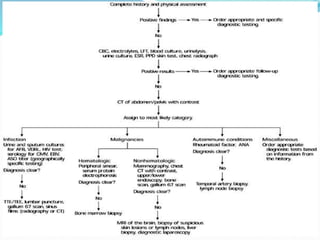
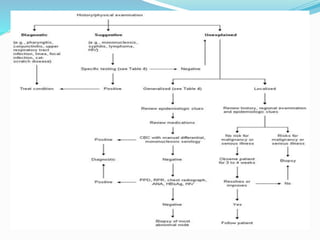
Investigation
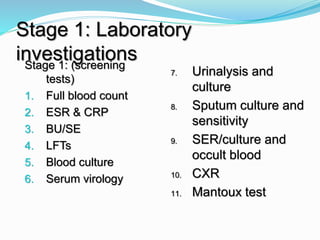
Stage 1: Laboratory
investigationsStage 1: (screening
tests)
1. Full blood count
2. ESR & CRP
3. BU/SE
4. LFTs
5. Blood culture
6. Serum virology
7. Urinalysis and
culture
8. Sputum culture and
sensitivity
9. SER/culture and
occult blood
10. CXR
11. Mantoux test
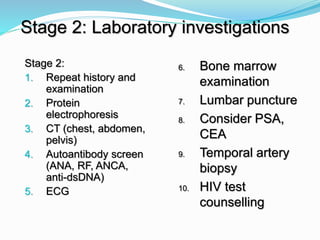
Stage 2:
1. Repeat history and
examination
2. Protein
electrophoresis
3. CT (chest, abdomen,
pelvis)
4. Autoantibody screen
(ANA, RF, ANCA,
anti-dsDNA)
5. ECG
Stage 2: Laboratory investigations
6. Bone marrow
examination
7. Lumbar puncture
8. Consider PSA,
CEA
9. Temporal artery
biopsy
10. HIV test
counselling
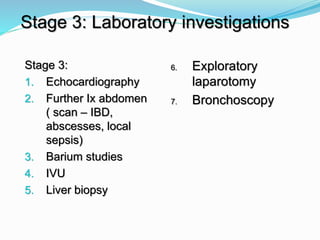
Stage 3:
1. Echocardiography
2. Further Ix abdomen
( scan – IBD,
abscesses, local
sepsis)
3. Barium studies
4. IVU
5. Liver biopsy
Stage 3: Laboratory investigations
6. Exploratory
laparotomy
7. Bronchoscopy
 Treat TB,
 endocarditis,
 vasculitis,
 trial of aspirin/ steroids
Stage 4: Laboratory investigations
Diagnosing
Pyrexia of
Unknown
Origin
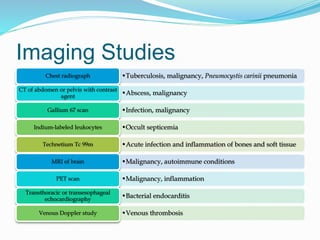
Imaging Studies
•Tuberculosis, malignancy, Pneumocystis carinii pneumoniaChest radiograph
•Abscess, malignancy
CT of abdomen or pelvis with contrast
agent
•Infection, malignancyGallium 67 scan
•Occult septicemiaIndium-labeled leukocytes
•Acute infection and inflammation of bones and soft tissueTechnetium Tc 99m
•Malignancy, autoimmune conditionsMRI of brain
•Malignancy, inflammationPET scan
•Bacterial endocarditis
Transthoracic or transesophageal
echocardiography
•Venous thrombosisVenous Doppler study
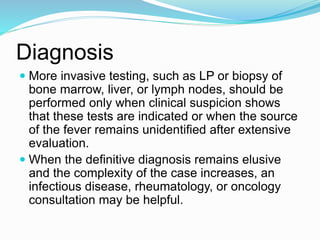
Diagnosis
 More invasive testing, such as LP or biopsy of
bone marrow, liver, or lymph nodes, should be
performed only when clinical suspicion shows
that these tests are indicated or when the source
of the fever remains unidentified after extensive
evaluation.
 When the definitive diagnosis remains elusive
and the complexity of the case increases, an
infectious disease, rheumatology, or oncology
consultation may be helpful.
Thank you!

Evaluation of puo

  • 1.
  • 2.
    Definition  Temperatures ≥38.3ºC (101ºF) on several occasions  Fever ≥ 3 weeks  Failure to reach a diagnosis despite 1 week of inpatient investigations or 3 outpatient visits.
  • 3.
    Classification of PUO CategoryDefinition Aetiologies Classic • Temperature >38.3°C (100.9°F) ; • Duration of >3 weeks • Evaluation of at least 3 outpatient visits or 3 days in hospital • Infection • Malignancy • collagen vascular disease Nosocomial • Temperature >38.3°C • Patient hospitalized ≥ 24 hours but no fever or incubating on admission • Evaluation of at least 3 days • Clostridium difficile enterocolitis • drug-induced • pulmonary embolism • septic thrombophlebitis, • sinusitis Neutropenic • Temperature >38.3°C • Neutrophil count ≤ 500 per mm3 • Evaluation of at least 3 days • Opportunistic bacterial infections, • aspergillosis, • candidiasis, • herpes virus HIV- associated • Temperature >38.3°C • Duration of >4 weeks for outpatients, >3 days for inpatients • HIV infection confirmed • Cytomegalovirus, • Mycobacterium avium-intracellulare complex, • Pneumocystis carinii pneumonia, • drug-induced, • Kaposi’s sarcoma, lymphoma
  • 4.
    COMMON CAUSES OFPUO Infection (40%) Malignancy (25%) Autoimmune Disease (15%) Others/ Miscellaneous (10%) Undiagnosed (10%)
  • 5.
    Classic PUO 3 commonetiologies which account for the majority of classic PUO: Infections Malignancies Collagen Vascular Disease Others/Miscellaneous which includes drug-induced fever.
  • 6.
    Infections  Bacterial: abscesses,TB, complicated UTI, endocarditis, osteomyelitis, sinusitis, Lyme disease, prostatitis, cholecystitis, empyema, biliary tract infection, brucellosis, typhoid, leptospirosis,  Q fever, borreliosis, etc.  Parasite: Malaria, toxoplamosis, leishmaniasis, etc.  Fungal: histoplasmosis, etc.  Viral: CMV, infectious mononucleosis, HIV, etc.
  • 7.
    Infections  As durationof fever increases, infectious etiology decreases  Malignancy and factitious fevers are more common in patients with prolonged FUO.
  • 8.
    Malignancies  Haematological  Lymphoma Chronic leukemia  Non-haematological  Renal cell cancer  Hepatocellular carcinoma  Pancreatic cancer  Colon cancer  Hepatoma  Myelodysplastic Syndrome  Sarcomas
  • 9.
    Collagen vascular disease/ Autoimmune disease Polyarteritis nodosa  Giant cell arteritis  Kawasaki disease  Still’s disease  Adult Still's disease  Polymyalgia rheumatica  Temporal arteritis  Rheumatoid arthritis  Rheumatic fever  Inflammatory bowel disease  Reiter's syndrome  Systemic lupus erythematosus  Vasculitides
  • 10.
    Others/miscellaneous  Drugs: penicilin,phenytoin, captopril, allopurinol, erythromycin, cimetidine, etc.  Hyperthyroidism  Alcoholic hepatitis  Sarcoidosis  Inflammatory bowel disease  Deep Venous Thrombosis
  • 11.
    Roth AR andBasello GM. Am Fam Physician. 2003 Dec 1;68(11):2223-8.
  • 12.
    Nosocomial PUO  Morethan 50% of patients with nosocomial PUO are due to infection.  Focus on sites where occult infections may be sequestered, such as: - Sinusitis of patients with NG or oro-tracheal tubes. - Prostatic abscess in a man with a urinary catheter.  25% of non-infectious cause includes: - Acalculous cholecystitis, - Deep vein thrombophlebitis - Pulmonary embolism.
  • 13.
    Neutropenic PUO  Patientson chemotherapy or immune deficiencies are susceptible to: - Opportunistic bacterial infection - Fungal infections such as candidiasis - Bacteremic infections - Infections involving catheters - Perianal infections.  Examples of aetiological agent: - aspergillus - Candida - CMV - Herpes simplex
  • 14.
    HIV-associated PUO  HIVinfection alone may be a cause of fever.  Common secondary causes include: - Tuberculosis - Toxoplasmosis - CMV infection - P. carinii infection - Salmonellosis - Cryptococcosis - Histoplasmosis - Non-Hodgkin's lymphoma - Drug-induced fever
  • 15.
  • 16.
    History Taking History ofPresenting Complaint- (HPC) 1。Onset  - acute: Malaria, pyogenic infection  - gradual: TB, thyphoid fever 2。Character  high grade fever: UTI, TB, malaria, drug 3。Pattern  sustained/persistent: Thyphoid fever, drugs
  • 17.
     intermittent fever: Daily spikes: Abscess, TB, Schistosomiasis  Twice-daily spikes: Leishmaniasis  Saddleback fever: Leptospirosis, dengue,borrelia  -relapsing/ recurrent fever: Non-falciparum malaria, Brucellosis, Hodgkin’s lymphoma 4。Antecedents - prior to onset of fever:  dental extraction: Infective endocarditis  Urinary catherization: UTI, bacteremia.
  • 18.
    5。Associated symptoms  Chills& rigors  bacterial, rickettsial and protozoal disease,  influenza, lymphoma, leukaemia, drug-induced  Night sweats  TB, Hodgkin’s lymphoma  Loss of weight  Malignancy, TB  Cough and Dyspnoea  Miliary TB, multiple pulmonary emboli, AIDS patient with PCP, CMV.  Headache  Giant cell arteritis, typhoid fever, sinusitis  Joint pain  RA, SLE, vasculitis
  • 19.
     Abd. Pain Cholangitis, biliary obstruction, perinephric abscess, Crohn’s disease, dissecting aneuryms, gynaecological infection  Bone pain  Osteomyelitis, lymphoma  Sorethroat  IM, retropharyngeal abscess, post-Streptococcal infection  Dysuria, rectal pain  Prostatic abscess, UTI  Altered bowel habit  IBD, thyphoid fever, schistosomiasis, amoebiasis  Skin rash  Gonococcal infection, PAN,NHL, dengue fever
  • 20.
     Past MedicalHistory  Malignancy = leukemia, lymphoma, hepatocellular ca  HIV infection  DM  IBD  collagen vascular disease-SLE, RA, giant cell arteritis  TB  Heart disease: valvular heart disease Past Surgical History  Post splenectomy/ post- transplantation  Prosthetic heart valve  Catheter, AV fistula  Recent surgery/ operation
  • 21.
     Drug History Immunosuppressive drug/ corticosteroid  Anticoagulants: accumulation of old blood in closed space e.g. retroperitoneal, perisplenic  Before fever: drug fever occur within 3 months after starting taking drugs  may cause hypersensitivity and low grade fever, usually associated with rash  Due to the allergic reaction, direct effect of drug which impair temperature regulation (e.g. phenothiazine)  E.g. Antiarrhythmic drug: procainamide, quinidine; Antimicrobacterial agent: penicillin, cephalosporin, hydralazine  After fever: may modify clinical pictures, mask certain infection e.g. SBE, antibiotic allergy  Family History  Anyone in family has similar problem: TB, familial Mediterranian fever
  • 22.
     Social History Travel  amoebiasis, typhoid fever, malaria, Schistosomiasis  Residental area  malaria, leptospirosis, brucellosis  Occupation  farmers, veterinarian, slaughter-house workers = Brucellosis  workers in the plastic industries = polymer-fume fever  Contact with domestic / wild animal / birds :  Brucellosis, psittacosis (pigeons), Leptospirosis, Q fever, Toxoplasmosis  Diet history  unpasteurized milk/cheese = Brucellosis  poorly cooked pork = Trichinosis  IVDU = HIV-AIDS related condition, endocarditis  Sexual orientation = HIV, STD, PID  Close contact with TB patients
  • 23.
  • 24.
    Examination  General  Patternof fever (continous, intermittent, relapsing)  Ill/not ill  Weight loss (chronic illness)  Skin rash
  • 25.
    Hands  Stigmata ofInfective Endocarditis  Vasculitis changes  Clubbing  Presence of arthropathy  Raynaud’s phenomenon
  • 26.
    Arms  Drug injectionsites (ivdu)  Epitrochlear and axillary nodes (lymphoma, sarcoidosis, focal infection)  Skin
  • 27.
    Head & neck Feel temporal arteries (tender & thicken)  Eyes – iritis/conjuctivitis (CTD – reiter syndrome)  Jaundice (ascending cholangitis)  Fundi – choroidal tubercle (miliary TB), roth’s spot (IE) and retinal haemorrhage (leukaemia)  Lymphadenopathy
  • 28.
    Face & mouth Butterfly rash  Mucous membranes  Seborrhoic dermatitis (HIV)  Mouth ulcers (SLE)  Buccal candidiasis  Teeth & tonsils infection (abscess)  Parotid enlargement  Ears – otitis media
  • 29.
    Chest  Bony tenderness CVS – murmurs (ie, atrial myxoma), rubs (pericarditis)  RS – signs of pneumonia, TB, empyema and lung CA
  • 30.
    Abdomen Rose colouredspot (typhoid fever)  Hepatomegaly (sbp, hepatic ca, met)  Splenomegaly (haemopoietic malignancy, ie, malaria)  Renal enlargement (renal cell ca)  Testicular enlargement (seminoma)  Penis & scrotum – discharge/rash  Inguinal ligament  Per rectal exam – mass/tenderness in rectum/pelvis (abscess, ca, prostatitis)  Vaginal Examination – collection of pelvic pus/ Pelvic Inflammatory Disease
  • 31.
    Central Nervous System Signs of meningism (chronic tb meningitis)  Focal neurological signs (brain abscess, mononeuritis multiplex in polyarteritis nodosa)
  • 32.
  • 33.
    Stage 1: Laboratory investigationsStage1: (screening tests) 1. Full blood count 2. ESR & CRP 3. BU/SE 4. LFTs 5. Blood culture 6. Serum virology 7. Urinalysis and culture 8. Sputum culture and sensitivity 9. SER/culture and occult blood 10. CXR 11. Mantoux test
  • 34.
    Stage 2: 1. Repeathistory and examination 2. Protein electrophoresis 3. CT (chest, abdomen, pelvis) 4. Autoantibody screen (ANA, RF, ANCA, anti-dsDNA) 5. ECG Stage 2: Laboratory investigations 6. Bone marrow examination 7. Lumbar puncture 8. Consider PSA, CEA 9. Temporal artery biopsy 10. HIV test counselling
  • 35.
    Stage 3: 1. Echocardiography 2.Further Ix abdomen ( scan – IBD, abscesses, local sepsis) 3. Barium studies 4. IVU 5. Liver biopsy Stage 3: Laboratory investigations 6. Exploratory laparotomy 7. Bronchoscopy
  • 36.
     Treat TB, endocarditis,  vasculitis,  trial of aspirin/ steroids Stage 4: Laboratory investigations
  • 37.
  • 39.
    Imaging Studies •Tuberculosis, malignancy,Pneumocystis carinii pneumoniaChest radiograph •Abscess, malignancy CT of abdomen or pelvis with contrast agent •Infection, malignancyGallium 67 scan •Occult septicemiaIndium-labeled leukocytes •Acute infection and inflammation of bones and soft tissueTechnetium Tc 99m •Malignancy, autoimmune conditionsMRI of brain •Malignancy, inflammationPET scan •Bacterial endocarditis Transthoracic or transesophageal echocardiography •Venous thrombosisVenous Doppler study
  • 40.
    Diagnosis  More invasivetesting, such as LP or biopsy of bone marrow, liver, or lymph nodes, should be performed only when clinical suspicion shows that these tests are indicated or when the source of the fever remains unidentified after extensive evaluation.  When the definitive diagnosis remains elusive and the complexity of the case increases, an infectious disease, rheumatology, or oncology consultation may be helpful.
  • 41.