Q
I
A
14
Fast & Easy ECGs – A Self-Paced
Learning Program
Hypertrophy, Bundle Branch
Block and Preexcitation
Hypertrophy
•  Condition in which muscular wall of the
ventricle(s) becomes thicker than normal
Dilation or Enlargement
•  Occurs as result of volume overload where
chamber dilates to accommodate
increased blood volume
Hypertrophy or Enlargement
•  Enlargement associated with atria
– P wave changes used to identify atrial
enlargement
•  Hypertrophy associated with ventricles
– QRS complex changes used to identify
ventricular hypertrophy
I
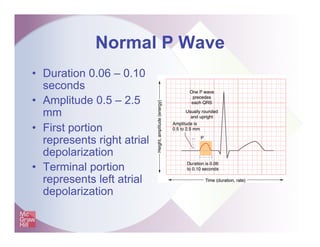
Normal P Wave
•  Duration 0.06 – 0.10
seconds
•  Amplitude 0.5 – 2.5
mm
•  First portion
represents right atrial
depolarization
•  Terminal portion
represents left atrial
depolarization
Atrial Enlargement
•  Caused by various conditions
– Chronic pulmonary disease may cause right
atria enlargement in response to the need for
greater filling pressures in the right ventricle
– Mitral valve prolapse may result in blood
being forced backwards into the left atria
causing it to enlarge
A
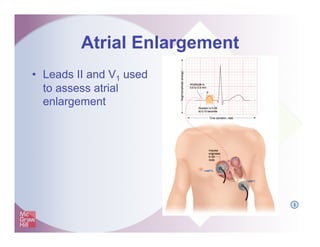
Atrial Enlargement
•  Leads II and V1 used
to assess atrial
enlargement
I
Right Atrial Enlargement
•  Increase in
amplitude of the
first part of the
P wave
Left Atrial Enlargement
•  Increased
amplitude in the
terminal portion of
the P wave in V1
•  Increased duration
or width of the P
wave
I
Ventricular Hypertrophy
•  Commonly caused by chronic, poorly
treated hypertension
•  Because there is more muscle to
depolarize there is more electrical activity
occurring in the hypertrophied muscle
– Reflected by changes in the amplitude of
portions of the QRS complex
I
Ventricular Hypertrophy
•  V1 electrode normally
positive
•  Wave of
depolarization moving
through LV moving
away from electrode
•  Produces mainly
negative QRS
complexes (short R
waves with larger S
waves)
Right Ventricular Hypertrophy
•  Most common
characteristic in limb
leads is right axis
deviation
I
Right Ventricular Hypertrophy
•  In precordial leads R
waves are more
positive in leads
which lie closer to
lead V1
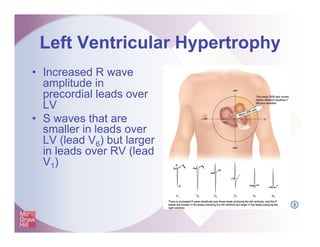
Left Ventricular Hypertrophy
•  Increased R wave
amplitude in
precordial leads over
LV
•  S waves that are
smaller in leads over
LV (lead V6) but larger
in leads over RV (lead
V1)
I
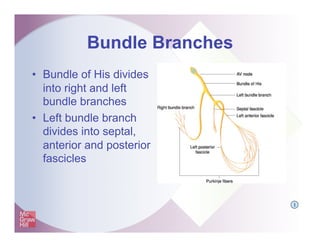
Bundle Branches
•  Bundle of His divides
into right and left
bundle branches
•  Left bundle branch
divides into septal,
anterior and posterior
fascicles
I
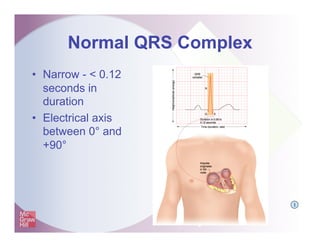
Normal QRS Complex
•  Narrow - < 0.12
seconds in
duration
•  Electrical axis
between 0° and
+90°
I
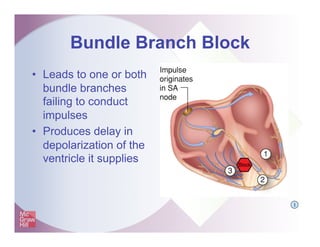
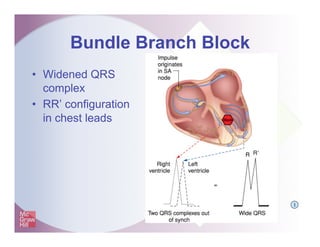
Bundle Branch Block
•  Leads to one or both
bundle branches
failing to conduct
impulses
•  Produces delay in
depolarization of the
ventricle it supplies
I
Bundle Branch Block
•  Widened QRS
complex
•  RR’ configuration
in chest leads
I
Right Bundle Branch Block
•  Look for RR’ in leads
V1 or V2
Left Bundle Branch Block
•  Look for RR’ in leads
V5 or V6
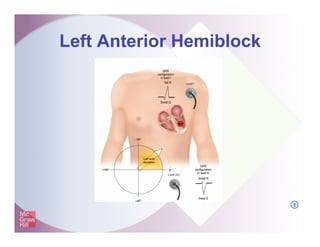
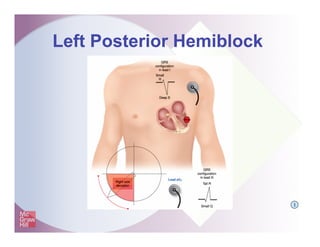
Hemiblocks
•  Occur when one of fascicles of LBB
blocked
•  Key to detecting is a change in the QRS
axis
I
Left Anterior Hemiblock
I
Left Posterior Hemiblock
I
Preexcitation Syndrome
•  Accessory conduction pathways
sometimes exist between atria and
ventricles
– Bypass AV node and bundle of His and allow
early depolarization of ventricles
•  Results in a short PR interval
Wolff-Parkinson-White (WPW)
Syndrome
•  PR interval < 0.12
seconds
•  Wide QRS
complexes
•  Delta wave seen in
some leads
•  Patients with WPW
are vulnerable to
PSVT
Lown-Ganong-Levine (LGL)
Syndrome
•  Intranodal
accessory
pathway bypasses
normal delay in
AV node
•  PR interval < 0.12
seconds , normal
QRS complex
Practice Makes Perfect
•  Determine the type of condition
I
Practice Makes Perfect
•  Determine the type of condition
I
Practice Makes Perfect
•  Determine the type of condition
I
Summary
•  In hypertrophy the muscular wall of the ventricle(s)
becomes thicker than normal.
•  Dilation or enlargement of a chamber occurs because of
volume overload where the chamber dilates to
accommodate the increased blood volume.
•  Enlargement is associated with the atria while
hypertrophy is associated with the ventricles.
Summary
•  The P wave is used to assess for atrial enlargement.
•  The QRS complex is examined to identify ventricular
hypertrophy.
•  Indicators of enlargement or hypertrophy include an
increase in the duration of the waveform, an increase in
the amplitude of the waveform and axis deviation.
•  Leads II and V1 provide the necessary information to
assess atrial enlargement.
Summary
•  Diagnosis of right atrial enlargement is made when there
is an increase in the amplitude of the first part of the P
wave.
•  Two indicators of left atrial enlargement are (1) increased
amplitude in the terminal portion of the P in V1 (2)
increased duration or width of the P wave.
•  In limb leads, right axis deviation is most common
characteristic seen with right ventricular hypertrophy.
Summary
•  In precordial leads, right ventricular hypertrophy causes
the R waves to be more positive in leads which lie closer
to lead V1.
•  Left ventricular hypertrophy is identified by increased R
wave amplitude of those precordial leads overlying the
left ventricle and S waves that are smaller in the leads
overlying the left ventricle (lead V6) but larger in the
leads (lead V1) overlying the right ventricle.
Summary
•  Bundle branch block is a disorder that leads to one or
both of the bundle branches failing to conduct impulses.
This produces a delay in the depolarization of the
ventricle it supplies.
•  In bundle branch block a widened QRS complex and a
RR’ configuration is seen in the chest leads.
•  To diagnose right bundle branch block check for an RR’
in the right chest leads; leads V1 or V2.
Summary
•  To diagnose left bundle branch block check for an R, R’
in leads V5 or V6.
•  Hemiblocks cause axis deviation.
•  Preexcitation syndromes occur in some persons
because accessory conduction pathways exist between
the atria and ventricles which bypass the AV node and
bundle of His and allow the atria to depolarize the
ventricles earlier than usual.
Summary
•  Criteria for WPW include a PR interval less than 0.12
seconds, wide QRS complexes and a Delta wave seen
in some leads.
•  In LGL there is an intranodal accessory pathway that
bypasses the normal delay within the AV node. This
produces a PR interval less than 0.12 seconds and a
normal QRS.

Shadechapter14.ppt [read only]

  • 1.
    Q I A 14 Fast & EasyECGs – A Self-Paced Learning Program Hypertrophy, Bundle Branch Block and Preexcitation
  • 2.
    Hypertrophy •  Condition inwhich muscular wall of the ventricle(s) becomes thicker than normal
  • 3.
    Dilation or Enlargement • Occurs as result of volume overload where chamber dilates to accommodate increased blood volume
  • 4.
    Hypertrophy or Enlargement • Enlargement associated with atria – P wave changes used to identify atrial enlargement •  Hypertrophy associated with ventricles – QRS complex changes used to identify ventricular hypertrophy I
  • 5.
    Normal P Wave • Duration 0.06 – 0.10 seconds •  Amplitude 0.5 – 2.5 mm •  First portion represents right atrial depolarization •  Terminal portion represents left atrial depolarization
  • 6.
    Atrial Enlargement •  Causedby various conditions – Chronic pulmonary disease may cause right atria enlargement in response to the need for greater filling pressures in the right ventricle – Mitral valve prolapse may result in blood being forced backwards into the left atria causing it to enlarge A
  • 7.
    Atrial Enlargement •  LeadsII and V1 used to assess atrial enlargement I
  • 8.
    Right Atrial Enlargement • Increase in amplitude of the first part of the P wave
  • 9.
    Left Atrial Enlargement • Increased amplitude in the terminal portion of the P wave in V1 •  Increased duration or width of the P wave I
  • 10.
    Ventricular Hypertrophy •  Commonlycaused by chronic, poorly treated hypertension •  Because there is more muscle to depolarize there is more electrical activity occurring in the hypertrophied muscle – Reflected by changes in the amplitude of portions of the QRS complex I
  • 11.
    Ventricular Hypertrophy •  V1electrode normally positive •  Wave of depolarization moving through LV moving away from electrode •  Produces mainly negative QRS complexes (short R waves with larger S waves)
  • 12.
    Right Ventricular Hypertrophy • Most common characteristic in limb leads is right axis deviation I
  • 13.
    Right Ventricular Hypertrophy • In precordial leads R waves are more positive in leads which lie closer to lead V1
  • 14.
    Left Ventricular Hypertrophy • Increased R wave amplitude in precordial leads over LV •  S waves that are smaller in leads over LV (lead V6) but larger in leads over RV (lead V1) I
  • 15.
    Bundle Branches •  Bundleof His divides into right and left bundle branches •  Left bundle branch divides into septal, anterior and posterior fascicles I
  • 16.
    Normal QRS Complex • Narrow - < 0.12 seconds in duration •  Electrical axis between 0° and +90° I
  • 17.
    Bundle Branch Block • Leads to one or both bundle branches failing to conduct impulses •  Produces delay in depolarization of the ventricle it supplies I
  • 18.
    Bundle Branch Block • Widened QRS complex •  RR’ configuration in chest leads I
  • 19.
    Right Bundle BranchBlock •  Look for RR’ in leads V1 or V2
  • 20.
    Left Bundle BranchBlock •  Look for RR’ in leads V5 or V6
  • 21.
    Hemiblocks •  Occur whenone of fascicles of LBB blocked •  Key to detecting is a change in the QRS axis I
  • 22.
  • 23.
  • 24.
    Preexcitation Syndrome •  Accessoryconduction pathways sometimes exist between atria and ventricles – Bypass AV node and bundle of His and allow early depolarization of ventricles •  Results in a short PR interval
  • 25.
    Wolff-Parkinson-White (WPW) Syndrome •  PRinterval < 0.12 seconds •  Wide QRS complexes •  Delta wave seen in some leads •  Patients with WPW are vulnerable to PSVT
  • 26.
    Lown-Ganong-Levine (LGL) Syndrome •  Intranodal accessory pathwaybypasses normal delay in AV node •  PR interval < 0.12 seconds , normal QRS complex
  • 27.
    Practice Makes Perfect • Determine the type of condition I
  • 28.
    Practice Makes Perfect • Determine the type of condition I
  • 29.
    Practice Makes Perfect • Determine the type of condition I
  • 30.
    Summary •  In hypertrophythe muscular wall of the ventricle(s) becomes thicker than normal. •  Dilation or enlargement of a chamber occurs because of volume overload where the chamber dilates to accommodate the increased blood volume. •  Enlargement is associated with the atria while hypertrophy is associated with the ventricles.
  • 31.
    Summary •  The Pwave is used to assess for atrial enlargement. •  The QRS complex is examined to identify ventricular hypertrophy. •  Indicators of enlargement or hypertrophy include an increase in the duration of the waveform, an increase in the amplitude of the waveform and axis deviation. •  Leads II and V1 provide the necessary information to assess atrial enlargement.
  • 32.
    Summary •  Diagnosis ofright atrial enlargement is made when there is an increase in the amplitude of the first part of the P wave. •  Two indicators of left atrial enlargement are (1) increased amplitude in the terminal portion of the P in V1 (2) increased duration or width of the P wave. •  In limb leads, right axis deviation is most common characteristic seen with right ventricular hypertrophy.
  • 33.
    Summary •  In precordialleads, right ventricular hypertrophy causes the R waves to be more positive in leads which lie closer to lead V1. •  Left ventricular hypertrophy is identified by increased R wave amplitude of those precordial leads overlying the left ventricle and S waves that are smaller in the leads overlying the left ventricle (lead V6) but larger in the leads (lead V1) overlying the right ventricle.
  • 34.
    Summary •  Bundle branchblock is a disorder that leads to one or both of the bundle branches failing to conduct impulses. This produces a delay in the depolarization of the ventricle it supplies. •  In bundle branch block a widened QRS complex and a RR’ configuration is seen in the chest leads. •  To diagnose right bundle branch block check for an RR’ in the right chest leads; leads V1 or V2.
  • 35.
    Summary •  To diagnoseleft bundle branch block check for an R, R’ in leads V5 or V6. •  Hemiblocks cause axis deviation. •  Preexcitation syndromes occur in some persons because accessory conduction pathways exist between the atria and ventricles which bypass the AV node and bundle of His and allow the atria to depolarize the ventricles earlier than usual.
  • 36.
    Summary •  Criteria forWPW include a PR interval less than 0.12 seconds, wide QRS complexes and a Delta wave seen in some leads. •  In LGL there is an intranodal accessory pathway that bypasses the normal delay within the AV node. This produces a PR interval less than 0.12 seconds and a normal QRS.