M.I denotes cellular damage due to prolonged
ischaemia .Sudden cardiac death is a frequent
presenting feature of MI with most of deaths
occuring within one hour due to ventricular
arrythymias.
In presence of ischaemic symptoms the diagnosisof MI
is based upon one of the following
1.Development of new pathological Q waves.
2.Presence of ST segment elevation or depression
3.Development of new LBBB
 The changes in ECG should be present in two
contiguous leads.
 Confirmation by diagnosis can be done by
demonstration by elevation in cardiac
enzymes,ECHO,or by coronary angiography.
Based on ECG, MI is further differentiated as
STEMI and NSTEMI.
Evolution of NSTEMI into STEMI is possible and
therefore both subsets should be treated as
aggresively as possible
The ECG changes evolve over a period of time
and are described as
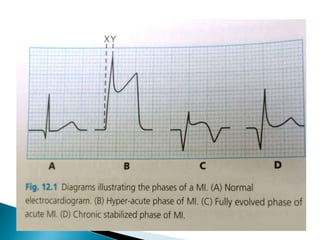
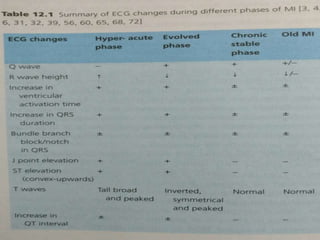
1.HYPERACUTE PHASE(over minutes-hours)
2.EVOLVED PHASE(over hours)
3.CHRONIC STABILISED PHASE(over days-weeks)
The changes in ECG of chronic stabilised phase
persists throughout life and generally represent
changes of changes of old MI in absence of further
progession of disease.
The ECG changes in this phase are
1.Tall,symmetrical,peaked and widened T waves
2.Slope elevation of ST segment
3.Increased amplitude of R wave/changes in
Terminal QRS complex
4.Increased ventricular activation time
This phase is critical because complication of
Ventricular fibrillation is most likely to occur and
Coronary reperfusion during this phase totally
reverses changes without any residual myocardial
damage.
The Twaves are tall and wide sometimes itmay
exceed amplitude of associated R wave.
Although for individual leads,different
thresholds of calling tall T waves exist,roughly
>0.5mv in limb leads and >1mv in precordial
leads can be considerded tall.
-One of most noticeable and characteristic
feature is slope elevation of ST segment,which
loses its upwards concavity and becomes
straightened with upward slope
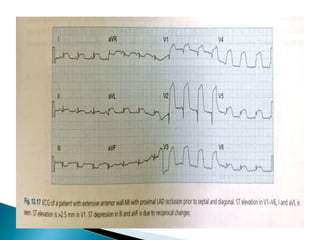
-New onset J point and ST elevation of >0.1m in
leads ll,III,aVF,V4,V5,V6,I and aVL
and in leads V2,V3 of >0.2mv in males >40yr
and>0.25mv in Males <40yrs
and >0.15mm in females
-in absence of ventricular hypertrophy or LBBB
represent best variables for diagnosis of MI.
The R wave becomes taller than normal.
Tall R wave,slope elevated ST segment and tall
widened T wave at times merge with each other
so that it is difficult to separate 3 deflections
and the resulting wide complex is result of
QRS-ST-T fusion.
 There is increase in ventricular activationtime,
the time from beginning of QRS complex to
apexof the R wave
 The ventricular activation time is delayed
beyond 40ms
This phase is characterised by
1.Appearance of new q waves and decrease in
R wave height
2.J point and ST segment elevation
3.T wave inversion
4.Increase in ventricular activation time and
appearance of new conduction defects,blocks
5.QT prolongation
 Appearance of new q waves is considered
pathognomic of myocardical necrosis and
indicates irreversible myocardial damage.
 Q waves >20ms in V1 to V4 and >30ms in
other leads except III and aVR is considered
pathological.
 J point and ST elevation decreases in this
phase
 Tall peaked wave of hyperacute phase start to
decrease in amplitude and becomes inverted in
the infarcted area which occurs simultaneously
along with new q waves and decrease in ST
segment
 The QRS complex becomes wider due to
increase in ventricular activation time due to
slow conduction and delayed depolarization
in affected area.
QT interval may be prolonged due to increase
in durationof depolarization and repolarization
and appearance of new conduction defects.
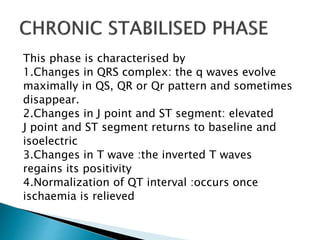
This phase is characterised by
1.Changes in QRS complex: the q waves evolve
maximally in QS, QR or Qr pattern and sometimes
disappear.
2.Changes in J point and ST segment: elevated
J point and ST segment returns to baseline and
isoelectric
3.Changes in T wave :the inverted T waves
regains its positivity
4.Normalization of QT interval :occurs once
ischaemia is relieved
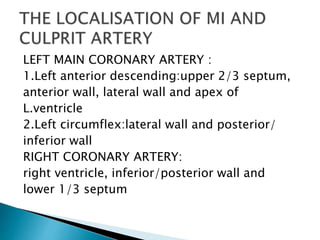
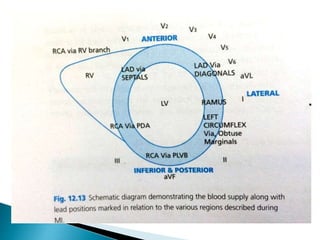
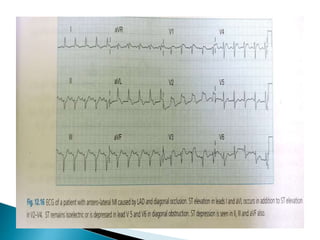
LEFT MAIN CORONARY ARTERY :
1.Left anterior descending:upper 2/3 septum,
anterior wall, lateral wall and apex of
L.ventricle
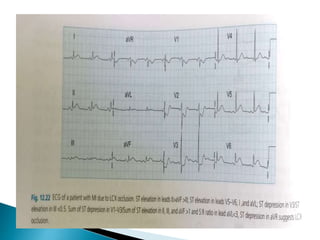
2.Left circumflex:lateral wall and posterior/
inferior wall
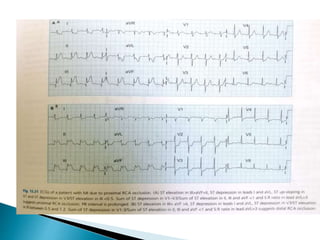
RIGHT CORONARY ARTERY:
right ventricle, inferior/posterior wall and
lower 1/3 septum
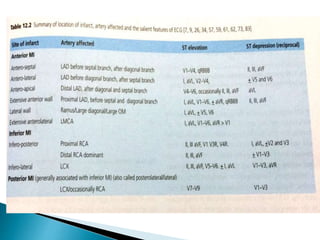
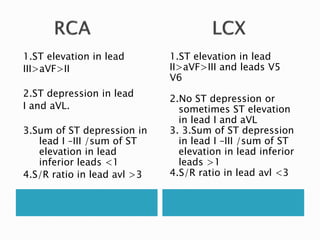
1.ST elevation in lead
III>aVF>II
2.ST depression in lead
I and aVL.
3.Sum of ST depression in
lead I –III /sum of ST
elevation in lead
inferior leads <1
4.S/R ratio in lead avl >3
1.ST elevation in lead
II>aVF>III and leads V5
V6
2.No ST depression or
sometimes ST elevation
in lead I and aVL
3. 3.Sum of ST depression
in lead I –III /sum of ST
elevation in lead inferior
leads >1
4.S/R ratio in lead avl <3
New onset of LBBB suggests acute MI.
In patients with documented LBBB earlier,it is
difficult to diagnose AWMI due to masking
effect of LBBB on QRST changes.
CRITERIA USED FOR ACUTE AWMI WITH PRIOR
LBBB IS SGARBOSSA CRITERIA
1.ST elevation in atleast one lead of >1mm
concordant to positive QRS complex[5]
2.ST depression of >1mm in V1 to V3[3]
3.Discordant ST elevation >5mm in atleast one
leads with prominant negative QRS[2]
A total of >= 3 points suggests
An acute IWMI in presence of LBBB can be
diagnosed as there is no masking effect of
LBBB in inferior leads.
Characterised by ST segment depression dueto
Myocardial ischaemia of subendocardial region.
Following are ECG changes in NSTEMI:
1.ST segment depression
2.T wave inversion
There is little or no alternation of QRS
complex.
New horizontal or down sloping ST segment of
>0.05mv in two contiguous leads suggests
ongoing myocardial ischaemia
T wave inversion of >0.1mv in two contiguous
leads with prominent R wave suggests
myocardial ischaemia.
T wave inversion accompanies changes of ST
segment depression in NSTEMI
RISK OF ASSESSMENT IN NSTEMI BASED ON
ECG
1.LBBB
2.ST segment deviation of >0.05mv(1/2 small
sq)
3.T wave inversion of >0.3mv(3 small sq)
Descibed in a patient who presents with
history of chestpain.
ECG during during episode appears to be
normal, with ST segment in V2 and V3 being
either concave or straight and which is
Isoelectric or minimally elevated.
Following chest pain symmetric and deep T
Wave invwesion may develop in pain free
periods with no pathological Q waves and there
is no significant biochemical alternation.
This is due to tight proximal LAD stenosis.
The ECG dignosis reinfarction following initial
infarction may be confounded by the initial
evolutionary ECG changes.
Reinarction should be considered when ST
elevation of 0.1mv reoccurs in a patient having
lesser degree of ST elevation or new
pathognomic Q waves appear in atleast two
contiguous leads when associated with
Ischaemic symptoms for >= 20 min

Ecg changes in mi

  • 2.
    M.I denotes cellulardamage due to prolonged ischaemia .Sudden cardiac death is a frequent presenting feature of MI with most of deaths occuring within one hour due to ventricular arrythymias. In presence of ischaemic symptoms the diagnosisof MI is based upon one of the following 1.Development of new pathological Q waves. 2.Presence of ST segment elevation or depression 3.Development of new LBBB
  • 3.
     The changesin ECG should be present in two contiguous leads.  Confirmation by diagnosis can be done by demonstration by elevation in cardiac enzymes,ECHO,or by coronary angiography.
  • 4.
    Based on ECG,MI is further differentiated as STEMI and NSTEMI. Evolution of NSTEMI into STEMI is possible and therefore both subsets should be treated as aggresively as possible
  • 5.
    The ECG changesevolve over a period of time and are described as 1.HYPERACUTE PHASE(over minutes-hours) 2.EVOLVED PHASE(over hours) 3.CHRONIC STABILISED PHASE(over days-weeks) The changes in ECG of chronic stabilised phase persists throughout life and generally represent changes of changes of old MI in absence of further progession of disease.
  • 6.
    The ECG changesin this phase are 1.Tall,symmetrical,peaked and widened T waves 2.Slope elevation of ST segment 3.Increased amplitude of R wave/changes in Terminal QRS complex 4.Increased ventricular activation time This phase is critical because complication of Ventricular fibrillation is most likely to occur and Coronary reperfusion during this phase totally reverses changes without any residual myocardial damage.
  • 7.
    The Twaves aretall and wide sometimes itmay exceed amplitude of associated R wave. Although for individual leads,different thresholds of calling tall T waves exist,roughly >0.5mv in limb leads and >1mv in precordial leads can be considerded tall.
  • 8.
    -One of mostnoticeable and characteristic feature is slope elevation of ST segment,which loses its upwards concavity and becomes straightened with upward slope -New onset J point and ST elevation of >0.1m in leads ll,III,aVF,V4,V5,V6,I and aVL and in leads V2,V3 of >0.2mv in males >40yr and>0.25mv in Males <40yrs and >0.15mm in females -in absence of ventricular hypertrophy or LBBB represent best variables for diagnosis of MI.
  • 9.
    The R wavebecomes taller than normal. Tall R wave,slope elevated ST segment and tall widened T wave at times merge with each other so that it is difficult to separate 3 deflections and the resulting wide complex is result of QRS-ST-T fusion.
  • 10.
     There isincrease in ventricular activationtime, the time from beginning of QRS complex to apexof the R wave  The ventricular activation time is delayed beyond 40ms
  • 11.
    This phase ischaracterised by 1.Appearance of new q waves and decrease in R wave height 2.J point and ST segment elevation 3.T wave inversion 4.Increase in ventricular activation time and appearance of new conduction defects,blocks 5.QT prolongation
  • 12.
     Appearance ofnew q waves is considered pathognomic of myocardical necrosis and indicates irreversible myocardial damage.  Q waves >20ms in V1 to V4 and >30ms in other leads except III and aVR is considered pathological.  J point and ST elevation decreases in this phase
  • 13.
     Tall peakedwave of hyperacute phase start to decrease in amplitude and becomes inverted in the infarcted area which occurs simultaneously along with new q waves and decrease in ST segment  The QRS complex becomes wider due to increase in ventricular activation time due to slow conduction and delayed depolarization in affected area.
  • 14.
    QT interval maybe prolonged due to increase in durationof depolarization and repolarization and appearance of new conduction defects.
  • 15.
    This phase ischaracterised by 1.Changes in QRS complex: the q waves evolve maximally in QS, QR or Qr pattern and sometimes disappear. 2.Changes in J point and ST segment: elevated J point and ST segment returns to baseline and isoelectric 3.Changes in T wave :the inverted T waves regains its positivity 4.Normalization of QT interval :occurs once ischaemia is relieved
  • 18.
    LEFT MAIN CORONARYARTERY : 1.Left anterior descending:upper 2/3 septum, anterior wall, lateral wall and apex of L.ventricle 2.Left circumflex:lateral wall and posterior/ inferior wall RIGHT CORONARY ARTERY: right ventricle, inferior/posterior wall and lower 1/3 septum
  • 23.
    1.ST elevation inlead III>aVF>II 2.ST depression in lead I and aVL. 3.Sum of ST depression in lead I –III /sum of ST elevation in lead inferior leads <1 4.S/R ratio in lead avl >3 1.ST elevation in lead II>aVF>III and leads V5 V6 2.No ST depression or sometimes ST elevation in lead I and aVL 3. 3.Sum of ST depression in lead I –III /sum of ST elevation in lead inferior leads >1 4.S/R ratio in lead avl <3
  • 26.
    New onset ofLBBB suggests acute MI. In patients with documented LBBB earlier,it is difficult to diagnose AWMI due to masking effect of LBBB on QRST changes. CRITERIA USED FOR ACUTE AWMI WITH PRIOR LBBB IS SGARBOSSA CRITERIA 1.ST elevation in atleast one lead of >1mm concordant to positive QRS complex[5] 2.ST depression of >1mm in V1 to V3[3] 3.Discordant ST elevation >5mm in atleast one leads with prominant negative QRS[2] A total of >= 3 points suggests
  • 27.
    An acute IWMIin presence of LBBB can be diagnosed as there is no masking effect of LBBB in inferior leads.
  • 28.
    Characterised by STsegment depression dueto Myocardial ischaemia of subendocardial region. Following are ECG changes in NSTEMI: 1.ST segment depression 2.T wave inversion There is little or no alternation of QRS complex.
  • 29.
    New horizontal ordown sloping ST segment of >0.05mv in two contiguous leads suggests ongoing myocardial ischaemia
  • 30.
    T wave inversionof >0.1mv in two contiguous leads with prominent R wave suggests myocardial ischaemia. T wave inversion accompanies changes of ST segment depression in NSTEMI
  • 31.
    RISK OF ASSESSMENTIN NSTEMI BASED ON ECG 1.LBBB 2.ST segment deviation of >0.05mv(1/2 small sq) 3.T wave inversion of >0.3mv(3 small sq)
  • 32.
    Descibed in apatient who presents with history of chestpain. ECG during during episode appears to be normal, with ST segment in V2 and V3 being either concave or straight and which is Isoelectric or minimally elevated. Following chest pain symmetric and deep T Wave invwesion may develop in pain free periods with no pathological Q waves and there is no significant biochemical alternation. This is due to tight proximal LAD stenosis.
  • 33.
    The ECG dignosisreinfarction following initial infarction may be confounded by the initial evolutionary ECG changes. Reinarction should be considered when ST elevation of 0.1mv reoccurs in a patient having lesser degree of ST elevation or new pathognomic Q waves appear in atleast two contiguous leads when associated with Ischaemic symptoms for >= 20 min