Ventricular   Rhythms Electrical impulses that originate from the ventricular conduction system.
Ventricular Rhythms Bundle Branch Blocks (BBB) & Hemiblocks Premature Ventricular Contractions (PVC) Ventricular Escape Beat Idioventricular Rhythm & AIVR Ventricular Tachycardia Ventricular Fibrillation Ventricular Standstill Asystole
Wide, Bizarre QRS’s Sequential Depolarization The electrical impulse originates from an ectopic site within one of the ventricles stimulating that side first, then depolarizes the other ventricle Conduction time is slower than normal causing a wide, bizarre QRS complex  ( >  0.12 sec)
Bundle Branch Block (BBB) A bundle branch block refers to an obstruction in the transmission of the electrical impulse through one branch (either right or left) of the  bundle of His.
Hemiblocks A bundle branch block that occurs farther down the left bundle branch is called a hemiblock Left Posterior Fascicular Block Left Anterior Fascicular Block
Bundle Branch Block (BBB) In a bundle branch block, the impulse travels down the unaffected bundle branch and then from one myocardial cell to the next to depolarize the ventricle Because this cell-to-cell conduction progresses much more slowly than the conduction along the specialized cells of the conduction system, ventricular polarization is prolonged
Bundle Branch Block (BBB)
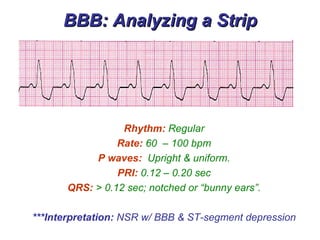
BBB: Analyzing a Strip Rhythm:   Regular Rate:  60  – 100 bpm P waves:  Upright & uniform. PRI:  0.12 – 0.20 sec QRS:  > 0.12 sec; notched or “bunny ears”. ***Interpretation:  NSR w/ BBB & ST-segment depression
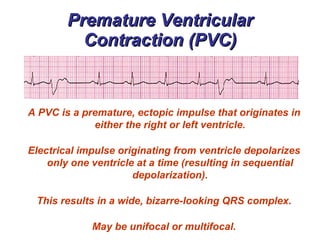
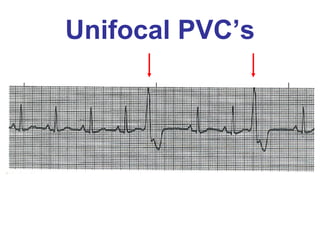
Premature Ventricular Contraction (PVC) A PVC is a premature, ectopic impulse that originates in either the right or left ventricle. Electrical impulse originating from ventricle depolarizes only one ventricle at a time (resulting in sequential depolarization). This results in a wide, bizarre-looking QRS complex. May be unifocal or multifocal.
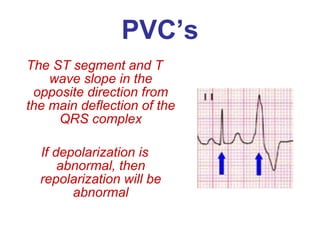
PVC’s The ST segment and T wave slope in the opposite direction from the main deflection of the QRS complex If depolarization is abnormal, then repolarization will be abnormal
Compensatory Pause Occurs because the SA node isn’t depolarized by the ectopic ventricular beat, the discharge timing of the sinus node remains unchanged and the underlying rhythm will resume on time after the PVC
Unifocal PVC’s
Multifocal PVC’s
Patterned PVC’s Bigeminy, Trigeminy, Quadrigeminy
Premature Ventricular Contraction (PVC) Causes: Electrolyte Imbalances Hypokalemia, Hyperkalemia, Hypomagnesemia, Hypocalcemia Metabolic Acidosis Hypoxia Myocardial Ischemia Drug Intoxications Cocaine, amphetamines, TCA’s LV Enlargement Increased Sympathetic Stimulation Myocarditis
Premature Ventricular Contraction (PVC) Treatment: If asymptomatic, no treatment may be required Antiarrhythmics such as amiodarone (Cordarone), lidocaine, or procainamide (Pronestyl), propafenone (Rythmol)
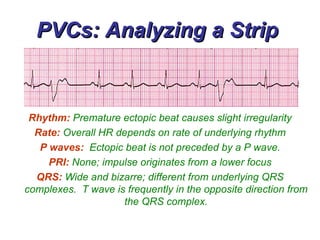
PVCs: Analyzing a Strip  Rhythm:   Premature ectopic beat causes slight irregularity Rate:  Overall HR depends on rate of underlying rhythm P waves:  Ectopic beat is not preceded by a P wave. PRI:  None; impulse originates from a lower focus QRS:  Wide and bizarre; different from underlying QRS complexes.  T wave is frequently in the opposite direction from the QRS complex.
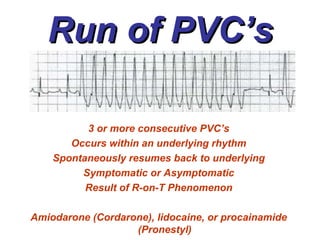
Run of PVC’s 3 or more consecutive PVC’s Occurs within an underlying rhythm Spontaneously resumes back to underlying Symptomatic or Asymptomatic Result of R-on-T Phenomenon Amiodarone (Cordarone), lidocaine, or procainamide (Pronestyl)
Run of PVCs: Analyzing a Strip Atrial Fibrillation (controlled) with a 5-beat run of PVCs  (run of V-Tach or burst of PVCs)  & ST-segment depression
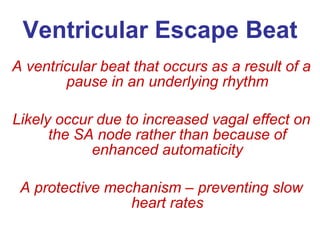
Ventricular Escape Beat A ventricular beat that occurs as a result of a pause in an underlying rhythm Likely occur due to increased vagal effect on the SA node rather than because of enhanced automaticity A protective mechanism – preventing slow heart rates
Ventricular Escape Beat How does this beat differ from a junctional escape beat??? Interpretation: NSR w/ ventricular escape beat following a pause converting back to NSR
Idioventricular (Escape) Rhythm
Idioventricular (Escape) Rhythm Idioventricular rhythms occur when all pacemakers fail to function or when SV impulses can’t reach the ventricles because of a block in the conduction system
Idioventricular (Escape) Rhythm Causes: Accompanied by Complete Heart Block Myocardial Ischemia MI Digoxin Toxicity Pacemaker Failure Metabolic Imbalances
Idioventricular (Escape) Rhythm Treatment: Pacemaker (Temporary – Permanent) Treat Underlying Cause
IVR: Analyzing a Strip Rhythm:   Regular; can slow down as heart dies. Rate:  No atrial rate; ventricular rate 20 – 40 bpm P waves:  None; impulse originates from a lower focus PRI:  None; impulse originates from a lower focus QRS:  Wide and bizarre; equal to or > 0.12 sec. T wave not visible Interpretation: Idioventricular Rhythm (IVR)
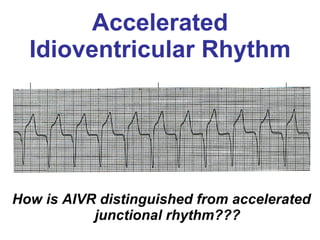
Accelerated Idioventricular Rhythm Rate: 41 - 100 Wide, bizarre QRS complexes No P waves
Accelerated Idioventricular Rhythm How is AIVR distinguished from accelerated junctional rhythm???
Ventricular Tachycardias Monomorphic, Polymorphic, Torsades de Pointes
Ventricular Tachycardia Ventricular tachycardia usually results from increased myocardial irritability, which may be triggered by enhanced automaticity or reentry within the Perkinje system or by PVC’s initiating the R-on-T phenomenon
Ventricular Tachycardia Causes: Myocardial ischemia MI CAD Valvular heart disease Heart failure Cardiomyopathy Electrolyte imbalances Drug intoxication – digoxin, procainamide, quinidine, or cocaine
Ventricular Tachycardia Non-sustained:   Paroxysmal bursts lasting less than 30 seconds Sustained: Stable, Unstable, or Pulseless
Ventricular Tachycardia Three Types of ACLS Algorithms for V-Tach: Stable Ventricular Tachycardia Unstable Ventricular Tachycardia Pulseless Ventricular Tachycardia
Monomorphic VT: Analyzing a Strip Rhythm:   Regular; sometimes slightly irregular Rate:  no atrial rate; ventricular rate 150 – 250 bpm P waves:  No P waves present PRI:  None QRS:  Wide and bizarre; Uniform; 0.12 sec.  T wave opposite direction of QRS ***Interpretation: Ventricular Tachycardia (VT)
Ventricular Tachycardia A.K.A. – Monomorphic V-Tach
Polymorphic VT:  Analyzing a Strip Rhythm:   Regular; sometimes slightly irregular Rate:  no atrial rate; ventricular rate 150 – 250 bpm P waves:  No P waves present PRI:  None QRS:  Wide and bizarre; Varied morphology;  >  0.12 sec.  T wave opposite direction of QRS ***Interpretation: Polymorphic VT
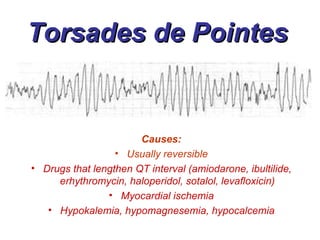
Torsades de Pointes Causes: Usually reversible Drugs that lengthen QT interval (amiodarone, ibultilide, erhythromycin, haloperidol, sotalol, levafloxicin) Myocardial ischemia Hypokalemia, hypomagnesemia, hypocalcemia
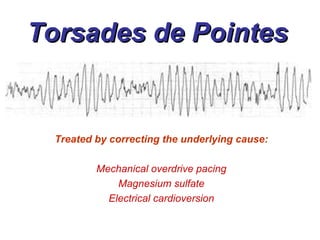
Torsades de Pointes Treated by correcting the underlying cause: Mechanical overdrive pacing Magnesium sulfate Electrical cardioversion
Torsades de Pointes: Analyzing a Strip Rhythm:   Irregular; sometimes slightly irregular Rate:  no atrial rate; ventricular rate 150 – 250 bpm P waves:  No P waves present PRI:  None QRS:  Wide and bizarre; Varied morphology;  >  0.12 sec.  T wave opposite direction of QRS ***Interpretation: Torsades de pointes
Ventricular Fibrillation (VF) A chaotic pattern of electrical activity in the ventricles in which electrical impulses arise from many different foci. No effective myocardial contraction = No CO Untreated V-fib causes most cases of sudden cardiac death in people outside of the hospital
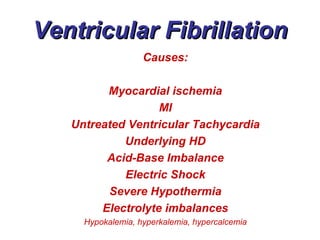
Ventricular Fibrillation Causes: Myocardial ischemia MI Untreated Ventricular Tachycardia Underlying HD Acid-Base Imbalance Electric Shock Severe Hypothermia Electrolyte imbalances Hypokalemia, hyperkalemia, hypercalcemia
Ventricular Fibrillation Fine or Coarse
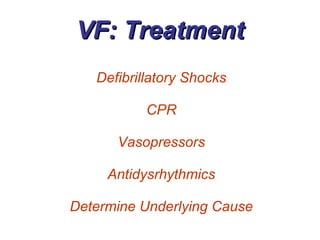
VF: Treatment Defibrillatory Shocks CPR Vasopressors Antidysrhythmics Determine Underlying Cause
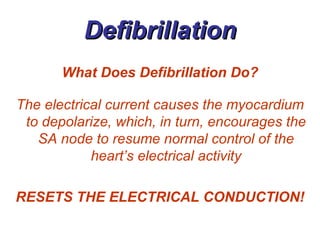
Defibrillation What Does Defibrillation Do? The electrical current causes the myocardium to depolarize, which, in turn, encourages the SA node to resume normal control of the heart’s electrical activity RESETS THE ELECTRICAL CONDUCTION!
VF: Analyzing a Strip Rhythm:   Chaotic Rate:  Cannot be determined; no discernible waves P waves:  No P waves PRI:  None QRS:  No discernible QRS complexes ***Interpretation: Ventricular Fibrillation (VF)
Ventricular Standstill  SA node intact, so P waves are present No ventricular conduction due to a preceding advanced AV block
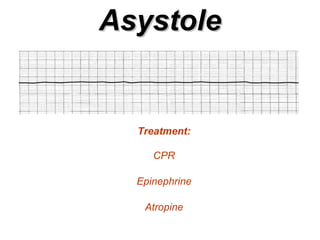
Asystole NO ELECTRICAL ACTIVITY NO MECHANICAL ACTIVITY
Asystole Treatment: CPR Epinephrine Atropine
TIME TO WORKOUT!!!
References Beverage, D. Haworth, K., Labus, D. Mayer, B. H., & Munson, C. (2005).  ECG interpretation made incredibly easy,  (3 rd  ed.). Ambler, PA: Lippincott, Williams, & Wilkins. Chernecky, C., et al. (2002).  Real world nursing survival guide: ECG’s & the heart.  United States of America: W. B. Saunders Company. Huff, J. (2006).  ECG workout: Exercises in arrhythmia interpretation  (5 th  ed.). United States of America: Lippincott, Williams & Wilkins. Walraven, G. (1999).  Basic arrhythmias  (5 th  ed.). United States of America: Prentice-Hall, Inc. www.madsci.com/manu/ekg_rhy.htm

Ventricular Rhythms - BMH/Tele

  • 1.
    Ventricular Rhythms Electrical impulses that originate from the ventricular conduction system.
  • 2.
    Ventricular Rhythms BundleBranch Blocks (BBB) & Hemiblocks Premature Ventricular Contractions (PVC) Ventricular Escape Beat Idioventricular Rhythm & AIVR Ventricular Tachycardia Ventricular Fibrillation Ventricular Standstill Asystole
  • 3.
    Wide, Bizarre QRS’sSequential Depolarization The electrical impulse originates from an ectopic site within one of the ventricles stimulating that side first, then depolarizes the other ventricle Conduction time is slower than normal causing a wide, bizarre QRS complex ( > 0.12 sec)
  • 4.
    Bundle Branch Block(BBB) A bundle branch block refers to an obstruction in the transmission of the electrical impulse through one branch (either right or left) of the bundle of His.
  • 5.
    Hemiblocks A bundlebranch block that occurs farther down the left bundle branch is called a hemiblock Left Posterior Fascicular Block Left Anterior Fascicular Block
  • 6.
    Bundle Branch Block(BBB) In a bundle branch block, the impulse travels down the unaffected bundle branch and then from one myocardial cell to the next to depolarize the ventricle Because this cell-to-cell conduction progresses much more slowly than the conduction along the specialized cells of the conduction system, ventricular polarization is prolonged
  • 7.
  • 8.
    BBB: Analyzing aStrip Rhythm: Regular Rate: 60 – 100 bpm P waves: Upright & uniform. PRI: 0.12 – 0.20 sec QRS: > 0.12 sec; notched or “bunny ears”. ***Interpretation: NSR w/ BBB & ST-segment depression
  • 9.
    Premature Ventricular Contraction(PVC) A PVC is a premature, ectopic impulse that originates in either the right or left ventricle. Electrical impulse originating from ventricle depolarizes only one ventricle at a time (resulting in sequential depolarization). This results in a wide, bizarre-looking QRS complex. May be unifocal or multifocal.
  • 10.
    PVC’s The STsegment and T wave slope in the opposite direction from the main deflection of the QRS complex If depolarization is abnormal, then repolarization will be abnormal
  • 11.
    Compensatory Pause Occursbecause the SA node isn’t depolarized by the ectopic ventricular beat, the discharge timing of the sinus node remains unchanged and the underlying rhythm will resume on time after the PVC
  • 12.
  • 13.
  • 14.
    Patterned PVC’s Bigeminy,Trigeminy, Quadrigeminy
  • 15.
    Premature Ventricular Contraction(PVC) Causes: Electrolyte Imbalances Hypokalemia, Hyperkalemia, Hypomagnesemia, Hypocalcemia Metabolic Acidosis Hypoxia Myocardial Ischemia Drug Intoxications Cocaine, amphetamines, TCA’s LV Enlargement Increased Sympathetic Stimulation Myocarditis
  • 16.
    Premature Ventricular Contraction(PVC) Treatment: If asymptomatic, no treatment may be required Antiarrhythmics such as amiodarone (Cordarone), lidocaine, or procainamide (Pronestyl), propafenone (Rythmol)
  • 17.
    PVCs: Analyzing aStrip Rhythm: Premature ectopic beat causes slight irregularity Rate: Overall HR depends on rate of underlying rhythm P waves: Ectopic beat is not preceded by a P wave. PRI: None; impulse originates from a lower focus QRS: Wide and bizarre; different from underlying QRS complexes. T wave is frequently in the opposite direction from the QRS complex.
  • 18.
    Run of PVC’s3 or more consecutive PVC’s Occurs within an underlying rhythm Spontaneously resumes back to underlying Symptomatic or Asymptomatic Result of R-on-T Phenomenon Amiodarone (Cordarone), lidocaine, or procainamide (Pronestyl)
  • 19.
    Run of PVCs:Analyzing a Strip Atrial Fibrillation (controlled) with a 5-beat run of PVCs (run of V-Tach or burst of PVCs) & ST-segment depression
  • 20.
    Ventricular Escape BeatA ventricular beat that occurs as a result of a pause in an underlying rhythm Likely occur due to increased vagal effect on the SA node rather than because of enhanced automaticity A protective mechanism – preventing slow heart rates
  • 21.
    Ventricular Escape BeatHow does this beat differ from a junctional escape beat??? Interpretation: NSR w/ ventricular escape beat following a pause converting back to NSR
  • 22.
  • 23.
    Idioventricular (Escape) RhythmIdioventricular rhythms occur when all pacemakers fail to function or when SV impulses can’t reach the ventricles because of a block in the conduction system
  • 24.
    Idioventricular (Escape) RhythmCauses: Accompanied by Complete Heart Block Myocardial Ischemia MI Digoxin Toxicity Pacemaker Failure Metabolic Imbalances
  • 25.
    Idioventricular (Escape) RhythmTreatment: Pacemaker (Temporary – Permanent) Treat Underlying Cause
  • 26.
    IVR: Analyzing aStrip Rhythm: Regular; can slow down as heart dies. Rate: No atrial rate; ventricular rate 20 – 40 bpm P waves: None; impulse originates from a lower focus PRI: None; impulse originates from a lower focus QRS: Wide and bizarre; equal to or > 0.12 sec. T wave not visible Interpretation: Idioventricular Rhythm (IVR)
  • 27.
    Accelerated Idioventricular RhythmRate: 41 - 100 Wide, bizarre QRS complexes No P waves
  • 28.
    Accelerated Idioventricular RhythmHow is AIVR distinguished from accelerated junctional rhythm???
  • 29.
    Ventricular Tachycardias Monomorphic,Polymorphic, Torsades de Pointes
  • 30.
    Ventricular Tachycardia Ventriculartachycardia usually results from increased myocardial irritability, which may be triggered by enhanced automaticity or reentry within the Perkinje system or by PVC’s initiating the R-on-T phenomenon
  • 31.
    Ventricular Tachycardia Causes:Myocardial ischemia MI CAD Valvular heart disease Heart failure Cardiomyopathy Electrolyte imbalances Drug intoxication – digoxin, procainamide, quinidine, or cocaine
  • 32.
    Ventricular Tachycardia Non-sustained: Paroxysmal bursts lasting less than 30 seconds Sustained: Stable, Unstable, or Pulseless
  • 33.
    Ventricular Tachycardia ThreeTypes of ACLS Algorithms for V-Tach: Stable Ventricular Tachycardia Unstable Ventricular Tachycardia Pulseless Ventricular Tachycardia
  • 34.
    Monomorphic VT: Analyzinga Strip Rhythm: Regular; sometimes slightly irregular Rate: no atrial rate; ventricular rate 150 – 250 bpm P waves: No P waves present PRI: None QRS: Wide and bizarre; Uniform; 0.12 sec. T wave opposite direction of QRS ***Interpretation: Ventricular Tachycardia (VT)
  • 35.
    Ventricular Tachycardia A.K.A.– Monomorphic V-Tach
  • 36.
    Polymorphic VT: Analyzing a Strip Rhythm: Regular; sometimes slightly irregular Rate: no atrial rate; ventricular rate 150 – 250 bpm P waves: No P waves present PRI: None QRS: Wide and bizarre; Varied morphology; > 0.12 sec. T wave opposite direction of QRS ***Interpretation: Polymorphic VT
  • 37.
    Torsades de PointesCauses: Usually reversible Drugs that lengthen QT interval (amiodarone, ibultilide, erhythromycin, haloperidol, sotalol, levafloxicin) Myocardial ischemia Hypokalemia, hypomagnesemia, hypocalcemia
  • 38.
    Torsades de PointesTreated by correcting the underlying cause: Mechanical overdrive pacing Magnesium sulfate Electrical cardioversion
  • 39.
    Torsades de Pointes:Analyzing a Strip Rhythm: Irregular; sometimes slightly irregular Rate: no atrial rate; ventricular rate 150 – 250 bpm P waves: No P waves present PRI: None QRS: Wide and bizarre; Varied morphology; > 0.12 sec. T wave opposite direction of QRS ***Interpretation: Torsades de pointes
  • 40.
    Ventricular Fibrillation (VF)A chaotic pattern of electrical activity in the ventricles in which electrical impulses arise from many different foci. No effective myocardial contraction = No CO Untreated V-fib causes most cases of sudden cardiac death in people outside of the hospital
  • 41.
    Ventricular Fibrillation Causes:Myocardial ischemia MI Untreated Ventricular Tachycardia Underlying HD Acid-Base Imbalance Electric Shock Severe Hypothermia Electrolyte imbalances Hypokalemia, hyperkalemia, hypercalcemia
  • 42.
  • 43.
    VF: Treatment DefibrillatoryShocks CPR Vasopressors Antidysrhythmics Determine Underlying Cause
  • 44.
    Defibrillation What DoesDefibrillation Do? The electrical current causes the myocardium to depolarize, which, in turn, encourages the SA node to resume normal control of the heart’s electrical activity RESETS THE ELECTRICAL CONDUCTION!
  • 45.
    VF: Analyzing aStrip Rhythm: Chaotic Rate: Cannot be determined; no discernible waves P waves: No P waves PRI: None QRS: No discernible QRS complexes ***Interpretation: Ventricular Fibrillation (VF)
  • 46.
    Ventricular Standstill SA node intact, so P waves are present No ventricular conduction due to a preceding advanced AV block
  • 47.
    Asystole NO ELECTRICALACTIVITY NO MECHANICAL ACTIVITY
  • 48.
    Asystole Treatment: CPREpinephrine Atropine
  • 49.
  • 50.
    References Beverage, D.Haworth, K., Labus, D. Mayer, B. H., & Munson, C. (2005). ECG interpretation made incredibly easy, (3 rd ed.). Ambler, PA: Lippincott, Williams, & Wilkins. Chernecky, C., et al. (2002). Real world nursing survival guide: ECG’s & the heart. United States of America: W. B. Saunders Company. Huff, J. (2006). ECG workout: Exercises in arrhythmia interpretation (5 th ed.). United States of America: Lippincott, Williams & Wilkins. Walraven, G. (1999). Basic arrhythmias (5 th ed.). United States of America: Prentice-Hall, Inc. www.madsci.com/manu/ekg_rhy.htm