STRESS
ECHOCARDIOGRAPHY
Dr. Muhammad Mobarock Hossain
MBBS(CU), MD (card) phase B
University cardiac centre, BSMMU
DHAKA, BANGLADESH.
Contact: +8801914007246
Email: mobarockdr@gmail.com
History
History :
The Krannert Institute and Indiana University
introduced the technique of dobutamine stress
echocardiography in the United States over 17 years
ago.
Link: http://medicine.iupui.edu/krannert/programs/echo/dobutamine/
Cont…
Cardiac ultrasound is used to image the function of
the heart and
Medicines (dobutamine or dopamine) are used to stress
the heart.
Cardiac ultrasound can detect the presence of
blockages in the arteries to the heart if a region of
the heart is seen to have reduced pumping function
during stress.
Link: http://medicine.iupui.edu/krannert/programs/echo/dobutamine/
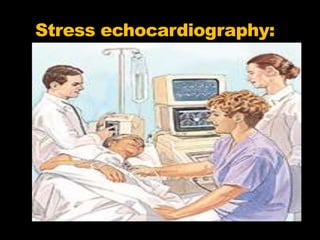
Stress echocardiography:
Definition
Definition of stress
echocardiography :
SE is an effective method for the evaluation of
myocardial ischemia, based on the detection of
“ Stress induced regional wall motion
abnormality”.
About SE
 Accuracy of SE in the detection of significant
coronary artery disease is 80-90%.
 SE is superior to ETT and can be comparable
to nuclear stress imaging.
 SE is safe and economical.
 Mortality 1 in 1000
Pathophysiology
Pathophysiology :
Exercise and inotropic stress normally provoke a
generalised increase of regional wall motion and
thickening, with an increment of ejection fraction
mainly caused by a reduction of systolic
dimensions.
Regional systolic dysfunction is usually caused by
coronary artery disease, but cardiomyopathies
may also show regional variation in function.
Cont…
The presence of residual viable tissue is more
common in hypo kinetic than akinetic
Segments &
least common in dyskinetic segments.
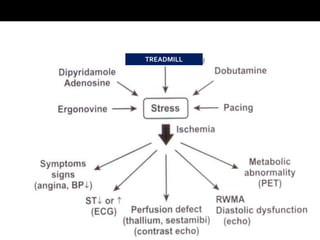
Ischemic cascade
Myocardial ischemia due to coronary luminal obstruction
Decreased myocardial perfusion ――> [NS,PET,CPE]
Metabolic changes ――> [ PET scan]
Diastolic dysfunction ――> [Stress Echo]
Systolic dysfunction ――> [Stress Echo]
ECG change ――> [ECG]
Chest pain ――> [History]
Importance of SE:
SE can differentiate viable myocardium from
the scarred myocardium which may help
whether there will be any benefit from the
revascularization or not.
Cont…
 The severity of valvular disease
 Hypertrophic cardiomyopathy
 Exercise induced pulmonary hypertension
Contraindications to SE:
1. Unstable angina
2. Severe base line hypertension
3. Uncontrolled arrhythmias
4. Mobile LV thrombus
5. SevereAortic stenosis
6. HOCM
7. Decompensated HF.
Stressors
Stressors :
 Exercise
 Pharmacological agents
 Atrial pacing
TREADMILL
Methodology
Methodology :
 Patient’s preparation
 Equipments
 Performing the test
Patient’s
preparation
Patient’s preparation
 Written consent from the patient.
 Avoid heavy meal several hours before the
test.
 Rate limiting drugs like beta blockers should
be stopped 3-5 half lives.
 Standard connections for a 12 lead ECG.
Equipments
Equipments:
 Exercise echocardiographic machine with
standard hemodynamic monitoring
equipment is needed.
 Resuscitation equipments and defibrillator
should be available for emergency crisis.
 Software for the echocardiographic machine
is necessary to acquire digital images and to
allow side by side comparison of pre test with
post peak stress images
Performing
the test
Exercise stress
echocardiography :
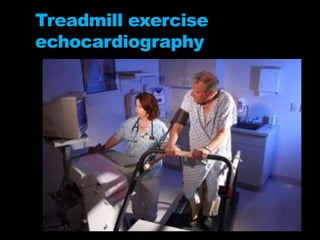
 Treadmill exercise echocardiography
 Upright bicycle echocardiography
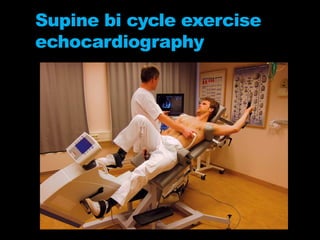
 Supine bi cycle exercise echocardiography
Treadmill exercise
echocardiography
Supine bi cycle exercise
echocardiography
Exercise stress test:
 Exercise stress is preferred over non exercise
stress because it is more closely reproduce
daily activities .
 Images are to be obtained at peak exercise
with bicycle ergometry while the patient
continues to exercise.
 Sensitivity will be reduced if the images are
not taken within 90 sec after exercise.
End points for exercise SE:
 Target HR (85% of APMHR)
 Chest pain and dyspnoea
 Severe hypertension( Sys>220 mm of Hg,
Dia > 110 mm of Hg)
 Hypotension( Sys < 90 mm of Hg or fall of >
20 mm of Hg from the base line).
 Ventricular tachycardia or sustained SVT
 Developments ofWMA in at least two
contiguous segments
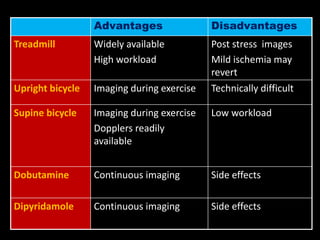
Advantages Disadvantages
Treadmill Widely available
High workload
Post stress images
Mild ischemia may
revert
Upright bicycle Imaging during exercise Technically difficult
Supine bicycle Imaging during exercise
Dopplers readily
available
Low workload
Dobutamine Continuous imaging Side effects
Dipyridamole Continuous imaging Side effects
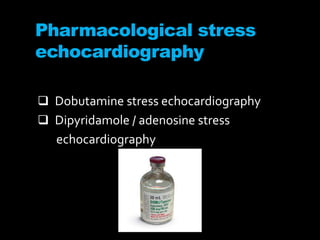
Pharmacological stress
echocardiography
 Dobutamine stress echocardiography
 Dipyridamole / adenosine stress
echocardiography
American society of
echocardiography (ASE)
In 2007, American society of
echocardiography (ASE) guidelines
recommended “ Dobutamine” as the 1st line
agent for pharmacologic stress
echocardiography.
Dobutamine
 Sympathomimetic drugs which causes
increase ionotrophic, increase chronotrophic
and increase Blood pressure.
 Plasma half life is 2-3 minutes
 Low dose dobutamine causes (+) ionotrophic
effect through cardiac α₁ and β₁ receptors
thus causing increase contractality of heart.
 Higher dose causing (+) chronotrophic
effects through cardiac β₂ receptors.
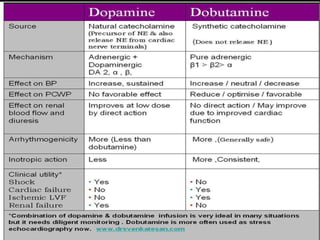
Dopamine vs
Dobutamine
Contraindication for
dobutamine :
 Unstable ventricular arrhythmias
Other factors
1. Unstable angina
2. Severe base line hypertension
3. Uncontrolled arrhythmias
4. Mobile LV thrombus
5. SevereAortic stenosis
6. HOCM
7. Decompensated HF.
How to start with
Dobutamine
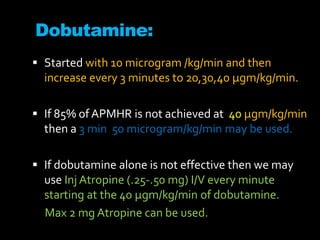
Dobutamine:
 Started with 10 microgram /kg/min and then
increase every 3 minutes to 20,30,40 μgm/kg/min.
 If 85% of APMHR is not achieved at 40 μgm/kg/min
then a 3 min 50 microgram/kg/min may be used.
 If dobutamine alone is not effective then we may
use Inj Atropine (.25-.50 mg) I/V every minute
starting at the 40 μgm/kg/min of dobutamine.
Max 2 mg Atropine can be used.
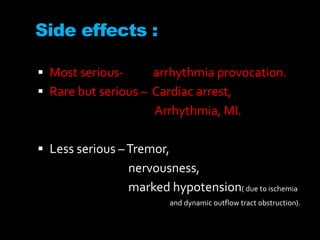
Side effects :
 Most serious- arrhythmia provocation.
 Rare but serious – Cardiac arrest,
Arrhythmia, MI.
 Less serious –Tremor,
nervousness,
marked hypotension( due to ischemia
and dynamic outflow tract obstruction).
Combat with the
side effects of
Dobutamine
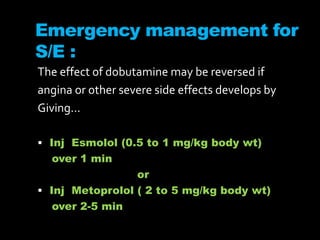
Emergency management for
S/E :
The effect of dobutamine may be reversed if
angina or other severe side effects develops by
Giving…
 Inj Esmolol (0.5 to 1 mg/kg body wt)
over 1 min
or
 Inj Metoprolol ( 2 to 5 mg/kg body wt)
over 2-5 min
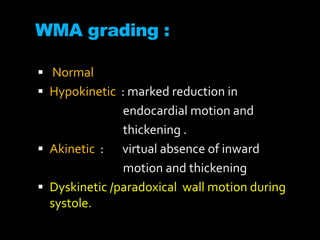
WMA grading :
 Normal
 Hypokinetic : marked reduction in
endocardial motion and
thickening .
 Akinetic : virtual absence of inward
motion and thickening
 Dyskinetic /paradoxical wall motion during
systole.
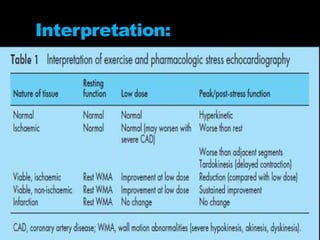
Interpretation:
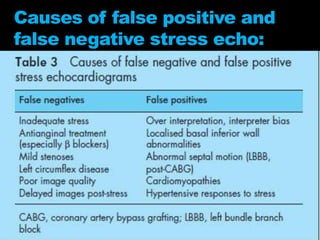
Causes of false positive and
false negative stress echo:
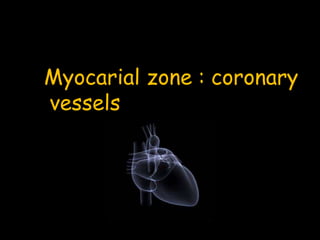
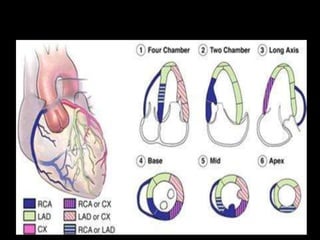
Myocarial zone : coronary
vessels
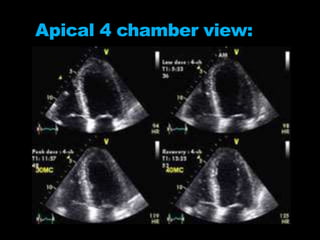
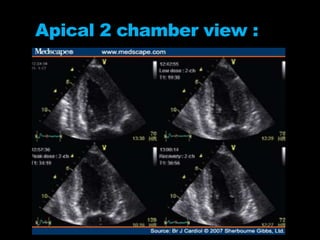
Sample pictures of
DSE
Apical 4 chamber view:
Apical 2 chamber view :
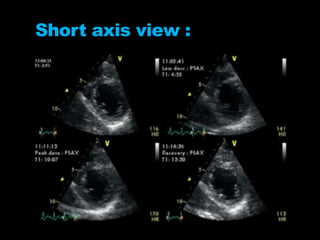
Short axis view :
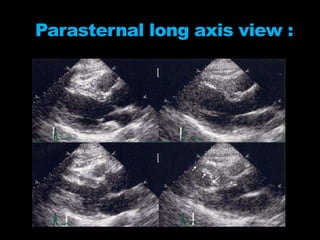
Parasternal long axis view :
Stress echocardiography

Stress echocardiography

  • 1.
    STRESS ECHOCARDIOGRAPHY Dr. Muhammad MobarockHossain MBBS(CU), MD (card) phase B University cardiac centre, BSMMU DHAKA, BANGLADESH. Contact: +8801914007246 Email: mobarockdr@gmail.com
  • 2.
  • 3.
    History : The KrannertInstitute and Indiana University introduced the technique of dobutamine stress echocardiography in the United States over 17 years ago. Link: http://medicine.iupui.edu/krannert/programs/echo/dobutamine/
  • 4.
    Cont… Cardiac ultrasound isused to image the function of the heart and Medicines (dobutamine or dopamine) are used to stress the heart. Cardiac ultrasound can detect the presence of blockages in the arteries to the heart if a region of the heart is seen to have reduced pumping function during stress. Link: http://medicine.iupui.edu/krannert/programs/echo/dobutamine/
  • 5.
  • 6.
  • 7.
    Definition of stress echocardiography: SE is an effective method for the evaluation of myocardial ischemia, based on the detection of “ Stress induced regional wall motion abnormality”.
  • 8.
    About SE  Accuracyof SE in the detection of significant coronary artery disease is 80-90%.  SE is superior to ETT and can be comparable to nuclear stress imaging.  SE is safe and economical.  Mortality 1 in 1000
  • 9.
  • 10.
    Pathophysiology : Exercise andinotropic stress normally provoke a generalised increase of regional wall motion and thickening, with an increment of ejection fraction mainly caused by a reduction of systolic dimensions. Regional systolic dysfunction is usually caused by coronary artery disease, but cardiomyopathies may also show regional variation in function.
  • 11.
    Cont… The presence ofresidual viable tissue is more common in hypo kinetic than akinetic Segments & least common in dyskinetic segments.
  • 12.
    Ischemic cascade Myocardial ischemiadue to coronary luminal obstruction Decreased myocardial perfusion ――> [NS,PET,CPE] Metabolic changes ――> [ PET scan] Diastolic dysfunction ――> [Stress Echo] Systolic dysfunction ――> [Stress Echo] ECG change ――> [ECG] Chest pain ――> [History]
  • 13.
    Importance of SE: SEcan differentiate viable myocardium from the scarred myocardium which may help whether there will be any benefit from the revascularization or not.
  • 14.
    Cont…  The severityof valvular disease  Hypertrophic cardiomyopathy  Exercise induced pulmonary hypertension
  • 15.
    Contraindications to SE: 1.Unstable angina 2. Severe base line hypertension 3. Uncontrolled arrhythmias 4. Mobile LV thrombus 5. SevereAortic stenosis 6. HOCM 7. Decompensated HF.
  • 16.
  • 17.
    Stressors :  Exercise Pharmacological agents  Atrial pacing
  • 18.
  • 19.
  • 20.
    Methodology :  Patient’spreparation  Equipments  Performing the test
  • 21.
  • 22.
    Patient’s preparation  Writtenconsent from the patient.  Avoid heavy meal several hours before the test.  Rate limiting drugs like beta blockers should be stopped 3-5 half lives.  Standard connections for a 12 lead ECG.
  • 23.
  • 24.
    Equipments:  Exercise echocardiographicmachine with standard hemodynamic monitoring equipment is needed.  Resuscitation equipments and defibrillator should be available for emergency crisis.  Software for the echocardiographic machine is necessary to acquire digital images and to allow side by side comparison of pre test with post peak stress images
  • 25.
  • 26.
    Exercise stress echocardiography : Treadmill exercise echocardiography  Upright bicycle echocardiography  Supine bi cycle exercise echocardiography
  • 27.
  • 28.
    Supine bi cycleexercise echocardiography
  • 29.
    Exercise stress test: Exercise stress is preferred over non exercise stress because it is more closely reproduce daily activities .  Images are to be obtained at peak exercise with bicycle ergometry while the patient continues to exercise.  Sensitivity will be reduced if the images are not taken within 90 sec after exercise.
  • 30.
    End points forexercise SE:  Target HR (85% of APMHR)  Chest pain and dyspnoea  Severe hypertension( Sys>220 mm of Hg, Dia > 110 mm of Hg)  Hypotension( Sys < 90 mm of Hg or fall of > 20 mm of Hg from the base line).  Ventricular tachycardia or sustained SVT  Developments ofWMA in at least two contiguous segments
  • 31.
    Advantages Disadvantages Treadmill Widelyavailable High workload Post stress images Mild ischemia may revert Upright bicycle Imaging during exercise Technically difficult Supine bicycle Imaging during exercise Dopplers readily available Low workload Dobutamine Continuous imaging Side effects Dipyridamole Continuous imaging Side effects
  • 32.
    Pharmacological stress echocardiography  Dobutaminestress echocardiography  Dipyridamole / adenosine stress echocardiography
  • 33.
    American society of echocardiography(ASE) In 2007, American society of echocardiography (ASE) guidelines recommended “ Dobutamine” as the 1st line agent for pharmacologic stress echocardiography.
  • 34.
    Dobutamine  Sympathomimetic drugswhich causes increase ionotrophic, increase chronotrophic and increase Blood pressure.  Plasma half life is 2-3 minutes  Low dose dobutamine causes (+) ionotrophic effect through cardiac α₁ and β₁ receptors thus causing increase contractality of heart.  Higher dose causing (+) chronotrophic effects through cardiac β₂ receptors.
  • 35.
  • 37.
    Contraindication for dobutamine : Unstable ventricular arrhythmias
  • 38.
    Other factors 1. Unstableangina 2. Severe base line hypertension 3. Uncontrolled arrhythmias 4. Mobile LV thrombus 5. SevereAortic stenosis 6. HOCM 7. Decompensated HF.
  • 39.
    How to startwith Dobutamine
  • 40.
    Dobutamine:  Started with10 microgram /kg/min and then increase every 3 minutes to 20,30,40 μgm/kg/min.  If 85% of APMHR is not achieved at 40 μgm/kg/min then a 3 min 50 microgram/kg/min may be used.  If dobutamine alone is not effective then we may use Inj Atropine (.25-.50 mg) I/V every minute starting at the 40 μgm/kg/min of dobutamine. Max 2 mg Atropine can be used.
  • 41.
    Side effects : Most serious- arrhythmia provocation.  Rare but serious – Cardiac arrest, Arrhythmia, MI.  Less serious –Tremor, nervousness, marked hypotension( due to ischemia and dynamic outflow tract obstruction).
  • 42.
    Combat with the sideeffects of Dobutamine
  • 43.
    Emergency management for S/E: The effect of dobutamine may be reversed if angina or other severe side effects develops by Giving…  Inj Esmolol (0.5 to 1 mg/kg body wt) over 1 min or  Inj Metoprolol ( 2 to 5 mg/kg body wt) over 2-5 min
  • 44.
    WMA grading : Normal  Hypokinetic : marked reduction in endocardial motion and thickening .  Akinetic : virtual absence of inward motion and thickening  Dyskinetic /paradoxical wall motion during systole.
  • 45.
  • 46.
    Causes of falsepositive and false negative stress echo:
  • 47.
    Myocarial zone :coronary vessels
  • 49.
  • 50.
  • 51.
  • 52.
  • 53.