WIDE COMPLEX
TACHYCARDIA-
SVT vs VT
DR MAHENDRA
CARDIOLOGY, JIPMER
1
Definitions
 WCT- A rhythm with a rate of ≥ 100/min and QRSd ≥120 ms
 VT - A WCT originating below the level of His bundle
 SVT - A tachycardia dependent on structures at or above the level
of His bundle
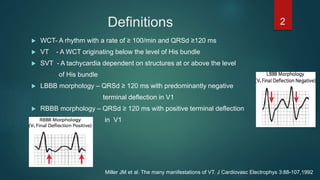
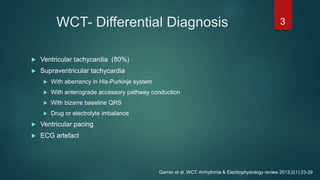
 LBBB morphology – QRSd ≥ 120 ms with predominantly negative
terminal deflection in V1
 RBBB morphology – QRSd ≥ 120 ms with positive terminal deflection
in V1
2
Miller JM et al. The many manifestations of VT. J Cardiovasc Electrophys 3:88-107,1992
WCT- Differential Diagnosis
 Ventricular tachycardia (80%)
 Supraventricular tachycardia
 With aberrancy in His-Purkinje system
 With anterograde accessory pathway conduction
 With bizarre baseline QRS
 Drug or electrolyte imbalance
 Ventricular pacing
 ECG artefact
Garner et al, WCT. Arrhythmia & Electrophysiology review 2013;2(1):23-29
3
Why to recognize ?
 Misdiagnosing VT as SVT  IV verapamil or adenosine  hemodynamic
deterioration
 Wrongly labelling SVT as VT  inappropriate chronic therapy
 Assumptions
 “WCT in a alert and hemodynamically stable patient must be SVT”❌
 ”Patients with VT are always unstable”❌
4
History & examination
 H/O Prior MI (98% PPV for VT)
 H/O CHF (100% PPV for VT)
 H/O Recent angina (100% PPV for VT)
 Age > 35 years (92% sensitivity for VT)
 Variable S1 (s/o VT)
 Cannon ’a’ waves (favours VT)
5
Baerman JM et al. Ann Emerg Med 1987;16:40-3
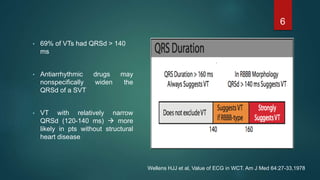
• 69% of VTs had QRSd > 140
ms
• Antiarrhythmic drugs may
nonspecifically widen the
QRSd of a SVT
• VT with relatively narrow
QRSd (120-140 ms)  more
likely in pts without structural
heart disease
6
Wellens HJJ et al, Value of ECG in WCT. Am J Med 64:27-33,1978
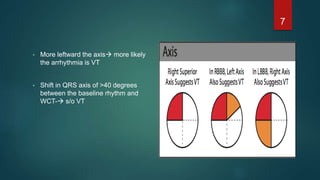
• More leftward the axis more likely
the arrhythmia is VT
• Shift in QRS axis of >40 degrees
between the baseline rhythm and
WCT- s/o VT
7
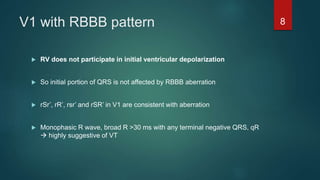
V1 with RBBB pattern
 RV does not participate in initial ventricular depolarization
 So initial portion of QRS is not affected by RBBB aberration
 rSr’, rR’, rsr’ and rSR’ in V1 are consistent with aberration
 Monophasic R wave, broad R >30 ms with any terminal negative QRS, qR
 highly suggestive of VT
8
V6 with RBBB pattern
 In true RBBB aberration  delayed RV activation  small ‘s’ wave in
V6 (relatively smaller RV mass as compared to LV)
 Ventricular activation over LBB  qRs, Rs, or RS (R/S >1) in V6
 So patterns different from these  rS, Qrs, QS, QR, monophasic R wave,
RS with R/S <1  VT
 Large ‘S’ wave in V6 during VT  RV activation + larger LV activation
propagating away from V6
9
10
Garner et al, WCT. Arrhythmia & Electrophysiology review 2013;2(1):23-29
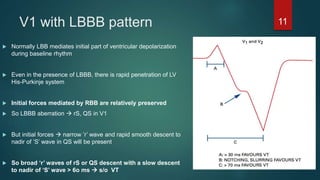
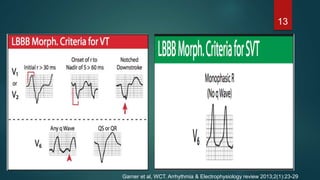
V1 with LBBB pattern
 Normally LBB mediates initial part of ventricular depolarization
during baseline rhythm
 Even in the presence of LBBB, there is rapid penetration of LV
His-Purkinje system
 Initial forces mediated by RBB are relatively preserved
 So LBBB aberration  rS, QS in V1
 But initial forces  narrow ’r’ wave and rapid smooth descent to
nadir of ’S’ wave in QS will be present
 So broad ‘r’ waves of rS or QS descent with a slow descent
to nadir of ‘S’ wave > 6o ms  s/o VT
11
V6 with LBBB pattern
 Typical LBBB initial ’q’ wave in QRS is absent
 So RR’ or monophasic R wave is seen during SVT-A
 If QR, QS, QrS, Rr’ present  s/o VT
12
13
Garner et al, WCT. Arrhythmia & Electrophysiology review 2013;2(1):23-29
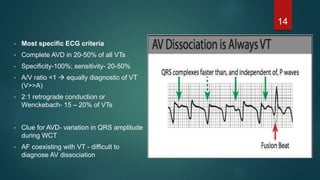
• Most specific ECG criteria
• Complete AVD in 20-50% of all VTs
• Specificity-100%; sensitivity- 20-50%
• A/V ratio <1  equally diagnostic of VT
(V>>A)
• 2:1 retrograde conduction or
Wenckebach- 15 – 20% of VTs
• Clue for AVD- variation in QRS amplitude
during WCT
• AF coexisting with VT - difficult to
diagnose AV dissociation
14
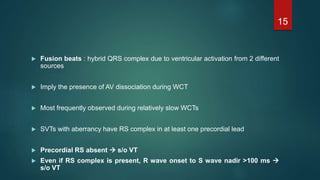
 Fusion beats : hybrid QRS complex due to ventricular activation from 2 different
sources
 Imply the presence of AV dissociation during WCT
 Most frequently observed during relatively slow WCTs
 SVTs with aberrancy have RS complex in at least one precordial lead
 Precordial RS absent  s/o VT
 Even if RS complex is present, R wave onset to S wave nadir >100 ms 
s/o VT
15
Concordance in precordial leads
 V1 to V6 - Positive or negative concordance
 Present only in 20% of all VTs
 In most series, divided between positive and negative patterns
 Diagnostic of ventricular origin; specificity >90% , low sensitivity
 Negative concordance is nearly always VT
 Exception: Positive concordance seen in antidromic tachycardia mediated
by LP or LL pathway(1-6% of all WCTs)
16
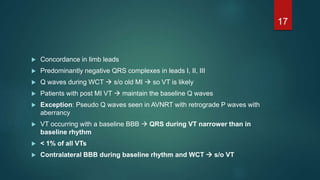
 Concordance in limb leads
 Predominantly negative QRS complexes in leads I, II, III
 Q waves during WCT  s/o old MI  so VT is likely
 Patients with post MI VT  maintain the baseline Q waves
 Exception: Pseudo Q waves seen in AVNRT with retrograde P waves with
aberrancy
 VT occurring with a baseline BBB  QRS during VT narrower than in
baseline rhythm
 < 1% of all VTs
 Contralateral BBB during baseline rhythm and WCT  s/o VT
17
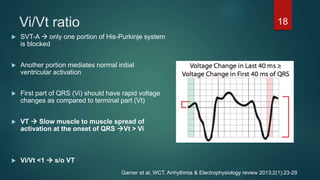
Vi/Vt ratio
 SVT-A  only one portion of His-Purkinje system
is blocked
 Another portion mediates normal initial
ventricular activation
 First part of QRS (Vi) should have rapid voltage
changes as compared to terminal part (Vt)
 VT  Slow muscle to muscle spread of
activation at the onset of QRS Vt > Vi
 Vi/Vt <1  s/o VT
18
Garner et al, WCT. Arrhythmia & Electrophysiology review 2013;2(1):23-29
MORPHOLOGY CRITERIA
19
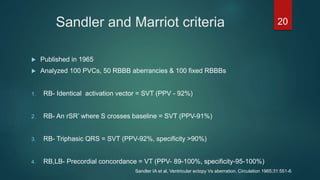
Sandler and Marriot criteria
 Published in 1965
 Analyzed 100 PVCs, 50 RBBB aberrancies & 100 fixed RBBBs
1. RB- Identical activation vector = SVT (PPV - 92%)
2. RB- An rSR’ where S crosses baseline = SVT (PPV-91%)
3. RB- Triphasic QRS = SVT (PPV-92%, specificity >90%)
4. RB,LB- Precordial concordance = VT (PPV- 89-100%, specificity-95-100%)
20
Sandler IA et al, Ventricular ectopy Vs aberration. Circulation 1965;31:551-6
Wellens criteria of RBBB
 Published in 1978
 Simultaneous analysis of ECG and His-bundle electrograms
 Analyzed EP proved 70 sustained VT and 70 SVTs with aberrancy
21
Wellens HJJ et al, Value of ECG in WCT. Am J Med 64:27-33,1978
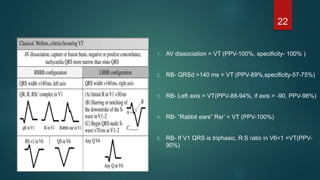
1. AV dissociation = VT (PPV-100%, specificity- 100% )
2. RB- QRSd >140 ms = VT (PPV-89%,specificity-57-75%)
3. RB- Left axis = VT(PPV-88-94%, if axis > -90, PPV-98%)
4. RB- “Rabbit ears” Rsr’ = VT (PPV-100%)
5. RB- If V1 QRS is triphasic, R:S ratio in V6<1 =VT(PPV-
90%)
22
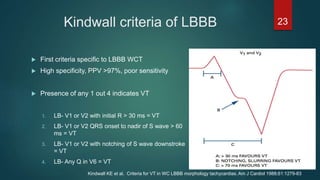
Kindwall criteria of LBBB
 First criteria specific to LBBB WCT
 High specificity, PPV >97%, poor sensitivity
 Presence of any 1 out 4 indicates VT
1. LB- V1 or V2 with initial R > 30 ms = VT
2. LB- V1 or V2 QRS onset to nadir of S wave > 60
ms = VT
3. LB- V1 or V2 with notching of S wave downstroke
= VT
4. LB- Any Q in V6 = VT
23
Kindwall KE et al. Criteria for VT in WC LBBB morphology tachycardias. Am J Cardiol 1988;61:1279-83
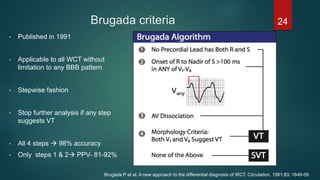
Brugada criteria
• Published in 1991
• Applicable to all WCT without
limitation to any BBB pattern
• Stepwise fashion
• Stop further analysis if any step
suggests VT
• All 4 steps  98% accuracy
• Only steps 1 & 2 PPV- 81-92%
24
Brugada P et al. A new approach to the differential diagnosis of WCT. Circulation. 1991;83: 1649-59
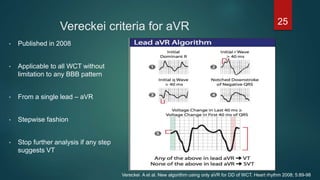
Vereckei criteria for aVR
• Published in 2008
• Applicable to all WCT without
limitation to any BBB pattern
• From a single lead – aVR
• Stepwise fashion
• Stop further analysis if any step
suggests VT
25
Vereckei A et al. New algorithm using only aVR for DD of WCT. Heart rhythm 2008; 5:89-98
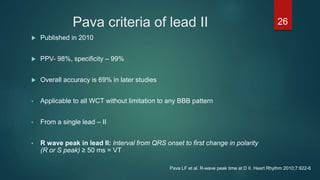
Pava criteria of lead II
 Published in 2010
 PPV- 98%, specificity – 99%
 Overall accuracy is 69% in later studies
• Applicable to all WCT without limitation to any BBB pattern
• From a single lead – II
• R wave peak in lead II: Interval from QRS onset to first change in polarity
(R or S peak) ≥ 50 ms = VT
26
Pava LF et al. R-wave peak time at D II. Heart Rhythm 2010;7:922-6
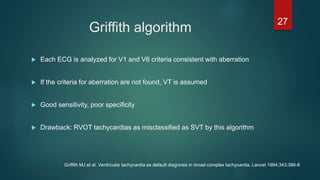
Griffith algorithm
 Each ECG is analyzed for V1 and V6 criteria consistent with aberration
 If the criteria for aberration are not found, VT is assumed
 Good sensitivity, poor specificity
 Drawback: RVOT tachycardias as misclassified as SVT by this algorithm
27
Griffith MJ et al. Ventricular tachycardia as default diagnosis in broad complex tachycardia. Lancet 1994;343:386-8
28
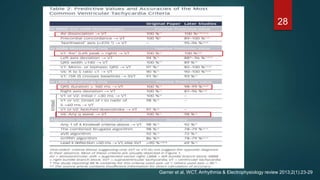
Garner et al, WCT. Arrhythmia & Electrophysiology review 2013;2(1):23-29
29
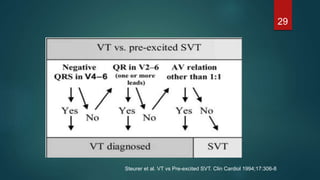
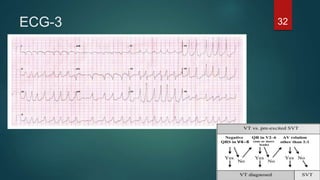
Steurer et al. VT vs Pre-excited SVT. Clin Cardiol 1994;17:306-8
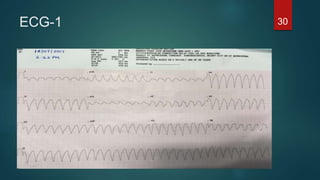
ECG-1 30
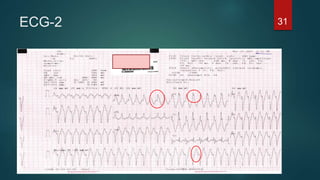
ECG-2 31
ECG-3 32
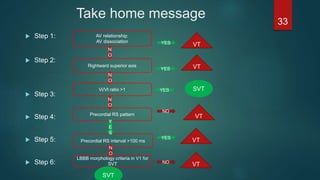
Take home message
 Step 1:
 Step 2:
 Step 3:
 Step 4:
 Step 5:
 Step 6:
33
AV relationship:
AV dissociation YES VT
N
O
Rightward superior axis
YES VT
N
O
Vi/Vt ratio >1 YES SVT
Precordial RS pattern
Precordial RS interval >100 ms
LBBB morphology criteria in V1 for
SVT
N
O
Y
E
S
N
O
NO
VT
VT
VTNO
SVT
YES
34
THANK YOU

approach to wide complex tachycardia

  • 1.
    WIDE COMPLEX TACHYCARDIA- SVT vsVT DR MAHENDRA CARDIOLOGY, JIPMER 1
  • 2.
    Definitions  WCT- Arhythm with a rate of ≥ 100/min and QRSd ≥120 ms  VT - A WCT originating below the level of His bundle  SVT - A tachycardia dependent on structures at or above the level of His bundle  LBBB morphology – QRSd ≥ 120 ms with predominantly negative terminal deflection in V1  RBBB morphology – QRSd ≥ 120 ms with positive terminal deflection in V1 2 Miller JM et al. The many manifestations of VT. J Cardiovasc Electrophys 3:88-107,1992
  • 3.
    WCT- Differential Diagnosis Ventricular tachycardia (80%)  Supraventricular tachycardia  With aberrancy in His-Purkinje system  With anterograde accessory pathway conduction  With bizarre baseline QRS  Drug or electrolyte imbalance  Ventricular pacing  ECG artefact Garner et al, WCT. Arrhythmia & Electrophysiology review 2013;2(1):23-29 3
  • 4.
    Why to recognize?  Misdiagnosing VT as SVT  IV verapamil or adenosine  hemodynamic deterioration  Wrongly labelling SVT as VT  inappropriate chronic therapy  Assumptions  “WCT in a alert and hemodynamically stable patient must be SVT”❌  ”Patients with VT are always unstable”❌ 4
  • 5.
    History & examination H/O Prior MI (98% PPV for VT)  H/O CHF (100% PPV for VT)  H/O Recent angina (100% PPV for VT)  Age > 35 years (92% sensitivity for VT)  Variable S1 (s/o VT)  Cannon ’a’ waves (favours VT) 5 Baerman JM et al. Ann Emerg Med 1987;16:40-3
  • 6.
    • 69% ofVTs had QRSd > 140 ms • Antiarrhythmic drugs may nonspecifically widen the QRSd of a SVT • VT with relatively narrow QRSd (120-140 ms)  more likely in pts without structural heart disease 6 Wellens HJJ et al, Value of ECG in WCT. Am J Med 64:27-33,1978
  • 7.
    • More leftwardthe axis more likely the arrhythmia is VT • Shift in QRS axis of >40 degrees between the baseline rhythm and WCT- s/o VT 7
  • 8.
    V1 with RBBBpattern  RV does not participate in initial ventricular depolarization  So initial portion of QRS is not affected by RBBB aberration  rSr’, rR’, rsr’ and rSR’ in V1 are consistent with aberration  Monophasic R wave, broad R >30 ms with any terminal negative QRS, qR  highly suggestive of VT 8
  • 9.
    V6 with RBBBpattern  In true RBBB aberration  delayed RV activation  small ‘s’ wave in V6 (relatively smaller RV mass as compared to LV)  Ventricular activation over LBB  qRs, Rs, or RS (R/S >1) in V6  So patterns different from these  rS, Qrs, QS, QR, monophasic R wave, RS with R/S <1  VT  Large ‘S’ wave in V6 during VT  RV activation + larger LV activation propagating away from V6 9
  • 10.
    10 Garner et al,WCT. Arrhythmia & Electrophysiology review 2013;2(1):23-29
  • 11.
    V1 with LBBBpattern  Normally LBB mediates initial part of ventricular depolarization during baseline rhythm  Even in the presence of LBBB, there is rapid penetration of LV His-Purkinje system  Initial forces mediated by RBB are relatively preserved  So LBBB aberration  rS, QS in V1  But initial forces  narrow ’r’ wave and rapid smooth descent to nadir of ’S’ wave in QS will be present  So broad ‘r’ waves of rS or QS descent with a slow descent to nadir of ‘S’ wave > 6o ms  s/o VT 11
  • 12.
    V6 with LBBBpattern  Typical LBBB initial ’q’ wave in QRS is absent  So RR’ or monophasic R wave is seen during SVT-A  If QR, QS, QrS, Rr’ present  s/o VT 12
  • 13.
    13 Garner et al,WCT. Arrhythmia & Electrophysiology review 2013;2(1):23-29
  • 14.
    • Most specificECG criteria • Complete AVD in 20-50% of all VTs • Specificity-100%; sensitivity- 20-50% • A/V ratio <1  equally diagnostic of VT (V>>A) • 2:1 retrograde conduction or Wenckebach- 15 – 20% of VTs • Clue for AVD- variation in QRS amplitude during WCT • AF coexisting with VT - difficult to diagnose AV dissociation 14
  • 15.
     Fusion beats: hybrid QRS complex due to ventricular activation from 2 different sources  Imply the presence of AV dissociation during WCT  Most frequently observed during relatively slow WCTs  SVTs with aberrancy have RS complex in at least one precordial lead  Precordial RS absent  s/o VT  Even if RS complex is present, R wave onset to S wave nadir >100 ms  s/o VT 15
  • 16.
    Concordance in precordialleads  V1 to V6 - Positive or negative concordance  Present only in 20% of all VTs  In most series, divided between positive and negative patterns  Diagnostic of ventricular origin; specificity >90% , low sensitivity  Negative concordance is nearly always VT  Exception: Positive concordance seen in antidromic tachycardia mediated by LP or LL pathway(1-6% of all WCTs) 16
  • 17.
     Concordance inlimb leads  Predominantly negative QRS complexes in leads I, II, III  Q waves during WCT  s/o old MI  so VT is likely  Patients with post MI VT  maintain the baseline Q waves  Exception: Pseudo Q waves seen in AVNRT with retrograde P waves with aberrancy  VT occurring with a baseline BBB  QRS during VT narrower than in baseline rhythm  < 1% of all VTs  Contralateral BBB during baseline rhythm and WCT  s/o VT 17
  • 18.
    Vi/Vt ratio  SVT-A only one portion of His-Purkinje system is blocked  Another portion mediates normal initial ventricular activation  First part of QRS (Vi) should have rapid voltage changes as compared to terminal part (Vt)  VT  Slow muscle to muscle spread of activation at the onset of QRS Vt > Vi  Vi/Vt <1  s/o VT 18 Garner et al, WCT. Arrhythmia & Electrophysiology review 2013;2(1):23-29
  • 19.
  • 20.
    Sandler and Marriotcriteria  Published in 1965  Analyzed 100 PVCs, 50 RBBB aberrancies & 100 fixed RBBBs 1. RB- Identical activation vector = SVT (PPV - 92%) 2. RB- An rSR’ where S crosses baseline = SVT (PPV-91%) 3. RB- Triphasic QRS = SVT (PPV-92%, specificity >90%) 4. RB,LB- Precordial concordance = VT (PPV- 89-100%, specificity-95-100%) 20 Sandler IA et al, Ventricular ectopy Vs aberration. Circulation 1965;31:551-6
  • 21.
    Wellens criteria ofRBBB  Published in 1978  Simultaneous analysis of ECG and His-bundle electrograms  Analyzed EP proved 70 sustained VT and 70 SVTs with aberrancy 21 Wellens HJJ et al, Value of ECG in WCT. Am J Med 64:27-33,1978
  • 22.
    1. AV dissociation= VT (PPV-100%, specificity- 100% ) 2. RB- QRSd >140 ms = VT (PPV-89%,specificity-57-75%) 3. RB- Left axis = VT(PPV-88-94%, if axis > -90, PPV-98%) 4. RB- “Rabbit ears” Rsr’ = VT (PPV-100%) 5. RB- If V1 QRS is triphasic, R:S ratio in V6<1 =VT(PPV- 90%) 22
  • 23.
    Kindwall criteria ofLBBB  First criteria specific to LBBB WCT  High specificity, PPV >97%, poor sensitivity  Presence of any 1 out 4 indicates VT 1. LB- V1 or V2 with initial R > 30 ms = VT 2. LB- V1 or V2 QRS onset to nadir of S wave > 60 ms = VT 3. LB- V1 or V2 with notching of S wave downstroke = VT 4. LB- Any Q in V6 = VT 23 Kindwall KE et al. Criteria for VT in WC LBBB morphology tachycardias. Am J Cardiol 1988;61:1279-83
  • 24.
    Brugada criteria • Publishedin 1991 • Applicable to all WCT without limitation to any BBB pattern • Stepwise fashion • Stop further analysis if any step suggests VT • All 4 steps  98% accuracy • Only steps 1 & 2 PPV- 81-92% 24 Brugada P et al. A new approach to the differential diagnosis of WCT. Circulation. 1991;83: 1649-59
  • 25.
    Vereckei criteria foraVR • Published in 2008 • Applicable to all WCT without limitation to any BBB pattern • From a single lead – aVR • Stepwise fashion • Stop further analysis if any step suggests VT 25 Vereckei A et al. New algorithm using only aVR for DD of WCT. Heart rhythm 2008; 5:89-98
  • 26.
    Pava criteria oflead II  Published in 2010  PPV- 98%, specificity – 99%  Overall accuracy is 69% in later studies • Applicable to all WCT without limitation to any BBB pattern • From a single lead – II • R wave peak in lead II: Interval from QRS onset to first change in polarity (R or S peak) ≥ 50 ms = VT 26 Pava LF et al. R-wave peak time at D II. Heart Rhythm 2010;7:922-6
  • 27.
    Griffith algorithm  EachECG is analyzed for V1 and V6 criteria consistent with aberration  If the criteria for aberration are not found, VT is assumed  Good sensitivity, poor specificity  Drawback: RVOT tachycardias as misclassified as SVT by this algorithm 27 Griffith MJ et al. Ventricular tachycardia as default diagnosis in broad complex tachycardia. Lancet 1994;343:386-8
  • 28.
    28 Garner et al,WCT. Arrhythmia & Electrophysiology review 2013;2(1):23-29
  • 29.
    29 Steurer et al.VT vs Pre-excited SVT. Clin Cardiol 1994;17:306-8
  • 30.
  • 31.
  • 32.
  • 33.
    Take home message Step 1:  Step 2:  Step 3:  Step 4:  Step 5:  Step 6: 33 AV relationship: AV dissociation YES VT N O Rightward superior axis YES VT N O Vi/Vt ratio >1 YES SVT Precordial RS pattern Precordial RS interval >100 ms LBBB morphology criteria in V1 for SVT N O Y E S N O NO VT VT VTNO SVT YES
  • 34.

Editor's Notes

  • #6 Differentiate it from FROG SIGN of AVNRT- retrograde P wave occurs early in systole when the AV ring is still positioned backwards towards the atria In VT- retrograde conduction occurs later in systole when the AV ring has moved towards the apex which enlarges the atria and minimizes backflow
  • #7 Because QRSd with LBBB aberrancy is slightly longer than with RBBB, this criterion has been modified such that for RBBB it is >140 ms and for LBBB IT IS >160 ms
  • #8 True LAFB- axis is from -30 to -90; in true LPFB axis is +110 to +150 So this leaves the quadrant of -90 to +180  cannot be achieved by any combination of BBB and fascicular block
  • #12 (Before 2nd point)LBBB would be expected to cause a change from the initial vector of ventricular depolarization during basline rhythm; BUT THIS IS NOT WHAT IT HAPPENS
  • #18 This is another way of describing rightward superior axis which is already very much suggestive of VT Last point RBBB in baseline rhythm and LBBB during WCT  points VT as the diagnosis
  • #19 Concept: With aberration, Ventricular activation during first portion of QRS is mediated by His-Purkinje system Wheras in VT His-Purkinje system is engaged later in the QRS complex
  • #21 If the initial 20 ms of the QRS are same in sinus rhythm and WCT, SVT is favoured by 20:1 Presence of such rSR’ in RBBB WCT favours SVT by atleast 11:1
  • #23 4. An unusual triphasic V1 with the left R wave taller than the right and the S wave not crossing the baseline invariably associated with VT
  • #31 65/F, H/O chest pain x 2 days
  • #32 Recurrent palpitations, associated with presyncope, 2 episodes in last 2 months treated with DC cardioversion
  • #33 37/F, SOB,palpitations
  • #34 Practical approach with more specific criteria