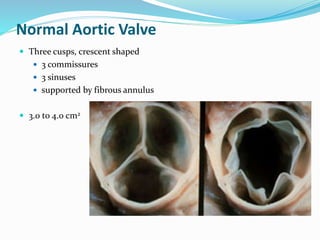
Normal Aortic Valve
 Three cusps, crescent shaped
 3 commissures
 3 sinuses
 supported by fibrous annulus
 3.0 to 4.0 cm2
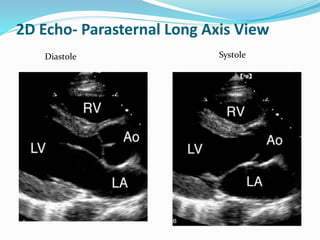
2D Echo- Parasternal Long Axis View
Diastole Systole
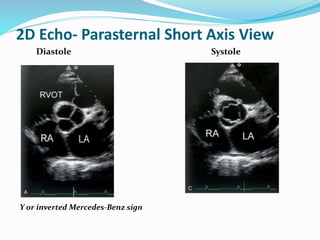
2D Echo- Parasternal Short Axis View
Diastole Systole
Y or inverted Mercedes-Benz sign
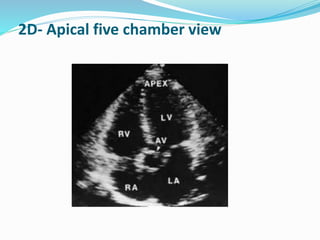
2D- Apical five chamber view
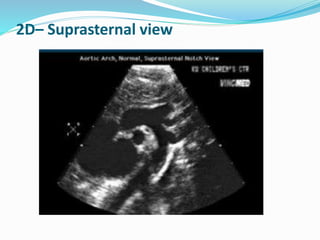
2D– Suprasternal view
M Mode-Normal aortic valve
Introduction
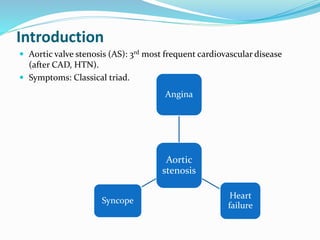
 Aortic valve stenosis (AS): 3rd most frequent cardiovascular disease
(after CAD, HTN).
 Symptoms: Classical triad.
Aortic
stenosis
Angina
Heart
failure
Syncope
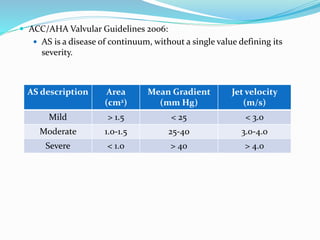
 ACC/AHA Valvular Guidelines 2006:
 AS is a disease of continuum, without a single value defining its
severity.
AS description Area
(cm2)
Mean Gradient
(mm Hg)
Jet velocity
(m/s)
Mild > 1.5 < 25 < 3.0
Moderate 1.0-1.5 25-40 3.0-4.0
Severe < 1.0 > 40 > 4.0
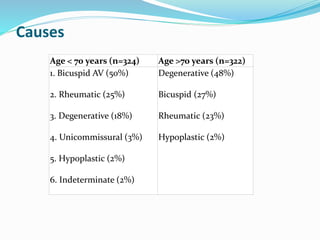
Causes
Age < 70 years (n=324) Age >70 years (n=322)
1. Bicuspid AV (50%)
2. Rheumatic (25%)
3. Degenerative (18%)
4. Unicommissural (3%)
5. Hypoplastic (2%)
6. Indeterminate (2%)
Degenerative (48%)
Bicuspid (27%)
Rheumatic (23%)
Hypoplastic (2%)
Anatomic evaluation
 Combination of short and long axis images to identify
 Number of leaflets
 Describe leaf mobility, thickness, calcification
 Combination of imaging and doppler allows the determination of the
level of obstruction: subvalvular, valvular, or supravalvular.
 Transesophageal echocardiography may be helpful when image quality
is suboptimal.
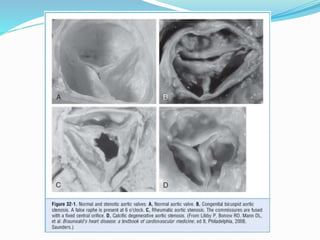
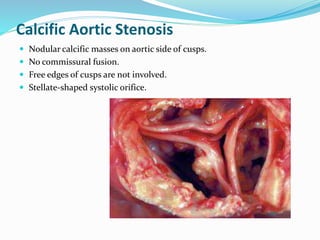
Calcific Aortic Stenosis
 Nodular calcific masses on aortic side of cusps.
 No commissural fusion.
 Free edges of cusps are not involved.
 Stellate-shaped systolic orifice.
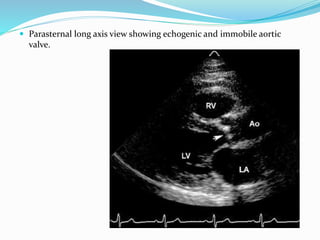
 Parasternal long axis view showing echogenic and immobile aortic
valve.
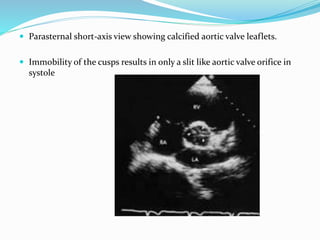
 Parasternal short-axis view showing calcified aortic valve leaflets.
 Immobility of the cusps results in only a slit like aortic valve orifice in
systole
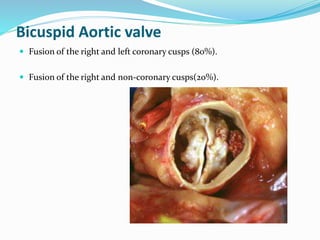
Bicuspid Aortic valve
 Fusion of the right and left coronary cusps (80%).
 Fusion of the right and non-coronary cusps(20%).
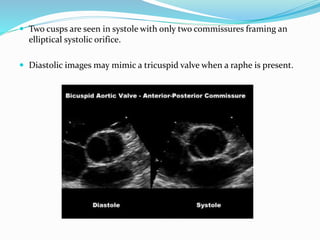
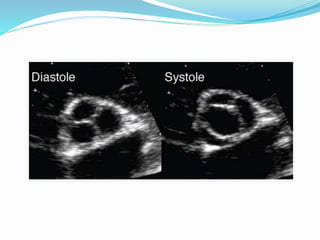
 Two cusps are seen in systole with only two commissures framing an
elliptical systolic orifice.
 Diastolic images may mimic a tricuspid valve when a raphe is present.
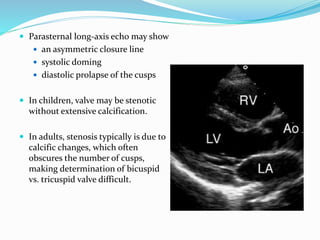
 Parasternal long-axis echo may show
 an asymmetric closure line
 systolic doming
 diastolic prolapse of the cusps
 In children, valve may be stenotic
without extensive calcification.
 In adults, stenosis typically is due to
calcific changes, which often
obscures the number of cusps,
making determination of bicuspid
vs. tricuspid valve difficult.
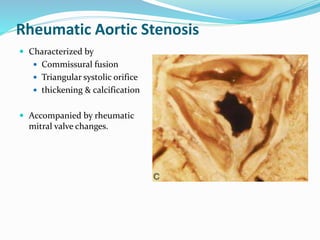
Rheumatic Aortic Stenosis
 Characterized by
 Commissural fusion
 Triangular systolic orifice
 thickening & calcification
 Accompanied by rheumatic
mitral valve changes.
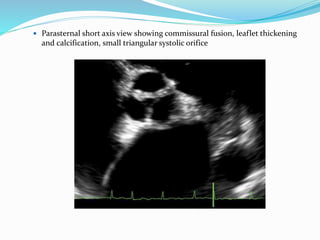
 Parasternal short axis view showing commissural fusion, leaflet thickening
and calcification, small triangular systolic orifice
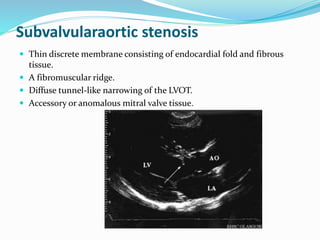
Subvalvularaortic stenosis
 Thin discrete membrane consisting of endocardial fold and fibrous
tissue.
 A fibromuscular ridge.
 Diffuse tunnel-like narrowing of the LVOT.
 Accessory or anomalous mitral valve tissue.
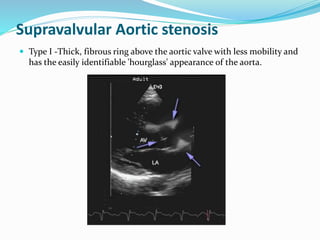
Supravalvular Aortic stenosis
 Type I -Thick, fibrous ring above the aortic valve with less mobility and
has the easily identifiable 'hourglass' appearance of the aorta.
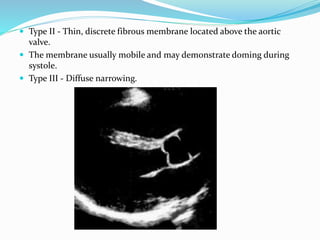
 Type II - Thin, discrete fibrous membrane located above the aortic
valve.
 The membrane usually mobile and may demonstrate doming during
systole.
 Type III - Diffuse narrowing.
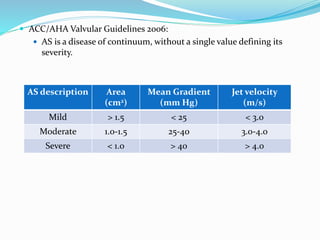
 ACC/AHA Valvular Guidelines 2006:
 AS is a disease of continuum, without a single value defining its
severity.
AS description Area
(cm2)
Mean Gradient
(mm Hg)
Jet velocity
(m/s)
Mild > 1.5 < 25 < 3.0
Moderate 1.0-1.5 25-40 3.0-4.0
Severe < 1.0 > 40 > 4.0
Doppler
 Peak transvalvular velocity.
 Mean transvalvular gradient.
 Valve area by continuity equation.
Peak transvalvular velocity
 Continuous-wave Doppler ultrasound.
 Multiple acoustic windows
 Apical and suprasternal or right parasternal almost frequently yield
the highest velocity.
 Rarely subcostal or supraclavicular windows may be required.
 Three or more beats are averaged in sinus rhythm, with irregular
rhythms at least 5 consecutive beats.
 AS jet velocity: Highest velocity signal obtained.
 A smooth velocity curve with a dense outer edge and clear maximum
velocity should be recorded.
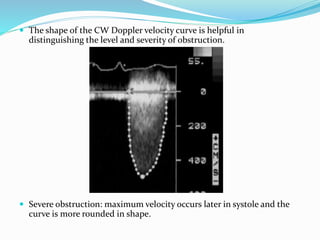
 The shape of the CW Doppler velocity curve is helpful in
distinguishing the level and severity of obstruction.
 Severe obstruction: maximum velocity occurs later in systole and the
curve is more rounded in shape.
 Mild obstruction: The peak is in early systole with a triangular shape of
the velocity curve.
 The shape of the CWD velocity curve also can be helpful in
determining whether the obstruction is fixed or dynamic.
 Dynamic sub aortic obstruction: Characteristic late-peaking velocity
curve, often with a concave upward curve in early systole.
Mean transvalvular gradient
 The difference in pressure between the left ventricle and aorta in
systole.
 Gradients are calculated from velocity information.
 The relationship between peak and mean gradient depends on the
shape of the velocity curve.
 Bernoulli equations
ΔP =4v²
 The maximum gradient is calculated from maximum velocity
ΔP max =4v² max
 The mean gradient is calculated by averaging the instantaneous
gradients over the ejection period.
 The accuracy of the Bernoulli equation to quantify AS pressure
gradients is well established.
Sources of error for pressure gradient
calculations
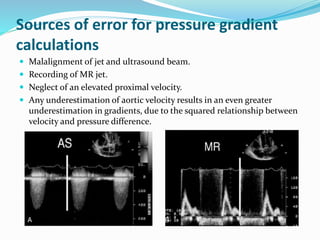
 Malalignment of jet and ultrasound beam.
 Recording of MR jet.
 Neglect of an elevated proximal velocity.
 Any underestimation of aortic velocity results in an even greater
underestimation in gradients, due to the squared relationship between
velocity and pressure difference.
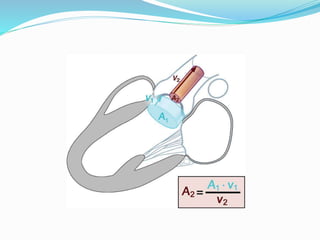
Aortic valve area by Continuity equation
 Well validated - clinical & experimental studies.
 Measures the effective valve area - the primary predictor of clinical
outcome (and not the anatomic orifice area).
 Continuity equation concept: SV ejected through the LV outflow tract
all passes through the stenotic orifice.
 Calculation of continuity-equation valve area requires three
measurements
 AS jet velocity by CWD.
 LVOT diameter for calculation of a circular CSA.
 LVOT velocity recorded with pulsed Doppler.
AVA = CSALVOT × VTILVOT / VTIAV
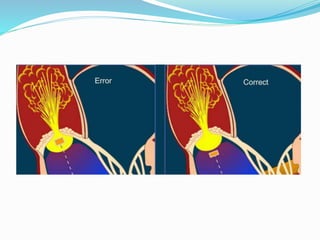
 LVOT diameter and velocity should be measured at the same distance
from the aortic valve.
 When the PW sample volume is optimally positioned, the recording
shows a smooth velocity curve with a well-defined peak.
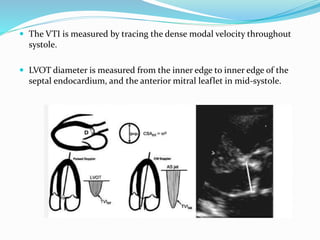
 The VTI is measured by tracing the dense modal velocity throughout
systole.
 LVOT diameter is measured from the inner edge to inner edge of the
septal endocardium, and the anterior mitral leaflet in mid-systole.
Limitations of continuity-equation valve area
 Intra-and inter observer variability
 AS jet and LVOT velocity 3 to4%.
 LVOT diameter 5% to 8%.
 When sub aortic flow velocities are abnormal SV calculation at this site
are not accurate.
 Sample volume placement near to septum or anterior mitral leaflet.
 Observed changes in valve area with changes in flow rate.
 AS and normal LV function, the effects of flow rate are minimal.
 This effect may be significant in presence concurrent LV dysfunction.
 Three different subgroups of Severe AS:
1. High gradient, high velocity, normal LVEF.
2. Low gradient, low velocity, and low EF.
3. Low flow, low gradient but preserved LVEF (paradoxical low flow,
low gradient AS).
High gradient, High flow, Normal LVEF AS
 AVA by 2D Echo – Continuity equation:
 Volume flow (or stroke volume) proximal to the valve = volume flow
through the narrowed valve.
 AVA = CSALVOT × VTILVOT / VTIAV
 Severe AS:
 Area < 1 cm2
 Systolic LV-Ao gradient > 40 mm Hg
 Jet velocity > 4 m/s.
 Standard and most common subgroup of severe AS.
Low flow, Low gradient, Low LVEF AS
 Low EF  low SV and low gradient.
 Effective orifice area < 1.0 cm2
 LV ejection fraction < 40%
 Mean pressure gradient < 40 mm Hg
 Severe AS and severely reduced LVEF represent 5% of AS patients.
 Difficult to distinguish between:
1. Severe AS with diminished contractility.
2. Mild or moderate AS with myocardial disorders (such as
cardiomyopathy, infarction or ischemia).
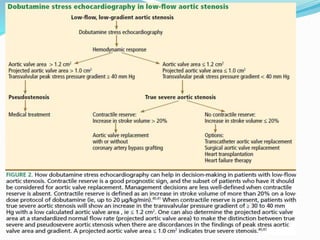
 Inotropic challenge test: Dobutamine stress echo (DSE).
Dobutamine stress Echo
 Provides information on the changes in aortic velocity, mean gradient,
valve area, SV and EF as flow rate increases.
 Measure of the contractile response to dobutamine.
 LV dysfuction with severe AS has two diagnostic possibilities:
 True anatomically severe aortic stenosis.
 Functionally severe aortic stenosis (pseudosevere - aortic valve with
mild or moderately severe stenosis may not open fully if the stroke
volume is low).
 Dobutamine (up to a maximum 20 μg/kg/min):
 Increase stroke volume.
 Helpful in differentiating morphologically severe AS from a
decreased effective stenotic orifice area caused by low cardiac
output (pseudosevere aortic stenosis).
 Dobutamine infused gradually from 5 µg/kg/minute in 5 µg increments
every 5 minutes until the LVOT velocity or VTI reaches a normal value
i.e., 0.8 to 1.2 m/s or 20 to 25 cm, respectively.
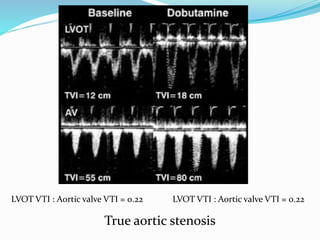
 True AS:
 Increase in the peak velocity and VTI of both the LVOT and aortic valve
proportionally.
 Hence, the LVOTVTI : AoV VTI remains constant.
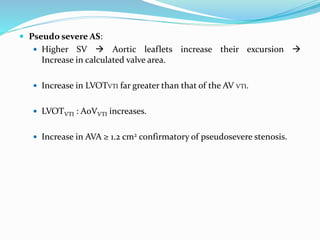
 Pseudo severe AS:
 Higher SV  Aortic leaflets increase their excursion 
Increase in calculated valve area.
 Increase in LVOTVTI far greater than that of the AV VTI.
 LVOTVTI : AoVVTI increases.
 Increase in AVA ≥ 1.2 cm2 confirmatory of pseudosevere stenosis.
LVOT VTI : Aortic valve VTI = 0.22 LVOT VTI : Aortic valve VTI = 0.22
True aortic stenosis
 LV systolic dysfunction and cardiac output is reduced, aortic stenosis is
probably severe if:
 Aortic valve area by the continuity equation is ≤ 1.0 cm2
 LVOTVTI : AoVVTI is ≤ 0.25
 Another most important role of dobutamine infusion in patients who
have severe aortic stenosis and a low gradient is to assess inotropic
reserve:
 Defined as an increase in stroke volume of more than 20% with
dobutamine.
 Failure of ventricle to augment with dobutamine portends poor
perioperative mortality (50% vs. 7%) if aortic valve replacement is
attempted.
 Prognosis is improved with aortic valve replacement in patients with
contractile reserve and true AS.
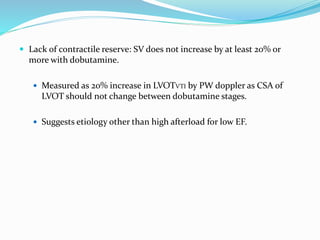
 Lack of contractile reserve: SV does not increase by at least 20% or
more with dobutamine.
 Measured as 20% increase in LVOTVTI by PW doppler as CSA of
LVOT should not change between dobutamine stages.
 Suggests etiology other than high afterload for low EF.
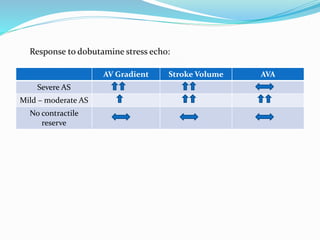
AV Gradient Stroke Volume AVA
Severe AS
Mild – moderate AS
No contractile
reserve
Response to dobutamine stress echo:
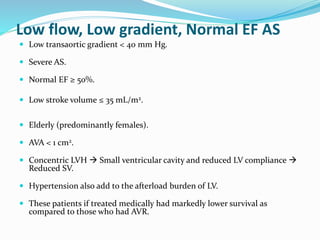
Low flow, Low gradient, Normal EF AS
 Low transaortic gradient < 40 mm Hg.
 Severe AS.
 Normal EF ≥ 50%.
 Low stroke volume ≤ 35 mL/m2.
 Elderly (predominantly females).
 AVA < 1 cm2.
 Concentric LVH  Small ventricular cavity and reduced LV compliance 
Reduced SV.
 Hypertension also add to the afterload burden of LV.
 These patients if treated medically had markedly lower survival as
compared to those who had AVR.
Summary
Normal Flow,
High
Gradient
Low Flow,
Low Gradient,
Normal EF
Low flow,
Low Gradient,
Low EF
AVA, cm2 ≤ 1.0 ≤ 1.0 ≤ 1.0
Mean gradient, mm Hg > 40 < 40 < 40
LVIDd, mm 45-55 < 47 > 50
LVEF, % > 50 > 50 < 50
Stroke volume index,
mL/m2
> 35 < 35 < 35
Myocardial fibrosis + ++ +++
Plasma NT-proBNP,
pg/mL
< 1500 > 1500 > 1500
Typical Characteristics of Three Main Entities of Severe AS
Thank you.

Aortic stenosis - Echocardiography

  • 2.
    Normal Aortic Valve Three cusps, crescent shaped  3 commissures  3 sinuses  supported by fibrous annulus  3.0 to 4.0 cm2
  • 3.
    2D Echo- ParasternalLong Axis View Diastole Systole
  • 4.
    2D Echo- ParasternalShort Axis View Diastole Systole Y or inverted Mercedes-Benz sign
  • 5.
    2D- Apical fivechamber view
  • 6.
  • 7.
  • 9.
    Introduction  Aortic valvestenosis (AS): 3rd most frequent cardiovascular disease (after CAD, HTN).  Symptoms: Classical triad. Aortic stenosis Angina Heart failure Syncope
  • 10.
     ACC/AHA ValvularGuidelines 2006:  AS is a disease of continuum, without a single value defining its severity. AS description Area (cm2) Mean Gradient (mm Hg) Jet velocity (m/s) Mild > 1.5 < 25 < 3.0 Moderate 1.0-1.5 25-40 3.0-4.0 Severe < 1.0 > 40 > 4.0
  • 11.
    Causes Age < 70years (n=324) Age >70 years (n=322) 1. Bicuspid AV (50%) 2. Rheumatic (25%) 3. Degenerative (18%) 4. Unicommissural (3%) 5. Hypoplastic (2%) 6. Indeterminate (2%) Degenerative (48%) Bicuspid (27%) Rheumatic (23%) Hypoplastic (2%)
  • 13.
    Anatomic evaluation  Combinationof short and long axis images to identify  Number of leaflets  Describe leaf mobility, thickness, calcification  Combination of imaging and doppler allows the determination of the level of obstruction: subvalvular, valvular, or supravalvular.  Transesophageal echocardiography may be helpful when image quality is suboptimal.
  • 14.
    Calcific Aortic Stenosis Nodular calcific masses on aortic side of cusps.  No commissural fusion.  Free edges of cusps are not involved.  Stellate-shaped systolic orifice.
  • 15.
     Parasternal longaxis view showing echogenic and immobile aortic valve.
  • 16.
     Parasternal short-axisview showing calcified aortic valve leaflets.  Immobility of the cusps results in only a slit like aortic valve orifice in systole
  • 17.
    Bicuspid Aortic valve Fusion of the right and left coronary cusps (80%).  Fusion of the right and non-coronary cusps(20%).
  • 18.
     Two cuspsare seen in systole with only two commissures framing an elliptical systolic orifice.  Diastolic images may mimic a tricuspid valve when a raphe is present.
  • 20.
     Parasternal long-axisecho may show  an asymmetric closure line  systolic doming  diastolic prolapse of the cusps  In children, valve may be stenotic without extensive calcification.  In adults, stenosis typically is due to calcific changes, which often obscures the number of cusps, making determination of bicuspid vs. tricuspid valve difficult.
  • 21.
    Rheumatic Aortic Stenosis Characterized by  Commissural fusion  Triangular systolic orifice  thickening & calcification  Accompanied by rheumatic mitral valve changes.
  • 22.
     Parasternal shortaxis view showing commissural fusion, leaflet thickening and calcification, small triangular systolic orifice
  • 23.
    Subvalvularaortic stenosis  Thindiscrete membrane consisting of endocardial fold and fibrous tissue.  A fibromuscular ridge.  Diffuse tunnel-like narrowing of the LVOT.  Accessory or anomalous mitral valve tissue.
  • 24.
    Supravalvular Aortic stenosis Type I -Thick, fibrous ring above the aortic valve with less mobility and has the easily identifiable 'hourglass' appearance of the aorta.
  • 25.
     Type II- Thin, discrete fibrous membrane located above the aortic valve.  The membrane usually mobile and may demonstrate doming during systole.  Type III - Diffuse narrowing.
  • 27.
     ACC/AHA ValvularGuidelines 2006:  AS is a disease of continuum, without a single value defining its severity. AS description Area (cm2) Mean Gradient (mm Hg) Jet velocity (m/s) Mild > 1.5 < 25 < 3.0 Moderate 1.0-1.5 25-40 3.0-4.0 Severe < 1.0 > 40 > 4.0
  • 28.
    Doppler  Peak transvalvularvelocity.  Mean transvalvular gradient.  Valve area by continuity equation.
  • 29.
    Peak transvalvular velocity Continuous-wave Doppler ultrasound.  Multiple acoustic windows  Apical and suprasternal or right parasternal almost frequently yield the highest velocity.  Rarely subcostal or supraclavicular windows may be required.  Three or more beats are averaged in sinus rhythm, with irregular rhythms at least 5 consecutive beats.  AS jet velocity: Highest velocity signal obtained.  A smooth velocity curve with a dense outer edge and clear maximum velocity should be recorded.
  • 30.
     The shapeof the CW Doppler velocity curve is helpful in distinguishing the level and severity of obstruction.  Severe obstruction: maximum velocity occurs later in systole and the curve is more rounded in shape.
  • 31.
     Mild obstruction:The peak is in early systole with a triangular shape of the velocity curve.
  • 32.
     The shapeof the CWD velocity curve also can be helpful in determining whether the obstruction is fixed or dynamic.  Dynamic sub aortic obstruction: Characteristic late-peaking velocity curve, often with a concave upward curve in early systole.
  • 33.
    Mean transvalvular gradient The difference in pressure between the left ventricle and aorta in systole.  Gradients are calculated from velocity information.  The relationship between peak and mean gradient depends on the shape of the velocity curve.  Bernoulli equations ΔP =4v²  The maximum gradient is calculated from maximum velocity ΔP max =4v² max
  • 34.
     The meangradient is calculated by averaging the instantaneous gradients over the ejection period.  The accuracy of the Bernoulli equation to quantify AS pressure gradients is well established.
  • 35.
    Sources of errorfor pressure gradient calculations  Malalignment of jet and ultrasound beam.  Recording of MR jet.  Neglect of an elevated proximal velocity.  Any underestimation of aortic velocity results in an even greater underestimation in gradients, due to the squared relationship between velocity and pressure difference.
  • 36.
    Aortic valve areaby Continuity equation  Well validated - clinical & experimental studies.  Measures the effective valve area - the primary predictor of clinical outcome (and not the anatomic orifice area).  Continuity equation concept: SV ejected through the LV outflow tract all passes through the stenotic orifice.  Calculation of continuity-equation valve area requires three measurements  AS jet velocity by CWD.  LVOT diameter for calculation of a circular CSA.  LVOT velocity recorded with pulsed Doppler. AVA = CSALVOT × VTILVOT / VTIAV
  • 37.
     LVOT diameterand velocity should be measured at the same distance from the aortic valve.  When the PW sample volume is optimally positioned, the recording shows a smooth velocity curve with a well-defined peak.
  • 38.
     The VTIis measured by tracing the dense modal velocity throughout systole.  LVOT diameter is measured from the inner edge to inner edge of the septal endocardium, and the anterior mitral leaflet in mid-systole.
  • 40.
    Limitations of continuity-equationvalve area  Intra-and inter observer variability  AS jet and LVOT velocity 3 to4%.  LVOT diameter 5% to 8%.  When sub aortic flow velocities are abnormal SV calculation at this site are not accurate.  Sample volume placement near to septum or anterior mitral leaflet.  Observed changes in valve area with changes in flow rate.  AS and normal LV function, the effects of flow rate are minimal.  This effect may be significant in presence concurrent LV dysfunction.
  • 43.
     Three differentsubgroups of Severe AS: 1. High gradient, high velocity, normal LVEF. 2. Low gradient, low velocity, and low EF. 3. Low flow, low gradient but preserved LVEF (paradoxical low flow, low gradient AS).
  • 44.
    High gradient, Highflow, Normal LVEF AS  AVA by 2D Echo – Continuity equation:  Volume flow (or stroke volume) proximal to the valve = volume flow through the narrowed valve.  AVA = CSALVOT × VTILVOT / VTIAV  Severe AS:  Area < 1 cm2  Systolic LV-Ao gradient > 40 mm Hg  Jet velocity > 4 m/s.  Standard and most common subgroup of severe AS.
  • 45.
    Low flow, Lowgradient, Low LVEF AS  Low EF  low SV and low gradient.  Effective orifice area < 1.0 cm2  LV ejection fraction < 40%  Mean pressure gradient < 40 mm Hg  Severe AS and severely reduced LVEF represent 5% of AS patients.  Difficult to distinguish between: 1. Severe AS with diminished contractility. 2. Mild or moderate AS with myocardial disorders (such as cardiomyopathy, infarction or ischemia).  Inotropic challenge test: Dobutamine stress echo (DSE).
  • 46.
    Dobutamine stress Echo Provides information on the changes in aortic velocity, mean gradient, valve area, SV and EF as flow rate increases.  Measure of the contractile response to dobutamine.  LV dysfuction with severe AS has two diagnostic possibilities:  True anatomically severe aortic stenosis.  Functionally severe aortic stenosis (pseudosevere - aortic valve with mild or moderately severe stenosis may not open fully if the stroke volume is low).
  • 47.
     Dobutamine (upto a maximum 20 μg/kg/min):  Increase stroke volume.  Helpful in differentiating morphologically severe AS from a decreased effective stenotic orifice area caused by low cardiac output (pseudosevere aortic stenosis).  Dobutamine infused gradually from 5 µg/kg/minute in 5 µg increments every 5 minutes until the LVOT velocity or VTI reaches a normal value i.e., 0.8 to 1.2 m/s or 20 to 25 cm, respectively.  True AS:  Increase in the peak velocity and VTI of both the LVOT and aortic valve proportionally.  Hence, the LVOTVTI : AoV VTI remains constant.
  • 48.
     Pseudo severeAS:  Higher SV  Aortic leaflets increase their excursion  Increase in calculated valve area.  Increase in LVOTVTI far greater than that of the AV VTI.  LVOTVTI : AoVVTI increases.  Increase in AVA ≥ 1.2 cm2 confirmatory of pseudosevere stenosis.
  • 50.
    LVOT VTI :Aortic valve VTI = 0.22 LVOT VTI : Aortic valve VTI = 0.22 True aortic stenosis
  • 51.
     LV systolicdysfunction and cardiac output is reduced, aortic stenosis is probably severe if:  Aortic valve area by the continuity equation is ≤ 1.0 cm2  LVOTVTI : AoVVTI is ≤ 0.25  Another most important role of dobutamine infusion in patients who have severe aortic stenosis and a low gradient is to assess inotropic reserve:  Defined as an increase in stroke volume of more than 20% with dobutamine.  Failure of ventricle to augment with dobutamine portends poor perioperative mortality (50% vs. 7%) if aortic valve replacement is attempted.  Prognosis is improved with aortic valve replacement in patients with contractile reserve and true AS.
  • 52.
     Lack ofcontractile reserve: SV does not increase by at least 20% or more with dobutamine.  Measured as 20% increase in LVOTVTI by PW doppler as CSA of LVOT should not change between dobutamine stages.  Suggests etiology other than high afterload for low EF.
  • 53.
    AV Gradient StrokeVolume AVA Severe AS Mild – moderate AS No contractile reserve Response to dobutamine stress echo:
  • 56.
    Low flow, Lowgradient, Normal EF AS  Low transaortic gradient < 40 mm Hg.  Severe AS.  Normal EF ≥ 50%.  Low stroke volume ≤ 35 mL/m2.  Elderly (predominantly females).  AVA < 1 cm2.  Concentric LVH  Small ventricular cavity and reduced LV compliance  Reduced SV.  Hypertension also add to the afterload burden of LV.  These patients if treated medically had markedly lower survival as compared to those who had AVR.
  • 57.
    Summary Normal Flow, High Gradient Low Flow, LowGradient, Normal EF Low flow, Low Gradient, Low EF AVA, cm2 ≤ 1.0 ≤ 1.0 ≤ 1.0 Mean gradient, mm Hg > 40 < 40 < 40 LVIDd, mm 45-55 < 47 > 50 LVEF, % > 50 > 50 < 50 Stroke volume index, mL/m2 > 35 < 35 < 35 Myocardial fibrosis + ++ +++ Plasma NT-proBNP, pg/mL < 1500 > 1500 > 1500 Typical Characteristics of Three Main Entities of Severe AS
  • 58.