LEFT BUNDLE BRANCH BLOCK WITH
AMI
• Acute Myocardial Infarction (AMI) continues to be a
major cause of morbidity and mortality in Malaysia.
• With timely intervention and early reperfusion, the
cardiovascular outcomes have improved.
• The biggest challenge has been to reduce the total
ischaemic time, which is the time from onset of
chest pain till the time when the infarct related
artery is opened.
• A large portion of this delay has been the late
presentation of the patient with AMI to medical
attention (onset of chest pain to First Medical
Contact – FMC).
Despite this , in-hospital mortality remain high.
❏ Late presentation (lack of public awareness )
❏ Misdiagnosis (lack of our awareness )
STEMI EQUIVALENTS
Are those patients who do not present
with this classical ECG changes but
have acutely occluded coronary artery.
• They are often associated with poorer
outcome and worse prognosis.
• Benefit from timely intervention
1- Wellens syndromes
2- de Winter syndrome
3- LBBB
4- ST elevation in lead AVR
5- Isolated posterior MI
Common STEMI EQUIVALENTS are :
4.LBBB
Acute chest pain with LBBB can manifest in any of the
following 3 ways:
I. Commonest - LBBB but no pre-existing ECG.
II. LBBB and previous ECGs do not show LBBB.
III. LBBB and is known to have LBBB on old ECGs.
• New or presumably new LBBB has been considered a
STEMI equivalent (2004) until AHA guidelines 2013
• New LBBB should not be considered diagnostic of acute
MI in isolation
Left Bundle Branch Block LBBB
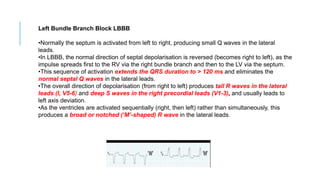
•Normally the septum is activated from left to right, producing small Q waves in the lateral
leads.
•In LBBB, the normal direction of septal depolarisation is reversed (becomes right to left), as the
impulse spreads first to the RV via the right bundle branch and then to the LV via the septum.
•This sequence of activation extends the QRS duration to > 120 ms and eliminates the
normal septal Q waves in the lateral leads.
•The overall direction of depolarisation (from right to left) produces tall R waves in the lateral
leads (I, V5-6) and deep S waves in the right precordial leads (V1-3), and usually leads to
left axis deviation.
•As the ventricles are activated sequentially (right, then left) rather than simultaneously, this
produces a broad or notched (‘M’-shaped) R wave in the lateral leads.
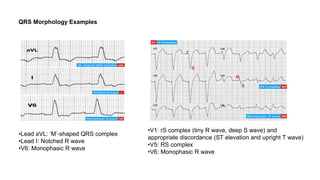
QRS Morphology Examples
•Lead aVL: ‘M’-shaped QRS complex
•Lead I: Notched R wave
•V6: Monophasic R wave
•V1: rS complex (tiny R wave, deep S wave) and
appropriate discordance (ST elevation and upright T wave)
•V5: RS complex
•V6: Monophasic R wave
CHALLENGING OF DIAGNOSING MI
IN LBBB
• Most cases of LBBB in suspected MI are not a result of focal infarction.
• Instead, extensive myocardial damage involving a large portion of the
distal conduction system is usually required to cause LBBB.
1. Septal Q waves indicative of an MI are absent as Left ventricular
activation is delayed in LBBB and the initial septal activation is from
right to left (opposite of the normal situation)
2. Secondary ST-T wave abnormalities that occur in LBBB obscure the
recognition of injury currents in ischemia and infarction.
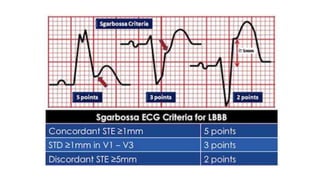
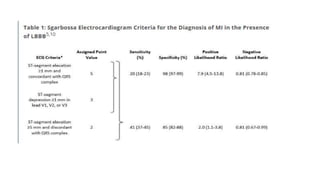
In 1996 Sgarbossa et al : A total score of ≥ 3 is reported to have a specificity
of 90% for diagnosing myocardial infarction.
These criteria are specific, but not sensitive for myocardial infarction.
● 1. ST-elevation of ≥1 mm and concordant with the QRS complex (5
points).
● 2. ST-segment depression ≥1 mm in lead V1, V2, or V3 (3 points).
● 3. ST elevation ≥5 mm and discordant with the QRS complex (2
points).
In uncomplicated LBBB (without STEMI), the ST segment should be in the
opposite direction the majority of the QRS.
Any degree of ST segment elevation in a lead with a positive QRS
complex was a highly specific sign of acute myocardial infarction .
Leads V1-V3 always have predominantly negative QRS complexes, and
therefore ST segment depression should not be present, ST segment
depression ≥1 mm in just one of these leads is diagnostic of STEMI.
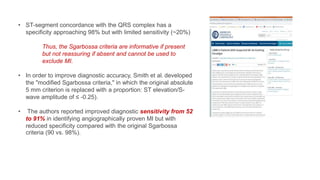
• ST-segment concordance with the QRS complex has a
specificity approaching 98% but with limited sensitivity (~20%)
Thus, the Sgarbossa criteria are informative if present
but not reassuring if absent and cannot be used to
exclude MI.
• In order to improve diagnostic accuracy, Smith et al. developed
the "modified Sgarbossa criteria," in which the original absolute
5 mm criterion is replaced with a proportion: ST elevation/S-
wave amplitude of ≤ -0.25).
• The authors reported improved diagnostic sensitivity from 52
to 91% in identifying angiographically proven MI but with
reduced specificity compared with the original Sgarbossa
criteria (90 vs. 98%).
CONCLUSION
• Less than half of all patients with suspected MI and LBBB ultimately will be diagnosed with an
MI.
2012 – SW Smith modified the third component of the original criteria
from absolute (>5mm discordant ST elevation) to proportional (any ST segment
to S-wave ratio less than -0.25, with at least 1 mm ST elevation)
•≥ 1 lead with ≥1 mm of concordant ST elevation
•≥ 1 lead of V1-V3 with ≥ 1 mm of concordant ST depression
•≥ 1 lead anywhere with ≥ 1 mm STE and proportionally excessive discordant
STE, as defined by ≥ 25% of the depth of the preceding S-wave.
‘Replacement of the absolute ST-elevation measurement of greater than or
equal to 5 mm in the third component of the Sgarbossa rule with an ST/S ratio
less than -0.25 greatly improves diagnostic utility of the rule for STEMI.
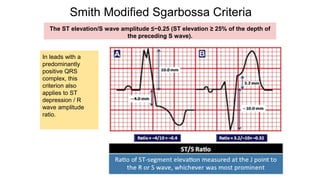
Smith Modified Sgarbossa Criteria
The ST elevation/S wave amplitude ≤−0.25 (ST elevation ≥ 25% of the depth of
the preceding S wave).
In leads with a
predominantly
positive QRS
complex, this
criterion also
applies to ST
depression / R
wave amplitude
ratio.
PCI for LBBB in 3
situations:
1) Unstable patient
(hypotension,
pulmonary edema,
electrical instability)
2) The Sgarbossa
criteria satisfied (
score ≥ 3 points)
3) Smith Modified
Sgarbossa Criteria
Satisfied
Cai et al. diagnosis and triage algorithm
Proposed diagnosis and
treatment algorithm for
suspected myocardial
infarction and new left
bundle branch block with
results of retrospective
analysis of our database.
This hierarchical algorithm
approach yielded a high
sensitivity (97%) for the
identification of a culprit
coronary artery lesion,
although specificity (48%)
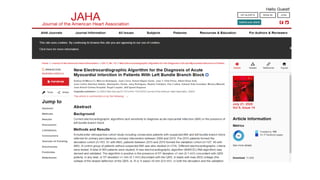
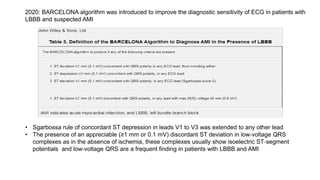
2020: BARCELONA algorithm was introduced to improve the diagnostic sensitivity of ECG in patients with
LBBB and suspected AMI
• Sgarbossa rule of concordant ST depression in leads V1 to V3 was extended to any other lead
• The presence of an appreciable (≥1 mm or 0.1 mV) discordant ST deviation in low‐voltage QRS
complexes as in the absence of ischemia, these complexes usually show isoelectric ST‐segment
potentials and low‐voltage QRS are a frequent finding in patients with LBBB and AMI
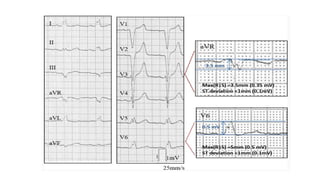
ECG from a patient with acute myocardial infarction and culprit lesion in the right coronary artery,
showing ST‐segment depression ≥1 mm (0.1 mV) concordant with negative QRS polarity in lead V5.
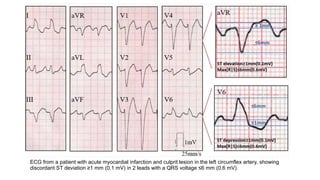
ECG from a patient with acute myocardial infarction and culprit lesion in the left circumflex artery, showing
discordant ST deviation ≥1 mm (0.1 mV) in 2 leads with a QRS voltage ≤6 mm (0.6 mV).
ECG from a patient with acute myocardial infarction and culprit artery in the left main.Discordant ST deviation ≥1 mm
(0.1 mV) in leads with max (R|S) voltage ≤6 mm (0.6 mV) is present in leads III, aVR, and aVL.
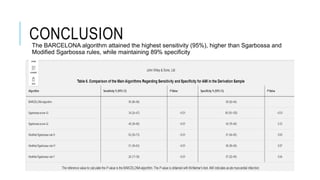
CONCLUSION
The BARCELONA algorithm attained the highest sensitivity (95%), higher than Sgarbossa and
Modified Sgarbossa rules, while maintaining 89% specificity
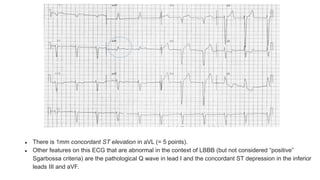
ECG EXAMPLE
● There is 1mm concordant ST elevation in aVL (= 5 points).
● Other features on this ECG that are abnormal in the context of LBBB (but not considered “positive”
Sgarbossa criteria) are the pathological Q wave in lead I and the concordant ST depression in the inferior
leads III and aVF.
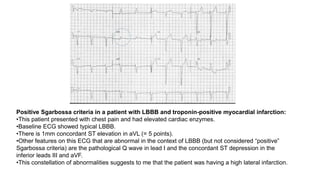
Positive Sgarbossa criteria in a patient with LBBB and troponin-positive myocardial infarction:
•This patient presented with chest pain and had elevated cardiac enzymes.
•Baseline ECG showed typical LBBB.
•There is 1mm concordant ST elevation in aVL (= 5 points).
•Other features on this ECG that are abnormal in the context of LBBB (but not considered “positive”
Sgarbossa criteria) are the pathological Q wave in lead I and the concordant ST depression in the
inferior leads III and aVF.
•This constellation of abnormalities suggests to me that the patient was having a high lateral infarction.
REFERENCES
1. Dr. Smith’s ECG blog
2. Life In The Fast Lane ,Sgarbossa Criteria by Dr Mike Cadogan, last update
May 22, 2019
3. https://epmonthly.com/article/stemi-in-the-presence-of-lbbb/
4. LBBB in Patients With Suspected MI: An Evolving Paradigm
https://www.acc.org/latest-in-cardiology/articles/2017/02/28/14/10/lbbb-in-
patients-with-suspected-mi
THANK YOU

BUNDLE BRANCH BLOCK WITH AMI latest.pptx

  • 1.
    LEFT BUNDLE BRANCHBLOCK WITH AMI
  • 2.
    • Acute MyocardialInfarction (AMI) continues to be a major cause of morbidity and mortality in Malaysia. • With timely intervention and early reperfusion, the cardiovascular outcomes have improved. • The biggest challenge has been to reduce the total ischaemic time, which is the time from onset of chest pain till the time when the infarct related artery is opened. • A large portion of this delay has been the late presentation of the patient with AMI to medical attention (onset of chest pain to First Medical Contact – FMC). Despite this , in-hospital mortality remain high. ❏ Late presentation (lack of public awareness ) ❏ Misdiagnosis (lack of our awareness )
  • 4.
    STEMI EQUIVALENTS Are thosepatients who do not present with this classical ECG changes but have acutely occluded coronary artery. • They are often associated with poorer outcome and worse prognosis. • Benefit from timely intervention
  • 5.
    1- Wellens syndromes 2-de Winter syndrome 3- LBBB 4- ST elevation in lead AVR 5- Isolated posterior MI Common STEMI EQUIVALENTS are :
  • 6.
    4.LBBB Acute chest painwith LBBB can manifest in any of the following 3 ways: I. Commonest - LBBB but no pre-existing ECG. II. LBBB and previous ECGs do not show LBBB. III. LBBB and is known to have LBBB on old ECGs. • New or presumably new LBBB has been considered a STEMI equivalent (2004) until AHA guidelines 2013 • New LBBB should not be considered diagnostic of acute MI in isolation
  • 7.
    Left Bundle BranchBlock LBBB •Normally the septum is activated from left to right, producing small Q waves in the lateral leads. •In LBBB, the normal direction of septal depolarisation is reversed (becomes right to left), as the impulse spreads first to the RV via the right bundle branch and then to the LV via the septum. •This sequence of activation extends the QRS duration to > 120 ms and eliminates the normal septal Q waves in the lateral leads. •The overall direction of depolarisation (from right to left) produces tall R waves in the lateral leads (I, V5-6) and deep S waves in the right precordial leads (V1-3), and usually leads to left axis deviation. •As the ventricles are activated sequentially (right, then left) rather than simultaneously, this produces a broad or notched (‘M’-shaped) R wave in the lateral leads.
  • 8.
    QRS Morphology Examples •LeadaVL: ‘M’-shaped QRS complex •Lead I: Notched R wave •V6: Monophasic R wave •V1: rS complex (tiny R wave, deep S wave) and appropriate discordance (ST elevation and upright T wave) •V5: RS complex •V6: Monophasic R wave
  • 9.
    CHALLENGING OF DIAGNOSINGMI IN LBBB • Most cases of LBBB in suspected MI are not a result of focal infarction. • Instead, extensive myocardial damage involving a large portion of the distal conduction system is usually required to cause LBBB. 1. Septal Q waves indicative of an MI are absent as Left ventricular activation is delayed in LBBB and the initial septal activation is from right to left (opposite of the normal situation) 2. Secondary ST-T wave abnormalities that occur in LBBB obscure the recognition of injury currents in ischemia and infarction.
  • 10.
    In 1996 Sgarbossaet al : A total score of ≥ 3 is reported to have a specificity of 90% for diagnosing myocardial infarction. These criteria are specific, but not sensitive for myocardial infarction. ● 1. ST-elevation of ≥1 mm and concordant with the QRS complex (5 points). ● 2. ST-segment depression ≥1 mm in lead V1, V2, or V3 (3 points). ● 3. ST elevation ≥5 mm and discordant with the QRS complex (2 points). In uncomplicated LBBB (without STEMI), the ST segment should be in the opposite direction the majority of the QRS. Any degree of ST segment elevation in a lead with a positive QRS complex was a highly specific sign of acute myocardial infarction . Leads V1-V3 always have predominantly negative QRS complexes, and therefore ST segment depression should not be present, ST segment depression ≥1 mm in just one of these leads is diagnostic of STEMI.
  • 12.
    • ST-segment concordancewith the QRS complex has a specificity approaching 98% but with limited sensitivity (~20%) Thus, the Sgarbossa criteria are informative if present but not reassuring if absent and cannot be used to exclude MI. • In order to improve diagnostic accuracy, Smith et al. developed the "modified Sgarbossa criteria," in which the original absolute 5 mm criterion is replaced with a proportion: ST elevation/S- wave amplitude of ≤ -0.25). • The authors reported improved diagnostic sensitivity from 52 to 91% in identifying angiographically proven MI but with reduced specificity compared with the original Sgarbossa criteria (90 vs. 98%).
  • 14.
    CONCLUSION • Less thanhalf of all patients with suspected MI and LBBB ultimately will be diagnosed with an MI.
  • 15.
    2012 – SWSmith modified the third component of the original criteria from absolute (>5mm discordant ST elevation) to proportional (any ST segment to S-wave ratio less than -0.25, with at least 1 mm ST elevation) •≥ 1 lead with ≥1 mm of concordant ST elevation •≥ 1 lead of V1-V3 with ≥ 1 mm of concordant ST depression •≥ 1 lead anywhere with ≥ 1 mm STE and proportionally excessive discordant STE, as defined by ≥ 25% of the depth of the preceding S-wave. ‘Replacement of the absolute ST-elevation measurement of greater than or equal to 5 mm in the third component of the Sgarbossa rule with an ST/S ratio less than -0.25 greatly improves diagnostic utility of the rule for STEMI.
  • 16.
    Smith Modified SgarbossaCriteria The ST elevation/S wave amplitude ≤−0.25 (ST elevation ≥ 25% of the depth of the preceding S wave). In leads with a predominantly positive QRS complex, this criterion also applies to ST depression / R wave amplitude ratio.
  • 17.
    PCI for LBBBin 3 situations: 1) Unstable patient (hypotension, pulmonary edema, electrical instability) 2) The Sgarbossa criteria satisfied ( score ≥ 3 points) 3) Smith Modified Sgarbossa Criteria Satisfied Cai et al. diagnosis and triage algorithm
  • 18.
    Proposed diagnosis and treatmentalgorithm for suspected myocardial infarction and new left bundle branch block with results of retrospective analysis of our database. This hierarchical algorithm approach yielded a high sensitivity (97%) for the identification of a culprit coronary artery lesion, although specificity (48%)
  • 21.
    2020: BARCELONA algorithmwas introduced to improve the diagnostic sensitivity of ECG in patients with LBBB and suspected AMI • Sgarbossa rule of concordant ST depression in leads V1 to V3 was extended to any other lead • The presence of an appreciable (≥1 mm or 0.1 mV) discordant ST deviation in low‐voltage QRS complexes as in the absence of ischemia, these complexes usually show isoelectric ST‐segment potentials and low‐voltage QRS are a frequent finding in patients with LBBB and AMI
  • 23.
    ECG from apatient with acute myocardial infarction and culprit lesion in the right coronary artery, showing ST‐segment depression ≥1 mm (0.1 mV) concordant with negative QRS polarity in lead V5.
  • 24.
    ECG from apatient with acute myocardial infarction and culprit lesion in the left circumflex artery, showing discordant ST deviation ≥1 mm (0.1 mV) in 2 leads with a QRS voltage ≤6 mm (0.6 mV).
  • 25.
    ECG from apatient with acute myocardial infarction and culprit artery in the left main.Discordant ST deviation ≥1 mm (0.1 mV) in leads with max (R|S) voltage ≤6 mm (0.6 mV) is present in leads III, aVR, and aVL.
  • 26.
    CONCLUSION The BARCELONA algorithmattained the highest sensitivity (95%), higher than Sgarbossa and Modified Sgarbossa rules, while maintaining 89% specificity
  • 27.
  • 28.
    ● There is1mm concordant ST elevation in aVL (= 5 points). ● Other features on this ECG that are abnormal in the context of LBBB (but not considered “positive” Sgarbossa criteria) are the pathological Q wave in lead I and the concordant ST depression in the inferior leads III and aVF.
  • 29.
    Positive Sgarbossa criteriain a patient with LBBB and troponin-positive myocardial infarction: •This patient presented with chest pain and had elevated cardiac enzymes. •Baseline ECG showed typical LBBB. •There is 1mm concordant ST elevation in aVL (= 5 points). •Other features on this ECG that are abnormal in the context of LBBB (but not considered “positive” Sgarbossa criteria) are the pathological Q wave in lead I and the concordant ST depression in the inferior leads III and aVF. •This constellation of abnormalities suggests to me that the patient was having a high lateral infarction.
  • 30.
    REFERENCES 1. Dr. Smith’sECG blog 2. Life In The Fast Lane ,Sgarbossa Criteria by Dr Mike Cadogan, last update May 22, 2019 3. https://epmonthly.com/article/stemi-in-the-presence-of-lbbb/ 4. LBBB in Patients With Suspected MI: An Evolving Paradigm https://www.acc.org/latest-in-cardiology/articles/2017/02/28/14/10/lbbb-in- patients-with-suspected-mi
  • 31.