Physician’s Meet M3 unit  Dr. S Sundar’s Unit  ECG of the week Dr. Deepu Sebin
 
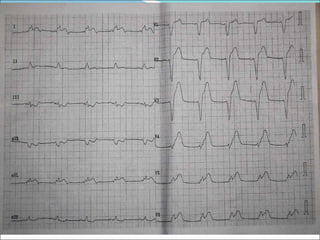
12 lead ECG Sinus Rhythm Rate = 62/m Axis = +30 Pace maker spikes + PR Interval = 0.12 QRS duration = 0.16sec LBBB pattern Concordent ST evelevation in V4,V5,V6,1,aVL ST segment depression in 111,aVF
AnteroLateral  MI with LBBB
LBBB and MI Left bundle branch block (LBBB) is present in approximately 7 percent of acute infarctions  Patients with LBBB have more comorbid conditions, are less likely to receive therapy, and have an increased risk for in-hospital death compared with patients with no BBB.  TI - Bundle-branch block and in-hospital mortality in acute myocardial infarction. National Registry of Myocardial Infarction 2 Investigators. AU - Go AS; Barron HV; Rundle AC; Ornato JP; Avins AL SO - Ann Intern Med 1998 Nov 1;129(9):690-7.
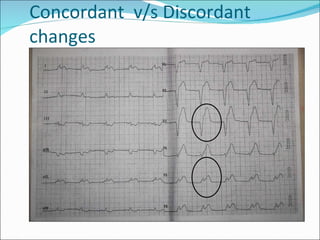
The sequence of repolarization is altered in LBBB, with the ST segment and T wave vectors being  directed opposite   to the QRS complex. These changes may mask the ST segment depression and T wave inversion induced by ischemia. The diagnosis of an acute MI or ischemia can occasionally be made in a patient with underlying LBBB if certain ST-T changes are seen, particularly if the ST-T vectors are in the  same direction  as the QRS complex.
Concordant  v/s Discordant changes
Sgarbossa Criteria The three ECG criteria with an independent value in the diagnosis of acute infarction and the score for each were:  ST segment elevation of 1 mm or more that was in the same direction (concordant) as the QRS complex in any lead — score 5.  ST segment depression of 1 mm or more in any lead from V1 to V3 — score 3.  ST segment elevation of 5 mm or more that was discordant with the QRS complex (ie, associated with a QS or rS complex) — score 2 Electrocardiographic  diagnosis of evolving acute myocardial infarction in the presence of left bundle-branch block. GUSTO-1 (Global Utilization of Streptokinase and Tissue Plasminogen Activator for Occluded Coronary Arteries) Investigators. AU - Sgarbossa EB; Pinski SL; Barbagelata A; Underwood DA; Gates KB; Topol EJ; Califf RM; Wagner GS SO - N Engl J Med 1996 Feb 22;334(8):481-7
At a score-sum of 3, these criteria have a specificity of 90% for detecting a myocardial infarction.
A Sgarbossa score of ≥ 3 was highly specific (ie, few false positives) but much less sensitive (36 percent) in the validation sample in the original report. Similar findings were noted in a subsequent meta-analysis of 10 studies of 1614 patients in which a Sgarbossa score of ≥ 3.
Additional Findings The presence of  deep T wave inversions  in leads with a predominantly negative QRS complex (eg, V1-V3) is highly suggestive of evolving ischemia or MI. The presence of  QR complexes  in leads I, V5, or V6, or in II, III, and aVF with LBBB strongly suggests underlying infarction. Pseudonormalization  of previously inverted T waves is suggestive but not diagnostic of ischemia.
Additional Findings An anterolateral MI should be suspected if  new S  waves appear in leftward leads (I, aVL, and V6) in a patient with preexisting common LBBB. Underlying MI is also suggested by notching of the ascending part of a wide S waves in the mid-precordial leads ( Cabrera's sign ) is present.
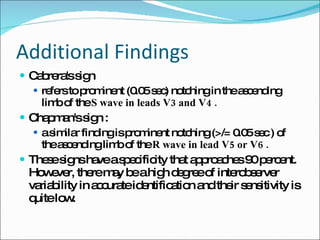
Additional Findings Cabrera's sign  refers to prominent (0.05 sec) notching in the ascending limb of the  S wave in leads V3 and V4 .  Chapman's sign : a similar finding is prominent notching (>/= 0.05 sec ) of the ascending limb of the  R wave in lead V5 or V6 .  These signs have a specificity that approaches 90 percent. However, there may be a high degree of interobserver variability in accurate identification and their sensitivity is quite low.
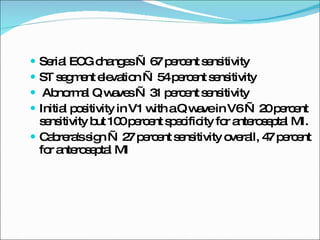
Serial ECG changes — 67 percent sensitivity  ST segment elevation — 54 percent sensitivity Abnormal Q waves — 31 percent sensitivity  Initial positivity in V1 with a Q wave in V6 — 20 percent sensitivity but 100 percent specificity for anteroseptal MI.  Cabrera's sign — 27 percent sensitivity overall, 47 percent for anteroseptal MI
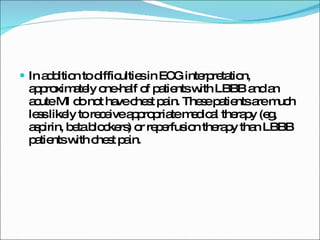
In addition to difficulties in ECG interpretation, approximately one-half of patients with LBBB and an acute MI do not have chest pain. These patients are much less likely to receive appropriate medical therapy (eg, aspirin, beta blockers) or reperfusion therapy than LBBB patients with chest pain.
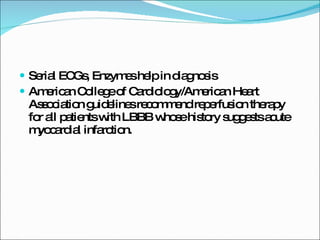
Serial ECGs, Enzymes help in diagnosis American College of Cardiology/American Heart Association guidelines recommend reperfusion therapy for all patients with LBBB whose history suggests acute myocardial infarction.
Thank you

ECG: Multifocal Atrial Tachycardia

  • 1.
    Physician’s Meet M3unit Dr. S Sundar’s Unit ECG of the week Dr. Deepu Sebin
  • 2.
  • 3.
    12 lead ECGSinus Rhythm Rate = 62/m Axis = +30 Pace maker spikes + PR Interval = 0.12 QRS duration = 0.16sec LBBB pattern Concordent ST evelevation in V4,V5,V6,1,aVL ST segment depression in 111,aVF
  • 4.
  • 5.
    LBBB and MILeft bundle branch block (LBBB) is present in approximately 7 percent of acute infarctions Patients with LBBB have more comorbid conditions, are less likely to receive therapy, and have an increased risk for in-hospital death compared with patients with no BBB. TI - Bundle-branch block and in-hospital mortality in acute myocardial infarction. National Registry of Myocardial Infarction 2 Investigators. AU - Go AS; Barron HV; Rundle AC; Ornato JP; Avins AL SO - Ann Intern Med 1998 Nov 1;129(9):690-7.
  • 6.
    The sequence ofrepolarization is altered in LBBB, with the ST segment and T wave vectors being directed opposite to the QRS complex. These changes may mask the ST segment depression and T wave inversion induced by ischemia. The diagnosis of an acute MI or ischemia can occasionally be made in a patient with underlying LBBB if certain ST-T changes are seen, particularly if the ST-T vectors are in the same direction as the QRS complex.
  • 7.
    Concordant v/sDiscordant changes
  • 8.
    Sgarbossa Criteria Thethree ECG criteria with an independent value in the diagnosis of acute infarction and the score for each were: ST segment elevation of 1 mm or more that was in the same direction (concordant) as the QRS complex in any lead — score 5. ST segment depression of 1 mm or more in any lead from V1 to V3 — score 3. ST segment elevation of 5 mm or more that was discordant with the QRS complex (ie, associated with a QS or rS complex) — score 2 Electrocardiographic diagnosis of evolving acute myocardial infarction in the presence of left bundle-branch block. GUSTO-1 (Global Utilization of Streptokinase and Tissue Plasminogen Activator for Occluded Coronary Arteries) Investigators. AU - Sgarbossa EB; Pinski SL; Barbagelata A; Underwood DA; Gates KB; Topol EJ; Califf RM; Wagner GS SO - N Engl J Med 1996 Feb 22;334(8):481-7
  • 9.
    At a score-sumof 3, these criteria have a specificity of 90% for detecting a myocardial infarction.
  • 10.
    A Sgarbossa scoreof ≥ 3 was highly specific (ie, few false positives) but much less sensitive (36 percent) in the validation sample in the original report. Similar findings were noted in a subsequent meta-analysis of 10 studies of 1614 patients in which a Sgarbossa score of ≥ 3.
  • 11.
    Additional Findings Thepresence of deep T wave inversions in leads with a predominantly negative QRS complex (eg, V1-V3) is highly suggestive of evolving ischemia or MI. The presence of QR complexes in leads I, V5, or V6, or in II, III, and aVF with LBBB strongly suggests underlying infarction. Pseudonormalization of previously inverted T waves is suggestive but not diagnostic of ischemia.
  • 12.
    Additional Findings Ananterolateral MI should be suspected if new S waves appear in leftward leads (I, aVL, and V6) in a patient with preexisting common LBBB. Underlying MI is also suggested by notching of the ascending part of a wide S waves in the mid-precordial leads ( Cabrera's sign ) is present.
  • 13.
    Additional Findings Cabrera'ssign refers to prominent (0.05 sec) notching in the ascending limb of the S wave in leads V3 and V4 . Chapman's sign : a similar finding is prominent notching (>/= 0.05 sec ) of the ascending limb of the R wave in lead V5 or V6 . These signs have a specificity that approaches 90 percent. However, there may be a high degree of interobserver variability in accurate identification and their sensitivity is quite low.
  • 14.
    Serial ECG changes— 67 percent sensitivity ST segment elevation — 54 percent sensitivity Abnormal Q waves — 31 percent sensitivity Initial positivity in V1 with a Q wave in V6 — 20 percent sensitivity but 100 percent specificity for anteroseptal MI. Cabrera's sign — 27 percent sensitivity overall, 47 percent for anteroseptal MI
  • 15.
    In addition todifficulties in ECG interpretation, approximately one-half of patients with LBBB and an acute MI do not have chest pain. These patients are much less likely to receive appropriate medical therapy (eg, aspirin, beta blockers) or reperfusion therapy than LBBB patients with chest pain.
  • 16.
    Serial ECGs, Enzymeshelp in diagnosis American College of Cardiology/American Heart Association guidelines recommend reperfusion therapy for all patients with LBBB whose history suggests acute myocardial infarction.
  • 17.