BUNDLE BRANCH BLOCKS
DR.SONU KURIAN
MODERATOR:DR.MAHIM MITTAL MD
REFERENCES
• MARRIOT’S PRACTICAL ECG 12TH ED
• LEO SCHAMROTH’S INTRODUCTION TO ECG
7TH ED
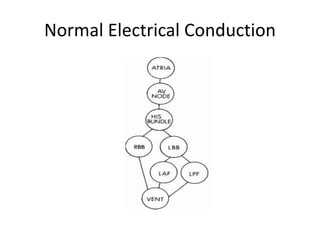
Normal Electrical Conduction
Right bundle branch
• 40 mm long
• Conduction Velocity 2m/s
• 1cm increase conduction time increase 5ms
BLOOD SUPPLY
• SEPTAL BRANCHES OF LAD (90%)
• RBB,LAF
• RCA VIA AV NODAL ARTERY(90%)
• LPF
• DUAL SUPPLY TO LPF IN 40-50%
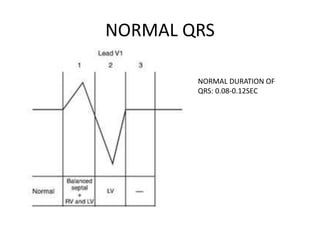
NORMAL QRS
NORMAL DURATION OF
QRS: 0.08-0.12SEC
• BLOCK IN AV JUNCTION AFFECT PR INTERVAL
• BLOCK IN BUNDLES AFFECT THE QRS
DURATION
• NORMAL DURATION OF QRS: 0.08-0.12SEC
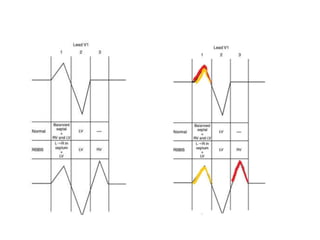
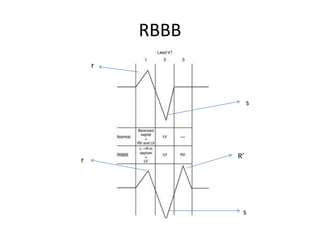
RBBB
R’
s
s
r
RBBB
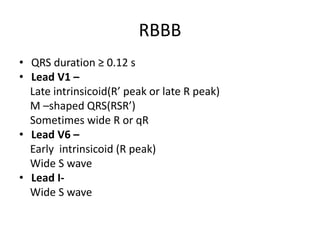
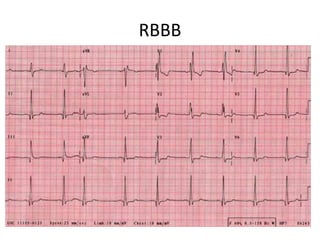
• QRS duration ≥ 0.12 s
• Lead V1 –
Late intrinsicoid(R’ peak or late R peak)
M –shaped QRS(RSR’)
Sometimes wide R or qR
• Lead V6 –
Early intrinsicoid (R peak)
Wide S wave
• Lead I-
Wide S wave
RIGHT BUNDLE BRANCH BLOCK
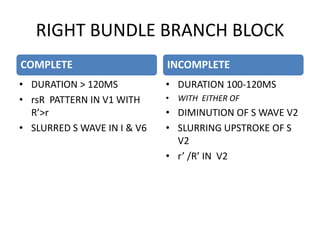
COMPLETE
• DURATION > 120MS
• rsR PATTERN IN V1 WITH
R’>r
• SLURRED S WAVE IN I & V6
INCOMPLETE
• DURATION 100-120MS
• WITH EITHER OF
• DIMINUTION OF S WAVE V2
• SLURRING UPSTROKE OF S
V2
• r’ /R’ IN V2
RBBB
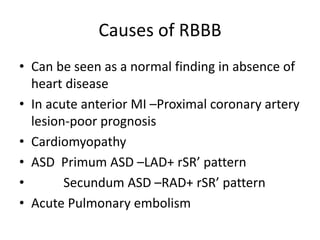
Causes of RBBB
• Can be seen as a normal finding in absence of
heart disease
• In acute anterior MI –Proximal coronary artery
lesion-poor prognosis
• Cardiomyopathy
• ASD Primum ASD –LAD+ rSR’ pattern
• Secundum ASD –RAD+ rSR’ pattern
• Acute Pulmonary embolism
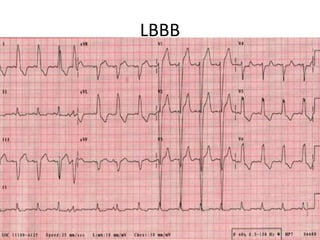
LBBB
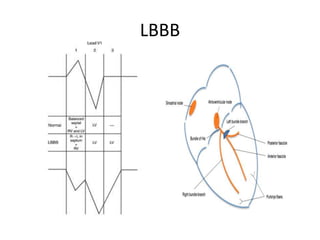
LBBB
CONVENTIONAL CRITERIA
• Lead V1: QS or Rs
• Lead V6: Late intrinsicoid (R or R’ peak),
No Q waves, monophasic R
• Lead I : Monophasic R wave ,No Q
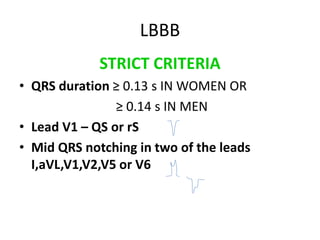
STRICT CRITERIA
• QRS duration ≥ 0.13 s IN WOMEN OR
≥ 0.14 s IN MEN
• Lead V1 – QS or rS
• Mid QRS notching in two of the leads
I,aVL,V1,V2,V5 or V6
LBBB
ST T CHANGES IN LBBB
IMPORTANT NOTE
• ST SEGMENT AND T WAVE ARE IN OPPOSITE
DIRECTIONS TO TERMINAL QRS DEFLECTION
LBBB
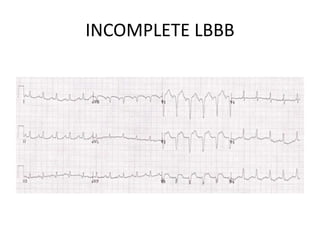
INCOMPLETE LBBB
• EARLIEST CHANGE:
DISAPPEARANCE OF INITIAL
q WAVE OF QR COMPLEX IN LEFT LEADS
TALL R
• SMALL INITIAL R WAVE IN RIGHT LEADS
DISAPPEAR QS COMPLEX
INCOMPLETE LBBB
CAUSES OF LBBB
• IHD
• CARDIOMYOPATHY
• HYPERTENSIVE HEART DISEASE
• ACUTE MI-can be the presenting ecg change
• Aortic stenosis
• INTRINSIC DISEASES OF CONDUCTION SYSTEM-
Primary degenerative disease (fibrosis) of the
conducting system (Lenegre disease)
• Digoxin toxicity
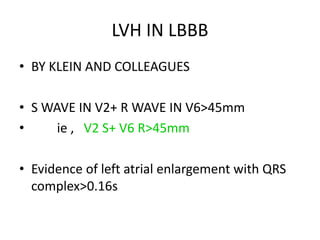
LVH IN LBBB
• BY KLEIN AND COLLEAGUES
• S WAVE IN V2+ R WAVE IN V6>45mm
• ie , V2 S+ V6 R>45mm
• Evidence of left atrial enlargement with QRS
complex>0.16s
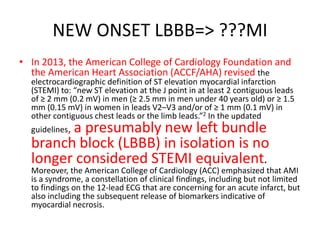
NEW ONSET LBBB=> ???MI
• In 2013, the American College of Cardiology Foundation and
the American Heart Association (ACCF/AHA) revised the
electrocardiographic definition of ST elevation myocardial infarction
(STEMI) to: “new ST elevation at the J point in at least 2 contiguous leads
of ≥ 2 mm (0.2 mV) in men (≥ 2.5 mm in men under 40 years old) or ≥ 1.5
mm (0.15 mV) in women in leads V2–V3 and/or of ≥ 1 mm (0.1 mV) in
other contiguous chest leads or the limb leads.”2 In the updated
guidelines, a presumably new left bundle
branch block (LBBB) in isolation is no
longer considered STEMI equivalent.
Moreover, the American College of Cardiology (ACC) emphasized that AMI
is a syndrome, a constellation of clinical findings, including but not limited
to findings on the 12-lead ECG that are concerning for an acute infarct, but
also including the subsequent release of biomarkers indicative of
myocardial necrosis.
MI IN PRESENCE OF LBBB
SGARBOSSA’S
CRITERIA
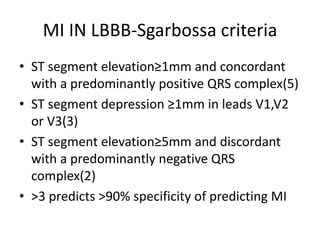
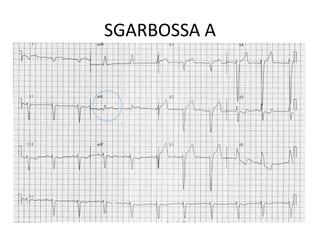
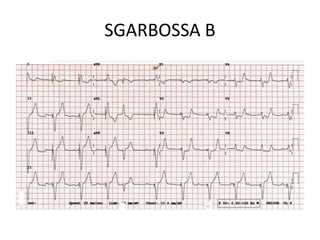
MI IN LBBB-Sgarbossa criteria
• ST segment elevation≥1mm and concordant
with a predominantly positive QRS complex(5)
• ST segment depression ≥1mm in leads V1,V2
or V3(3)
• ST segment elevation≥5mm and discordant
with a predominantly negative QRS
complex(2)
• >3 predicts >90% specificity of predicting MI
Modified Sgarbossa Criteria
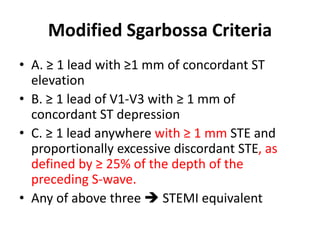
• A. ≥ 1 lead with ≥1 mm of concordant ST
elevation
• B. ≥ 1 lead of V1-V3 with ≥ 1 mm of
concordant ST depression
• C. ≥ 1 lead anywhere with ≥ 1 mm STE and
proportionally excessive discordant STE, as
defined by ≥ 25% of the depth of the
preceding S-wave.
• Any of above three  STEMI equivalent
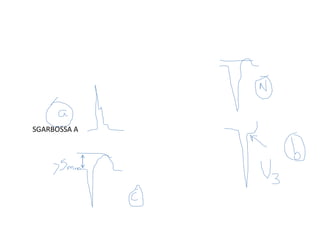
SGARBOSSA A
SGARBOSSA A
SGARBOSSA B
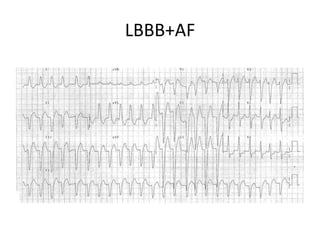
LBBB+AF
Why finding LBBB is significant in
cardiomyopathy???
In CM with LBBBCRT-biventricular pacing is
. indicated
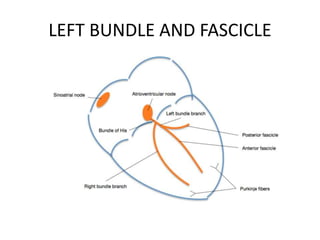
LEFT BUNDLE AND FASCICLE
LEFT BUNDLE DIVIDES AS:
ANTEROSUPERIOR
• LONG ,THIN
• SINGLE BLOOD SUPPLY
• SEPTAL BRANCH OF LAD
WHICH ALSO SUPPLY RBB
• BLOCK:LAFB
POSTEROINFERIOR
• THICKER
• DUAL SUPPLY
• LAD+ AV NODAL ARTERY
• BLOCK:LPFB
LAFB
• Left axis deviation (usually ≥ -30°) !MCC!
• Small Q (qR complexes)in leads I and
aVL;small r(rS complexes)in II,III,aVF
• Minimal QRS prolongation (0.020s) from
baseline
• Late intrinsicoid (R wave peak) deflection in
aVL (>0.045s)
• Increased QRS voltage in limb leads
T wave changes -LAFB
• In any intraventricular conduction defect T
wave vector goes in opposite direction of main
QRS vector
• LAFB: T low or inverted in I ,aVL
T upright in II,III,aVF
LAFB
rS
qR
LAD
LAFB+LVH
• ECG S/O LAFB WITH
• S WAVE IN LEAD III > 1.5mm(0.15mV)
• Can also due to advanced LAFB
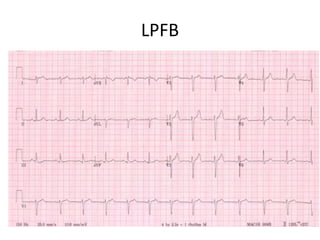
LPFB
• Right axis deviation(usually ≥ +120°)
• Small R in leads I and aVL(rS complexes);small
Q in II,III,aVF(qR complexes)
• Usually normal QRS duration
• Late intrinsicoid (R wave peak) deflection in
aVF (>0.045s)
• Increased QRS voltage in limb leads
• No evidence of RVH
T wave changes LPFB
• T inverted in II,III,aVF
• Upright T waves in lead I
LPFB
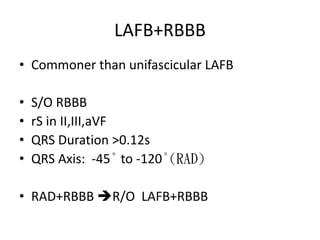
LAFB+RBBB
• Commoner than unifascicular LAFB
• S/O RBBB
• rS in II,III,aVF
• QRS Duration >0.12s
• QRS Axis: -45° to -120°(RAD)
• RAD+RBBB R/O LAFB+RBBB
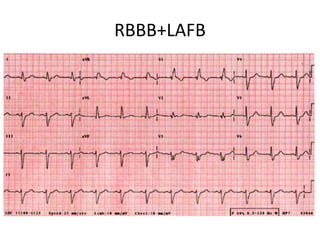
RBBB+LAFB
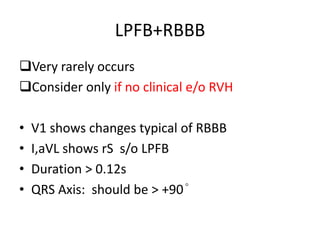
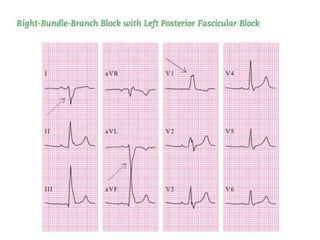
LPFB+RBBB
Very rarely occurs
Consider only if no clinical e/o RVH
• V1 shows changes typical of RBBB
• I,aVL shows rS s/o LPFB
• Duration > 0.12s
• QRS Axis: should be > +90°
SEPTAL FASCICLE??
• BELIEVED TO BE RESPONSIBLE FOR INITIAL
LEFT TO RIGHT SEPTAL ACTIVATION
• INITIAL 35-40ms OF QRS COMPLEX
LSFB-LEFT SEPTAL FASCICULAR BLOCK
• QRS duration normal or minimally increased
• Normal QRS axis
• Prominent R waves in leads V1-V3
• Loss of septal q waves
• Initial q waves in lead V1 & V2
TRIFASCICULAR BLOCK
• RBB+ LAFB+ LPFB
OR
• AV NODAL BLOCK+ BIFASCICULAR
BLOCK
INCOMPLETE TRIFASCICULAR
• BIFASCICULAR BLOCK WITH EVIDENCE OF
DELAYED CONDUCTION IN AV NODE
• FIXED BLOCK OF ONE FASCICLE WITH
INTERMITTENT FAILURE OF OTHER TWO
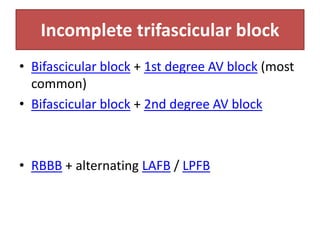
Incomplete trifascicular block
• Bifascicular block + 1st degree AV block (most
common)
• Bifascicular block + 2nd degree AV block
• RBBB + alternating LAFB / LPFB
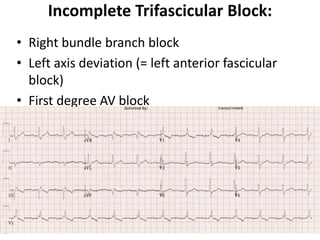
Incomplete Trifascicular Block:
• Right bundle branch block
• Left axis deviation (= left anterior fascicular
block)
• First degree AV block
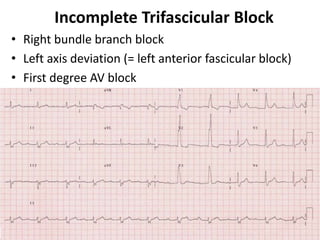
Incomplete Trifascicular Block
• Right bundle branch block
• Left axis deviation (= left anterior fascicular block)
• First degree AV block
•
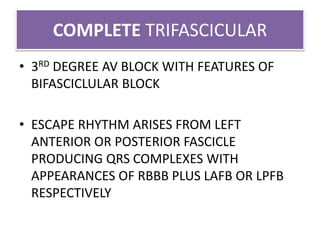
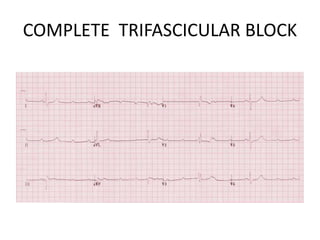
COMPLETE TRIFASCICULAR
• 3RD DEGREE AV BLOCK WITH FEATURES OF
BIFASCICLULAR BLOCK
• ESCAPE RHYTHM ARISES FROM LEFT
ANTERIOR OR POSTERIOR FASCICLE
PRODUCING QRS COMPLEXES WITH
APPEARANCES OF RBBB PLUS LAFB OR LPFB
RESPECTIVELY
COMPLETE TRIFASCICULAR BLOCK
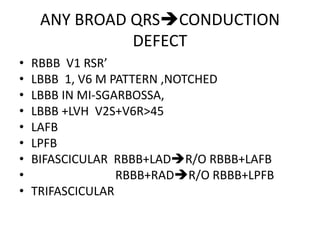
ANY BROAD QRSCONDUCTION
DEFECT
• RBBB V1 RSR’
• LBBB 1, V6 M PATTERN ,NOTCHED
• LBBB IN MI-SGARBOSSA,
• LBBB +LVH V2S+V6R>45
• LAFB
• LPFB
• BIFASCICULAR RBBB+LADR/O RBBB+LAFB
• RBBB+RADR/O RBBB+LPFB
• TRIFASCICULAR
Bundle branch blocks

Bundle branch blocks

  • 1.
    BUNDLE BRANCH BLOCKS DR.SONUKURIAN MODERATOR:DR.MAHIM MITTAL MD
  • 2.
    REFERENCES • MARRIOT’S PRACTICALECG 12TH ED • LEO SCHAMROTH’S INTRODUCTION TO ECG 7TH ED
  • 3.
  • 4.
    Right bundle branch •40 mm long • Conduction Velocity 2m/s • 1cm increase conduction time increase 5ms
  • 5.
    BLOOD SUPPLY • SEPTALBRANCHES OF LAD (90%) • RBB,LAF • RCA VIA AV NODAL ARTERY(90%) • LPF • DUAL SUPPLY TO LPF IN 40-50%
  • 6.
    NORMAL QRS NORMAL DURATIONOF QRS: 0.08-0.12SEC
  • 7.
    • BLOCK INAV JUNCTION AFFECT PR INTERVAL • BLOCK IN BUNDLES AFFECT THE QRS DURATION • NORMAL DURATION OF QRS: 0.08-0.12SEC
  • 9.
  • 10.
    RBBB • QRS duration≥ 0.12 s • Lead V1 – Late intrinsicoid(R’ peak or late R peak) M –shaped QRS(RSR’) Sometimes wide R or qR • Lead V6 – Early intrinsicoid (R peak) Wide S wave • Lead I- Wide S wave
  • 11.
    RIGHT BUNDLE BRANCHBLOCK COMPLETE • DURATION > 120MS • rsR PATTERN IN V1 WITH R’>r • SLURRED S WAVE IN I & V6 INCOMPLETE • DURATION 100-120MS • WITH EITHER OF • DIMINUTION OF S WAVE V2 • SLURRING UPSTROKE OF S V2 • r’ /R’ IN V2
  • 12.
  • 13.
    Causes of RBBB •Can be seen as a normal finding in absence of heart disease • In acute anterior MI –Proximal coronary artery lesion-poor prognosis • Cardiomyopathy • ASD Primum ASD –LAD+ rSR’ pattern • Secundum ASD –RAD+ rSR’ pattern • Acute Pulmonary embolism
  • 14.
  • 15.
    LBBB CONVENTIONAL CRITERIA • LeadV1: QS or Rs • Lead V6: Late intrinsicoid (R or R’ peak), No Q waves, monophasic R • Lead I : Monophasic R wave ,No Q
  • 16.
    STRICT CRITERIA • QRSduration ≥ 0.13 s IN WOMEN OR ≥ 0.14 s IN MEN • Lead V1 – QS or rS • Mid QRS notching in two of the leads I,aVL,V1,V2,V5 or V6 LBBB
  • 17.
    ST T CHANGESIN LBBB IMPORTANT NOTE • ST SEGMENT AND T WAVE ARE IN OPPOSITE DIRECTIONS TO TERMINAL QRS DEFLECTION
  • 18.
  • 19.
    INCOMPLETE LBBB • EARLIESTCHANGE: DISAPPEARANCE OF INITIAL q WAVE OF QR COMPLEX IN LEFT LEADS TALL R • SMALL INITIAL R WAVE IN RIGHT LEADS DISAPPEAR QS COMPLEX
  • 20.
  • 21.
    CAUSES OF LBBB •IHD • CARDIOMYOPATHY • HYPERTENSIVE HEART DISEASE • ACUTE MI-can be the presenting ecg change • Aortic stenosis • INTRINSIC DISEASES OF CONDUCTION SYSTEM- Primary degenerative disease (fibrosis) of the conducting system (Lenegre disease) • Digoxin toxicity
  • 22.
    LVH IN LBBB •BY KLEIN AND COLLEAGUES • S WAVE IN V2+ R WAVE IN V6>45mm • ie , V2 S+ V6 R>45mm • Evidence of left atrial enlargement with QRS complex>0.16s
  • 23.
    NEW ONSET LBBB=>???MI • In 2013, the American College of Cardiology Foundation and the American Heart Association (ACCF/AHA) revised the electrocardiographic definition of ST elevation myocardial infarction (STEMI) to: “new ST elevation at the J point in at least 2 contiguous leads of ≥ 2 mm (0.2 mV) in men (≥ 2.5 mm in men under 40 years old) or ≥ 1.5 mm (0.15 mV) in women in leads V2–V3 and/or of ≥ 1 mm (0.1 mV) in other contiguous chest leads or the limb leads.”2 In the updated guidelines, a presumably new left bundle branch block (LBBB) in isolation is no longer considered STEMI equivalent. Moreover, the American College of Cardiology (ACC) emphasized that AMI is a syndrome, a constellation of clinical findings, including but not limited to findings on the 12-lead ECG that are concerning for an acute infarct, but also including the subsequent release of biomarkers indicative of myocardial necrosis.
  • 24.
    MI IN PRESENCEOF LBBB SGARBOSSA’S CRITERIA
  • 25.
    MI IN LBBB-Sgarbossacriteria • ST segment elevation≥1mm and concordant with a predominantly positive QRS complex(5) • ST segment depression ≥1mm in leads V1,V2 or V3(3) • ST segment elevation≥5mm and discordant with a predominantly negative QRS complex(2) • >3 predicts >90% specificity of predicting MI
  • 26.
    Modified Sgarbossa Criteria •A. ≥ 1 lead with ≥1 mm of concordant ST elevation • B. ≥ 1 lead of V1-V3 with ≥ 1 mm of concordant ST depression • C. ≥ 1 lead anywhere with ≥ 1 mm STE and proportionally excessive discordant STE, as defined by ≥ 25% of the depth of the preceding S-wave. • Any of above three  STEMI equivalent
  • 27.
  • 28.
  • 29.
  • 30.
  • 31.
    Why finding LBBBis significant in cardiomyopathy??? In CM with LBBBCRT-biventricular pacing is . indicated
  • 32.
  • 33.
    LEFT BUNDLE DIVIDESAS: ANTEROSUPERIOR • LONG ,THIN • SINGLE BLOOD SUPPLY • SEPTAL BRANCH OF LAD WHICH ALSO SUPPLY RBB • BLOCK:LAFB POSTEROINFERIOR • THICKER • DUAL SUPPLY • LAD+ AV NODAL ARTERY • BLOCK:LPFB
  • 34.
    LAFB • Left axisdeviation (usually ≥ -30°) !MCC! • Small Q (qR complexes)in leads I and aVL;small r(rS complexes)in II,III,aVF • Minimal QRS prolongation (0.020s) from baseline • Late intrinsicoid (R wave peak) deflection in aVL (>0.045s) • Increased QRS voltage in limb leads
  • 35.
    T wave changes-LAFB • In any intraventricular conduction defect T wave vector goes in opposite direction of main QRS vector • LAFB: T low or inverted in I ,aVL T upright in II,III,aVF
  • 36.
  • 37.
    LAFB+LVH • ECG S/OLAFB WITH • S WAVE IN LEAD III > 1.5mm(0.15mV) • Can also due to advanced LAFB
  • 38.
    LPFB • Right axisdeviation(usually ≥ +120°) • Small R in leads I and aVL(rS complexes);small Q in II,III,aVF(qR complexes) • Usually normal QRS duration • Late intrinsicoid (R wave peak) deflection in aVF (>0.045s) • Increased QRS voltage in limb leads • No evidence of RVH
  • 39.
    T wave changesLPFB • T inverted in II,III,aVF • Upright T waves in lead I
  • 40.
  • 41.
    LAFB+RBBB • Commoner thanunifascicular LAFB • S/O RBBB • rS in II,III,aVF • QRS Duration >0.12s • QRS Axis: -45° to -120°(RAD) • RAD+RBBB R/O LAFB+RBBB
  • 42.
  • 43.
    LPFB+RBBB Very rarely occurs Consideronly if no clinical e/o RVH • V1 shows changes typical of RBBB • I,aVL shows rS s/o LPFB • Duration > 0.12s • QRS Axis: should be > +90°
  • 45.
    SEPTAL FASCICLE?? • BELIEVEDTO BE RESPONSIBLE FOR INITIAL LEFT TO RIGHT SEPTAL ACTIVATION • INITIAL 35-40ms OF QRS COMPLEX
  • 46.
    LSFB-LEFT SEPTAL FASCICULARBLOCK • QRS duration normal or minimally increased • Normal QRS axis • Prominent R waves in leads V1-V3 • Loss of septal q waves • Initial q waves in lead V1 & V2
  • 47.
    TRIFASCICULAR BLOCK • RBB+LAFB+ LPFB OR • AV NODAL BLOCK+ BIFASCICULAR BLOCK
  • 48.
    INCOMPLETE TRIFASCICULAR • BIFASCICULARBLOCK WITH EVIDENCE OF DELAYED CONDUCTION IN AV NODE • FIXED BLOCK OF ONE FASCICLE WITH INTERMITTENT FAILURE OF OTHER TWO
  • 49.
    Incomplete trifascicular block •Bifascicular block + 1st degree AV block (most common) • Bifascicular block + 2nd degree AV block • RBBB + alternating LAFB / LPFB
  • 50.
    Incomplete Trifascicular Block: •Right bundle branch block • Left axis deviation (= left anterior fascicular block) • First degree AV block
  • 51.
    Incomplete Trifascicular Block •Right bundle branch block • Left axis deviation (= left anterior fascicular block) • First degree AV block •
  • 52.
    COMPLETE TRIFASCICULAR • 3RDDEGREE AV BLOCK WITH FEATURES OF BIFASCICLULAR BLOCK • ESCAPE RHYTHM ARISES FROM LEFT ANTERIOR OR POSTERIOR FASCICLE PRODUCING QRS COMPLEXES WITH APPEARANCES OF RBBB PLUS LAFB OR LPFB RESPECTIVELY
  • 53.
  • 54.
    ANY BROAD QRSCONDUCTION DEFECT •RBBB V1 RSR’ • LBBB 1, V6 M PATTERN ,NOTCHED • LBBB IN MI-SGARBOSSA, • LBBB +LVH V2S+V6R>45 • LAFB • LPFB • BIFASCICULAR RBBB+LADR/O RBBB+LAFB • RBBB+RADR/O RBBB+LPFB • TRIFASCICULAR