DR.W.A.P.S.R.WEERARATHNA
REGISTRAR-WD 10/02
 Renal artery Stenosis(RAS) –an overview
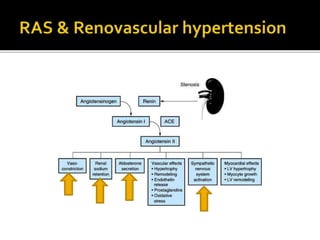
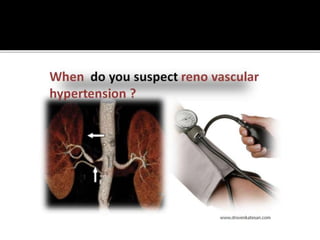
 RAS & Renovascular hypertension-
Pathophysiology
 Clinical presentation
 Evaluation & diagnostic modalities
 Current clinical evidence
 Management options- current
reccomendations
 Summary
 References
 Mainly 2 types-
 1. Atherosclotic reno vascular
disease(ARVD)
 2.Fibromuscular dysplasia (FMD) <10%
 Two common clininical syndromes-
 1. Hypertension
 2. Ischaemic nephropathty
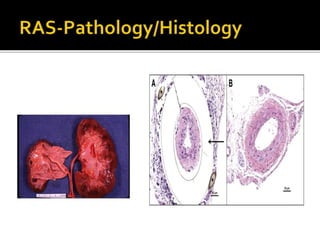
 Affects media in >90%
 Cause-unknown
 ?genetic/?smoking/?hormonal/?disorders of
vasa vasarum
Female>male, common in 15-50 years
Common in distal 2/3 of renal artey/branches
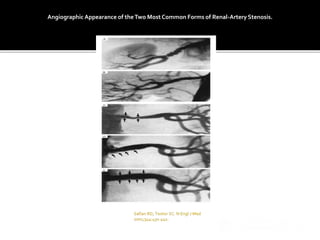
 Angiography-beading/aneursyms
 Progressive dissection/thrombosis common
in intimal & periaoric types
 90%
 Usually osteal/proximal 1/3 of main renal
artery/perirenal aorta
 Ischaemic nephropathy-segmental/diffuse
 Increased prevalence- advanced
age/DM/aoroto-iliac disease/CAD/HTN
 ARVD-5 years after diagnosis
progressive stenosis 51%
total occlusion 3-16%
renal atrophy 21% (60%
occlusion)
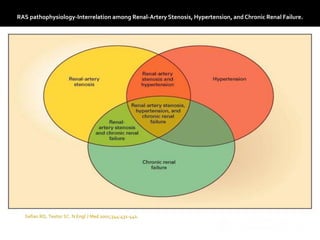
RAS pathophysiology-Interrelation among Renal-Artery Stenosis, Hypertension, and Chronic Renal Failure.
 Renovascular HTN-accelarated/malignant
 NOT readily distinguishable from Essential
HTN
 Classic features- (none have significant
predictive value!)
Hypokalemia
Abdominal bruit
Absence of family H/O HTN
Duration of HTN < 1 year
Onset of HTN < 50 years
 Majority of Renovascular HTN have Essential
HTN
 HTN usually persist despite
revascurization!
 Reverse tachyphylaxis- sustained HTN 
redused plasma Renin levels (limitations in
measuring plasma renin levels in patients
with Renovascular HTN)
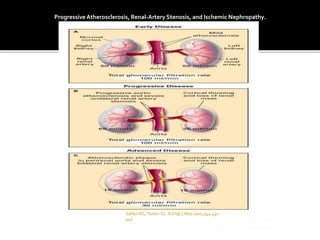
ProgressiveAtherosclerosis, Renal-Artery Stenosis, and Ischemic Nephropathy.
Angiographic Appearance of theTwo Most Common Forms of Renal-Artery Stenosis.
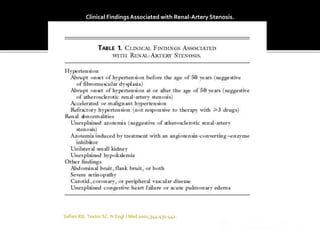
Clinical FindingsAssociated with Renal-Artery Stenosis.
 Noninvasive/ invasive modalities
 May include studies to asses
Overall RFT
Asses RAAS
Perfusion studies-differential renal BF
Imaging studies- to asses RAS
 Measuring the response of RAAS-more useful
in younger patients with FMD(HTN is renin
dependent than in elderly withARVD! & likely
to be cured by revascularization!)
 Renin –Na+ profiling
 Assesment of (Renin) before / after
captopril
 Assesment of effect of BP/RFT of an ACEI
 Captopril renography-diffential renal
perfusion cont…
 Elderly withARVDimaging is prefferd!
 Duplex ultrasonography-assesment of
Renal arteries/BF velosities/pressure wave
forms
 MRA- Gd enhanced Renal arteries/aorta
 CTA-
 (Gd usually not toxic/exclude if eGFR <30 )
 Contrast enhanced angiography-
 To confirm the diagnosis
 To detect cause of RAS
 To evaluate the extent of intrarenal vascular
disease
 To determine the dimentions
 To identify associate aneurysms/occlusive
disease of aorta
 Intraarterial DSA- low volume of contrast
medium needed & no worsening of RFT.
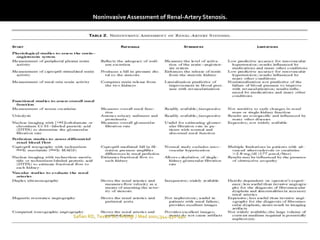
NoninvasiveAssessment of Renal-Artery Stenosis.
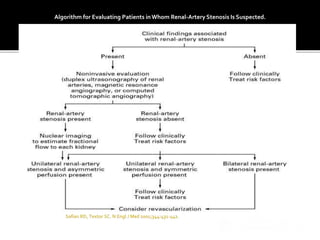
Algorithm for Evaluating Patients inWhom Renal-Artery Stenosis Is Suspected.
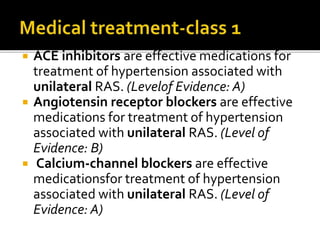
 ACE inhibitors are effective medications for
treatment of hypertension associated with
unilateral RAS. (Levelof Evidence: A)
 Angiotensin receptor blockers are effective
medications for treatment of hypertension
associated with unilateral RAS. (Level of
Evidence: B)
 Calcium-channel blockers are effective
medicationsfor treatment of hypertension
associated with unilateral RAS. (Level of
Evidence: A)
 Beta blockers are effective medications for
treatment of hypertension associated with
RAS. (Level of Evidence: A)
 Asymptomatic stenosis -class 2 B
 Percutaneous revascularization may be
considered for treatment of an asymptomatic
bilateral or solitary viable kidney with a
hemodynamically significant RAS. (Level of
Evidence: C)
 The usefulness of percutaneous
revascularization of an asymptomatic unilateral
hemodynamically significant RAS in a viable
kidney is not well established and is presently
clinically unproven. (Level of Evidence: C)
 Hypertension-class 2a
 Percutaneous revascularization is reasonable
for patients with-
Hemodynamically significant RAS and
accelerated hypertension,
Resistant hypertension,
Malignant hypertension,
Hypertension with an unexplained
unilateral small kidney
 Hypertension with intolerance to
medication
 Class 2A
 Percutaneous revascularization is reasonable for
patients with RAS and progressive chronic
kidney disease with bilateral RAS or a RAS to a
solitary functioning kidney. (Level of Evidence:
B)
 Class2 B
 Percutaneous revascularization may be
considered for patients with RAS and chronic
renal insufficiency with unilateral RAS. (Level
of Evidence: C)
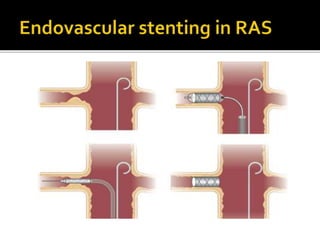
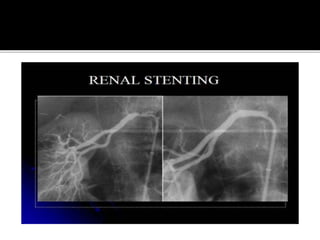
 Class1
 Renal stent placement is indicated for ostia
atherosclerotic RAS lesions that meet the
clinical criteria for intervention. (Level of
Evidence: B)
 Balloon angioplasty with bailout stent
placement if necessary is recommended for
fibromuscular dysplasia lesions. (Level of
Evidence: B)
 Class 1
 Percutaneous revascularization is indicated for
patients with hemodynamically significant RAS
and recurrent, unexplained congestive heart
failure or sudden, unexplained pulmonary
edema-Flash pulmonary oedema. (Level of
Evidence: B)
 Class 2A
 Percutaneous revascularization is reasonable for
patients with hemodynamically significant RAS
and unstable angina. (Level of Evidence: B)
 Class1
 Vascular surgical reconstruction is indicated
for patients with fibromuscular dysplastic
RAS with clinical indications for interventions
(same as for percutaneous transluminal
angioplasty), especially those exhibiting
complex disease that extends into the
segmental arteries and those having
macroaneurysms. (Level of
 Vascular surgical reconstruction is indicated
for patients with atherosclerotic RAS and
clinical indications for intervention, especially
those with multiple small renal arteries or
early primary branching of the main renal
artery. (Level of Evidence: B)
 Vascular surgical reconstruction is indicated
for patients with atherosclerotic RAS in
combination with pararenal aortic
reconstructions (in treatment of aortic
aneurysms or severe aortoiliac occlusive
disease).
 ACCF/AHA Practice guide line-Management
of patients with Peripheral atrerial
Diseases(compilation of 2005 &2011
ACCF/AHA guide line reccomendations)
 NEJM-Renal-Artery Stenosis- Robert D Saflan
& StephanCTextor MD NEJ MED 2001
Ras an up date.

Ras an up date.

  • 1.
  • 2.
     Renal arteryStenosis(RAS) –an overview  RAS & Renovascular hypertension- Pathophysiology  Clinical presentation  Evaluation & diagnostic modalities  Current clinical evidence  Management options- current reccomendations  Summary  References
  • 3.
     Mainly 2types-  1. Atherosclotic reno vascular disease(ARVD)  2.Fibromuscular dysplasia (FMD) <10%  Two common clininical syndromes-  1. Hypertension  2. Ischaemic nephropathty
  • 4.
     Affects mediain >90%  Cause-unknown  ?genetic/?smoking/?hormonal/?disorders of vasa vasarum Female>male, common in 15-50 years Common in distal 2/3 of renal artey/branches  Angiography-beading/aneursyms  Progressive dissection/thrombosis common in intimal & periaoric types
  • 5.
     90%  Usuallyosteal/proximal 1/3 of main renal artery/perirenal aorta  Ischaemic nephropathy-segmental/diffuse  Increased prevalence- advanced age/DM/aoroto-iliac disease/CAD/HTN  ARVD-5 years after diagnosis progressive stenosis 51% total occlusion 3-16% renal atrophy 21% (60% occlusion)
  • 6.
    RAS pathophysiology-Interrelation amongRenal-Artery Stenosis, Hypertension, and Chronic Renal Failure.
  • 9.
     Renovascular HTN-accelarated/malignant NOT readily distinguishable from Essential HTN  Classic features- (none have significant predictive value!) Hypokalemia Abdominal bruit Absence of family H/O HTN Duration of HTN < 1 year Onset of HTN < 50 years
  • 10.
     Majority ofRenovascular HTN have Essential HTN  HTN usually persist despite revascurization!  Reverse tachyphylaxis- sustained HTN  redused plasma Renin levels (limitations in measuring plasma renin levels in patients with Renovascular HTN)
  • 11.
  • 13.
    Angiographic Appearance oftheTwo Most Common Forms of Renal-Artery Stenosis.
  • 15.
    Clinical FindingsAssociated withRenal-Artery Stenosis.
  • 16.
     Noninvasive/ invasivemodalities  May include studies to asses Overall RFT Asses RAAS Perfusion studies-differential renal BF Imaging studies- to asses RAS
  • 17.
     Measuring theresponse of RAAS-more useful in younger patients with FMD(HTN is renin dependent than in elderly withARVD! & likely to be cured by revascularization!)  Renin –Na+ profiling  Assesment of (Renin) before / after captopril  Assesment of effect of BP/RFT of an ACEI  Captopril renography-diffential renal perfusion cont…
  • 18.
     Elderly withARVDimagingis prefferd!  Duplex ultrasonography-assesment of Renal arteries/BF velosities/pressure wave forms  MRA- Gd enhanced Renal arteries/aorta  CTA-  (Gd usually not toxic/exclude if eGFR <30 )
  • 19.
     Contrast enhancedangiography-  To confirm the diagnosis  To detect cause of RAS  To evaluate the extent of intrarenal vascular disease  To determine the dimentions  To identify associate aneurysms/occlusive disease of aorta  Intraarterial DSA- low volume of contrast medium needed & no worsening of RFT.
  • 20.
  • 21.
    Algorithm for EvaluatingPatients inWhom Renal-Artery Stenosis Is Suspected.
  • 23.
     ACE inhibitorsare effective medications for treatment of hypertension associated with unilateral RAS. (Levelof Evidence: A)  Angiotensin receptor blockers are effective medications for treatment of hypertension associated with unilateral RAS. (Level of Evidence: B)  Calcium-channel blockers are effective medicationsfor treatment of hypertension associated with unilateral RAS. (Level of Evidence: A)
  • 24.
     Beta blockersare effective medications for treatment of hypertension associated with RAS. (Level of Evidence: A)
  • 25.
     Asymptomatic stenosis-class 2 B  Percutaneous revascularization may be considered for treatment of an asymptomatic bilateral or solitary viable kidney with a hemodynamically significant RAS. (Level of Evidence: C)  The usefulness of percutaneous revascularization of an asymptomatic unilateral hemodynamically significant RAS in a viable kidney is not well established and is presently clinically unproven. (Level of Evidence: C)
  • 26.
     Hypertension-class 2a Percutaneous revascularization is reasonable for patients with- Hemodynamically significant RAS and accelerated hypertension, Resistant hypertension, Malignant hypertension, Hypertension with an unexplained unilateral small kidney  Hypertension with intolerance to medication
  • 27.
     Class 2A Percutaneous revascularization is reasonable for patients with RAS and progressive chronic kidney disease with bilateral RAS or a RAS to a solitary functioning kidney. (Level of Evidence: B)  Class2 B  Percutaneous revascularization may be considered for patients with RAS and chronic renal insufficiency with unilateral RAS. (Level of Evidence: C)
  • 28.
     Class1  Renalstent placement is indicated for ostia atherosclerotic RAS lesions that meet the clinical criteria for intervention. (Level of Evidence: B)  Balloon angioplasty with bailout stent placement if necessary is recommended for fibromuscular dysplasia lesions. (Level of Evidence: B)
  • 31.
     Class 1 Percutaneous revascularization is indicated for patients with hemodynamically significant RAS and recurrent, unexplained congestive heart failure or sudden, unexplained pulmonary edema-Flash pulmonary oedema. (Level of Evidence: B)  Class 2A  Percutaneous revascularization is reasonable for patients with hemodynamically significant RAS and unstable angina. (Level of Evidence: B)
  • 32.
     Class1  Vascularsurgical reconstruction is indicated for patients with fibromuscular dysplastic RAS with clinical indications for interventions (same as for percutaneous transluminal angioplasty), especially those exhibiting complex disease that extends into the segmental arteries and those having macroaneurysms. (Level of
  • 33.
     Vascular surgicalreconstruction is indicated for patients with atherosclerotic RAS and clinical indications for intervention, especially those with multiple small renal arteries or early primary branching of the main renal artery. (Level of Evidence: B)
  • 34.
     Vascular surgicalreconstruction is indicated for patients with atherosclerotic RAS in combination with pararenal aortic reconstructions (in treatment of aortic aneurysms or severe aortoiliac occlusive disease).
  • 35.
     ACCF/AHA Practiceguide line-Management of patients with Peripheral atrerial Diseases(compilation of 2005 &2011 ACCF/AHA guide line reccomendations)  NEJM-Renal-Artery Stenosis- Robert D Saflan & StephanCTextor MD NEJ MED 2001