Ventricular tachycardia
VT Cluster (VTC)
• SAMIR EL ANSARY
• ICU PROFESSOR
• AIN SHAMS
• CAIRO
VT Cluster (VTC)
• A VTC is defined as ≥ 3 sustained VTs/24
h.
• Ventricular tachycardia that repeatedly
recurs and persists for more than half of
a 24-h period despite repeated attempts
to terminate the arrhythmia is
designated “incessant.”
VT Cluster (VTC)
• Irrespective of the number of VTs, only 30.2%
of patients survived and 15.5% survived
without heart transplantation four years after
the first cluster.
• Incessant VT typically takes one of two forms.
The most common situation is for VT to be
sustained, terminated by external
cardioversions, but recurrent.
• The time between cardioversion and
recurrence may be seconds, minutes or more.
VT Cluster (VTC)
• A second form, common with the
idiopathic VTs, manifests as repeated
bursts, with runs of VT that
spontaneously terminate for a few
intervening sinus beats, followed by the
next tachycardia burst.
• Cardioversion is futile, but may be
periodically required if bursts of VT
occasionally degenerate to ventricular
fibrillation.
VT Cluster (VTC)
• When incessant VT is polymorphic, drug induced
torsade de pointes associated with QT prolongation,
or myocardial ischemia are the major concerns.
• Runs of polymorphic VT may even repeatedly initiate
monomorphic VT in patients with reentry circuits in
regions of scar.
• Suppression of torsade de pointes with intravenous
administration of magnesium sulfate and/or
overdrive pacing may restore stability.
VT Cluster (VTC)
Treatment Options:
• Antiarrythmic drugs
• Beta Blockade
• General anesthesia (to reduce sympathetic
tone)
• Intra aortic balloon counterpulsation
• Catheter ablation – percutaneous/ epicardial
• LVAD
Dosage
• Amiodarone — Amiodarone is given as a 150
mg (or 5 mg/kg) IV bolus over 10 minutes;
additional boluses of 150 mg over 10 minutes
are given every 10 to 15 minutes as needed.
Alternatively, an infusion of 360 mg (1
mg/min) over six hours followed by 540 mg
(0.5 mg/min) over the remaining 18 hours can
be used.
• The maximum total dose (including doses
given during resuscitation) is 2.2 grams in 24
hours.
Dosage
• Lidocaine
• Lidocaine is given by IV push in a dose of
0.5 to 0.75 mg/kg; repeated every 5 to
10 minutes as needed.
•
• At the same time, a continuous IV
infusion of 1 to 4 mg/min is begun.
• The maximum total dose is 3 mg/kg
over one hour.
Dosage
• Procainamide:
• Loading dose:
• 15-18 mg/kg administered as slow
infusion over 25-30 minutes or 100-200
mg/dose repeated every 5 minutes as
needed to a total dose of 1 g.
Dosage
• Procainamide:
• Reduce loading dose to 12 mg/kg in severe renal or
cardiac impairment.
Maintenance dose: 1-4 mg/minute by continuous
infusion.
• Maintenance infusions should be reduced by one-
third in patients with moderate renal or cardiac
impairment and by two-thirds in patients with severe
renal or cardiac impairment.
Dosage
• Procainamide:
ACLS guidelines: Infuse 20
mg/minute until arrhythmia is
controlled, hypotension occurs, QRS
complex widens by 50% of its
original width, or total of 17 mg/kg is
given.
SHock Inhibition Evaluation
with AzimiLiDe (SHIELD) Investigators
• uppression of ventricular tachycardia/fibrillation
(VT/VF) leading to implanted cardioverter
defibrillator (ICD) therapies.
• Of 633 ICD recipients, 148 (23%) experienced at least
one ES (electrical storm) over 1-year follow-up.
• Compared with placebo, azimilide reduced the risk of
recurrent ES by 37% (p=0.11) nonsignificantly.
• CONCLUSION: ES is common and unpredictable in
ICD recipients and it is a strong predictor of
hospitalization.
Left stellate ganglionic blockade
• Sympathetic blockade is superior to the
antiarrhythmic therapy recommended by the
ACLS guidelines in treating ES patients.
• The role of increased sympathetic activity in
the genesis of ES.
• Sympathetic blockade not class 1
antiarrhythmic drugs should be the treatment
of choice for ES.
Therapies for VT
ABLATION
Ablation is indicated in patients who are otherwise at low risk
for SCD and have sustained predominantly monomorphic VT
that is drug resistant, who are drug intolerant, or who do not
wish long-term drug therapy.
Ablation is indicated in patients with bundle-branch reentrant
VT.
Ablation is indicated as adjunctive therapy in patients with an
ICD who are receiving multiple shocks as a result of sustained
VT that is not manageable by reprogramming or changing drug
therapy or who do not wish long-term drug therapy.
Ablation is indicated in patients with WPW syndrome
resuscitated from sudden cardiac arrest due to AF
and rapid conduction over the accessory pathway
causing VF.
Therapies for VT
Ablation
Ablation can be useful therapy in patients who are
otherwise at low risk for SCD and have symptomatic
nonsustained monomorphic VT that is drug resistant, who
are drug intolerant or who do not wish long-term drug
therapy.
Ablation can be useful therapy in patients who are
otherwise at low risk for SCD and have frequent
symptomatic predominantly monomorphic PVCs that are
drug resistant or who are drug intolerant or who do not wish
long-term drug therapy.
Ablation can be useful in symptomatic patients
with WPW syndrome who have accessory
pathways with refractory periods less than
240 ms in duration.
Incessant VT
Revascularization and beta blockade followed by
intravenous antiarrythmic drugs such as
procainamide or
amiodarone are recommended for patients with
recurrent
or incessant polymorphic VT due to acute MI.
Intravenous amiodarone or procainamide followed by
VT
ablation can be effective in the management of
patients
Acute Management of Specific Arrhythmias
Incessant VT
Intravenous amiodarone and intravenous beta
blockers
separately or together may be reasonable in
patients
with VT storm.
Overdrive pacing or general anesthesia may
be considered for patients with frequently
recurring or incessant VT.
Spinal cord modulation may be considered for
some
patients with frequently recurring or incessant
Acute Management of Specific Arrhythmias
Digitalis Toxicity
An antidigitalis antibody is recommended for patients
who
present with sustained ventricular arrhythmias, advanced
AV
block, and/or asystole that are considered due to digitalis
toxicity.
Patients taking digitalis who present with mild cardiac
toxicity (e.g., isolated ectopic beats only) can be
managed
effectively with recognition, continuous monitoring of
cardiac
rhythm, withdrawal of digitalis, restoration of normal
electrolyte levels (including serum potassium greater
VA & SCD Related to Specific Populations
Digitalis Toxicity
Magnesium or pacing is reasonable
for patients
who take digitalis and present with
severe
toxicity
(sustained ventricular arrhythmias,
advanced AV block, and/or asystole).
VA & SCD Related to Specific Populations
Digitalis Toxicity
Dialysis for the management of
hyperkalemia may be
considered for patients who take
digitalis and present with
severe toxicity (sustained ventricular
arrhythmias; advanced
AV block, and/or asystole).
VA & SCD Related to Specific Populations
Digitalis Toxicity
Management by lidocaine or
phenytoin is not recommended
for patients taking digitalis and who
present with severe
toxicity (sustained ventricular
arrhythmias, advanced AV
block, and/or asystole).
VA & SCD Related to Specific Populations
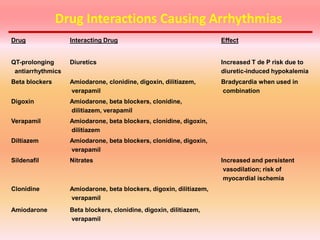
Drug Interacting Drug Effect
QT-prolonging
antiarrhythmics
Diuretics Increased T de P risk due to
diuretic-induced hypokalemia
Beta blockers Amiodarone, clonidine, digoxin, dilitiazem,
verapamil
Bradycardia when used in
combination
Digoxin Amiodarone, beta blockers, clonidine,
dilitiazem, verapamil
Verapamil Amiodarone, beta blockers, clonidine, digoxin,
dilitiazem
Diltiazem Amiodarone, beta blockers, clonidine, digoxin,
verapamil
Sildenafil Nitrates Increased and persistent
vasodilation; risk of
myocardial ischemia
Clonidine Amiodarone, beta blockers, digoxin, dilitiazem,
verapamil
Amiodarone Beta blockers, clonidine, digoxin, dilitiazem,
verapamil
Drug Interactions Causing Arrhythmias
https://www.facebook.com/groups/1451610115129555/#!/groups/145
1610115129555/
Wellcome in our new group ..... Dr.SAMIR EL ANSARY
GOOD LUCK
SAMIR EL ANSARY
ICU PROFESSOR
AIN SHAMS
CAIRO
elansarysamir@yahoo.com

Ventricular tachycardia

  • 1.
    Ventricular tachycardia VT Cluster(VTC) • SAMIR EL ANSARY • ICU PROFESSOR • AIN SHAMS • CAIRO
  • 2.
    VT Cluster (VTC) •A VTC is defined as ≥ 3 sustained VTs/24 h. • Ventricular tachycardia that repeatedly recurs and persists for more than half of a 24-h period despite repeated attempts to terminate the arrhythmia is designated “incessant.”
  • 3.
    VT Cluster (VTC) •Irrespective of the number of VTs, only 30.2% of patients survived and 15.5% survived without heart transplantation four years after the first cluster. • Incessant VT typically takes one of two forms. The most common situation is for VT to be sustained, terminated by external cardioversions, but recurrent. • The time between cardioversion and recurrence may be seconds, minutes or more.
  • 4.
    VT Cluster (VTC) •A second form, common with the idiopathic VTs, manifests as repeated bursts, with runs of VT that spontaneously terminate for a few intervening sinus beats, followed by the next tachycardia burst. • Cardioversion is futile, but may be periodically required if bursts of VT occasionally degenerate to ventricular fibrillation.
  • 5.
    VT Cluster (VTC) •When incessant VT is polymorphic, drug induced torsade de pointes associated with QT prolongation, or myocardial ischemia are the major concerns. • Runs of polymorphic VT may even repeatedly initiate monomorphic VT in patients with reentry circuits in regions of scar. • Suppression of torsade de pointes with intravenous administration of magnesium sulfate and/or overdrive pacing may restore stability.
  • 6.
    VT Cluster (VTC) TreatmentOptions: • Antiarrythmic drugs • Beta Blockade • General anesthesia (to reduce sympathetic tone) • Intra aortic balloon counterpulsation • Catheter ablation – percutaneous/ epicardial • LVAD
  • 7.
    Dosage • Amiodarone —Amiodarone is given as a 150 mg (or 5 mg/kg) IV bolus over 10 minutes; additional boluses of 150 mg over 10 minutes are given every 10 to 15 minutes as needed. Alternatively, an infusion of 360 mg (1 mg/min) over six hours followed by 540 mg (0.5 mg/min) over the remaining 18 hours can be used. • The maximum total dose (including doses given during resuscitation) is 2.2 grams in 24 hours.
  • 8.
    Dosage • Lidocaine • Lidocaineis given by IV push in a dose of 0.5 to 0.75 mg/kg; repeated every 5 to 10 minutes as needed. • • At the same time, a continuous IV infusion of 1 to 4 mg/min is begun. • The maximum total dose is 3 mg/kg over one hour.
  • 9.
    Dosage • Procainamide: • Loadingdose: • 15-18 mg/kg administered as slow infusion over 25-30 minutes or 100-200 mg/dose repeated every 5 minutes as needed to a total dose of 1 g.
  • 10.
    Dosage • Procainamide: • Reduceloading dose to 12 mg/kg in severe renal or cardiac impairment. Maintenance dose: 1-4 mg/minute by continuous infusion. • Maintenance infusions should be reduced by one- third in patients with moderate renal or cardiac impairment and by two-thirds in patients with severe renal or cardiac impairment.
  • 11.
    Dosage • Procainamide: ACLS guidelines:Infuse 20 mg/minute until arrhythmia is controlled, hypotension occurs, QRS complex widens by 50% of its original width, or total of 17 mg/kg is given.
  • 12.
    SHock Inhibition Evaluation withAzimiLiDe (SHIELD) Investigators • uppression of ventricular tachycardia/fibrillation (VT/VF) leading to implanted cardioverter defibrillator (ICD) therapies. • Of 633 ICD recipients, 148 (23%) experienced at least one ES (electrical storm) over 1-year follow-up. • Compared with placebo, azimilide reduced the risk of recurrent ES by 37% (p=0.11) nonsignificantly. • CONCLUSION: ES is common and unpredictable in ICD recipients and it is a strong predictor of hospitalization.
  • 13.
    Left stellate ganglionicblockade • Sympathetic blockade is superior to the antiarrhythmic therapy recommended by the ACLS guidelines in treating ES patients. • The role of increased sympathetic activity in the genesis of ES. • Sympathetic blockade not class 1 antiarrhythmic drugs should be the treatment of choice for ES.
  • 14.
    Therapies for VT ABLATION Ablationis indicated in patients who are otherwise at low risk for SCD and have sustained predominantly monomorphic VT that is drug resistant, who are drug intolerant, or who do not wish long-term drug therapy. Ablation is indicated in patients with bundle-branch reentrant VT. Ablation is indicated as adjunctive therapy in patients with an ICD who are receiving multiple shocks as a result of sustained VT that is not manageable by reprogramming or changing drug therapy or who do not wish long-term drug therapy. Ablation is indicated in patients with WPW syndrome resuscitated from sudden cardiac arrest due to AF and rapid conduction over the accessory pathway causing VF.
  • 15.
    Therapies for VT Ablation Ablationcan be useful therapy in patients who are otherwise at low risk for SCD and have symptomatic nonsustained monomorphic VT that is drug resistant, who are drug intolerant or who do not wish long-term drug therapy. Ablation can be useful therapy in patients who are otherwise at low risk for SCD and have frequent symptomatic predominantly monomorphic PVCs that are drug resistant or who are drug intolerant or who do not wish long-term drug therapy. Ablation can be useful in symptomatic patients with WPW syndrome who have accessory pathways with refractory periods less than 240 ms in duration.
  • 16.
    Incessant VT Revascularization andbeta blockade followed by intravenous antiarrythmic drugs such as procainamide or amiodarone are recommended for patients with recurrent or incessant polymorphic VT due to acute MI. Intravenous amiodarone or procainamide followed by VT ablation can be effective in the management of patients Acute Management of Specific Arrhythmias
  • 17.
    Incessant VT Intravenous amiodaroneand intravenous beta blockers separately or together may be reasonable in patients with VT storm. Overdrive pacing or general anesthesia may be considered for patients with frequently recurring or incessant VT. Spinal cord modulation may be considered for some patients with frequently recurring or incessant Acute Management of Specific Arrhythmias
  • 18.
    Digitalis Toxicity An antidigitalisantibody is recommended for patients who present with sustained ventricular arrhythmias, advanced AV block, and/or asystole that are considered due to digitalis toxicity. Patients taking digitalis who present with mild cardiac toxicity (e.g., isolated ectopic beats only) can be managed effectively with recognition, continuous monitoring of cardiac rhythm, withdrawal of digitalis, restoration of normal electrolyte levels (including serum potassium greater VA & SCD Related to Specific Populations
  • 19.
    Digitalis Toxicity Magnesium orpacing is reasonable for patients who take digitalis and present with severe toxicity (sustained ventricular arrhythmias, advanced AV block, and/or asystole). VA & SCD Related to Specific Populations
  • 20.
    Digitalis Toxicity Dialysis forthe management of hyperkalemia may be considered for patients who take digitalis and present with severe toxicity (sustained ventricular arrhythmias; advanced AV block, and/or asystole). VA & SCD Related to Specific Populations
  • 21.
    Digitalis Toxicity Management bylidocaine or phenytoin is not recommended for patients taking digitalis and who present with severe toxicity (sustained ventricular arrhythmias, advanced AV block, and/or asystole). VA & SCD Related to Specific Populations
  • 22.
    Drug Interacting DrugEffect QT-prolonging antiarrhythmics Diuretics Increased T de P risk due to diuretic-induced hypokalemia Beta blockers Amiodarone, clonidine, digoxin, dilitiazem, verapamil Bradycardia when used in combination Digoxin Amiodarone, beta blockers, clonidine, dilitiazem, verapamil Verapamil Amiodarone, beta blockers, clonidine, digoxin, dilitiazem Diltiazem Amiodarone, beta blockers, clonidine, digoxin, verapamil Sildenafil Nitrates Increased and persistent vasodilation; risk of myocardial ischemia Clonidine Amiodarone, beta blockers, digoxin, dilitiazem, verapamil Amiodarone Beta blockers, clonidine, digoxin, dilitiazem, verapamil Drug Interactions Causing Arrhythmias
  • 23.
  • 24.
    GOOD LUCK SAMIR ELANSARY ICU PROFESSOR AIN SHAMS CAIRO elansarysamir@yahoo.com