International Research Journal of Engineering and Technology (IRJET) e-ISSN: 2395-0056
Volume: 04 Issue: 07 | July -2017 www.irjet.net p-ISSN: 2395-0072
© 2017, IRJET | Impact Factor value: 5.181 | ISO 9001:2008 Certified Journal | Page 1724
Brain Tumor Classification using Support Vector Machine
N.Vani1, A.Sowmya2, N.Jayamma3
1,2,3Assistant Professor, Dept of electronics & Communication Engineering,SBIT college,Telangana,India
---------------------------------------------------------------------***---------------------------------------------------------------------
Abstract - Object detection plays a major role in many
areas like medical imaging, aerial surveillance, optimal
manipulation and analysis, surgical microscopes, etc. The
objective of this paper is to develop a model for brain
tumors detection and classification i.e., to classify whether
the tumor is cancerous or non-cancerous using SVM
algorithm. Earlier many have detected using ANN which
works on Empirical Risk Minimization. We are using
Support Vector Machine algorithm that works on structural
risk minimization to classify the images. The SVM algorithm
is applied to medical images for the tumor extraction, and a
Simulink model is developed for the tumor classification
function. This paper presents a prototype for SVM-based
object detection, which classifies the images and evaluates
whether the classified image is cancerous or non-cancerous.
Key Words: Image processing, SVM, Simulink, Object
detection
1.INTRODUCTION
Brain tumors are the most common issue in children.
Approximately 3,410 children and adolescents under age
20 are diagnosed with primary brain tumors each year.
Brain tumors, either malignant or benign, that originate in
the cells of the brain. Brain tumor detection and
segmentation in magnetic resonance images (MRI)
because it provides information associated with
anatomical structures as well as potential abnormal
tissues necessary to treatment planning and patient
follow-up. The segmentation of brain tumors can likewise
be useful for general demonstrating of neurotic brains and
the development of obsessive cerebrum brain atlases. [1]
Upgrades in database innovation, figuring execution
and man-made brainpower have added to the
improvement of clever information investigation.
The support vector machine has been created as a
hearty apparatus for order and relapse in loud, complex
spaces. Not at all like conventional strategies which limit
the observational preparing mistake. Bolster vector
machine goes for limiting an upper bound of the
speculation mistake through amplifying the edge between
isolating hyper plane and the information. This
can be viewed as a surmised usage of the Structure Risk
Minimization guideline.
By picking various types of bits, bolster vector machine
can understand Radial Basis Function (RBF), polynomial,
straight, and multi-layer preceptor classifiers.
A Simulink demonstrates is created for tumor grouping
where is characterizes whether the tumor is dangerous or
non-carcinogenic. Where Simulink is a piece chart
condition for multi area reenactment and model-based
plan. It bolsters reenactment, programmed code era and
consistent test and check of implanted frameworks.
Simulink gives a graphical proofreader, adaptable piece
libraries, and solvers for demonstrating and reenacting
dynamic frameworks,
The paper is organized as: Section 2 explains a brief
overview of SVMs and object detection in Section 2. An
overview of related SVM implementation is presented in
Section 3 and the brain tumor classification and its
evaluation are presented in Section 4. Finally, Section 5
concludes the paper, with some possible future directions.
2. Support Vector Machine
A support vector machine (SVM) is a supervised learning
algorithm based on statistical learning theory. Given a
labeled data set (training set), D= {|x,y||x  data sample,
y class label}, an SVM tries to compute a mapping
function f such that f(x) = y for all samples in the data set.
This mapping function describes the relationship between
the data samples and their respective class labels; and is
used to classify new unknown data. Classification in the
context of SVMs is done using the following classification
decision function (a process called the feed-forward phase)
( ) (∑ ( ) )
in which are the alpha coefficients, are the
class labels of the support vectors, are the support
vectors, z is the input vector, K(z, ) is the chosen kernel
function, and b is the bias.
Linear : K(x, z) = x●z,
Polynomial : K(x, z) = ((x●z)+1)d , d>0,
RBF : K(x, z) = exp(-||x-z||2 /(2σ2)).
Support Vector Machines – Explores the idea of
transforming the input domain into high dimensional
space to optimize over best of the best classification
function which otherwise is capable to realize. SVM can
realize RBF and multi-layer perceptron.
International Research Journal of Engineering and Technology (IRJET) e-ISSN: 2395-0056
Volume: 04 Issue: 07 | July -2017 www.irjet.net p-ISSN: 2395-0072
© 2017, IRJET | Impact Factor value: 5.181 | ISO 9001:2008 Certified Journal | Page 1725
Method:
The procedure of image object detection manages
deciding if a protest of intrigue is available in a picture
or not. A image object detection framework gets an
information picture, which will consequently hunt to
discover conceivable objects of intrigue. This hunt is
finished by removing littler districts from the edge,
called look windows, of m x n pixels which experience
some type of preprocessing (histogram equalization,
highlight extraction), and are then handled by a
classification algorithm to decide whether they contain
a protest of intrigue or not. In any case, the protest of
intrigue may have a bigger size than that of the pursuit
window, and given that the arrangement calculation is
prepared for a particular inquiry window estimate, the
question recognition framework must have a
component to deal with bigger articles.
Overview of SVM Implementations
Fig.4.2. SVM implementation
The working flow is as shown in the above flow chart.
Image Pre-processing
Pre-processing is the name used for operations on
images at the lowest level of abstraction. In this paper the
pre-processing includes:
- From the image database the images are to be
selected for which the tumor classification has to be
performed.
- For the selected images, the following steps are
applied.
• Thresholding
• Pixel – brightness transformation
• Image restoration
• Geometric transformations
• Local pre-processing
Feature detection and extraction
Recognition of image regions is an important step on
the way to understanding image data and requires
an exact region description in a form suitable for a
classifier.
This description should generate a numeric feature
vector or a non-numeric syntactic description word
which characterizes properties of the region.
Defining the shape of an object can prove to be very
difficult. Shape is usually represented verbally or in
figures and people use terms such as elongated,
rounded with sharp edges etc.
Shape representation & description
 Region description generates a numeric feature
vector or a non-numeric syntactic description
word that characterize properties of the
described region.
 While many practical shape description
methods exist there is no generally accepted
methodology of shape description. Facilitate it
is not realized what is essential fit as a fiddle.
 The shape classes represent the generic shapes
of the objects belonging to the same classes.
 Using the pixel brightness or the pixel value
(using imtool), the shape of the tumor is
extracted. By varying the pixel value the tumor
is extracted because the intensity value of
image varies from one to another. It takes time
to extract the shape but once you finished the
job it need not to do be done again.
Region identification
Region identification assigns unique labels to image
regions.
If non- repeating ordered numerical labels are used the
largest integer label gives the no. of regions in the image.
Brain tumor classification and its evaluation
Straightforward geometric locale descriptors utilize
geometric properties of depicted region:
o Euler’s number
o Area
o Eccentricity
o Height , width
o Compactness
Image Database
Image Pre-Processing
Feature Extraction
Target Identification
SVM Classification
SVM Training
International Research Journal of Engineering and Technology (IRJET) e-ISSN: 2395-0056
Volume: 04 Issue: 07 | July -2017 www.irjet.net p-ISSN: 2395-0072
© 2017, IRJET | Impact Factor value: 5.181 | ISO 9001:2008 Certified Journal | Page 1726
The shape classes represent to the nonexclusive states
of the items having a place with similar classes. Shape
classes ought to underscore shape contrasts among classes,
while the shape varieties inside classes ought not be
reflected in the shape class depiction. The features of the
picture are seen as demonstrated as follows.
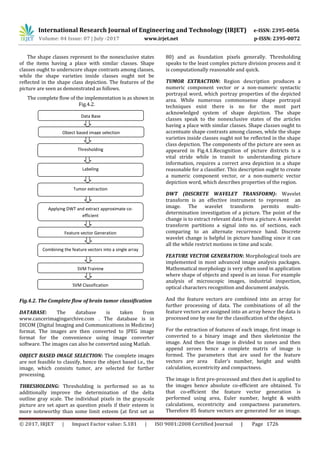
The complete flow of the implementation is as shown in
Fig.4.2.
Fig.4.2. The Complete flow of brain tumor classification
DATABASE: The database is taken from
www.cancerimagingarchive.com . The database is in
DICOM (Digital Imaging and Communications in Medicine)
format. The images are then converted to JPEG image
format for the convenience using image converter
software. The images can also be converted using Matlab.
OBJECT BASED IMAGE SELECTION: The complete images
are not feasible to classify, hence the object based i.e., the
image, which consists tumor, are selected for further
processing.
THRESHOLDING: Thresholding is performed so as to
additionally improve the determination of the delta
outline gray scale. The individual pixels in the grayscale
picture are set apart as question pixels if their esteem is
more noteworthy than some limit esteem (at first set as
80) and as foundation pixels generally. Thresholding
speaks to the least complex picture division process and it
is computationally reasonable and quick.
TUMOR EXTRACTION: Region description produces a
numeric component vector or a non-numeric syntactic
portrayal word, which portray properties of the depicted
area. While numerous commonsense shape portrayal
techniques exist there is no for the most part
acknowledged system of shape depiction. The shape
classes speak to the nonexclusive states of the articles
having a place with similar classes. Shape classes ought to
accentuate shape contrasts among classes, while the shape
varieties inside classes ought not be reflected in the shape
class depiction. The components of the picture are seen as
appeared in Fig.4.1.Recognition of picture districts is a
vital stride while in transit to understanding picture
information, requires a correct area depiction in a shape
reasonable for a classifier. This description ought to create
a numeric component vector, or a non-numeric vector
depiction word, which describes properties of the region.
DWT (DISCRETE WAVELET TRANSFORM): Wavelet
transform is an effective instrument to represent an
image. The wavelet transform permits multi-
determination investigation of a picture. The point of the
change is to extract relevant data from a picture. A wavelet
transform partitions a signal into no. of sections, each
comparing to an alternate recurrence band. Discrete
wavelet change is helpful in picture handling since it can
all the while restrict motions in time and scale.
FEATURE VECTOR GENERATION: Morphological tools are
implemented in most advanced image analysis packages.
Mathematical morphology is very often used in application
where shape of objects and speed is an issue. For example
analysis of microscopic images, industrial inspection,
optical characters recognition and document analysis.
And the feature vectors are combined into an array for
further processing of data. The combinations of all the
feature vectors are assigned into an array hence the data is
processed one by one for the classification of the object.
For the extraction of features of each image, first image is
converted to a binary image and then skeletonize the
image. And then the image is divided to zones and then
append zeroes hence a complete matrix of image is
formed. The parameters that are used for the feature
vectors are area Euler’s number, height and width
calculation, eccentricity and compactness.
The image is first pre-processed and then dwt is applied to
the images hence absolute co-efficient are obtained. To
that co-efficient the feature vector generation is
performed using area, Euler number, height & width
calculations, eccentricity and compactness parameters.
Therefore 85 feature vectors are generated for an image.
SVM Classification
SVM Training
Combining the feature vectors into a single array
Feature vector Generation
Applying DWT and extract approximate co-
efficient
Tumor extraction
Labeling
Thresholding
Object based image selection
Data Base
International Research Journal of Engineering and Technology (IRJET) e-ISSN: 2395-0056
Volume: 04 Issue: 07 | July -2017 www.irjet.net p-ISSN: 2395-0072
© 2017, IRJET | Impact Factor value: 5.181 | ISO 9001:2008 Certified Journal | Page 1727
As I considered 27 images for tumor classification, 27X85
array has form to train svm. By combining these feature
vectors 27X85 matrix is formed which is directly fed to the
SVM.
SVM TRAINING: Train an svm classifier with the svmtrain
function. The most common syntax is
SVMStruct=svmtrain(data, groups, ’kernel_function’, rbf);
data: Matrix of data points, where each column is one
feature.
groups: Column vector with each row corresponding to
the value of the corresponding row in data. Groups should
have only two types of entries. So groups can have logical
entries or can be a double vector or cell array with two
values.
SVM CLASSIFICATION: Support vectors are the data
points that lie closest to the decision surface. They are the
most difficult to classify. They have direct bearing on the
optimum location of the decision surface. We can show
that the optimal hyper plane stems from the function class
with the lowest capacity (VC dimension).
Support vector machines maximize the margin around the
separating hyper plane, The decision function is fully
specified by a subset of training samples, the support
vectors, Quadratic programming problem.
Evaluation: The database was in DICOM (Digital Imaging
and Communications in Medicine) format. The standard
encourages interoperability of medicinal imaging gear by
indicating and a restorative index structure to encourage
access to the pictures and related information stored on
trade media.
The basic database was in DICOM format, hence converted
into jpg format using image converter software. The
database after the extraction of the shape using
thresholding of the intensity of the border of the shape.
From each image basing on the intensity of image using
imtool for calculating the intensity of the image and the
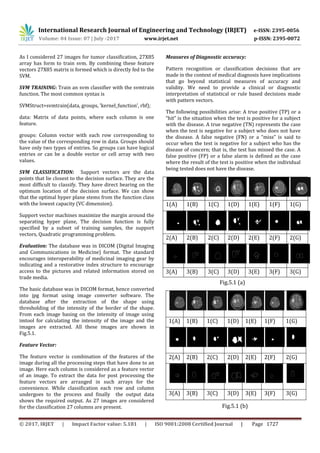
images are extracted. All these images are shown in
Fig.5.1.
Feature Vector:
The feature vector is combination of the features of the
image during all the processing steps that have done to an
image. Here each column is considered as a feature vector
of an image. To extract the data for post processing the
feature vectors are arranged in such arrays for the
convenience. While classification each row and column
undergoes to the process and finally the output data
shows the required output. As 27 images are considered
for the classification 27 columns are present.
Measures of Diagnostic accuracy:
Pattern recognition or classification decisions that are
made in the context of medical diagnosis have implications
that go beyond statistical measures of accuracy and
validity. We need to provide a clinical or diagnostic
interpretation of statistical or rule based decisions made
with pattern vectors.
The following possibilities arise: A true positive (TP) or a
“hit” is the situation when the test is positive for a subject
with the disease. A true negative (TN) represents the case
when the test is negative for a subject who does not have
the disease. A false negative (FN) or a “miss” is said to
occur when the test is negative for a subject who has the
disease of concern; that is, the test has missed the case. A
false positive (FP) or a false alarm is defined as the case
where the result of the test is positive when the individual
being tested does not have the disease.
1(A) 1(B) 1(C) 1(D) 1(E) 1(F) 1(G)
2(A) 2(B) 2(C) 2(D) 2(E) 2(F) 2(G)
3(A) 3(B) 3(C) 3(D) 3(E) 3(F) 3(G)
Fig.5.1 (a)
1(A) 1(B) 1(C) 1(D) 1(E) 1(F) 1(G)
2(A) 2(B) 2(C) 2(D) 2(E) 2(F) 2(G)
3(A) 3(B) 3(C) 3(D) 3(E) 3(F) 3(G)
Fig.5.1 (b)
International Research Journal of Engineering and Technology (IRJET) e-ISSN: 2395-0056
Volume: 04 Issue: 07 | July -2017 www.irjet.net p-ISSN: 2395-0072
© 2017, IRJET | Impact Factor value: 5.181 | ISO 9001:2008 Certified Journal | Page 1728
1(A) 1(B) 1(C) 1(D) 1(E) 1(F) 1(G)
2(A) 2(B) 2(C) 2(D) 2(E) 2(F) 2(G)
3(A) 3(B) 3(C) 3(D) 3(E) 3(F) 3(G)
Fig.5.1 (c)
1(A) 1(B) 1(C) 1(D) 1(E) 1(F)
2(A) 2(B) 2(C) 2(D) 2(E) 2(F)
3(A) 3(B) 3(C) 3(D) 3(E) 3(F)
Fig.5.1 (d)
Fig.5.1 Table of images
The first row of each table is the basic images, which are
converted to jpg format from DICOM format. In addition,
the second row indicates the shape extracted images of the
corresponding basic images. Finally, the third row shows
the region extracted images respectively.
SIMULINK MODEL FOR SVM CLASSIFICATION OF
BRAIN TUMORS:
F is the matrix of the feature vectors i.e., 27X85 array that
is given as input to the svm classification function.
Moreover, the corresponding output of the svm
classification. The results are shown in the command
window of the MATLAB.
Here the count value “0” is indicated as cancerous tumor
whereas count value “1” is indicated as non-cancerous
tumor.
3. CONCLUSIONS
This paper presents an prototype for object detection
with SVMs that can achieve real-time performance while
maintaining high detection accuracies. 82% of accuracy is
obtained and the positive predictive values (PPV) 81.48%,
Negative predictive value (NPV) are calculated. The True
positive cases are 22; True negative 5, False positive 5 and
False negative are 22. Furthermore, the same prototype
can be used for different application regardless of the
window size, number of support vectors, and image size.
REFERENCES
[1] C. Cortes and V. Vapnik, “Support-Vector Networks,”
Machine Learning, vol. 20, no. 3, pp. 273-297, 1995.
[2] H. Sahbi, D. Geman, and N. Boujemaa, “Face Detection
Using Coarse-to-Fine Support Vector Classifiers,”
Proc. Int’l Conf. Image Processing, pp. 925-928,
2002.
International Research Journal of Engineering and Technology (IRJET) e-ISSN: 2395-0056
Volume: 04 Issue: 07 | July -2017 www.irjet.net p-ISSN: 2395-0072
© 2017, IRJET | Impact Factor value: 5.181 | ISO 9001:2008 Certified Journal | Page 1729
[3] E. Osuna, R. Freund, and F. Girosi, “Training Support
Vector Machines: An Application to Face
Detection,” Proc. IEEE Conf. Computer Vision and
Pattern Recognition, pp. 130-136, 1997.
[4] Gudivada VN and Raghavan VV_ Content_based image
retrieval systems_IEEE Computer, 28(9):18-22,1995.
[5] Chezmar JL_ Robbins SM_ Nelson RC_ Steinberg HV_
Torres WE_ and Bernardino ME_ Adrenal masses_
Characterization with T1-weighted MR imaging_
Radiology. 166(2):357-359,1988.
[6] C.Cortes and Vapnik, “Support Vector Networks,”
Machine Learning, vol. 20, no.3, pp. 273-297, 1995.
[7] V.Vapnik, The Nature of statistical learning theory.
Springer-Verlag, 1995.
BIOGRAPHIES
N.Vani working as Assistant
Professor, SBIT & done M.Tech in
VLSI. Interested in Image
Processing.
A.Sowmya working as Assistant
Professor, SBIT & done M.Tech in
ECE. Interested in Image
Processing.
N.Jayamma working as Assistant
Professor, SBIT & done M.Tech in
ES. Interested in Signal Processing.
Figure 1

Brain Tumor Classification using Support Vector Machine

  • 1.
    International Research Journalof Engineering and Technology (IRJET) e-ISSN: 2395-0056 Volume: 04 Issue: 07 | July -2017 www.irjet.net p-ISSN: 2395-0072 © 2017, IRJET | Impact Factor value: 5.181 | ISO 9001:2008 Certified Journal | Page 1724 Brain Tumor Classification using Support Vector Machine N.Vani1, A.Sowmya2, N.Jayamma3 1,2,3Assistant Professor, Dept of electronics & Communication Engineering,SBIT college,Telangana,India ---------------------------------------------------------------------***--------------------------------------------------------------------- Abstract - Object detection plays a major role in many areas like medical imaging, aerial surveillance, optimal manipulation and analysis, surgical microscopes, etc. The objective of this paper is to develop a model for brain tumors detection and classification i.e., to classify whether the tumor is cancerous or non-cancerous using SVM algorithm. Earlier many have detected using ANN which works on Empirical Risk Minimization. We are using Support Vector Machine algorithm that works on structural risk minimization to classify the images. The SVM algorithm is applied to medical images for the tumor extraction, and a Simulink model is developed for the tumor classification function. This paper presents a prototype for SVM-based object detection, which classifies the images and evaluates whether the classified image is cancerous or non-cancerous. Key Words: Image processing, SVM, Simulink, Object detection 1.INTRODUCTION Brain tumors are the most common issue in children. Approximately 3,410 children and adolescents under age 20 are diagnosed with primary brain tumors each year. Brain tumors, either malignant or benign, that originate in the cells of the brain. Brain tumor detection and segmentation in magnetic resonance images (MRI) because it provides information associated with anatomical structures as well as potential abnormal tissues necessary to treatment planning and patient follow-up. The segmentation of brain tumors can likewise be useful for general demonstrating of neurotic brains and the development of obsessive cerebrum brain atlases. [1] Upgrades in database innovation, figuring execution and man-made brainpower have added to the improvement of clever information investigation. The support vector machine has been created as a hearty apparatus for order and relapse in loud, complex spaces. Not at all like conventional strategies which limit the observational preparing mistake. Bolster vector machine goes for limiting an upper bound of the speculation mistake through amplifying the edge between isolating hyper plane and the information. This can be viewed as a surmised usage of the Structure Risk Minimization guideline. By picking various types of bits, bolster vector machine can understand Radial Basis Function (RBF), polynomial, straight, and multi-layer preceptor classifiers. A Simulink demonstrates is created for tumor grouping where is characterizes whether the tumor is dangerous or non-carcinogenic. Where Simulink is a piece chart condition for multi area reenactment and model-based plan. It bolsters reenactment, programmed code era and consistent test and check of implanted frameworks. Simulink gives a graphical proofreader, adaptable piece libraries, and solvers for demonstrating and reenacting dynamic frameworks, The paper is organized as: Section 2 explains a brief overview of SVMs and object detection in Section 2. An overview of related SVM implementation is presented in Section 3 and the brain tumor classification and its evaluation are presented in Section 4. Finally, Section 5 concludes the paper, with some possible future directions. 2. Support Vector Machine A support vector machine (SVM) is a supervised learning algorithm based on statistical learning theory. Given a labeled data set (training set), D= {|x,y||x  data sample, y class label}, an SVM tries to compute a mapping function f such that f(x) = y for all samples in the data set. This mapping function describes the relationship between the data samples and their respective class labels; and is used to classify new unknown data. Classification in the context of SVMs is done using the following classification decision function (a process called the feed-forward phase) ( ) (∑ ( ) ) in which are the alpha coefficients, are the class labels of the support vectors, are the support vectors, z is the input vector, K(z, ) is the chosen kernel function, and b is the bias. Linear : K(x, z) = x●z, Polynomial : K(x, z) = ((x●z)+1)d , d>0, RBF : K(x, z) = exp(-||x-z||2 /(2σ2)). Support Vector Machines – Explores the idea of transforming the input domain into high dimensional space to optimize over best of the best classification function which otherwise is capable to realize. SVM can realize RBF and multi-layer perceptron.
  • 2.
    International Research Journalof Engineering and Technology (IRJET) e-ISSN: 2395-0056 Volume: 04 Issue: 07 | July -2017 www.irjet.net p-ISSN: 2395-0072 © 2017, IRJET | Impact Factor value: 5.181 | ISO 9001:2008 Certified Journal | Page 1725 Method: The procedure of image object detection manages deciding if a protest of intrigue is available in a picture or not. A image object detection framework gets an information picture, which will consequently hunt to discover conceivable objects of intrigue. This hunt is finished by removing littler districts from the edge, called look windows, of m x n pixels which experience some type of preprocessing (histogram equalization, highlight extraction), and are then handled by a classification algorithm to decide whether they contain a protest of intrigue or not. In any case, the protest of intrigue may have a bigger size than that of the pursuit window, and given that the arrangement calculation is prepared for a particular inquiry window estimate, the question recognition framework must have a component to deal with bigger articles. Overview of SVM Implementations Fig.4.2. SVM implementation The working flow is as shown in the above flow chart. Image Pre-processing Pre-processing is the name used for operations on images at the lowest level of abstraction. In this paper the pre-processing includes: - From the image database the images are to be selected for which the tumor classification has to be performed. - For the selected images, the following steps are applied. • Thresholding • Pixel – brightness transformation • Image restoration • Geometric transformations • Local pre-processing Feature detection and extraction Recognition of image regions is an important step on the way to understanding image data and requires an exact region description in a form suitable for a classifier. This description should generate a numeric feature vector or a non-numeric syntactic description word which characterizes properties of the region. Defining the shape of an object can prove to be very difficult. Shape is usually represented verbally or in figures and people use terms such as elongated, rounded with sharp edges etc. Shape representation & description  Region description generates a numeric feature vector or a non-numeric syntactic description word that characterize properties of the described region.  While many practical shape description methods exist there is no generally accepted methodology of shape description. Facilitate it is not realized what is essential fit as a fiddle.  The shape classes represent the generic shapes of the objects belonging to the same classes.  Using the pixel brightness or the pixel value (using imtool), the shape of the tumor is extracted. By varying the pixel value the tumor is extracted because the intensity value of image varies from one to another. It takes time to extract the shape but once you finished the job it need not to do be done again. Region identification Region identification assigns unique labels to image regions. If non- repeating ordered numerical labels are used the largest integer label gives the no. of regions in the image. Brain tumor classification and its evaluation Straightforward geometric locale descriptors utilize geometric properties of depicted region: o Euler’s number o Area o Eccentricity o Height , width o Compactness Image Database Image Pre-Processing Feature Extraction Target Identification SVM Classification SVM Training
  • 3.
    International Research Journalof Engineering and Technology (IRJET) e-ISSN: 2395-0056 Volume: 04 Issue: 07 | July -2017 www.irjet.net p-ISSN: 2395-0072 © 2017, IRJET | Impact Factor value: 5.181 | ISO 9001:2008 Certified Journal | Page 1726 The shape classes represent to the nonexclusive states of the items having a place with similar classes. Shape classes ought to underscore shape contrasts among classes, while the shape varieties inside classes ought not be reflected in the shape class depiction. The features of the picture are seen as demonstrated as follows. The complete flow of the implementation is as shown in Fig.4.2. Fig.4.2. The Complete flow of brain tumor classification DATABASE: The database is taken from www.cancerimagingarchive.com . The database is in DICOM (Digital Imaging and Communications in Medicine) format. The images are then converted to JPEG image format for the convenience using image converter software. The images can also be converted using Matlab. OBJECT BASED IMAGE SELECTION: The complete images are not feasible to classify, hence the object based i.e., the image, which consists tumor, are selected for further processing. THRESHOLDING: Thresholding is performed so as to additionally improve the determination of the delta outline gray scale. The individual pixels in the grayscale picture are set apart as question pixels if their esteem is more noteworthy than some limit esteem (at first set as 80) and as foundation pixels generally. Thresholding speaks to the least complex picture division process and it is computationally reasonable and quick. TUMOR EXTRACTION: Region description produces a numeric component vector or a non-numeric syntactic portrayal word, which portray properties of the depicted area. While numerous commonsense shape portrayal techniques exist there is no for the most part acknowledged system of shape depiction. The shape classes speak to the nonexclusive states of the articles having a place with similar classes. Shape classes ought to accentuate shape contrasts among classes, while the shape varieties inside classes ought not be reflected in the shape class depiction. The components of the picture are seen as appeared in Fig.4.1.Recognition of picture districts is a vital stride while in transit to understanding picture information, requires a correct area depiction in a shape reasonable for a classifier. This description ought to create a numeric component vector, or a non-numeric vector depiction word, which describes properties of the region. DWT (DISCRETE WAVELET TRANSFORM): Wavelet transform is an effective instrument to represent an image. The wavelet transform permits multi- determination investigation of a picture. The point of the change is to extract relevant data from a picture. A wavelet transform partitions a signal into no. of sections, each comparing to an alternate recurrence band. Discrete wavelet change is helpful in picture handling since it can all the while restrict motions in time and scale. FEATURE VECTOR GENERATION: Morphological tools are implemented in most advanced image analysis packages. Mathematical morphology is very often used in application where shape of objects and speed is an issue. For example analysis of microscopic images, industrial inspection, optical characters recognition and document analysis. And the feature vectors are combined into an array for further processing of data. The combinations of all the feature vectors are assigned into an array hence the data is processed one by one for the classification of the object. For the extraction of features of each image, first image is converted to a binary image and then skeletonize the image. And then the image is divided to zones and then append zeroes hence a complete matrix of image is formed. The parameters that are used for the feature vectors are area Euler’s number, height and width calculation, eccentricity and compactness. The image is first pre-processed and then dwt is applied to the images hence absolute co-efficient are obtained. To that co-efficient the feature vector generation is performed using area, Euler number, height & width calculations, eccentricity and compactness parameters. Therefore 85 feature vectors are generated for an image. SVM Classification SVM Training Combining the feature vectors into a single array Feature vector Generation Applying DWT and extract approximate co- efficient Tumor extraction Labeling Thresholding Object based image selection Data Base
  • 4.
    International Research Journalof Engineering and Technology (IRJET) e-ISSN: 2395-0056 Volume: 04 Issue: 07 | July -2017 www.irjet.net p-ISSN: 2395-0072 © 2017, IRJET | Impact Factor value: 5.181 | ISO 9001:2008 Certified Journal | Page 1727 As I considered 27 images for tumor classification, 27X85 array has form to train svm. By combining these feature vectors 27X85 matrix is formed which is directly fed to the SVM. SVM TRAINING: Train an svm classifier with the svmtrain function. The most common syntax is SVMStruct=svmtrain(data, groups, ’kernel_function’, rbf); data: Matrix of data points, where each column is one feature. groups: Column vector with each row corresponding to the value of the corresponding row in data. Groups should have only two types of entries. So groups can have logical entries or can be a double vector or cell array with two values. SVM CLASSIFICATION: Support vectors are the data points that lie closest to the decision surface. They are the most difficult to classify. They have direct bearing on the optimum location of the decision surface. We can show that the optimal hyper plane stems from the function class with the lowest capacity (VC dimension). Support vector machines maximize the margin around the separating hyper plane, The decision function is fully specified by a subset of training samples, the support vectors, Quadratic programming problem. Evaluation: The database was in DICOM (Digital Imaging and Communications in Medicine) format. The standard encourages interoperability of medicinal imaging gear by indicating and a restorative index structure to encourage access to the pictures and related information stored on trade media. The basic database was in DICOM format, hence converted into jpg format using image converter software. The database after the extraction of the shape using thresholding of the intensity of the border of the shape. From each image basing on the intensity of image using imtool for calculating the intensity of the image and the images are extracted. All these images are shown in Fig.5.1. Feature Vector: The feature vector is combination of the features of the image during all the processing steps that have done to an image. Here each column is considered as a feature vector of an image. To extract the data for post processing the feature vectors are arranged in such arrays for the convenience. While classification each row and column undergoes to the process and finally the output data shows the required output. As 27 images are considered for the classification 27 columns are present. Measures of Diagnostic accuracy: Pattern recognition or classification decisions that are made in the context of medical diagnosis have implications that go beyond statistical measures of accuracy and validity. We need to provide a clinical or diagnostic interpretation of statistical or rule based decisions made with pattern vectors. The following possibilities arise: A true positive (TP) or a “hit” is the situation when the test is positive for a subject with the disease. A true negative (TN) represents the case when the test is negative for a subject who does not have the disease. A false negative (FN) or a “miss” is said to occur when the test is negative for a subject who has the disease of concern; that is, the test has missed the case. A false positive (FP) or a false alarm is defined as the case where the result of the test is positive when the individual being tested does not have the disease. 1(A) 1(B) 1(C) 1(D) 1(E) 1(F) 1(G) 2(A) 2(B) 2(C) 2(D) 2(E) 2(F) 2(G) 3(A) 3(B) 3(C) 3(D) 3(E) 3(F) 3(G) Fig.5.1 (a) 1(A) 1(B) 1(C) 1(D) 1(E) 1(F) 1(G) 2(A) 2(B) 2(C) 2(D) 2(E) 2(F) 2(G) 3(A) 3(B) 3(C) 3(D) 3(E) 3(F) 3(G) Fig.5.1 (b)
  • 5.
    International Research Journalof Engineering and Technology (IRJET) e-ISSN: 2395-0056 Volume: 04 Issue: 07 | July -2017 www.irjet.net p-ISSN: 2395-0072 © 2017, IRJET | Impact Factor value: 5.181 | ISO 9001:2008 Certified Journal | Page 1728 1(A) 1(B) 1(C) 1(D) 1(E) 1(F) 1(G) 2(A) 2(B) 2(C) 2(D) 2(E) 2(F) 2(G) 3(A) 3(B) 3(C) 3(D) 3(E) 3(F) 3(G) Fig.5.1 (c) 1(A) 1(B) 1(C) 1(D) 1(E) 1(F) 2(A) 2(B) 2(C) 2(D) 2(E) 2(F) 3(A) 3(B) 3(C) 3(D) 3(E) 3(F) Fig.5.1 (d) Fig.5.1 Table of images The first row of each table is the basic images, which are converted to jpg format from DICOM format. In addition, the second row indicates the shape extracted images of the corresponding basic images. Finally, the third row shows the region extracted images respectively. SIMULINK MODEL FOR SVM CLASSIFICATION OF BRAIN TUMORS: F is the matrix of the feature vectors i.e., 27X85 array that is given as input to the svm classification function. Moreover, the corresponding output of the svm classification. The results are shown in the command window of the MATLAB. Here the count value “0” is indicated as cancerous tumor whereas count value “1” is indicated as non-cancerous tumor. 3. CONCLUSIONS This paper presents an prototype for object detection with SVMs that can achieve real-time performance while maintaining high detection accuracies. 82% of accuracy is obtained and the positive predictive values (PPV) 81.48%, Negative predictive value (NPV) are calculated. The True positive cases are 22; True negative 5, False positive 5 and False negative are 22. Furthermore, the same prototype can be used for different application regardless of the window size, number of support vectors, and image size. REFERENCES [1] C. Cortes and V. Vapnik, “Support-Vector Networks,” Machine Learning, vol. 20, no. 3, pp. 273-297, 1995. [2] H. Sahbi, D. Geman, and N. Boujemaa, “Face Detection Using Coarse-to-Fine Support Vector Classifiers,” Proc. Int’l Conf. Image Processing, pp. 925-928, 2002.
  • 6.
    International Research Journalof Engineering and Technology (IRJET) e-ISSN: 2395-0056 Volume: 04 Issue: 07 | July -2017 www.irjet.net p-ISSN: 2395-0072 © 2017, IRJET | Impact Factor value: 5.181 | ISO 9001:2008 Certified Journal | Page 1729 [3] E. Osuna, R. Freund, and F. Girosi, “Training Support Vector Machines: An Application to Face Detection,” Proc. IEEE Conf. Computer Vision and Pattern Recognition, pp. 130-136, 1997. [4] Gudivada VN and Raghavan VV_ Content_based image retrieval systems_IEEE Computer, 28(9):18-22,1995. [5] Chezmar JL_ Robbins SM_ Nelson RC_ Steinberg HV_ Torres WE_ and Bernardino ME_ Adrenal masses_ Characterization with T1-weighted MR imaging_ Radiology. 166(2):357-359,1988. [6] C.Cortes and Vapnik, “Support Vector Networks,” Machine Learning, vol. 20, no.3, pp. 273-297, 1995. [7] V.Vapnik, The Nature of statistical learning theory. Springer-Verlag, 1995. BIOGRAPHIES N.Vani working as Assistant Professor, SBIT & done M.Tech in VLSI. Interested in Image Processing. A.Sowmya working as Assistant Professor, SBIT & done M.Tech in ECE. Interested in Image Processing. N.Jayamma working as Assistant Professor, SBIT & done M.Tech in ES. Interested in Signal Processing. Figure 1