2022 25th International Conference on Computer and Information Technology (ICCIT)
Brain Tumor Segmentation using Enhanced
U-Net Model with Empirical Analysis
MD Abdullah Al Nasim | Abdullah Al Munem | Maksuda Islam | Md Aminul
Haque Palash | MD. Mahim Anjum Haque | Faisal Muhammad Shah
1
2022 25th International Conference on Computer and Information Technology (ICCIT)
Presentation Outline
 Motivation and Problem Statement
 Related Works
 Research Questions and Objectives
 Methodology
 Dataset
 Experimental Results
 Conclusion and Future Work
2
2022 25th International Conference on Computer and Information Technology (ICCIT)
Motivation and Problem Statement
3
• Brain Tumor is a deadly disease, and it requires semantic segmentation.
• Automated and semi-automatic segmentation techniques have allowed experts
to work more efficiently.
• MRI images of Brain Tumor has multiple and overlapping modalities, thus it is
difficult to segment.
2022 25th International Conference on Computer and Information Technology (ICCIT)
Related Work
4
• Agravat et al. [1] achieved 88.1% dice similarity on BraTS 2020 dataset using 3D encoder-decoder
FCNN model.
• Xu et al. [2] considered the correlations between the modalities of the BraTS dataset. They used
LSTM multi-modal 2D U-Net on BraTS 2015 dataset and achieved dice scores of 0.7309, 0.6235,
and 0.4254 for whole, core and enhancing tumor, respectively.
• Dong et al. [3] utilized 2D U-Net architecture on the BraTS 2015 dataset and gained dice scores of
0.86, 0.86, and 0.65 for whole, core, and enhancing tumors, respectively.
• Singh et al. [4] trained RCNN model using the BraTS 2020 dataset and got a precision of 0.79,
recall of 0.72, and dice coefficient of 0.75.
• Mobarakol et al. [5] integrated a 3D attention module of the decoder paths of simple U-Net
architecture and achieved mean dice scores of 0.704, 0.898, and 0.792, for enhancing tumor, whole,
and core respectively on BraTS 2019 Dataset.
2022 25th International Conference on Computer and Information Technology (ICCIT)
Research Questions and objectives
 Which model can give better
performance for brain tumor
segmentation?
 How to improve the model
performance?
5
 To develop model for brain
tumor segmentation.
 To design a suitable methods to
improve model performance
2022 25th International Conference on Computer and Information Technology (ICCIT)
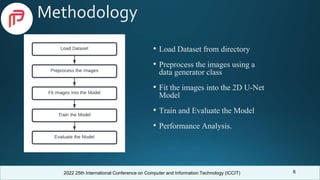
Methodology
• Load Dataset from directory
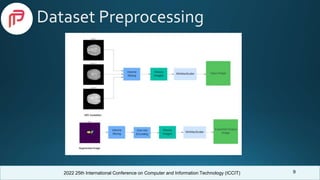
• Preprocess the images using a
data generator class
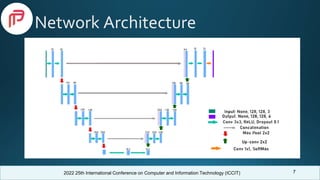
• Fit the images into the 2D U-Net
Model
• Train and Evaluate the Model
• Performance Analysis.
6
2022 25th International Conference on Computer and Information Technology (ICCIT)
Network Architecture
7
2022 25th International Conference on Computer and Information Technology (ICCIT)
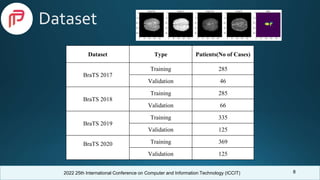
Dataset
Dataset Type Patients(No of Cases)
BraTS 2017
Training 285
Validation 46
BraTS 2018
Training 285
Validation 66
BraTS 2019
Training 335
Validation 125
BraTS 2020 Training 369
Validation 125
8
2022 25th International Conference on Computer and Information Technology (ICCIT)
Dataset Preprocessing
9
2022 25th International Conference on Computer and Information Technology (ICCIT)
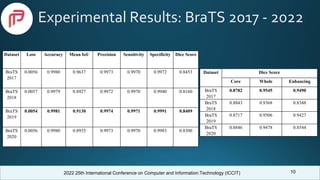
Experimental Results: BraTS 2017 - 2022
Dataset Loss Accuracy Mean IoU Precision Sensitivity Specificity Dice Score
BraTS
2017
0.0056 0.9980 0.9637 0.9973 0.9970 0.9972 0.8453
BraTS
2018
0.0057 0.9979 0.8927 0.9972 0.9970 0.9940 0.8160
BraTS
2019
0.0054 0.9981 0.9130 0.9974 0.9971 0.9991 0.8409
BraTS
2020
0.0056 0.9980 0.8935 0.9973 0.9970 0.9983 0.8300
10
Dataset Dice Score
Core Whole Enhancing
BraTS
2017
0.8782 0.9545 0.9490
BraTS
2018
0.8843 0.9368 0.8348
BraTS
2019
0.8717 0.9506 0.9427
BraTS
2020
0.8846 0.9478 0.8544
2022 25th International Conference on Computer and Information Technology (ICCIT)
Comparison With Previous Works
Model
Dataset
(BraTS)
Dice Score
Core Whole Enhancing
SVM [6] 2012 0.61 0.71 0.73
Random
Forest [7]
2012 0.73 0.59 -
Random
Forest [8]
2013 0.70 0.76 0.67
2D CNN [8] 2013 0.73 0.83 0.69
3D CNN [9] 2015 0.73 0.87 0.77
3D encoder-
decoder
FCNN [1]
2020 0.83 0.88 0.78
3D FCNN
[10]
2020 0.74 0.88 0.71
Our
Proposed
Model
2019 0.871 0.95 0.94
11
Model Dataset
(BraTS)
Accuracy Sensitivity /
Recall
Specificity
R-CNN
[11]
2020 - 0.72 -
LeNET
[12]
2019 0.944 0.956 0.945
AlexNET
[12]
2019 0.961 0.952 0.951
R-CNN
[13]
2018 0.963 0.935 0.972
Hybrid
Fast
R-CNN
& SVM
[14]
2015 0.987 - -
Our
proposed
model
2019 0.998 0.997 0.999
2022 25th International Conference on Computer and Information Technology (ICCIT)
Conclusion and Future Work
12
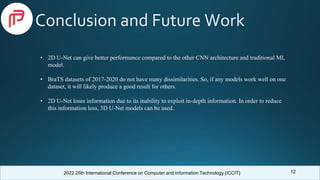
• 2D U-Net can give better performance compared to the other CNN architecture and traditional ML
model.
• BraTS datasets of 2017-2020 do not have many dissimilarities. So, if any models work well on one
dataset, it will likely produce a good result for others.
• 2D U-Net loses information due to its inability to exploit in-depth information. In order to reduce
this information loss, 3D U-Net models can be used.
2022 25th International Conference on Computer and Information Technology (ICCIT)
Selected References
 [1] R. R. Agravat and M. S. Raval, “3d semantic segmentation of brain tumor for overall survival prediction,” in International MICCAI Brainlesion
Workshop. Springer, 2020, pp. 215–227.
 [2] F. Xu, H. Ma, J. Sun, R. Wu, X. Liu, and Y. Kong, “Lstm multi-modal unet for brain tumor segmentation,” in 2019 IEEE 4th international conference
on image, vision and computing (ICIVC). IEEE, 2019, pp. 236–240.
 [3] H. Dong, G. Yang, F. Liu, Y. Mo, and Y. Guo, “Automatic brain tumor detection and segmentation using u-net based fully convolutional networks,” in
annual conference on medical image understanding and analysis. Springer, 2017, pp. 506–517.
 [4] S. Singh, “A novel mask r-cnn model to segment heterogeneous brain tumors through image subtraction,” arXiv preprint arXiv:2204.01201, 2022.
 [5] M. Islam, V. Vibashan, V. Jose, N. Wijethilake, U. Utkarsh, and H. Ren, “Brain tumor segmentation and survival prediction using 3d attention unet,” in
International MICCAI Brainlesion Workshop. Springer, 2019, pp. 262–272.
 [6] S. Bauer, L.-P. Nolte, and M. Reyes, “Fully automatic segmentation of brain tumor images using support vector machine classification in combination
with hierarchical conditional random field regularization,” in International conference on medical image computing and computerassisted intervention.
Springer, 2011, pp. 354–361
 [7] S. Bauer, T. Fejes, J. Slotboom, R. Wiest, L.-P. Nolte, and M. Reyes, “Segmentation of brain tumor images based on integrated hierarchical
classification and regularization,” in MICCAI BraTS Workshop. Nice: Miccai Society, vol. 11, 2012.
13
2022 25th International Conference on Computer and Information Technology (ICCIT)
Selected References
 [8] D. Zikic, Y. Ioannou, M. Brown, and A. Criminisi, “Segmentation of brain tumor tissues with convolutional neural networks,” Proceedings MICCAI-
BRATS, vol. 36, no. 2014, pp. 36–39, 2014.
 [9] K. Kamnitsas, E. Ferrante, S. Parisot, C. Ledig, A. V. Nori, A. Criminisi, D. Rueckert, and B. Glocker, “Deepmedic for brain tumor segmentation,” in
International workshop on Brainlesion: Glioma, multiple sclerosis, stroke and traumatic brain injuries. Springer, 2016, pp. 138–149
 [10] V. K. Anand, S. Grampurohit, P. Aurangabadkar, A. Kori, M. Khened, R. S. Bhat, and G. Krishnamurthi, “Brain tumor segmentation and survival
prediction using automatic hard mining in 3d cnn architecture,” in International MICCAI Brainlesion Workshop. Springer, 2020, pp.310–319.
 [11] R. Raza, U. I. Bajwa, Y. Mehmood, M. W. Anwar, and M. H. Jamal, “dresu-net: 3d deep residual u-net based brain tumor segmentation from
multimodal mri,” Biomedical Signal Processing and Control, p. 103861, 2022.
 [12] M. Gomathi and D. Dhanasekaran, “Glioma detection and segmentation using deep learning architectures,” Mathematical Statistician and Engineering
Applications, vol. 71, no. 4, pp. 452–461, 2022.
 [13] Y. Zhuge, H. Ning, P. Mathen, J. Y. Cheng, A. V. Krauze, K. Camphausen, and R. W. Miller, “Automated glioma grading on conventional mri images
using deep convolutional neural networks,” Medical physics, vol. 47, no. 7, pp. 3044–3053, 2020.
 [14] M. O. Khairandish, R. Gurta, and M. Sharma, “A hybrid model of faster r-cnn and svm for tumor detection and classification of mri brain images,” Int.
J. Mech. Prod. Eng. Res. Dev, vol. 10, no. 3, pp. 6863–6876, 2020.
14
2022 25th International Conference on Computer and Information Technology (ICCIT)
Thank You
15

Brain Tumor Segmentation using Enhanced U-Net Model with Empirical Analysis

  • 1.
    2022 25th InternationalConference on Computer and Information Technology (ICCIT) Brain Tumor Segmentation using Enhanced U-Net Model with Empirical Analysis MD Abdullah Al Nasim | Abdullah Al Munem | Maksuda Islam | Md Aminul Haque Palash | MD. Mahim Anjum Haque | Faisal Muhammad Shah 1
  • 2.
    2022 25th InternationalConference on Computer and Information Technology (ICCIT) Presentation Outline  Motivation and Problem Statement  Related Works  Research Questions and Objectives  Methodology  Dataset  Experimental Results  Conclusion and Future Work 2
  • 3.
    2022 25th InternationalConference on Computer and Information Technology (ICCIT) Motivation and Problem Statement 3 • Brain Tumor is a deadly disease, and it requires semantic segmentation. • Automated and semi-automatic segmentation techniques have allowed experts to work more efficiently. • MRI images of Brain Tumor has multiple and overlapping modalities, thus it is difficult to segment.
  • 4.
    2022 25th InternationalConference on Computer and Information Technology (ICCIT) Related Work 4 • Agravat et al. [1] achieved 88.1% dice similarity on BraTS 2020 dataset using 3D encoder-decoder FCNN model. • Xu et al. [2] considered the correlations between the modalities of the BraTS dataset. They used LSTM multi-modal 2D U-Net on BraTS 2015 dataset and achieved dice scores of 0.7309, 0.6235, and 0.4254 for whole, core and enhancing tumor, respectively. • Dong et al. [3] utilized 2D U-Net architecture on the BraTS 2015 dataset and gained dice scores of 0.86, 0.86, and 0.65 for whole, core, and enhancing tumors, respectively. • Singh et al. [4] trained RCNN model using the BraTS 2020 dataset and got a precision of 0.79, recall of 0.72, and dice coefficient of 0.75. • Mobarakol et al. [5] integrated a 3D attention module of the decoder paths of simple U-Net architecture and achieved mean dice scores of 0.704, 0.898, and 0.792, for enhancing tumor, whole, and core respectively on BraTS 2019 Dataset.
  • 5.
    2022 25th InternationalConference on Computer and Information Technology (ICCIT) Research Questions and objectives  Which model can give better performance for brain tumor segmentation?  How to improve the model performance? 5  To develop model for brain tumor segmentation.  To design a suitable methods to improve model performance
  • 6.
    2022 25th InternationalConference on Computer and Information Technology (ICCIT) Methodology • Load Dataset from directory • Preprocess the images using a data generator class • Fit the images into the 2D U-Net Model • Train and Evaluate the Model • Performance Analysis. 6
  • 7.
    2022 25th InternationalConference on Computer and Information Technology (ICCIT) Network Architecture 7
  • 8.
    2022 25th InternationalConference on Computer and Information Technology (ICCIT) Dataset Dataset Type Patients(No of Cases) BraTS 2017 Training 285 Validation 46 BraTS 2018 Training 285 Validation 66 BraTS 2019 Training 335 Validation 125 BraTS 2020 Training 369 Validation 125 8
  • 9.
    2022 25th InternationalConference on Computer and Information Technology (ICCIT) Dataset Preprocessing 9
  • 10.
    2022 25th InternationalConference on Computer and Information Technology (ICCIT) Experimental Results: BraTS 2017 - 2022 Dataset Loss Accuracy Mean IoU Precision Sensitivity Specificity Dice Score BraTS 2017 0.0056 0.9980 0.9637 0.9973 0.9970 0.9972 0.8453 BraTS 2018 0.0057 0.9979 0.8927 0.9972 0.9970 0.9940 0.8160 BraTS 2019 0.0054 0.9981 0.9130 0.9974 0.9971 0.9991 0.8409 BraTS 2020 0.0056 0.9980 0.8935 0.9973 0.9970 0.9983 0.8300 10 Dataset Dice Score Core Whole Enhancing BraTS 2017 0.8782 0.9545 0.9490 BraTS 2018 0.8843 0.9368 0.8348 BraTS 2019 0.8717 0.9506 0.9427 BraTS 2020 0.8846 0.9478 0.8544
  • 11.
    2022 25th InternationalConference on Computer and Information Technology (ICCIT) Comparison With Previous Works Model Dataset (BraTS) Dice Score Core Whole Enhancing SVM [6] 2012 0.61 0.71 0.73 Random Forest [7] 2012 0.73 0.59 - Random Forest [8] 2013 0.70 0.76 0.67 2D CNN [8] 2013 0.73 0.83 0.69 3D CNN [9] 2015 0.73 0.87 0.77 3D encoder- decoder FCNN [1] 2020 0.83 0.88 0.78 3D FCNN [10] 2020 0.74 0.88 0.71 Our Proposed Model 2019 0.871 0.95 0.94 11 Model Dataset (BraTS) Accuracy Sensitivity / Recall Specificity R-CNN [11] 2020 - 0.72 - LeNET [12] 2019 0.944 0.956 0.945 AlexNET [12] 2019 0.961 0.952 0.951 R-CNN [13] 2018 0.963 0.935 0.972 Hybrid Fast R-CNN & SVM [14] 2015 0.987 - - Our proposed model 2019 0.998 0.997 0.999
  • 12.
    2022 25th InternationalConference on Computer and Information Technology (ICCIT) Conclusion and Future Work 12 • 2D U-Net can give better performance compared to the other CNN architecture and traditional ML model. • BraTS datasets of 2017-2020 do not have many dissimilarities. So, if any models work well on one dataset, it will likely produce a good result for others. • 2D U-Net loses information due to its inability to exploit in-depth information. In order to reduce this information loss, 3D U-Net models can be used.
  • 13.
    2022 25th InternationalConference on Computer and Information Technology (ICCIT) Selected References  [1] R. R. Agravat and M. S. Raval, “3d semantic segmentation of brain tumor for overall survival prediction,” in International MICCAI Brainlesion Workshop. Springer, 2020, pp. 215–227.  [2] F. Xu, H. Ma, J. Sun, R. Wu, X. Liu, and Y. Kong, “Lstm multi-modal unet for brain tumor segmentation,” in 2019 IEEE 4th international conference on image, vision and computing (ICIVC). IEEE, 2019, pp. 236–240.  [3] H. Dong, G. Yang, F. Liu, Y. Mo, and Y. Guo, “Automatic brain tumor detection and segmentation using u-net based fully convolutional networks,” in annual conference on medical image understanding and analysis. Springer, 2017, pp. 506–517.  [4] S. Singh, “A novel mask r-cnn model to segment heterogeneous brain tumors through image subtraction,” arXiv preprint arXiv:2204.01201, 2022.  [5] M. Islam, V. Vibashan, V. Jose, N. Wijethilake, U. Utkarsh, and H. Ren, “Brain tumor segmentation and survival prediction using 3d attention unet,” in International MICCAI Brainlesion Workshop. Springer, 2019, pp. 262–272.  [6] S. Bauer, L.-P. Nolte, and M. Reyes, “Fully automatic segmentation of brain tumor images using support vector machine classification in combination with hierarchical conditional random field regularization,” in International conference on medical image computing and computerassisted intervention. Springer, 2011, pp. 354–361  [7] S. Bauer, T. Fejes, J. Slotboom, R. Wiest, L.-P. Nolte, and M. Reyes, “Segmentation of brain tumor images based on integrated hierarchical classification and regularization,” in MICCAI BraTS Workshop. Nice: Miccai Society, vol. 11, 2012. 13
  • 14.
    2022 25th InternationalConference on Computer and Information Technology (ICCIT) Selected References  [8] D. Zikic, Y. Ioannou, M. Brown, and A. Criminisi, “Segmentation of brain tumor tissues with convolutional neural networks,” Proceedings MICCAI- BRATS, vol. 36, no. 2014, pp. 36–39, 2014.  [9] K. Kamnitsas, E. Ferrante, S. Parisot, C. Ledig, A. V. Nori, A. Criminisi, D. Rueckert, and B. Glocker, “Deepmedic for brain tumor segmentation,” in International workshop on Brainlesion: Glioma, multiple sclerosis, stroke and traumatic brain injuries. Springer, 2016, pp. 138–149  [10] V. K. Anand, S. Grampurohit, P. Aurangabadkar, A. Kori, M. Khened, R. S. Bhat, and G. Krishnamurthi, “Brain tumor segmentation and survival prediction using automatic hard mining in 3d cnn architecture,” in International MICCAI Brainlesion Workshop. Springer, 2020, pp.310–319.  [11] R. Raza, U. I. Bajwa, Y. Mehmood, M. W. Anwar, and M. H. Jamal, “dresu-net: 3d deep residual u-net based brain tumor segmentation from multimodal mri,” Biomedical Signal Processing and Control, p. 103861, 2022.  [12] M. Gomathi and D. Dhanasekaran, “Glioma detection and segmentation using deep learning architectures,” Mathematical Statistician and Engineering Applications, vol. 71, no. 4, pp. 452–461, 2022.  [13] Y. Zhuge, H. Ning, P. Mathen, J. Y. Cheng, A. V. Krauze, K. Camphausen, and R. W. Miller, “Automated glioma grading on conventional mri images using deep convolutional neural networks,” Medical physics, vol. 47, no. 7, pp. 3044–3053, 2020.  [14] M. O. Khairandish, R. Gurta, and M. Sharma, “A hybrid model of faster r-cnn and svm for tumor detection and classification of mri brain images,” Int. J. Mech. Prod. Eng. Res. Dev, vol. 10, no. 3, pp. 6863–6876, 2020. 14
  • 15.
    2022 25th InternationalConference on Computer and Information Technology (ICCIT) Thank You 15