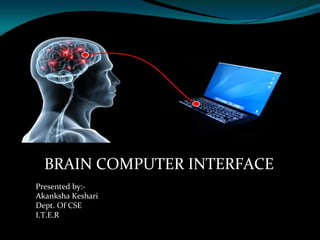
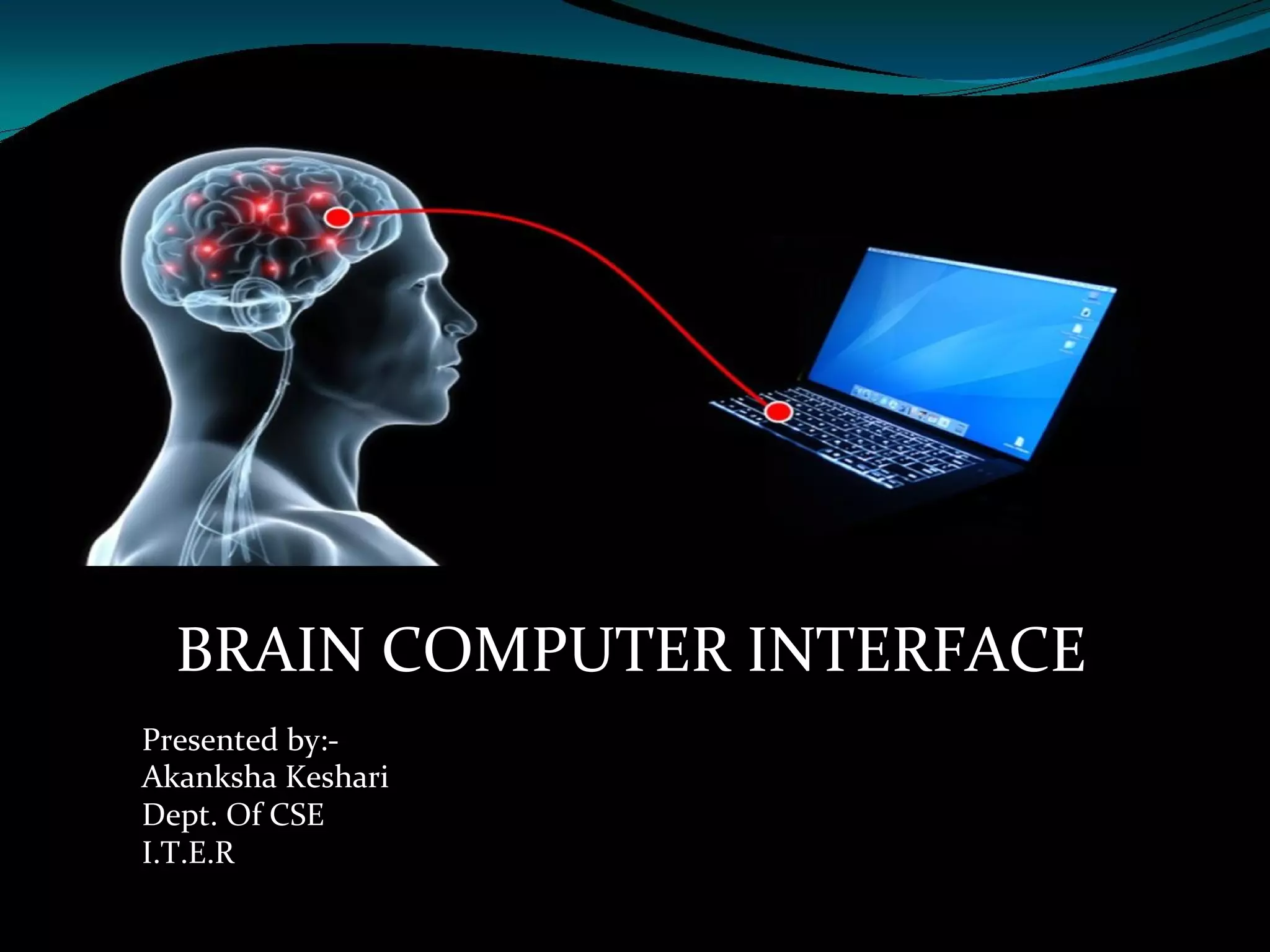
BRAIN COMPUTER INTERFACE
Presented by:-
Akanksha Keshari
Dept. Of CSE
I.T.E.R
Talk flow:
 BCI
 History
 Functioning of BCI
 Working Architecture
 Types of BCI
 Applications
 Advantages
 Disadvantage
 Conclusion
 References
BCI:
•What is BCI?
•What is the major goal of BCI?
•What does BCI Research area include?
•Who is Jacques Vidal?
History:
•1924, Hans Berger, a German neurologist was the 1st
to record
human brain activity by means of Electrocephalography (EEG) .
•1970 - Research on BCIs began at the University of California, Los
Angeles(UCLA).
•1978 - A prototype was implanted into a man blinded into adulthood.
•Mid 1990 – animal experiment the 1st
neuroprosthetic device implanted
into humans.
•2005 – Matthew Magle was the 1st
person to use BCI to restore
functionality loss due to paralysis.
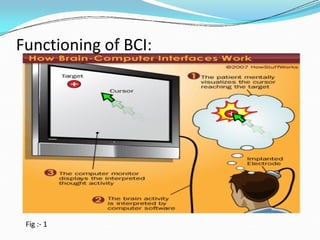
Functioning of BCI:
Fig :- 1
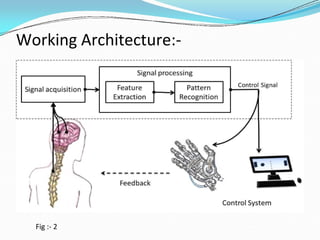
Working Architecture:-
Fig :- 2
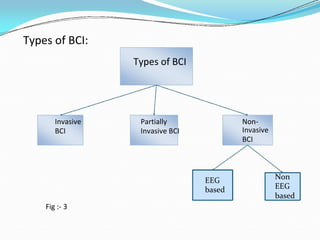
Types of BCI
Invasive
BCI
Partially
Invasive BCI
Non-
Invasive
BCI
Non
EEG
based
EEG
based
Fig :- 3
Types of BCI:
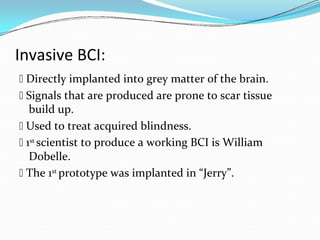
Invasive BCI:
 Directly implanted into grey matter of the brain.
 Signals that are produced are prone to scar tissue
build up.
 Used to treat acquired blindness.
 1st scientist to produce a working BCI is William
Dobelle.
 The 1st
prototype was implanted in “Jerry”.
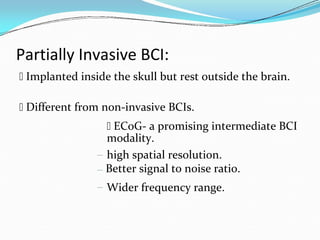
Partially Invasive BCI:
 Implanted inside the skull but rest outside the brain.
 Different from non-invasive BCIs.
 ECoG- a promising intermediate BCI
modality.
high spatial resolution.
Better signal to noise ratio.
Wider frequency range.
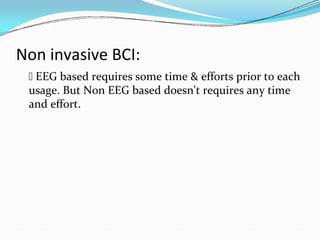
Non invasive BCI:
 EEG based requires some time & efforts prior to each
usage. But Non EEG based doesn't requires any time
and effort.
Application:
 Education and self regulation.
 Games and entertainment.
 Neuromarketing.
Games & Entertainment:
 In many non medical applications.
 Various games like helicopters are made to fly to any
point either a 2D or 3D virtual world.
 Combining the features of existing games with brain
controlled capacities tends to provide a multi brain
entertainment experience-Brain Arena.
Neuromarketing:
 Researchers have considered the impact of cognitive
function in neuro-marketing feilds.
 Estimating the memorization of TV ads thus
providing another method for advertising evaluation.
Advantages:
 Allow paralyzed people to control prosthetic limbs
with their mind.
 Transmit visual images to the mind of blind person,
allowing them to see.
 Transmit auditory data to the mind of deaf person,
allowing them to hear.
 Allow gamers to control video games with their minds.
 Allow amute person to have their thoughts displayed
and spoken by a computer.
Disadvantages of BCI:
 Research is still in beginning stages.
 Ethical issues may prevent its development.
 Electrodes outside the skull can detect very few
electric signals from the brain.
 Electrodes present inside the skull create scar tissue in
the brain.
Conclusion
 BCI are communication devices that translate signals
from the brain into electrical signals.
 It allows people to regain some form of control and
regain interaction with the environment.
References:
 https://en.wikipedia.org/wiki/Brain%E2%80%93computer_interface
 Brain computer interfacing: application and challenges Sarah N
Abdulkar, Ayman Atia, Mostafa-Sami M. Mostafa.
 Brain computer interface technology: A review of first international
meeting(IEEE Transaction on rehabilitation engineering ,Vol 8,No-
2,June 2000 )
Thank You

BRAIN COMPUTER INTERFACE

  • 1.
    BRAIN COMPUTER INTERFACE Presentedby:- Akanksha Keshari Dept. Of CSE I.T.E.R
  • 2.
    Talk flow:  BCI History  Functioning of BCI  Working Architecture  Types of BCI  Applications  Advantages  Disadvantage  Conclusion  References
  • 3.
    BCI: •What is BCI? •Whatis the major goal of BCI? •What does BCI Research area include? •Who is Jacques Vidal?
  • 4.
    History: •1924, Hans Berger,a German neurologist was the 1st to record human brain activity by means of Electrocephalography (EEG) . •1970 - Research on BCIs began at the University of California, Los Angeles(UCLA). •1978 - A prototype was implanted into a man blinded into adulthood. •Mid 1990 – animal experiment the 1st neuroprosthetic device implanted into humans. •2005 – Matthew Magle was the 1st person to use BCI to restore functionality loss due to paralysis.
  • 5.
  • 6.
  • 7.
    Types of BCI Invasive BCI Partially InvasiveBCI Non- Invasive BCI Non EEG based EEG based Fig :- 3 Types of BCI:
  • 8.
    Invasive BCI:  Directlyimplanted into grey matter of the brain.  Signals that are produced are prone to scar tissue build up.  Used to treat acquired blindness.  1st scientist to produce a working BCI is William Dobelle.  The 1st prototype was implanted in “Jerry”.
  • 9.
    Partially Invasive BCI: Implanted inside the skull but rest outside the brain.  Different from non-invasive BCIs.  ECoG- a promising intermediate BCI modality. high spatial resolution. Better signal to noise ratio. Wider frequency range.
  • 10.
    Non invasive BCI: EEG based requires some time & efforts prior to each usage. But Non EEG based doesn't requires any time and effort.
  • 11.
    Application:  Education andself regulation.  Games and entertainment.  Neuromarketing.
  • 12.
    Games & Entertainment: In many non medical applications.  Various games like helicopters are made to fly to any point either a 2D or 3D virtual world.  Combining the features of existing games with brain controlled capacities tends to provide a multi brain entertainment experience-Brain Arena.
  • 13.
    Neuromarketing:  Researchers haveconsidered the impact of cognitive function in neuro-marketing feilds.  Estimating the memorization of TV ads thus providing another method for advertising evaluation.
  • 14.
    Advantages:  Allow paralyzedpeople to control prosthetic limbs with their mind.  Transmit visual images to the mind of blind person, allowing them to see.  Transmit auditory data to the mind of deaf person, allowing them to hear.  Allow gamers to control video games with their minds.  Allow amute person to have their thoughts displayed and spoken by a computer.
  • 15.
    Disadvantages of BCI: Research is still in beginning stages.  Ethical issues may prevent its development.  Electrodes outside the skull can detect very few electric signals from the brain.  Electrodes present inside the skull create scar tissue in the brain.
  • 16.
    Conclusion  BCI arecommunication devices that translate signals from the brain into electrical signals.  It allows people to regain some form of control and regain interaction with the environment.
  • 17.
    References:  https://en.wikipedia.org/wiki/Brain%E2%80%93computer_interface  Braincomputer interfacing: application and challenges Sarah N Abdulkar, Ayman Atia, Mostafa-Sami M. Mostafa.  Brain computer interface technology: A review of first international meeting(IEEE Transaction on rehabilitation engineering ,Vol 8,No- 2,June 2000 )
  • 18.