BRAIN-SYSTEM INTERFACE BYE USING
BRAINGATE TECHNOLOGY
By :
K.R.Shyam
CONTENTS:
• INTRODUCTION
• PRINCIPLE
• BACK EFFORTS OF BRAIN
GATE
• HISTORY
• WORKING OF BRAINGATE
• IMPORTANCE OF
BRAINGATE
• MATERIALS USED
• ADVANTAGES &
DISADVANTAGES
• FUTURE ADVANCEMENTS
• APPLICATIONS
• CONCLUSION
INTRODUCTION:
Brian gate is a n brain implant system designed to
help those who have lost their limbs, or other bodily
functions like patients with spinal cord injury.
PRINCIPLE:
• The principle of operation of the BrainGate Neural
Interface System is that with intact brain function,
neural signals are generated even though they are not
sent to the arms, hands and legs.
• Conversion of Internal neural signals into output signal
under the users control by using an 100 Electrode-chip.
HISTORY:
• Developed by researchers of Brown University from
department of Neuroscience with help of cyberkinetics.Inc
a Biotech company from 2004 to 2006 under the guidance
of Sir.Nicholas Halspoulas.
• Later developments were done with co-ordination of
universities like:
ATLANTA(USA) MASSACHUSETTS(USA) SALT LAKE CITY(USA)
MATERIALS NEEDED:
• SENSORS
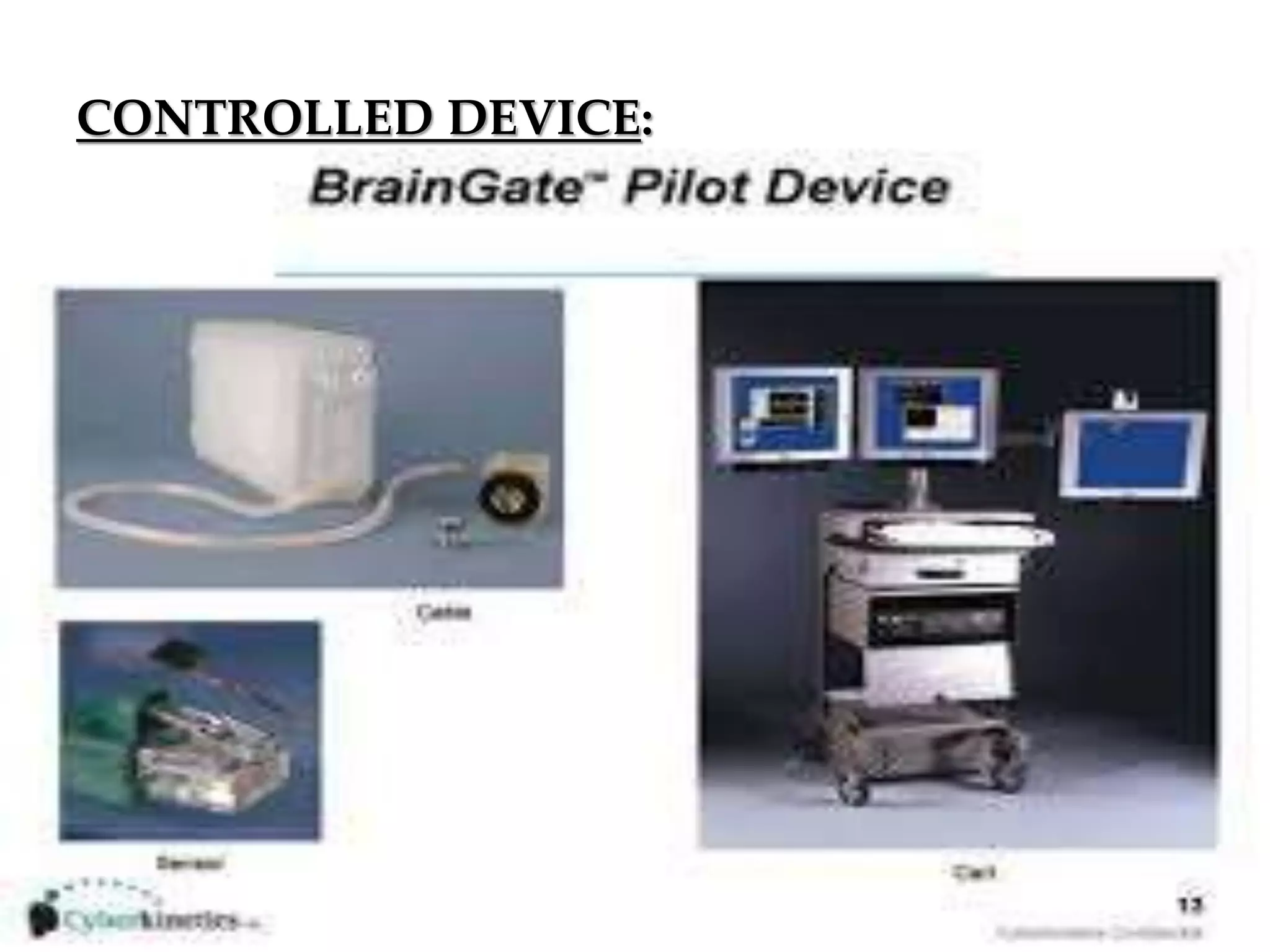
CONTROLLED DEVICE:
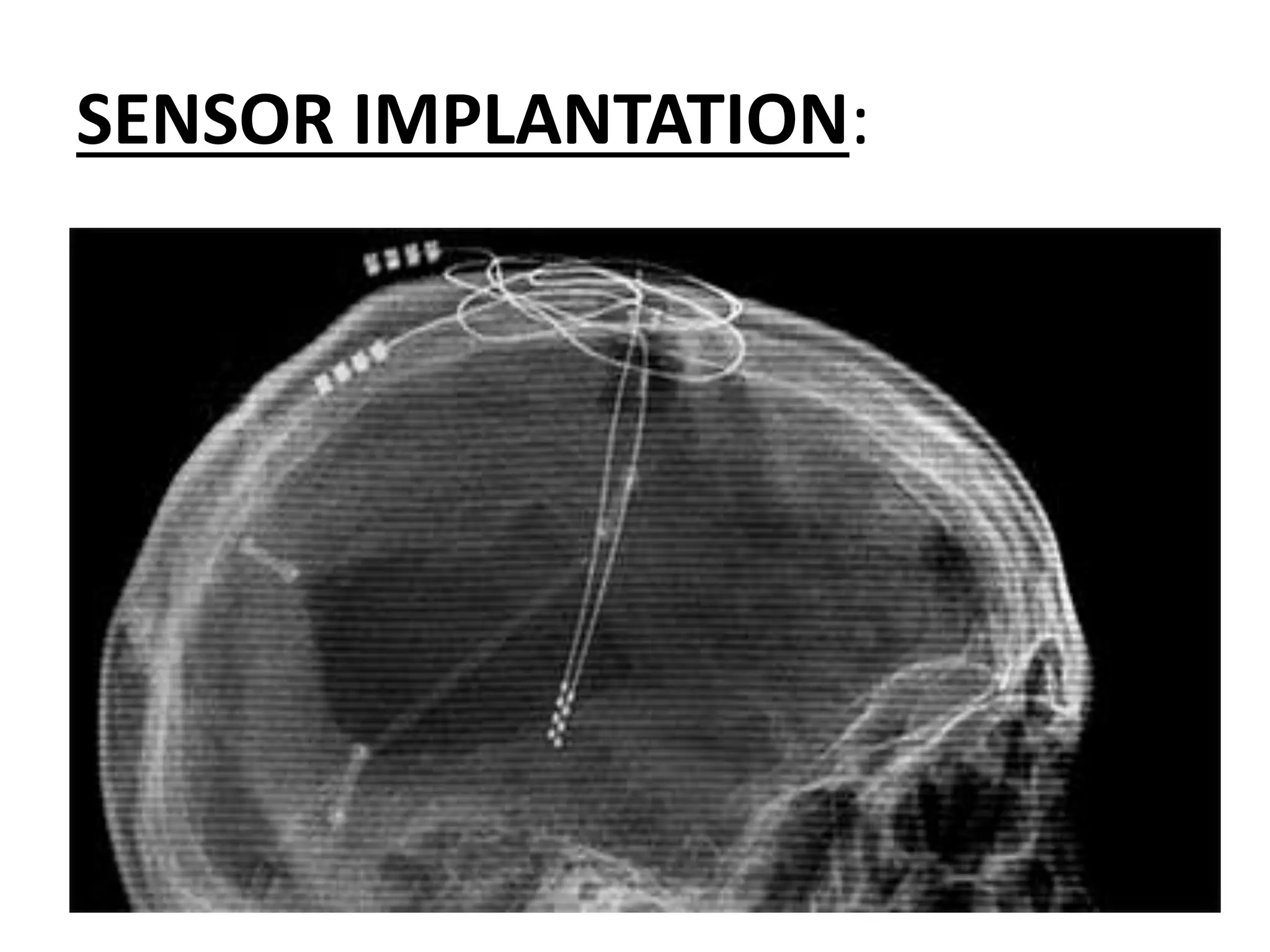
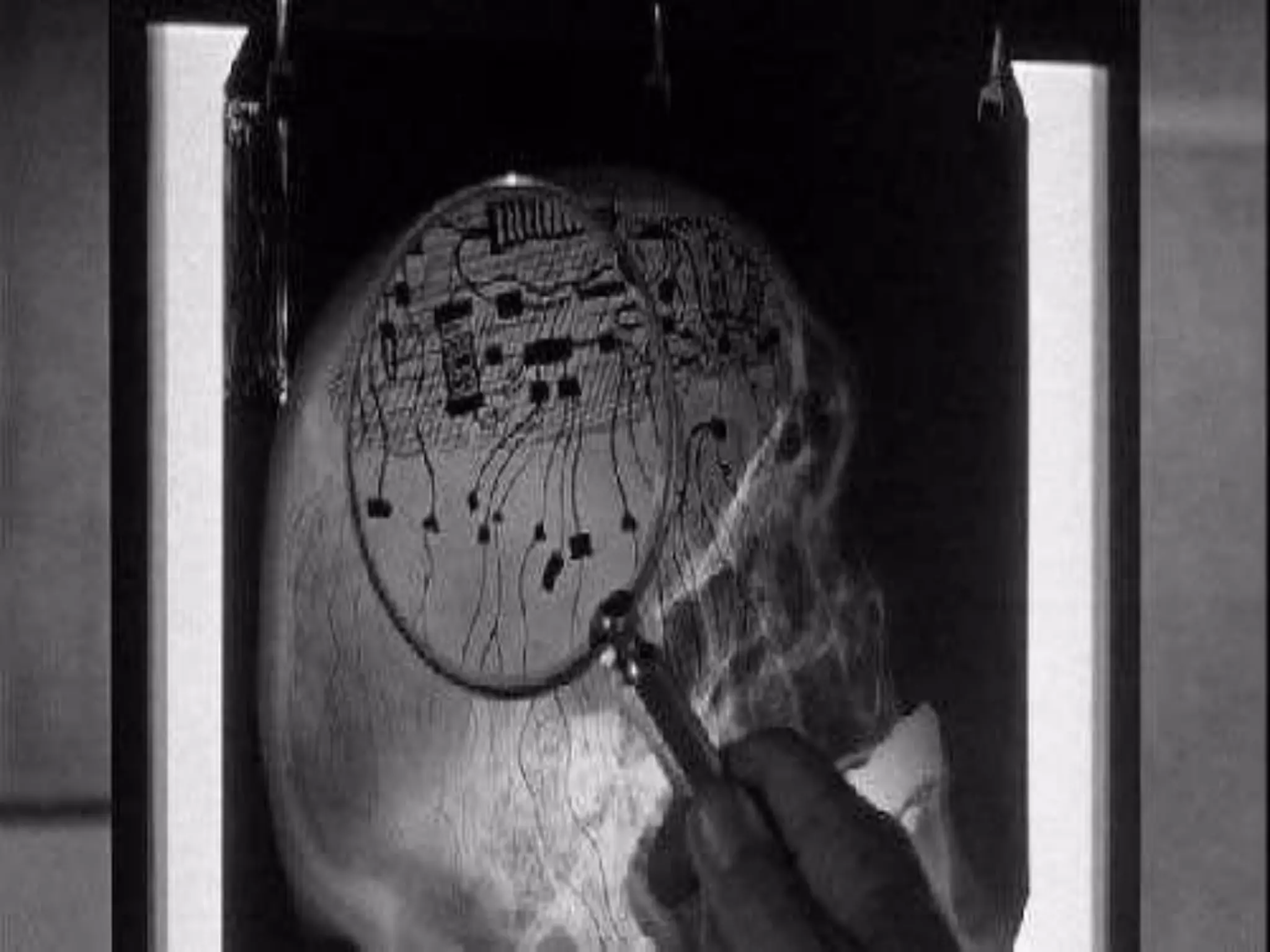
SENSOR IMPLANTATION:
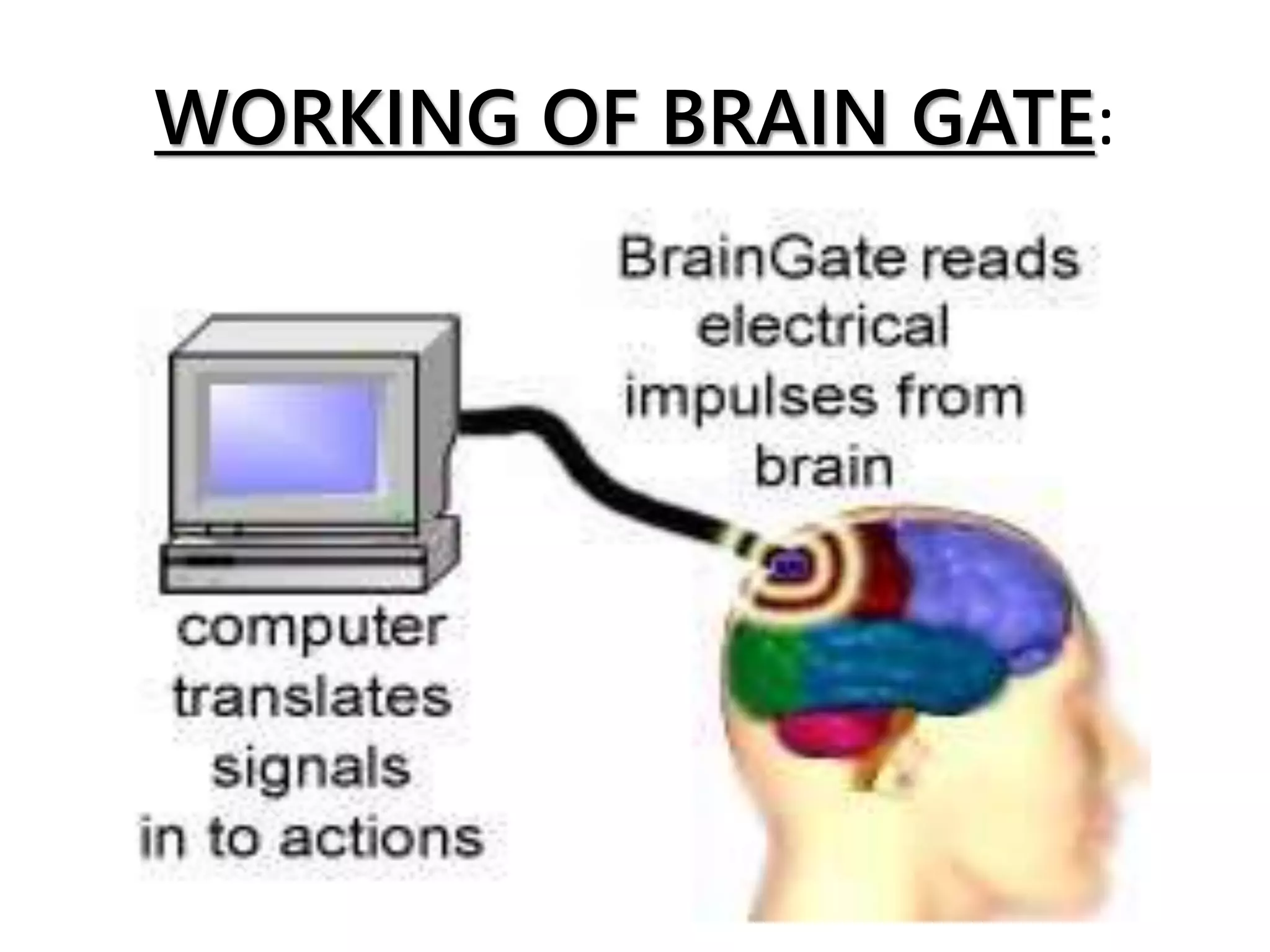
WORKING OF BRAIN GATE:
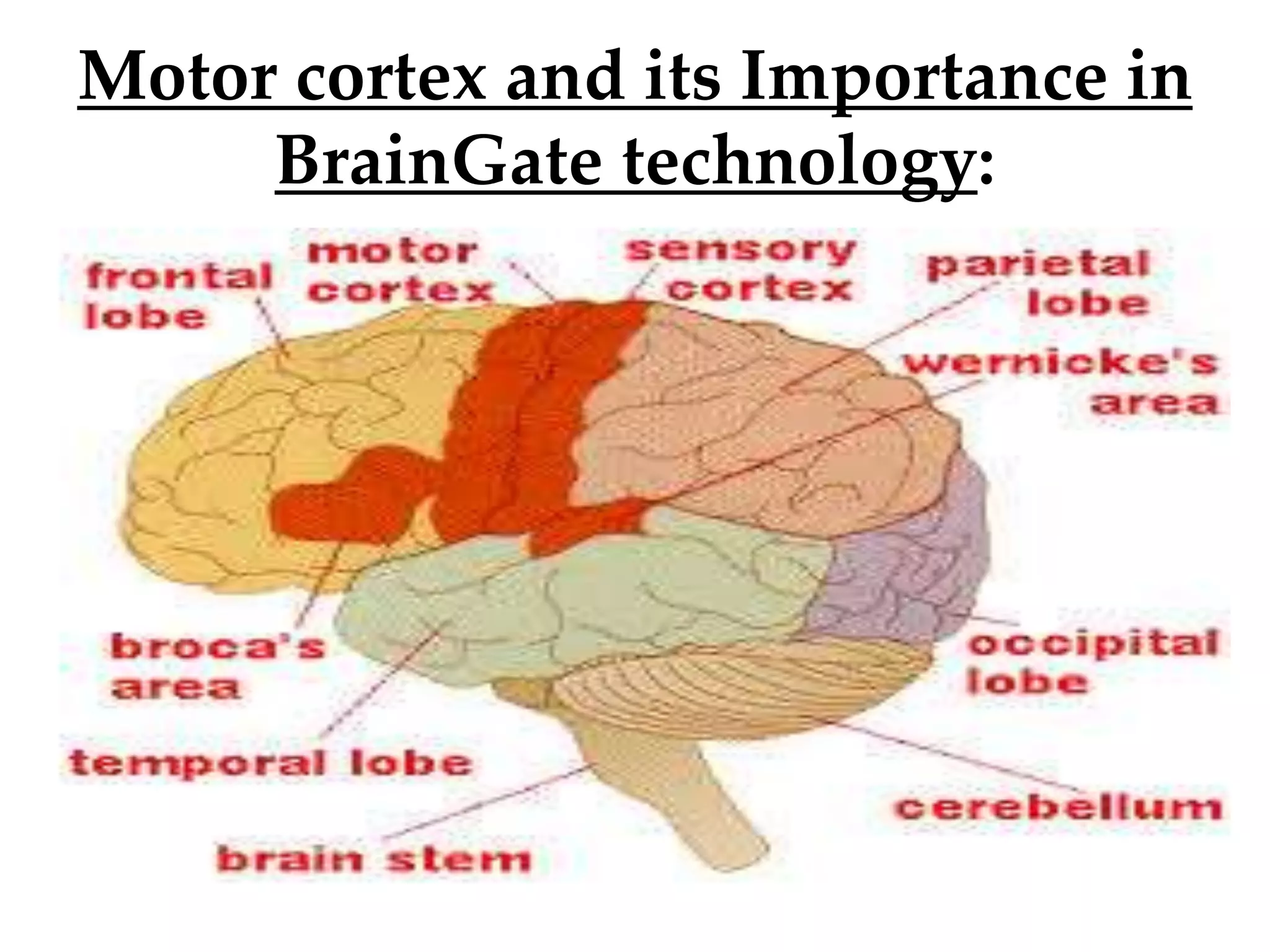
Motor cortex and its Importance in
BrainGate technology:
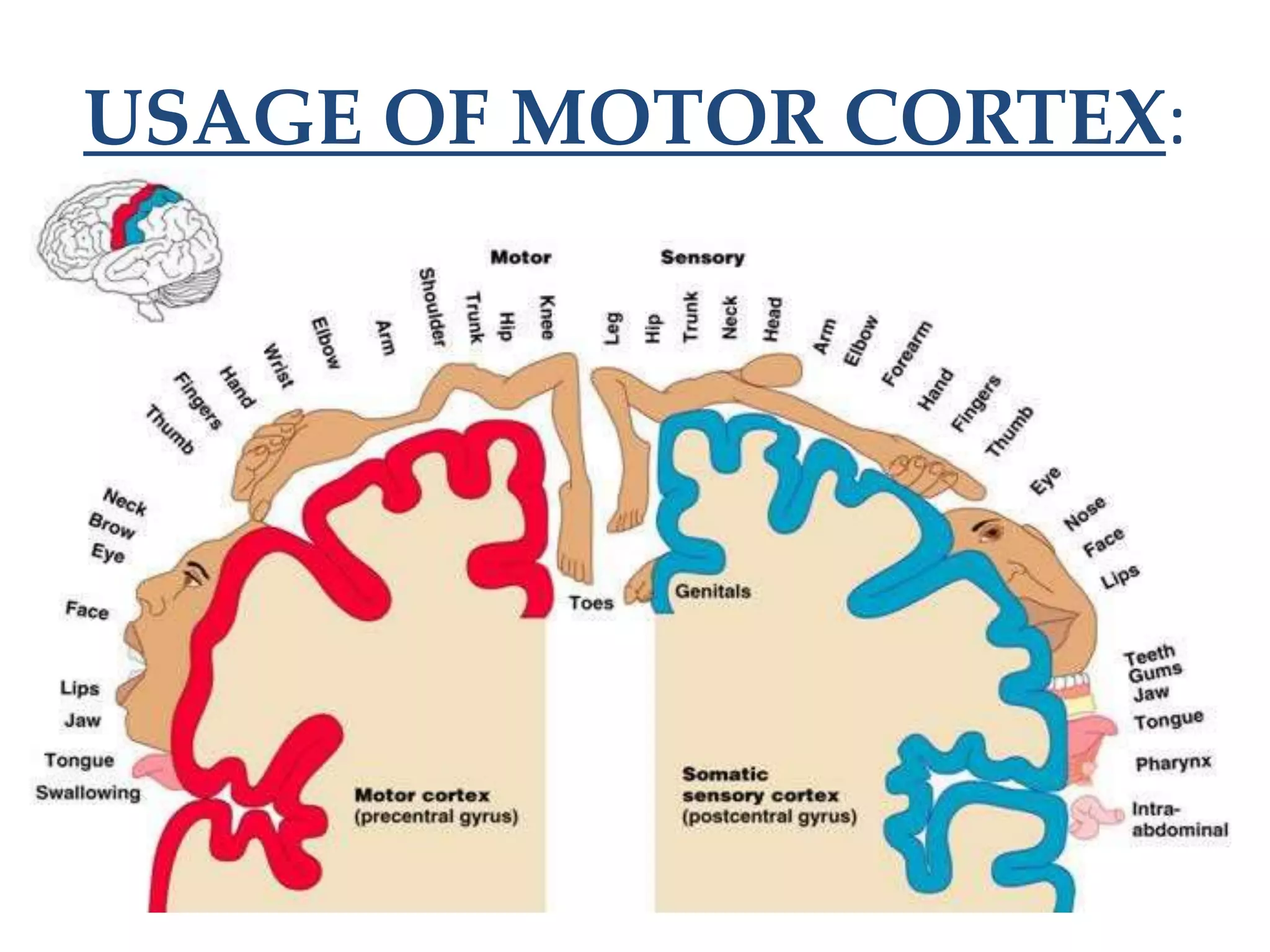
USAGE OF MOTOR CORTEX:
CLINICAL TRIALS:
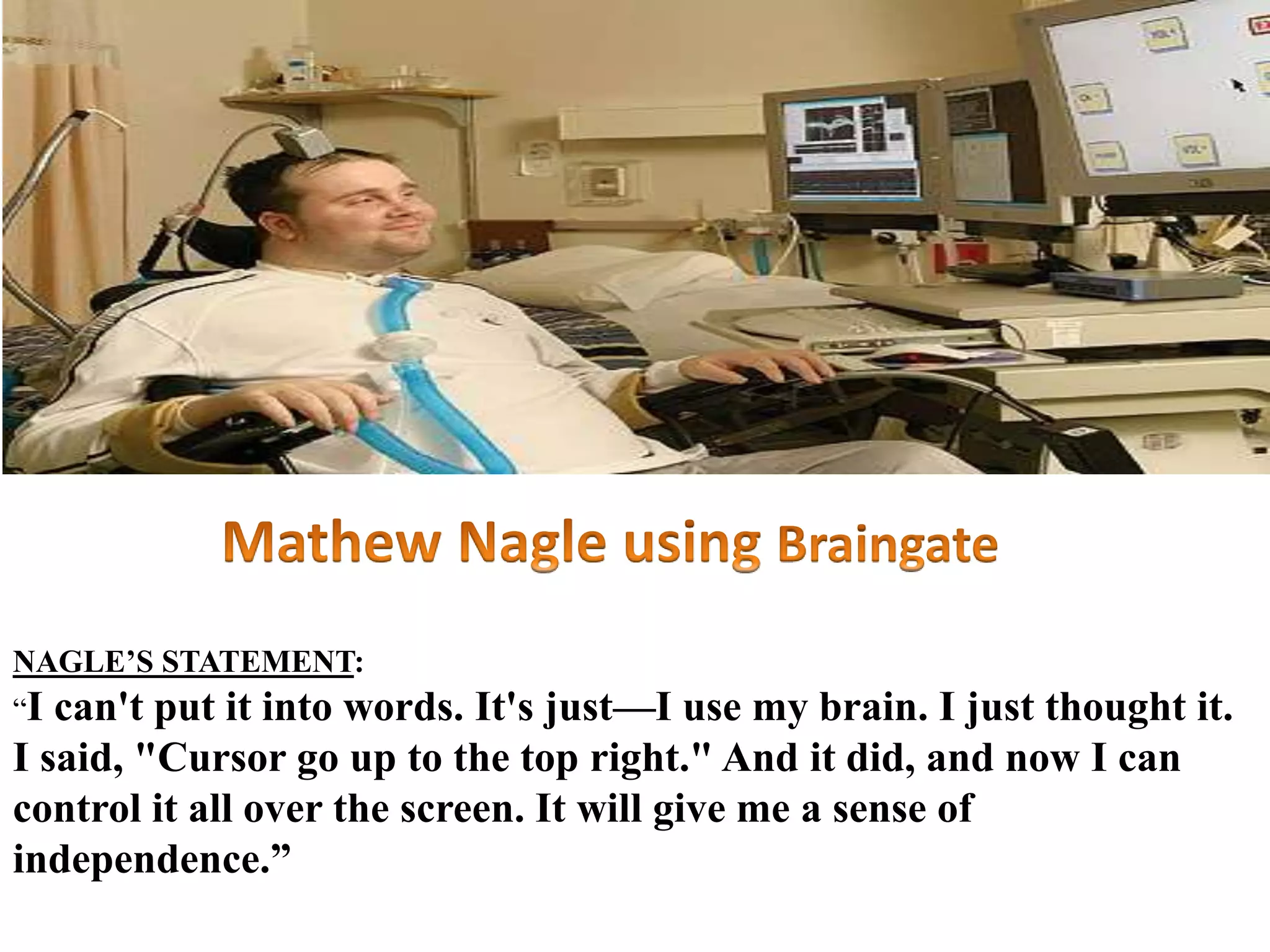
• The first clinical test was conducted on
MathewNagle on 22.06.2004. He was the first
person to use the brain computer interface to
restore functionality lost due to paralysis. He was
paralyzed from neck down after being stabbed.
• Neurosurgeon Gerhard Friehs implanted the
Braingate chip in his brain.
RESULT: After implantation, he was able to
control a computer mouse “cursor” and using it he
was able to press buttons that can control T.V,
check e-mails etc.
NAGLE’S STATEMENT:
“I can't put it into words. It's just—I use my brain. I just thought it.
I said, "Cursor go up to the top right." And it did, and now I can
control it all over the screen. It will give me a sense of
independence.”
PATIENT-2:Cathy Hutchinson’ a woman who
has suffered a stroke which left her mentatlly
sharp, but paralyzed and unable to speak.
RESULT :was able to use the arm to drink
coffee from a bottle, the first time she was able
to drink unaided in 15 years.This took place on
site at The Boston Home in Dorchester,
Massachusetts, a specialized residence where
Ms. Hutchinson resided.
ADVANTAGES:
 Can help people who have been paralyzed make use
of their limbs again through the use of their brain.
 While it was not originally created for government or
military use. This same technology, once better
developed and more advanced, can actually help us in
fighting wars.
 Using this technology with pilots by hooking up
pilots brain directly to the plane. Therefore the
reaction time on the controls would be quicker since
it is a direct path from the brain to the plane controls.
DISADVANTAGES:
 While still being perfected, the switches must be frequently
adjusted which is a time consume process.
 High Cost.
 Pain due to the ELECTRODE IMPLANTATION.
FUTURE ENHANCEMENTS:
• Mind control sensors.
• Neuro Imaging.
• Mind controlled weapons.
• Better advancements in treatment of paralysed people.
• Development in medical treatments.
RECENT PUBLIACTIONS:
CONCLUSION:
• The clinical trials and other experiments has
shown good results and boosted the scientists
to do lot more in this field.
• The brain gate is being made completely
implantable and doesn’t have a plug which
makes it safer and less weighable.
References:
http://www.braingate.com/
http://www.braingate.com/technology.html
http://en.wikipedia.org/wiki/BrainGate
http://www.cyberkinetics.com/what_is_braingate.html
QUERIES:
Brain gate technology

Brain gate technology

  • 1.
    BRAIN-SYSTEM INTERFACE BYEUSING BRAINGATE TECHNOLOGY By : K.R.Shyam
  • 2.
    CONTENTS: • INTRODUCTION • PRINCIPLE •BACK EFFORTS OF BRAIN GATE • HISTORY • WORKING OF BRAINGATE • IMPORTANCE OF BRAINGATE • MATERIALS USED • ADVANTAGES & DISADVANTAGES • FUTURE ADVANCEMENTS • APPLICATIONS • CONCLUSION
  • 3.
    INTRODUCTION: Brian gate isa n brain implant system designed to help those who have lost their limbs, or other bodily functions like patients with spinal cord injury.
  • 4.
    PRINCIPLE: • The principleof operation of the BrainGate Neural Interface System is that with intact brain function, neural signals are generated even though they are not sent to the arms, hands and legs. • Conversion of Internal neural signals into output signal under the users control by using an 100 Electrode-chip.
  • 6.
    HISTORY: • Developed byresearchers of Brown University from department of Neuroscience with help of cyberkinetics.Inc a Biotech company from 2004 to 2006 under the guidance of Sir.Nicholas Halspoulas. • Later developments were done with co-ordination of universities like: ATLANTA(USA) MASSACHUSETTS(USA) SALT LAKE CITY(USA)
  • 7.
  • 8.
  • 9.
  • 10.
  • 12.
    Motor cortex andits Importance in BrainGate technology:
  • 13.
  • 16.
    CLINICAL TRIALS: • Thefirst clinical test was conducted on MathewNagle on 22.06.2004. He was the first person to use the brain computer interface to restore functionality lost due to paralysis. He was paralyzed from neck down after being stabbed. • Neurosurgeon Gerhard Friehs implanted the Braingate chip in his brain. RESULT: After implantation, he was able to control a computer mouse “cursor” and using it he was able to press buttons that can control T.V, check e-mails etc.
  • 17.
    NAGLE’S STATEMENT: “I can'tput it into words. It's just—I use my brain. I just thought it. I said, "Cursor go up to the top right." And it did, and now I can control it all over the screen. It will give me a sense of independence.”
  • 18.
    PATIENT-2:Cathy Hutchinson’ awoman who has suffered a stroke which left her mentatlly sharp, but paralyzed and unable to speak. RESULT :was able to use the arm to drink coffee from a bottle, the first time she was able to drink unaided in 15 years.This took place on site at The Boston Home in Dorchester, Massachusetts, a specialized residence where Ms. Hutchinson resided.
  • 20.
    ADVANTAGES:  Can helppeople who have been paralyzed make use of their limbs again through the use of their brain.  While it was not originally created for government or military use. This same technology, once better developed and more advanced, can actually help us in fighting wars.  Using this technology with pilots by hooking up pilots brain directly to the plane. Therefore the reaction time on the controls would be quicker since it is a direct path from the brain to the plane controls.
  • 21.
    DISADVANTAGES:  While stillbeing perfected, the switches must be frequently adjusted which is a time consume process.  High Cost.  Pain due to the ELECTRODE IMPLANTATION.
  • 22.
    FUTURE ENHANCEMENTS: • Mindcontrol sensors. • Neuro Imaging. • Mind controlled weapons. • Better advancements in treatment of paralysed people. • Development in medical treatments.
  • 23.
  • 25.
    CONCLUSION: • The clinicaltrials and other experiments has shown good results and boosted the scientists to do lot more in this field. • The brain gate is being made completely implantable and doesn’t have a plug which makes it safer and less weighable.
  • 26.
  • 27.