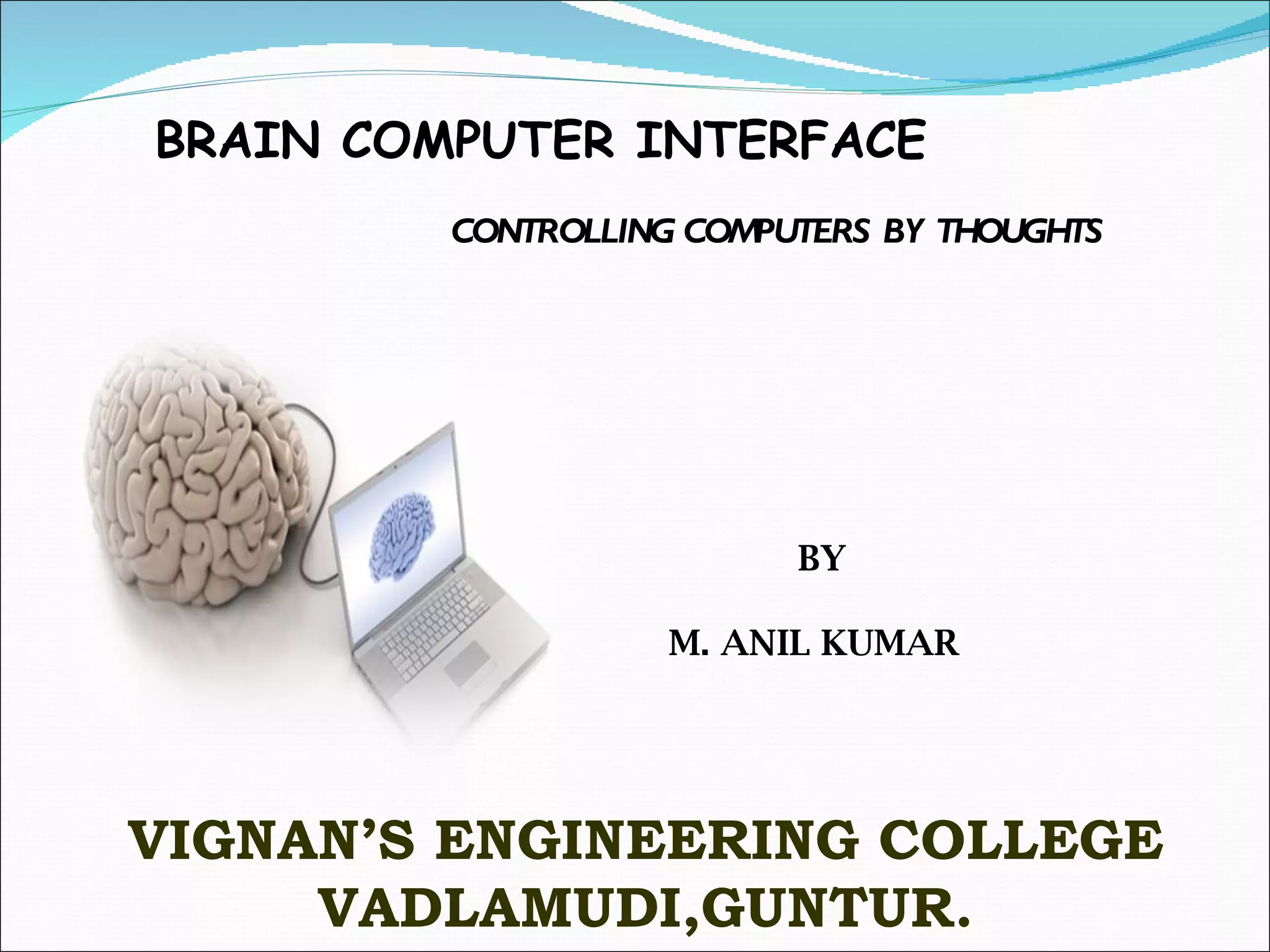
BRAIN COMPUTER INTERFACE CONTROLLING COMPUTERS BY THOUGHTS   BY M. ANIL KUMAR VIGNAN’S ENGINEERING COLLEGE VADLAMUDI,GUNTUR.
BCI MEANS…? BCI is a new communication link between a functioning human  brain and the outside world. BCI transforms mental decisions into control signals by analyzing the bioelectrical brain activity.
Introduction: Most of the studies have concentrated on the BCI for control of prosthesis, rehabilitation and interfaces for users with motor disabilities.  T he commercial brain-computer interface devices are emerging in gaming industry.  The brain robot interface becomes an important trend for human-robot interfaces in the future.
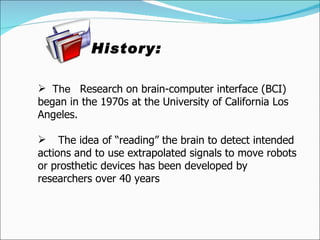
History: The  Research on brain-computer interface (BCI) began in the 1970s at the University of California Los Angeles. The idea of “reading” the brain to detect intended actions and to use extrapolated signals to move robots or prosthetic devices has been developed by researchers over 40 years
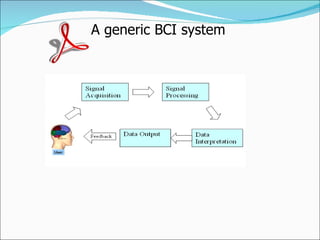
A generic BCI system
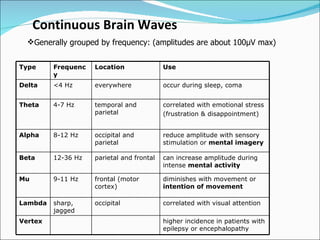
Continuous Brain Waves Generally grouped by frequency: (amplitudes are about 100µV max) Type Frequency Location Use Delta <4 Hz everywhere occur during sleep, coma Theta 4-7 Hz temporal and parietal correlated with emotional stress (frustration & disappointment) Alpha 8-12 Hz occipital and parietal reduce amplitude with sensory stimulation or  mental imagery Beta 12-36 Hz parietal and frontal can increase amplitude during intense  mental activity Mu 9-11 Hz frontal (motor cortex) diminishes with movement or  intention of movement Lambda sharp, jagged occipital correlated with visual attention Vertex higher incidence in patients with epilepsy or encephalopathy
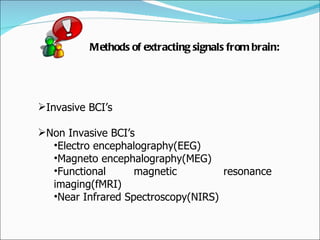
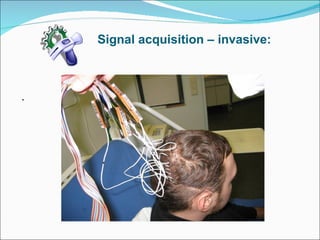
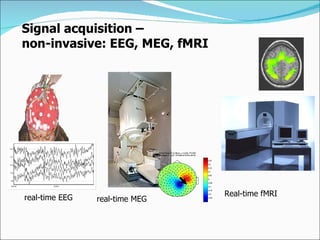
Methods of extracting signals from brain:  Invasive BCI’s Non Invasive BCI’s Electro encephalography(EEG) Magneto encephalography(MEG) Functional magnetic resonance imaging(fMRI) Near Infrared Spectroscopy(NIRS)
Signal acquisition – invasive: .
Real-time fMRI Signal acquisition –  non-invasive: EEG, MEG, fMRI real-time EEG real-time MEG
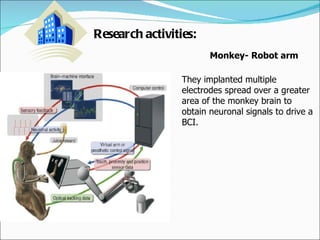
Research activities: Monkey- Robot arm  They implanted multiple electrodes spread over a greater area of the monkey brain to obtain neuronal signals to drive a BCI.
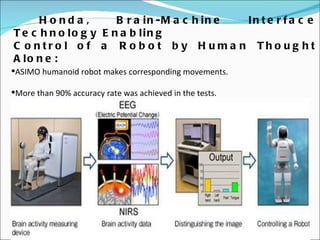
Honda, Brain-Machine Interface Technology Enabling  Control of a Robot by Human Thought Alone: ASIMO humanoid robot makes corresponding movements. More than 90% accuracy rate was achieved in the tests.
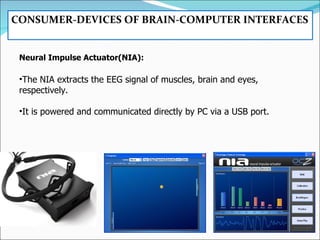
CONSUMER-DEVICES OF BRAIN-COMPUTER INTERFACES Neural Impulse Actuator(NIA): The NIA extracts the EEG signal of muscles, brain and eyes, respectively. It is powered and communicated directly by PC via a USB port.
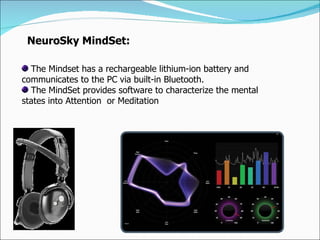
The Mindset has a rechargeable lithium-ion battery and communicates to the PC via built-in Bluetooth. The MindSet provides software to characterize the mental states into Attention  or Meditation NeuroSky MindSet:
Future  developments Better signal detection (SVM...) BCI illiterates (what prevents learning?) Shortening training time Improving learning (neurobiological and psychological basis) New recording methods (NIRS, ECoG)
Conclusion…..!
References:  : [1] “A Roadmap for US Robotics”,  http://www.us-robotics.us/ May 21, 2009 [2] B. Zhang, “Three-Dimensional Laser-Assisted Image Analysis for Robotic Surface Operation with Camera-Space Manipulation,” Ph.D. dissertation, Dept. Aerospace and Mechanical Eng., University of Notre Dame, Notre Dame, IN, 2007. [3] http://www.biocontrol.com/eeg.html [4]http://www.asel.udel.edu/speech/Spch_proc/eeg.html [5]Toward a P300-based Computer Interface James B. Polikoff, H. Timothy Bunnell, & Winslow J. Borkowski Jr. Applied Science and Engineering Laboratories Alfred I. Dupont Institute [6] B. Zhang and S. B Skaar, “Robotic De-Palletizing Using Uncalibrated Vision and 3D Laser-Assisted Image Analysis,” in 2009 Proc. IROS conf., pp 3820-3825
Thank You
 

Brain computer interface

  • 1.
    BRAIN COMPUTER INTERFACECONTROLLING COMPUTERS BY THOUGHTS BY M. ANIL KUMAR VIGNAN’S ENGINEERING COLLEGE VADLAMUDI,GUNTUR.
  • 2.
    BCI MEANS…? BCIis a new communication link between a functioning human brain and the outside world. BCI transforms mental decisions into control signals by analyzing the bioelectrical brain activity.
  • 3.
    Introduction: Most ofthe studies have concentrated on the BCI for control of prosthesis, rehabilitation and interfaces for users with motor disabilities. T he commercial brain-computer interface devices are emerging in gaming industry. The brain robot interface becomes an important trend for human-robot interfaces in the future.
  • 4.
    History: The Research on brain-computer interface (BCI) began in the 1970s at the University of California Los Angeles. The idea of “reading” the brain to detect intended actions and to use extrapolated signals to move robots or prosthetic devices has been developed by researchers over 40 years
  • 5.
  • 6.
    Continuous Brain WavesGenerally grouped by frequency: (amplitudes are about 100µV max) Type Frequency Location Use Delta <4 Hz everywhere occur during sleep, coma Theta 4-7 Hz temporal and parietal correlated with emotional stress (frustration & disappointment) Alpha 8-12 Hz occipital and parietal reduce amplitude with sensory stimulation or mental imagery Beta 12-36 Hz parietal and frontal can increase amplitude during intense mental activity Mu 9-11 Hz frontal (motor cortex) diminishes with movement or intention of movement Lambda sharp, jagged occipital correlated with visual attention Vertex higher incidence in patients with epilepsy or encephalopathy
  • 7.
    Methods of extractingsignals from brain: Invasive BCI’s Non Invasive BCI’s Electro encephalography(EEG) Magneto encephalography(MEG) Functional magnetic resonance imaging(fMRI) Near Infrared Spectroscopy(NIRS)
  • 8.
  • 9.
    Real-time fMRI Signalacquisition – non-invasive: EEG, MEG, fMRI real-time EEG real-time MEG
  • 10.
    Research activities: Monkey-Robot arm They implanted multiple electrodes spread over a greater area of the monkey brain to obtain neuronal signals to drive a BCI.
  • 11.
    Honda, Brain-Machine InterfaceTechnology Enabling Control of a Robot by Human Thought Alone: ASIMO humanoid robot makes corresponding movements. More than 90% accuracy rate was achieved in the tests.
  • 12.
    CONSUMER-DEVICES OF BRAIN-COMPUTERINTERFACES Neural Impulse Actuator(NIA): The NIA extracts the EEG signal of muscles, brain and eyes, respectively. It is powered and communicated directly by PC via a USB port.
  • 13.
    The Mindset hasa rechargeable lithium-ion battery and communicates to the PC via built-in Bluetooth. The MindSet provides software to characterize the mental states into Attention or Meditation NeuroSky MindSet:
  • 14.
    Future developmentsBetter signal detection (SVM...) BCI illiterates (what prevents learning?) Shortening training time Improving learning (neurobiological and psychological basis) New recording methods (NIRS, ECoG)
  • 15.
  • 16.
    References: :[1] “A Roadmap for US Robotics”, http://www.us-robotics.us/ May 21, 2009 [2] B. Zhang, “Three-Dimensional Laser-Assisted Image Analysis for Robotic Surface Operation with Camera-Space Manipulation,” Ph.D. dissertation, Dept. Aerospace and Mechanical Eng., University of Notre Dame, Notre Dame, IN, 2007. [3] http://www.biocontrol.com/eeg.html [4]http://www.asel.udel.edu/speech/Spch_proc/eeg.html [5]Toward a P300-based Computer Interface James B. Polikoff, H. Timothy Bunnell, & Winslow J. Borkowski Jr. Applied Science and Engineering Laboratories Alfred I. Dupont Institute [6] B. Zhang and S. B Skaar, “Robotic De-Palletizing Using Uncalibrated Vision and 3D Laser-Assisted Image Analysis,” in 2009 Proc. IROS conf., pp 3820-3825
  • 17.
  • 18.