BRAIN COMPUTER INTERFACES
Presented by
Pavani Tripuram
M.pharmacy 1st year
Contents
•
•
•
•
•
•
Introduction
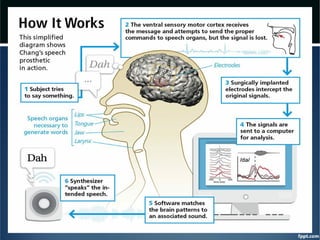
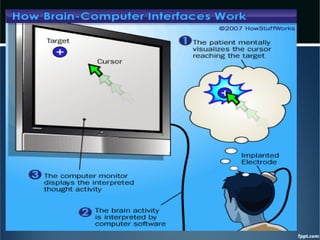
How the BCI Works
Types of BCI
BCI SYSTEM
Applications
References
Introduction
•
•
•
•
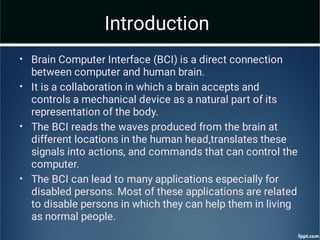
Brain Computer Interface (BCI) is a direct connection
between computer and human brain.
It is a collaboration in which a brain accepts and
controls a mechanical device as a natural part of its
representation of the body.
The BCI reads the waves produced from the brain at
different locations in the human head,translates these
signals into actions, and commands that can control the
computer.
The BCI can lead to many applications especially for
disabled persons. Most of these applications are related
to disable persons in which they can help them in living
as normal people.
•
•
•
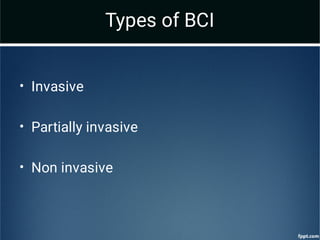
Invasive
Partially invasive
Non invasive
Types of BCI
•
•
•
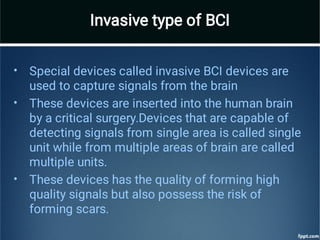
Special devices called invasive BCI devices are
used to capture signals from the brain
These devices are inserted into the human brain
by a critical surgery.Devices that are capable of
detecting signals from single area is called single
unit while from multiple areas of brain are called
multiple units.
These devices has the quality of forming high
quality signals but also possess the risk of
forming scars.
Invasive type of BCI
Partially invasive BCI
•
•
Devices are inserted in the skull on the top
of human brain
These devices have bit weaker quality of
human brain signals than invasive BCIs
and have less risk of forming scar tissue.
Non invasive BCI technique
•
•
•
Safest and low cost type
The detection of signals is done by some
electrodes placed on the scalp.
These devices have weaker human brain
signals than other BCI devices due to the
skull but placing the electrodes is easy as
well as portable.
BCI SYSTEM
•
•
•
•
Step 1: Signal Acquisition
Signal acquisition process is required to
capture the brain electric signals. The
electric signals could be recorded from
the scalp, the surface of the brain, or from
the neural activity.
Step 2: Signal Processing
In this step, obtained signals in step 1 are
analyzed to get the control signals.
Signal processing
•
•
•
•
Preprocessing
The first part of signal processing is preparing the
recording electric signal for processing like
enhancement to make the features clear for detection.
Some filtering techniques could be used in the
preprocessing operation
• Feature extraction
Simply, feature extraction means extracting specific
signal features.
Signal Classification: translation algorithm
The next stage, the translation algorithm, in which it translates
the extracted
signal features into device commands orders
that carry out the user’s intent. The
signals are classified on
both frequency and on their shape; the classification
algorithm
might use linear methods or nonlinear methods.
Step 3: Data Manipulation
Once the signals are classified, the output is manipulated to
suite the output
devices (e.g. computer screen).
Applications
COCHLEAR IMPLANT
Artificial eye development
• Electrodes are implanted in or near the
visual cortex, the area of the brain that
processes visual information from the
retinas. A pair of glasses holding small
cameras is connected to a computer and,
in turn, to the implants. After a training
period similar to the one used for remote
thought-controlled movement, the subject
can see.
ALS
• Amyotropic lateral sclerosis
Other applications
•
•
•
•
The BCI can lead to many applications especially for
disabled persons such as
(1) new ways for gamers to play games using their
heads,
(2) social interactions; enabling social applications to
capture feelings and emotions,
(3) helping—partially or fully-disabled people to interact
with different computational devices,
(4) helping understanding more about brain activities
and human neural networks.
•
•
•
•
Control robots working in dangerous
conditions.
Evaluating psychological state
Monitoring stages of sleep
Monitoring long term drug effects.
References
•
•
•
•
•
•
1. Melody, M.: Real-world applications for brain-computer interface technology.
IEEE Trans.Neural Syst. Rehabil. Eng. 11(2), 162–165 (2003)
2. Pei, X., Barbour, D., Leuthardt, E., Schalk, G.: Decoding vowels and consonants
in spoken and imagined words using electrocorticographic signals in humans. J.
Neural. Eng. 8(4), 1–11(2011)
3. Azar, A.T., Balas, V.E., Olariu, T.: Classification of EEG-based brain-computer
interfaces.advanced intelligent computational technologies and decision support
systems. Stud. Comput.Intell. 486, 97–106 (2014)
4. Buckner, R., Andrews-Hanna, J., Schacter, D.: The brain’s default network:
anatomy,function, and relevance to disease. Ann. N. Y. Acad. Sci. 1124, 1–38
(2008)
5. Minshew, N., Keller, T.: The nature of brain dysfunction in autism: functional
brain imaging studies. Curr. Opin. Neurol. 23, 124–130 (2010)
6. Gilbert, S., Dumontheil, I., Simons, J., Frith, C., Burgess, P.: Wandering minds:
the defaultnetwork and stimulus-independent thought. Sci. Mag. 315(5810),
393–395 (2007)
References
•
•
7.Mohamed Mostafa M. Fouad, Khalid Mohamed Amin, Nashwa El-
Bendary and Aboul Ella Hassanien,Brain Computer Interface: A
Review Chapter in Intelligent Systems Reference Library,November
(2014)
8.Rabie A. Ramadan, S. Refat, Marwa A. Elshahed and Rasha A. Ali,
Chapter 2,Basics of Brain Computer Interface.
Brain computer interfaces

Brain computer interfaces

  • 1.
    BRAIN COMPUTER INTERFACES Presentedby Pavani Tripuram M.pharmacy 1st year
  • 2.
    Contents • • • • • • Introduction How the BCIWorks Types of BCI BCI SYSTEM Applications References
  • 3.
    Introduction • • • • Brain Computer Interface(BCI) is a direct connection between computer and human brain. It is a collaboration in which a brain accepts and controls a mechanical device as a natural part of its representation of the body. The BCI reads the waves produced from the brain at different locations in the human head,translates these signals into actions, and commands that can control the computer. The BCI can lead to many applications especially for disabled persons. Most of these applications are related to disable persons in which they can help them in living as normal people.
  • 6.
  • 7.
    • • • Special devices calledinvasive BCI devices are used to capture signals from the brain These devices are inserted into the human brain by a critical surgery.Devices that are capable of detecting signals from single area is called single unit while from multiple areas of brain are called multiple units. These devices has the quality of forming high quality signals but also possess the risk of forming scars. Invasive type of BCI
  • 8.
    Partially invasive BCI • • Devicesare inserted in the skull on the top of human brain These devices have bit weaker quality of human brain signals than invasive BCIs and have less risk of forming scar tissue.
  • 9.
    Non invasive BCItechnique • • • Safest and low cost type The detection of signals is done by some electrodes placed on the scalp. These devices have weaker human brain signals than other BCI devices due to the skull but placing the electrodes is easy as well as portable.
  • 10.
  • 11.
    • • • • Step 1: SignalAcquisition Signal acquisition process is required to capture the brain electric signals. The electric signals could be recorded from the scalp, the surface of the brain, or from the neural activity. Step 2: Signal Processing In this step, obtained signals in step 1 are analyzed to get the control signals.
  • 12.
    Signal processing • • • • Preprocessing The firstpart of signal processing is preparing the recording electric signal for processing like enhancement to make the features clear for detection. Some filtering techniques could be used in the preprocessing operation • Feature extraction Simply, feature extraction means extracting specific signal features.
  • 13.
    Signal Classification: translationalgorithm The next stage, the translation algorithm, in which it translates the extracted signal features into device commands orders that carry out the user’s intent. The signals are classified on both frequency and on their shape; the classification algorithm might use linear methods or nonlinear methods. Step 3: Data Manipulation Once the signals are classified, the output is manipulated to suite the output devices (e.g. computer screen).
  • 14.
  • 15.
    Artificial eye development •Electrodes are implanted in or near the visual cortex, the area of the brain that processes visual information from the retinas. A pair of glasses holding small cameras is connected to a computer and, in turn, to the implants. After a training period similar to the one used for remote thought-controlled movement, the subject can see.
  • 16.
  • 17.
    Other applications • • • • The BCIcan lead to many applications especially for disabled persons such as (1) new ways for gamers to play games using their heads, (2) social interactions; enabling social applications to capture feelings and emotions, (3) helping—partially or fully-disabled people to interact with different computational devices, (4) helping understanding more about brain activities and human neural networks.
  • 18.
    • • • • Control robots workingin dangerous conditions. Evaluating psychological state Monitoring stages of sleep Monitoring long term drug effects.
  • 19.
    References • • • • • • 1. Melody, M.:Real-world applications for brain-computer interface technology. IEEE Trans.Neural Syst. Rehabil. Eng. 11(2), 162–165 (2003) 2. Pei, X., Barbour, D., Leuthardt, E., Schalk, G.: Decoding vowels and consonants in spoken and imagined words using electrocorticographic signals in humans. J. Neural. Eng. 8(4), 1–11(2011) 3. Azar, A.T., Balas, V.E., Olariu, T.: Classification of EEG-based brain-computer interfaces.advanced intelligent computational technologies and decision support systems. Stud. Comput.Intell. 486, 97–106 (2014) 4. Buckner, R., Andrews-Hanna, J., Schacter, D.: The brain’s default network: anatomy,function, and relevance to disease. Ann. N. Y. Acad. Sci. 1124, 1–38 (2008) 5. Minshew, N., Keller, T.: The nature of brain dysfunction in autism: functional brain imaging studies. Curr. Opin. Neurol. 23, 124–130 (2010) 6. Gilbert, S., Dumontheil, I., Simons, J., Frith, C., Burgess, P.: Wandering minds: the defaultnetwork and stimulus-independent thought. Sci. Mag. 315(5810), 393–395 (2007)
  • 20.
    References • • 7.Mohamed Mostafa M.Fouad, Khalid Mohamed Amin, Nashwa El- Bendary and Aboul Ella Hassanien,Brain Computer Interface: A Review Chapter in Intelligent Systems Reference Library,November (2014) 8.Rabie A. Ramadan, S. Refat, Marwa A. Elshahed and Rasha A. Ali, Chapter 2,Basics of Brain Computer Interface.