
BRAIN COMPUTER INTERFACE
PRESENTED BY :-
R.K.DISILA DEVI
TRADE – ECE
8th semester
CONTENTS
 INTRODUCTION
 WHAT IS BCI?
 HOW DOES ITWORK?
 HUMAN BRAIN
 SIGNALACQUISITION
 SIGNAL PROCESSING
 EXTERNEL DEVICES
 DISADVANTAGE
 CONCLUSION
INTRODUCTION
“FICTION TO REALITY”
What is BCI?
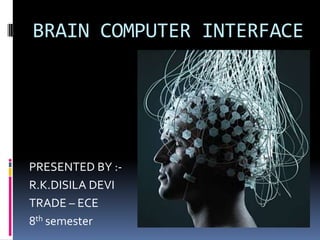
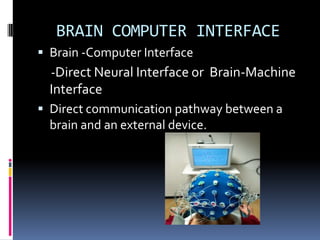
BRAIN COMPUTER INTERFACE
 Brain -Computer Interface
-Direct Neural Interface or Brain-Machine
Interface
 Direct communication pathway between a
brain and an external device.
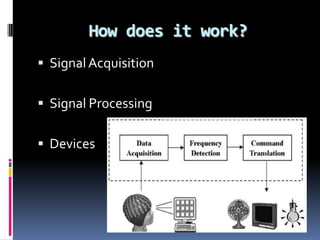
How does it work?
 SignalAcquisition
 Signal Processing
 Devices
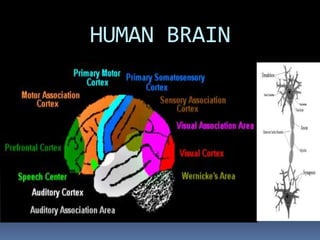
HUMAN BRAIN
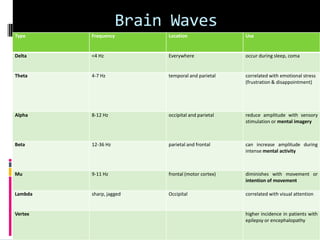
Brain Waves
Type Frequency Location Use
Delta <4 Hz Everywhere occur during sleep, coma
Theta 4-7 Hz temporal and parietal correlated with emotional stress
(frustration & disappointment)
Alpha 8-12 Hz occipital and parietal reduce amplitude with sensory
stimulation or mental imagery
Beta 12-36 Hz parietal and frontal can increase amplitude during
intense mental activity
Mu 9-11 Hz frontal (motor cortex) diminishes with movement or
intention of movement
Lambda sharp, jagged Occipital correlated with visual attention
Vertex higher incidence in patients with
epilepsy or encephalopathy
SIGNAL ACQUISITION
EEG(ELECTROENCHEPHALOGRAPHY)
 Measurements of electrical activity of the brain .
 The basic frequency of the EEG range is classified into five bands for
purposes of EEG analysis called brain rhythms.
Band Frequency [Hz]
Delta 0.5- 4
Theta 4- 8
Alpha 8- 13
Beta 13- 22
Gamma 22-30
THE TWO TYPES OF BCI
 Invasive BCIs
 Non-Invasive BCIs
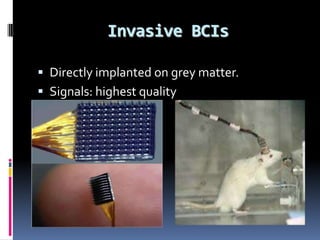
Invasive BCIs
 Directly implanted on grey matter.
 Signals: highest quality
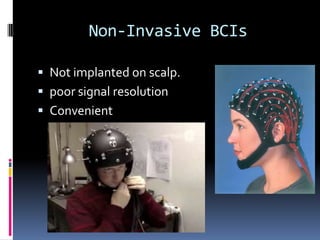
Non-Invasive BCIs
 Not implanted on scalp.
 poor signal resolution
 Convenient
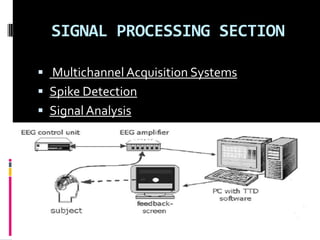
SIGNAL PROCESSING SECTION
 Multichannel Acquisition Systems
 Spike Detection
 Signal Analysis
Multichannel Acquisition
Systems
 Amplification
 Initial filtering of EEG signal
 Analog EEG signal is digitized.
 Processed signals are time-division
multiplexed and sampled.
Spike Detection
 transmit only the action potential waveforms
 This compression reduces the transmitted
data rate per channel
 implemented using an application-specific
integrated circuit (ASIC) with limited
computational resources.
Signal Analysis
 Feature extraction and classification of EEG
are dealt in this section.
 form distinct set of features for each mental
task.
 The features extracted in the previous stage
are the input for the classifier.
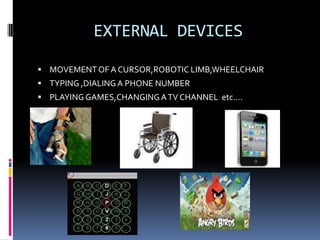
EXTERNAL DEVICES
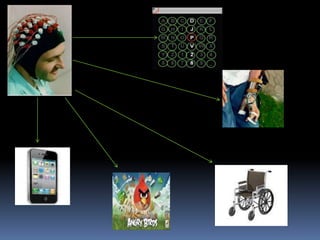
 MOVEMENTOF A CURSOR,ROBOTIC LIMB,WHEELCHAIR
 TYPING ,DIALINGA PHONE NUMBER
 PLAYINGGAMES,CHANGINGATV CHANNEL etc….
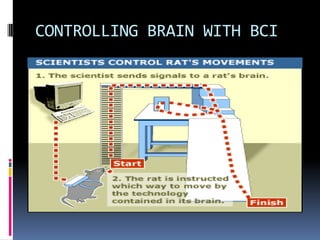
CONTROLLING BRAIN WITH BCI
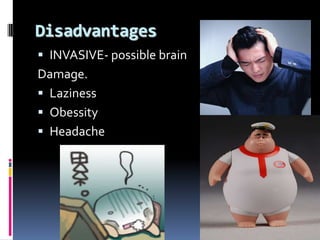
Disadvantages
 INVASIVE- possible brain
Damage.
 Laziness
 Obessity
 Headache
CONCLUSION
 “No more handicap people (Synthetic arms, legs, eye,
sensitive skin etc.) !”
 What happens when humans merge with machines?The
question is not what will the computer be like in the future,
but instead, what will we be like?What kind of people are
we becoming?
“HUMAN BRAIN
COULD BE
CONTROLLED”
REFERENCES
 WWW.HOWSTUFFWORKS.COM
 www.en.wikipedia.com/braincomputerinte
rface
 www.youtube.com/watch?v=7-cpcoIJbOU
 www.brainlab.org
 www.nicolelislab.net/NLnet_Load.html
 www.betterhumans.com
 www.popsci.com

Brain computer interface