PROJECT MANAGEMENT
BEST PRACTICES
S.A.A.D.C.I Athukorala
1/21/2016 Project Management Best Practices 1
Content
What is a Project
The Triple Constraint
What is Project Management
Why need Project Management?
Suggested Skills for a Project Manager
Project Management Best Practices
1/21/2016 Project Management Best Practices 2
What is a Project
 A project is a temporary endeavor undertaken to
accomplish a unique purpose.
Attributes of projects
Unique purpose
Temporary
Require resources, often from various areas
should have a primary sponsor and/or customer
Involve uncertainty
1/21/2016 Project Management Best Practices 3
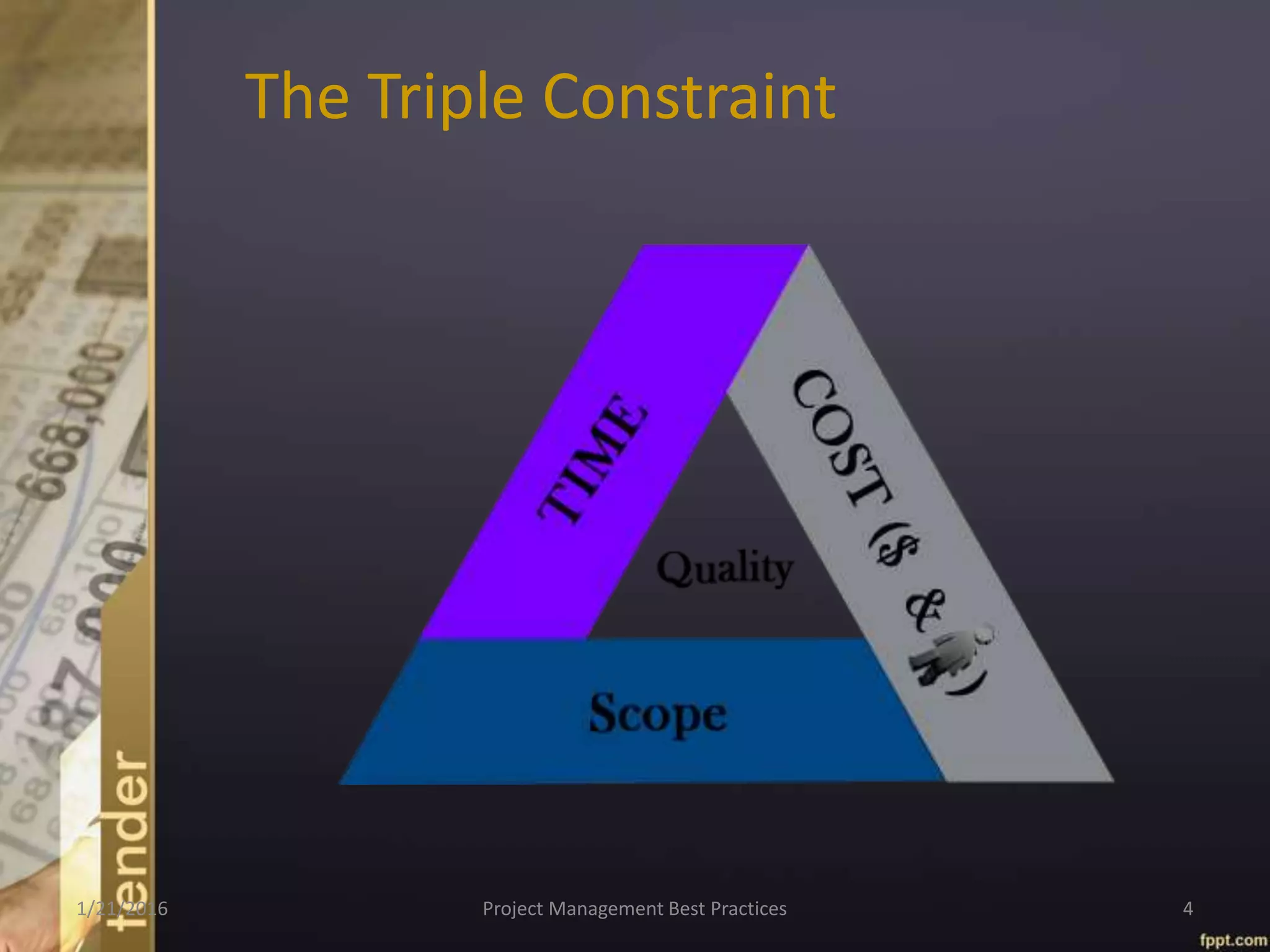
The Triple Constraint
1/21/2016 Project Management Best Practices 4
What is Project Management
 Project management is “the application of knowledge , skills ,
tools , and techniques to project activities in order to meet or
exceed stakeholder needs and expectations from a project”
PMI*, Project Management Body of Knowledge(PMBOK)
1/21/2016 Project Management Best Practices 5
Why Need This Project Management
Bosses, customers, and other stakeholders do
not like surprises.
Good project management (PM) provides
assurance and reduces risk.
Project members learn and grow by working in a
cross-functional team environment.
PM provides the tools and environment to plan,
monitor, track, and manage schedules, resources,
costs, and quality
1/21/2016 Project Management Best Practices 6
Suggested Skills for a Project Manager
Communication Skills : Listening
Organizational skills : Planning , goal-setting
Team Building skills : empathy , motivation , team
spirit
Leadership skills : sets example , energetic , positive
Technological skills : experience , project knowledge
1/21/2016 Project Management Best Practices 7
Project Management Best Practices
Define the Project Definition Document
The project definition is the primary deliverable
from the planning process and describes all
aspects of the project at a high level.
Once approved by the customer and relevant
stakeholders, it becomes the basis for the work to
be performed.
1/21/2016 Project Management Best Practices 8
The project definition should include the
following:
 Project overview
 Objectives
 Scope
 Assumptions and risks
 Approach
 Organization
 Signature page
1/21/2016 Project Management Best Practices 9
 Project Planning
 Planning requires that the project manager decides which
people, resources and budget are required to complete
the project.
 Define what activities are required to produce the
deliverables using techniques.
 estimate the time and effort required for each activity,
dependencies between activities.
 Estimate how long activities will take.
 Write this into the project plan and get the key
stakeholders to review and agree to the plan.
1/21/2016 Project Management Best Practices 10
Communicate with all project stakeholders
From the first day project manager kick the
project off PM need to be communicating.
Not to just a select few, but to all the
project stakeholders.
 This includes key people like team members,
managers, project sponsors, clients, and valued
users.
1/21/2016 Project Management Best Practices 11
Tracking and Reporting Project Progress
When the project is underway it must monitor
and compare the actual progress with the planned
progress.
It needs to record variations between the actual
and planned cost, schedule and scope.
It needs to report variations to your manager and
key stakeholders and take corrective actions if
variations get too large.
1/21/2016 Project Management Best Practices 12
Risk Management
Risks are events which can adversely affect the
successful outcome of the project.
Plans must be made to avoid the risk.
If the risk cannot be avoided, to mitigate the risk
to lessen its impact if it occurs.
This is known as risk management.
Not managing risks effectively is a common reason
why projects fail.
1/21/2016 Project Management Best Practices 13
Change Management
Stakeholders often change their mind about what
must be delivered.
By managing changes, the project manager can
make decisions about whether or not to
incorporate the changes immediately or in the
future, or to reject them.
Not managing changes effectively is often a
reason why projects fail.
1/21/2016 Project Management Best Practices 14
Hold The Wrap- Up Meeting
Once the project has been completed, it’s time to
reflect and see how we can optimize the next
projects for success.
Holding a wrap-up meeting is a perfect
opportunity to get all of the project members
together for discussion.
Go over lessons learned and ways to improve for
next time.
1/21/2016 Project Management Best Practices 15
References
https://cdn.projectsmart.co.uk/pdf/project-
management-success.pdf
http://www.techrepublic.com/blog/10-things/10-
best-practices-for-successful-project-management/
https://www.wrike.com/blog/project-management-
best-practices-infographic/
1/21/2016 Project Management Best Practices 16
1/21/2016 Project Management Best Practices 17

Project management best practices

  • 1.
    PROJECT MANAGEMENT BEST PRACTICES S.A.A.D.C.IAthukorala 1/21/2016 Project Management Best Practices 1
  • 2.
    Content What is aProject The Triple Constraint What is Project Management Why need Project Management? Suggested Skills for a Project Manager Project Management Best Practices 1/21/2016 Project Management Best Practices 2
  • 3.
    What is aProject  A project is a temporary endeavor undertaken to accomplish a unique purpose. Attributes of projects Unique purpose Temporary Require resources, often from various areas should have a primary sponsor and/or customer Involve uncertainty 1/21/2016 Project Management Best Practices 3
  • 4.
    The Triple Constraint 1/21/2016Project Management Best Practices 4
  • 5.
    What is ProjectManagement  Project management is “the application of knowledge , skills , tools , and techniques to project activities in order to meet or exceed stakeholder needs and expectations from a project” PMI*, Project Management Body of Knowledge(PMBOK) 1/21/2016 Project Management Best Practices 5
  • 6.
    Why Need ThisProject Management Bosses, customers, and other stakeholders do not like surprises. Good project management (PM) provides assurance and reduces risk. Project members learn and grow by working in a cross-functional team environment. PM provides the tools and environment to plan, monitor, track, and manage schedules, resources, costs, and quality 1/21/2016 Project Management Best Practices 6
  • 7.
    Suggested Skills fora Project Manager Communication Skills : Listening Organizational skills : Planning , goal-setting Team Building skills : empathy , motivation , team spirit Leadership skills : sets example , energetic , positive Technological skills : experience , project knowledge 1/21/2016 Project Management Best Practices 7
  • 8.
    Project Management BestPractices Define the Project Definition Document The project definition is the primary deliverable from the planning process and describes all aspects of the project at a high level. Once approved by the customer and relevant stakeholders, it becomes the basis for the work to be performed. 1/21/2016 Project Management Best Practices 8
  • 9.
    The project definitionshould include the following:  Project overview  Objectives  Scope  Assumptions and risks  Approach  Organization  Signature page 1/21/2016 Project Management Best Practices 9
  • 10.
     Project Planning Planning requires that the project manager decides which people, resources and budget are required to complete the project.  Define what activities are required to produce the deliverables using techniques.  estimate the time and effort required for each activity, dependencies between activities.  Estimate how long activities will take.  Write this into the project plan and get the key stakeholders to review and agree to the plan. 1/21/2016 Project Management Best Practices 10
  • 11.
    Communicate with allproject stakeholders From the first day project manager kick the project off PM need to be communicating. Not to just a select few, but to all the project stakeholders.  This includes key people like team members, managers, project sponsors, clients, and valued users. 1/21/2016 Project Management Best Practices 11
  • 12.
    Tracking and ReportingProject Progress When the project is underway it must monitor and compare the actual progress with the planned progress. It needs to record variations between the actual and planned cost, schedule and scope. It needs to report variations to your manager and key stakeholders and take corrective actions if variations get too large. 1/21/2016 Project Management Best Practices 12
  • 13.
    Risk Management Risks areevents which can adversely affect the successful outcome of the project. Plans must be made to avoid the risk. If the risk cannot be avoided, to mitigate the risk to lessen its impact if it occurs. This is known as risk management. Not managing risks effectively is a common reason why projects fail. 1/21/2016 Project Management Best Practices 13
  • 14.
    Change Management Stakeholders oftenchange their mind about what must be delivered. By managing changes, the project manager can make decisions about whether or not to incorporate the changes immediately or in the future, or to reject them. Not managing changes effectively is often a reason why projects fail. 1/21/2016 Project Management Best Practices 14
  • 15.
    Hold The Wrap-Up Meeting Once the project has been completed, it’s time to reflect and see how we can optimize the next projects for success. Holding a wrap-up meeting is a perfect opportunity to get all of the project members together for discussion. Go over lessons learned and ways to improve for next time. 1/21/2016 Project Management Best Practices 15
  • 16.
  • 17.