BRAIN MACHINE INTERFACE
by suvarcha sharma
1014331852
2EC 3rd year
CONTENT
Introduction to BMI
The human brain
Model of BMI
What is EEG ?
How does BMI works????
Advantages
Disadvantages
Application
Conclusion
INTRODUCTION
1. Introduced in 1924 by HANS
BERGER.
2. BRAIN MACHINE INTERFACE
(BMI) is a direct communication
pathway between a brain and an
external device.
• BMI uses brain activity to command,
control, actuate and communicate with the
world directly through brain integration
with peripheral devices and systems.
• Main principle behind this interface is the
bioelectrical activity of nerves and
muscles.
THE HUMAN BRAIN
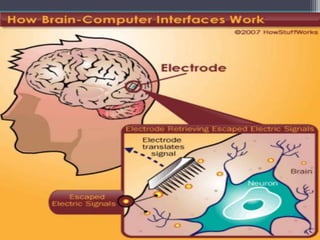
Brain is composed of millions of neurons. When
the neuron fires, or activates, there is a voltage
change across the cell which generates signals on
the surface of the brain. By monitoring and
analyzing these signals we can understand the
working of brain.
NEURONS
MODEL OF BMI
INVASIVE AND NON-INVASIVE
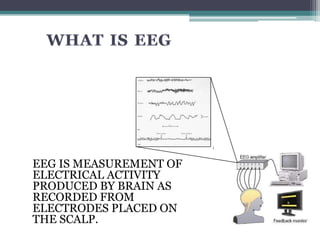
EEG IS MEASUREMENT OF
ELECTRICAL ACTIVITY
PRODUCED BY BRAIN AS
RECORDED FROM
ELECTRODES PLACED ON
THE SCALP.
 An electroencephalogram (EEG) is a
measure of the brain's voltage fluctuations
as detected from scalp electrodes
 It is an approximation of the cumulative
electrical
activity of neurons
 It is the foundation of current BMI
research
PREDEFINED POINTS OF BRAIN
HOW BMI WORKS???
• It sound like science fiction but is a clever app of
science and technology. the system does not really
read thoughts; rather, it measures fluctuations in
electrical voltage in the brain and translates them
into commands on a computer screen.
• The human brain controls memory, vision,
learning, thought, consciousness and other
activities. By means of electrochemical impulses
the brain directly controls conscious or voluntary
behavior.
• The system consists of a cap that fits over the
user's head, with a few dozen holes through
which electrodes are attached so they rest on the
scalp.
• The electrodes are connected via thin cables to
a"biosignal amplifier," which transmits the
signals from the brain to a computer.
ELECTROENCEPHALOGRAM(EEG)
• An electroencephalogram (EEG) measures the
brain's voltage fluctuations as detected from
scalp through electrodes.
 Technique is very beneficial in field of severe disease,
brain & neural injuries.
 Provides daily life support to physically disabled and
aged people, making use of bioengineering control
devices & robots to grant healthy life for elderly people.
 Assists scientist to understand how the brain memory,
internal connection works can be understood to a great
extent.
 Assists devices to help disabled people.
ADVANTAGES
¤ Requires a high mental concentration
¤ Can pose a threat to mental stability of the subject
¤ May result in chronic strokes in severe cases
¤ There is a risk of severe mental infections such as
meningitis
DISADVANTAGES
APPLICATIONS OF BMI
1. MEDICINE
2. MILITARY
3. MANUFACTURING
4. GAMING
AND MANY OTHERS……
¤ A potential remedial tool.
¤ BMI is an advancing technology promising pattern shift in
areas like Machine Control, Human Enhancement, Virtual
reality ,etc.
¤ Several potential applications of BMI hold promise for
rehabilitation and improving performance, such as
treating emotional disorders (for example, depression or
anxiety), easing chronic pain, and overcoming movement
disabilities due to stroke.
¤ Intense R&D in future to attain intuitive efficiency.
Conclusion
Brain machine interface

Brain machine interface

  • 1.
    BRAIN MACHINE INTERFACE bysuvarcha sharma 1014331852 2EC 3rd year
  • 2.
    CONTENT Introduction to BMI Thehuman brain Model of BMI What is EEG ? How does BMI works???? Advantages Disadvantages Application Conclusion
  • 3.
    INTRODUCTION 1. Introduced in1924 by HANS BERGER. 2. BRAIN MACHINE INTERFACE (BMI) is a direct communication pathway between a brain and an external device.
  • 4.
    • BMI usesbrain activity to command, control, actuate and communicate with the world directly through brain integration with peripheral devices and systems. • Main principle behind this interface is the bioelectrical activity of nerves and muscles.
  • 5.
    THE HUMAN BRAIN Brainis composed of millions of neurons. When the neuron fires, or activates, there is a voltage change across the cell which generates signals on the surface of the brain. By monitoring and analyzing these signals we can understand the working of brain.
  • 6.
  • 7.
  • 8.
  • 9.
    EEG IS MEASUREMENTOF ELECTRICAL ACTIVITY PRODUCED BY BRAIN AS RECORDED FROM ELECTRODES PLACED ON THE SCALP.
  • 10.
     An electroencephalogram(EEG) is a measure of the brain's voltage fluctuations as detected from scalp electrodes  It is an approximation of the cumulative electrical activity of neurons  It is the foundation of current BMI research
  • 11.
  • 12.
    HOW BMI WORKS??? •It sound like science fiction but is a clever app of science and technology. the system does not really read thoughts; rather, it measures fluctuations in electrical voltage in the brain and translates them into commands on a computer screen. • The human brain controls memory, vision, learning, thought, consciousness and other activities. By means of electrochemical impulses the brain directly controls conscious or voluntary behavior.
  • 13.
    • The systemconsists of a cap that fits over the user's head, with a few dozen holes through which electrodes are attached so they rest on the scalp. • The electrodes are connected via thin cables to a"biosignal amplifier," which transmits the signals from the brain to a computer.
  • 15.
    ELECTROENCEPHALOGRAM(EEG) • An electroencephalogram(EEG) measures the brain's voltage fluctuations as detected from scalp through electrodes.
  • 16.
     Technique isvery beneficial in field of severe disease, brain & neural injuries.  Provides daily life support to physically disabled and aged people, making use of bioengineering control devices & robots to grant healthy life for elderly people.  Assists scientist to understand how the brain memory, internal connection works can be understood to a great extent.  Assists devices to help disabled people. ADVANTAGES
  • 17.
    ¤ Requires ahigh mental concentration ¤ Can pose a threat to mental stability of the subject ¤ May result in chronic strokes in severe cases ¤ There is a risk of severe mental infections such as meningitis DISADVANTAGES
  • 18.
    APPLICATIONS OF BMI 1.MEDICINE 2. MILITARY 3. MANUFACTURING 4. GAMING AND MANY OTHERS……
  • 20.
    ¤ A potentialremedial tool. ¤ BMI is an advancing technology promising pattern shift in areas like Machine Control, Human Enhancement, Virtual reality ,etc. ¤ Several potential applications of BMI hold promise for rehabilitation and improving performance, such as treating emotional disorders (for example, depression or anxiety), easing chronic pain, and overcoming movement disabilities due to stroke. ¤ Intense R&D in future to attain intuitive efficiency. Conclusion