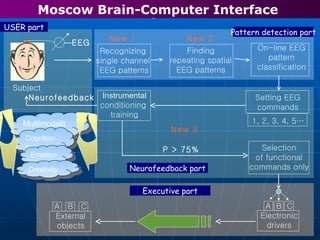
The document discusses brain-computer interfaces (BCI), including definitions, goals, challenges, and research being done at the NNCI Moscow laboratory. Some key points:
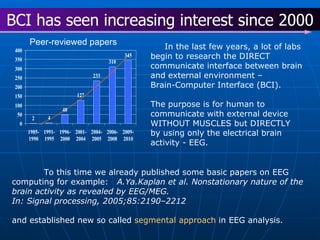
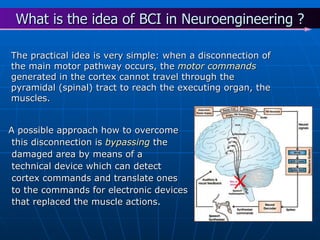
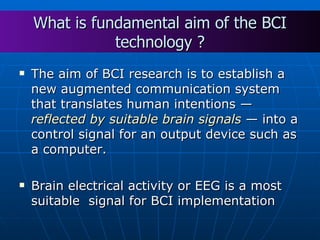
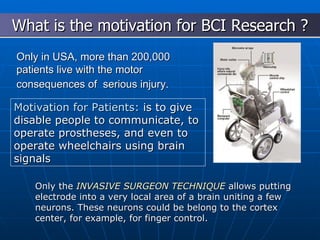
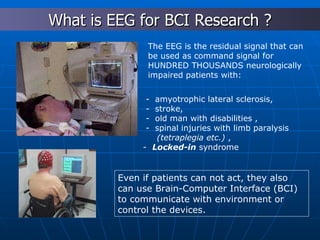
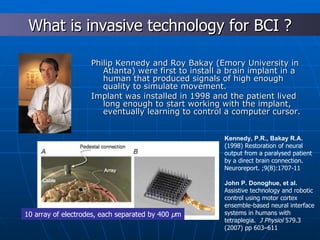
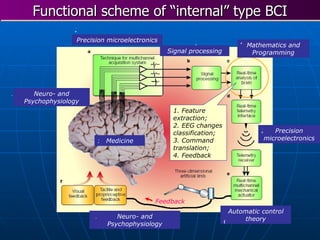
- A BCI allows humans to communicate with external devices using only brain signals (EEG) without muscles. The goal is to help disabled patients communicate and control devices.
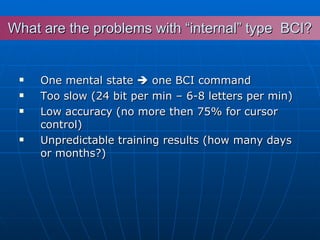
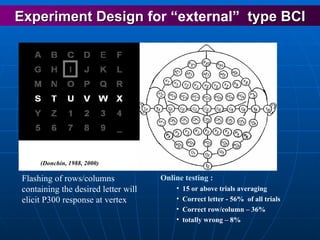
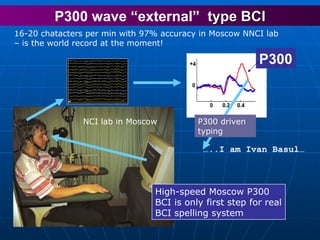
- Challenges include low speeds, accuracy, and unpredictability of training. The Moscow lab achieved world-record speeds of 16-20 characters per minute with their P300-based BCI.
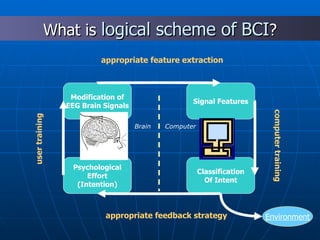
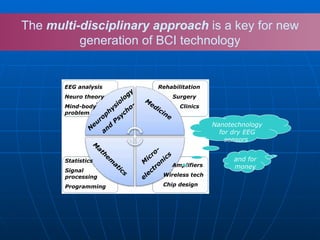
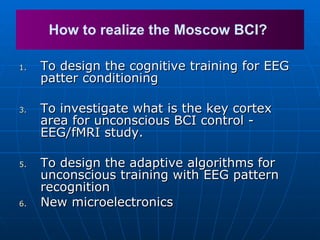
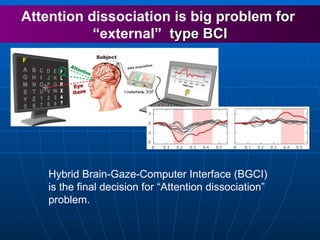
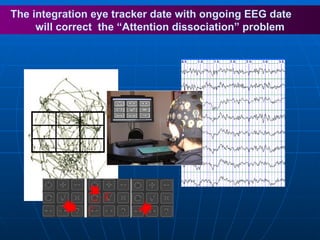
- Areas of research include improving feature extraction, classification algorithms, and developing hybrid BCIs that incorporate eye tracking to address "attention dissociation" problems.
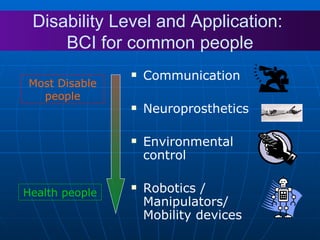
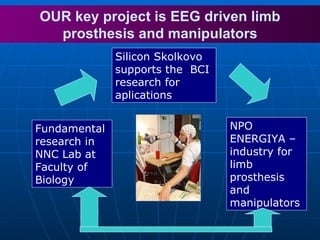
- Applications
![Brain-Computer Interface: Alexander Kaplan Head of Laboratory for Neurophysiology and Neuro-Computer Interfaces (NNCI Moscow) Contacts: [email_address] ; http:// brain.bio.msu.ru Lomonosov Moscow State University Faculty of Biology Dean of the Faculty: A cademician Mikhail P. Kirpichnikov Rebuilding radically new output of the Human Brain](https://image.slidesharecdn.com/kaplanalexanderbraincomputerinterface-110204111336-phpapp02/85/Kaplan-alexander-brain-computer-interface-1-320.jpg)
![Brain-Computer Interface: Alexander Kaplan Head of Laboratory for Neurophysiology and Neuro-Computer Interfaces (NNCI Moscow) Contacts: [email_address] ; http:// brain.bio.msu.ru Lomonosov Moscow State University Faculty of Biology Dean of the Faculty: A cademician Mikhail P. Kirpichnikov Rebuilding radically new output of the Human Brain](https://image.slidesharecdn.com/kaplanalexanderbraincomputerinterface-110204111336-phpapp02/75/Kaplan-alexander-brain-computer-interface-1-2048.jpg)
![“ A Brain-Computer Interface is a communication system that do not depend on peripheral nerves and muscles “ [J. R. Wolpaw et al. “Brain- computer interface technology: A review of the first international meeting,” IEEE Trans. Rehab. Eng., vol. 8, no. 2, pp. 164–173, 2000] What is the Definition of BCI ?](https://image.slidesharecdn.com/kaplanalexanderbraincomputerinterface-110204111336-phpapp02/85/Kaplan-alexander-brain-computer-interface-3-320.jpg)


![[IJET-V1I5P6] Authors:M. Newlin Rajkumar, M. Lavanya](https://cdn.slidesharecdn.com/ss_thumbnails/ijet-v1i5p6-151022011423-lva1-app6891-thumbnail.jpg?width=640&height=640&fit=bounds)


