Brain-Computer Interfaces
What is Brain-Computer Interfaces
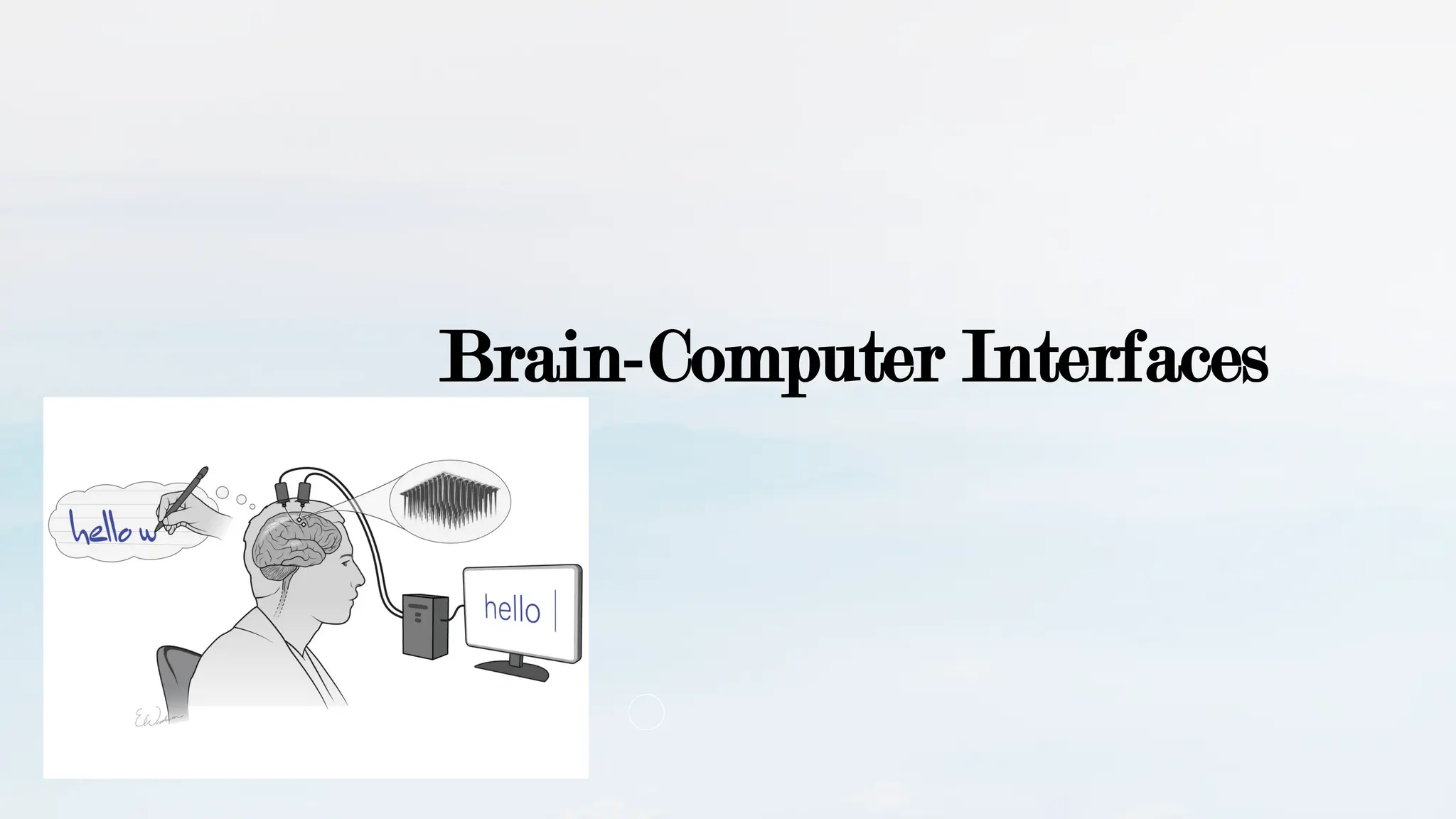
• Brain Computer Interfaces (BCIs) are like technological mind-
bridges.
• Create a direct communication pathway between your brain's
electrical activity and an external device.
• Brain-Computer Interfaces (BCIs) act as a translator between your
brain and external devices.
• Eg: Controlling a computer or even a robotic limb just by thinking
about it.
Types of BCIs
Invasive BCIs
• These involve surgically implanting
electrodes directly into the brain
tissue.
• They offer a clearer picture of brain
activity but require surgery and carry
some risks.
Non-invasive BCIs
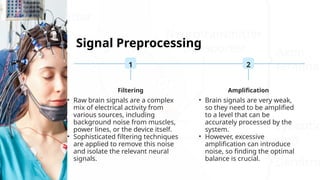
• These are less risky and use sensors
placed on the scalp (EEG) or near the
ears (fNIRS) to detect brainwaves.
• While convenient, they might not
capture brain signals with the same
detail as invasive BCIs.
Signal Acquisition: Invasive BCIs
1 Electrode Implantation
• Surgical procedures are
conducted to implant tiny
electrodes directly into specific
areas of the brain responsible
for movement, vision, or other
desired functions.
• These electrodes are
biocompatible and strategically
placed to pick up electrical
signals generated by groups of
neurons in those regions.
2 Signal Recording
• The electrodes act as sensors,
continuously recording the
electrical activity of nearby
neurons.
• These signals are in the form of
tiny voltage fluctuations
(millivolts) that occur when
neurons communicate with
each other.
Signal Acquisition: on-invasive BCIs
1 Scalp Electrodes (EEG)
• An EEG cap is worn,
containing multiple
electrodes placed
strategically on the scalp.
• These electrodes detect
changes in voltage caused
by the synchronized firing
of large groups of neurons
underneath them.
2 Near-Infrared
Spectroscopy (fNIRS)
• Sensors are positioned
near the forehead or
temples.
• They emit and detect near-
infrared light to measure
changes in blood flow in
the brain.
• Increased blood flow is
indirectly linked to
increased neuronal activity
in that region.
Signal Preprocessing
1
Filtering
• Raw brain signals are a complex
mix of electrical activity from
various sources, including
background noise from muscles,
power lines, or the device itself.
• Sophisticated filtering techniques
are applied to remove this noise
and isolate the relevant neural
signals.
2
Amplification
• Brain signals are very weak,
so they need to be amplified
to a level that can be
accurately processed by the
system.
• However, excessive
amplification can introduce
noise, so finding the optimal
balance is crucial.
Feature Extraction
Identifying Patterns
• After filtering and
amplification, the processed
signal still contains a lot of
information.
• Feature extraction
techniques are used to
identify specific patterns or
features within the signal
that are most relevant to
the desired action or
thought.
Motor Imagery Example
For example, in motor
imagery BCIs (where users
control a device by
imagining movement),
specific patterns of brain
activity might be
associated with imagining
movement of the right arm
compared to the left arm.
Feature extraction
algorithms identify these
unique patterns.
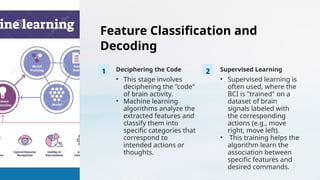
Feature Classification and
Decoding
1 Deciphering the Code
• This stage involves
deciphering the "code"
of brain activity.
• Machine learning
algorithms analyze the
extracted features and
classify them into
specific categories that
correspond to
intended actions or
thoughts.
2 Supervised Learning
• Supervised learning is
often used, where the
BCI is "trained" on a
dataset of brain
signals labeled with
the corresponding
actions (e.g., move
right, move left).
• This training helps the
algorithm learn the
association between
specific features and
desired commands.
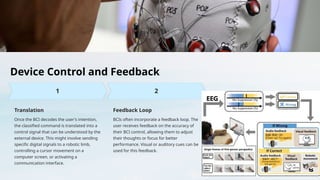
Device Control and Feedback
Translation
Once the BCI decodes the user's intention,
the classified command is translated into a
control signal that can be understood by the
external device. This might involve sending
specific digital signals to a robotic limb,
controlling a cursor movement on a
computer screen, or activating a
communication interface.
Feedback Loop
BCIs often incorporate a feedback loop. The
user receives feedback on the accuracy of
their BCI control, allowing them to adjust
their thoughts or focus for better
performance. Visual or auditory cues can be
used for this feedback.
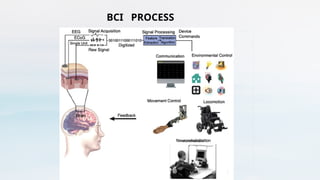
BCI PROCESS
Challenges and Considerations
Signal-to-Noise Ratio (SNR) A major challenge, particularly for non-
invasive BCIs, is the low SNR of brain
signals. Separating the weak neural signals
from background noise remains an ongoing
area of research.
Individual Variability Brain activity patterns vary significantly
between individuals. BCIs often require
calibration sessions to personalize the
system to each user's unique brain
signature for optimal performance.
Real-Time Processing The entire BCI process, from signal
acquisition to device control, needs to
happen in real-time for seamless
communication between the brain and the
device. This necessitates efficient
algorithms and powerful computing
resources.
Ethical Considerations As BCIs become more sophisticated, issues
of privacy, security of brain data, and
potential misuse of this technology need
careful consideration and ethical
frameworks.
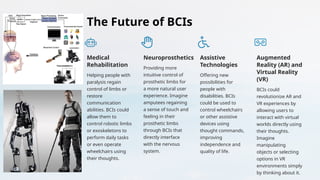
The Future of BCIs
Medical
Rehabilitation
Helping people with
paralysis regain
control of limbs or
restore
communication
abilities. BCIs could
allow them to
control robotic limbs
or exoskeletons to
perform daily tasks
or even operate
wheelchairs using
their thoughts.
Neuroprosthetics
Providing more
intuitive control of
prosthetic limbs for
a more natural user
experience. Imagine
amputees regaining
a sense of touch and
feeling in their
prosthetic limbs
through BCIs that
directly interface
with the nervous
system.
Assistive
Technologies
Offering new
possibilities for
people with
disabilities. BCIs
could be used to
control wheelchairs
or other assistive
devices using
thought commands,
improving
independence and
quality of life.
Augmented
Reality (AR) and
Virtual Reality
(VR)
BCIs could
revolutionize AR and
VR experiences by
allowing users to
interact with virtual
worlds directly using
their thoughts.
Imagine
manipulating
objects or selecting
options in VR
environments simply
by thinking about it.
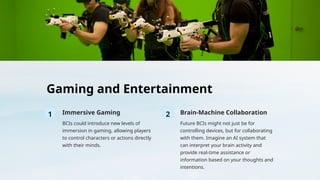
Gaming and Entertainment
1 Immersive Gaming
BCIs could introduce new levels of
immersion in gaming, allowing players
to control characters or actions directly
with their minds.
2 Brain-Machine Collaboration
Future BCIs might not just be for
controlling devices, but for collaborating
with them. Imagine an AI system that
can interpret your brain activity and
provide real-time assistance or
information based on your thoughts and
intentions.
Ethical Considerations
Privacy and Security
Brain data is highly personal
and sensitive. Robust
security measures are
crucial to protect user
privacy and prevent
unauthorized access to
brain data.
Equity and
Accessibility
BCI technology should be
accessible and affordable
for everyone, not just the
privileged few.
Misuse and Abuse
The potential for misuse of
BCI technology, such as
manipulating people's
thoughts or emotions,
needs to be addressed
through strong ethical
frameworks and
regulations.
The Future of BCIs
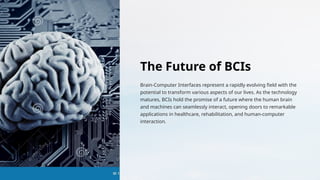
Brain-Computer Interfaces represent a rapidly evolving field with the
potential to transform various aspects of our lives. As the technology
matures, BCIs hold the promise of a future where the human brain
and machines can seamlessly interact, opening doors to remarkable
applications in healthcare, rehabilitation, and human-computer
interaction.
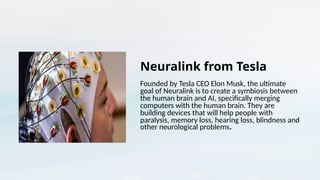
Neuralink from Tesla
Founded by Tesla CEO Elon Musk, the ultimate
goal of Neuralink is to create a symbiosis between
the human brain and AI, specifically merging
computers with the human brain. They are
building devices that will help people with
paralysis, memory loss, hearing loss, blindness and
other neurological problems.

Brain-Computer-Interfaces-A-Technological-Mind-Bridge.pptx

  • 1.
  • 2.
    What is Brain-ComputerInterfaces • Brain Computer Interfaces (BCIs) are like technological mind- bridges. • Create a direct communication pathway between your brain's electrical activity and an external device. • Brain-Computer Interfaces (BCIs) act as a translator between your brain and external devices. • Eg: Controlling a computer or even a robotic limb just by thinking about it.
  • 3.
    Types of BCIs InvasiveBCIs • These involve surgically implanting electrodes directly into the brain tissue. • They offer a clearer picture of brain activity but require surgery and carry some risks. Non-invasive BCIs • These are less risky and use sensors placed on the scalp (EEG) or near the ears (fNIRS) to detect brainwaves. • While convenient, they might not capture brain signals with the same detail as invasive BCIs.
  • 4.
    Signal Acquisition: InvasiveBCIs 1 Electrode Implantation • Surgical procedures are conducted to implant tiny electrodes directly into specific areas of the brain responsible for movement, vision, or other desired functions. • These electrodes are biocompatible and strategically placed to pick up electrical signals generated by groups of neurons in those regions. 2 Signal Recording • The electrodes act as sensors, continuously recording the electrical activity of nearby neurons. • These signals are in the form of tiny voltage fluctuations (millivolts) that occur when neurons communicate with each other.
  • 5.
    Signal Acquisition: on-invasiveBCIs 1 Scalp Electrodes (EEG) • An EEG cap is worn, containing multiple electrodes placed strategically on the scalp. • These electrodes detect changes in voltage caused by the synchronized firing of large groups of neurons underneath them. 2 Near-Infrared Spectroscopy (fNIRS) • Sensors are positioned near the forehead or temples. • They emit and detect near- infrared light to measure changes in blood flow in the brain. • Increased blood flow is indirectly linked to increased neuronal activity in that region.
  • 6.
    Signal Preprocessing 1 Filtering • Rawbrain signals are a complex mix of electrical activity from various sources, including background noise from muscles, power lines, or the device itself. • Sophisticated filtering techniques are applied to remove this noise and isolate the relevant neural signals. 2 Amplification • Brain signals are very weak, so they need to be amplified to a level that can be accurately processed by the system. • However, excessive amplification can introduce noise, so finding the optimal balance is crucial.
  • 7.
    Feature Extraction Identifying Patterns •After filtering and amplification, the processed signal still contains a lot of information. • Feature extraction techniques are used to identify specific patterns or features within the signal that are most relevant to the desired action or thought. Motor Imagery Example For example, in motor imagery BCIs (where users control a device by imagining movement), specific patterns of brain activity might be associated with imagining movement of the right arm compared to the left arm. Feature extraction algorithms identify these unique patterns.
  • 8.
    Feature Classification and Decoding 1Deciphering the Code • This stage involves deciphering the "code" of brain activity. • Machine learning algorithms analyze the extracted features and classify them into specific categories that correspond to intended actions or thoughts. 2 Supervised Learning • Supervised learning is often used, where the BCI is "trained" on a dataset of brain signals labeled with the corresponding actions (e.g., move right, move left). • This training helps the algorithm learn the association between specific features and desired commands.
  • 9.
    Device Control andFeedback Translation Once the BCI decodes the user's intention, the classified command is translated into a control signal that can be understood by the external device. This might involve sending specific digital signals to a robotic limb, controlling a cursor movement on a computer screen, or activating a communication interface. Feedback Loop BCIs often incorporate a feedback loop. The user receives feedback on the accuracy of their BCI control, allowing them to adjust their thoughts or focus for better performance. Visual or auditory cues can be used for this feedback.
  • 10.
  • 11.
    Challenges and Considerations Signal-to-NoiseRatio (SNR) A major challenge, particularly for non- invasive BCIs, is the low SNR of brain signals. Separating the weak neural signals from background noise remains an ongoing area of research. Individual Variability Brain activity patterns vary significantly between individuals. BCIs often require calibration sessions to personalize the system to each user's unique brain signature for optimal performance. Real-Time Processing The entire BCI process, from signal acquisition to device control, needs to happen in real-time for seamless communication between the brain and the device. This necessitates efficient algorithms and powerful computing resources. Ethical Considerations As BCIs become more sophisticated, issues of privacy, security of brain data, and potential misuse of this technology need careful consideration and ethical frameworks.
  • 12.
    The Future ofBCIs Medical Rehabilitation Helping people with paralysis regain control of limbs or restore communication abilities. BCIs could allow them to control robotic limbs or exoskeletons to perform daily tasks or even operate wheelchairs using their thoughts. Neuroprosthetics Providing more intuitive control of prosthetic limbs for a more natural user experience. Imagine amputees regaining a sense of touch and feeling in their prosthetic limbs through BCIs that directly interface with the nervous system. Assistive Technologies Offering new possibilities for people with disabilities. BCIs could be used to control wheelchairs or other assistive devices using thought commands, improving independence and quality of life. Augmented Reality (AR) and Virtual Reality (VR) BCIs could revolutionize AR and VR experiences by allowing users to interact with virtual worlds directly using their thoughts. Imagine manipulating objects or selecting options in VR environments simply by thinking about it.
  • 13.
    Gaming and Entertainment 1Immersive Gaming BCIs could introduce new levels of immersion in gaming, allowing players to control characters or actions directly with their minds. 2 Brain-Machine Collaboration Future BCIs might not just be for controlling devices, but for collaborating with them. Imagine an AI system that can interpret your brain activity and provide real-time assistance or information based on your thoughts and intentions.
  • 14.
    Ethical Considerations Privacy andSecurity Brain data is highly personal and sensitive. Robust security measures are crucial to protect user privacy and prevent unauthorized access to brain data. Equity and Accessibility BCI technology should be accessible and affordable for everyone, not just the privileged few. Misuse and Abuse The potential for misuse of BCI technology, such as manipulating people's thoughts or emotions, needs to be addressed through strong ethical frameworks and regulations.
  • 15.
    The Future ofBCIs Brain-Computer Interfaces represent a rapidly evolving field with the potential to transform various aspects of our lives. As the technology matures, BCIs hold the promise of a future where the human brain and machines can seamlessly interact, opening doors to remarkable applications in healthcare, rehabilitation, and human-computer interaction.
  • 16.
    Neuralink from Tesla Foundedby Tesla CEO Elon Musk, the ultimate goal of Neuralink is to create a symbiosis between the human brain and AI, specifically merging computers with the human brain. They are building devices that will help people with paralysis, memory loss, hearing loss, blindness and other neurological problems.

Editor's Notes

  • #3 Electroencephalography is a Functional near-infrared spectroscopy is an optical brain monitoring technique which uses near-infrared spectroscopy for the purpose of functional neuroimaging. method to record an electrogram of the spontaneous electrical activity of the brain.
  • #4  the condition of being compatible with living tissue or a living system by not being toxic or injurious and not causing immunological rejection. 
  • #16 https://rossdawson.com/futurist/companies-creating-future/leading-brain-computer-interface-companies-bci/#:~:text=Founded%20by%20Tesla%20CEO%20Elon,blindness%20and%20other%20neurological%20problems. https://analyticsindiamag.com/10-times-companies-made-inexpensive-consumer-based-bci-devices-using-eeg/