

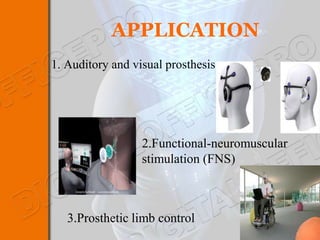
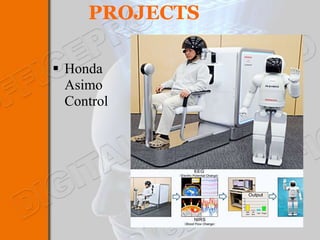
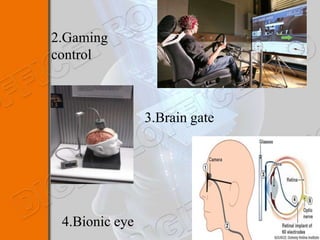
This document discusses brain-machine interfaces (BMI). A BMI establishes a communication link between the brain and external devices. Signals from the brain are detected via implants and transformed to control signals. There are invasive, partially invasive and non-invasive BMI approaches. A typical BMI system includes implant devices to detect brain signals, signal processing to analyze the signals, an external device to be controlled, and feedback. Potential applications include assisting people with disabilities and developing prosthetics. However, BMIs also face challenges regarding signal detection and processing.
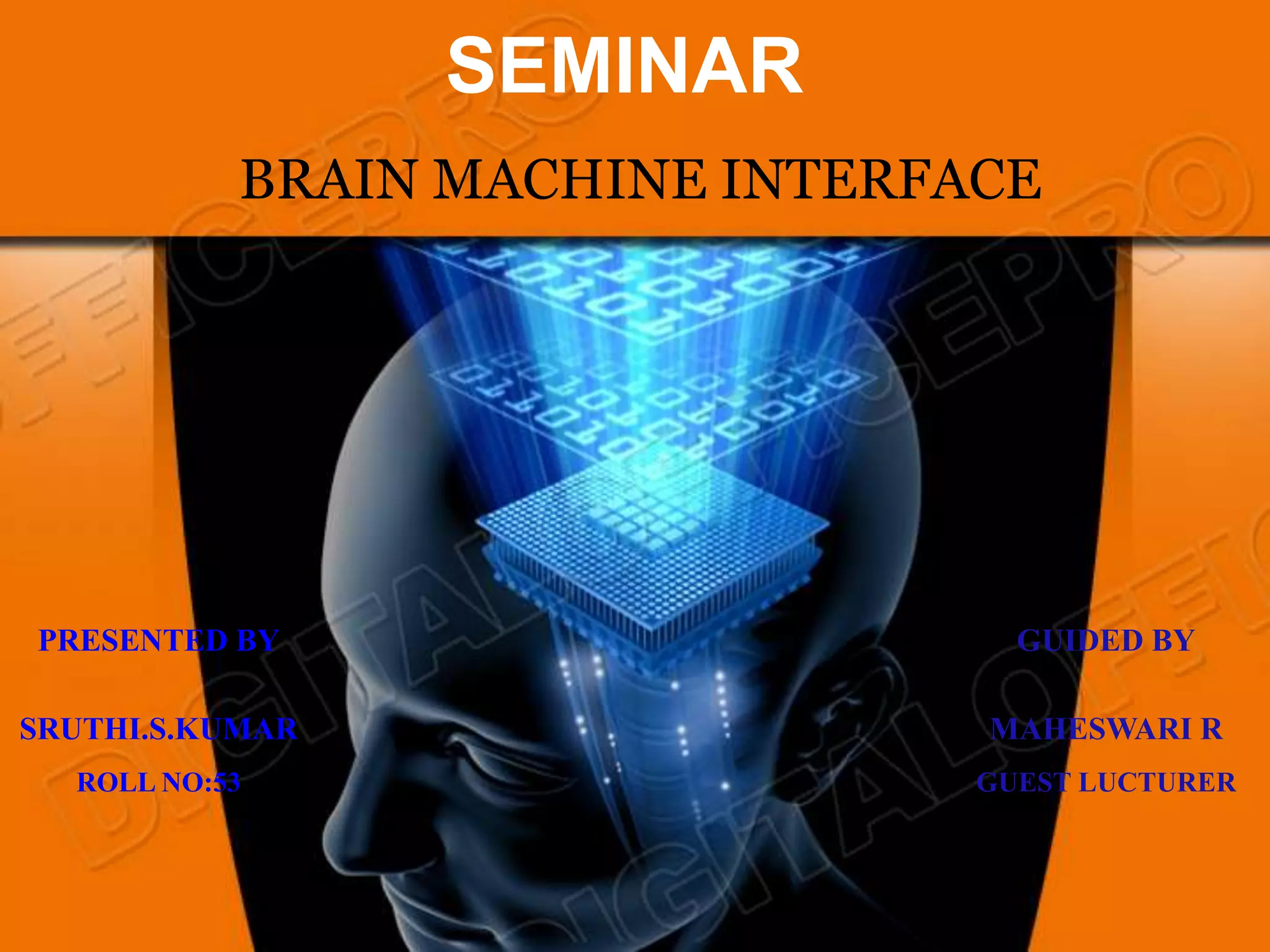
SEMINAR
BRAIN MACHINE INTERFACE
PRESENTED BY GUIDED BY
SRUTHI.S.KUMAR MAHESWARI R
ROLL NO:53 GUEST LUCTURER
2.
INTRODUCTION
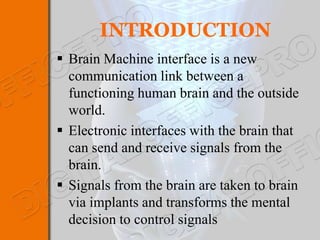
Brain Machineinterface is a new
communication link between a
functioning human brain and the outside
world.
Electronic interfaces with the brain that
can send and receive signals from the
brain.
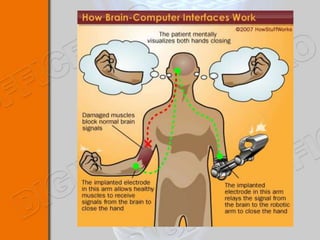
Signals from the brain are taken to brain
via implants and transforms the mental
decision to control signals
4.
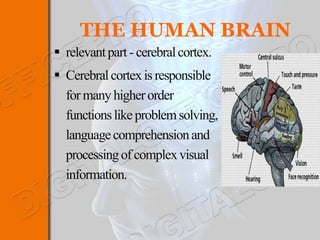
THE HUMAN BRAIN
relevant part - cerebral cortex.
Cerebral cortex is responsible
for many higher order
functions like problem solving,
language comprehension and
processing of complex visual
information.
5.
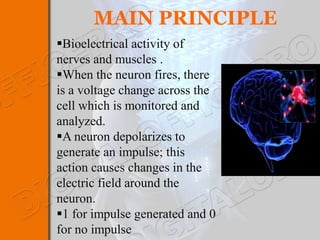
MAIN PRINCIPLE
Bioelectrical activityof
nerves and muscles .
When the neuron fires, there
is a voltage change across the
cell which is monitored and
analyzed.
A neuron depolarizes to
generate an impulse; this
action causes changes in the
electric field around the
neuron.
1 for impulse generated and 0
for no impulse
6.
BMI APPROACHES
1. Patternrecognition approach based on
mental tasks.
2. Operant conditioning approach based
on the self-regulation of the EEG
response.
8.
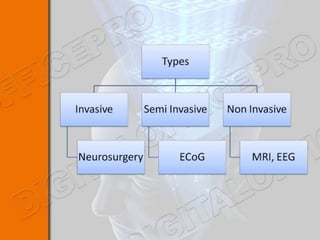
1.INVASIVE
directly implantedinto the
grey matter.
produce the highest quality
signals
prone to building up of scar-
tissue
9.
2.PARTIALLY INVASIVE
Implantedinside the skull but rest
outside.
produce better resolution signals than
non-invasive BCIs
Electrocorticography (ECoG) uses the
same technology, the electrodes are
embedded in a thin plastic pad that is
placed above the cortex.
10.
3.NON INVASIVE
Electroencephalography-recordingis
obtained by placing electrodes on the
scalp with a conductive gel or paste.
FMRI(Functional Magnetic Resonance
Imaging) exploits the changes in the
magnetic properties of hemoglobin as it
carries oxygen. Activation of a part of the
brain increases oxygen levels there
increasing the ratio of oxyhemoglobin to
deoxyhemoglobin.
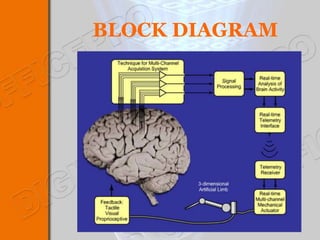
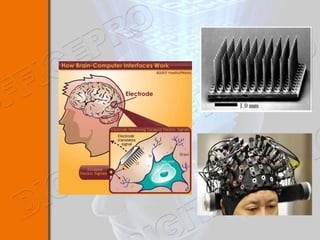
1.IMPLANT DEVICES
Implanted arrayof
microelectrodes into
the frontal and parietal
lobes.
provide the electrical
contact between the
skin which transforms
the ionic current on
the skin to the
electrical current in
the wires.
15.
2.SIGNAL PROCESSING
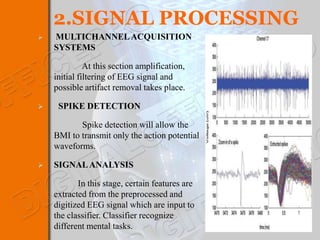
MULTICHANNEL ACQUISITION
SYSTEMS
At this section amplification,
initial filtering of EEG signal and
possible artifact removal takes place.
SPIKE DETECTION
Spike detection will allow the
BMI to transmit only the action potential
waveforms.
SIGNAL ANALYSIS
In this stage, certain features are
extracted from the preprocessed and
digitized EEG signal which are input to
the classifier. Classifier recognize
different mental tasks.
16.
3.EXTERNAL DEVICES
The classifier’s output is the input for the
device control. The device control
simply transforms the classification to a
particular action.
Examples are robotic arm, thought
controlled wheel chair etc
17.
4.FEEDBACK
Feedback isneeded for learning and for
control.
In the BMIs based on the operant
conditioning approach, feedback training
is essential for the user to acquire the
control of his or her EEG response.
The BMIs based on the pattern
recognition approach and using mental
tasks do not definitely require feedback
training.
18.
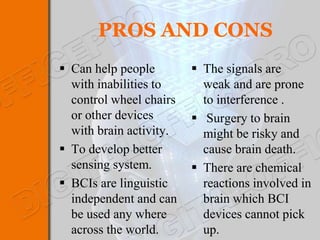
PROS AND CONS
Can help people The signals are
with inabilities to weak and are prone
control wheel chairs to interference .
or other devices Surgery to brain
with brain activity. might be risky and
To develop better cause brain death.
sensing system. There are chemical
BCIs are linguistic reactions involved in
independent and can brain which BCI
be used any where devices cannot pick
across the world. up.
CONCLUSION
A potentialtherapeutic tool.
Brain-Computer Interface (BCI) is a
method of communication based on
voluntary neural activity generated by the
brain.
have the ability to give people back their
lost capabilities.
23.
REFERENCES
P. Sajda,K-R. Mueller, and K.V. Shenoy, eds.,
special issue, “Brain Computer Interfaces,”
IEEE Signal Processing Magazine,Jan. 2008
Wolpaw, J.R. et al. (2002) Brain–computer
interfaces for communication and control. Clin.
Neurophysiol. 113, 767–791
Birbaumer, N. (2006) Brain–computer-interface
research: coming of age. Clin. Neurophysiol.
117, 479–483
www.betterhumans.com
www.howstuffworks.com