






A Seminar on

Brain Computer Interfaces

Submitted By
MUSTAHID ALI
Some videos… Probably you have already
seen!
Fiction??
Agenda
•
•
•
•
•
•
•
•

???? - ???? -????
Introduction
BCI Model
Early Work
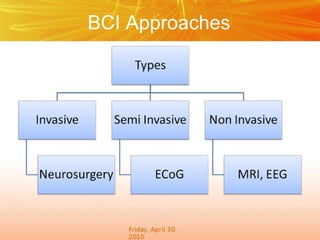
BCI Approaches
Applications
Current Projects
Conclusion
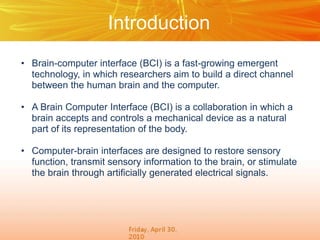
Introduction
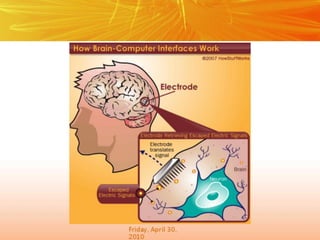
• Brain-computer interface (BCI) is a fast-growing emergent
technology, in which researchers aim to build a direct channel
between the human brain and the computer.
• A Brain Computer Interface (BCI) is a collaboration in which a
brain accepts and controls a mechanical device as a natural
part of its representation of the body.
• Computer-brain interfaces are designed to restore sensory
function, transmit sensory information to the brain, or stimulate
the brain through artificially generated electrical signals.
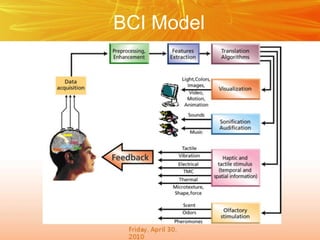
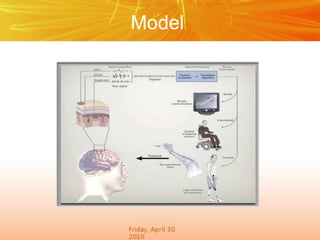
BCI Model
Model
Early work
• Algorithms to reconstruct movements from motor cortex
neurons, which control movement, were developed in 1970s.
• The first Intra-Cortical Brain-Computer Interface was built by
implanting electrodes into monkeys.
• After conducting initial studies in rats during the 1990s,
researchers developed Brain Computer Interfaces that decoded
brain activity in monkeys and used the devices to reproduce
movements in monkeys and used the devices to reproduce
monkey movements in robotic arms.
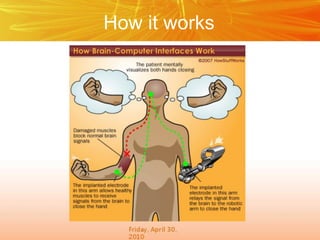
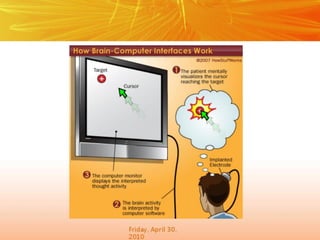
How it works
BCI Approaches
Invasive
• Invasive BCIs are implanted directly into the grey matter of the
brain during neurosurgery.

• As they rest in the grey matter, invasive devices produce the
highest quality signals of BCI devices but are prone to scartissue build-up, causing the signal to become weaker or even
lost as the body reacts to a foreign object in the brain.
Semi and Non Invasive
• Electrocorticography (ECoG) measures the electrical activity of the brain taken
from beneath the skull in a similar way to non-invasive electroencephalography but the
electrodes are embedded in a thin plastic pad that is placed above the cortex, beneath
the dura mater.
•

Electroencephalography In conventional scalp EEG, the recording is obtained
by placing electrodes on the scalp with a conductive gel or paste, usually after
preparing the scalp area by light abrasion to reduce impedance due to dead skin
cells. Many systems typically use electrodes, each of which is attached to an
individual wire.

•

fMRI = Functional Magnetic Resonance Imaging fMRI exploits the changes in
the magnetic properties of hemoglobin as it carries oxygen. Activation of a part of
the brain increases oxygen levels there increasing the ratio of oxyhemoglobin to
deoxyhemoglobin.

•

Magnetoencephalography (MEG) MEG detects the tiny magnetic fields created
as individual neurons "fire" within the brain. It can pinpoint the active region with a
millimeter, and can follow the movement of brain activity as it travels from region
to region within the brain.
Applications
• Provide disabled people with communication, environment

control, and movement restoration.

• Provide enhanced control of devices such as wheelchairs,
vehicles, or assistance robots for people with disabilities.
• Provide additional channel of control in computer games.
• Monitor attention in long-distance drivers or aircraft pilots, send
out alert and warning for aircraft pilots.
• Develop intelligent relaxation devices.
Applications
• Control robots that function in dangerous or inhospitable
situations (e.g., underwater or in extreme heat or cold).
• Create a feedback loop to enhance the benefits of certain
therapeutic methods.
• Develop passive devices for monitoring function, such as
monitoring long-term drug effects, evaluating
psychological state, etc.
• Monitor stages of sleep
Applications
• Bionics/Cybernetics

• Memory Upload/Download
• Dream Capture
• Brain as a Computer
• “Google Search” through brain
Projects
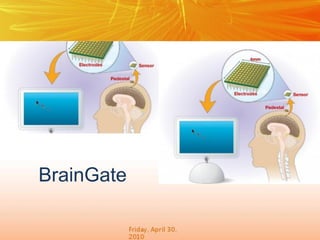
• BrainGate
• BCI2000
• Australian Bionic Eye
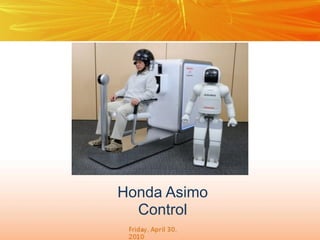
• Honda Asimo Control
• Kevin Warwick – The First Human Cyborg
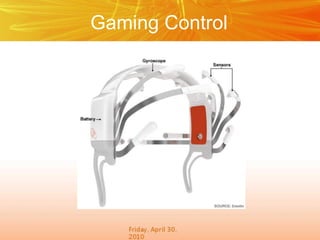
• Gaming Control

• Many Others….
BrainGate
Honda Asimo
Control
Gaming Control
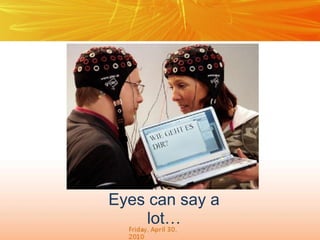
Eyes can say a
lot…
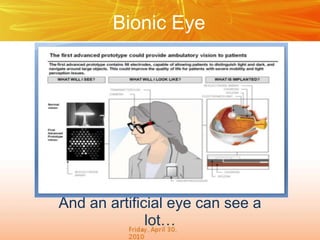
Bionic Eye

And an artificial eye can see a
lot…
Some More
Videos…
Fiction or Future??
Conclusion
• A potential therapeutic tool.
• BCI is an advancing technology promising paradigm shift in
areas like Machine Control, Human Enhancement, Virtual
reality and etc. So, it’s potentially high impact technology.
• Several potential applications of BCI hold promise for
rehabilitation and improving performance, such as treating
emotional disorders (for example, depression or anxiety),
easing chronic pain, and overcoming movement disabilities due
to stroke.
• Will enable us to achieve singularity very soon.
• Intense R&D in future to attain intuitive efficiency.
References
• Sixto Ortiz Jr., "Brain-Computer Interfaces: Where Human and Machine
Meet," Computer, vol. 40, no. 1, pp. 17-21, Jan., 2007

• F. Babiloni, A. Cichocki, and S. Gao, eds., special issue, “BrainComputer Interfaces: Towards Practical Implementations and Potential
Applications,” ComputationalIntelligence and Neuroscience, 2007
• P. Sajda, K-R. Mueller, and K.V. Shenoy, eds., special issue, “Brain
Computer Interfaces,” IEEE Signal Processing Magazine,Jan. 2008
• The MIT Press – “Toward Brain-Computer Interfacing”
• Wikipedia, HowStuffWorks and various other website sources…
Thank You!

Brain computer interfaces 12

  • 1.
    A Seminar on BrainComputer Interfaces Submitted By MUSTAHID ALI
  • 2.
    Some videos… Probablyyou have already seen!
  • 3.
  • 4.
    Agenda • • • • • • • • ???? - ????-???? Introduction BCI Model Early Work BCI Approaches Applications Current Projects Conclusion
  • 5.
    Introduction • Brain-computer interface(BCI) is a fast-growing emergent technology, in which researchers aim to build a direct channel between the human brain and the computer. • A Brain Computer Interface (BCI) is a collaboration in which a brain accepts and controls a mechanical device as a natural part of its representation of the body. • Computer-brain interfaces are designed to restore sensory function, transmit sensory information to the brain, or stimulate the brain through artificially generated electrical signals.
  • 6.
  • 7.
  • 8.
    Early work • Algorithmsto reconstruct movements from motor cortex neurons, which control movement, were developed in 1970s. • The first Intra-Cortical Brain-Computer Interface was built by implanting electrodes into monkeys. • After conducting initial studies in rats during the 1990s, researchers developed Brain Computer Interfaces that decoded brain activity in monkeys and used the devices to reproduce movements in monkeys and used the devices to reproduce monkey movements in robotic arms.
  • 9.
  • 12.
  • 13.
    Invasive • Invasive BCIsare implanted directly into the grey matter of the brain during neurosurgery. • As they rest in the grey matter, invasive devices produce the highest quality signals of BCI devices but are prone to scartissue build-up, causing the signal to become weaker or even lost as the body reacts to a foreign object in the brain.
  • 14.
    Semi and NonInvasive • Electrocorticography (ECoG) measures the electrical activity of the brain taken from beneath the skull in a similar way to non-invasive electroencephalography but the electrodes are embedded in a thin plastic pad that is placed above the cortex, beneath the dura mater. • Electroencephalography In conventional scalp EEG, the recording is obtained by placing electrodes on the scalp with a conductive gel or paste, usually after preparing the scalp area by light abrasion to reduce impedance due to dead skin cells. Many systems typically use electrodes, each of which is attached to an individual wire. • fMRI = Functional Magnetic Resonance Imaging fMRI exploits the changes in the magnetic properties of hemoglobin as it carries oxygen. Activation of a part of the brain increases oxygen levels there increasing the ratio of oxyhemoglobin to deoxyhemoglobin. • Magnetoencephalography (MEG) MEG detects the tiny magnetic fields created as individual neurons "fire" within the brain. It can pinpoint the active region with a millimeter, and can follow the movement of brain activity as it travels from region to region within the brain.
  • 15.
    Applications • Provide disabledpeople with communication, environment control, and movement restoration. • Provide enhanced control of devices such as wheelchairs, vehicles, or assistance robots for people with disabilities. • Provide additional channel of control in computer games. • Monitor attention in long-distance drivers or aircraft pilots, send out alert and warning for aircraft pilots. • Develop intelligent relaxation devices.
  • 16.
    Applications • Control robotsthat function in dangerous or inhospitable situations (e.g., underwater or in extreme heat or cold). • Create a feedback loop to enhance the benefits of certain therapeutic methods. • Develop passive devices for monitoring function, such as monitoring long-term drug effects, evaluating psychological state, etc. • Monitor stages of sleep
  • 17.
    Applications • Bionics/Cybernetics • MemoryUpload/Download • Dream Capture • Brain as a Computer • “Google Search” through brain
  • 18.
    Projects • BrainGate • BCI2000 •Australian Bionic Eye • Honda Asimo Control • Kevin Warwick – The First Human Cyborg • Gaming Control • Many Others….
  • 19.
  • 20.
  • 21.
  • 22.
    Eyes can saya lot…
  • 23.
    Bionic Eye And anartificial eye can see a lot…
  • 24.
  • 25.
  • 26.
    Conclusion • A potentialtherapeutic tool. • BCI is an advancing technology promising paradigm shift in areas like Machine Control, Human Enhancement, Virtual reality and etc. So, it’s potentially high impact technology. • Several potential applications of BCI hold promise for rehabilitation and improving performance, such as treating emotional disorders (for example, depression or anxiety), easing chronic pain, and overcoming movement disabilities due to stroke. • Will enable us to achieve singularity very soon. • Intense R&D in future to attain intuitive efficiency.
  • 27.
    References • Sixto OrtizJr., "Brain-Computer Interfaces: Where Human and Machine Meet," Computer, vol. 40, no. 1, pp. 17-21, Jan., 2007 • F. Babiloni, A. Cichocki, and S. Gao, eds., special issue, “BrainComputer Interfaces: Towards Practical Implementations and Potential Applications,” ComputationalIntelligence and Neuroscience, 2007 • P. Sajda, K-R. Mueller, and K.V. Shenoy, eds., special issue, “Brain Computer Interfaces,” IEEE Signal Processing Magazine,Jan. 2008 • The MIT Press – “Toward Brain-Computer Interfacing” • Wikipedia, HowStuffWorks and various other website sources…
  • 29.