INTRODUCTION
HISTORY OF BCI
BRAIN WAVES
WHAT IS BCI
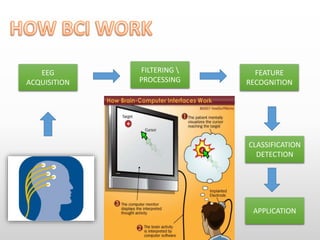
HOW BCI WORK
APROACHES OF BCI
USESES OF BCI
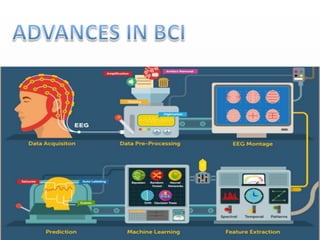
ADVANCES OF BCI
PRO’S &CON’S OFBCI
CONCLUSION
Brain computer interface (BCI) is a fast-growing emergent
technology, in which researchers aim to build a direct channel
between the mind and computer.
A BCI is a collaboration in which a brain accepts and controls a
mechanical device as a natural part of its representation of a
body.
Computer-brain interfaces are designed through artificial to
restore sensory function. Transmit sensory information to the
brain, or stimulate the brain through artificially generated
electrical signals.
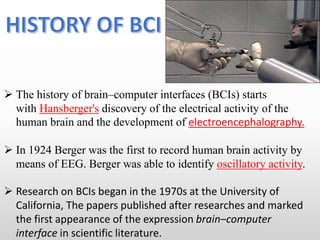
 The history of brain–computer interfaces (BCIs) starts
with Hansberger's discovery of the electrical activity of the
human brain and the development of electroencephalography.
 In 1924 Berger was the first to record human brain activity by
means of EEG. Berger was able to identify oscillatory activity.
 Research on BCIs began in the 1970s at the University of
California, The papers published after researches and marked
the first appearance of the expression brain–computer
interface in scientific literature.
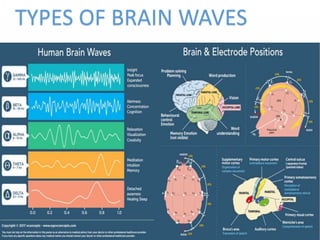
TYPES OF BRAIN WAVES
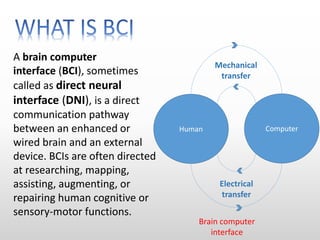
A brain computer
interface (BCI), sometimes
called as direct neural
interface (DNI), is a direct
communication pathway
between an enhanced or
wired brain and an external
device. BCIs are often directed
at researching, mapping,
assisting, augmenting, or
repairing human cognitive or
sensory-motor functions.
ComputerHuman
Mechanical
transfer
Electrical
transfer
Brain computer
interface
EEG
ACQUISITION
FILTERING 
PROCESSING
FEATURE
RECOGNITION
CLASSIFICATION
DETECTION
APPLICATION
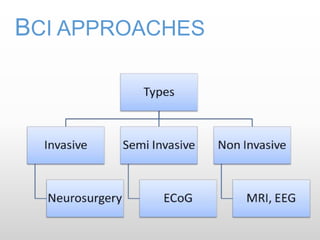
BCI APPROACHES
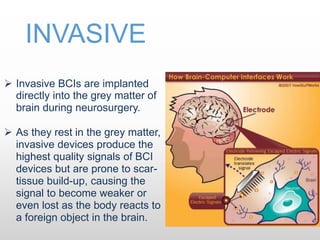
 Invasive BCIs are implanted
directly into the grey matter of
brain during neurosurgery.
 As they rest in the grey matter,
invasive devices produce the
highest quality signals of BCI
devices but are prone to scar-
tissue build-up, causing the
signal to become weaker or
even lost as the body reacts to
a foreign object in the brain.
INVASIVE
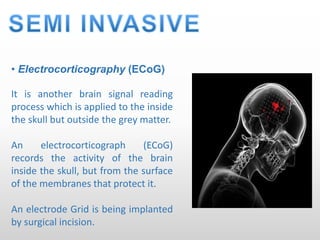
• Electrocorticography (ECoG)
It is another brain signal reading
process which is applied to the inside
the skull but outside the grey matter.
An electrocorticograph (ECoG)
records the activity of the brain
inside the skull, but from the surface
of the membranes that protect it.
An electrode Grid is being implanted
by surgical incision.
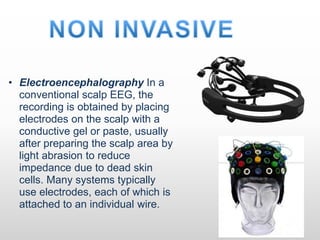
• Electroencephalography In a
conventional scalp EEG, the
recording is obtained by placing
electrodes on the scalp with a
conductive gel or paste, usually
after preparing the scalp area by
light abrasion to reduce
impedance due to dead skin
cells. Many systems typically
use electrodes, each of which is
attached to an individual wire.
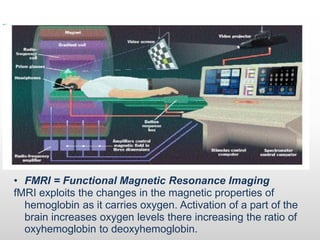
• FMRI = Functional Magnetic Resonance Imaging
fMRI exploits the changes in the magnetic properties of
hemoglobin as it carries oxygen. Activation of a part of the
brain increases oxygen levels there increasing the ratio of
oxyhemoglobin to deoxyhemoglobin.
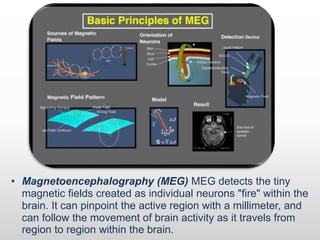
• Magnetoencephalography (MEG) MEG detects the tiny
magnetic fields created as individual neurons "fire" within the
brain. It can pinpoint the active region with a millimeter, and
can follow the movement of brain activity as it travels from
region to region within the brain.
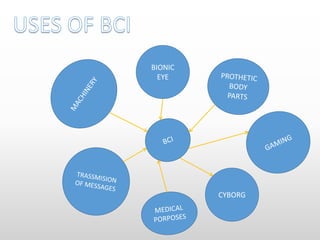
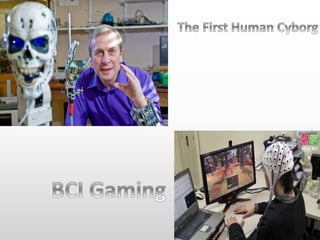
BIONIC
EYE
CYBORG
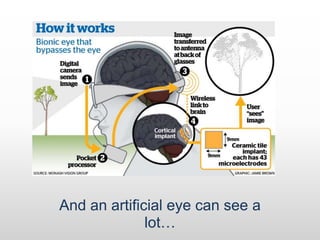
Bionic Eye
And an artificial eye can see a
lot…
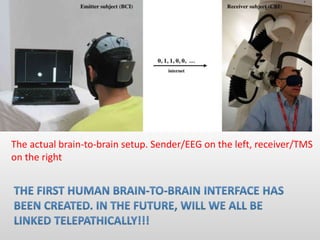
The actual brain-to-brain setup. Sender/EEG on the left, receiver/TMS
on the right
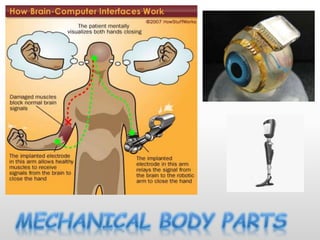
Eventually, this technology could:
•Allow paralyzed people to control prosthetic limbs with
their mind.
•Transmit visual images to the mind of a blind person,
allowing them to see.
•Transmit auditory data to the mind of a deaf person,
allowing them to hear.
• Allow a mute person to have their thoughts displayed and
spoken by a computer.
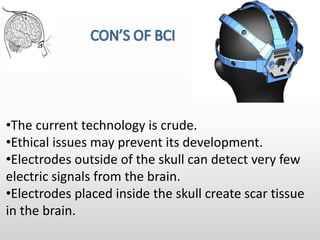
•The current technology is crude.
•Ethical issues may prevent its development.
•Electrodes outside of the skull can detect very few
electric signals from the brain.
•Electrodes placed inside the skull create scar tissue
in the brain.
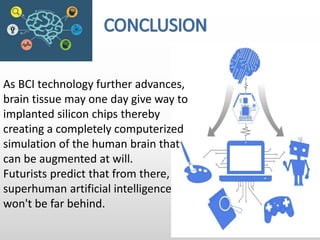
As BCI technology further advances,
brain tissue may one day give way to
implanted silicon chips thereby
creating a completely computerized
simulation of the human brain that
can be augmented at will.
Futurists predict that from there,
superhuman artificial intelligence
won't be far behind.
Brain computer interface

Brain computer interface

  • 2.
    INTRODUCTION HISTORY OF BCI BRAINWAVES WHAT IS BCI HOW BCI WORK APROACHES OF BCI USESES OF BCI ADVANCES OF BCI PRO’S &CON’S OFBCI CONCLUSION
  • 3.
    Brain computer interface(BCI) is a fast-growing emergent technology, in which researchers aim to build a direct channel between the mind and computer. A BCI is a collaboration in which a brain accepts and controls a mechanical device as a natural part of its representation of a body. Computer-brain interfaces are designed through artificial to restore sensory function. Transmit sensory information to the brain, or stimulate the brain through artificially generated electrical signals.
  • 4.
     The historyof brain–computer interfaces (BCIs) starts with Hansberger's discovery of the electrical activity of the human brain and the development of electroencephalography.  In 1924 Berger was the first to record human brain activity by means of EEG. Berger was able to identify oscillatory activity.  Research on BCIs began in the 1970s at the University of California, The papers published after researches and marked the first appearance of the expression brain–computer interface in scientific literature.
  • 5.
  • 6.
    A brain computer interface(BCI), sometimes called as direct neural interface (DNI), is a direct communication pathway between an enhanced or wired brain and an external device. BCIs are often directed at researching, mapping, assisting, augmenting, or repairing human cognitive or sensory-motor functions. ComputerHuman Mechanical transfer Electrical transfer Brain computer interface
  • 7.
  • 8.
  • 9.
     Invasive BCIsare implanted directly into the grey matter of brain during neurosurgery.  As they rest in the grey matter, invasive devices produce the highest quality signals of BCI devices but are prone to scar- tissue build-up, causing the signal to become weaker or even lost as the body reacts to a foreign object in the brain. INVASIVE
  • 10.
    • Electrocorticography (ECoG) Itis another brain signal reading process which is applied to the inside the skull but outside the grey matter. An electrocorticograph (ECoG) records the activity of the brain inside the skull, but from the surface of the membranes that protect it. An electrode Grid is being implanted by surgical incision.
  • 11.
    • Electroencephalography Ina conventional scalp EEG, the recording is obtained by placing electrodes on the scalp with a conductive gel or paste, usually after preparing the scalp area by light abrasion to reduce impedance due to dead skin cells. Many systems typically use electrodes, each of which is attached to an individual wire.
  • 12.
    • FMRI =Functional Magnetic Resonance Imaging fMRI exploits the changes in the magnetic properties of hemoglobin as it carries oxygen. Activation of a part of the brain increases oxygen levels there increasing the ratio of oxyhemoglobin to deoxyhemoglobin.
  • 13.
    • Magnetoencephalography (MEG)MEG detects the tiny magnetic fields created as individual neurons "fire" within the brain. It can pinpoint the active region with a millimeter, and can follow the movement of brain activity as it travels from region to region within the brain.
  • 14.
  • 15.
    Bionic Eye And anartificial eye can see a lot…
  • 18.
    The actual brain-to-brainsetup. Sender/EEG on the left, receiver/TMS on the right
  • 20.
    Eventually, this technologycould: •Allow paralyzed people to control prosthetic limbs with their mind. •Transmit visual images to the mind of a blind person, allowing them to see. •Transmit auditory data to the mind of a deaf person, allowing them to hear. • Allow a mute person to have their thoughts displayed and spoken by a computer.
  • 21.
    •The current technologyis crude. •Ethical issues may prevent its development. •Electrodes outside of the skull can detect very few electric signals from the brain. •Electrodes placed inside the skull create scar tissue in the brain.
  • 22.
    As BCI technologyfurther advances, brain tissue may one day give way to implanted silicon chips thereby creating a completely computerized simulation of the human brain that can be augmented at will. Futurists predict that from there, superhuman artificial intelligence won't be far behind.