DR NILESH KATE
MBBS,MD
ASSOCIATE PROF
DEPT. OF PHYSIOLOGY
BODY FLUIDS
OBJECTIVES
1. Volumes & Compartments of body fluids
2. Composition of body fluids
3. Measurement of each compartment
4. Significance of body fluids.
5. Water balance – positive and negative
water balance
6. Oedema , Dehydration.
Thursday, December 10, 2015
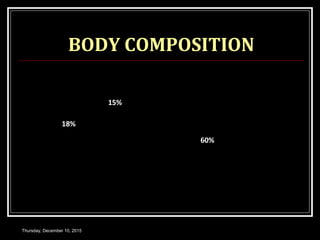
BODY COMPOSITION
60%
7%
18%
15%
BODY COMPOSITION
WATER
MINERALS
PROTEINS
FATS
Thursday, December 10, 2015
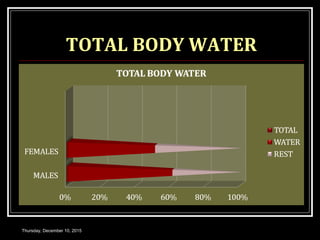
TOTAL BODY WATER
Thursday, December 10, 2015
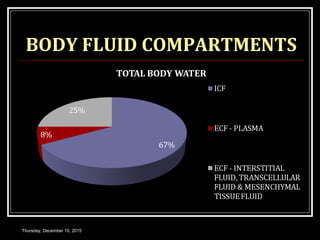
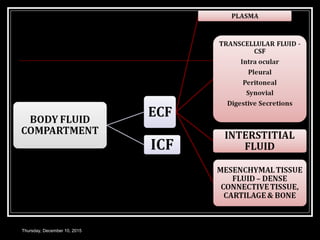
BODY FLUID COMPARTMENTS
Thursday, December 10, 2015
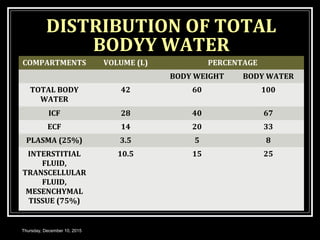
DISTRIBUTION OF TOTAL
BODYY WATER
COMPARTMENTS VOLUME (L) PERCENTAGE
BODY WEIGHT BODY WATER
TOTAL BODY
WATER
42 60 100
ICF 28 40 67
ECF 14 20 33
PLASMA (25%) 3.5 5 8
INTERSTITIAL
FLUID,
TRANSCELLULAR
FLUID,
MESENCHYMAL
TISSUE (75%)
10.5 15 25
Thursday, December 10, 2015
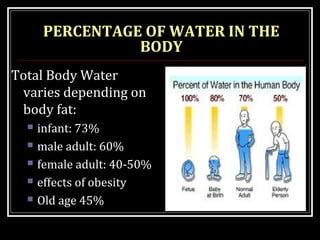
PERCENTAGE OF WATER IN THE
BODY
Total Body Water
varies depending on

body fat:
 infant: 73%
 male adult: 60%
 female adult: 40-50%
 effects of obesity
 Old age 45%
Thursday, December 10, 2015
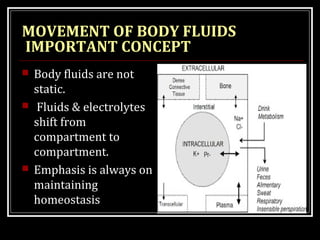
MOVEMENT OF BODY FLUIDS
IMPORTANT CONCEPT
 Body fluids are not
static.
 Fluids & electrolytes
shift from
compartment to
compartment.
 Emphasis is always on
maintaining
homeostasis
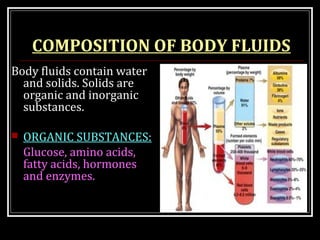
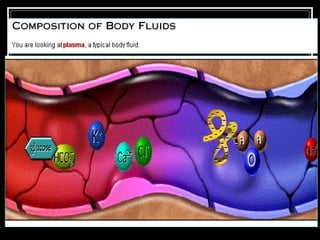
COMPOSITION OF BODY FLUIDS
Body fluids contain water
and solids. Solids are
organic and inorganic
substances.
 ORGANIC SUBSTANCES:
Glucose, amino acids,
fatty acids, hormones
and enzymes.
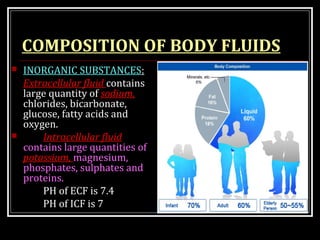
COMPOSITION OF BODY FLUIDS
 INORGANIC SUBSTANCES:
Extracellular fluid contains
large quantity of sodium,
chlorides, bicarbonate,
glucose, fatty acids and
oxygen.
 Intracellular fluid
contains large quantities of
potassium, magnesium,
phosphates, sulphates and
proteins.
PH of ECF is 7.4
PH of ICF is 7
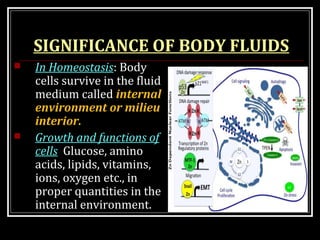
SIGNIFICANCE OF BODY FLUIDS
 In Homeostasis: Body
cells survive in the fluid
medium called internal
environment or milieu
interior.
 Growth and functions of
cells Glucose, amino
acids, lipids, vitamins,
ions, oxygen etc., in
proper quantities in the
internal environment.
SIGNIFICANCE OF BODY FLUIDS
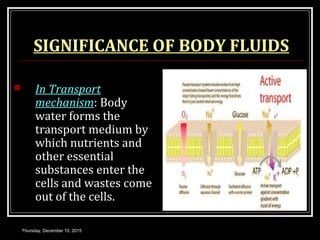
 In Transport
mechanism: Body
water forms the
transport medium by
which nutrients and
other essential
substances enter the
cells and wastes come
out of the cells.
Thursday, December 10, 2015
SIGNIFICANCE OF BODY FLUIDS
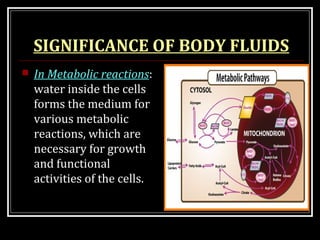
 In Metabolic reactions:
water inside the cells
forms the medium for
various metabolic
reactions, which are
necessary for growth
and functional
activities of the cells.
SIGNIFICANCE OF BODY FLUIDS
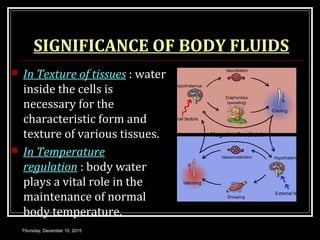
 In Texture of tissues : water
inside the cells is
necessary for the
characteristic form and
texture of various tissues.
 In Temperature
regulation : body water
plays a vital role in the
maintenance of normal
body temperature.
Thursday, December 10, 2015
REGULATORY MECHANISMS
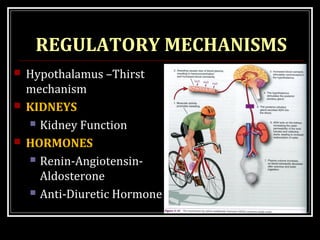
 Hypothalamus –Thirst
mechanism
 KIDNEYS
 Kidney Function
 HORMONES
 Renin-Angiotensin-
Aldosterone
 Anti-Diuretic Hormone
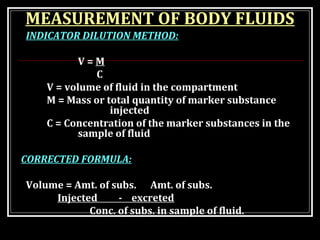
MEASUREMENT OF BODY FLUIDS
INDICATOR DILUTION METHOD:
V = M
C
V = volume of fluid in the compartment
M = Mass or total quantity of marker substance
injected
C = Concentration of the marker substances in the
sample of fluid
CORRECTED FORMULA:
Volume = Amt. of subs. Amt. of subs.
Injected - excreted
Conc. of subs. in sample of fluid.
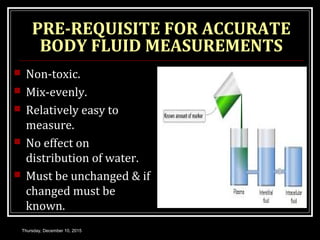
PRE-REQUISITE FOR ACCURATE
BODY FLUID MEASUREMENTS
 Non-toxic.
 Mix-evenly.
 Relatively easy to
measure.
 No effect on
distribution of water.
 Must be unchanged & if
changed must be
known.
Thursday, December 10, 2015
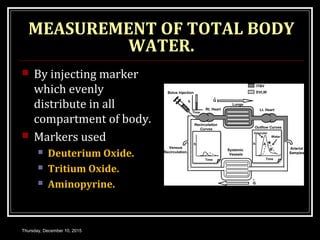
MEASUREMENT OF TOTAL BODY
WATER.
 By injecting marker
which evenly
distribute in all
compartment of body.
 Markers used
 Deuterium Oxide.
 Tritium Oxide.
 Aminopyrine.
Thursday, December 10, 2015
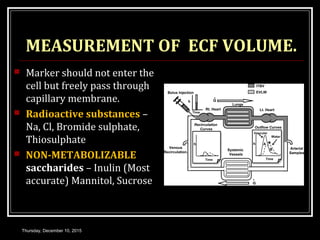
MEASUREMENT OF ECF VOLUME.
 Marker should not enter the
cell but freely pass through
capillary membrane.
 Radioactive substances –
Na, Cl, Bromide sulphate,
Thiosulphate
 NON-METABOLIZABLE
saccharides – Inulin (Most
accurate) Mannitol, Sucrose
Thursday, December 10, 2015
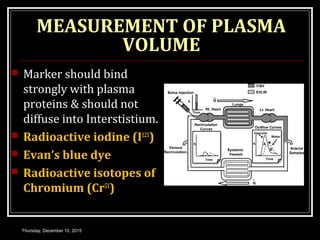
MEASUREMENT OF PLASMA
VOLUME
 Marker should bind
strongly with plasma
proteins & should not
diffuse into Interstistium.
 Radioactive iodine (I121
)
 Evan’s blue dye
 Radioactive isotopes of
Chromium (Cr51
)
Thursday, December 10, 2015
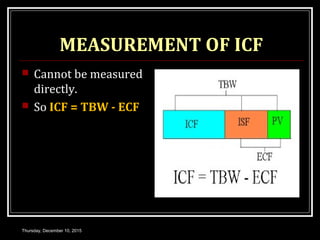
MEASUREMENT OF ICF
 Cannot be measured
directly.
 So ICF = TBW - ECF
Thursday, December 10, 2015
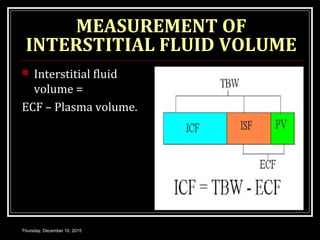
MEASUREMENT OF
INTERSTITIAL FLUID VOLUME
 Interstitial fluid
volume =
ECF – Plasma volume.
Thursday, December 10, 2015
WATER BALANCE
Body fluid levels are maintained at normal
levels when the intake and output of
water are balanced.
INTAKE OUTPUT
Drinking – 1300 Urine – 1500
Food – 850 Sweat through skin - 500
Metabolic origin – 350 Feces – 100
------------ Expired air - 400
2500 ml ----------
2500ml
When the intake is more than the output then
a positive water balance develops.
PHYSIOLOGICAL POSITIVE
WATER BALANCE
 Growth
 Convalescence
 Pregnancy
PATHOLOGICAL POSITIVE WATER
BALANCE
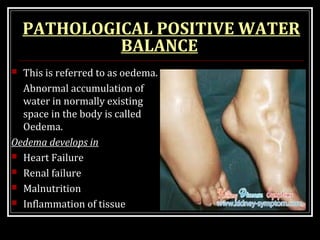
 This is referred to as oedema.
Abnormal accumulation of
water in normally existing
space in the body is called
Oedema.
Oedema develops in
 Heart Failure
 Renal failure
 Malnutrition
 Inflammation of tissue
OEDEMA
Oedema is mostly extracellular and may develop
due to:
 Increase in capillary hydrostatic pressure
 Decreased colloidal osmotic pressure
 Increased permeability of the capillary
 Lymphatic obstruction
 Failure of kidney to excrete excess water
NEGATIVE WATER BALANCE
 PHYSIOLOGICAL NEGATIVE WATER BALANCE:
occurs during exercise, working in hot sun.
 PATHOLOGICAL NEGATIVE WATER BALANCE: is
seen in dehydration, burns, hemorrhage,
vomiting, diarrhea when the output is more
than input, negative water balance develops.
DEHYDRATION
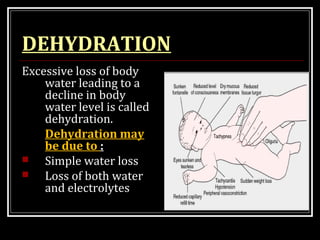
Excessive loss of body
water leading to a
decline in body
water level is called
dehydration.
Dehydration may
be due to :
 Simple water loss
 Loss of both water
and electrolytes
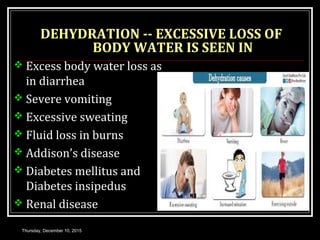
DEHYDRATION -- EXCESSIVE LOSS OF
BODY WATER IS SEEN IN
 Excess body water loss as
in diarrhea
 Severe vomiting
 Excessive sweating
 Fluid loss in burns
 Addison’s disease
 Diabetes mellitus and
Diabetes insipedus
 Renal disease
Thursday, December 10, 2015
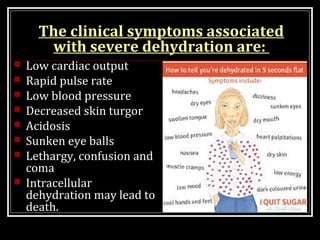
The clinical symptoms associated
with severe dehydration are:
 Low cardiac output
 Rapid pulse rate
 Low blood pressure
 Decreased skin turgor
 Acidosis
 Sunken eye balls
 Lethargy, confusion and
coma
 Intracellular
dehydration may lead to
death.
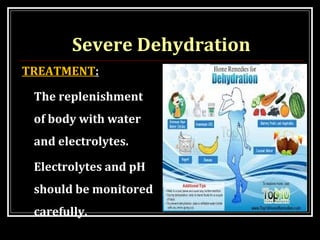
Severe Dehydration
TREATMENT:
The replenishment
of body with water
and electrolytes.
Electrolytes and pH
should be monitored
carefully.
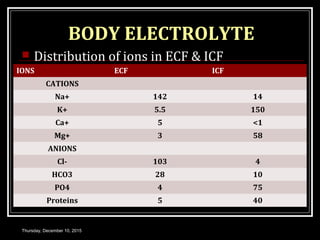
BODY ELECTROLYTE
 Distribution of ions in ECF & ICF
Thursday, December 10, 2015
IONS ECF ICF
CATIONS
Na+ 142 14
K+ 5.5 150
Ca+ 5 <1
Mg+ 3 58
ANIONS
Cl- 103 4
HCO3 28 10
PO4 4 75
Proteins 5 40
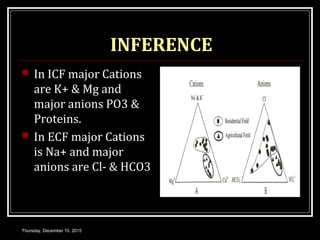
INFERENCE
 In ICF major Cations
are K+ & Mg and
major anions PO3 &
Proteins.
 In ECF major Cations
is Na+ and major
anions are Cl- & HCO3
Thursday, December 10, 2015
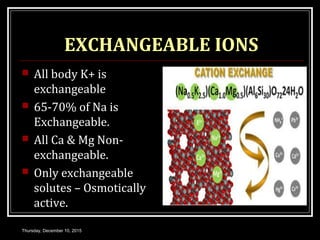
EXCHANGEABLE IONS
 All body K+ is
exchangeable
 65-70% of Na is
Exchangeable.
 All Ca & Mg Non-
exchangeable.
 Only exchangeable
solutes – Osmotically
active.
Thursday, December 10, 2015
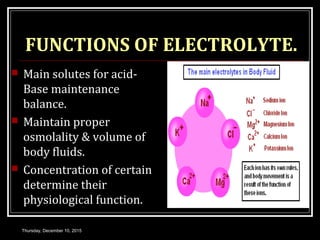
FUNCTIONS OF ELECTROLYTE.
 Main solutes for acid-
Base maintenance
balance.
 Maintain proper
osmolality & volume of
body fluids.
 Concentration of certain
determine their
physiological function.
Thursday, December 10, 2015
Thank you.
Thursday, December 10, 2015

Body fluids

  • 1.
    DR NILESH KATE MBBS,MD ASSOCIATEPROF DEPT. OF PHYSIOLOGY BODY FLUIDS
  • 2.
    OBJECTIVES 1. Volumes &Compartments of body fluids 2. Composition of body fluids 3. Measurement of each compartment 4. Significance of body fluids. 5. Water balance – positive and negative water balance 6. Oedema , Dehydration. Thursday, December 10, 2015
  • 3.
  • 4.
    TOTAL BODY WATER Thursday,December 10, 2015
  • 5.
  • 6.
    DISTRIBUTION OF TOTAL BODYYWATER COMPARTMENTS VOLUME (L) PERCENTAGE BODY WEIGHT BODY WATER TOTAL BODY WATER 42 60 100 ICF 28 40 67 ECF 14 20 33 PLASMA (25%) 3.5 5 8 INTERSTITIAL FLUID, TRANSCELLULAR FLUID, MESENCHYMAL TISSUE (75%) 10.5 15 25 Thursday, December 10, 2015
  • 7.
    PERCENTAGE OF WATERIN THE BODY Total Body Water varies depending on body fat:  infant: 73%  male adult: 60%  female adult: 40-50%  effects of obesity  Old age 45%
  • 8.
  • 9.
    MOVEMENT OF BODYFLUIDS IMPORTANT CONCEPT  Body fluids are not static.  Fluids & electrolytes shift from compartment to compartment.  Emphasis is always on maintaining homeostasis
  • 10.
    COMPOSITION OF BODYFLUIDS Body fluids contain water and solids. Solids are organic and inorganic substances.  ORGANIC SUBSTANCES: Glucose, amino acids, fatty acids, hormones and enzymes.
  • 11.
    COMPOSITION OF BODYFLUIDS  INORGANIC SUBSTANCES: Extracellular fluid contains large quantity of sodium, chlorides, bicarbonate, glucose, fatty acids and oxygen.  Intracellular fluid contains large quantities of potassium, magnesium, phosphates, sulphates and proteins. PH of ECF is 7.4 PH of ICF is 7
  • 13.
    SIGNIFICANCE OF BODYFLUIDS  In Homeostasis: Body cells survive in the fluid medium called internal environment or milieu interior.  Growth and functions of cells Glucose, amino acids, lipids, vitamins, ions, oxygen etc., in proper quantities in the internal environment.
  • 14.
    SIGNIFICANCE OF BODYFLUIDS  In Transport mechanism: Body water forms the transport medium by which nutrients and other essential substances enter the cells and wastes come out of the cells. Thursday, December 10, 2015
  • 15.
    SIGNIFICANCE OF BODYFLUIDS  In Metabolic reactions: water inside the cells forms the medium for various metabolic reactions, which are necessary for growth and functional activities of the cells.
  • 16.
    SIGNIFICANCE OF BODYFLUIDS  In Texture of tissues : water inside the cells is necessary for the characteristic form and texture of various tissues.  In Temperature regulation : body water plays a vital role in the maintenance of normal body temperature. Thursday, December 10, 2015
  • 17.
    REGULATORY MECHANISMS  Hypothalamus–Thirst mechanism  KIDNEYS  Kidney Function  HORMONES  Renin-Angiotensin- Aldosterone  Anti-Diuretic Hormone
  • 18.
    MEASUREMENT OF BODYFLUIDS INDICATOR DILUTION METHOD: V = M C V = volume of fluid in the compartment M = Mass or total quantity of marker substance injected C = Concentration of the marker substances in the sample of fluid CORRECTED FORMULA: Volume = Amt. of subs. Amt. of subs. Injected - excreted Conc. of subs. in sample of fluid.
  • 19.
    PRE-REQUISITE FOR ACCURATE BODYFLUID MEASUREMENTS  Non-toxic.  Mix-evenly.  Relatively easy to measure.  No effect on distribution of water.  Must be unchanged & if changed must be known. Thursday, December 10, 2015
  • 20.
    MEASUREMENT OF TOTALBODY WATER.  By injecting marker which evenly distribute in all compartment of body.  Markers used  Deuterium Oxide.  Tritium Oxide.  Aminopyrine. Thursday, December 10, 2015
  • 21.
    MEASUREMENT OF ECFVOLUME.  Marker should not enter the cell but freely pass through capillary membrane.  Radioactive substances – Na, Cl, Bromide sulphate, Thiosulphate  NON-METABOLIZABLE saccharides – Inulin (Most accurate) Mannitol, Sucrose Thursday, December 10, 2015
  • 22.
    MEASUREMENT OF PLASMA VOLUME Marker should bind strongly with plasma proteins & should not diffuse into Interstistium.  Radioactive iodine (I121 )  Evan’s blue dye  Radioactive isotopes of Chromium (Cr51 ) Thursday, December 10, 2015
  • 23.
    MEASUREMENT OF ICF Cannot be measured directly.  So ICF = TBW - ECF Thursday, December 10, 2015
  • 24.
    MEASUREMENT OF INTERSTITIAL FLUIDVOLUME  Interstitial fluid volume = ECF – Plasma volume. Thursday, December 10, 2015
  • 25.
    WATER BALANCE Body fluidlevels are maintained at normal levels when the intake and output of water are balanced. INTAKE OUTPUT Drinking – 1300 Urine – 1500 Food – 850 Sweat through skin - 500 Metabolic origin – 350 Feces – 100 ------------ Expired air - 400 2500 ml ---------- 2500ml When the intake is more than the output then a positive water balance develops.
  • 26.
    PHYSIOLOGICAL POSITIVE WATER BALANCE Growth  Convalescence  Pregnancy
  • 27.
    PATHOLOGICAL POSITIVE WATER BALANCE This is referred to as oedema. Abnormal accumulation of water in normally existing space in the body is called Oedema. Oedema develops in  Heart Failure  Renal failure  Malnutrition  Inflammation of tissue
  • 28.
    OEDEMA Oedema is mostlyextracellular and may develop due to:  Increase in capillary hydrostatic pressure  Decreased colloidal osmotic pressure  Increased permeability of the capillary  Lymphatic obstruction  Failure of kidney to excrete excess water
  • 29.
    NEGATIVE WATER BALANCE PHYSIOLOGICAL NEGATIVE WATER BALANCE: occurs during exercise, working in hot sun.  PATHOLOGICAL NEGATIVE WATER BALANCE: is seen in dehydration, burns, hemorrhage, vomiting, diarrhea when the output is more than input, negative water balance develops.
  • 30.
    DEHYDRATION Excessive loss ofbody water leading to a decline in body water level is called dehydration. Dehydration may be due to :  Simple water loss  Loss of both water and electrolytes
  • 31.
    DEHYDRATION -- EXCESSIVELOSS OF BODY WATER IS SEEN IN  Excess body water loss as in diarrhea  Severe vomiting  Excessive sweating  Fluid loss in burns  Addison’s disease  Diabetes mellitus and Diabetes insipedus  Renal disease Thursday, December 10, 2015
  • 32.
    The clinical symptomsassociated with severe dehydration are:  Low cardiac output  Rapid pulse rate  Low blood pressure  Decreased skin turgor  Acidosis  Sunken eye balls  Lethargy, confusion and coma  Intracellular dehydration may lead to death.
  • 33.
    Severe Dehydration TREATMENT: The replenishment ofbody with water and electrolytes. Electrolytes and pH should be monitored carefully.
  • 34.
    BODY ELECTROLYTE  Distributionof ions in ECF & ICF Thursday, December 10, 2015 IONS ECF ICF CATIONS Na+ 142 14 K+ 5.5 150 Ca+ 5 <1 Mg+ 3 58 ANIONS Cl- 103 4 HCO3 28 10 PO4 4 75 Proteins 5 40
  • 35.
    INFERENCE  In ICFmajor Cations are K+ & Mg and major anions PO3 & Proteins.  In ECF major Cations is Na+ and major anions are Cl- & HCO3 Thursday, December 10, 2015
  • 36.
    EXCHANGEABLE IONS  Allbody K+ is exchangeable  65-70% of Na is Exchangeable.  All Ca & Mg Non- exchangeable.  Only exchangeable solutes – Osmotically active. Thursday, December 10, 2015
  • 37.
    FUNCTIONS OF ELECTROLYTE. Main solutes for acid- Base maintenance balance.  Maintain proper osmolality & volume of body fluids.  Concentration of certain determine their physiological function. Thursday, December 10, 2015
  • 38.