BODY FLUIDS
PY 1.6 Describe the fluid compartments of the
body, its ionic composition & measurements
DR SHIKHA SAXENA
BODY FLUIDS
• On completion of study of this chapter, the student MUST be able to:
• 1. Give the normal values of total body water (TBW) as % of body weight in
different age groups in males and females.
• 2. Gives the % distribution of body water in different body fluid compartments.
• 3. Name different body fluid compartments, total fluid present in the
compartment and composition of ions in each compartment.
• 4. Give the characteristics of an ideal indicator used for measuring body fluid
volumes.
• 5. Name the units of measurement, name the indicator used, give the basic
principle and method of measurement of body fluid volume of different
compartments.
• 6. Explain why dehydration is common and often severe in children.
The student MAY also be able to:
1. Describe details of methods of measurement of various body fluid compartments
BODY COMPOSITION
• The normal body in an average adult male is composed of
water (60%), minerals (7%), protein and related substances
(18%), and fat (15%).
• The water, denoted by the term total body water (TBW),
and the electrolytes need special emphasis.
TOTAL BODY WATER
• Water is the principal and essential constituent of the
human body.
• The total body water is about 10% less in a normal young
adult female (average 50%) than that in an average adult
male (60%) due to relatively greater amount of adipose
tissue in the females.
• In both sexes the value tends to decrease with age.
THE BODY FLUID COMPARTMENTS-
1. INTRACELLULAR FLUID COMPARTMENT
• The intracellular fluid (ICF) compartment comprises about
40% of the body weight, the bulk of which is contained in
the muscles.
DISTRIBUTION OF TOTAL BODY WATER IN A
NORMAL 70 KG PERSON
Compartment Volume (L) Body weight (%) Body water (%)
Total body water
(TBW)
42 60 100
Intracellular fluid (ICF) 28 40 67
Extracellular fluid
(ECF)
• Plasma (25%
of ECF)
• Interstitial
fluid,
transcellular
fluid and
mesenchymal
tissue fluid (75%
of ECF)
14
3.5
10.5
20
5
15
33
8
25
2. EXTRACELLULAR FLUID COMPARTMENT
• The extracellular fluid (ECF) compartment constitutes about
20% of the body weight. The ECF compartment comprises
following-
• (i) Plasma- It is the fluid portion of the blood (intravascular
fluid) and comprises about 5% of the body weight (i.e. 25% of
the ECF). On an average out of 5 L of total blood volume 3.5 L
is plasma.
• (ii) Interstitial fluid including lymph- It constitutes the
major portion (about 3/4) of the ECF. The composition of
interstitial fluid is the same as that of plasma except it has
little protein. Thus, interstitial fluid is an ultrafiltrate of
plasma.
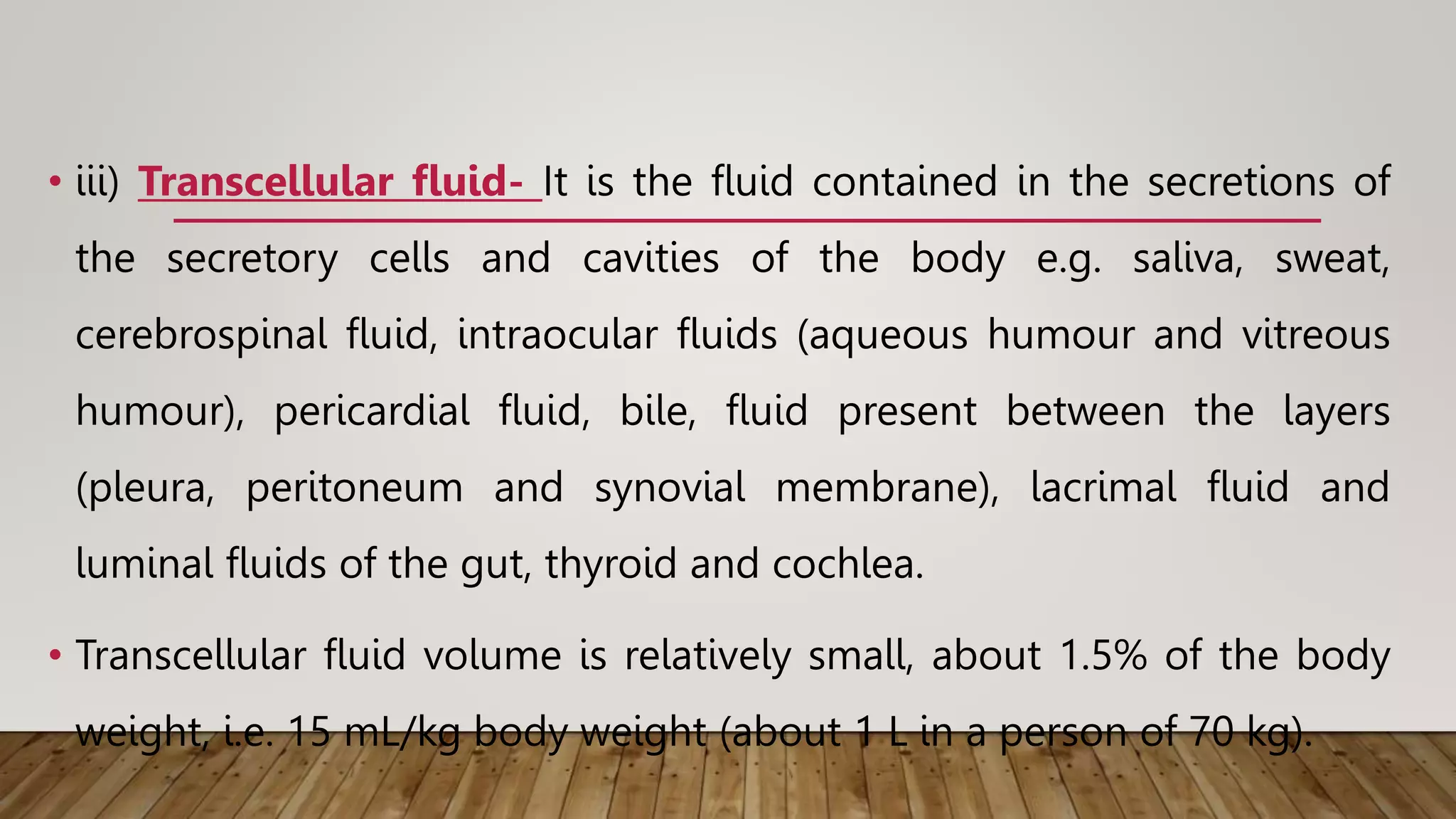
• iii) Transcellular fluid- It is the fluid contained in the secretions of
the secretory cells and cavities of the body e.g. saliva, sweat,
cerebrospinal fluid, intraocular fluids (aqueous humour and vitreous
humour), pericardial fluid, bile, fluid present between the layers
(pleura, peritoneum and synovial membrane), lacrimal fluid and
luminal fluids of the gut, thyroid and cochlea.
• Transcellular fluid volume is relatively small, about 1.5% of the body
weight, i.e. 15 mL/kg body weight (about 1 L in a person of 70 kg).
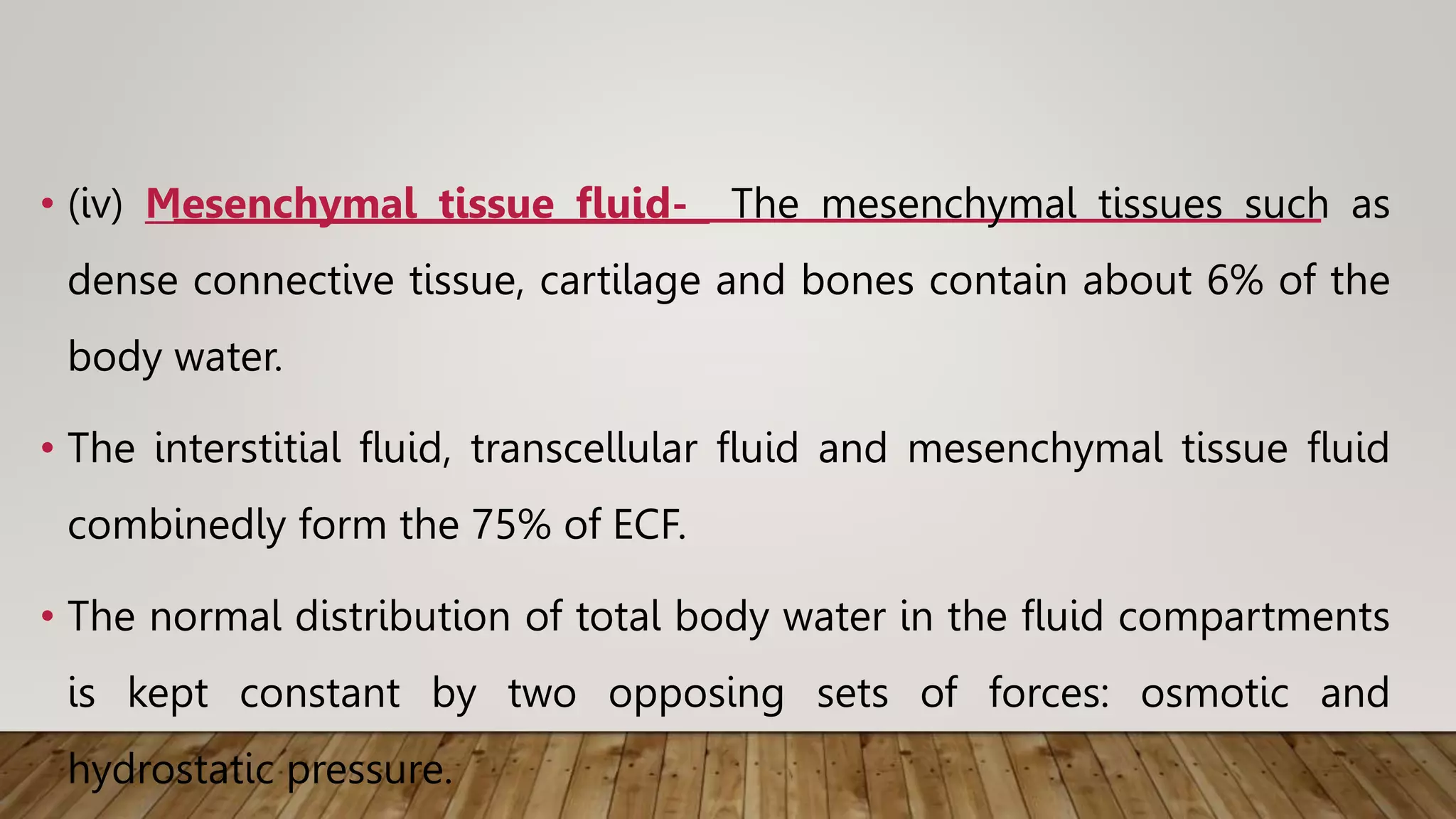
• (iv) Mesenchymal tissue fluid- The mesenchymal tissues such as
dense connective tissue, cartilage and bones contain about 6% of the
body water.
• The interstitial fluid, transcellular fluid and mesenchymal tissue fluid
combinedly form the 75% of ECF.
• The normal distribution of total body water in the fluid compartments
is kept constant by two opposing sets of forces: osmotic and
hydrostatic pressure.
MEASUREMENT OF BODY FLUID VOLUMES
• To measure the volume of each fluid component by injecting a
substance (indicator) that will stay in only one compartment
(provided the concentration of the substance in the body fluid and
the amount removed by excretion and metabolism can be
accurately measured) as:
• V=A1-A2/C
V = Volume of fluid compartment,
A1 = Amount of indicator injected in the fluid,
A2 = Amount of indicator removed by excretion and metabolism, and
PREREQUISITES FOR ACCURATE BODY FLUID
MEASUREMENT [INDICATOR DILUTION METHOD]
• The material injected (indicator) should have following characteristics:
• It should be non-toxic.
• It must mix evenly throughout the compartment being measured.
• It should be relatively easy to measure its concentration.
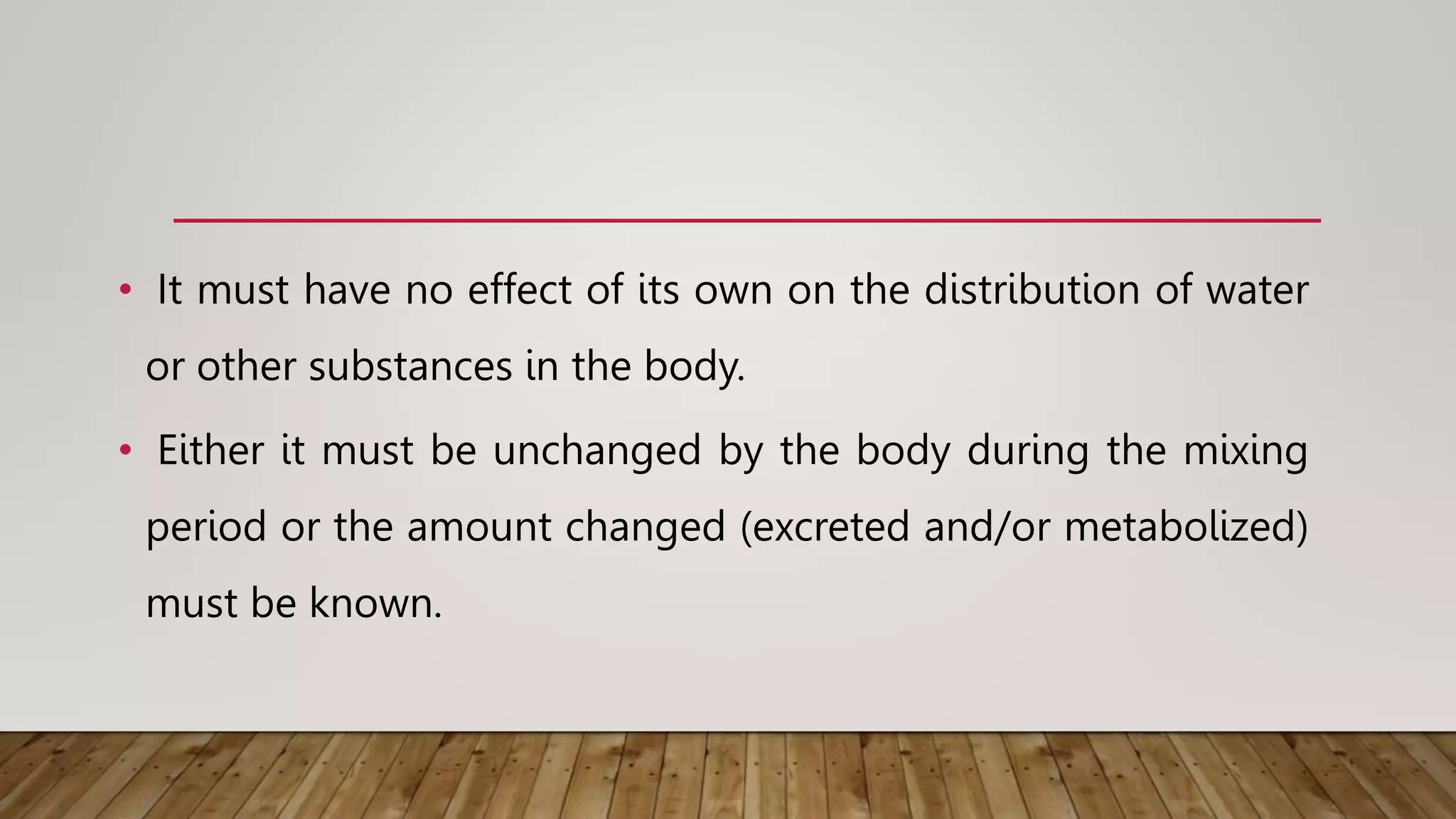
• It must have no effect of its own on the distribution of water
or other substances in the body.
• Either it must be unchanged by the body during the mixing
period or the amount changed (excreted and/or metabolized)
must be known.
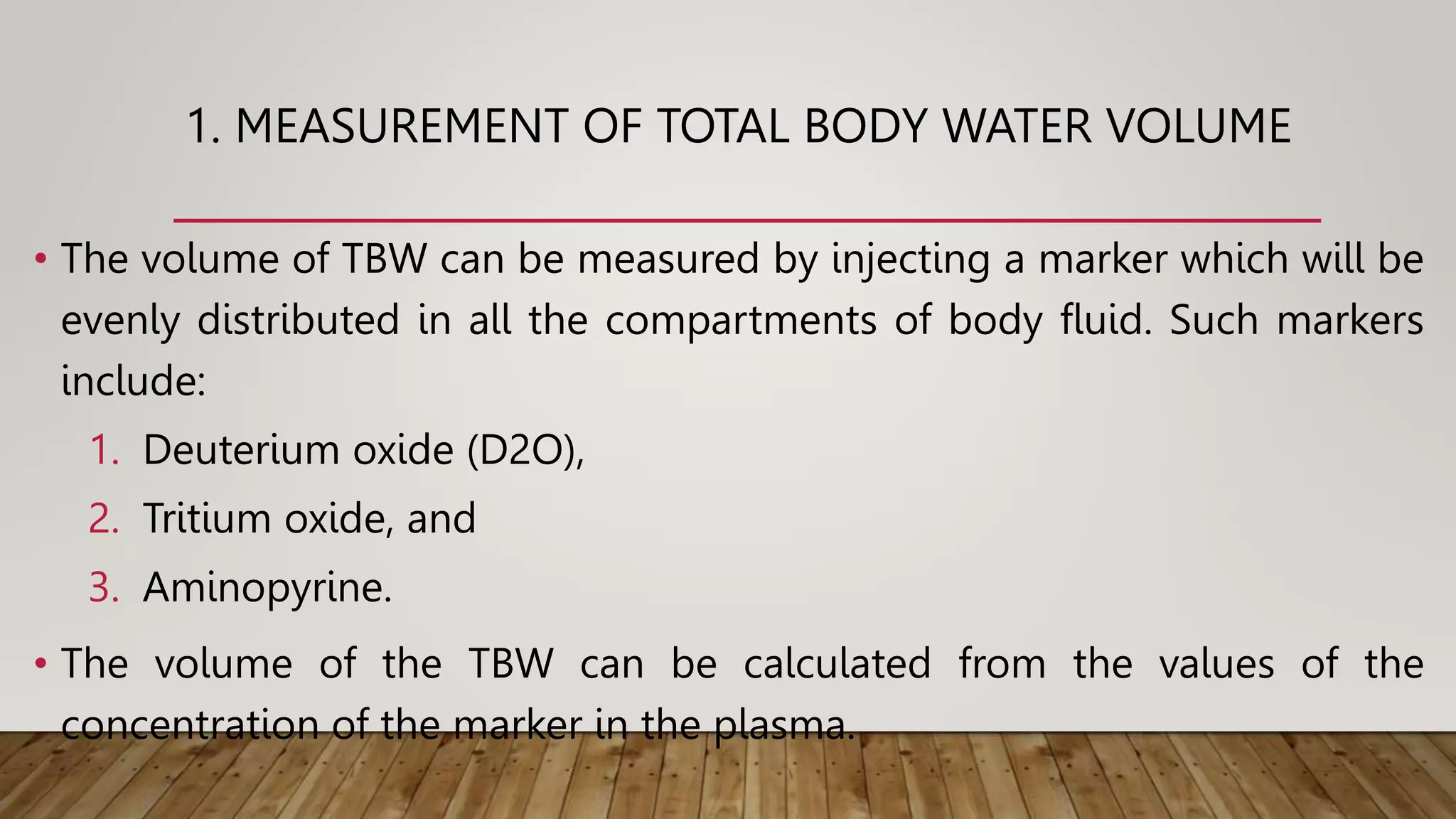
1. MEASUREMENT OF TOTAL BODY WATER VOLUME
• The volume of TBW can be measured by injecting a marker which will be
evenly distributed in all the compartments of body fluid. Such markers
include:
1. Deuterium oxide (D2O),
2. Tritium oxide, and
3. Aminopyrine.
• The volume of the TBW can be calculated from the values of the
concentration of the marker in the plasma.
2. MEASUREMENT OF EXTRACELLULAR FLUID
VOLUME
• The volume of ECF can be measured by injecting those marker
substances which cannot enter the cells but can freely pass through the
capillary membrane, and thus can distribute evenly in all the
compartments of ECF.
1. Radioactive substances like sodium, chloride (36Cl− and 38Cl−),
bromide (82Br−), sulphate and thiosulphate; and
2. Non-metabolizable saccharides like inulin, mannitol and sucrose.
Most accurate method of measuring the volume of ECF is by using
inulin (polysaccharide, MW 5200).
• The values of ECF volume are calculated from the values of
concentration of inulin in the plasma since it makes an important
component of the ECF.
3. MEASUREMENT OF PLASMA VOLUME
• The plasma volume can be measured by injecting those markers
which bind strongly with the plasma protein and either do not diffuse
or diffuse only in small quantities into the interstitium.
I. Radioactive iodine – 131I, and
II. The dye Evan’s blue – T-1824.
• The plasma volume can also be calculated from the values of the
Red Blood Cells which can be measured using radioactive isotopes
of chromium (51Cr).
4. MEASUREMENT OF INTRACELLULAR FLUID VOLUME
• The volume of ICF cannot be measured directly, since there is no
substance which can be confined exclusively to this compartment
after intravenous injection.
• Therefore, values of ICF volume are calculated from the values of
TBW and ECF as
• ICF volume = TBW volume − ECF volume.
5. MEASUREMENT OF INTERSTITIAL FLUID VOLUME
• The volume of interstitial fluid also cannot be measured directly for the
same reasons.
• Interstitial fluid volume = ECF volume − plasma volume.
• Note. The ECF volume/intracellular fluid volume ratio is larger in infants
and children as compared to adults, but absolute volume of ECF in
children is smaller than in adults. Therefore, dehydration develops rapidly,
more frequently and severe in children than in adults.
BODY ELECTROLYTES
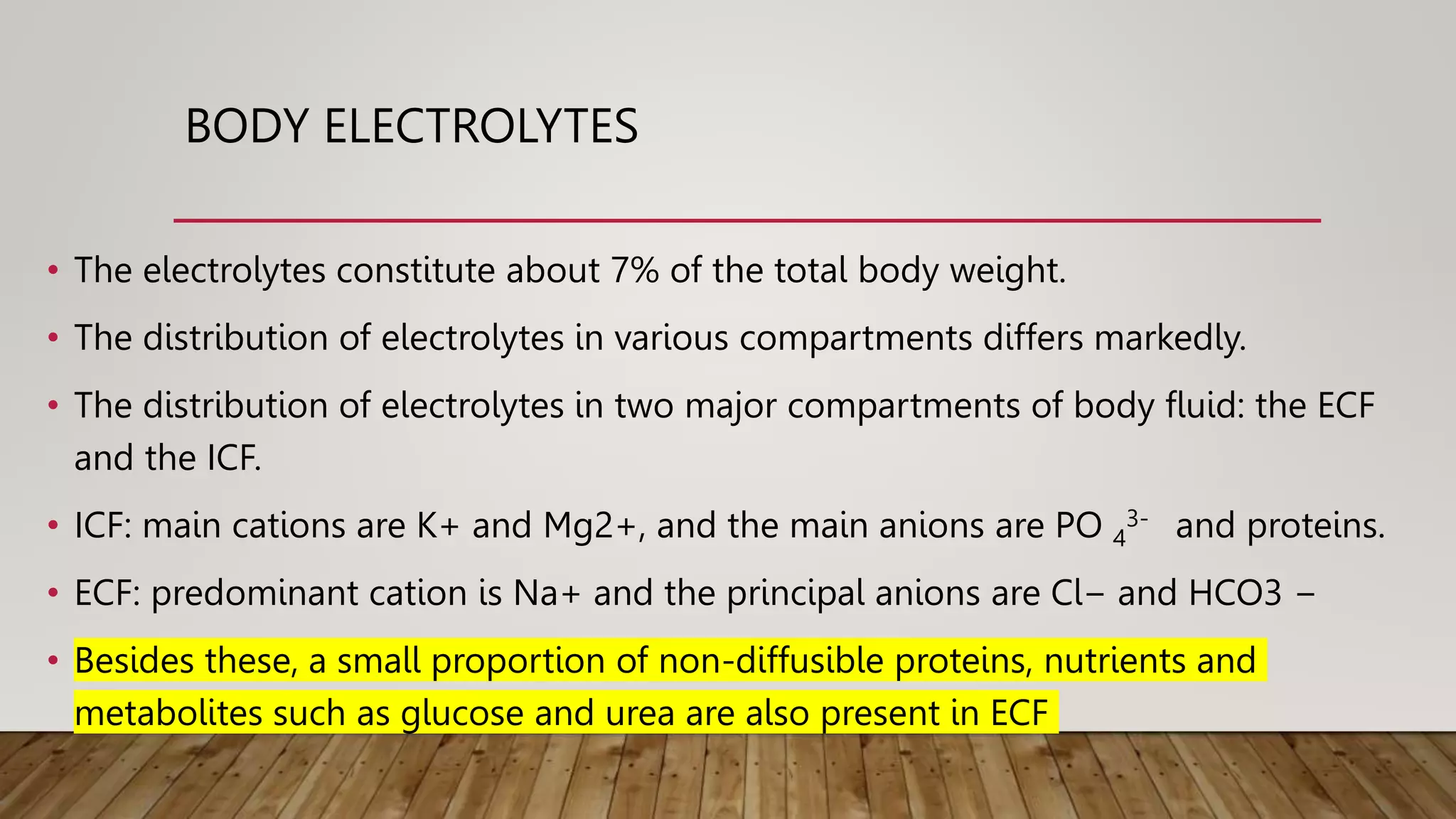
• The electrolytes constitute about 7% of the total body weight.
• The distribution of electrolytes in various compartments differs markedly.
• The distribution of electrolytes in two major compartments of body fluid: the ECF
and the ICF.
• ICF: main cations are K+ and Mg2+, and the main anions are PO 4
3- and proteins.
• ECF: predominant cation is Na+ and the principal anions are Cl− and HCO3 −
• Besides these, a small proportion of non-diffusible proteins, nutrients and
metabolites such as glucose and urea are also present in ECF
DISTRIBUTION OF IONS IN THE ECF AND ICF
(VALUES ARE IN meq/l OF H2O)
Ion Extracellular fluid Intracellular fluid
CATIONS
Na 142 14
K 5.5 150
Ca 5 <1
Mg 3 58
ANIONS
Cl 103 4
HCO3 28 10
PO4 4 75
Proteins 1 g/dl 5 g/ dl
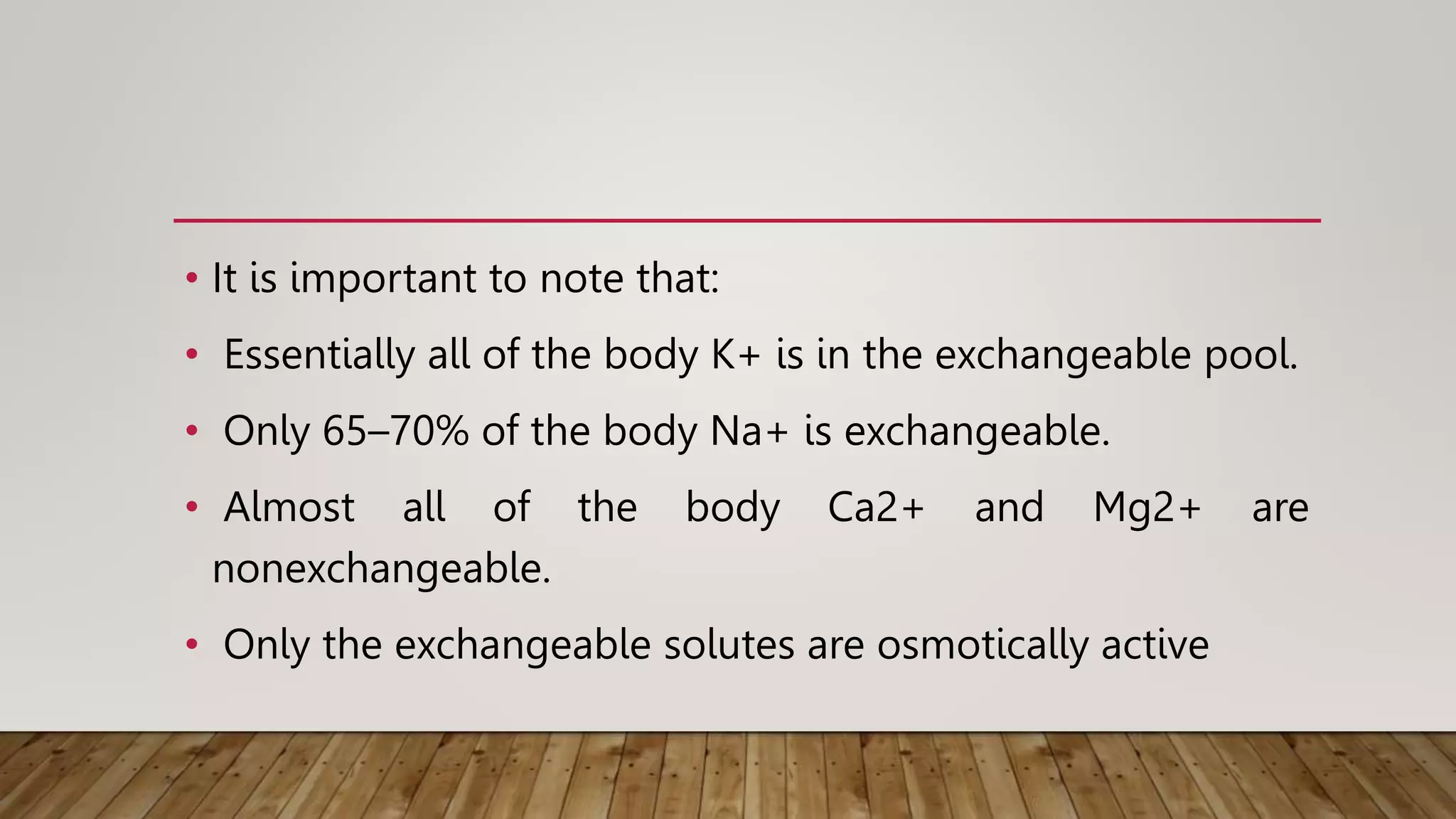
• It is important to note that:
• Essentially all of the body K+ is in the exchangeable pool.
• Only 65–70% of the body Na+ is exchangeable.
• Almost all of the body Ca2+ and Mg2+ are
nonexchangeable.
• Only the exchangeable solutes are osmotically active
FUNCTIONS OF ELECTROLYTES
• 1. Electrolytes are the main solutes in the body fluids for maintenance
of acid–base balance.
• 2. Electrolytes maintain the proper osmolality and volume of body
fluids.
• 3. The concentration of certain electrolytes determines their specific
physiologic functions, e.g. the effect of calcium ions on
neuromuscular excitability
Body fluid PY 1.6.pptx

Body fluid PY 1.6.pptx

  • 1.
    BODY FLUIDS PY 1.6Describe the fluid compartments of the body, its ionic composition & measurements DR SHIKHA SAXENA
  • 2.
    BODY FLUIDS • Oncompletion of study of this chapter, the student MUST be able to: • 1. Give the normal values of total body water (TBW) as % of body weight in different age groups in males and females. • 2. Gives the % distribution of body water in different body fluid compartments. • 3. Name different body fluid compartments, total fluid present in the compartment and composition of ions in each compartment. • 4. Give the characteristics of an ideal indicator used for measuring body fluid volumes. • 5. Name the units of measurement, name the indicator used, give the basic principle and method of measurement of body fluid volume of different compartments. • 6. Explain why dehydration is common and often severe in children. The student MAY also be able to: 1. Describe details of methods of measurement of various body fluid compartments
  • 3.
    BODY COMPOSITION • Thenormal body in an average adult male is composed of water (60%), minerals (7%), protein and related substances (18%), and fat (15%). • The water, denoted by the term total body water (TBW), and the electrolytes need special emphasis.
  • 4.
    TOTAL BODY WATER •Water is the principal and essential constituent of the human body. • The total body water is about 10% less in a normal young adult female (average 50%) than that in an average adult male (60%) due to relatively greater amount of adipose tissue in the females. • In both sexes the value tends to decrease with age.
  • 5.
    THE BODY FLUIDCOMPARTMENTS- 1. INTRACELLULAR FLUID COMPARTMENT • The intracellular fluid (ICF) compartment comprises about 40% of the body weight, the bulk of which is contained in the muscles.
  • 6.
    DISTRIBUTION OF TOTALBODY WATER IN A NORMAL 70 KG PERSON Compartment Volume (L) Body weight (%) Body water (%) Total body water (TBW) 42 60 100 Intracellular fluid (ICF) 28 40 67 Extracellular fluid (ECF) • Plasma (25% of ECF) • Interstitial fluid, transcellular fluid and mesenchymal tissue fluid (75% of ECF) 14 3.5 10.5 20 5 15 33 8 25
  • 8.
    2. EXTRACELLULAR FLUIDCOMPARTMENT • The extracellular fluid (ECF) compartment constitutes about 20% of the body weight. The ECF compartment comprises following- • (i) Plasma- It is the fluid portion of the blood (intravascular fluid) and comprises about 5% of the body weight (i.e. 25% of the ECF). On an average out of 5 L of total blood volume 3.5 L is plasma.
  • 9.
    • (ii) Interstitialfluid including lymph- It constitutes the major portion (about 3/4) of the ECF. The composition of interstitial fluid is the same as that of plasma except it has little protein. Thus, interstitial fluid is an ultrafiltrate of plasma.
  • 10.
    • iii) Transcellularfluid- It is the fluid contained in the secretions of the secretory cells and cavities of the body e.g. saliva, sweat, cerebrospinal fluid, intraocular fluids (aqueous humour and vitreous humour), pericardial fluid, bile, fluid present between the layers (pleura, peritoneum and synovial membrane), lacrimal fluid and luminal fluids of the gut, thyroid and cochlea. • Transcellular fluid volume is relatively small, about 1.5% of the body weight, i.e. 15 mL/kg body weight (about 1 L in a person of 70 kg).
  • 11.
    • (iv) Mesenchymaltissue fluid- The mesenchymal tissues such as dense connective tissue, cartilage and bones contain about 6% of the body water. • The interstitial fluid, transcellular fluid and mesenchymal tissue fluid combinedly form the 75% of ECF. • The normal distribution of total body water in the fluid compartments is kept constant by two opposing sets of forces: osmotic and hydrostatic pressure.
  • 14.
    MEASUREMENT OF BODYFLUID VOLUMES • To measure the volume of each fluid component by injecting a substance (indicator) that will stay in only one compartment (provided the concentration of the substance in the body fluid and the amount removed by excretion and metabolism can be accurately measured) as: • V=A1-A2/C V = Volume of fluid compartment, A1 = Amount of indicator injected in the fluid, A2 = Amount of indicator removed by excretion and metabolism, and
  • 15.
    PREREQUISITES FOR ACCURATEBODY FLUID MEASUREMENT [INDICATOR DILUTION METHOD] • The material injected (indicator) should have following characteristics: • It should be non-toxic. • It must mix evenly throughout the compartment being measured. • It should be relatively easy to measure its concentration.
  • 16.
    • It musthave no effect of its own on the distribution of water or other substances in the body. • Either it must be unchanged by the body during the mixing period or the amount changed (excreted and/or metabolized) must be known.
  • 17.
    1. MEASUREMENT OFTOTAL BODY WATER VOLUME • The volume of TBW can be measured by injecting a marker which will be evenly distributed in all the compartments of body fluid. Such markers include: 1. Deuterium oxide (D2O), 2. Tritium oxide, and 3. Aminopyrine. • The volume of the TBW can be calculated from the values of the concentration of the marker in the plasma.
  • 18.
    2. MEASUREMENT OFEXTRACELLULAR FLUID VOLUME • The volume of ECF can be measured by injecting those marker substances which cannot enter the cells but can freely pass through the capillary membrane, and thus can distribute evenly in all the compartments of ECF. 1. Radioactive substances like sodium, chloride (36Cl− and 38Cl−), bromide (82Br−), sulphate and thiosulphate; and 2. Non-metabolizable saccharides like inulin, mannitol and sucrose.
  • 19.
    Most accurate methodof measuring the volume of ECF is by using inulin (polysaccharide, MW 5200). • The values of ECF volume are calculated from the values of concentration of inulin in the plasma since it makes an important component of the ECF.
  • 20.
    3. MEASUREMENT OFPLASMA VOLUME • The plasma volume can be measured by injecting those markers which bind strongly with the plasma protein and either do not diffuse or diffuse only in small quantities into the interstitium. I. Radioactive iodine – 131I, and II. The dye Evan’s blue – T-1824. • The plasma volume can also be calculated from the values of the Red Blood Cells which can be measured using radioactive isotopes of chromium (51Cr).
  • 21.
    4. MEASUREMENT OFINTRACELLULAR FLUID VOLUME • The volume of ICF cannot be measured directly, since there is no substance which can be confined exclusively to this compartment after intravenous injection. • Therefore, values of ICF volume are calculated from the values of TBW and ECF as • ICF volume = TBW volume − ECF volume.
  • 22.
    5. MEASUREMENT OFINTERSTITIAL FLUID VOLUME • The volume of interstitial fluid also cannot be measured directly for the same reasons. • Interstitial fluid volume = ECF volume − plasma volume. • Note. The ECF volume/intracellular fluid volume ratio is larger in infants and children as compared to adults, but absolute volume of ECF in children is smaller than in adults. Therefore, dehydration develops rapidly, more frequently and severe in children than in adults.
  • 23.
    BODY ELECTROLYTES • Theelectrolytes constitute about 7% of the total body weight. • The distribution of electrolytes in various compartments differs markedly. • The distribution of electrolytes in two major compartments of body fluid: the ECF and the ICF. • ICF: main cations are K+ and Mg2+, and the main anions are PO 4 3- and proteins. • ECF: predominant cation is Na+ and the principal anions are Cl− and HCO3 − • Besides these, a small proportion of non-diffusible proteins, nutrients and metabolites such as glucose and urea are also present in ECF
  • 24.
    DISTRIBUTION OF IONSIN THE ECF AND ICF (VALUES ARE IN meq/l OF H2O) Ion Extracellular fluid Intracellular fluid CATIONS Na 142 14 K 5.5 150 Ca 5 <1 Mg 3 58 ANIONS Cl 103 4 HCO3 28 10 PO4 4 75 Proteins 1 g/dl 5 g/ dl
  • 25.
    • It isimportant to note that: • Essentially all of the body K+ is in the exchangeable pool. • Only 65–70% of the body Na+ is exchangeable. • Almost all of the body Ca2+ and Mg2+ are nonexchangeable. • Only the exchangeable solutes are osmotically active
  • 26.
    FUNCTIONS OF ELECTROLYTES •1. Electrolytes are the main solutes in the body fluids for maintenance of acid–base balance. • 2. Electrolytes maintain the proper osmolality and volume of body fluids. • 3. The concentration of certain electrolytes determines their specific physiologic functions, e.g. the effect of calcium ions on neuromuscular excitability