BODY FLUIDS
Presented By; Dr. Daniel Bassana
Date;16th
December 2015
OBJECTIVES
At the end of the lesson students should be able to :
1.give the Composition of fluids in human body
2.Differentiate between extracellular fluid and
intracellular fluid
3.Estimate the percentage of fluid in an average
person
4.Give the different types of electrolytes in the
various compartments
5.Describe Mechanism of water loss in the body.
BODY FLUIDS
BODY FLUIDS
Composition of the human body:
1-Water → 60% of the body weight.
2-Proteins → 18% of the body weight.
3-Fats → 18% of the body weight.
4-Minerals → 4% of the body weight.
Body Fluids
•Water content in the body is divided into 2
compartments:
1. Extracellular fluid (ECF): (external environment )
- fluid outside the cells.
 1/3 volume of fluids in body ( 33% of total body
water).
- contains ions & nutrients needed for cellular life.
2. Intracellular fluid (ICF):
- fluid inside the cells.
 2/3 volume of fluids in body ( 67% of total body
water).
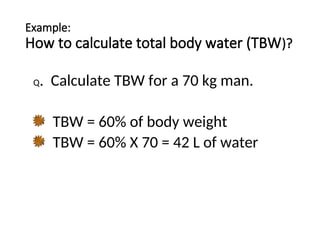
Example:
How to calculate total body water (TBW)?
Q. Calculate TBW for a 70 kg man.
TBW = 60% of body weight
TBW = 60% X 70 = 42 L of water
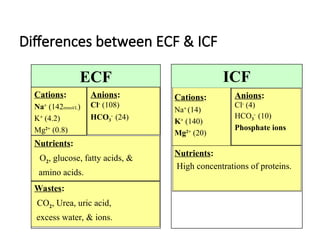
Differences between ECF & ICF
ECF
Cations:
Na+
(142mmol/L)
K+
(4.2)
Mg2+
(0.8)
Anions:
Cl-
(108)
HCO3
-
(24)
Nutrients:
O2, glucose, fatty acids, &
amino acids.
Wastes:
CO2, Urea, uric acid,
excess water, & ions.
ICF
Cations:
Na+
(14)
K+
(140)
Mg2+
(20)
Anions:
Cl-
(4)
HCO3
-
(10)
Phosphate ions
Nutrients:
High concentrations of proteins.
COMPOSITION OF BODY FLUIDS
CATIONS (mmol/l) Plasma Interstitial Intracellular
Na 142 139 14
K 4.2 4.0 140
Ca 1.3 1.2 0
Mg 0.8 0.7 20
ANIONS (mmol/l)
Cl 108 108 4.0
HCO3 24.0 28.3 10
Protein 1.2 0.2 4.0
HPO4 2.0 2.0 11
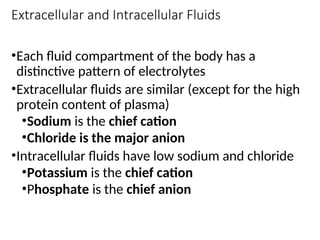
Extracellular and Intracellular Fluids
•Each fluid compartment of the body has a
distinctive pattern of electrolytes
•Extracellular fluids are similar (except for the high
protein content of plasma)
•Sodium is the chief cation
•Chloride is the major anion
•Intracellular fluids have low sodium and chloride
•Potassium is the chief cation
•Phosphate is the chief anion
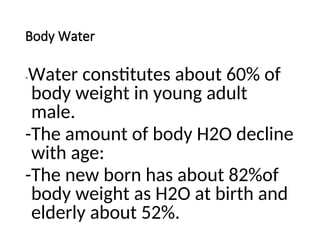
Body Water
-Water constitutes about 60% of
body weight in young adult
male.
-The amount of body H2O decline
with age:
-The new born has about 82%of
body weight as H2O at birth and
elderly about 52%.
Body Water
-Loss of body H2O is a common cause of
death in children who suffer from
dehydration.
-The amount of H2O in the body is
affected by the quantity of body fat..
Lean subjects have a higher percentage
of H2O than those with more body fat.
This is because adipose tissue contains
far less H2O than muscle, skin, and
other soft tissues.
Body Water
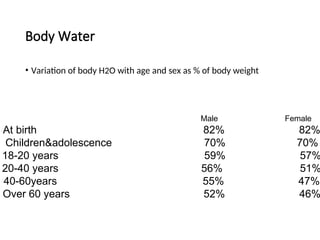
• Variation of body H2O with age and sex as % of body weight
Male Female
At birth 82% 82%
Children&adolescence 70% 70%
18-20 years 59% 57%
20-40 years 56% 51%
40-60years 55% 47%
Over 60 years 52% 46%
Body Water
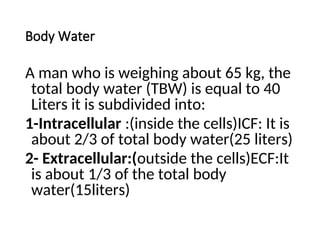
A man who is weighing about 65 kg, the
total body water (TBW) is equal to 40
Liters it is subdivided into:
1-Intracellular :(inside the cells)ICF: It is
about 2/3 of total body water(25 liters)
2- Extracellular:(outside the cells)ECF:It
is about 1/3 of the total body
water(15liters)
Body Water
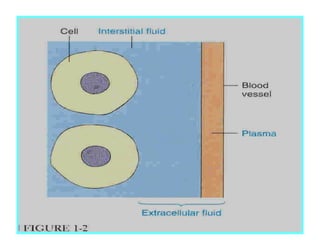
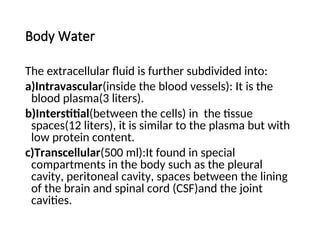
The extracellular fluid is further subdivided into:
a)Intravascular(inside the blood vessels): It is the
blood plasma(3 liters).
b)Interstitial(between the cells) in the tissue
spaces(12 liters), it is similar to the plasma but with
low protein content.
c)Transcellular(500 ml):It found in special
compartments in the body such as the pleural
cavity, peritoneal cavity, spaces between the lining
of the brain and spinal cord (CSF)and the joint
cavities.
Body Water
There is continuous exchange between the
intravascular and interstitial fluid to supply
the nutrients needed by the cells and
removing the waste products. This exchange
keeps the internal environment constant
Comparison of ECF&ICF solutes:
ECF contains large amount of Na+ and Cl- but
only small amounts of K+,Mg++ and PO4--
In contrast, ICF contains large quantities of
K+,PO4--,moderate amounts of Mg++ and
exceedingly few Ca++.
Osmolality of body fluids:
Because the cell membrane is highly permeable to
water, the osmolarity of ECF&ICF compartments are
normally the same, about 290milliosmol/L
The plasma osmolality is calculated by using the
following formula:
Osmolality =2[Na+] +0.055[Glucose] +0.36[ Urea]
mEq/L mg% mg%
Mechanism of water balance:
Normally ,total body water remains
constant, therefore over 24-hours
period, intake and loss of water must
balance exactly to precisely regulate ECF
osmolality and Na+ concentration.
Maintenance of TBW balance involves
regulation of both water excretion by
the kidneys and regulation of water
intake by the thirst mechanism.
Mechanism of water balance:
Water intake:
1-Drinks and food → supply about
2100 ml/day.
2-Oxidation of carbohydrates, produces
about 300ml/day.
Mechanism of water balance:
Water loss:
1-Urine: about 1.5L/day.
2-Sweat: variable amount depending on the
environmental temperature and physical
activity. The volume of sweat is normally
100ml/day.In hot weather or during heavy
exercise, water loss may increase up to 1-2
liters/hour.
3-Insensible water loss by evaporation
through skin and respiratory system. It is
termed insensible water loss because we are
not consciously aware of it. It is about 0.5
L/day.
Mechanism of water balance:
Regulation of water intake:
-It is controlled by thirst sensation.
-Thirst sensation: It is the conscious desire for water.
-The thirst center is found in the lateral nuclei of the
hypothalamus.
-This center is connected to the osmoreceptors in
the anterior nuclei of the hypothalamus.
Regulation of water intake:
Water intake is stimulated by:
1-Inceased effective osmotic pressure of the
plasma:
It acts via osmoreceptors located in the
anterior hypothalamus. When the Na+
concentration increases about 2 mEq/L above
normal, the thirst mechanism is activated
causing a desire to drink water .This is called the
threshold for drinking.
2-Decreased extracellular fluid volume:
Hemorrhage or hypotension caused increased
drinking even though there is no change in
osmolality of the plasma
Regulation of water intake:
Mechanism:
a)Renin-Angiotensin System:
Hypovolemia stimulates Renin secretion→
resulting in rise of Angiotensin II in the
circulation.
Angiotensin II stimulates thirst & acts on the
kidney to reduce fluid and electrolyte
excretion.
b)Baroreceptors in the heart and blood
vessels:
Regulation of H2O excretion by
kidney:
-Urine output is regulated and is one of the
primary contributions to maintaining water
balance.
-Daily urine output can be as high as 20L or as
low as 500mL depending on the water intake
Regulation of water intake:
Mechanism:
3-Other factors:
-Dryness of the pharyngeal mucous membrane→
thirst sensation.
-Prandial drinking: The intake of liquids is increased
during eating:
a-Increased plasma osmolality as food is
absorbed.
b-Gastro-instinal hormones may stimulate the
thirst.
Regulation of H2O excretion by
kidney
a-In conditions of H2O excess: as a result of excess
fluid intake: The renal response is to increase water
excretion. In conditions of maximal water excretion
urine volume can increase to 18-20L/day.
b-Conditions of fluid depletion: as a result of
restricted intake or inappropriate losses, the renal
response is to reduce water excretion. The urine
volume can be reduced to as little as 500ml/day .
Regulation of H2O excretion by kidney
-The ability of the kidney to excrete urine
of variable volume and osmolality is
absolutely dependent on the action of
ADH.
Regulation of H2O excretion by kidney
ADH secretion is triggered by:
1-Rise in plasma osmolality,which are detected
by hypothalamic osmoreceptors.
2-Decrease in ECF volume: This is detected by
baroreceptors.
The osmoreceptors mechanism is the most
important for minute to minute control of ADH
secretion.
ADH increases water reabsorption by the
collecting duct and therefore minimizes water
loss.
THANK YOU

FULL LECTURE ON BODY FLUIDS BY DR DANIEL.ppt

  • 1.
    BODY FLUIDS Presented By;Dr. Daniel Bassana Date;16th December 2015
  • 2.
    OBJECTIVES At the endof the lesson students should be able to : 1.give the Composition of fluids in human body 2.Differentiate between extracellular fluid and intracellular fluid 3.Estimate the percentage of fluid in an average person 4.Give the different types of electrolytes in the various compartments 5.Describe Mechanism of water loss in the body.
  • 3.
    BODY FLUIDS BODY FLUIDS Compositionof the human body: 1-Water → 60% of the body weight. 2-Proteins → 18% of the body weight. 3-Fats → 18% of the body weight. 4-Minerals → 4% of the body weight.
  • 4.
    Body Fluids •Water contentin the body is divided into 2 compartments: 1. Extracellular fluid (ECF): (external environment ) - fluid outside the cells.  1/3 volume of fluids in body ( 33% of total body water). - contains ions & nutrients needed for cellular life. 2. Intracellular fluid (ICF): - fluid inside the cells.  2/3 volume of fluids in body ( 67% of total body water).
  • 6.
    Example: How to calculatetotal body water (TBW)? Q. Calculate TBW for a 70 kg man. TBW = 60% of body weight TBW = 60% X 70 = 42 L of water
  • 7.
    Differences between ECF& ICF ECF Cations: Na+ (142mmol/L) K+ (4.2) Mg2+ (0.8) Anions: Cl- (108) HCO3 - (24) Nutrients: O2, glucose, fatty acids, & amino acids. Wastes: CO2, Urea, uric acid, excess water, & ions. ICF Cations: Na+ (14) K+ (140) Mg2+ (20) Anions: Cl- (4) HCO3 - (10) Phosphate ions Nutrients: High concentrations of proteins.
  • 8.
    COMPOSITION OF BODYFLUIDS CATIONS (mmol/l) Plasma Interstitial Intracellular Na 142 139 14 K 4.2 4.0 140 Ca 1.3 1.2 0 Mg 0.8 0.7 20 ANIONS (mmol/l) Cl 108 108 4.0 HCO3 24.0 28.3 10 Protein 1.2 0.2 4.0 HPO4 2.0 2.0 11
  • 9.
    Extracellular and IntracellularFluids •Each fluid compartment of the body has a distinctive pattern of electrolytes •Extracellular fluids are similar (except for the high protein content of plasma) •Sodium is the chief cation •Chloride is the major anion •Intracellular fluids have low sodium and chloride •Potassium is the chief cation •Phosphate is the chief anion
  • 10.
    Body Water -Water constitutesabout 60% of body weight in young adult male. -The amount of body H2O decline with age: -The new born has about 82%of body weight as H2O at birth and elderly about 52%.
  • 11.
    Body Water -Loss ofbody H2O is a common cause of death in children who suffer from dehydration. -The amount of H2O in the body is affected by the quantity of body fat.. Lean subjects have a higher percentage of H2O than those with more body fat. This is because adipose tissue contains far less H2O than muscle, skin, and other soft tissues.
  • 12.
    Body Water • Variationof body H2O with age and sex as % of body weight Male Female At birth 82% 82% Children&adolescence 70% 70% 18-20 years 59% 57% 20-40 years 56% 51% 40-60years 55% 47% Over 60 years 52% 46%
  • 13.
    Body Water A manwho is weighing about 65 kg, the total body water (TBW) is equal to 40 Liters it is subdivided into: 1-Intracellular :(inside the cells)ICF: It is about 2/3 of total body water(25 liters) 2- Extracellular:(outside the cells)ECF:It is about 1/3 of the total body water(15liters)
  • 14.
    Body Water The extracellularfluid is further subdivided into: a)Intravascular(inside the blood vessels): It is the blood plasma(3 liters). b)Interstitial(between the cells) in the tissue spaces(12 liters), it is similar to the plasma but with low protein content. c)Transcellular(500 ml):It found in special compartments in the body such as the pleural cavity, peritoneal cavity, spaces between the lining of the brain and spinal cord (CSF)and the joint cavities.
  • 15.
    Body Water There iscontinuous exchange between the intravascular and interstitial fluid to supply the nutrients needed by the cells and removing the waste products. This exchange keeps the internal environment constant
  • 16.
    Comparison of ECF&ICFsolutes: ECF contains large amount of Na+ and Cl- but only small amounts of K+,Mg++ and PO4-- In contrast, ICF contains large quantities of K+,PO4--,moderate amounts of Mg++ and exceedingly few Ca++.
  • 17.
    Osmolality of bodyfluids: Because the cell membrane is highly permeable to water, the osmolarity of ECF&ICF compartments are normally the same, about 290milliosmol/L The plasma osmolality is calculated by using the following formula: Osmolality =2[Na+] +0.055[Glucose] +0.36[ Urea] mEq/L mg% mg%
  • 18.
    Mechanism of waterbalance: Normally ,total body water remains constant, therefore over 24-hours period, intake and loss of water must balance exactly to precisely regulate ECF osmolality and Na+ concentration. Maintenance of TBW balance involves regulation of both water excretion by the kidneys and regulation of water intake by the thirst mechanism.
  • 19.
    Mechanism of waterbalance: Water intake: 1-Drinks and food → supply about 2100 ml/day. 2-Oxidation of carbohydrates, produces about 300ml/day.
  • 20.
    Mechanism of waterbalance: Water loss: 1-Urine: about 1.5L/day. 2-Sweat: variable amount depending on the environmental temperature and physical activity. The volume of sweat is normally 100ml/day.In hot weather or during heavy exercise, water loss may increase up to 1-2 liters/hour. 3-Insensible water loss by evaporation through skin and respiratory system. It is termed insensible water loss because we are not consciously aware of it. It is about 0.5 L/day.
  • 21.
    Mechanism of waterbalance: Regulation of water intake: -It is controlled by thirst sensation. -Thirst sensation: It is the conscious desire for water. -The thirst center is found in the lateral nuclei of the hypothalamus. -This center is connected to the osmoreceptors in the anterior nuclei of the hypothalamus.
  • 22.
    Regulation of waterintake: Water intake is stimulated by: 1-Inceased effective osmotic pressure of the plasma: It acts via osmoreceptors located in the anterior hypothalamus. When the Na+ concentration increases about 2 mEq/L above normal, the thirst mechanism is activated causing a desire to drink water .This is called the threshold for drinking. 2-Decreased extracellular fluid volume: Hemorrhage or hypotension caused increased drinking even though there is no change in osmolality of the plasma
  • 23.
    Regulation of waterintake: Mechanism: a)Renin-Angiotensin System: Hypovolemia stimulates Renin secretion→ resulting in rise of Angiotensin II in the circulation. Angiotensin II stimulates thirst & acts on the kidney to reduce fluid and electrolyte excretion. b)Baroreceptors in the heart and blood vessels:
  • 24.
    Regulation of H2Oexcretion by kidney: -Urine output is regulated and is one of the primary contributions to maintaining water balance. -Daily urine output can be as high as 20L or as low as 500mL depending on the water intake
  • 25.
    Regulation of waterintake: Mechanism: 3-Other factors: -Dryness of the pharyngeal mucous membrane→ thirst sensation. -Prandial drinking: The intake of liquids is increased during eating: a-Increased plasma osmolality as food is absorbed. b-Gastro-instinal hormones may stimulate the thirst.
  • 26.
    Regulation of H2Oexcretion by kidney a-In conditions of H2O excess: as a result of excess fluid intake: The renal response is to increase water excretion. In conditions of maximal water excretion urine volume can increase to 18-20L/day. b-Conditions of fluid depletion: as a result of restricted intake or inappropriate losses, the renal response is to reduce water excretion. The urine volume can be reduced to as little as 500ml/day .
  • 27.
    Regulation of H2Oexcretion by kidney -The ability of the kidney to excrete urine of variable volume and osmolality is absolutely dependent on the action of ADH.
  • 28.
    Regulation of H2Oexcretion by kidney ADH secretion is triggered by: 1-Rise in plasma osmolality,which are detected by hypothalamic osmoreceptors. 2-Decrease in ECF volume: This is detected by baroreceptors. The osmoreceptors mechanism is the most important for minute to minute control of ADH secretion. ADH increases water reabsorption by the collecting duct and therefore minimizes water loss.
  • 29.