BODY WATER
&
OSMOLALITY
Ola H. Elgaddar

MBChB, MSc, MD, CPHQ, LSSGB
Lecturer of Chemical Pathology
Medical Research Institute
Alexandria University
Ola.elgaddar@alexu.edu.eg
Page 1
ILOs:
After this lecture, you should be able to:
 Understand the volume and distribution of

body
water
among
different
body
compartments.
 Explain the reasons for composition
differences of body fluids.
 Understand Gibbs – Donnan Euilibrium.
Page 2
ILOs:
After this lecture, you should be able to:
 Explain what osmotic pressure is.

 Understand the colligative properties of a
solution.
 Calculate teh osmolality of a solution.
 Know the different methods used in
measuring osmolality
 Recognize the significance of Osmolal gap.
Page 3
BODY
WATER
Page 4
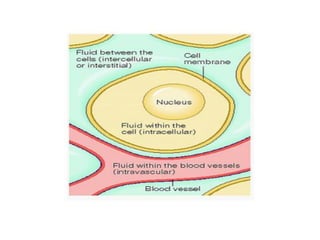
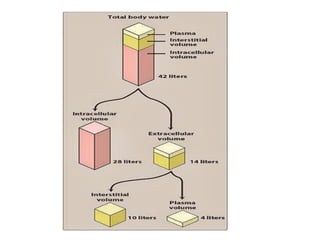
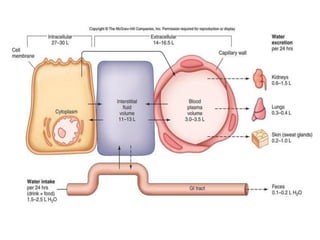
Total Body Water (TBW)
• During gestation~ 90 % of fetal body wt

• Decreases gradually
• Adult male ~ 65 % of body weight
• Adult females ~ 55 % of body weigth
Page 5
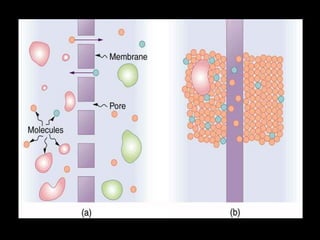
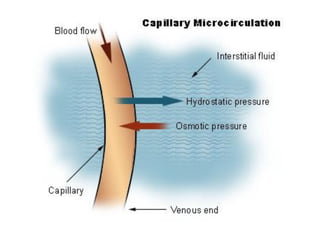
Starling forces
 Interstitial fluid is an ultrafiltrate from
plasma and both are separated by
caillary endothelial lining which acts as
a semipermeable membrane.

Page 8
Semipermeable membrane
 A membrane that allows certain
types of molecules to pass through but
blocks others, based on characteristics
such as the molecules size, chemistry,
solubility, or other specific properties.

Page 10
Starling forces
 Starling
forces
formula
demonstrates that the net movement
of fluid across a capillary membrane is
a function of membrane permeability
and differences in hydrostatic and
oncotic pressure on the two sides of
the membrane.
Page 13
Hydrostatic Pressure

The pressure exerted by a fluid at
equilibrium at a given point within the
fluid, due to the force of gravity.

Page 14
Oncotic pressure
(Colloid osmotic pressure)
A form of osmotic pressure exerted
by proteins in a blood vessel, that
usually tends to pull water into the
circulatory system.
It is the opposing force to hydrostatic
pressure.
Page 15
Osmotic Pressure

???
Page 17
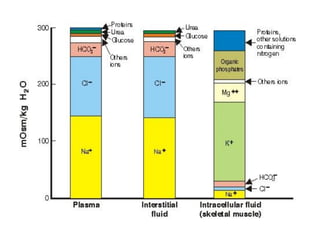
Electrolytes composition among
Different body compartements
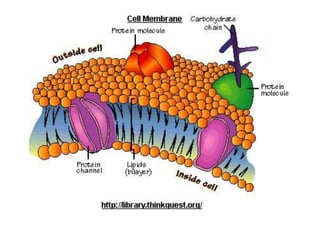
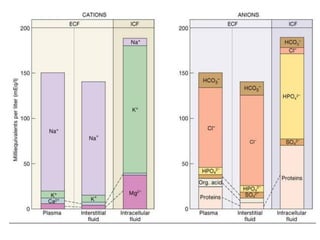
The composition of ICF differs
markedly from that of ECF because of
the
separation
of
these
compartements by the cell membrane

Page 19
Electrolytes composition among
Different body compartements
The composition differences are a
consequence of both Gibbs-Donnan
Equilibrium and active transport of
ions.

Page 21
Gibbs-Donnan Equilibrium
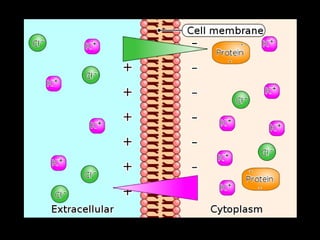
when a semipermeable membrane separates nondiffusible substance (ex:protein), from diffusible
substances (ex: electrolytes), the diffusible
substances are distributed on the two sides of the
membrane so that 1) the products of their
concentrations are equal, and 2) the sum of the
diffusible and non-diffusible anions on either side of
the membrane is equal to the sum of the
concentrations of diffusible and non-diffusible
cations; the unequal distribution of diffusible ions
thus produced creates a potential difference across
Page 22
the membrane (membrane potential).
Active ions transportation
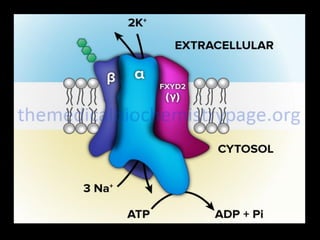
The sodium-potassium pump, also known as
the Na, K-ATPase, is a critical protein found
in the membranes of all animal cells.
It functions in the active transport of sodium
and potassium ions across the cell
membrane against their concentration
gradients.
For each ATP the pump breaks down, two
potassium ions are transported into the cell
Page 24
and three sodium ions out of the cell
OSMOLALITY
Page 26
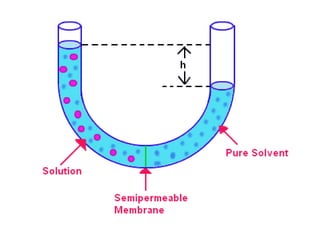
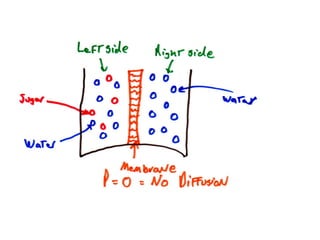
Osmotic pressure and osmosis
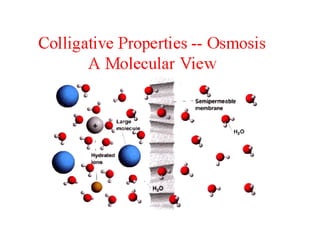
 Osmotic pressure governs the movement
of solvents (water) across membranes that
separate two solutions.
 Different membranes vary in pore size
and shape (e.g: glomerular and capillary
vessels) They are permeable to water,
small molecules, and ions, but not
permeable to macromolecules e.g. proteins.
Page 27
Osmotic pressure and osmosis
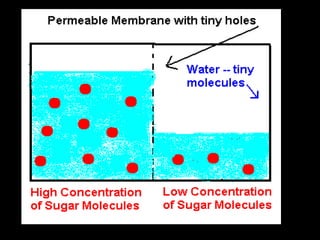
Differences in concentration of molecule
that cannot cross membranes will cause
those that can cross to move, thus
establishing an osmotic equilibrium. This
movement of solute and permeable ions
exerts what is known as osmotic pressure

Page 29
Osmotic pressure and osmosis
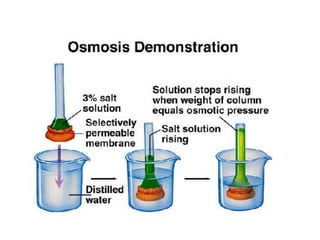
Osmosis is the process that constitutes
the movement of solvent across a
membrane is response to differences in
osmotic pressure across the 2 sides of the
membrane.
 Water migrates across the membrane
toward the side containg more concentrated
solute.
Page 31
Osmolality and Osmolarity
 Osmolality is a physical property of a
solution that is based on the number of
particles of the solute relative to mass of
the solvent (expressed as mmols) / kg of
solvent (w/w). (? Molality)

Page 34
Osmolality and Osmolarity
 Osmolarity is the no of particles of solute
per liter of the solution, its units of
measurement is mosmol/Liter or mmol/Liter.
(? Molar conc.)

Page 35
Osmolality and Osmolarity

Which is the more exact expression;
Osmolality or Osmolarity?
Which has higher osmolality; Nacl or
glucose?

Page 36
Colligative properties of solutions
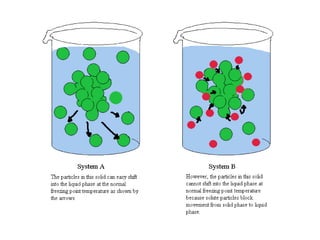
When a solute is added to a solvent the
following occurs:
Increased osmotic pressure.
Lowered vapour pressure.
Increased boiling point.
Decreased freezing point.

Page 37
Colligative properties of solutions
 Colligative properties are all directly
related to the total number of solute
particles per mass of solvent.
1 osmolal solution is defined to contain 1
osmol/k.g H2O.

Page 38
Colligative properties of solutions
 An electrolyte in solution dissociates into
2 (e.g. NaCl) or 3 (CaCl2) particles. The
colligative effects of such solutions are
multiplied by the no of dissociated ions
formed/molecule.
 Incomplete dissociation??

Page 39
Plasma and Urine Osmolality
Clinical significance:
 Assessment of acid-base disorders
 Assessment of electrolyte disorders e.g.
in diabetes inspidus or in syndrome of
inappropriate secretion of anti-diuretic
hormone (SIADH).

Page 40
Calculation of Plasma Osmolality:
mOsm/Kg =
1.86 [Na+(mmol/L)]+Glucose
+urea (mmol/L)+9

(mmol/L)

1.86= Na+ and Cl- (incomplete dissociation)
9: The contribution of other osmotically
active substances in plasma such as K+,
Ca2+, and proteins.
Page 42
Calculation of Plasma Osmolality:
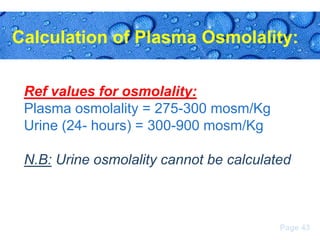
Ref values for osmolality:
Plasma osmolality = 275-300 mosm/Kg
Urine (24- hours) = 300-900 mosm/Kg
N.B: Urine osmolality cannot be calculated

Page 43
Measuring Plasma Osmolality:
Comparison of measured osmolality to the
calculated value can help identify the
presence of an osmolal gap which can be
important in determining the presence of
exogenous osmotic substances that can
lead to acid-base disturbances, ex: ethanol
intoxication
Page 44
Measuring Plasma Osmolality:
The methods for determining osmolality are
based on the collegative properties which
are properties of a solution related to the
number of molecules of solute per kilogram
of solvent, such as changes in freezing
point and vapor pressure.

Page 45
Measuring Plasma Osmolality:
 An increase in osmolality decreases the
freezing point temperature and the vapor
pressure.
 Measurment of freezing point depression
and vapor pressure decrease (Dew point)
are the 2 mostly used methods of analysis
 Freezing point depression is better??
Page 46
Freezing point depression osmometer:
(Cryoscope)
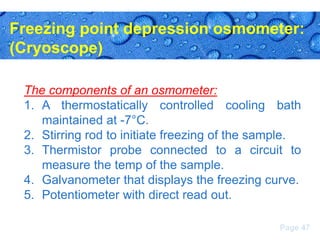
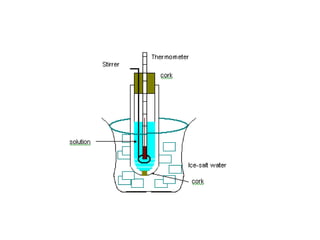
The components of an osmometer:
1. A thermostatically controlled cooling bath
maintained at -7°C.
2. Stirring rod to initiate freezing of the sample.
3. Thermistor probe connected to a circuit to
measure the temp of the sample.
4. Galvanometer that displays the freezing curve.
5. Potentiometer with direct read out.
Page 47
Body water and Osmolality

Body water and Osmolality

  • 1.
    BODY WATER & OSMOLALITY Ola H.Elgaddar MBChB, MSc, MD, CPHQ, LSSGB Lecturer of Chemical Pathology Medical Research Institute Alexandria University Ola.elgaddar@alexu.edu.eg Page 1
  • 2.
    ILOs: After this lecture,you should be able to:  Understand the volume and distribution of body water among different body compartments.  Explain the reasons for composition differences of body fluids.  Understand Gibbs – Donnan Euilibrium. Page 2
  • 3.
    ILOs: After this lecture,you should be able to:  Explain what osmotic pressure is.  Understand the colligative properties of a solution.  Calculate teh osmolality of a solution.  Know the different methods used in measuring osmolality  Recognize the significance of Osmolal gap. Page 3
  • 4.
  • 5.
    Total Body Water(TBW) • During gestation~ 90 % of fetal body wt • Decreases gradually • Adult male ~ 65 % of body weight • Adult females ~ 55 % of body weigth Page 5
  • 8.
    Starling forces  Interstitialfluid is an ultrafiltrate from plasma and both are separated by caillary endothelial lining which acts as a semipermeable membrane. Page 8
  • 10.
    Semipermeable membrane  Amembrane that allows certain types of molecules to pass through but blocks others, based on characteristics such as the molecules size, chemistry, solubility, or other specific properties. Page 10
  • 13.
    Starling forces  Starling forces formula demonstratesthat the net movement of fluid across a capillary membrane is a function of membrane permeability and differences in hydrostatic and oncotic pressure on the two sides of the membrane. Page 13
  • 14.
    Hydrostatic Pressure The pressureexerted by a fluid at equilibrium at a given point within the fluid, due to the force of gravity. Page 14
  • 15.
    Oncotic pressure (Colloid osmoticpressure) A form of osmotic pressure exerted by proteins in a blood vessel, that usually tends to pull water into the circulatory system. It is the opposing force to hydrostatic pressure. Page 15
  • 17.
  • 19.
    Electrolytes composition among Differentbody compartements The composition of ICF differs markedly from that of ECF because of the separation of these compartements by the cell membrane Page 19
  • 21.
    Electrolytes composition among Differentbody compartements The composition differences are a consequence of both Gibbs-Donnan Equilibrium and active transport of ions. Page 21
  • 22.
    Gibbs-Donnan Equilibrium when asemipermeable membrane separates nondiffusible substance (ex:protein), from diffusible substances (ex: electrolytes), the diffusible substances are distributed on the two sides of the membrane so that 1) the products of their concentrations are equal, and 2) the sum of the diffusible and non-diffusible anions on either side of the membrane is equal to the sum of the concentrations of diffusible and non-diffusible cations; the unequal distribution of diffusible ions thus produced creates a potential difference across Page 22 the membrane (membrane potential).
  • 24.
    Active ions transportation Thesodium-potassium pump, also known as the Na, K-ATPase, is a critical protein found in the membranes of all animal cells. It functions in the active transport of sodium and potassium ions across the cell membrane against their concentration gradients. For each ATP the pump breaks down, two potassium ions are transported into the cell Page 24 and three sodium ions out of the cell
  • 26.
  • 27.
    Osmotic pressure andosmosis  Osmotic pressure governs the movement of solvents (water) across membranes that separate two solutions.  Different membranes vary in pore size and shape (e.g: glomerular and capillary vessels) They are permeable to water, small molecules, and ions, but not permeable to macromolecules e.g. proteins. Page 27
  • 29.
    Osmotic pressure andosmosis Differences in concentration of molecule that cannot cross membranes will cause those that can cross to move, thus establishing an osmotic equilibrium. This movement of solute and permeable ions exerts what is known as osmotic pressure Page 29
  • 31.
    Osmotic pressure andosmosis Osmosis is the process that constitutes the movement of solvent across a membrane is response to differences in osmotic pressure across the 2 sides of the membrane.  Water migrates across the membrane toward the side containg more concentrated solute. Page 31
  • 34.
    Osmolality and Osmolarity Osmolality is a physical property of a solution that is based on the number of particles of the solute relative to mass of the solvent (expressed as mmols) / kg of solvent (w/w). (? Molality) Page 34
  • 35.
    Osmolality and Osmolarity Osmolarity is the no of particles of solute per liter of the solution, its units of measurement is mosmol/Liter or mmol/Liter. (? Molar conc.) Page 35
  • 36.
    Osmolality and Osmolarity Whichis the more exact expression; Osmolality or Osmolarity? Which has higher osmolality; Nacl or glucose? Page 36
  • 37.
    Colligative properties ofsolutions When a solute is added to a solvent the following occurs: Increased osmotic pressure. Lowered vapour pressure. Increased boiling point. Decreased freezing point. Page 37
  • 38.
    Colligative properties ofsolutions  Colligative properties are all directly related to the total number of solute particles per mass of solvent. 1 osmolal solution is defined to contain 1 osmol/k.g H2O. Page 38
  • 39.
    Colligative properties ofsolutions  An electrolyte in solution dissociates into 2 (e.g. NaCl) or 3 (CaCl2) particles. The colligative effects of such solutions are multiplied by the no of dissociated ions formed/molecule.  Incomplete dissociation?? Page 39
  • 40.
    Plasma and UrineOsmolality Clinical significance:  Assessment of acid-base disorders  Assessment of electrolyte disorders e.g. in diabetes inspidus or in syndrome of inappropriate secretion of anti-diuretic hormone (SIADH). Page 40
  • 42.
    Calculation of PlasmaOsmolality: mOsm/Kg = 1.86 [Na+(mmol/L)]+Glucose +urea (mmol/L)+9 (mmol/L) 1.86= Na+ and Cl- (incomplete dissociation) 9: The contribution of other osmotically active substances in plasma such as K+, Ca2+, and proteins. Page 42
  • 43.
    Calculation of PlasmaOsmolality: Ref values for osmolality: Plasma osmolality = 275-300 mosm/Kg Urine (24- hours) = 300-900 mosm/Kg N.B: Urine osmolality cannot be calculated Page 43
  • 44.
    Measuring Plasma Osmolality: Comparisonof measured osmolality to the calculated value can help identify the presence of an osmolal gap which can be important in determining the presence of exogenous osmotic substances that can lead to acid-base disturbances, ex: ethanol intoxication Page 44
  • 45.
    Measuring Plasma Osmolality: Themethods for determining osmolality are based on the collegative properties which are properties of a solution related to the number of molecules of solute per kilogram of solvent, such as changes in freezing point and vapor pressure. Page 45
  • 46.
    Measuring Plasma Osmolality: An increase in osmolality decreases the freezing point temperature and the vapor pressure.  Measurment of freezing point depression and vapor pressure decrease (Dew point) are the 2 mostly used methods of analysis  Freezing point depression is better?? Page 46
  • 47.
    Freezing point depressionosmometer: (Cryoscope) The components of an osmometer: 1. A thermostatically controlled cooling bath maintained at -7°C. 2. Stirring rod to initiate freezing of the sample. 3. Thermistor probe connected to a circuit to measure the temp of the sample. 4. Galvanometer that displays the freezing curve. 5. Potentiometer with direct read out. Page 47