Lesson 1: Introduction to Chemical
             Bonding
          Covalent Bonding Unit
Targets
I can define chemical bond.
I can describe covalent bonding.
I can classify bonding type according to
 electronegativity differences.
Definitions
Chemical Bond – mutual electrical attraction between the
 nuclei and valence electrons of different atoms that bind
 the atoms together
Valence electrons – outermost electrons that are available
 to be lost, gained, or shared to form a chemical bond
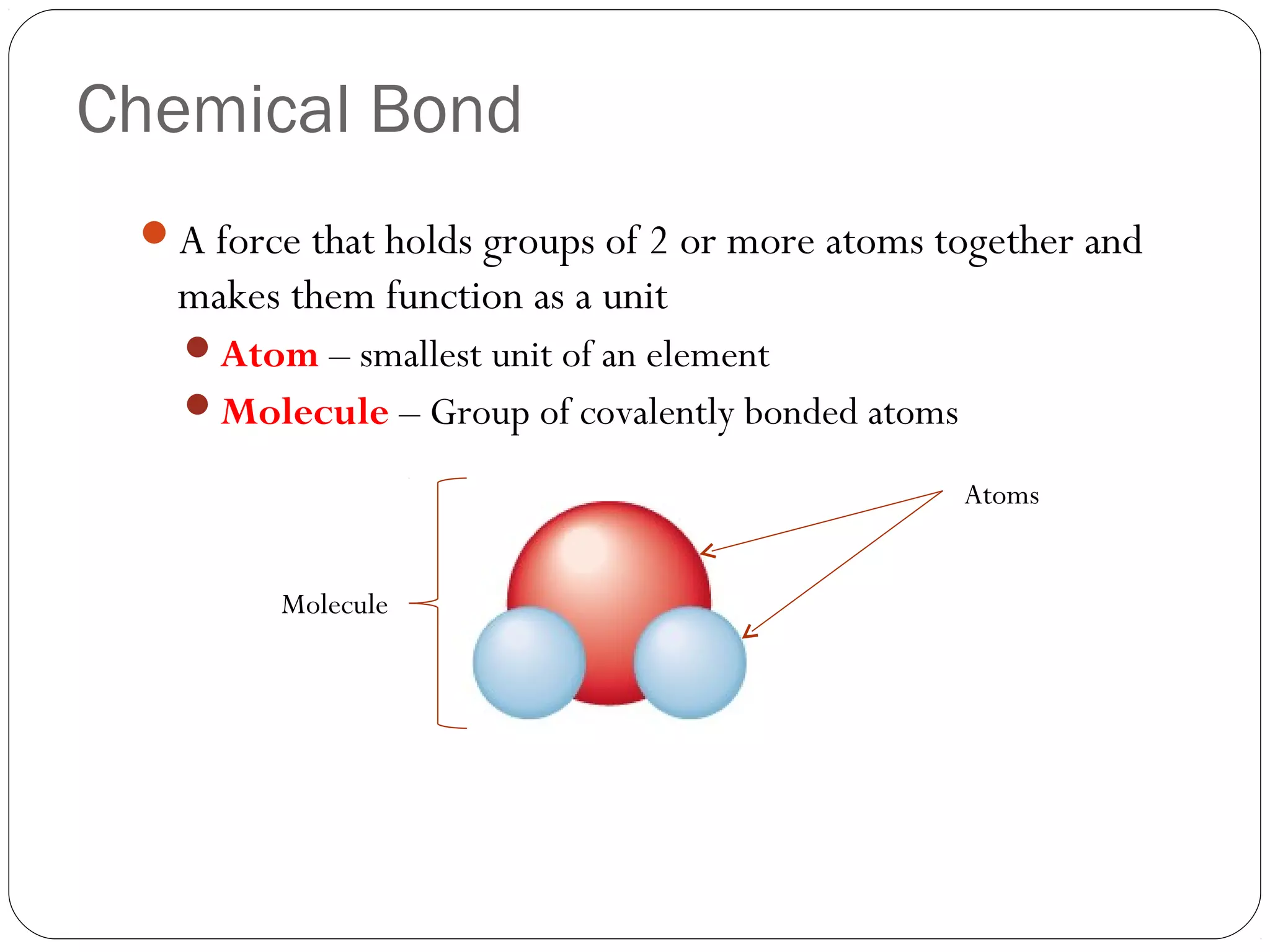
Chemical Bond
 A force that holds groups of 2 or more atoms together and
   makes them function as a unit
   Atom – smallest unit of an element
   Molecule – Group of covalently bonded atoms

                                                  Atoms


         Molecule
Types of Chemical Bonds
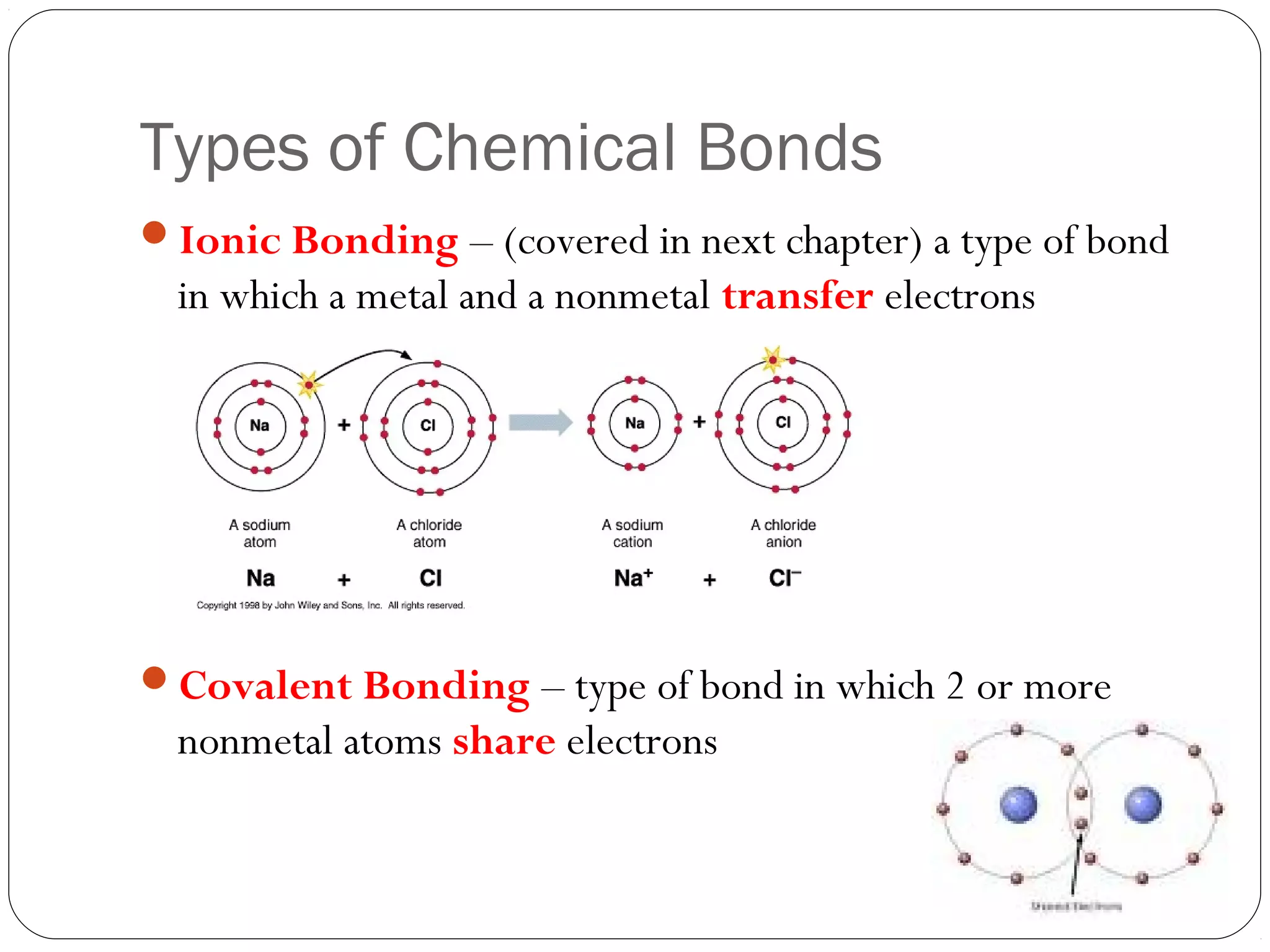
Ionic Bonding – (covered in next chapter) a type of bond
  in which a metal and a nonmetal transfer electrons


Covalent Bonding – type of bond in which 2 or more
  nonmetal atoms share electrons
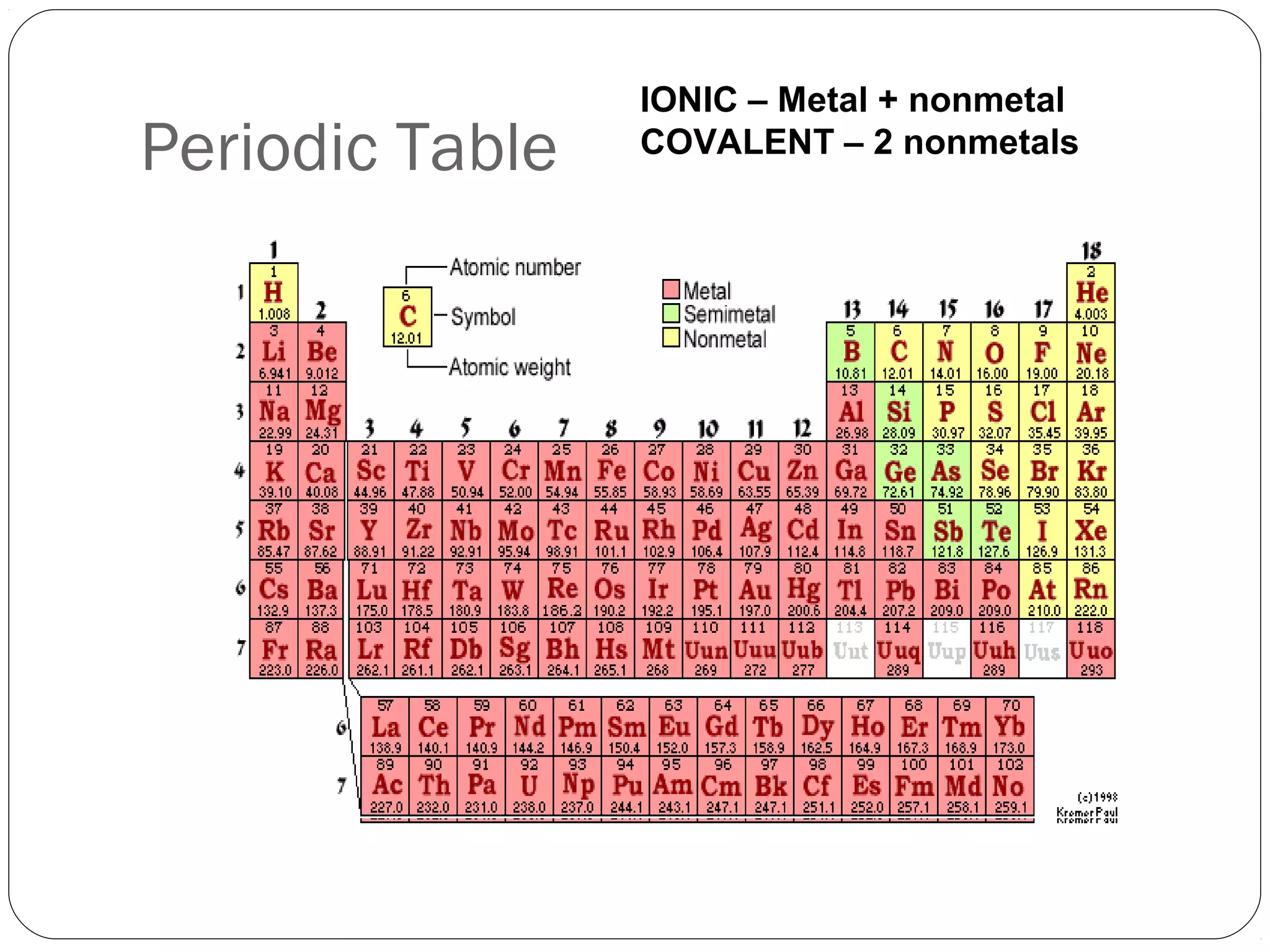
IONIC – Metal + nonmetal
Periodic Table   COVALENT – 2 nonmetals
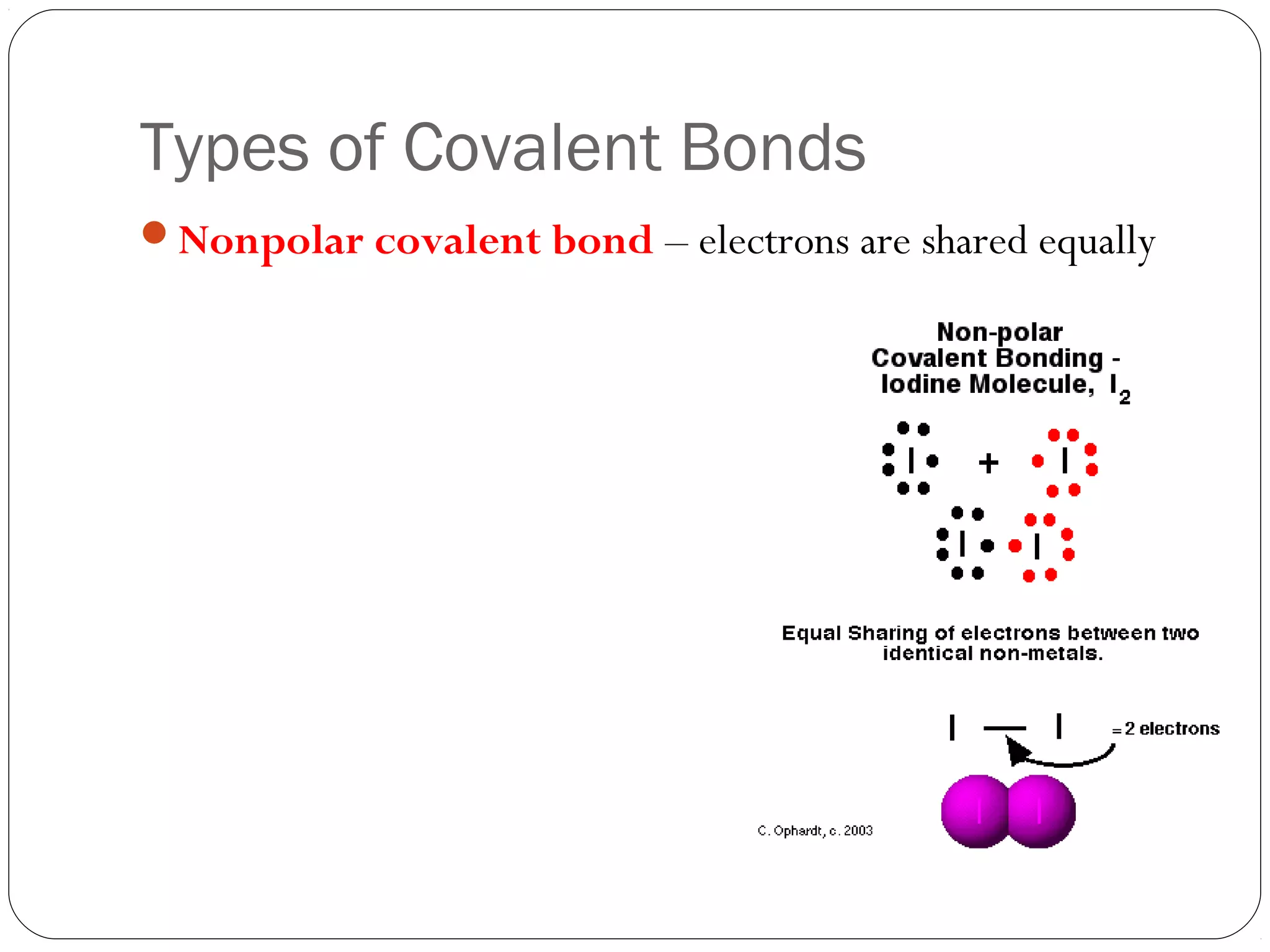
Types of Covalent Bonds
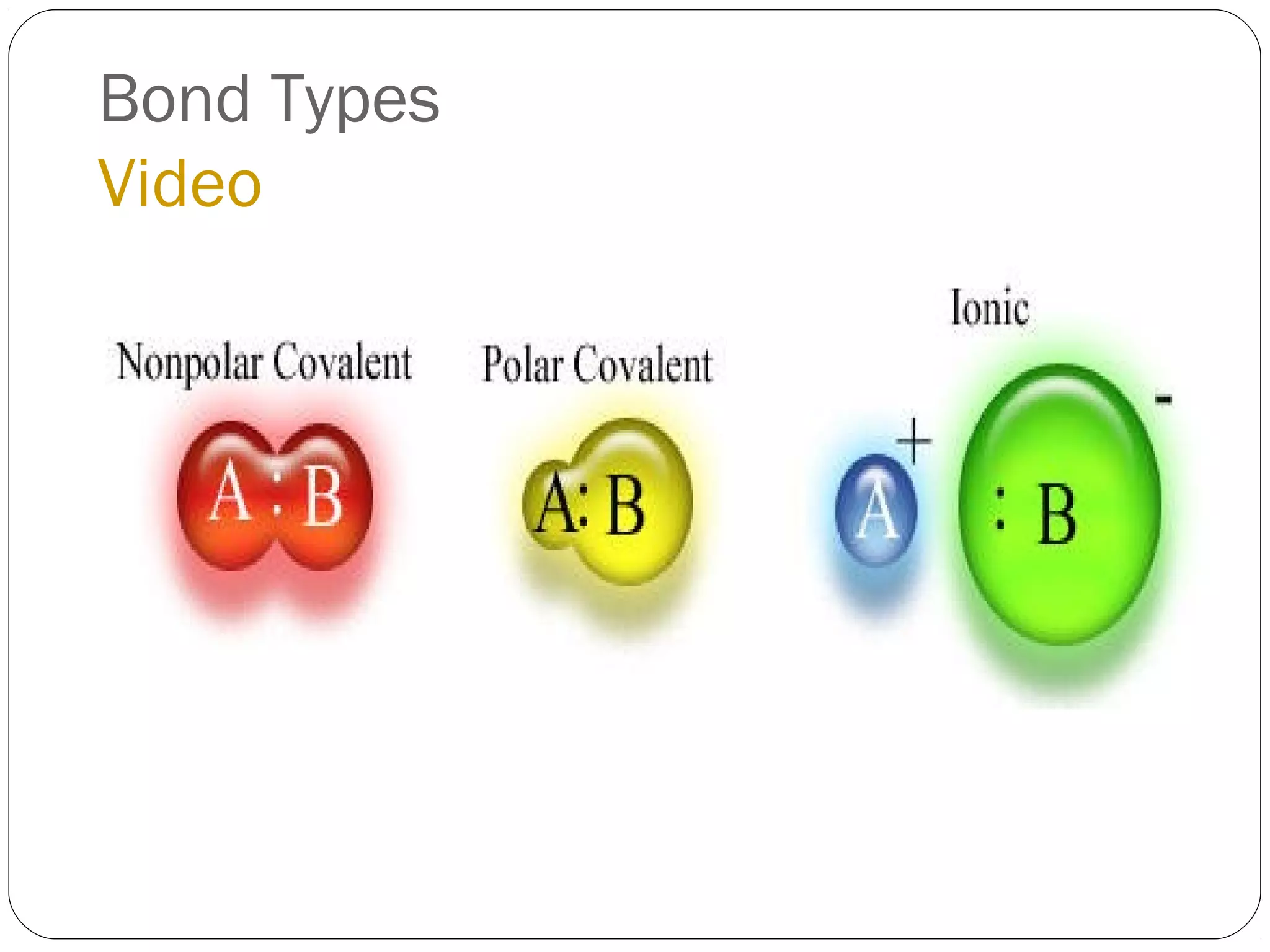
Nonpolar covalent bond – electrons are shared equally
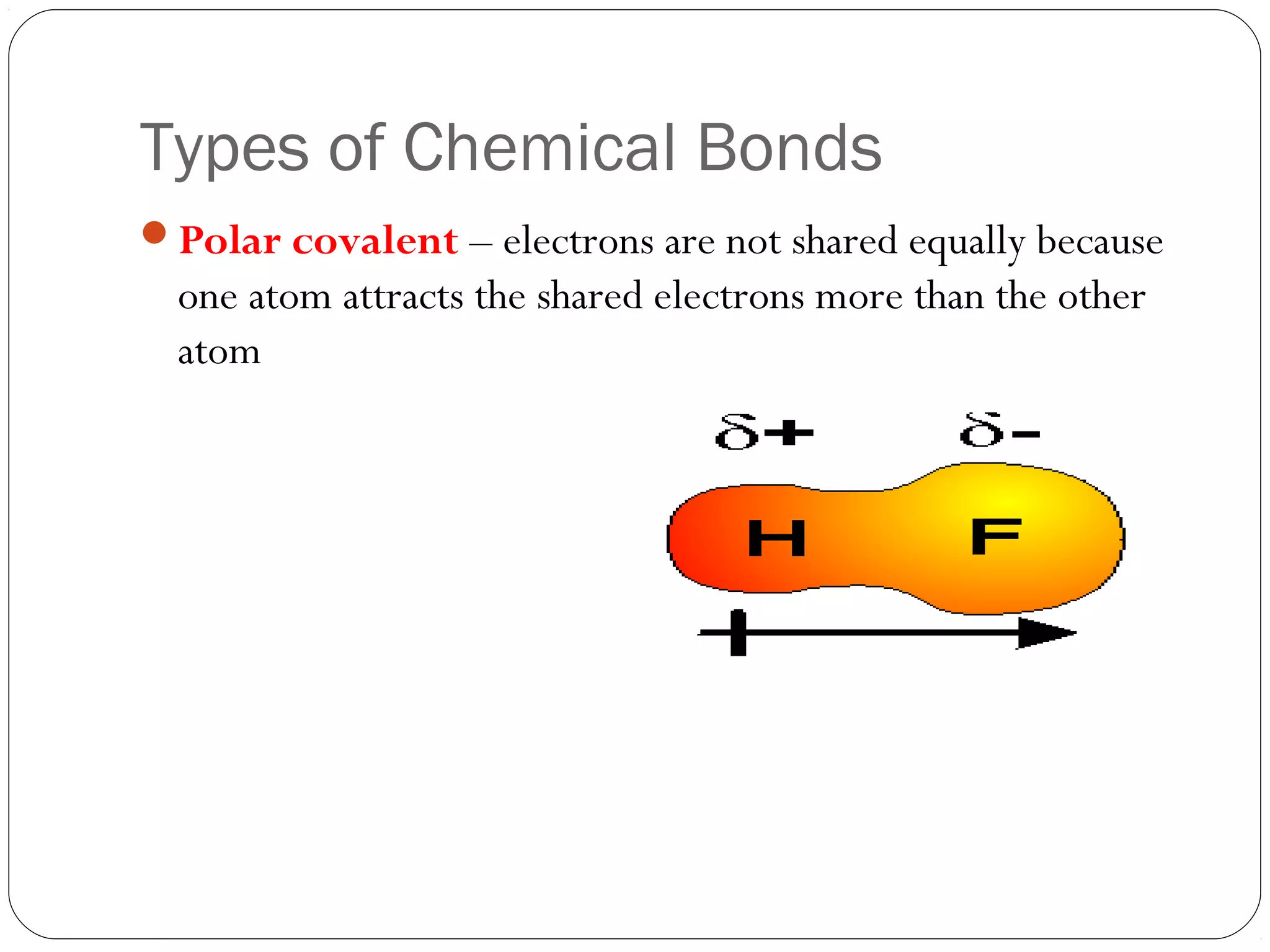
Types of Chemical Bonds
Polar covalent – electrons are not shared equally because
  one atom attracts the shared electrons more than the other
  atom
Bond Types
Video
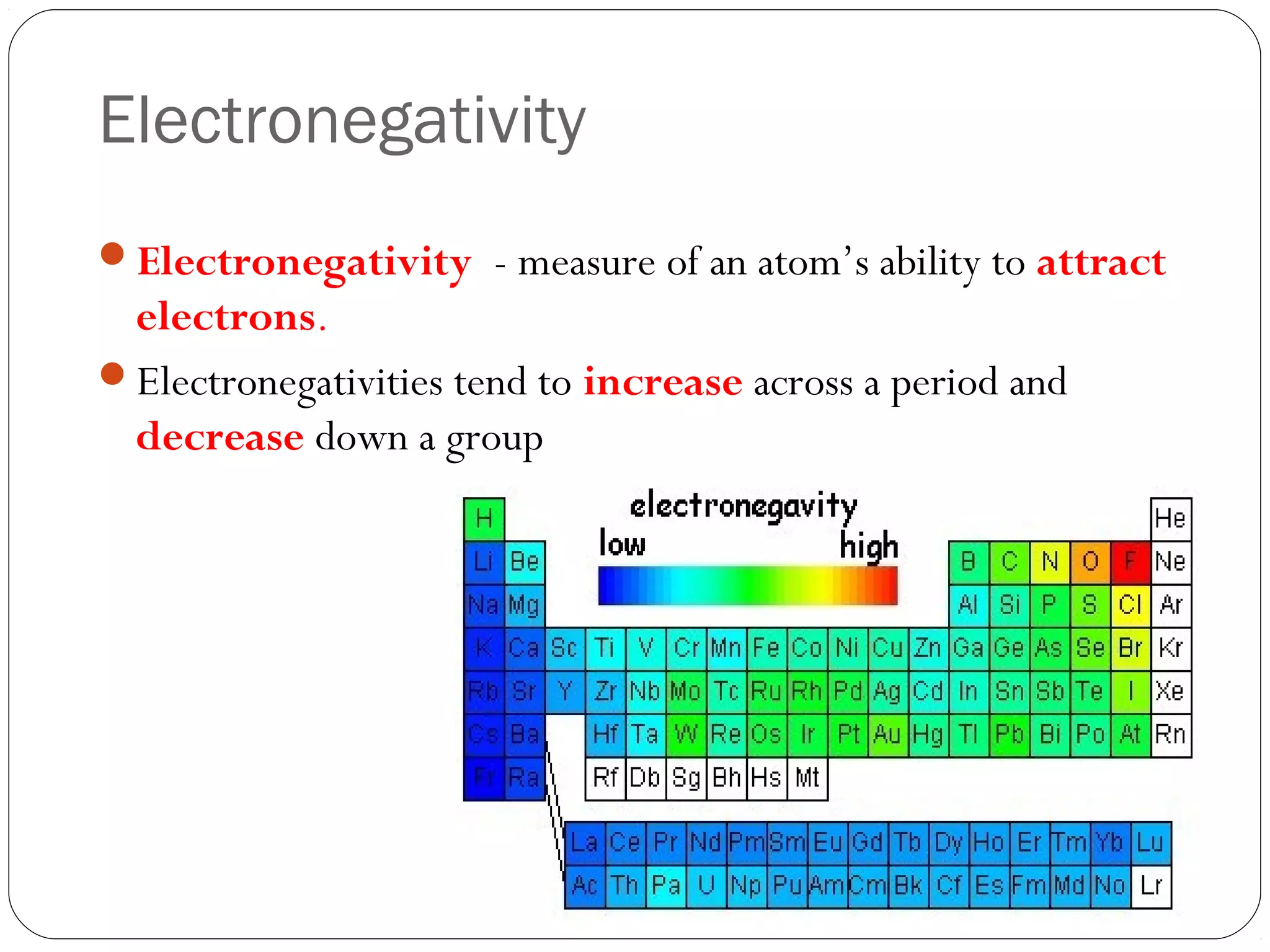
Electronegativity
Electronegativity - measure of an atom’s ability to attract
 electrons.
Electronegativities tend to increase across a period and
 decrease down a group
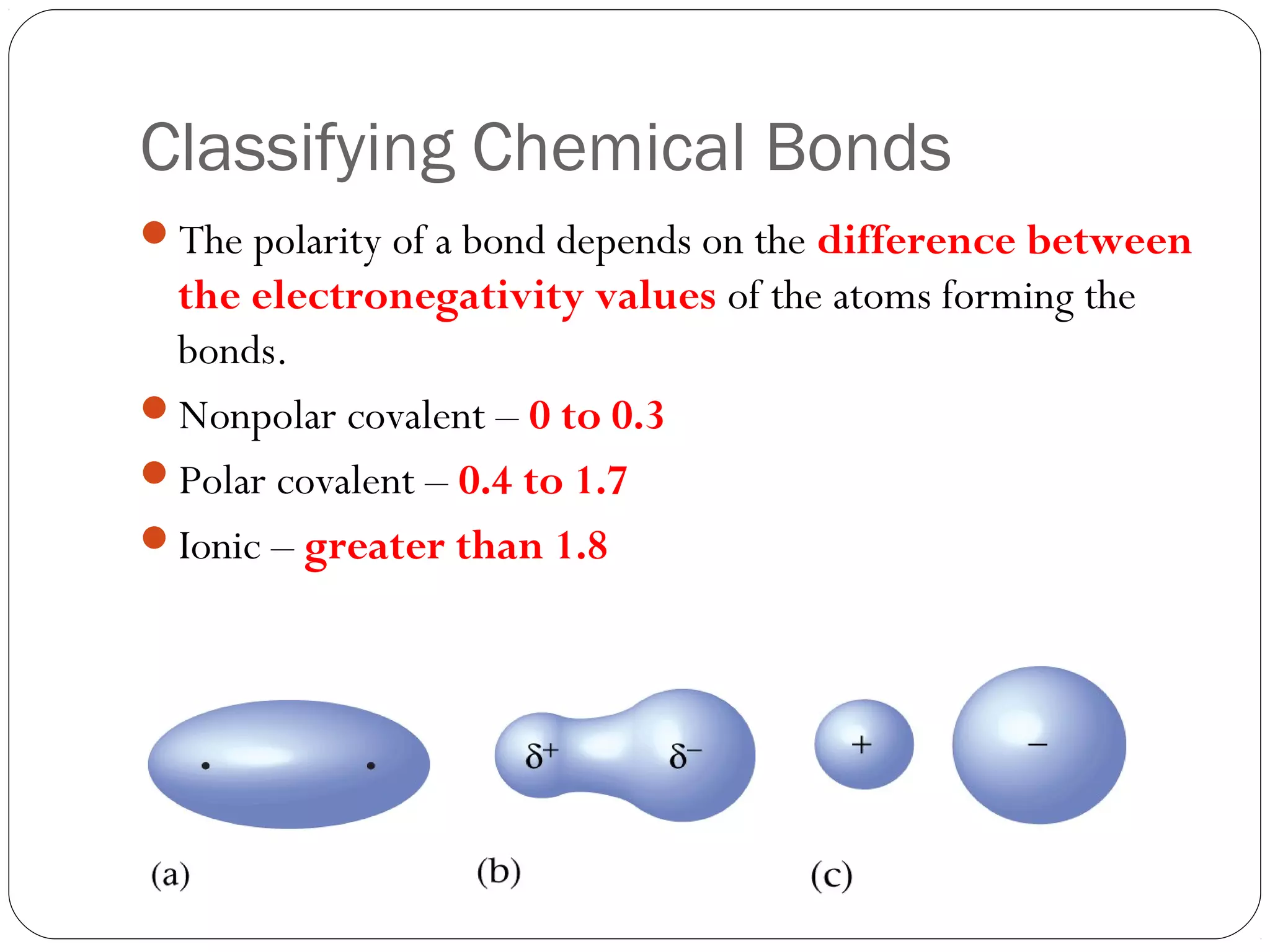
Classifying Chemical Bonds
The polarity of a bond depends on the difference between
 the electronegativity values of the atoms forming the
 bonds.
Nonpolar covalent – 0 to 0.3
Polar covalent – 0.4 to 1.7
Ionic – greater than 1.8
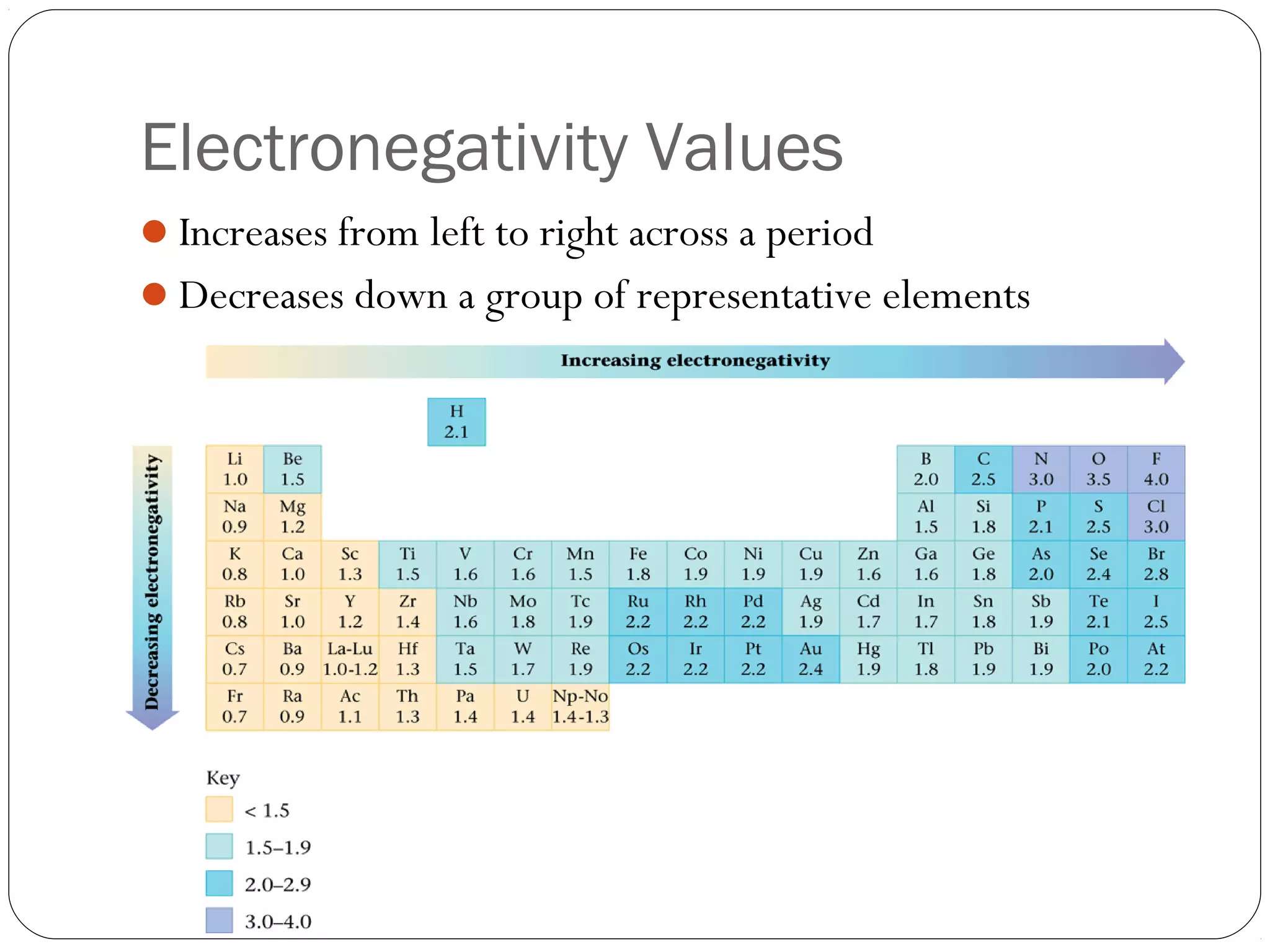
Electronegativity Values
Increases from left to right across a period
Decreases down a group of representative elements
Practice
Use electronegativity values to classify the following bonds:
       a.   Sulfur and Hydrogen
       b.   Lithium and Fluorine
       c.   Potassium and Chlorine
       d.   Iodine and Bromine
       e.   Carbon and Hydrogen
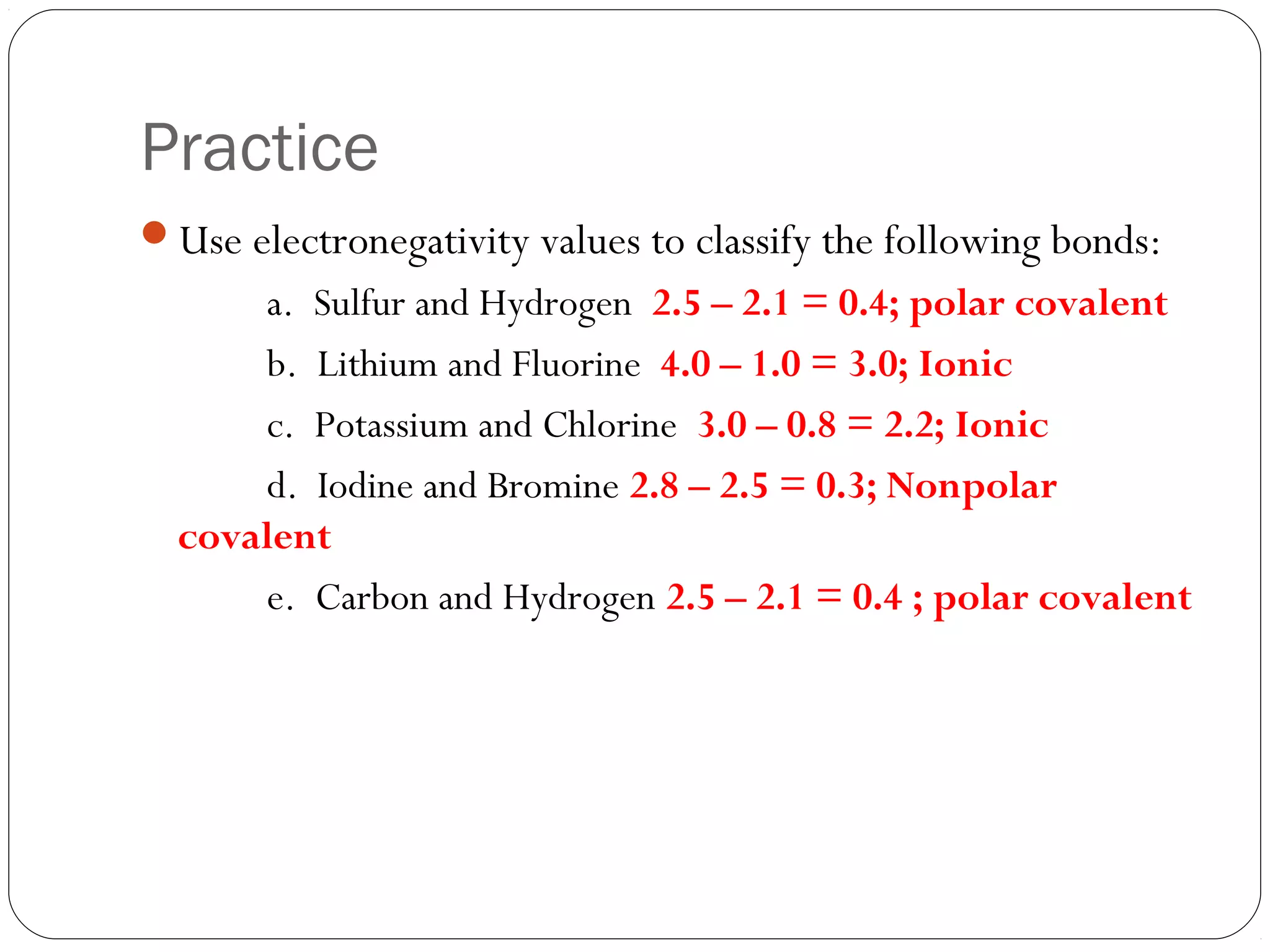
Practice
Use electronegativity values to classify the following bonds:
      a. Sulfur and Hydrogen 2.5 – 2.1 = 0.4; polar covalent
      b. Lithium and Fluorine 4.0 – 1.0 = 3.0; Ionic
      c. Potassium and Chlorine 3.0 – 0.8 = 2.2; Ionic
      d. Iodine and Bromine 2.8 – 2.5 = 0.3; Nonpolar
  covalent
      e. Carbon and Hydrogen 2.5 – 2.1 = 0.4 ; polar covalent
Covalent Bonding

Covalent Bonding and Molecular Compounds
Targets
I can explain why most atoms form chemical bonds.
I can explain the relationships among potential energy,
 distance between approaching atoms, bond length and bond
 energy.
I can state the octet rule.
I can determine the number of valence electrons for a given
 atom.
Formation of a Covalent Bond
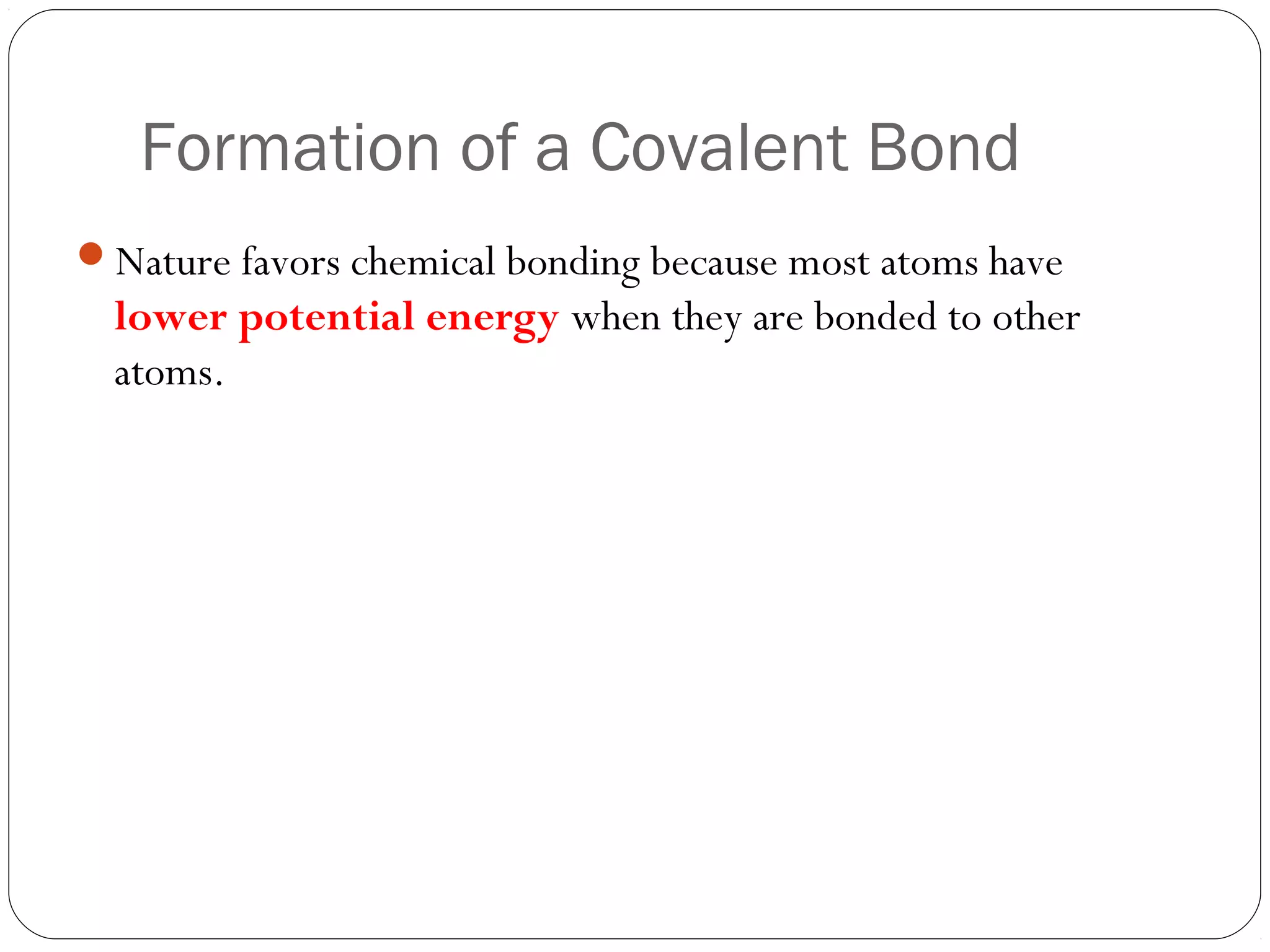
Nature favors chemical bonding because most atoms have
  lower potential energy when they are bonded to other
  atoms.
Formation of a Covalent Bond
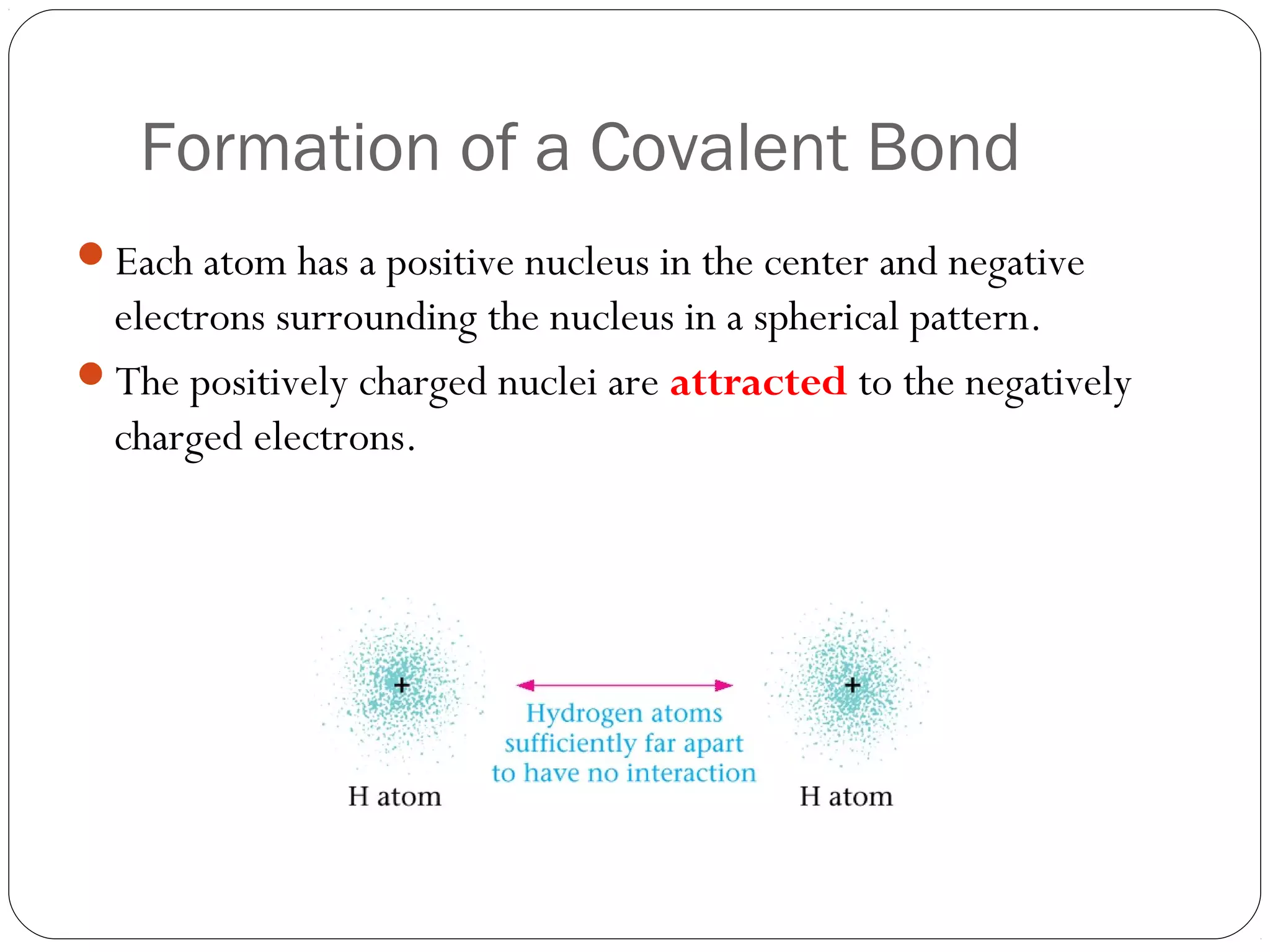
Each atom has a positive nucleus in the center and negative
 electrons surrounding the nucleus in a spherical pattern.
The positively charged nuclei are attracted to the negatively
 charged electrons.
Formation of a Covalent Bond
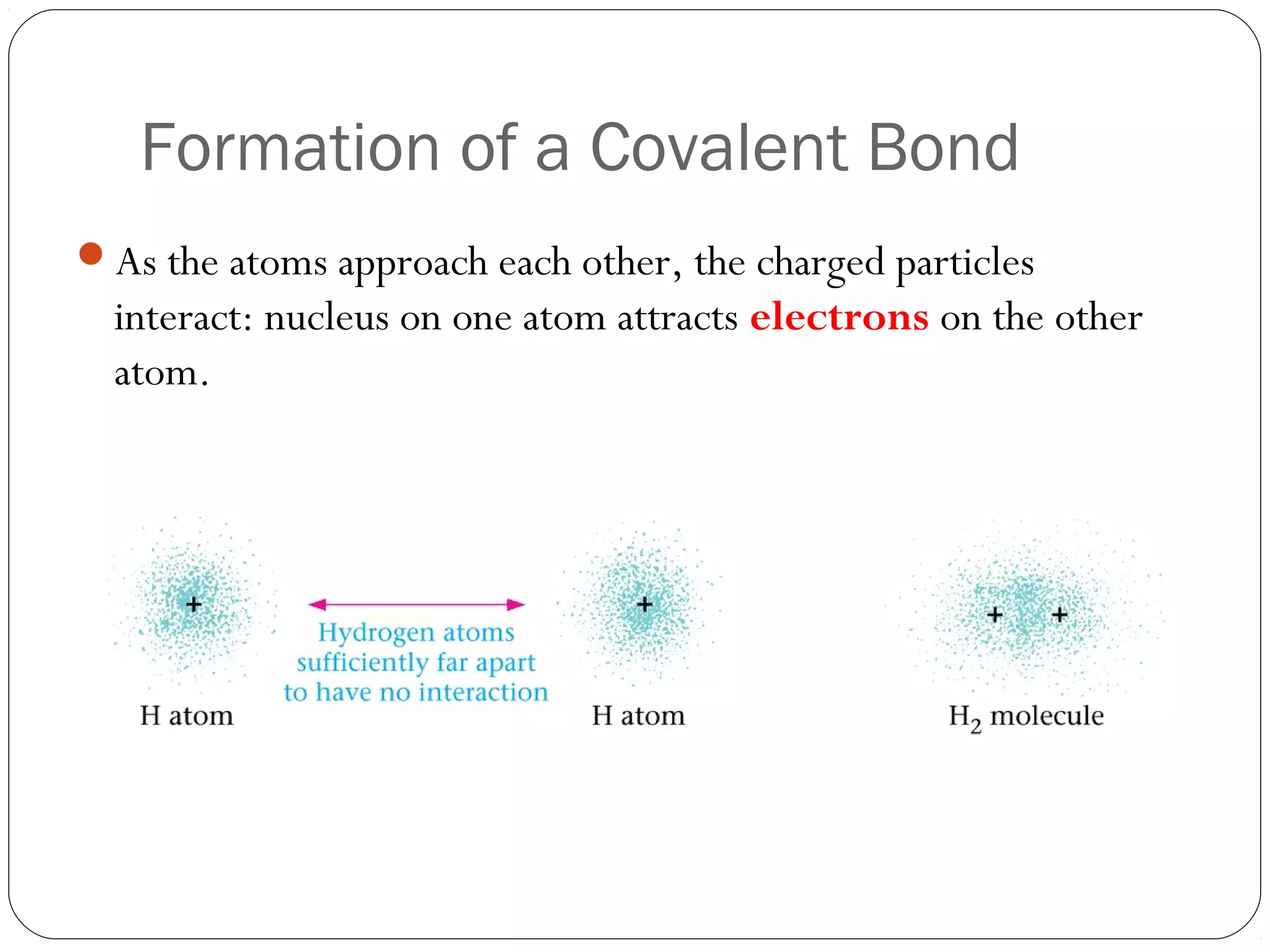
As the atoms approach each other, the charged particles
  interact: nucleus on one atom attracts electrons on the other
  atom.
Formation of a Covalent Bond
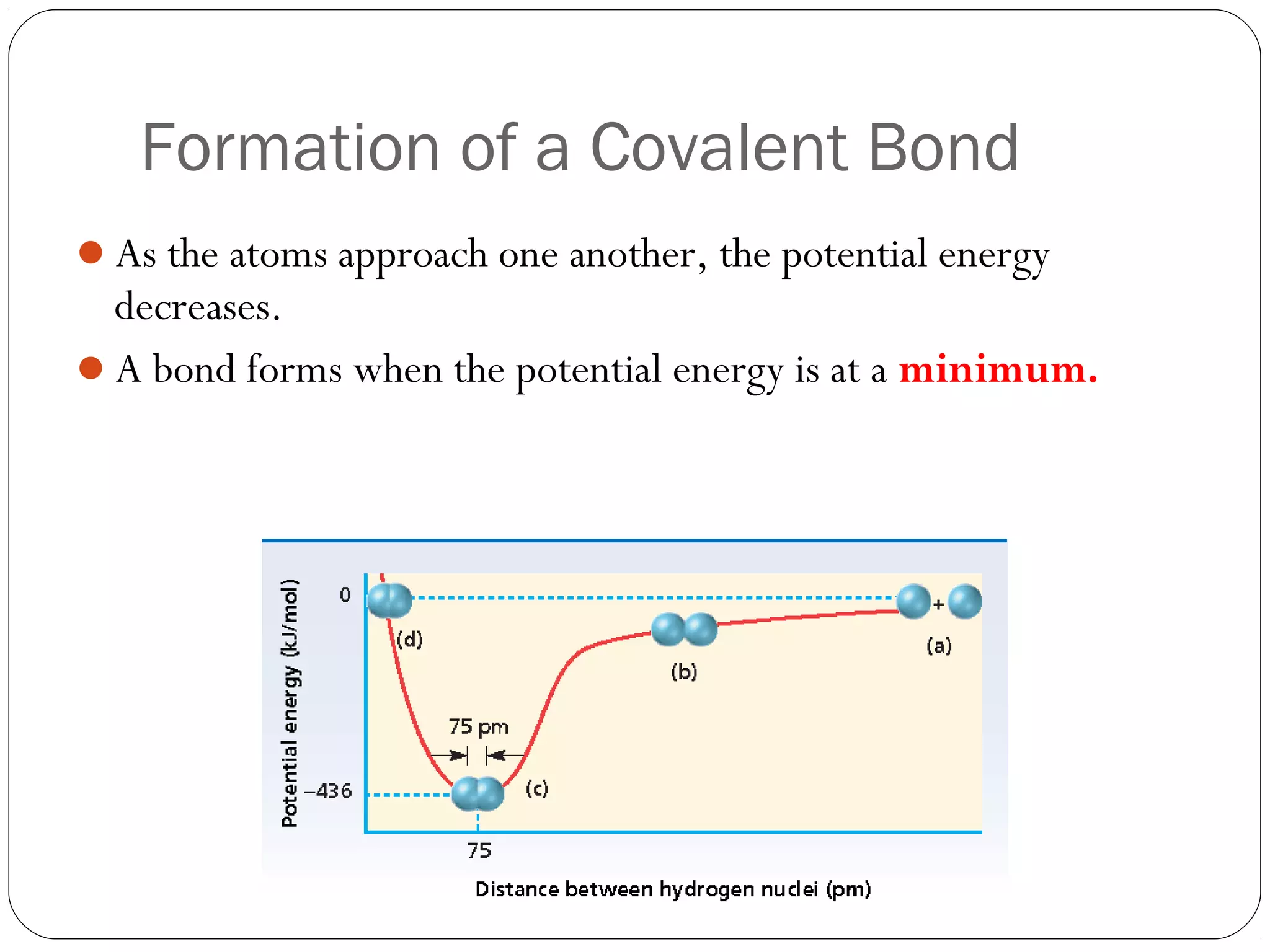
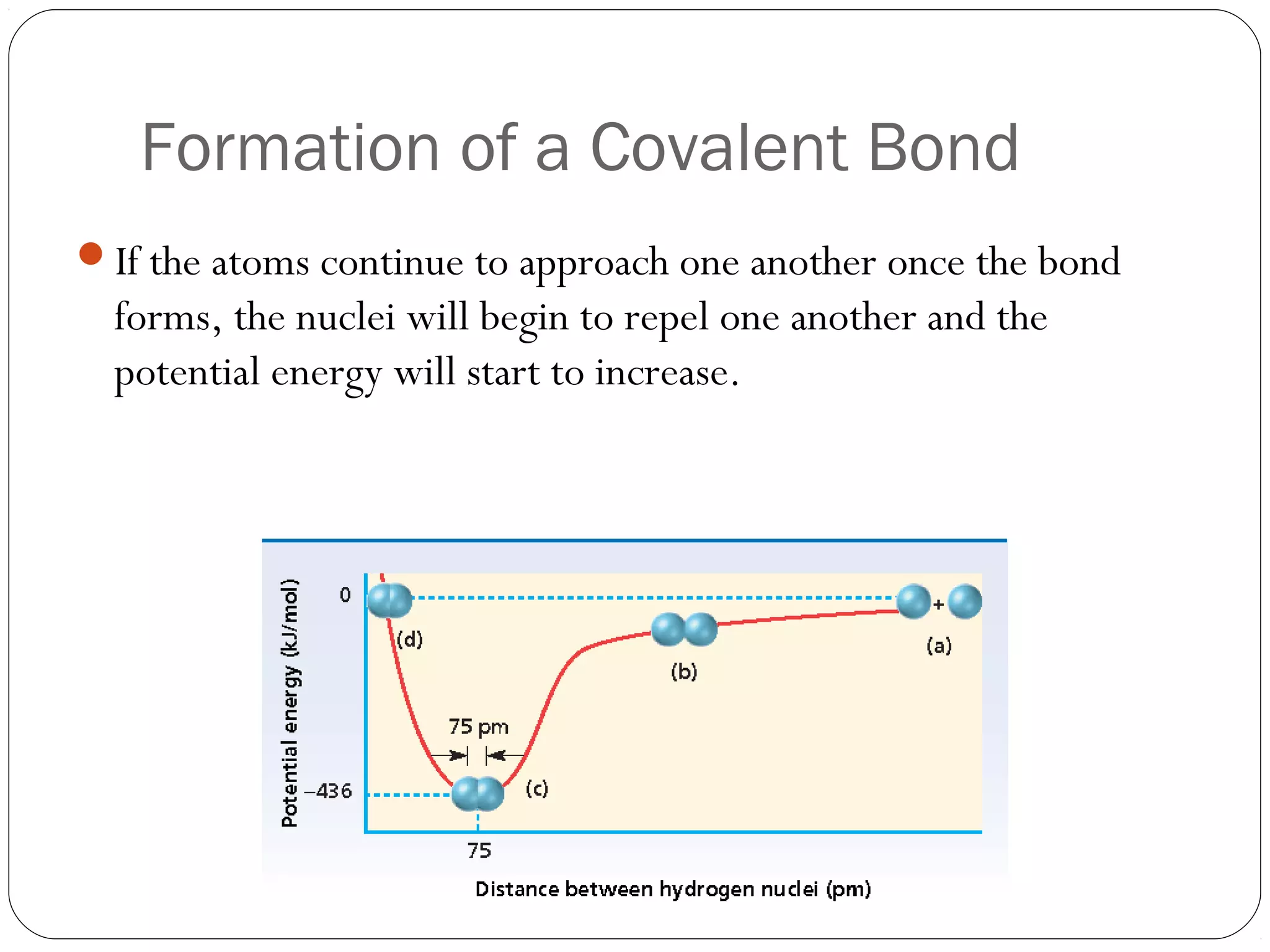
As the atoms approach one another, the potential energy
 decreases.
A bond forms when the potential energy is at a minimum.
Formation of a Covalent Bond
If the atoms continue to approach one another once the bond
  forms, the nuclei will begin to repel one another and the
  potential energy will start to increase.
Characteristics of the Covalent Bond
   Bond length – distance between two bonded atoms at
    their minimum potential energy or the average distance
    between two bonded atoms
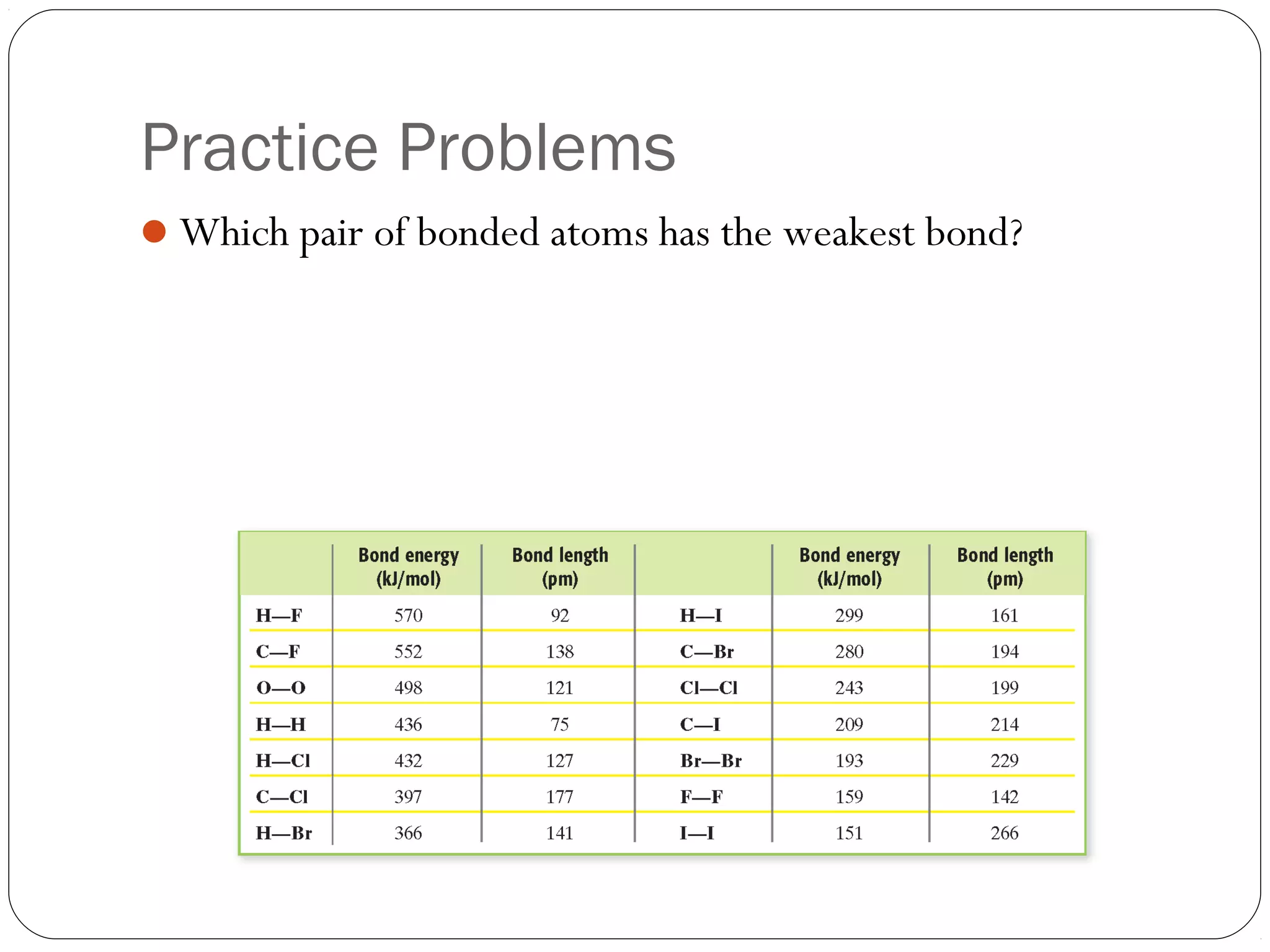
   Bond energy – energy required to break a chemical bond
    and form neutral isolated atoms
          - kilojoules per mole (kJ/mol)
   Bond lengths and bond energies vary with the types of atoms
    that have combined
The Octet Rule
The octet rule states that atoms tend to lose, gain or
 share electrons until they are surrounded by 8
 electrons in their valence shell.
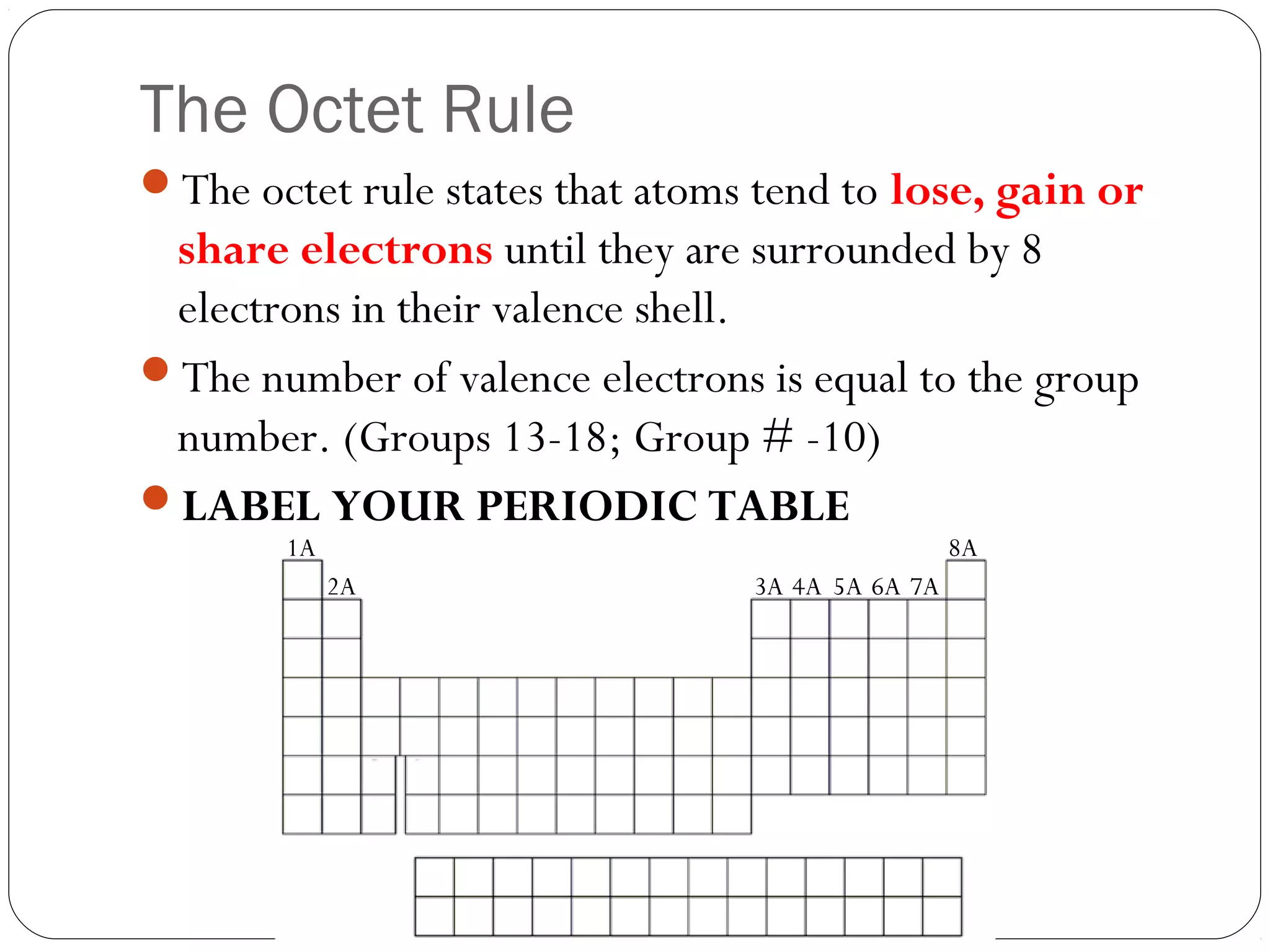
The number of valence electrons is equal to the group
 number. (Groups 13-18; Group # -10)
LABEL YOUR PERIODIC TABLE
        1A                                        8A
             2A                  3A 4A 5A 6A 7A
Practice
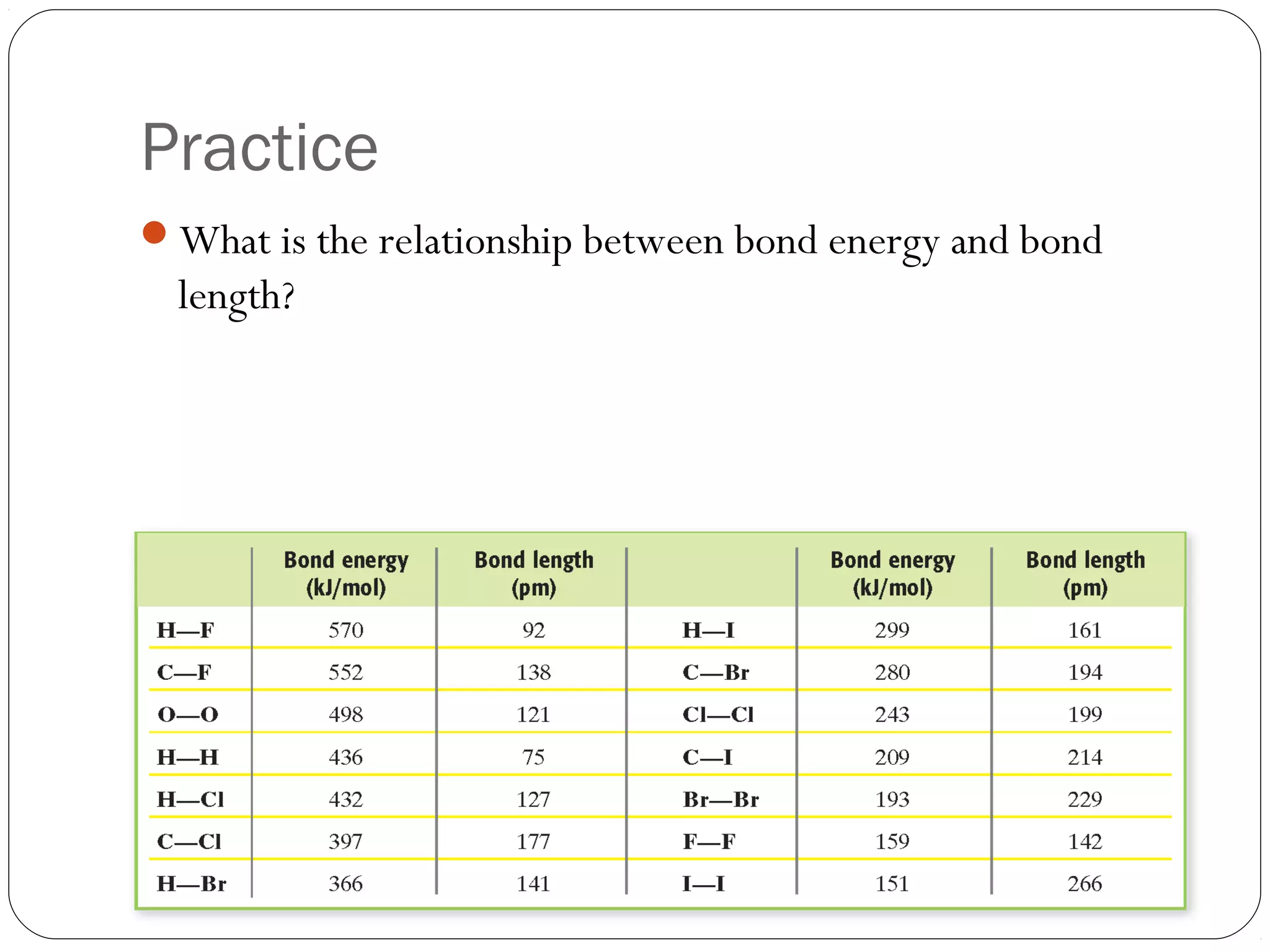
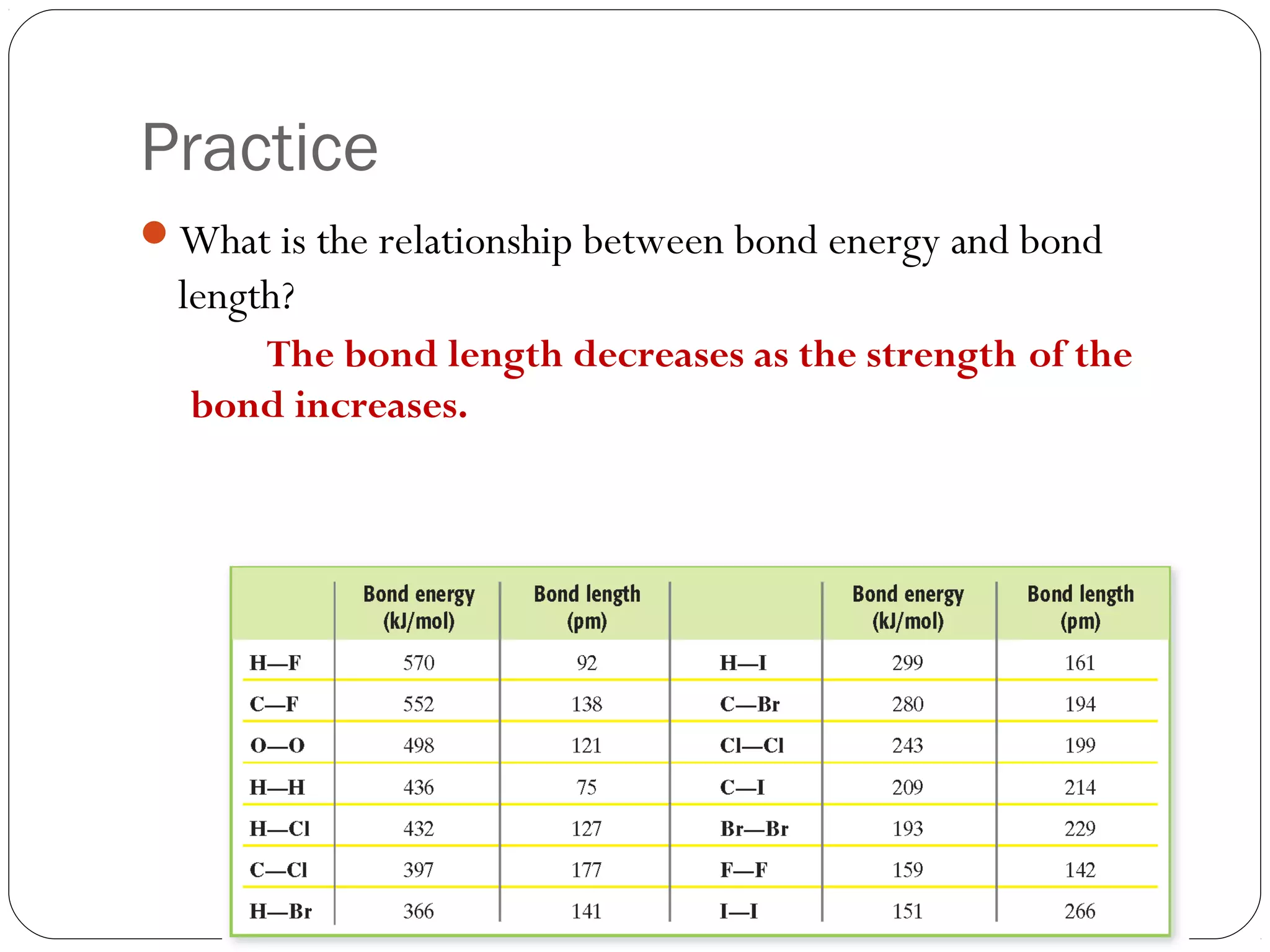
What is the relationship between bond energy and bond
  length?
Practice
What is the relationship between bond energy and bond
  length?
     The bond length decreases as the strength of the
  bond increases.
Practice
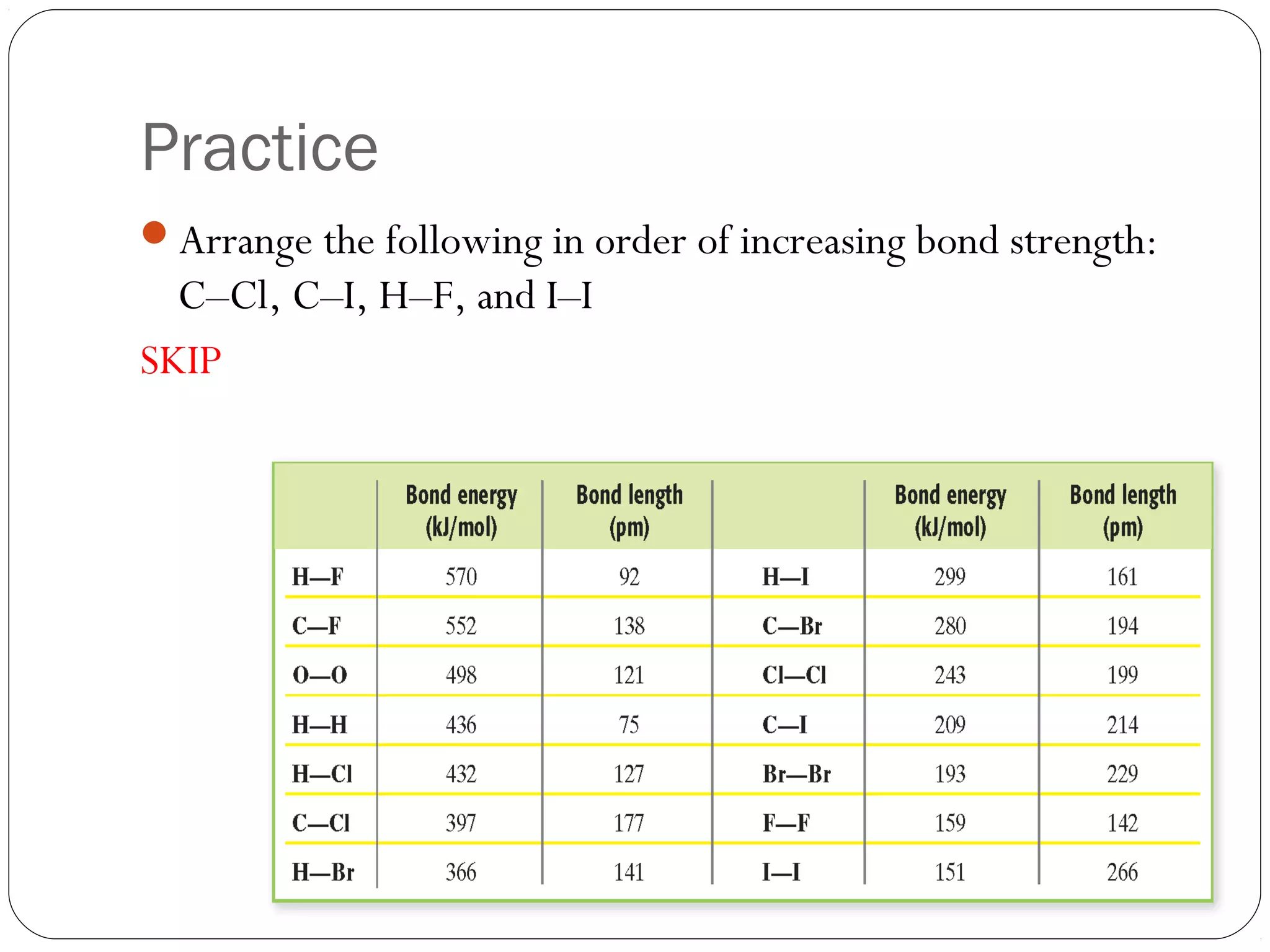
Arrange the following in order of increasing bond strength:
  C–Cl, C–I, H–F, and I–I
SKIP
Practice
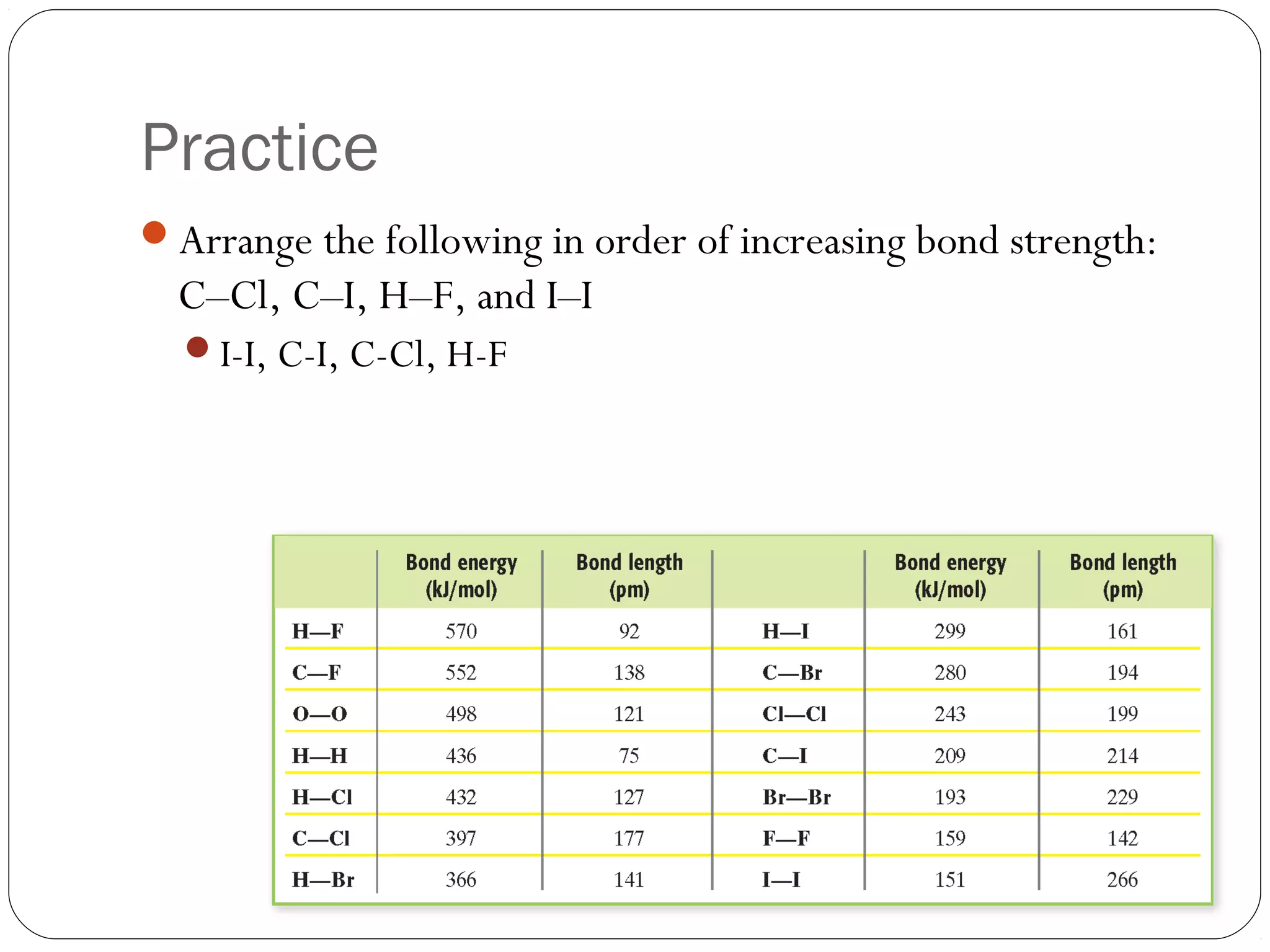
Arrange the following in order of increasing bond strength:
  C–Cl, C–I, H–F, and I–I
  I-I, C-I, C-Cl, H-F
Practice Problems
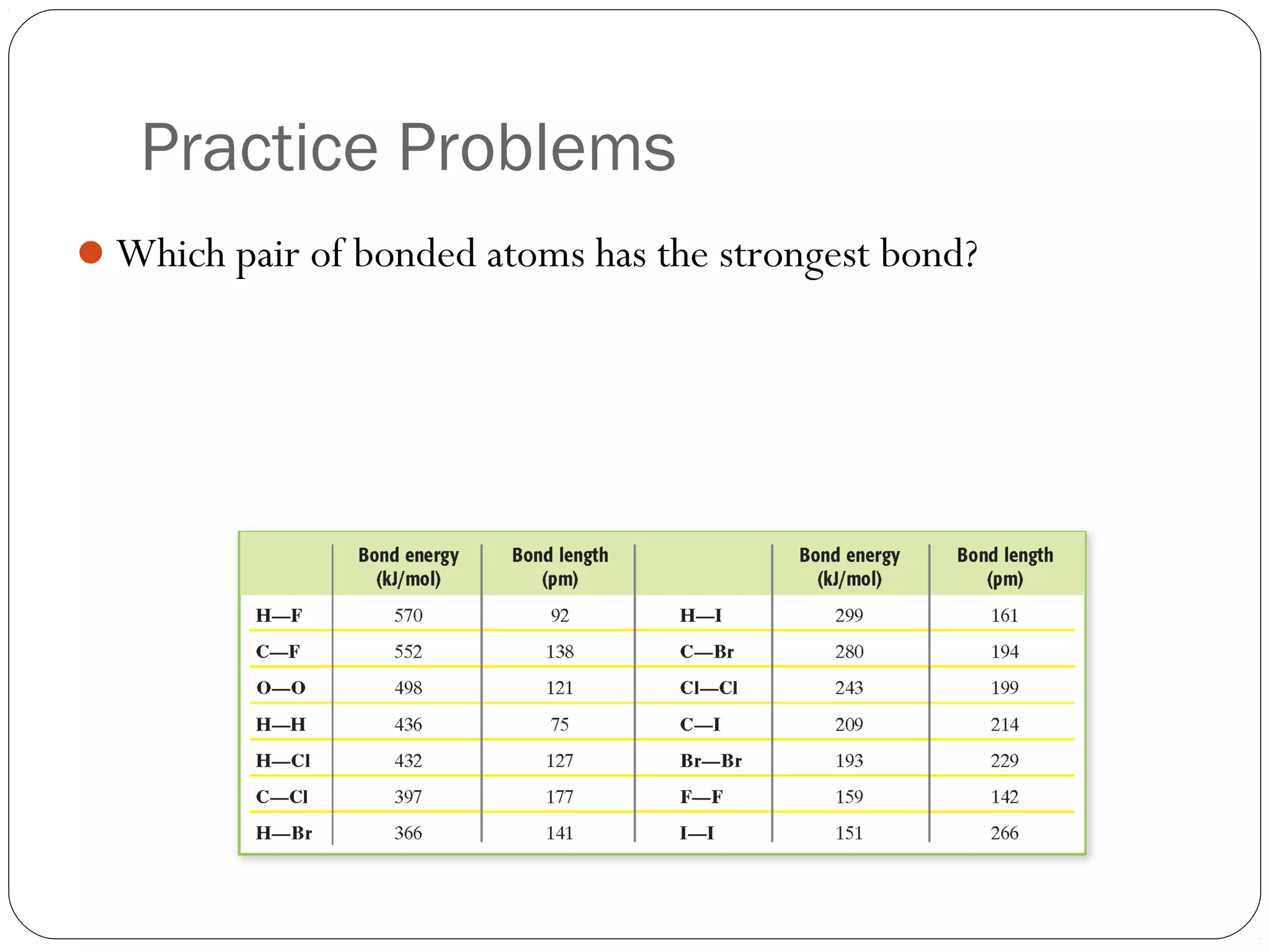
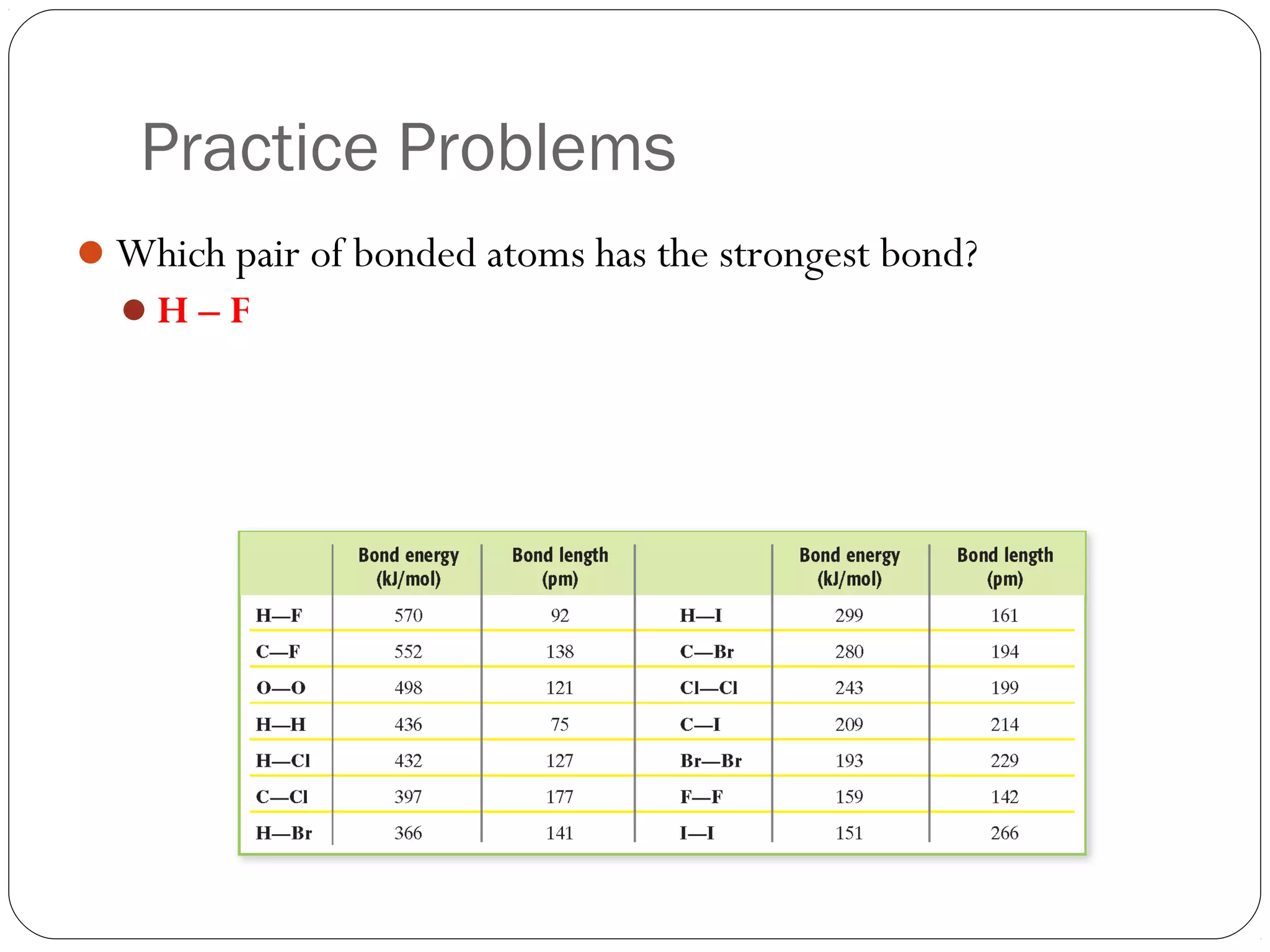
Which pair of bonded atoms has the strongest bond?
Practice Problems
Which pair of bonded atoms has the strongest bond?
  H – F
Practice Problems
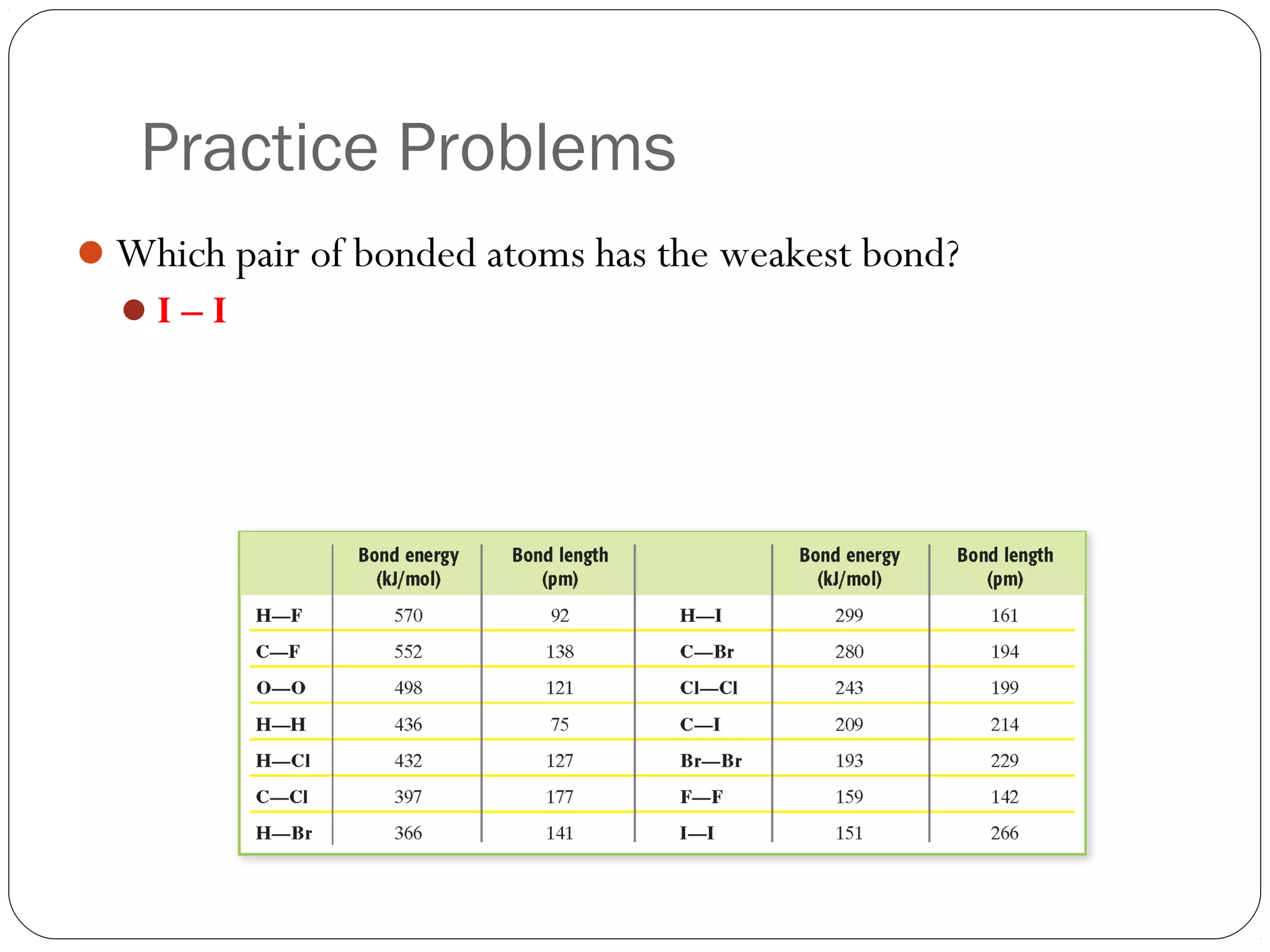
Which pair of bonded atoms has the weakest bond?
Practice Problems
Which pair of bonded atoms has the weakest bond?
  I – I
Practice Problems
Arrange the following bond lengths in order of increasing bond
  strength: 72 pm, 149 pm, 53 pm, and 398 pm

  SKIP
Practice Problems
Arrange the following bond lengths in order of increasing bond
  strength: 72 pm, 149 pm, 53 pm, and 398 pm
  398 pm, 149 pm, 72 pm, 53 pm
Practice Problems
Determine the number of valence electrons in each of the
  following atoms.
  Lithium
  Sulfur
  Carbon
  Neon
Practice Problems
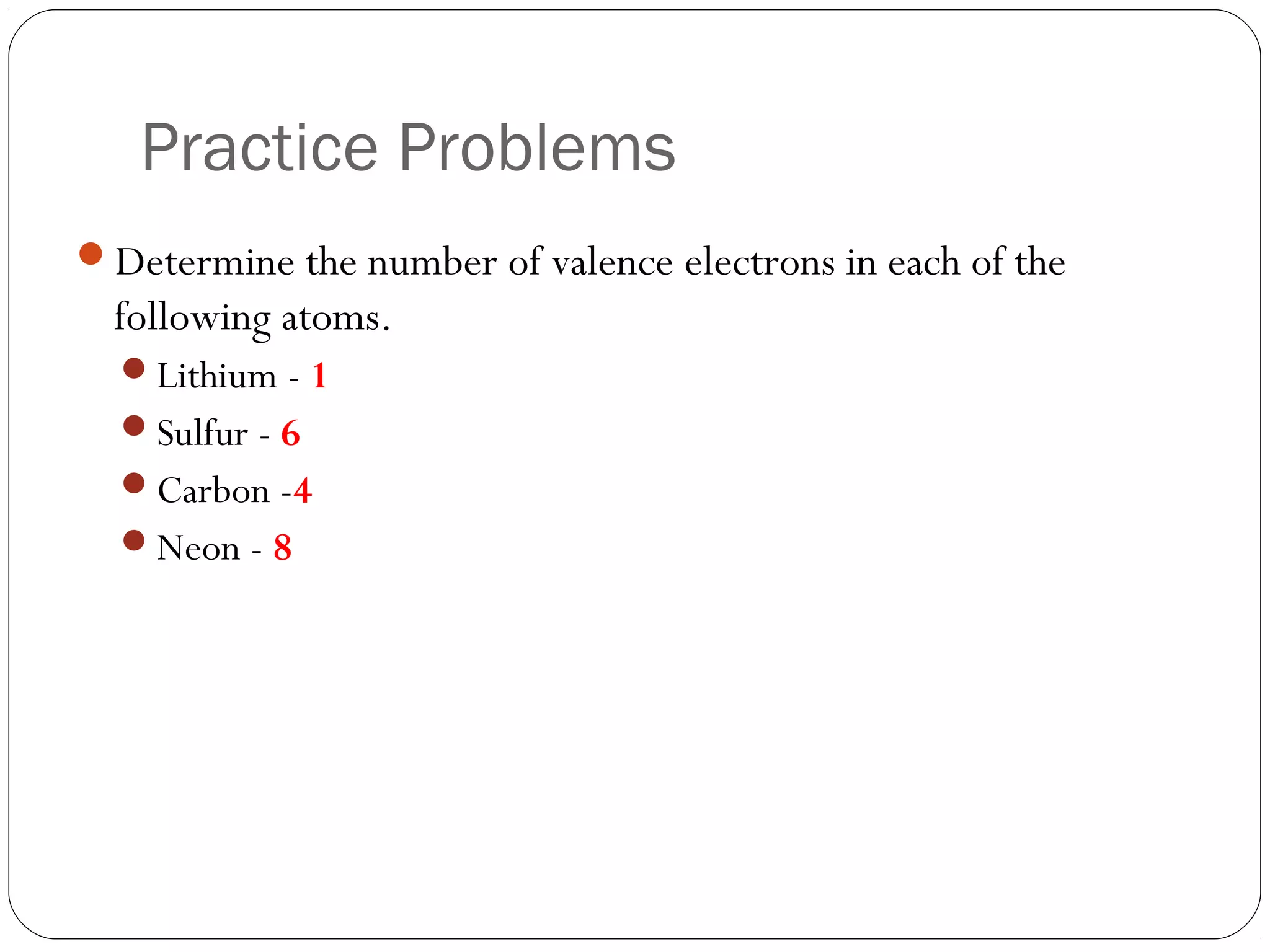
Determine the number of valence electrons in each of the
  following atoms.
  Lithium - 1
  Sulfur - 6
  Carbon -4
  Neon - 8

Lesson 1 Intro to Chemical Bonding

  • 1.
    Lesson 1: Introductionto Chemical Bonding Covalent Bonding Unit
  • 2.
    Targets I can definechemical bond. I can describe covalent bonding. I can classify bonding type according to electronegativity differences.
  • 3.
    Definitions Chemical Bond –mutual electrical attraction between the nuclei and valence electrons of different atoms that bind the atoms together Valence electrons – outermost electrons that are available to be lost, gained, or shared to form a chemical bond
  • 4.
    Chemical Bond Aforce that holds groups of 2 or more atoms together and makes them function as a unit Atom – smallest unit of an element Molecule – Group of covalently bonded atoms Atoms Molecule
  • 5.
    Types of ChemicalBonds Ionic Bonding – (covered in next chapter) a type of bond in which a metal and a nonmetal transfer electrons Covalent Bonding – type of bond in which 2 or more nonmetal atoms share electrons
  • 6.
    IONIC – Metal+ nonmetal Periodic Table COVALENT – 2 nonmetals
  • 7.
    Types of CovalentBonds Nonpolar covalent bond – electrons are shared equally
  • 8.
    Types of ChemicalBonds Polar covalent – electrons are not shared equally because one atom attracts the shared electrons more than the other atom
  • 9.
  • 10.
    Electronegativity Electronegativity - measureof an atom’s ability to attract electrons. Electronegativities tend to increase across a period and decrease down a group
  • 11.
    Classifying Chemical Bonds Thepolarity of a bond depends on the difference between the electronegativity values of the atoms forming the bonds. Nonpolar covalent – 0 to 0.3 Polar covalent – 0.4 to 1.7 Ionic – greater than 1.8
  • 12.
    Electronegativity Values Increases fromleft to right across a period Decreases down a group of representative elements
  • 13.
    Practice Use electronegativity valuesto classify the following bonds: a. Sulfur and Hydrogen b. Lithium and Fluorine c. Potassium and Chlorine d. Iodine and Bromine e. Carbon and Hydrogen
  • 14.
    Practice Use electronegativity valuesto classify the following bonds: a. Sulfur and Hydrogen 2.5 – 2.1 = 0.4; polar covalent b. Lithium and Fluorine 4.0 – 1.0 = 3.0; Ionic c. Potassium and Chlorine 3.0 – 0.8 = 2.2; Ionic d. Iodine and Bromine 2.8 – 2.5 = 0.3; Nonpolar covalent e. Carbon and Hydrogen 2.5 – 2.1 = 0.4 ; polar covalent
  • 15.
    Covalent Bonding Covalent Bondingand Molecular Compounds
  • 16.
    Targets I can explainwhy most atoms form chemical bonds. I can explain the relationships among potential energy, distance between approaching atoms, bond length and bond energy. I can state the octet rule. I can determine the number of valence electrons for a given atom.
  • 17.
    Formation of aCovalent Bond Nature favors chemical bonding because most atoms have lower potential energy when they are bonded to other atoms.
  • 18.
    Formation of aCovalent Bond Each atom has a positive nucleus in the center and negative electrons surrounding the nucleus in a spherical pattern. The positively charged nuclei are attracted to the negatively charged electrons.
  • 19.
    Formation of aCovalent Bond As the atoms approach each other, the charged particles interact: nucleus on one atom attracts electrons on the other atom.
  • 20.
    Formation of aCovalent Bond As the atoms approach one another, the potential energy decreases. A bond forms when the potential energy is at a minimum.
  • 21.
    Formation of aCovalent Bond If the atoms continue to approach one another once the bond forms, the nuclei will begin to repel one another and the potential energy will start to increase.
  • 22.
    Characteristics of theCovalent Bond Bond length – distance between two bonded atoms at their minimum potential energy or the average distance between two bonded atoms Bond energy – energy required to break a chemical bond and form neutral isolated atoms - kilojoules per mole (kJ/mol) Bond lengths and bond energies vary with the types of atoms that have combined
  • 23.
    The Octet Rule Theoctet rule states that atoms tend to lose, gain or share electrons until they are surrounded by 8 electrons in their valence shell. The number of valence electrons is equal to the group number. (Groups 13-18; Group # -10) LABEL YOUR PERIODIC TABLE 1A 8A 2A 3A 4A 5A 6A 7A
  • 24.
    Practice What is therelationship between bond energy and bond length?
  • 25.
    Practice What is therelationship between bond energy and bond length? The bond length decreases as the strength of the bond increases.
  • 26.
    Practice Arrange the followingin order of increasing bond strength: C–Cl, C–I, H–F, and I–I SKIP
  • 27.
    Practice Arrange the followingin order of increasing bond strength: C–Cl, C–I, H–F, and I–I I-I, C-I, C-Cl, H-F
  • 28.
    Practice Problems Which pairof bonded atoms has the strongest bond?
  • 29.
    Practice Problems Which pairof bonded atoms has the strongest bond? H – F
  • 30.
    Practice Problems Which pairof bonded atoms has the weakest bond?
  • 31.
    Practice Problems Which pairof bonded atoms has the weakest bond? I – I
  • 32.
    Practice Problems Arrange thefollowing bond lengths in order of increasing bond strength: 72 pm, 149 pm, 53 pm, and 398 pm SKIP
  • 33.
    Practice Problems Arrange thefollowing bond lengths in order of increasing bond strength: 72 pm, 149 pm, 53 pm, and 398 pm 398 pm, 149 pm, 72 pm, 53 pm
  • 34.
    Practice Problems Determine thenumber of valence electrons in each of the following atoms. Lithium Sulfur Carbon Neon
  • 35.
    Practice Problems Determine thenumber of valence electrons in each of the following atoms. Lithium - 1 Sulfur - 6 Carbon -4 Neon - 8