ANATOMY AND
PHYSIOLOGY
BODY FLUIDS AND ELECTROLYTES
INTRODUCTION
• Body Fluids and Electrolytes
• The total body fluid in adults of average build is about 60% of body weight. This
proportion is higher in young people and in adults below average weight. It is
lower in the elderly and in obese individuals in all age groups. Extracellular water
contributes to about 22% of body weight and intracellular water contributes to
about 38% of body weight.Oxygen and nutrients must continually be delivered to
cells in order for them to accomplish their numerous physiological activities and
waste products of metabolism must be continually removed from the cells. Cells
are bathed in a fluid environment so that water soluble substances can diffuse in
either direction through the cell membrane.
General Objective: At the end of the lecture, students
should have an understanding on the fluid and electrolyte
balance in the body.
Specific objectives: At the end of the lecture, students
should:
• State the composition of body fluid compartments.
• Discuss the intake and output of total body water.
• State the components of some electrolytes in the body.
Body Fluid Compartments
Body fluid is found in two locations, called compartments. There is
the intracellular compartment and the extracellular compartment.
The intracellular compartment known as intracellular fluids (ICF)
refers to fluids inside the cells and is about 28 litres in volume. The
other compartment called the extracellular fluids (ECF) refers to
fluids found outside the cell and is about 14 litres in volume.
Approximately two thirds of body fluids are in the intracellular space
(ICF) compartment and located primarily in the skeletal muscle mass.
Intracellular fluid compartment
Approximately 55 % of total body water is located
inside the cells and is referred to as Intracellular
Fluid.
The composition of intracellular fluid (ICF) is largely
controlled by the cell itself, because there is selective
uptake and discharge mechanisms present in the cell
membrane. ICF constitutes about 40% of body
mass.Hope you still remember that, intracellular fluid
is the fluid found inside the cell.
Water moves in and out of the cell by osmotic
pressure. Osmotic pressure is the attraction of water
to electrolytes or solutes. It is the force that pulls fluid
from one compartment to another. The level of
osmotic pressure remains approximately equal in the
ICF and the ECF.
If the amount of water in the cell decreases,
electrolytes move into the cell prompting water to
move into the cell. The opposite happens if there is
an increase in water in the cells. Electrolytes move
composition of ICF can be very different from that of ECF.
For instance, sodium levels are nearly ten times higher in
ECF than in ICF. This concentration difference occurs
because although sodium diffuses into the cell down its
concentration gradient, there is a pump in the membrane
which selectively pumps it back out again. This
concentration gradient is essential for the function of
excitable cells (mainly nerve and muscle).
Conversely, many substances are found in significantly
higher amounts inside the cell than outside. For instance,
Adenosine triphosphate (ATP), protein and potassium.
For a healthy man who weighs 70kgs, total body water is
about 42 liters, and almost 25 liters is intracellular
Extracellular fluid compartment
The remaining 45% of body water is located outside
the cell membrane and is thus referred to as
Extracellular fluid. ECF is further divided into
intravascular, interstitial and transcellular. It constitutes
20% of body weight.
Extracellular fluid (ECF) consists of blood, plasma,
lymph, cerebrospinal fluid and fluid in the interstitial
spaces of the body. Interstitial or intercellular fluid
(tissue fluid) bathes all the cells of the body except the
outer layers of skin. It is the medium through which
substances pass from blood to the cells and from the
cells to blood.
The intravascular which is the fluid within the blood vessels contains plasma,
the effective circulating volume. Approximately 3liters of the 6liters of the
blood volume is made up of plasma. The remaining 3liters is made up of
erythrocytes, leucocytes and thrombocytes.
The extracellular fluids are further divided into:
Interstitial fluids (ISF): found in the spaces between the cells. They
are about 11 litres in volume.
Intravascular fluids: made up of blood plasma and lymph fluids. It
is about 3 litres in volume.
Transcellular fluids: fluids from synovial, peritoneal, pericardial,
intraocular spaces, cerebral spinal fluids, pleural and so on.
The interstitial space contains the fluid that
surrounds the cells and totals around 11-12liters in
an adult.
The trancellular is the smallest division of the ECF
compartment and contains approximately 1liter. It
includes the cerebral spinal fluid (CSF), pericardial,
synovial, intraocular and pleural fluid.
Fluid Balance
The body maintains its constant
internal environment by
maintaining the fluid contents. It
has the responsibility to balance
the fluid gain and fluid loss. If
there is an imbalance in the body
fluids, disease occurs.
FLUID GAIN
The body gains fluids from two main sources:
Fluids ingested in the form of liquids or water in the food.
This normally adds about 2300 ml/day to the body fluids.
Fluids which are synthesized in the body as a result of
oxidation of carbohydrates, adding about 200 ml/day.
This provides a total water intake of about 2500 ml/day. Water
intake, however, is highly variable among different people and
even within the same person on different days, depending on
climate, habits, and level of physical activity. The body
therefore gains a total of 2500L/day
FLUID LOSS
The body loses fluids in two main ways: sensible and insensible
loses. Sensible fluid loss refers to the amount of fluid loss that can
easily be measured. Insensible fluid loss refers to fluid loss that
cannot be easily measured.
The body loses fluids in the following ways:
Kidneys, urine (1500mL/day)- sensible
Faeces (100mL/day) –sensible
Sweat (100mL/day)- sensible
Evaporation from skin (500mL/day)-insensible
Exhalation from lungs (300mL/day) –insensible
It is important to note that fluids are also lost through the skin even
when one is not sweating. The body loses a total of 2500mL/day.
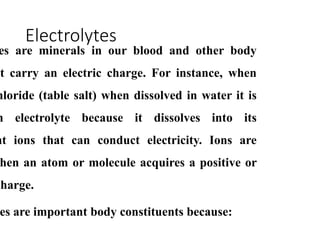
Electrolytes
es are minerals in our blood and other body
at carry an electric charge. For instance, when
hloride (table salt) when dissolved in water it is
n electrolyte because it dissolves into its
nt ions that can conduct electricity. Ions are
hen an atom or molecule acquires a positive or
charge.
es are important body constituents because:
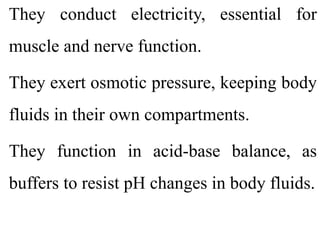
They conduct electricity, essential for
muscle and nerve function.
They exert osmotic pressure, keeping body
fluids in their own compartments.
They function in acid-base balance, as
buffers to resist pH changes in body fluids.
Acid-Base Balance
Acid-Base Balance is a state of having the right amount of acid
and base in the blood and other body fluids.
The number of hydrogen ions present in a solution is a measure
of the acidity of the solution. The maintenance of the normal
hydrogen ion concentration ([H+]) within the body is an
important factor in maintaining a stable environment or
homeostasis.
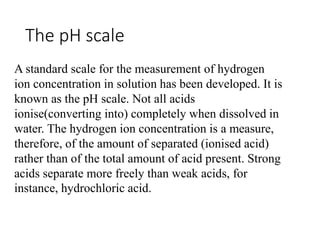
The pH scale
A standard scale for the measurement of hydrogen
ion concentration in solution has been developed. It is
known as the pH scale. Not all acids
ionise(converting into) completely when dissolved in
water. The hydrogen ion concentration is a measure,
therefore, of the amount of separated (ionised acid)
rather than of the total amount of acid present. Strong
acids separate more freely than weak acids, for
instance, hydrochloric acid.
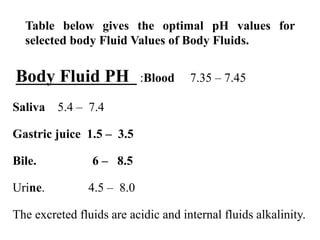
Table below gives the optimal pH values for
selected body Fluid Values of Body Fluids.
Body Fluid PH :Blood 7.35 – 7.45
Saliva 5.4 – 7.4
Gastric juice 1.5 – 3.5
Bile. 6 – 8.5
Urine. 4.5 – 8.0
The excreted fluids are acidic and internal fluids alkalinity.
Blood has a pH value between 7.35
and 7.45. The pH range of blood
which is compatible with life is 7.0 to
7.8. The metabolic activity of body
cells produces certain acids and alkalis
which alter the pH levels of the tissue
fluid and blood. To maintain the pH
within the normal range, certain
substances present in blood act as
buffers
Buffers
The optimum pH level is maintained by the
balance between acids and bases produced by
cells. Bases are substances that accept (or bind)
hydrogen ions and when dissolved in water they
produce an alkaline solution. Buffers are
substances such as phosphates, bicarbonates and
some proteins that maintain hydrogen ions [H+]
within normal, but narrow, limits. Some buffers
'bind' hydrogen ions and others 'bind' hydroxyl
ions, thus reducing their circulating levels and
preventing damaging changes
For example, if sodium hydroxide (NaOH) and
carbonic acid (H2CO3) are present, both will ionise to
some extent, but they will also react together to form
sodium bicarbonate (NaHCO3) and water (H.OH).
From this example, one of the hydrogen ions from the
acid has been 'bound' in the formation of the
bicarbonate radical, while the other has combined with
the hydroxyl radical to form water.
Acidosis refers to increased acidity in the
blood and other body tissues. It occurs when
the pH level falls below 7.35 and all the
reserves of alkaline buffers are used up.
Alkaline reserves are substances in the
complex buffer system that 'bind' hydrogen
ions. When the reverse situation occurs and
the pH rises above 7.45, and the increased
alkali uses up all the acid reserve, and then
alkalosis occurs
SUMMARY
Fluid and electrolyte balance is a dynamic process
that is crucial for life and homeostasis. Potential and
actual disorders of fluid and electrolyte balance occur
in every setting, with every disorder and with a
variety of changes that affect healthy people as well
as those who are ill. The body is equipped with
remarkable homeostatic mechanisms to keep the
composition and volume of fluids and electrolytes
within normal range
ASSIGNMENT
Briefly discuss the hormonal influence on fluid and electrolyte
balance.
Due date is on 22/05/24
Handwritten
REFERENCES
Lewis, et al, (2014), Medical-Surgical Nursing-Assessment and
Management of Clinical Problems, 9th edition, Elsevier, Mosby,
Canada.
Ray. A. H, (1996), Medical-Surgical Nursing, Philadelphia,
Lippincott.
Robbins, et al, (2010), Pathologic Basis of Disease, 8th edition,
Saunders Company, Philadelphia.
Smeltzer, et al, (2010), Brunner and Sudddartth’s text book of
Medical-Surgical Nursing, 12th edition, Lippincott, China.

Body fluids and electrolytes presentation.pptx

  • 1.
  • 2.
    INTRODUCTION • Body Fluidsand Electrolytes • The total body fluid in adults of average build is about 60% of body weight. This proportion is higher in young people and in adults below average weight. It is lower in the elderly and in obese individuals in all age groups. Extracellular water contributes to about 22% of body weight and intracellular water contributes to about 38% of body weight.Oxygen and nutrients must continually be delivered to cells in order for them to accomplish their numerous physiological activities and waste products of metabolism must be continually removed from the cells. Cells are bathed in a fluid environment so that water soluble substances can diffuse in either direction through the cell membrane.
  • 3.
    General Objective: Atthe end of the lecture, students should have an understanding on the fluid and electrolyte balance in the body. Specific objectives: At the end of the lecture, students should: • State the composition of body fluid compartments. • Discuss the intake and output of total body water. • State the components of some electrolytes in the body.
  • 4.
    Body Fluid Compartments Bodyfluid is found in two locations, called compartments. There is the intracellular compartment and the extracellular compartment. The intracellular compartment known as intracellular fluids (ICF) refers to fluids inside the cells and is about 28 litres in volume. The other compartment called the extracellular fluids (ECF) refers to fluids found outside the cell and is about 14 litres in volume. Approximately two thirds of body fluids are in the intracellular space (ICF) compartment and located primarily in the skeletal muscle mass.
  • 5.
    Intracellular fluid compartment Approximately55 % of total body water is located inside the cells and is referred to as Intracellular Fluid. The composition of intracellular fluid (ICF) is largely controlled by the cell itself, because there is selective uptake and discharge mechanisms present in the cell membrane. ICF constitutes about 40% of body mass.Hope you still remember that, intracellular fluid is the fluid found inside the cell.
  • 6.
    Water moves inand out of the cell by osmotic pressure. Osmotic pressure is the attraction of water to electrolytes or solutes. It is the force that pulls fluid from one compartment to another. The level of osmotic pressure remains approximately equal in the ICF and the ECF. If the amount of water in the cell decreases, electrolytes move into the cell prompting water to move into the cell. The opposite happens if there is an increase in water in the cells. Electrolytes move
  • 7.
    composition of ICFcan be very different from that of ECF. For instance, sodium levels are nearly ten times higher in ECF than in ICF. This concentration difference occurs because although sodium diffuses into the cell down its concentration gradient, there is a pump in the membrane which selectively pumps it back out again. This concentration gradient is essential for the function of excitable cells (mainly nerve and muscle). Conversely, many substances are found in significantly higher amounts inside the cell than outside. For instance, Adenosine triphosphate (ATP), protein and potassium. For a healthy man who weighs 70kgs, total body water is about 42 liters, and almost 25 liters is intracellular
  • 8.
    Extracellular fluid compartment Theremaining 45% of body water is located outside the cell membrane and is thus referred to as Extracellular fluid. ECF is further divided into intravascular, interstitial and transcellular. It constitutes 20% of body weight. Extracellular fluid (ECF) consists of blood, plasma, lymph, cerebrospinal fluid and fluid in the interstitial spaces of the body. Interstitial or intercellular fluid (tissue fluid) bathes all the cells of the body except the outer layers of skin. It is the medium through which substances pass from blood to the cells and from the cells to blood.
  • 9.
    The intravascular whichis the fluid within the blood vessels contains plasma, the effective circulating volume. Approximately 3liters of the 6liters of the blood volume is made up of plasma. The remaining 3liters is made up of erythrocytes, leucocytes and thrombocytes. The extracellular fluids are further divided into: Interstitial fluids (ISF): found in the spaces between the cells. They are about 11 litres in volume. Intravascular fluids: made up of blood plasma and lymph fluids. It is about 3 litres in volume. Transcellular fluids: fluids from synovial, peritoneal, pericardial, intraocular spaces, cerebral spinal fluids, pleural and so on.
  • 10.
    The interstitial spacecontains the fluid that surrounds the cells and totals around 11-12liters in an adult. The trancellular is the smallest division of the ECF compartment and contains approximately 1liter. It includes the cerebral spinal fluid (CSF), pericardial, synovial, intraocular and pleural fluid.
  • 11.
    Fluid Balance The bodymaintains its constant internal environment by maintaining the fluid contents. It has the responsibility to balance the fluid gain and fluid loss. If there is an imbalance in the body fluids, disease occurs.
  • 12.
    FLUID GAIN The bodygains fluids from two main sources: Fluids ingested in the form of liquids or water in the food. This normally adds about 2300 ml/day to the body fluids. Fluids which are synthesized in the body as a result of oxidation of carbohydrates, adding about 200 ml/day. This provides a total water intake of about 2500 ml/day. Water intake, however, is highly variable among different people and even within the same person on different days, depending on climate, habits, and level of physical activity. The body therefore gains a total of 2500L/day
  • 13.
    FLUID LOSS The bodyloses fluids in two main ways: sensible and insensible loses. Sensible fluid loss refers to the amount of fluid loss that can easily be measured. Insensible fluid loss refers to fluid loss that cannot be easily measured. The body loses fluids in the following ways: Kidneys, urine (1500mL/day)- sensible Faeces (100mL/day) –sensible Sweat (100mL/day)- sensible Evaporation from skin (500mL/day)-insensible Exhalation from lungs (300mL/day) –insensible It is important to note that fluids are also lost through the skin even when one is not sweating. The body loses a total of 2500mL/day.
  • 14.
    Electrolytes es are mineralsin our blood and other body at carry an electric charge. For instance, when hloride (table salt) when dissolved in water it is n electrolyte because it dissolves into its nt ions that can conduct electricity. Ions are hen an atom or molecule acquires a positive or charge. es are important body constituents because:
  • 15.
    They conduct electricity,essential for muscle and nerve function. They exert osmotic pressure, keeping body fluids in their own compartments. They function in acid-base balance, as buffers to resist pH changes in body fluids.
  • 16.
    Acid-Base Balance Acid-Base Balanceis a state of having the right amount of acid and base in the blood and other body fluids. The number of hydrogen ions present in a solution is a measure of the acidity of the solution. The maintenance of the normal hydrogen ion concentration ([H+]) within the body is an important factor in maintaining a stable environment or homeostasis.
  • 17.
    The pH scale Astandard scale for the measurement of hydrogen ion concentration in solution has been developed. It is known as the pH scale. Not all acids ionise(converting into) completely when dissolved in water. The hydrogen ion concentration is a measure, therefore, of the amount of separated (ionised acid) rather than of the total amount of acid present. Strong acids separate more freely than weak acids, for instance, hydrochloric acid.
  • 18.
    Table below givesthe optimal pH values for selected body Fluid Values of Body Fluids. Body Fluid PH :Blood 7.35 – 7.45 Saliva 5.4 – 7.4 Gastric juice 1.5 – 3.5 Bile. 6 – 8.5 Urine. 4.5 – 8.0 The excreted fluids are acidic and internal fluids alkalinity.
  • 19.
    Blood has apH value between 7.35 and 7.45. The pH range of blood which is compatible with life is 7.0 to 7.8. The metabolic activity of body cells produces certain acids and alkalis which alter the pH levels of the tissue fluid and blood. To maintain the pH within the normal range, certain substances present in blood act as buffers
  • 20.
    Buffers The optimum pHlevel is maintained by the balance between acids and bases produced by cells. Bases are substances that accept (or bind) hydrogen ions and when dissolved in water they produce an alkaline solution. Buffers are substances such as phosphates, bicarbonates and some proteins that maintain hydrogen ions [H+] within normal, but narrow, limits. Some buffers 'bind' hydrogen ions and others 'bind' hydroxyl ions, thus reducing their circulating levels and preventing damaging changes
  • 21.
    For example, ifsodium hydroxide (NaOH) and carbonic acid (H2CO3) are present, both will ionise to some extent, but they will also react together to form sodium bicarbonate (NaHCO3) and water (H.OH). From this example, one of the hydrogen ions from the acid has been 'bound' in the formation of the bicarbonate radical, while the other has combined with the hydroxyl radical to form water.
  • 22.
    Acidosis refers toincreased acidity in the blood and other body tissues. It occurs when the pH level falls below 7.35 and all the reserves of alkaline buffers are used up. Alkaline reserves are substances in the complex buffer system that 'bind' hydrogen ions. When the reverse situation occurs and the pH rises above 7.45, and the increased alkali uses up all the acid reserve, and then alkalosis occurs
  • 23.
    SUMMARY Fluid and electrolytebalance is a dynamic process that is crucial for life and homeostasis. Potential and actual disorders of fluid and electrolyte balance occur in every setting, with every disorder and with a variety of changes that affect healthy people as well as those who are ill. The body is equipped with remarkable homeostatic mechanisms to keep the composition and volume of fluids and electrolytes within normal range
  • 24.
    ASSIGNMENT Briefly discuss thehormonal influence on fluid and electrolyte balance. Due date is on 22/05/24 Handwritten
  • 25.
    REFERENCES Lewis, et al,(2014), Medical-Surgical Nursing-Assessment and Management of Clinical Problems, 9th edition, Elsevier, Mosby, Canada. Ray. A. H, (1996), Medical-Surgical Nursing, Philadelphia, Lippincott. Robbins, et al, (2010), Pathologic Basis of Disease, 8th edition, Saunders Company, Philadelphia. Smeltzer, et al, (2010), Brunner and Sudddartth’s text book of Medical-Surgical Nursing, 12th edition, Lippincott, China.