BLOCK DIAGRAM
http://alltypeim.blogspot.in/
BLOCK DIAGRAM:
o Defination:
1. A block diagram is a pictorial representation
of the entire system.
2. The block diagram represents the
relationship between the input and the
output of the entire system.
http://alltypeim.blogspot.in/
Different terms:
Block diagram:
Output:
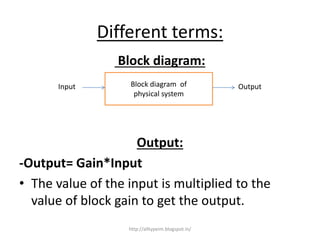
-Output= Gain*Input
• The value of the input is multiplied to the
value of block gain to get the output.
Block diagram of
physical system
OutputInput
http://alltypeim.blogspot.in/
G
R(s)input output
C(s)
Summing point
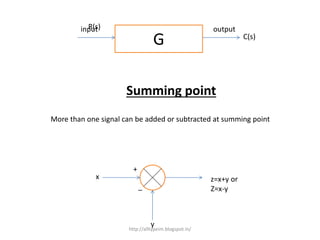
More than one signal can be added or subtracted at summing point
x
y
z=x+y or
Z=x-y
+
_
http://alltypeim.blogspot.in/
Take off point
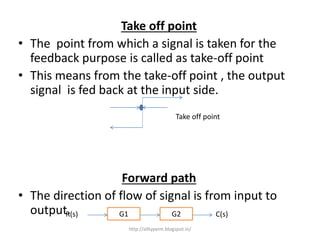
• The point from which a signal is taken for the
feedback purpose is called as take-off point
• This means from the take-off point , the output
signal is fed back at the input side.
Forward path
• The direction of flow of signal is from input to
output.
Take off point
G1 G2R(s) C(s)
http://alltypeim.blogspot.in/
Feedback path
• The direction of flow of signal is from output
to input. It is shown in figure.
GR(S)
+
_
C(S)
Feed back
pathhttp://alltypeim.blogspot.in/
Advantages of block diagram
• The functional operation of the system can be
observed from block diagram.
• Block diagram gives the information about
performance of system.
• Block diagram is used for analysis and design
of control system.
• It is very simple to construct the block diagram
for big and complicated system.
http://alltypeim.blogspot.in/
Disadvantages of block diagram
• Block diagram for a given system is not unique.
• Source of energy in the system is not shown in
the diagram.
• In the procedure of reduction of block diagram
algebra, some important functions may be
omitted or hidden.
• The block diagram does not give any information
about the physical construction of the system.
http://alltypeim.blogspot.in/
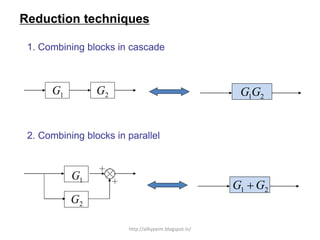
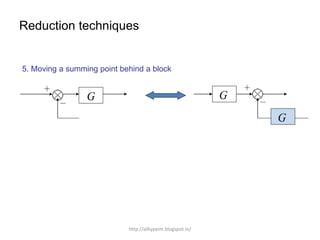
Reduction techniques
2G1G 21GG
1. Combining blocks in cascade
1G
2G
21 GG 
2. Combining blocks in parallel
http://alltypeim.blogspot.in/
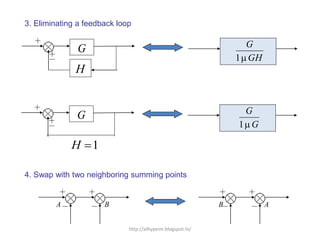
3. Eliminating a feedback loop
G
H
GH
G
1
4. Swap with two neighboring summing points
A B AB
G
1H
G
G
1
http://alltypeim.blogspot.in/
Reduction techniques
5. Moving a summing point behind a block
G G
G
http://alltypeim.blogspot.in/
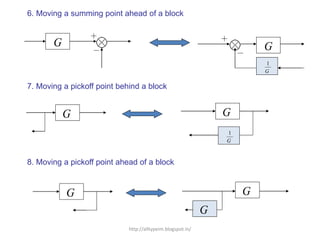
8. Moving a pickoff point ahead of a block
G G
G G
G
1
G
6. Moving a summing point ahead of a block
G G
G
1
7. Moving a pickoff point behind a block
http://alltypeim.blogspot.in/
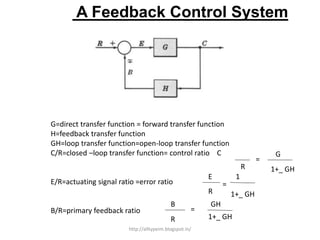
A Feedback Control System
G=direct transfer function = forward transfer function
H=feedback transfer function
GH=loop transfer function=open-loop transfer function
C/R=closed –loop transfer function= control ratio C
E/R=actuating signal ratio =error ratio
B/R=primary feedback ratio
R
R
=
G
1+_ GH
E 1
1+_ GH
B
R
=
=
GH
1+_ GH
http://alltypeim.blogspot.in/
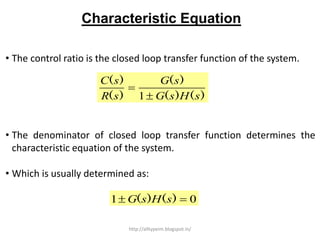
Characteristic Equation
• The control ratio is the closed loop transfer function of the system.
• The denominator of closed loop transfer function determines the
characteristic equation of the system.
• Which is usually determined as:
)()(
)(
)(
)(
sHsG
sG
sR
sC


1
01  )()( sHsG
http://alltypeim.blogspot.in/
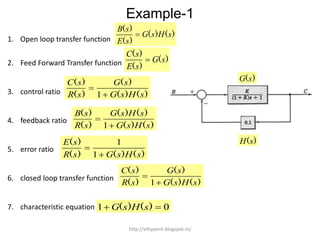
Example-1
1. Open loop transfer function
2. Feed Forward Transfer function
3. control ratio
4. feedback ratio
5. error ratio
6. closed loop transfer function
7. characteristic equation
)()(
)(
)(
sHsG
sE
sB

)(
)(
)(
sG
sE
sC

)()(
)(
)(
)(
sHsG
sG
sR
sC


1
)()(
)()(
)(
)(
sHsG
sHsG
sR
sB


1
)()()(
)(
sHsGsR
sE


1
1
)()(
)(
)(
)(
sHsG
sG
sR
sC


1
01  )()( sHsG
)(sG
)(sH
http://alltypeim.blogspot.in/
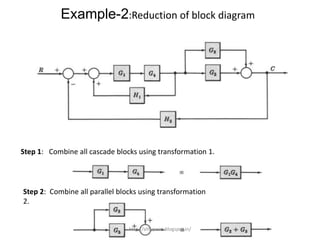
Example-2:Reduction of block diagram
Step 1: Combine all cascade blocks using transformation 1.
Step 2: Combine all parallel blocks using transformation
2.
http://alltypeim.blogspot.in/
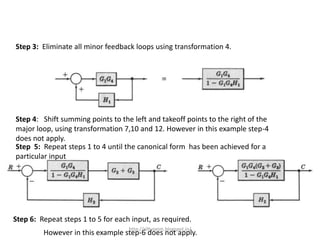
However in this example step-6 does not apply.
Step 3: Eliminate all minor feedback loops using transformation 4.
Step 4: Shift summing points to the left and takeoff points to the right of the
major loop, using transformation 7,10 and 12. However in this example step-4
does not apply.
Step 5: Repeat steps 1 to 4 until the canonical form has been achieved for a
particular input
Step 6: Repeat steps 1 to 5 for each input, as required.
http://alltypeim.blogspot.in/
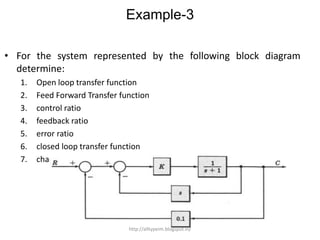
Example-3
• For the system represented by the following block diagram
determine:
1. Open loop transfer function
2. Feed Forward Transfer function
3. control ratio
4. feedback ratio
5. error ratio
6. closed loop transfer function
7. characteristic equation
http://alltypeim.blogspot.in/
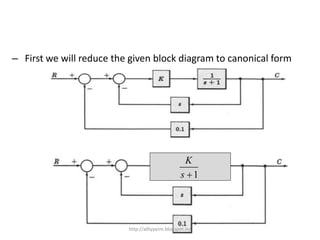
– First we will reduce the given block diagram to canonical form
1s
K
http://alltypeim.blogspot.in/
1s
K
s
s
K
s
K
GH
G
1
1
1
1




http://alltypeim.blogspot.in/
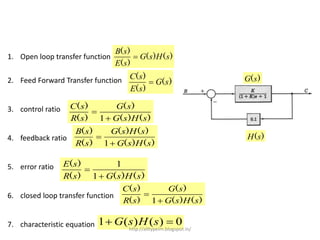
1. Open loop transfer function
2. Feed Forward Transfer function
3. control ratio
4. feedback ratio
5. error ratio
6. closed loop transfer function
7. characteristic equation
)()(
)(
)(
sHsG
sE
sB

)(
)(
)(
sG
sE
sC

)()(
)(
)(
)(
sHsG
sG
sR
sC


1
)()(
)()(
)(
)(
sHsG
sHsG
sR
sB


1
)()()(
)(
sHsGsR
sE


1
1
)()(
)(
)(
)(
sHsG
sG
sR
sC


1
0)()(1  sHsG
)(sG
)(sH
http://alltypeim.blogspot.in/
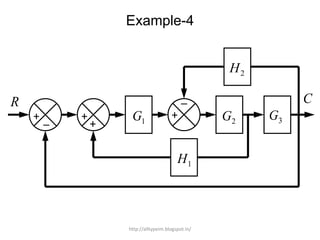
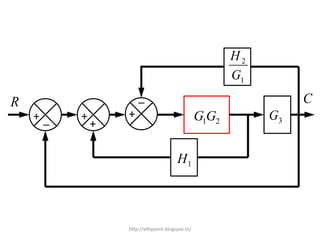
Example-4
R
_+
_
+1G 2G 3G
1H
2H
+
+
C
http://alltypeim.blogspot.in/
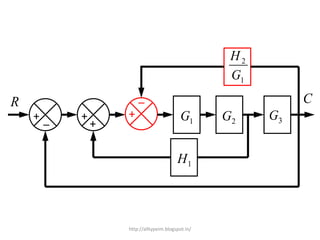
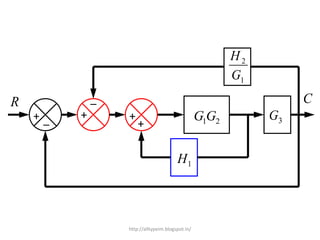
R
_+
_
+ 1G 2G 3G
1H
1
2
G
H
+
+
C
http://alltypeim.blogspot.in/
R
_+
_
+ 21GG 3G
1H
1
2
G
H
+
+
C
http://alltypeim.blogspot.in/
R
_+
_
+ 21GG 3G
1H
1
2
G
H
+
+
C
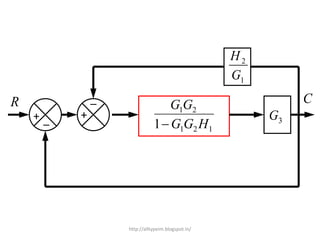
http://alltypeim.blogspot.in/
R
_+
_
+
121
21
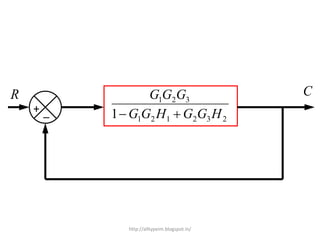
1 HGG
GG
 3G
1
2
G
H
C
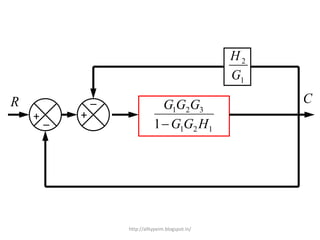
http://alltypeim.blogspot.in/
R
_+
_
+
121
321
1 HGG
GGG

1
2
G
H
C
http://alltypeim.blogspot.in/
R
_+
232121
321
1 HGGHGG
GGG

C
http://alltypeim.blogspot.in/
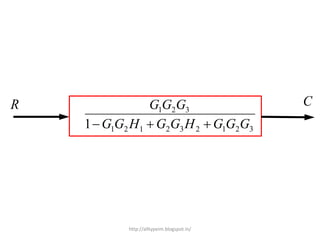
R
321232121
321
1 GGGHGGHGG
GGG

C
http://alltypeim.blogspot.in/
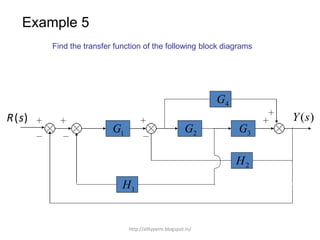
Example 5
Find the transfer function of the following block diagrams
2G 3G1G
4G
1H
2H
)(sY)(sR
http://alltypeim.blogspot.in/
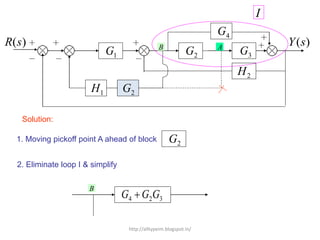
1. Moving pickoff point A ahead of block 2G
2. Eliminate loop I & simplify
324 GGG 
B
1G
2H
)(sY
4G
2G
1H
AB
3G
2G
)(sR
I
Solution:
http://alltypeim.blogspot.in/
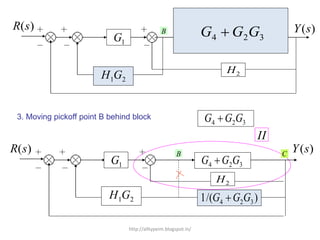
3. Moving pickoff point B behind block
324 GGG 
1G
B
)(sR
21GH 2H
)(sY
)/(1 324 GGG 
II
1G
B
)(sR C
324 GGG 
2H
)(sY
21GH
4G
2G A
3G 324 GGG 
http://alltypeim.blogspot.in/
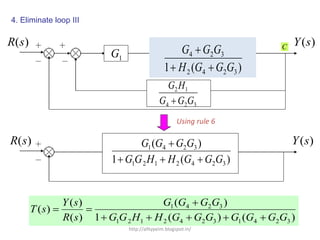
4. Eliminate loop III
)(sR
)(1
)(
3242121
3241
GGGHHGG
GGGG

 )(sY
)()(1
)(
)(
)(
)(
32413242121
3241
GGGGGGGHHGG
GGGG
sR
sY
sT



)(sR
1G
C
324
12
GGG
HG

)(sY
324 GGG 
2H
C
)(1 3242
324
GGGH
GGG


Using rule 6
http://alltypeim.blogspot.in/
……THANK YOU……

http://alltypeim.blogspot.in/

Block diagram

  • 1.
  • 2.
    BLOCK DIAGRAM: o Defination: 1.A block diagram is a pictorial representation of the entire system. 2. The block diagram represents the relationship between the input and the output of the entire system. http://alltypeim.blogspot.in/
  • 3.
    Different terms: Block diagram: Output: -Output=Gain*Input • The value of the input is multiplied to the value of block gain to get the output. Block diagram of physical system OutputInput http://alltypeim.blogspot.in/
  • 4.
    G R(s)input output C(s) Summing point Morethan one signal can be added or subtracted at summing point x y z=x+y or Z=x-y + _ http://alltypeim.blogspot.in/
  • 5.
    Take off point •The point from which a signal is taken for the feedback purpose is called as take-off point • This means from the take-off point , the output signal is fed back at the input side. Forward path • The direction of flow of signal is from input to output. Take off point G1 G2R(s) C(s) http://alltypeim.blogspot.in/
  • 6.
    Feedback path • Thedirection of flow of signal is from output to input. It is shown in figure. GR(S) + _ C(S) Feed back pathhttp://alltypeim.blogspot.in/
  • 7.
    Advantages of blockdiagram • The functional operation of the system can be observed from block diagram. • Block diagram gives the information about performance of system. • Block diagram is used for analysis and design of control system. • It is very simple to construct the block diagram for big and complicated system. http://alltypeim.blogspot.in/
  • 8.
    Disadvantages of blockdiagram • Block diagram for a given system is not unique. • Source of energy in the system is not shown in the diagram. • In the procedure of reduction of block diagram algebra, some important functions may be omitted or hidden. • The block diagram does not give any information about the physical construction of the system. http://alltypeim.blogspot.in/
  • 9.
    Reduction techniques 2G1G 21GG 1.Combining blocks in cascade 1G 2G 21 GG  2. Combining blocks in parallel http://alltypeim.blogspot.in/
  • 10.
    3. Eliminating afeedback loop G H GH G 1 4. Swap with two neighboring summing points A B AB G 1H G G 1 http://alltypeim.blogspot.in/
  • 11.
    Reduction techniques 5. Movinga summing point behind a block G G G http://alltypeim.blogspot.in/
  • 12.
    8. Moving apickoff point ahead of a block G G G G G 1 G 6. Moving a summing point ahead of a block G G G 1 7. Moving a pickoff point behind a block http://alltypeim.blogspot.in/
  • 13.
    A Feedback ControlSystem G=direct transfer function = forward transfer function H=feedback transfer function GH=loop transfer function=open-loop transfer function C/R=closed –loop transfer function= control ratio C E/R=actuating signal ratio =error ratio B/R=primary feedback ratio R R = G 1+_ GH E 1 1+_ GH B R = = GH 1+_ GH http://alltypeim.blogspot.in/
  • 14.
    Characteristic Equation • Thecontrol ratio is the closed loop transfer function of the system. • The denominator of closed loop transfer function determines the characteristic equation of the system. • Which is usually determined as: )()( )( )( )( sHsG sG sR sC   1 01  )()( sHsG http://alltypeim.blogspot.in/
  • 15.
    Example-1 1. Open looptransfer function 2. Feed Forward Transfer function 3. control ratio 4. feedback ratio 5. error ratio 6. closed loop transfer function 7. characteristic equation )()( )( )( sHsG sE sB  )( )( )( sG sE sC  )()( )( )( )( sHsG sG sR sC   1 )()( )()( )( )( sHsG sHsG sR sB   1 )()()( )( sHsGsR sE   1 1 )()( )( )( )( sHsG sG sR sC   1 01  )()( sHsG )(sG )(sH http://alltypeim.blogspot.in/
  • 16.
    Example-2:Reduction of blockdiagram Step 1: Combine all cascade blocks using transformation 1. Step 2: Combine all parallel blocks using transformation 2. http://alltypeim.blogspot.in/
  • 17.
    However in thisexample step-6 does not apply. Step 3: Eliminate all minor feedback loops using transformation 4. Step 4: Shift summing points to the left and takeoff points to the right of the major loop, using transformation 7,10 and 12. However in this example step-4 does not apply. Step 5: Repeat steps 1 to 4 until the canonical form has been achieved for a particular input Step 6: Repeat steps 1 to 5 for each input, as required. http://alltypeim.blogspot.in/
  • 18.
    Example-3 • For thesystem represented by the following block diagram determine: 1. Open loop transfer function 2. Feed Forward Transfer function 3. control ratio 4. feedback ratio 5. error ratio 6. closed loop transfer function 7. characteristic equation http://alltypeim.blogspot.in/
  • 19.
    – First wewill reduce the given block diagram to canonical form 1s K http://alltypeim.blogspot.in/
  • 20.
  • 21.
    1. Open looptransfer function 2. Feed Forward Transfer function 3. control ratio 4. feedback ratio 5. error ratio 6. closed loop transfer function 7. characteristic equation )()( )( )( sHsG sE sB  )( )( )( sG sE sC  )()( )( )( )( sHsG sG sR sC   1 )()( )()( )( )( sHsG sHsG sR sB   1 )()()( )( sHsGsR sE   1 1 )()( )( )( )( sHsG sG sR sC   1 0)()(1  sHsG )(sG )(sH http://alltypeim.blogspot.in/
  • 22.
  • 23.
    R _+ _ + 1G 2G3G 1H 1 2 G H + + C http://alltypeim.blogspot.in/
  • 24.
  • 25.
  • 26.
  • 27.
  • 28.
  • 29.
  • 30.
    Example 5 Find thetransfer function of the following block diagrams 2G 3G1G 4G 1H 2H )(sY)(sR http://alltypeim.blogspot.in/
  • 31.
    1. Moving pickoffpoint A ahead of block 2G 2. Eliminate loop I & simplify 324 GGG  B 1G 2H )(sY 4G 2G 1H AB 3G 2G )(sR I Solution: http://alltypeim.blogspot.in/
  • 32.
    3. Moving pickoffpoint B behind block 324 GGG  1G B )(sR 21GH 2H )(sY )/(1 324 GGG  II 1G B )(sR C 324 GGG  2H )(sY 21GH 4G 2G A 3G 324 GGG  http://alltypeim.blogspot.in/
  • 33.
    4. Eliminate loopIII )(sR )(1 )( 3242121 3241 GGGHHGG GGGG   )(sY )()(1 )( )( )( )( 32413242121 3241 GGGGGGGHHGG GGGG sR sY sT    )(sR 1G C 324 12 GGG HG  )(sY 324 GGG  2H C )(1 3242 324 GGGH GGG   Using rule 6 http://alltypeim.blogspot.in/
  • 34.