CONTROL SYSTEMS
THEORY
Transient response stability
CHAPTER 5
STB 35103
Objective
 To

determine the stability of a system
represented as a transfer function.
Introduction


In chapter 1, we learnt about 3
requirements needed when designing a
control system




Transient response
Stability
Steady-state errors
Introduction


What is stability?







Most important system specification.
We cannot use a control system if the system
is unstable
Stability is subjective

From Chapter 1, we have learned that we
can control the output of a system if the
steady-state response consists of only the
forced response. But the total response,
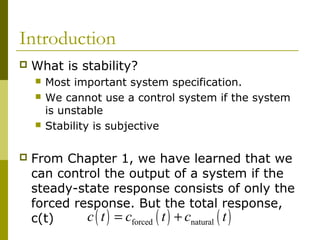
c ( t ) = cforced ( t ) + cnatural ( t )
c(t)
Introduction


Using this concept we can summarize the
definitions for linear, time-invariant
systems.



Using natural response;






A system is stable if the natural response
approaches zero as time approaches infinity.
A system is unstable if the natural response
approaches infinity as time approaches infinity.
A system is marginally stable if the natural
response neither decays nor grows but remains
constant or oscillates.
Introduction


A system is stable if every bounded input
yields a bounded output. (bounded =
terkawal). We call this statement the
bounded-input, bounded-output (BIBO).



Using the total response (BIBO)




A system is stable if every bounded input
yields a bounded output.
A system is unstable if any bounded input
yields an unbounded output.
Introduction


We can also determine the stability of a
system based on the system poles.






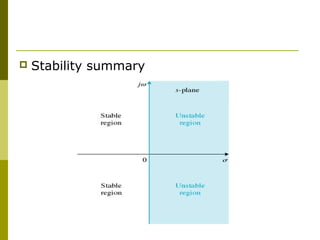
Stable systems have closed-loop transfer
functions with poles only in the left half-plane.
Unstable systems have closed-loop transfer
functions with at least one pole in the right
half-plane and/or poles of multiplicity greater
than 1 on the imaginary axis.
Marginally stable systems have closed-loop
transfer functions with only imaginary axis
poles of multiplicity 1 and poles in the left halfplane.
Introduction


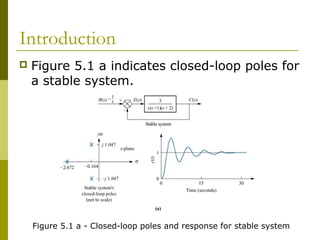
Figure 5.1 a indicates closed-loop poles for
a stable system.

Figure 5.1 a - Closed-loop poles and response for stable system
Introduction


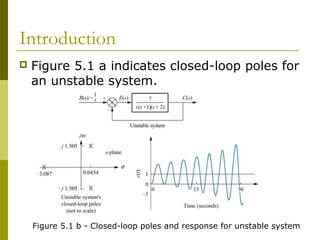
Figure 5.1 a indicates closed-loop poles for
an unstable system.

Figure 5.1 b - Closed-loop poles and response for unstable system


Stability summary
Introduction


In order for us to know the stability of our
system we need to draw the system poles.
To find the poles we need to calculate the
roots of the system polynomials.



Try to get the system poles for the
systems in Figure 5.1 a and Figure 5.1 b.
Introduction


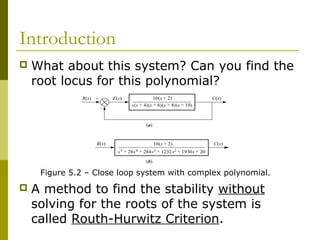
What about this system? Can you find the
root locus for this polynomial?

Figure 5.2 – Close loop system with complex polynomial.



A method to find the stability without
solving for the roots of the system is
called Routh-Hurwitz Criterion.
Routh-Hurwitz Criterion
We can use Routh-Hurwitz criterion
method to find how many closed-loop
system poles are in the LHP, RHP and on
the jω-axis
 Disadvantage : We cannot find their
coordinates
 The method requires two steps:





Generate a data table called a Routh table
Interpret the Routh table to tell how many
close-loop system poles are in the left halfplane, the right half-plane, and on the jω-axis
Routh-Hurwitz Criterion


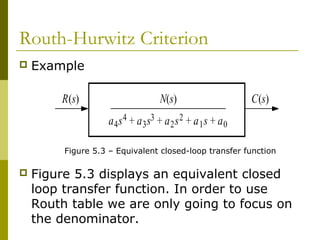
Example

Figure 5.3 – Equivalent closed-loop transfer function



Figure 5.3 displays an equivalent closed
loop transfer function. In order to use
Routh table we are only going to focus on
the denominator.
Routh-Hurwitz Criterion


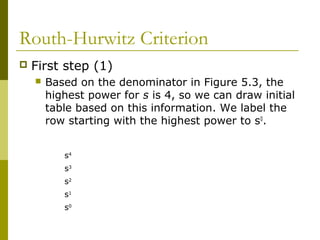
First step (1)


Based on the denominator in Figure 5.3, the
highest power for s is 4, so we can draw initial
table based on this information. We label the
row starting with the highest power to s0.
s4
s3
s2
s1
s0
Routh-Hurwitz Criterion


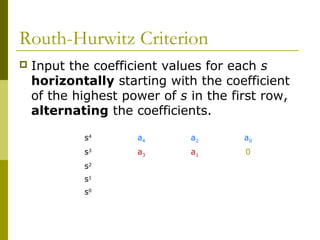
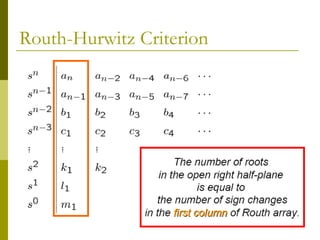
Input the coefficient values for each s
horizontally starting with the coefficient
of the highest power of s in the first row,
alternating the coefficients.
s4

a4

a2

a0

s3

a3

a1

0

s2
s1
s0
Routh-Hurwitz Criterion


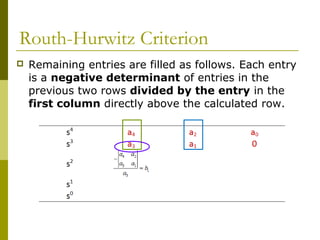
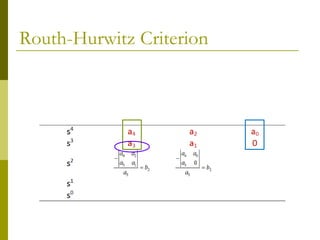
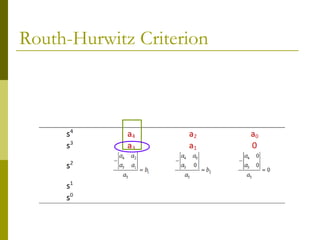
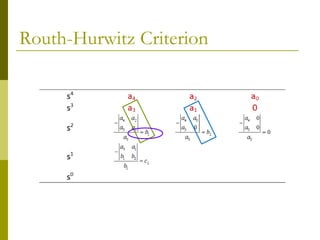
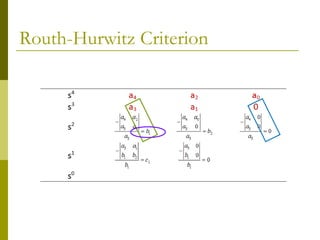
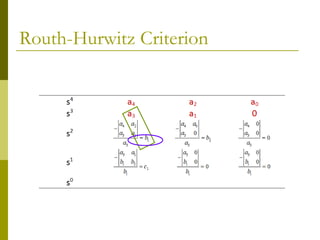
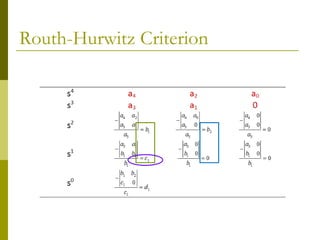
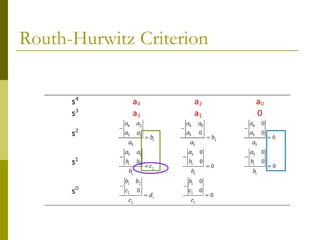
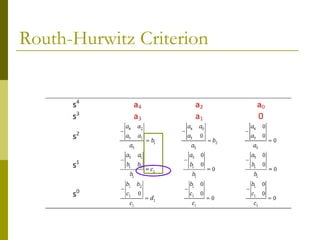
Remaining entries are filled as follows. Each entry
is a negative determinant of entries in the
previous two rows divided by the entry in the
first column directly above the calculated row.
Routh-Hurwitz Criterion


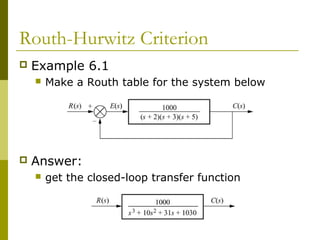
Example 6.1




Make a Routh table for the system below

Answer:


get the closed-loop transfer function
Routh-Hurwitz Criterion


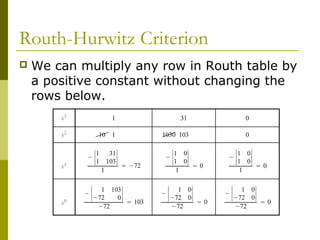
We can multiply any row in Routh table by
a positive constant without changing the
rows below.
Routh-Hurwitz Criterion


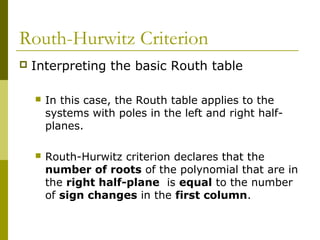
Interpreting the basic Routh table


In this case, the Routh table applies to the
systems with poles in the left and right halfplanes.



Routh-Hurwitz criterion declares that the
number of roots of the polynomial that are in
the right half-plane is equal to the number
of sign changes in the first column.
Routh-Hurwitz Criterion




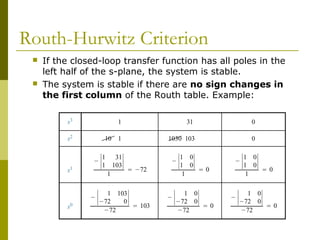
If the closed-loop transfer function has all poles in the
left half of the s-plane, the system is stable.
The system is stable if there are no sign changes in
the first column of the Routh table. Example:
Routh-Hurwitz Criterion
+
+


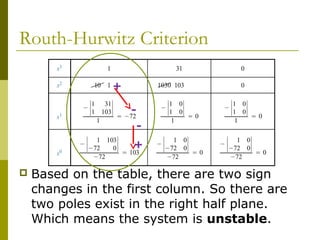
Based on the table, there are two sign
changes in the first column. So there are
two poles exist in the right half plane.
Which means the system is unstable.
Routh-Hurwitz Criterion


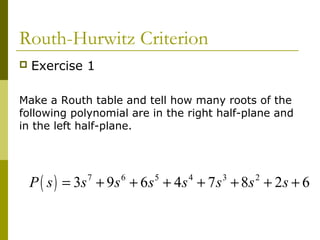
Exercise 1

Make a Routh table and tell how many roots of the
following polynomial are in the right half-plane and
in the left half-plane.

P ( s ) = 3s + 9s + 6s + 4s + 7 s + 8s + 2s + 6
7

6

5

4

3

2
Routh-Hurwitz Criterion
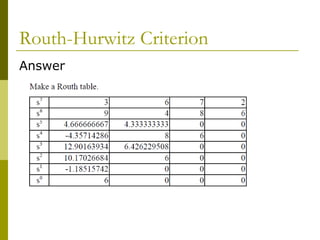
Answer
Routh-Hurwitz Criterion
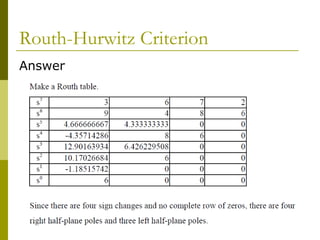
Answer
Routh Hurwitz


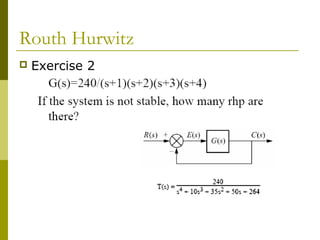
Exercise 2
Routh Hurwitz


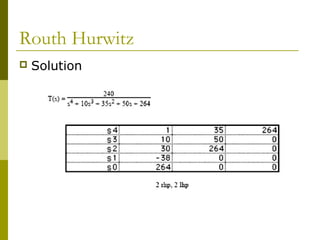
Solution
Routh Hurwitz


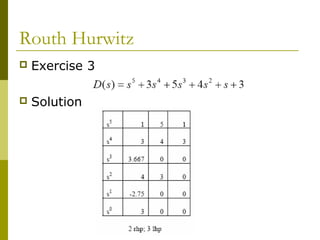
Exercise 3



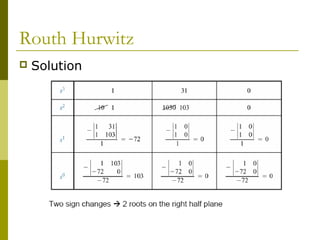
Solution
Routh Hurwitz


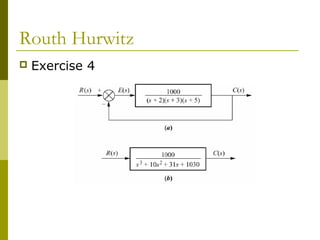
Exercise 4
Routh Hurwitz


Solution
Routh-Hurwitz Criterion: Special cases


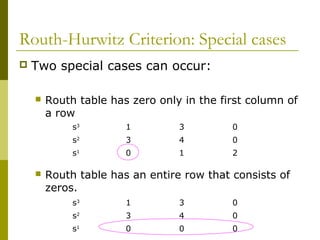
Two special cases can occur:


Routh table has zero only in the first column of
a row
s3

3

0

s2

3

4

0

s1


1
0

1

2

Routh table has an entire row that consists of
zeros.
s3

1

3

0

s2

3

4

0

s1

0

0

0
Routh-Hurwitz Criterion: Special cases


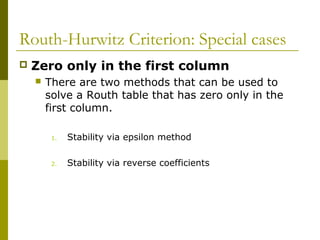
Zero only in the first column


There are two methods that can be used to
solve a Routh table that has zero only in the
first column.
1.

Stability via epsilon method

2.

Stability via reverse coefficients
Routh-Hurwitz Criterion: Special cases


Zero only in the first column


Stability via epsilon method

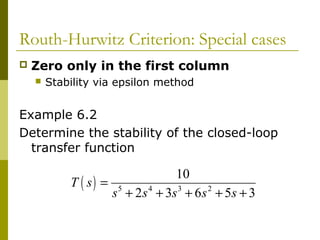
Example 6.2
Determine the stability of the closed-loop
transfer function

10
T ( s) = 5
s + 2 s 4 + 3s 3 + 6 s 2 + 5s + 3
Routh-Hurwitz Criterion: Special cases
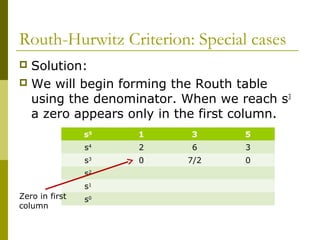
Solution:
 We will begin forming the Routh table
using the denominator. When we reach s3
a zero appears only in the first column.


s5

1

3

5

s4

2

6

3

s3

0

7/2

0

s2
s1
Zero in first
column

s0
Routh-Hurwitz Criterion: Special cases
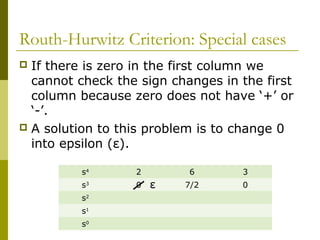
If there is zero in the first column we
cannot check the sign changes in the first
column because zero does not have ‘+’ or
‘-’.
 A solution to this problem is to change 0
into epsilon (ε).


s5

1

3

5

s4

2

6

3

s3

0

7/2

0

s2
s1
s0

ε
Routh-Hurwitz Criterion: Special cases


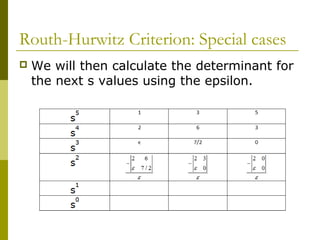
We will then calculate the determinant for
the next s values using the epsilon.
Routh-Hurwitz Criterion: Special cases
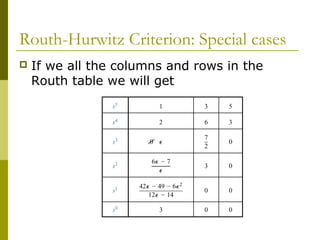


If we all the columns and rows in the
Routh table we will get
Routh-Hurwitz Criterion: Special cases


We can find the number of poles on the
right half plane based on the sign changes
in the first column. We can assume ε as
‘+’ or ‘-’
Routh-Hurwitz Criterion: Special cases


There are two sign changes so there are
two poles on the right half plane. Thus the
system is unstable.
Routh-Hurwitz Criterion: Special cases


Zero only in the first column


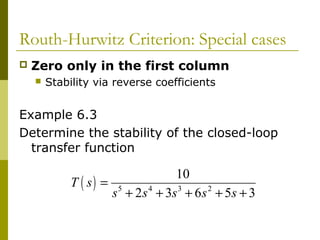
Stability via reverse coefficients

Example 6.3
Determine the stability of the closed-loop
transfer function

10
T ( s) = 5
s + 2 s 4 + 3s 3 + 6 s 2 + 5s + 3
Routh-Hurwitz Criterion: Special cases
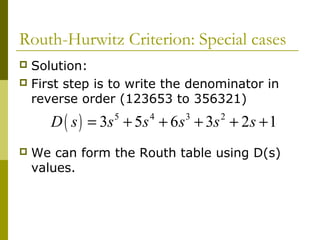
Solution:
 First step is to write the denominator in
reverse order (123653 to 356321)


D ( s ) = 3s + 5s + 6 s + 3s + 2s + 1
5



4

3

2

We can form the Routh table using D(s)
values.
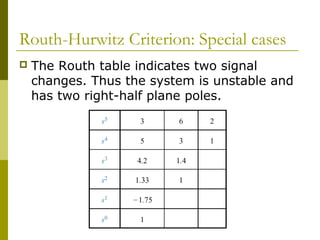
Routh-Hurwitz Criterion: Special cases


The Routh table indicates two signal
changes. Thus the system is unstable and
has two right-half plane poles.
Routh-Hurwitz Criterion: Special cases


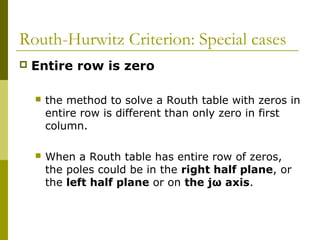
Entire row is zero


the method to solve a Routh table with zeros in
entire row is different than only zero in first
column.



When a Routh table has entire row of zeros,
the poles could be in the right half plane, or
the left half plane or on the jω axis.
Routh-Hurwitz Criterion: Special cases


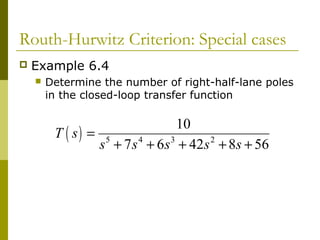
Example 6.4


Determine the number of right-half-lane poles
in the closed-loop transfer function

10
T ( s) = 5
s + 7 s 4 + 6s 3 + 42s 2 + 8s + 56
Routh-Hurwitz Criterion: Special cases
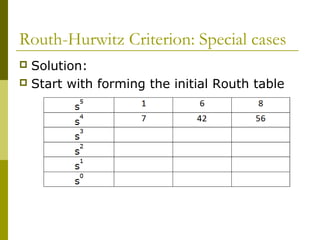
Solution:
 Start with forming the initial Routh table

Routh-Hurwitz Criterion: Special cases


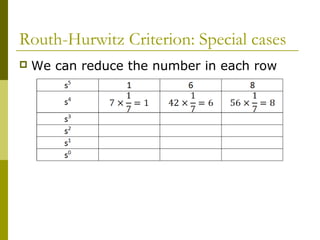
We can reduce the number in each row
Routh-Hurwitz Criterion: Special cases


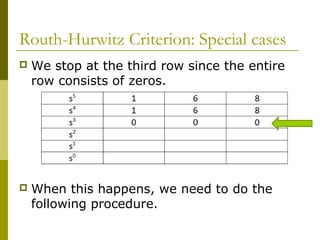
We stop at the third row since the entire
row consists of zeros.



When this happens, we need to do the
following procedure.
Routh-Hurwitz Criterion: Special cases
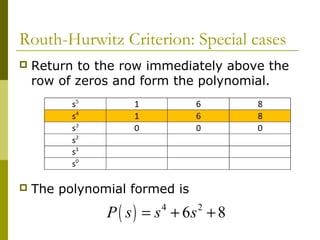


Return to the row immediately above the
row of zeros and form the polynomial.



The polynomial formed is

P ( s ) = s + 6s + 8
4

2
Routh-Hurwitz Criterion: Special cases


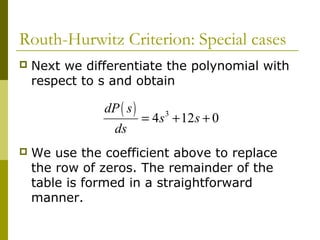
Next we differentiate the polynomial with
respect to s and obtain

dP ( s )
ds


= 4 s 3 + 12 s + 0

We use the coefficient above to replace
the row of zeros. The remainder of the
table is formed in a straightforward
manner.
Routh-Hurwitz Criterion: Special cases


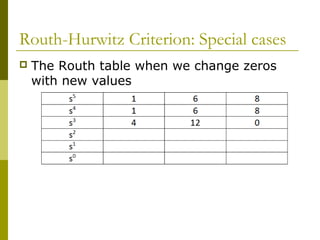
The Routh table when we change zeros
with new values
Routh-Hurwitz Criterion: Special cases


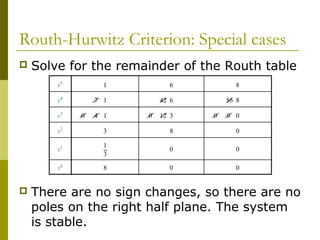
Solve for the remainder of the Routh table



There are no sign changes, so there are no
poles on the right half plane. The system
is stable.
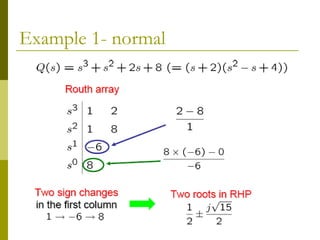
Example 1- normal
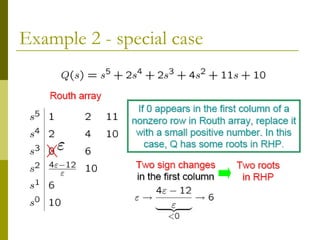
Example 2 - special case
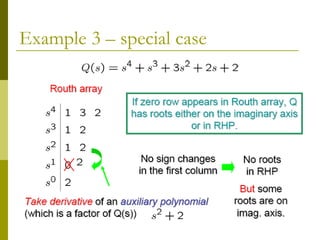
Example 3 – special case
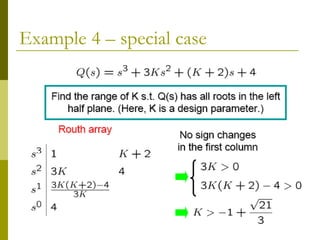
Example 4 – special case
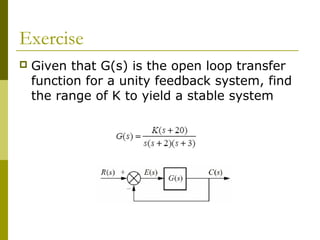
Exercise


Given that G(s) is the open loop transfer
function for a unity feedback system, find
the range of K to yield a stable system


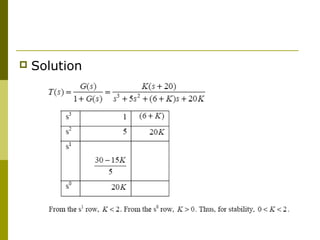
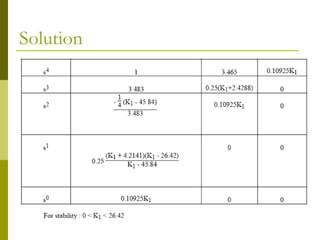
Solution
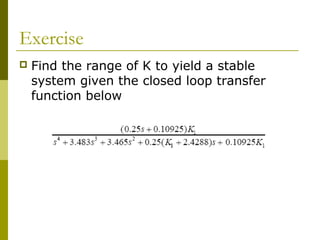
Exercise


Find the range of K to yield a stable
system given the closed loop transfer
function below
Solution

Control chap5

  • 1.
    CONTROL SYSTEMS THEORY Transient responsestability CHAPTER 5 STB 35103
  • 2.
    Objective  To determine thestability of a system represented as a transfer function.
  • 3.
    Introduction  In chapter 1,we learnt about 3 requirements needed when designing a control system    Transient response Stability Steady-state errors
  • 4.
    Introduction  What is stability?     Mostimportant system specification. We cannot use a control system if the system is unstable Stability is subjective From Chapter 1, we have learned that we can control the output of a system if the steady-state response consists of only the forced response. But the total response, c ( t ) = cforced ( t ) + cnatural ( t ) c(t)
  • 5.
    Introduction  Using this conceptwe can summarize the definitions for linear, time-invariant systems.  Using natural response;    A system is stable if the natural response approaches zero as time approaches infinity. A system is unstable if the natural response approaches infinity as time approaches infinity. A system is marginally stable if the natural response neither decays nor grows but remains constant or oscillates.
  • 6.
    Introduction  A system isstable if every bounded input yields a bounded output. (bounded = terkawal). We call this statement the bounded-input, bounded-output (BIBO).  Using the total response (BIBO)   A system is stable if every bounded input yields a bounded output. A system is unstable if any bounded input yields an unbounded output.
  • 7.
    Introduction  We can alsodetermine the stability of a system based on the system poles.    Stable systems have closed-loop transfer functions with poles only in the left half-plane. Unstable systems have closed-loop transfer functions with at least one pole in the right half-plane and/or poles of multiplicity greater than 1 on the imaginary axis. Marginally stable systems have closed-loop transfer functions with only imaginary axis poles of multiplicity 1 and poles in the left halfplane.
  • 8.
    Introduction  Figure 5.1 aindicates closed-loop poles for a stable system. Figure 5.1 a - Closed-loop poles and response for stable system
  • 9.
    Introduction  Figure 5.1 aindicates closed-loop poles for an unstable system. Figure 5.1 b - Closed-loop poles and response for unstable system
  • 10.
  • 11.
    Introduction  In order forus to know the stability of our system we need to draw the system poles. To find the poles we need to calculate the roots of the system polynomials.  Try to get the system poles for the systems in Figure 5.1 a and Figure 5.1 b.
  • 12.
    Introduction  What about thissystem? Can you find the root locus for this polynomial? Figure 5.2 – Close loop system with complex polynomial.  A method to find the stability without solving for the roots of the system is called Routh-Hurwitz Criterion.
  • 13.
    Routh-Hurwitz Criterion We canuse Routh-Hurwitz criterion method to find how many closed-loop system poles are in the LHP, RHP and on the jω-axis  Disadvantage : We cannot find their coordinates  The method requires two steps:    Generate a data table called a Routh table Interpret the Routh table to tell how many close-loop system poles are in the left halfplane, the right half-plane, and on the jω-axis
  • 14.
    Routh-Hurwitz Criterion  Example Figure 5.3– Equivalent closed-loop transfer function  Figure 5.3 displays an equivalent closed loop transfer function. In order to use Routh table we are only going to focus on the denominator.
  • 15.
    Routh-Hurwitz Criterion  First step(1)  Based on the denominator in Figure 5.3, the highest power for s is 4, so we can draw initial table based on this information. We label the row starting with the highest power to s0. s4 s3 s2 s1 s0
  • 16.
    Routh-Hurwitz Criterion  Input thecoefficient values for each s horizontally starting with the coefficient of the highest power of s in the first row, alternating the coefficients. s4 a4 a2 a0 s3 a3 a1 0 s2 s1 s0
  • 17.
    Routh-Hurwitz Criterion  Remaining entriesare filled as follows. Each entry is a negative determinant of entries in the previous two rows divided by the entry in the first column directly above the calculated row.
  • 18.
  • 19.
  • 20.
  • 21.
  • 22.
  • 23.
  • 24.
  • 25.
  • 26.
    Routh-Hurwitz Criterion  Example 6.1   Makea Routh table for the system below Answer:  get the closed-loop transfer function
  • 27.
    Routh-Hurwitz Criterion  We canmultiply any row in Routh table by a positive constant without changing the rows below.
  • 28.
    Routh-Hurwitz Criterion  Interpreting thebasic Routh table  In this case, the Routh table applies to the systems with poles in the left and right halfplanes.  Routh-Hurwitz criterion declares that the number of roots of the polynomial that are in the right half-plane is equal to the number of sign changes in the first column.
  • 29.
  • 30.
    Routh-Hurwitz Criterion   If theclosed-loop transfer function has all poles in the left half of the s-plane, the system is stable. The system is stable if there are no sign changes in the first column of the Routh table. Example:
  • 31.
    Routh-Hurwitz Criterion + +  Based onthe table, there are two sign changes in the first column. So there are two poles exist in the right half plane. Which means the system is unstable.
  • 32.
    Routh-Hurwitz Criterion  Exercise 1 Makea Routh table and tell how many roots of the following polynomial are in the right half-plane and in the left half-plane. P ( s ) = 3s + 9s + 6s + 4s + 7 s + 8s + 2s + 6 7 6 5 4 3 2
  • 33.
  • 34.
  • 35.
  • 36.
  • 37.
  • 38.
  • 39.
  • 40.
    Routh-Hurwitz Criterion: Specialcases  Two special cases can occur:  Routh table has zero only in the first column of a row s3 3 0 s2 3 4 0 s1  1 0 1 2 Routh table has an entire row that consists of zeros. s3 1 3 0 s2 3 4 0 s1 0 0 0
  • 41.
    Routh-Hurwitz Criterion: Specialcases  Zero only in the first column  There are two methods that can be used to solve a Routh table that has zero only in the first column. 1. Stability via epsilon method 2. Stability via reverse coefficients
  • 42.
    Routh-Hurwitz Criterion: Specialcases  Zero only in the first column  Stability via epsilon method Example 6.2 Determine the stability of the closed-loop transfer function 10 T ( s) = 5 s + 2 s 4 + 3s 3 + 6 s 2 + 5s + 3
  • 43.
    Routh-Hurwitz Criterion: Specialcases Solution:  We will begin forming the Routh table using the denominator. When we reach s3 a zero appears only in the first column.  s5 1 3 5 s4 2 6 3 s3 0 7/2 0 s2 s1 Zero in first column s0
  • 44.
    Routh-Hurwitz Criterion: Specialcases If there is zero in the first column we cannot check the sign changes in the first column because zero does not have ‘+’ or ‘-’.  A solution to this problem is to change 0 into epsilon (ε).  s5 1 3 5 s4 2 6 3 s3 0 7/2 0 s2 s1 s0 ε
  • 45.
    Routh-Hurwitz Criterion: Specialcases  We will then calculate the determinant for the next s values using the epsilon.
  • 46.
    Routh-Hurwitz Criterion: Specialcases  If we all the columns and rows in the Routh table we will get
  • 47.
    Routh-Hurwitz Criterion: Specialcases  We can find the number of poles on the right half plane based on the sign changes in the first column. We can assume ε as ‘+’ or ‘-’
  • 48.
    Routh-Hurwitz Criterion: Specialcases  There are two sign changes so there are two poles on the right half plane. Thus the system is unstable.
  • 49.
    Routh-Hurwitz Criterion: Specialcases  Zero only in the first column  Stability via reverse coefficients Example 6.3 Determine the stability of the closed-loop transfer function 10 T ( s) = 5 s + 2 s 4 + 3s 3 + 6 s 2 + 5s + 3
  • 50.
    Routh-Hurwitz Criterion: Specialcases Solution:  First step is to write the denominator in reverse order (123653 to 356321)  D ( s ) = 3s + 5s + 6 s + 3s + 2s + 1 5  4 3 2 We can form the Routh table using D(s) values.
  • 51.
    Routh-Hurwitz Criterion: Specialcases  The Routh table indicates two signal changes. Thus the system is unstable and has two right-half plane poles.
  • 52.
    Routh-Hurwitz Criterion: Specialcases  Entire row is zero  the method to solve a Routh table with zeros in entire row is different than only zero in first column.  When a Routh table has entire row of zeros, the poles could be in the right half plane, or the left half plane or on the jω axis.
  • 53.
    Routh-Hurwitz Criterion: Specialcases  Example 6.4  Determine the number of right-half-lane poles in the closed-loop transfer function 10 T ( s) = 5 s + 7 s 4 + 6s 3 + 42s 2 + 8s + 56
  • 54.
    Routh-Hurwitz Criterion: Specialcases Solution:  Start with forming the initial Routh table 
  • 55.
    Routh-Hurwitz Criterion: Specialcases  We can reduce the number in each row
  • 56.
    Routh-Hurwitz Criterion: Specialcases  We stop at the third row since the entire row consists of zeros.  When this happens, we need to do the following procedure.
  • 57.
    Routh-Hurwitz Criterion: Specialcases  Return to the row immediately above the row of zeros and form the polynomial.  The polynomial formed is P ( s ) = s + 6s + 8 4 2
  • 58.
    Routh-Hurwitz Criterion: Specialcases  Next we differentiate the polynomial with respect to s and obtain dP ( s ) ds  = 4 s 3 + 12 s + 0 We use the coefficient above to replace the row of zeros. The remainder of the table is formed in a straightforward manner.
  • 59.
    Routh-Hurwitz Criterion: Specialcases  The Routh table when we change zeros with new values
  • 60.
    Routh-Hurwitz Criterion: Specialcases  Solve for the remainder of the Routh table  There are no sign changes, so there are no poles on the right half plane. The system is stable.
  • 61.
  • 62.
    Example 2 -special case
  • 63.
    Example 3 –special case
  • 64.
    Example 4 –special case
  • 65.
    Exercise  Given that G(s)is the open loop transfer function for a unity feedback system, find the range of K to yield a stable system
  • 66.
  • 67.
    Exercise  Find the rangeof K to yield a stable system given the closed loop transfer function below
  • 68.