BLOCK DIAGRAM
PRESENTED BY:
17ME02 17ME03 17ME04
SUBMITTED TO: DR. DUR MUHAMMAD PATHAN
BLOCK DIAGRAM
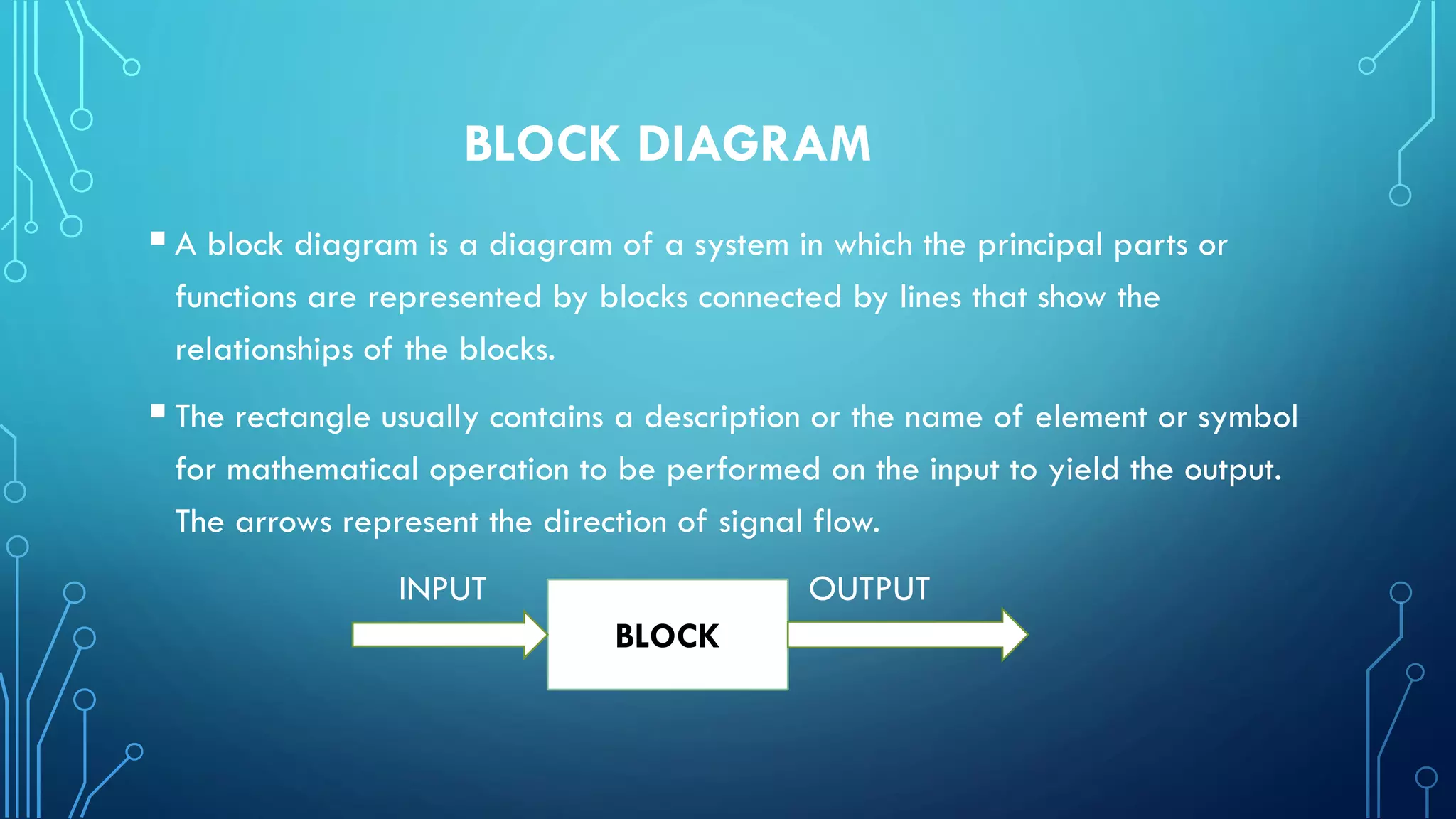
▪A block diagram is a diagram of a system in which the principal parts or
functions are represented by blocks connected by lines that show the
relationships of the blocks.
▪The rectangle usually contains a description or the name of element or symbol
for mathematical operation to be performed on the input to yield the output.
The arrows represent the direction of signal flow.
INPUT OUTPUT
BLOCK
▪ Many systems are composed of multiple sub systems hence a few more
schematic elements must be added to the Block Diagram. These new elements
are summing junctions and pick off points.
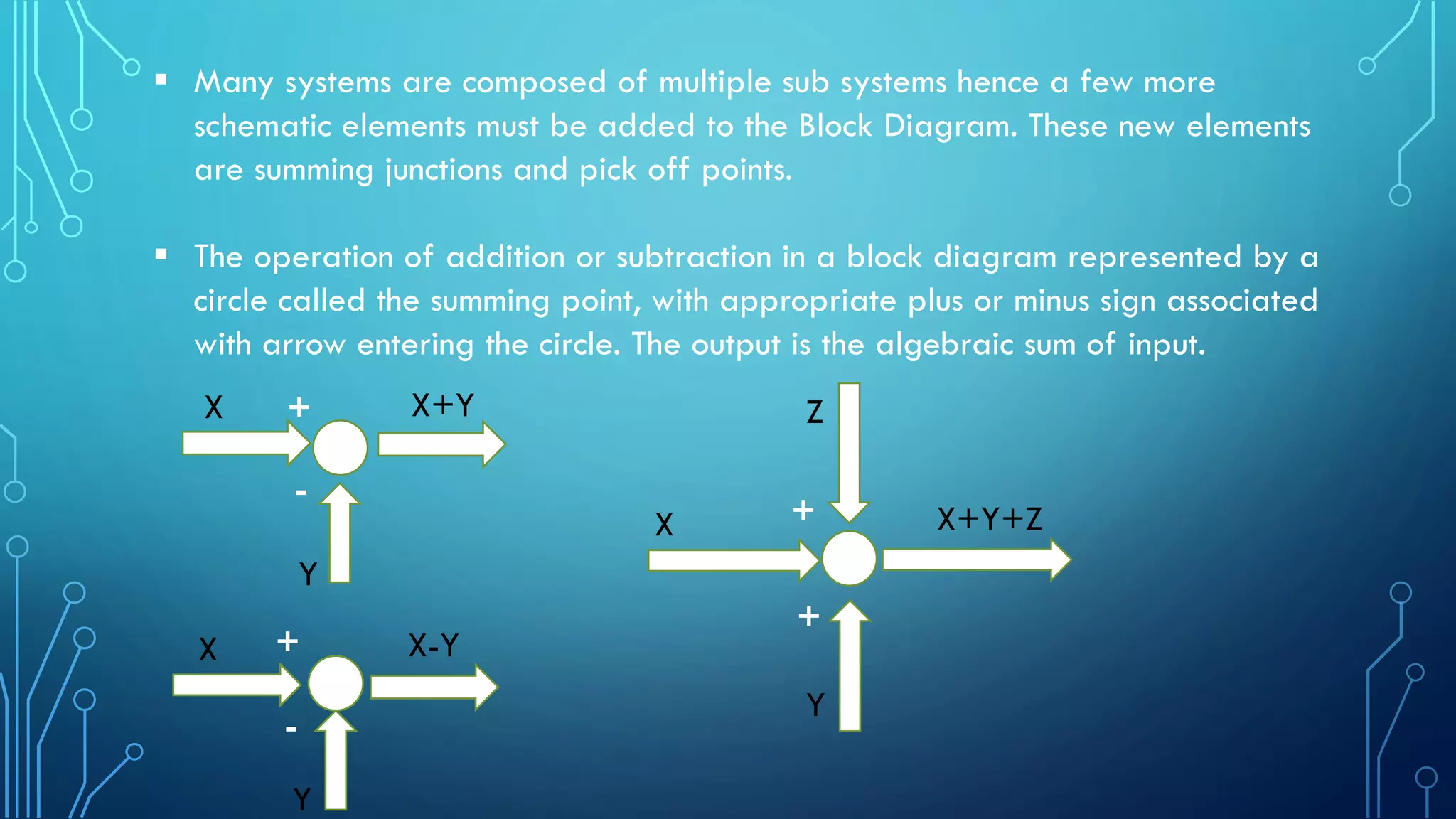
▪ The operation of addition or subtraction in a block diagram represented by a
circle called the summing point, with appropriate plus or minus sign associated
with arrow entering the circle. The output is the algebraic sum of input.
X
X-Y
Y
Y
X+Y
X
X
Y
Z
X+Y+Z
+
-
+
-
+
+
▪ In order to employ the same signal or variable as an input more than one block
a take off point is used. This permits the signal to proceed unaffected several
different paths to several destinations.
Take Off Point
X
X
X
X X X
X
❑ IMPORTANCE OF BLOCK DIAGRAM
▪A block diagram is a specialized, high-level flowchart used in engineering. It
is used to design new systems or to describe and improve existing ones. Its
structure provides a high-level overview of major system components, key
process participants, and important working relationships.
▪A block diagram provides a quick, high-level view of a system to rapidly
identify points of interest or trouble spots.
COMBINATION OF BLOCKS/REDUCTION TECHNIQUES
1)BLOCKS IN SERIES/CASCADE BLOCKS
▪The blocks connected in series in such a way that the output of one block is
input of preceding block.
▪Mathematically any finite number of such blocks can algebraically combined
by multiplication of transfer functions of each block.
G= 𝐺1* 𝐺2* 𝐺3* ……. * 𝐺𝑛
▪The Block diagram of such system is shown in figure
𝑞𝑖 𝑞𝑜
▪The transfer function of this system yields as:
𝑞𝑜/𝑞𝑖 = 𝐺1 * 𝐺2
𝐺1 𝐺2
02) COMBINING BLOCKS IN PARALLEL
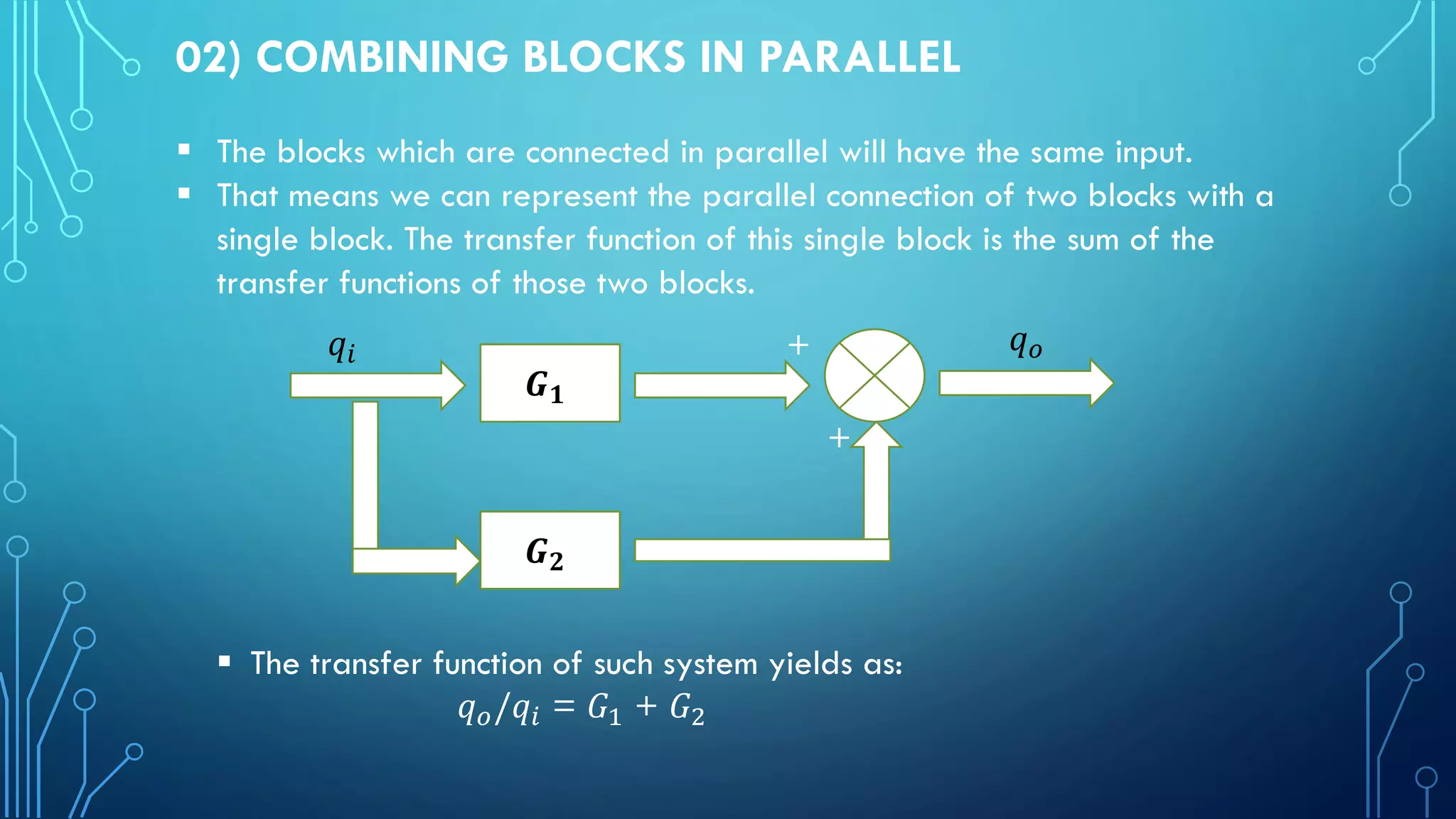
▪ The blocks which are connected in parallel will have the same input.
▪ That means we can represent the parallel connection of two blocks with a
single block. The transfer function of this single block is the sum of the
transfer functions of those two blocks.
𝑮𝟏
𝑮𝟐
q
𝑞𝑖 𝑞𝑜
+
+
▪ The transfer function of such system yields as:
𝑞𝑜/𝑞𝑖 = 𝐺1 + 𝐺2
03) BLOCKS IN FEEDBACK LOOP
▪A system in which the output of system is fed back towards the desired
input of the system and an element is provided in feedback path
resulting block diagram.
▪The transfer function of such system yields as:
𝑞𝑜/𝑞𝑖 = G/(1+ GH)
G
H
𝑞𝑖 𝑞𝑜
e
f
-
Block diagram

Block diagram

  • 2.
    BLOCK DIAGRAM PRESENTED BY: 17ME0217ME03 17ME04 SUBMITTED TO: DR. DUR MUHAMMAD PATHAN
  • 3.
    BLOCK DIAGRAM ▪A blockdiagram is a diagram of a system in which the principal parts or functions are represented by blocks connected by lines that show the relationships of the blocks. ▪The rectangle usually contains a description or the name of element or symbol for mathematical operation to be performed on the input to yield the output. The arrows represent the direction of signal flow. INPUT OUTPUT BLOCK
  • 4.
    ▪ Many systemsare composed of multiple sub systems hence a few more schematic elements must be added to the Block Diagram. These new elements are summing junctions and pick off points. ▪ The operation of addition or subtraction in a block diagram represented by a circle called the summing point, with appropriate plus or minus sign associated with arrow entering the circle. The output is the algebraic sum of input. X X-Y Y Y X+Y X X Y Z X+Y+Z + - + - + +
  • 5.
    ▪ In orderto employ the same signal or variable as an input more than one block a take off point is used. This permits the signal to proceed unaffected several different paths to several destinations. Take Off Point X X X X X X X
  • 6.
    ❑ IMPORTANCE OFBLOCK DIAGRAM ▪A block diagram is a specialized, high-level flowchart used in engineering. It is used to design new systems or to describe and improve existing ones. Its structure provides a high-level overview of major system components, key process participants, and important working relationships. ▪A block diagram provides a quick, high-level view of a system to rapidly identify points of interest or trouble spots.
  • 7.
    COMBINATION OF BLOCKS/REDUCTIONTECHNIQUES 1)BLOCKS IN SERIES/CASCADE BLOCKS ▪The blocks connected in series in such a way that the output of one block is input of preceding block. ▪Mathematically any finite number of such blocks can algebraically combined by multiplication of transfer functions of each block. G= 𝐺1* 𝐺2* 𝐺3* ……. * 𝐺𝑛 ▪The Block diagram of such system is shown in figure 𝑞𝑖 𝑞𝑜 ▪The transfer function of this system yields as: 𝑞𝑜/𝑞𝑖 = 𝐺1 * 𝐺2 𝐺1 𝐺2
  • 8.
    02) COMBINING BLOCKSIN PARALLEL ▪ The blocks which are connected in parallel will have the same input. ▪ That means we can represent the parallel connection of two blocks with a single block. The transfer function of this single block is the sum of the transfer functions of those two blocks. 𝑮𝟏 𝑮𝟐 q 𝑞𝑖 𝑞𝑜 + + ▪ The transfer function of such system yields as: 𝑞𝑜/𝑞𝑖 = 𝐺1 + 𝐺2
  • 9.
    03) BLOCKS INFEEDBACK LOOP ▪A system in which the output of system is fed back towards the desired input of the system and an element is provided in feedback path resulting block diagram. ▪The transfer function of such system yields as: 𝑞𝑜/𝑞𝑖 = G/(1+ GH) G H 𝑞𝑖 𝑞𝑜 e f -