SILVER OAK COLLEGE OF
ENGINEERING AND TECHNOLOGY
TOPIC :-
STUDENT NAME :- SIDDHI SHRIVAS (130770107163)
DIVISON :- COMPUTER – C
GUIDED BY :-MR. BIKAS MUDULI, SOCET
 WHAT IS MULTIPLEXER?
o A MULTIPLEXER is a digital circuit that has multiple inputs and a single
output.
o The selection of one of the n inputs is done by the select inputs
o It has one output selected at a time.
o It is also known as DATA SELECTOR.
o A multiplexer has
N data inputs(multiple)
1 output (single)
M select inputs, with 2M
=N
9/18/2014MULTIPLEXER 2
 BLOCK DIAGRAM OF MULTIPLEXER :
9/18/2014MULTIPLEXER 3
 Types:
 2-to-1 (1 select line)
 4-to-1 (2 select lines)
 8-to-1 (3 select lines)
 16-to-1 (4 select lines)
9/18/2014MULTIPLEXER 4
 2-TO-1 (1 SELECT LINES) MULTIPLEXER
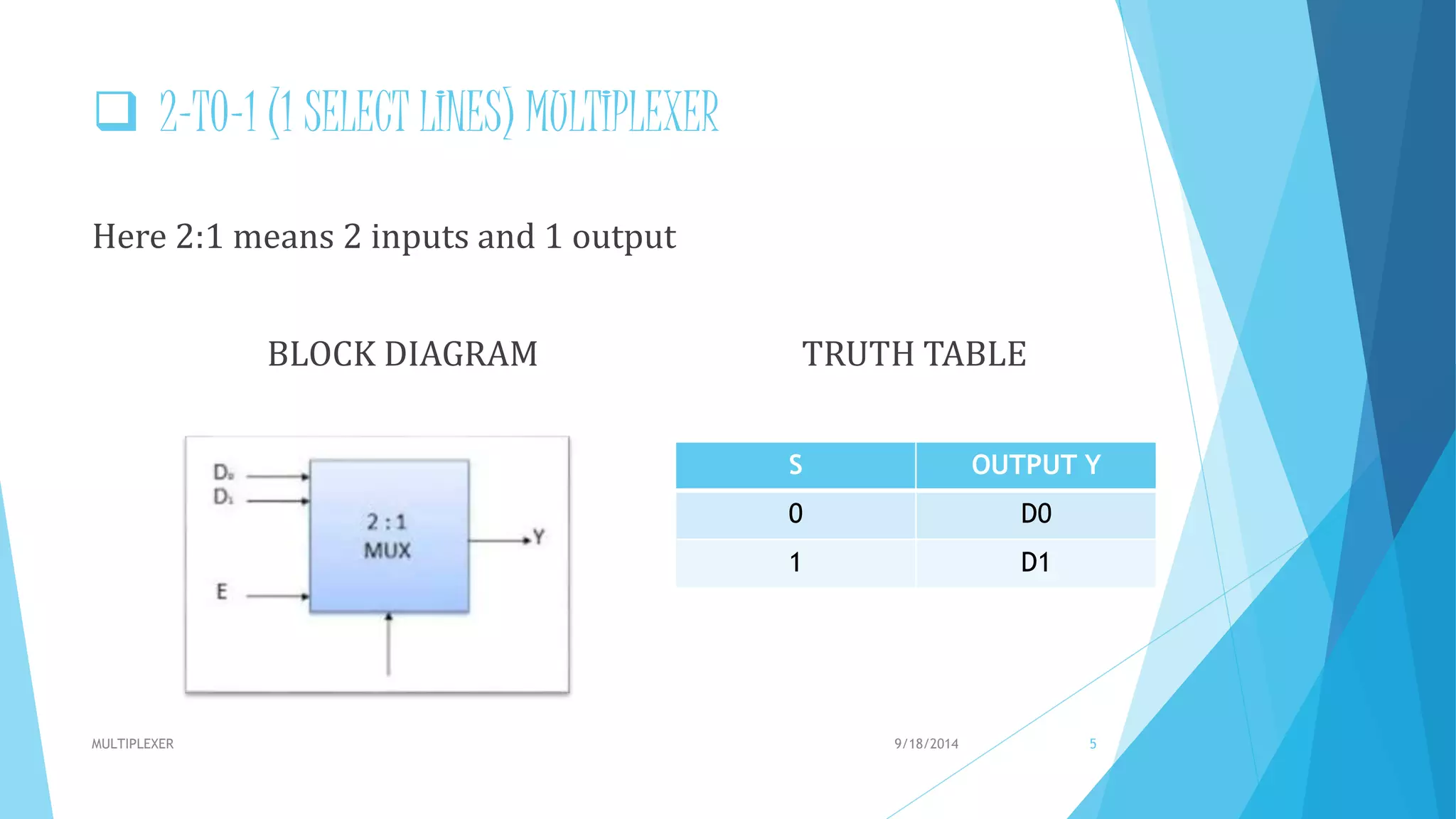
Here 2:1 means 2 inputs and 1 output
BLOCK DIAGRAM TRUTH TABLE
S OUTPUT Y
0 D0
1 D1
9/18/2014MULTIPLEXER 5
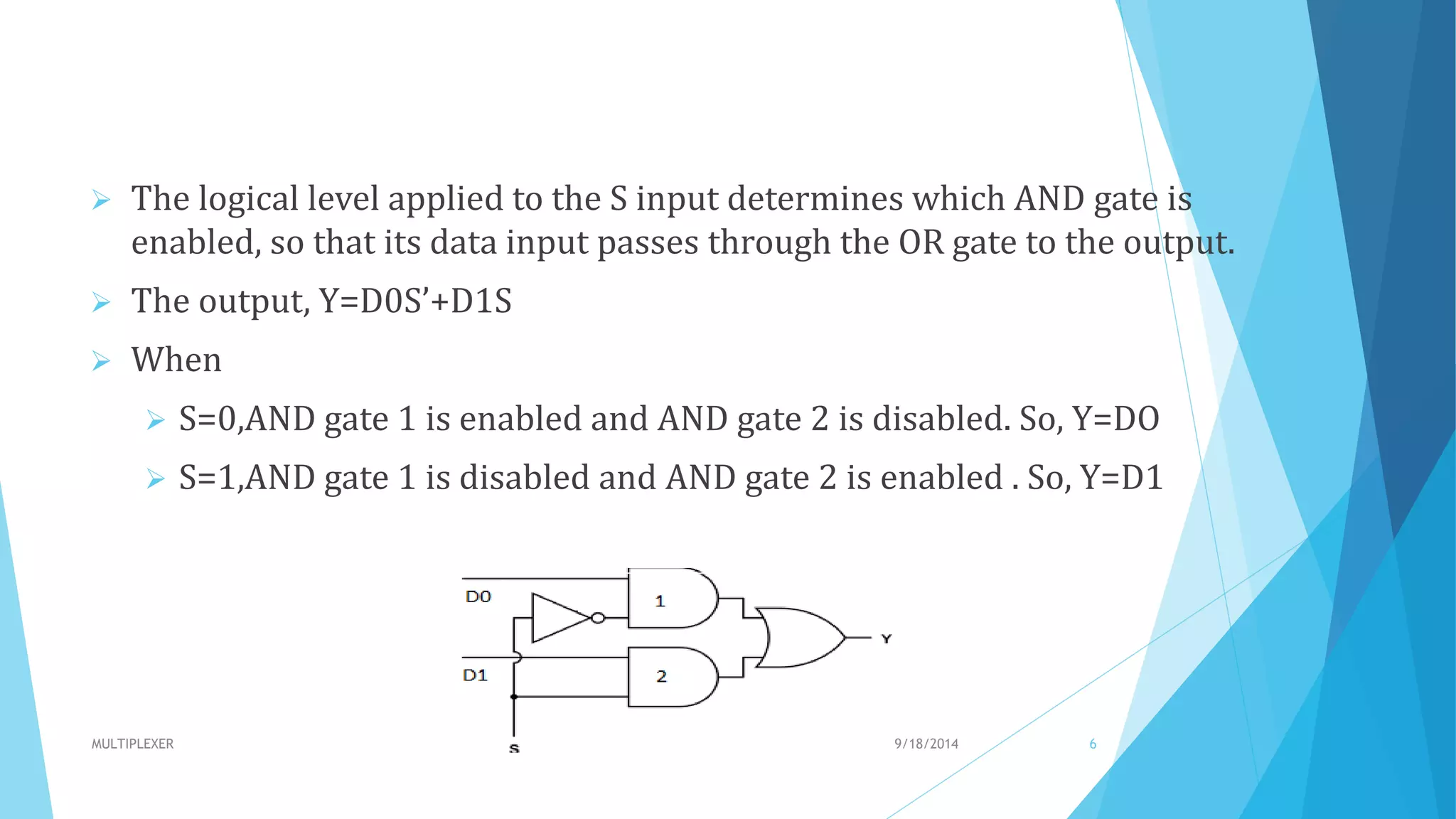
 The logical level applied to the S input determines which AND gate is
enabled, so that its data input passes through the OR gate to the output.
 The output, Y=D0S’+D1S
 When
 S=0,AND gate 1 is enabled and AND gate 2 is disabled. So, Y=DO
 S=1,AND gate 1 is disabled and AND gate 2 is enabled . So, Y=D1
9/18/2014MULTIPLEXER 6
 4-to-1 (2 select lines) Multiplexer
 4:1 MUX has 4 inputs(D0, D1, D2, D3) & 2 select lines(S0, S1)
BLOCK DIAGRAM TRUTH TABLE
S1 S0 Y
0 0 D0
0 1 D1
1 0 D2
1 1 D3
MUX
D0
D1
D2
D3
Y
S1 S0
9/18/2014MULTIPLEXER 7
 The logical level applied to the S input determines which AND
gate is enabled, so that its data input passes through the OR
gate to the output.
 The output, Y=S1’S0’D0+S1’S0D1+S1SO’D2+S1S0D3
9/18/2014MULTIPLEXER 8
 8-TO-1 (3 SELECT LINES) MULTIPLEXER
 8:1 MUX has 8 inputs(D0, D1, D2, D3, D4, D5, D6, D7) & 3
select lines(S0,S1, S2,)
BLOCK DIAGRAM TRUTH TABLE
S2 S1 S0 Y
0 0 0 D0
0 0 1 D1
0 1 0 D2
0 1 1 D3
1 0 0 D4
1 0 1 D5
1 1 0 D6
1 1 1 D79/18/2014MULTIPLEXER 9
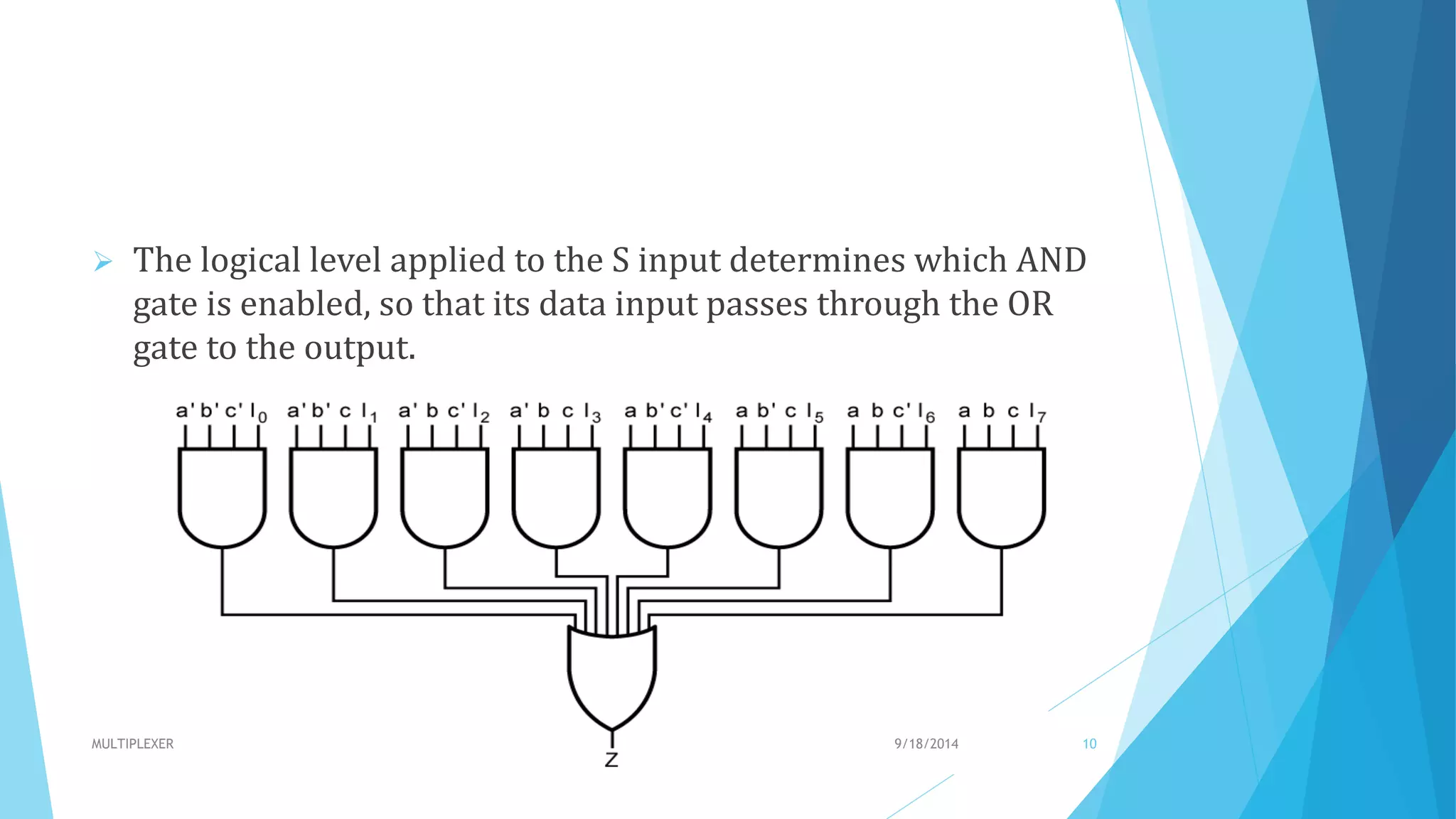
 The logical level applied to the S input determines which AND
gate is enabled, so that its data input passes through the OR
gate to the output.
9/18/2014MULTIPLEXER 10
 Uses of Multiplexers
 Used in data communications for several computers to
communicate over 1 line
 Used in radio to select one channel from many
 Used to route data within a computer
 Used for function generation
9/18/2014MULTIPLEXER 11
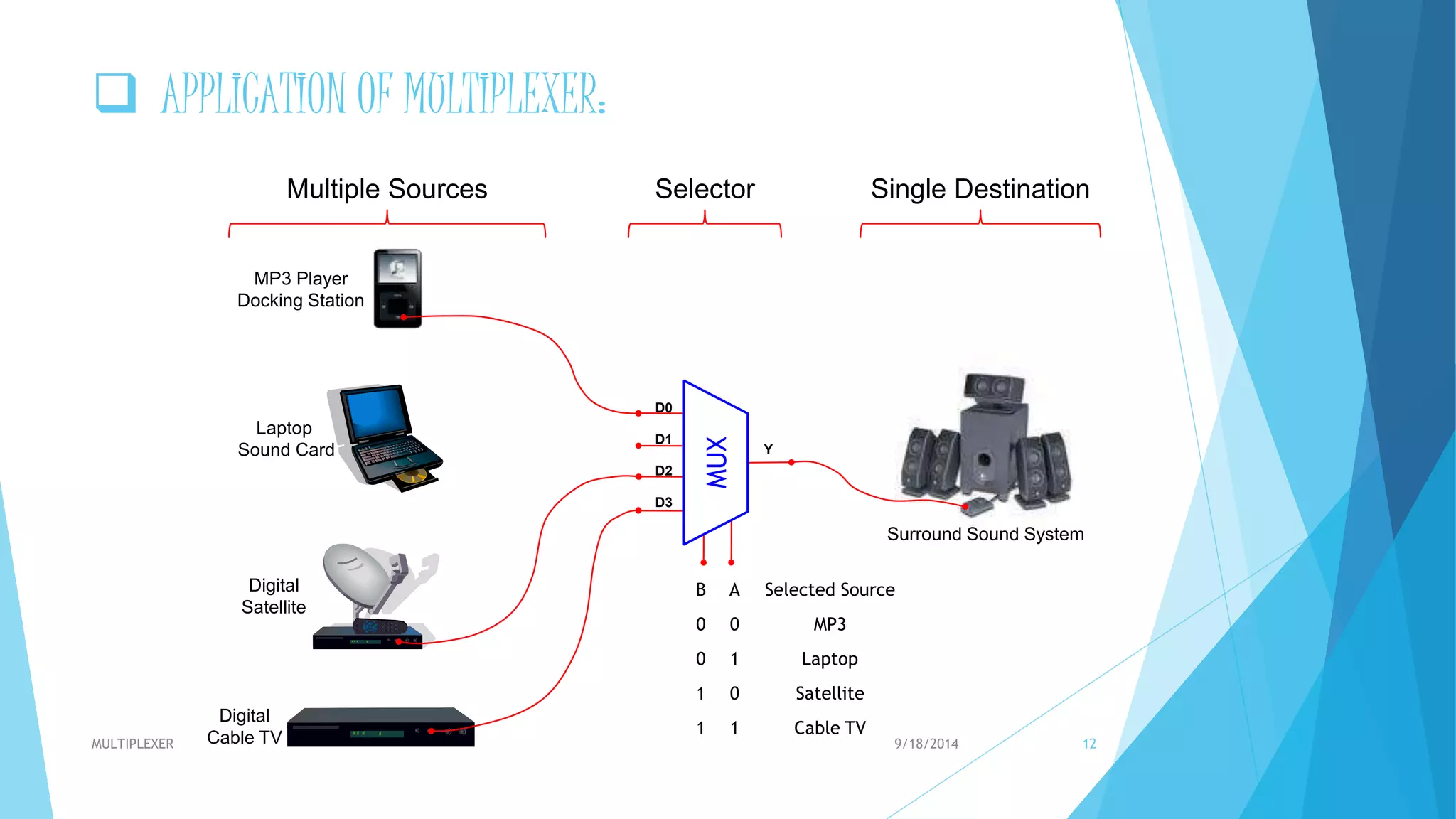
 APPLICATION OF MULTIPLEXER:
MP3 Player
Docking Station
Laptop
Sound Card
Digital
Satellite
Digital
Cable TV
Surround Sound System
MUX
D0
D1
D2
D3
Y
B A Selected Source
0 0 MP3
0 1 Laptop
1 0 Satellite
1 1 Cable TV
Multiple Sources Single DestinationSelector
9/18/2014MULTIPLEXER 12
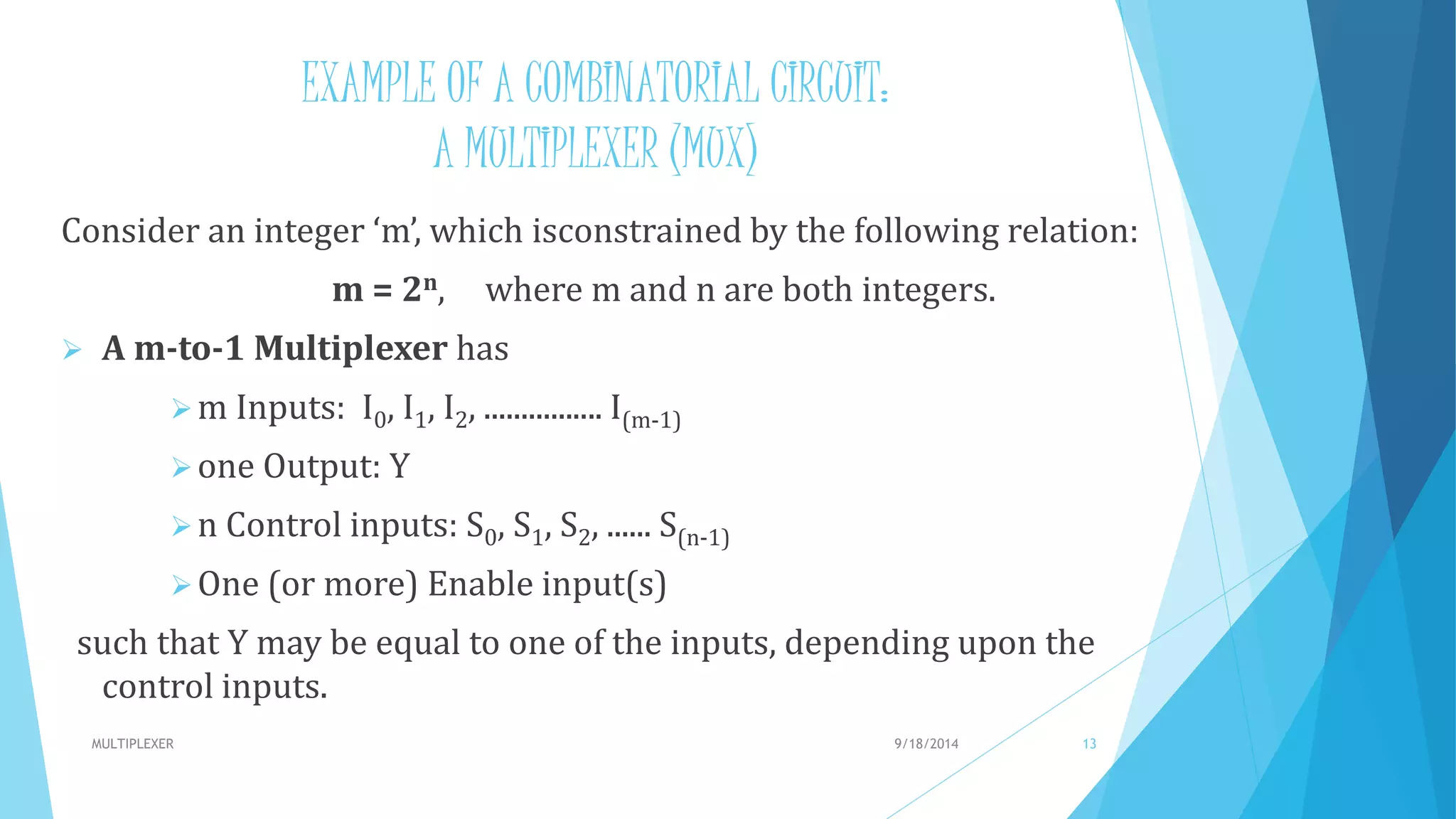
Consider an integer ‘m’, which isconstrained by the following relation:
m = 2n, where m and n are both integers.
 A m-to-1 Multiplexer has
m Inputs: I0, I1, I2, ................ I(m-1)
one Output: Y
n Control inputs: S0, S1, S2, ...... S(n-1)
One (or more) Enable input(s)
such that Y may be equal to one of the inputs, depending upon the
control inputs.
EXAMPLE OF A COMBINATORIAL CIRCUIT:
A MULTIPLEXER (MUX)
9/18/2014MULTIPLEXER 13
Implementing Digital Functions:
by using a Multiplexer:
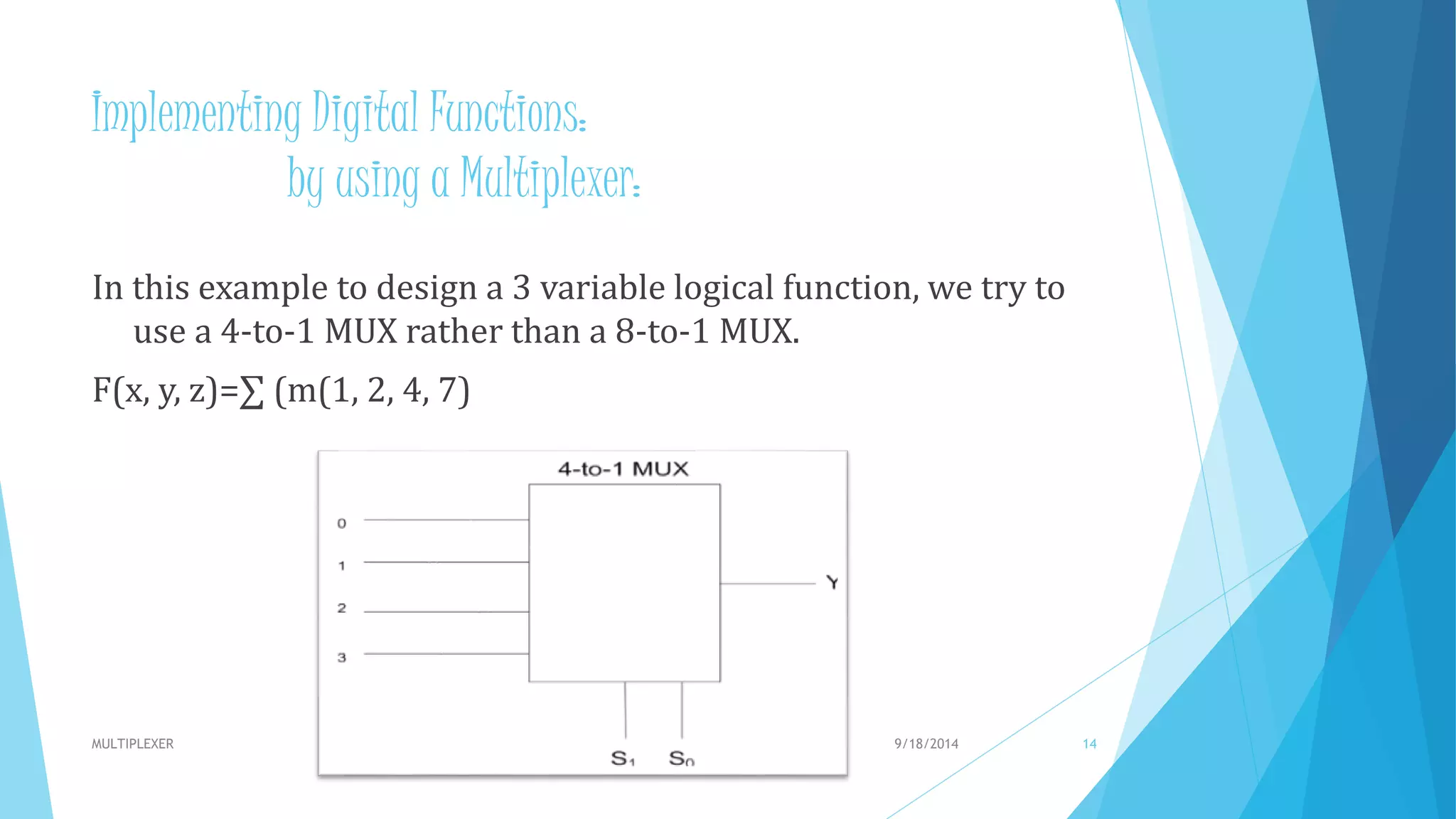
In this example to design a 3 variable logical function, we try to
use a 4-to-1 MUX rather than a 8-to-1 MUX.
F(x, y, z)=∑ (m(1, 2, 4, 7)
9/18/2014MULTIPLEXER 14
Implementing Digital Functions:
by using a Multiplexer: continue……
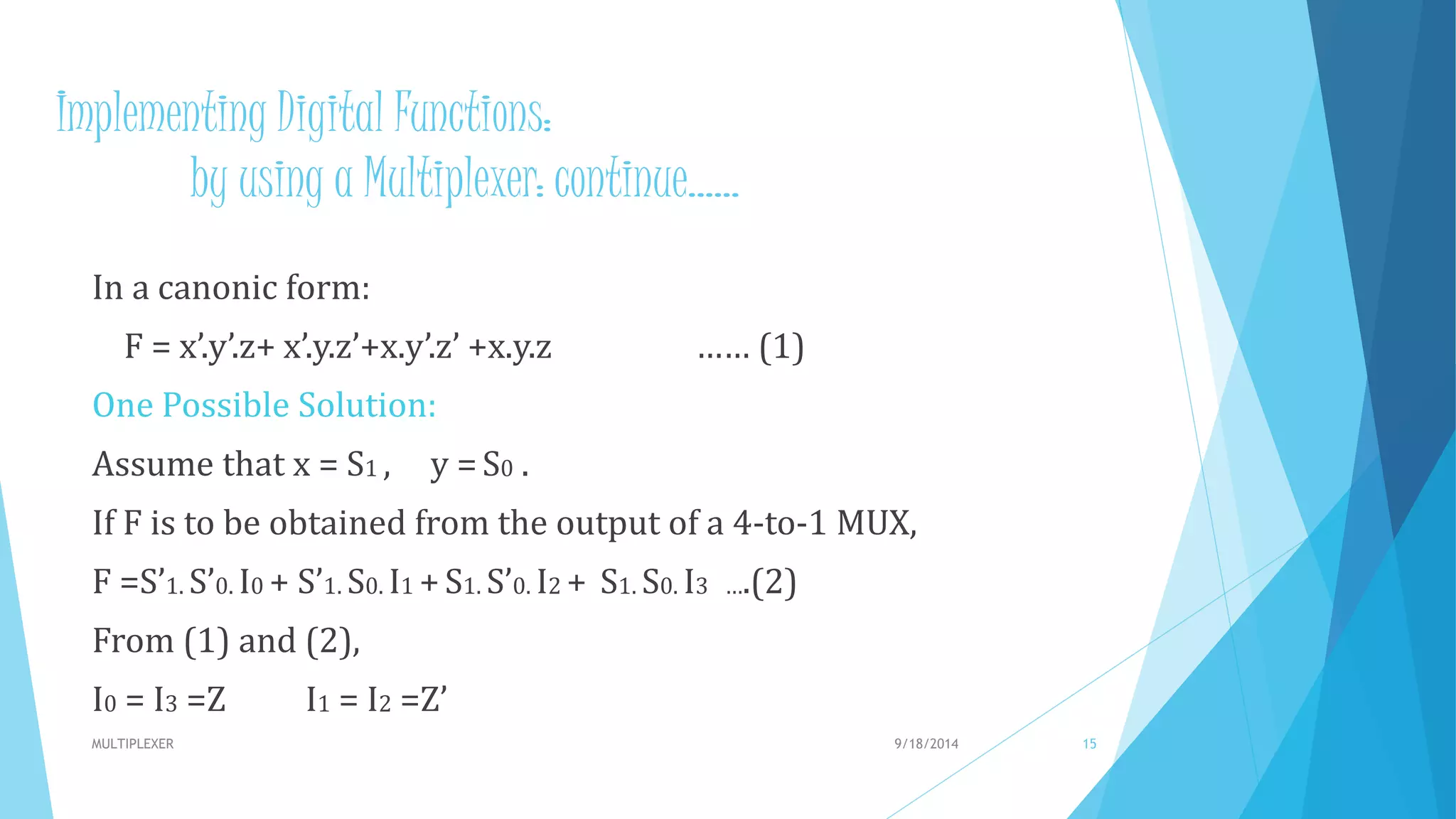
In a canonic form:
F = x’.y’.z+ x’.y.z’+x.y’.z’ +x.y.z …… (1)
One Possible Solution:
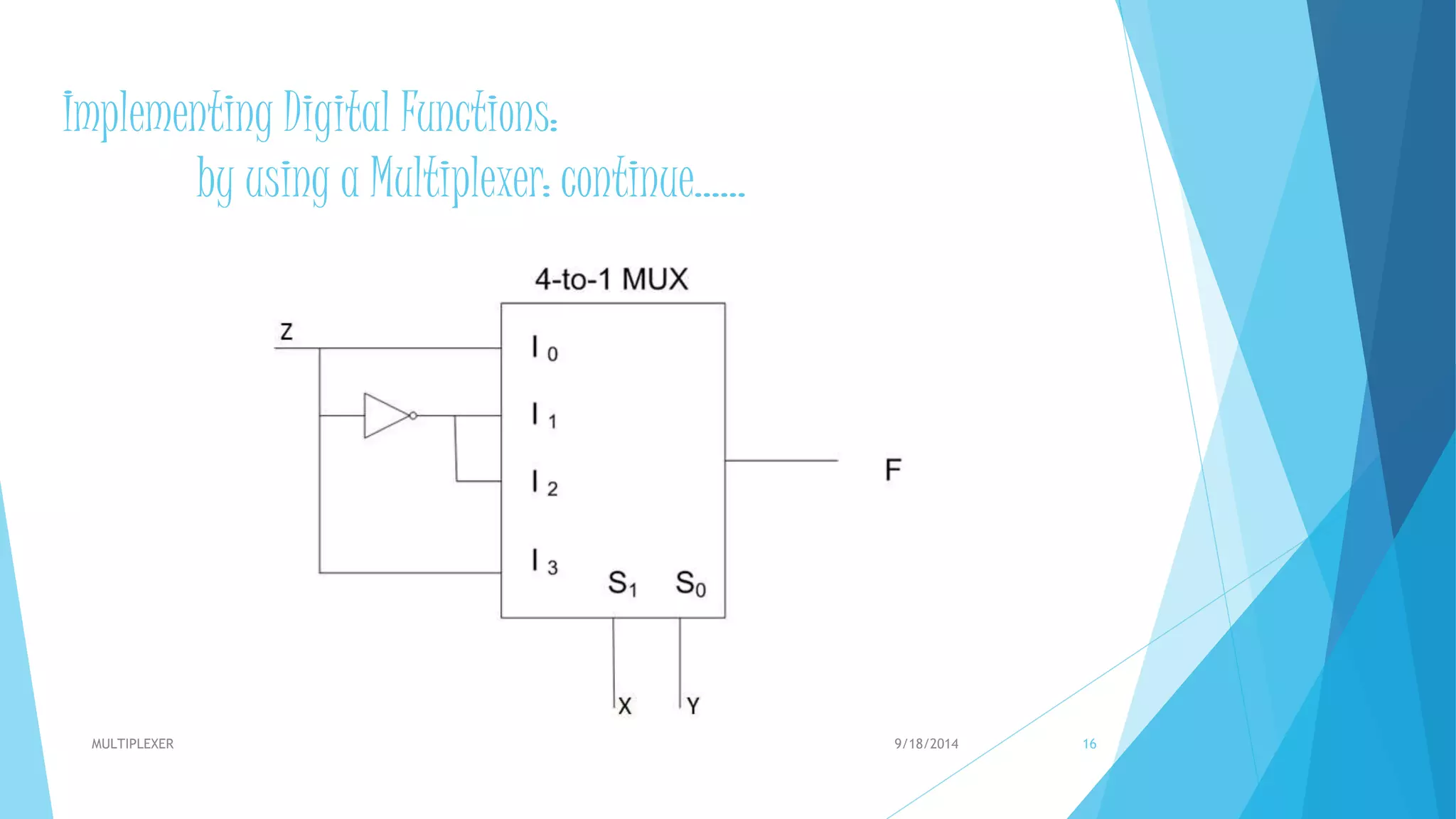
Assume that x = S1 , y =S0 .
If F is to be obtained from the output of a 4-to-1 MUX,
F =S’1. S’0. I0 + S’1. S0. I1 +S1. S’0. I2 + S1. S0. I3 ….(2)
From (1) and (2),
I0 = I3 =Z I1 = I2 =Z’
9/18/2014MULTIPLEXER 15
Implementing Digital Functions:
by using a Multiplexer: continue……
9/18/2014MULTIPLEXER 16
Another Possible Solution:
Assume that z = S1 , x =S0 .
If F is to be obtained from the output of a 4-to-1 MUX,
F = S’0 .I0 . S1 + S’0 .I1 . S’1 + S0 .I2 . S’1 + S0 .I3 . S1 ………… (3)
From (1) and (2),
I0 = y’ = I2
I1 = y = I3
Implementing Digital Functions:
by using a Multiplexer: continue……
9/18/2014MULTIPLEXER 17
Implementing Digital Functions:
by using a Multiplexer: continue……
9/18/2014MULTIPLEXER 18
THANK YOU
9/18/2014MULTIPLEXER 19

MULTIPLEXER

  • 1.
    SILVER OAK COLLEGEOF ENGINEERING AND TECHNOLOGY TOPIC :- STUDENT NAME :- SIDDHI SHRIVAS (130770107163) DIVISON :- COMPUTER – C GUIDED BY :-MR. BIKAS MUDULI, SOCET
  • 2.
     WHAT ISMULTIPLEXER? o A MULTIPLEXER is a digital circuit that has multiple inputs and a single output. o The selection of one of the n inputs is done by the select inputs o It has one output selected at a time. o It is also known as DATA SELECTOR. o A multiplexer has N data inputs(multiple) 1 output (single) M select inputs, with 2M =N 9/18/2014MULTIPLEXER 2
  • 3.
     BLOCK DIAGRAMOF MULTIPLEXER : 9/18/2014MULTIPLEXER 3
  • 4.
     Types:  2-to-1(1 select line)  4-to-1 (2 select lines)  8-to-1 (3 select lines)  16-to-1 (4 select lines) 9/18/2014MULTIPLEXER 4
  • 5.
     2-TO-1 (1SELECT LINES) MULTIPLEXER Here 2:1 means 2 inputs and 1 output BLOCK DIAGRAM TRUTH TABLE S OUTPUT Y 0 D0 1 D1 9/18/2014MULTIPLEXER 5
  • 6.
     The logicallevel applied to the S input determines which AND gate is enabled, so that its data input passes through the OR gate to the output.  The output, Y=D0S’+D1S  When  S=0,AND gate 1 is enabled and AND gate 2 is disabled. So, Y=DO  S=1,AND gate 1 is disabled and AND gate 2 is enabled . So, Y=D1 9/18/2014MULTIPLEXER 6
  • 7.
     4-to-1 (2select lines) Multiplexer  4:1 MUX has 4 inputs(D0, D1, D2, D3) & 2 select lines(S0, S1) BLOCK DIAGRAM TRUTH TABLE S1 S0 Y 0 0 D0 0 1 D1 1 0 D2 1 1 D3 MUX D0 D1 D2 D3 Y S1 S0 9/18/2014MULTIPLEXER 7
  • 8.
     The logicallevel applied to the S input determines which AND gate is enabled, so that its data input passes through the OR gate to the output.  The output, Y=S1’S0’D0+S1’S0D1+S1SO’D2+S1S0D3 9/18/2014MULTIPLEXER 8
  • 9.
     8-TO-1 (3SELECT LINES) MULTIPLEXER  8:1 MUX has 8 inputs(D0, D1, D2, D3, D4, D5, D6, D7) & 3 select lines(S0,S1, S2,) BLOCK DIAGRAM TRUTH TABLE S2 S1 S0 Y 0 0 0 D0 0 0 1 D1 0 1 0 D2 0 1 1 D3 1 0 0 D4 1 0 1 D5 1 1 0 D6 1 1 1 D79/18/2014MULTIPLEXER 9
  • 10.
     The logicallevel applied to the S input determines which AND gate is enabled, so that its data input passes through the OR gate to the output. 9/18/2014MULTIPLEXER 10
  • 11.
     Uses ofMultiplexers  Used in data communications for several computers to communicate over 1 line  Used in radio to select one channel from many  Used to route data within a computer  Used for function generation 9/18/2014MULTIPLEXER 11
  • 12.
     APPLICATION OFMULTIPLEXER: MP3 Player Docking Station Laptop Sound Card Digital Satellite Digital Cable TV Surround Sound System MUX D0 D1 D2 D3 Y B A Selected Source 0 0 MP3 0 1 Laptop 1 0 Satellite 1 1 Cable TV Multiple Sources Single DestinationSelector 9/18/2014MULTIPLEXER 12
  • 13.
    Consider an integer‘m’, which isconstrained by the following relation: m = 2n, where m and n are both integers.  A m-to-1 Multiplexer has m Inputs: I0, I1, I2, ................ I(m-1) one Output: Y n Control inputs: S0, S1, S2, ...... S(n-1) One (or more) Enable input(s) such that Y may be equal to one of the inputs, depending upon the control inputs. EXAMPLE OF A COMBINATORIAL CIRCUIT: A MULTIPLEXER (MUX) 9/18/2014MULTIPLEXER 13
  • 14.
    Implementing Digital Functions: byusing a Multiplexer: In this example to design a 3 variable logical function, we try to use a 4-to-1 MUX rather than a 8-to-1 MUX. F(x, y, z)=∑ (m(1, 2, 4, 7) 9/18/2014MULTIPLEXER 14
  • 15.
    Implementing Digital Functions: byusing a Multiplexer: continue…… In a canonic form: F = x’.y’.z+ x’.y.z’+x.y’.z’ +x.y.z …… (1) One Possible Solution: Assume that x = S1 , y =S0 . If F is to be obtained from the output of a 4-to-1 MUX, F =S’1. S’0. I0 + S’1. S0. I1 +S1. S’0. I2 + S1. S0. I3 ….(2) From (1) and (2), I0 = I3 =Z I1 = I2 =Z’ 9/18/2014MULTIPLEXER 15
  • 16.
    Implementing Digital Functions: byusing a Multiplexer: continue…… 9/18/2014MULTIPLEXER 16
  • 17.
    Another Possible Solution: Assumethat z = S1 , x =S0 . If F is to be obtained from the output of a 4-to-1 MUX, F = S’0 .I0 . S1 + S’0 .I1 . S’1 + S0 .I2 . S’1 + S0 .I3 . S1 ………… (3) From (1) and (2), I0 = y’ = I2 I1 = y = I3 Implementing Digital Functions: by using a Multiplexer: continue…… 9/18/2014MULTIPLEXER 17
  • 18.
    Implementing Digital Functions: byusing a Multiplexer: continue…… 9/18/2014MULTIPLEXER 18
  • 19.

Editor's Notes

  • #13 This slide shows a typical application of a multiplexer (in this case a 4-to-1 MUX). Have the students share other common applications of MUXs. http://images.tigerdirect.ca/skuimages/large/Logitech-X-540-L23-7250-mai.jpg