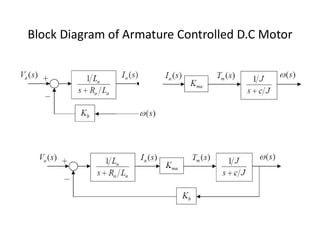
block diagram representation of control system.pdf
1.
Feedback Control Systems(FCS)
Dr. Imtiaz Hussain
email: imtiaz.hussain@faculty.muet.edu.pk
URL :http://imtiazhussainkalwar.weebly.com/
Lecture-8-9
Block Diagram Representation of Control Systems
2.
Introduction
• A BlockDiagram is a shorthand pictorial representation of
the cause-and-effect relationship of a system.
• The interior of the rectangle representing the block usually
contains a description of or the name of the element, gain,
or the symbol for the mathematical operation to be
performed on the input to yield the output.
• The arrows represent the direction of information or signal
flow.
dt
d
x y
3.
Introduction
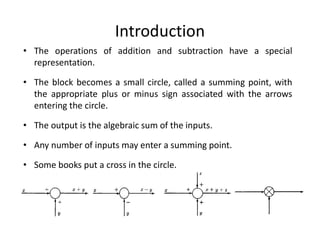
• The operationsof addition and subtraction have a special
representation.
• The block becomes a small circle, called a summing point, with
the appropriate plus or minus sign associated with the arrows
entering the circle.
• The output is the algebraic sum of the inputs.
• Any number of inputs may enter a summing point.
• Some books put a cross in the circle.
4.
Introduction
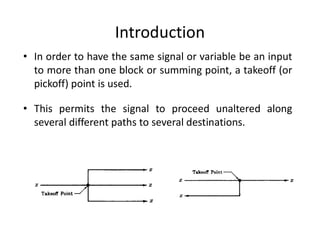
• In orderto have the same signal or variable be an input
to more than one block or summing point, a takeoff (or
pickoff) point is used.
• This permits the signal to proceed unaltered along
several different paths to several destinations.
5.
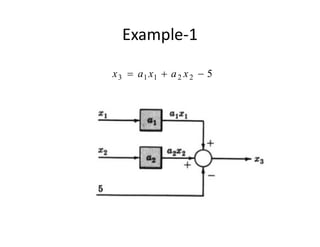
Example-1
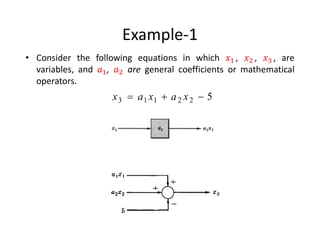
• Consider thefollowing equations in which , , , are
variables, and , are general coefficients or mathematical
operators.
5
2
2
1
1
3
x
a
x
a
x
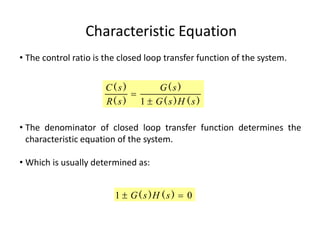
Characteristic Equation
• Thecontrol ratio is the closed loop transfer function of the system.
• The denominator of closed loop transfer function determines the
characteristic equation of the system.
• Which is usually determined as:
)
(
)
(
)
(
)
(
)
(
s
H
s
G
s
G
s
R
s
C
1
0
1
)
(
)
( s
H
s
G
10.
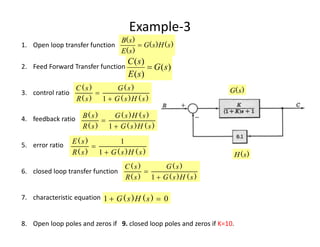
Example-3
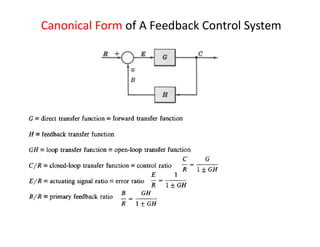
1. Open looptransfer function
2. Feed Forward Transfer function
3. control ratio
4. feedback ratio
5. error ratio
6. closed loop transfer function
7. characteristic equation
8. Open loop poles and zeros if 9. closed loop poles and zeros if K=10.
)
(
)
(
)
(
)
(
s
H
s
G
s
E
s
B
)
(
)
(
)
(
s
G
s
E
s
C
)
(
)
(
)
(
)
(
)
(
s
H
s
G
s
G
s
R
s
C
1
)
(
)
(
)
(
)
(
)
(
)
(
s
H
s
G
s
H
s
G
s
R
s
B
1
)
(
)
(
)
(
)
(
s
H
s
G
s
R
s
E
1
1
)
(
)
(
)
(
)
(
)
(
s
H
s
G
s
G
s
R
s
C
1
0
1
)
(
)
( s
H
s
G
)
(s
G
)
(s
H
Example-5
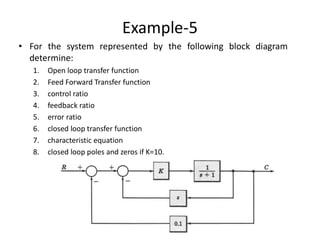
• For thesystem represented by the following block diagram
determine:
1. Open loop transfer function
2. Feed Forward Transfer function
3. control ratio
4. feedback ratio
5. error ratio
6. closed loop transfer function
7. characteristic equation
8. closed loop poles and zeros if K=10.
16.
Example-5
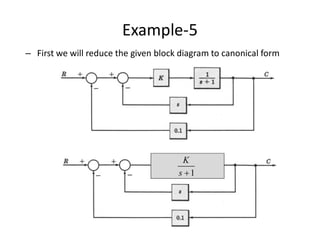
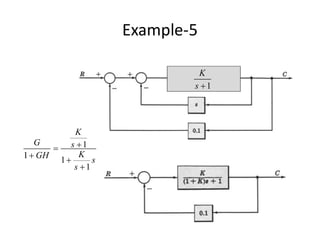
– First wewill reduce the given block diagram to canonical form
1
s
K
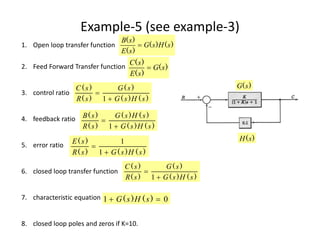
Example-5 (see example-3)
1.Open loop transfer function
2. Feed Forward Transfer function
3. control ratio
4. feedback ratio
5. error ratio
6. closed loop transfer function
7. characteristic equation
8. closed loop poles and zeros if K=10.
)
(
)
(
)
(
)
(
s
H
s
G
s
E
s
B
)
(
)
(
)
(
s
G
s
E
s
C
)
(
)
(
)
(
)
(
)
(
s
H
s
G
s
G
s
R
s
C
1
)
(
)
(
)
(
)
(
)
(
)
(
s
H
s
G
s
H
s
G
s
R
s
B
1
)
(
)
(
)
(
)
(
s
H
s
G
s
R
s
E
1
1
)
(
)
(
)
(
)
(
)
(
s
H
s
G
s
G
s
R
s
C
1
0
1
)
(
)
( s
H
s
G
)
(s
G
)
(s
H
19.
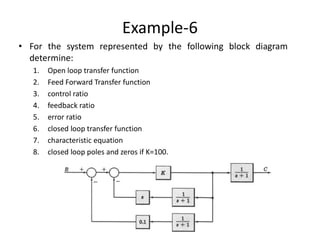
Example-6
• For thesystem represented by the following block diagram
determine:
1. Open loop transfer function
2. Feed Forward Transfer function
3. control ratio
4. feedback ratio
5. error ratio
6. closed loop transfer function
7. characteristic equation
8. closed loop poles and zeros if K=100.
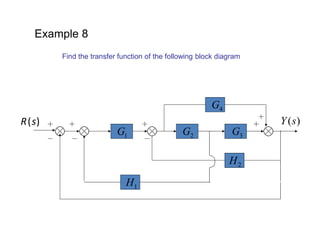
Example 8
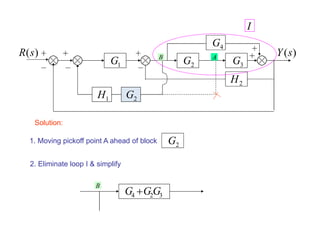
Find thetransfer function of the following block diagram
2
G 3
G
1
G
4
G
1
H
2
H
)
(s
Y
)
(s
R
31.
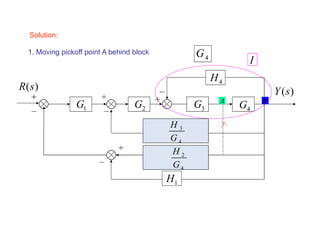
1. Moving pickoffpoint A ahead of block
2
G
2. Eliminate loop I & simplify
3
2
4 G
G
G
B
1
G
2
H
)
(s
Y
4
G
2
G
1
H
A
B
3
G
2
G
)
(s
R
I
Solution:
32.
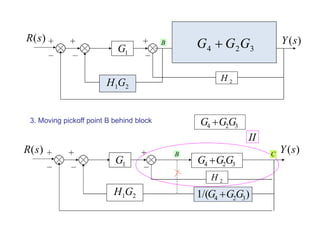
3. Moving pickoffpoint B behind block
3
2
4 G
G
G
1
G
B
)
(s
R
2
1G
H 2
H
)
(s
Y
)
/(
1 3
2
4 G
G
G
II
1
G
B
)
(s
R C
3
2
4 G
G
G
2
H
)
(s
Y
2
1G
H
4
G
2
G A
3
G 3
2
4 G
G
G
33.
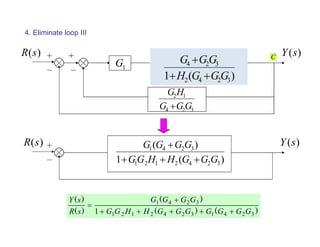
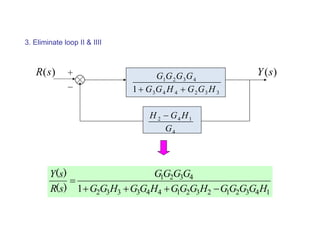
4. Eliminate loopIII
)
(s
R
)
(
1
)
(
3
2
4
2
1
2
1
3
2
4
1
G
G
G
H
H
G
G
G
G
G
G
)
(s
Y
)
(
)
(
)
(
)
(
)
(
3
2
4
1
3
2
4
2
1
2
1
3
2
4
1
1 G
G
G
G
G
G
G
H
H
G
G
G
G
G
G
s
R
s
Y
)
(s
R
1
G
C
3
2
4
1
2
G
G
G
H
G
)
(s
Y
3
2
4 G
G
G
2
H
C
)
(
1 3
2
4
2
3
2
4
G
G
G
H
G
G
G
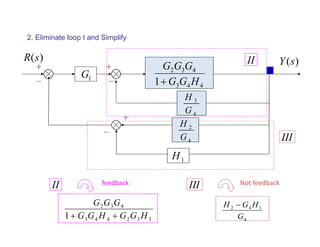
2. Eliminate loopI and Simplify
II
III
4
4
3
4
3
2
1 H
G
G
G
G
G
1
G
)
(s
Y
1
H
B
4
2
G
H
)
(s
R
4
3
G
H
II
3
3
2
4
4
3
4
3
2
1 H
G
G
H
G
G
G
G
G
III
4
1
4
2
G
H
G
H
Not feedback
feedback