The Entity-Relationship Model
yash
http://alltypeim.blogspot.in/
ER Model BASIC
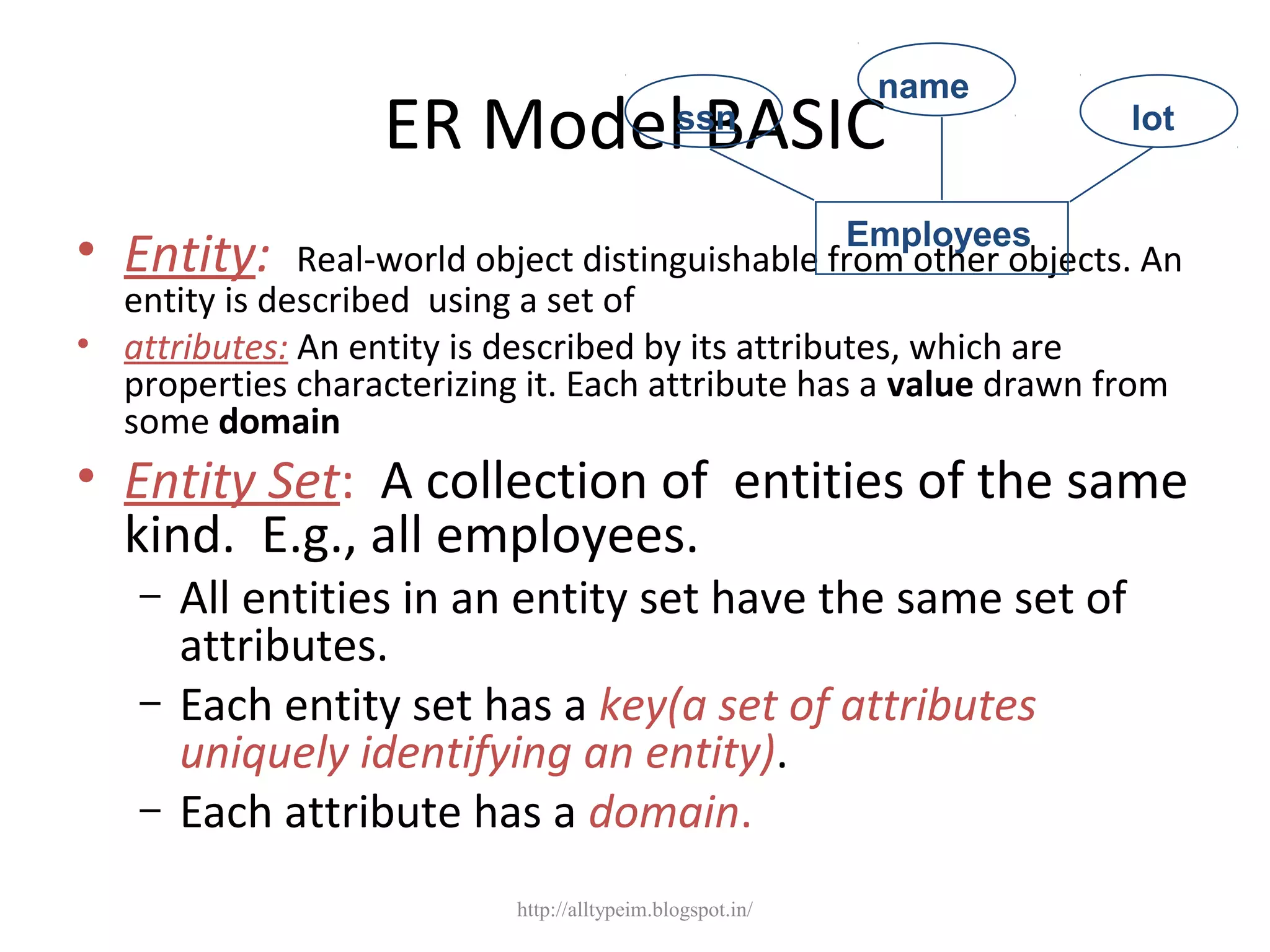
• Entity: Real-world object distinguishable from other objects. An
entity is described using a set of
• attributes: An entity is described by its attributes, which are
properties characterizing it. Each attribute has a value drawn from
some domain
• Entity Set: A collection of entities of the same
kind. E.g., all employees.
– All entities in an entity set have the same set of
attributes.
– Each entity set has a key(a set of attributes
uniquely identifying an entity).
– Each attribute has a domain.
Employees
ssn
name
lot
http://alltypeim.blogspot.in/
Key Constraints
(a.k.a. Cardinality)
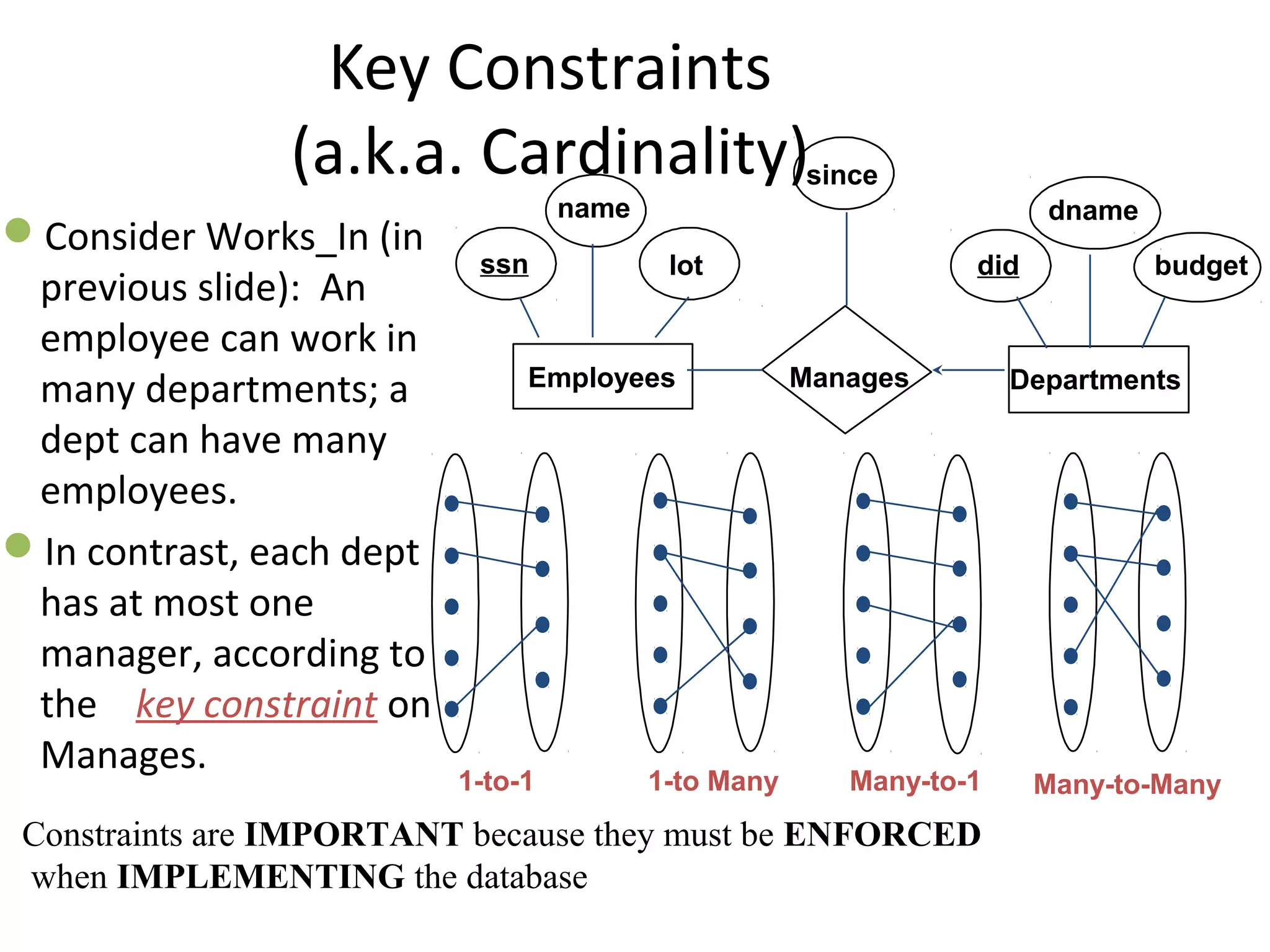
Consider Works_In (in
previous slide): An
employee can work in
many departments; a
dept can have many
employees.
In contrast, each dept
has at most one
manager, according to
the key constraint on
Manages.
Many-to-Many1-to-1 1-to Many Many-to-1
dname
budgetdid
since
lot
name
ssn
ManagesEmployees Departments
Constraints are IMPORTANT because they must be ENFORCED
when IMPLEMENTING the database
Key Constraints
(ternary relationships)
dname
budgetdid
name
lot
name
ssn
works_InEmployees Departments
Location
12-233
12-243
12-354
12-299 Rome
Paris
London
D10
D13
D12•
•
•
•
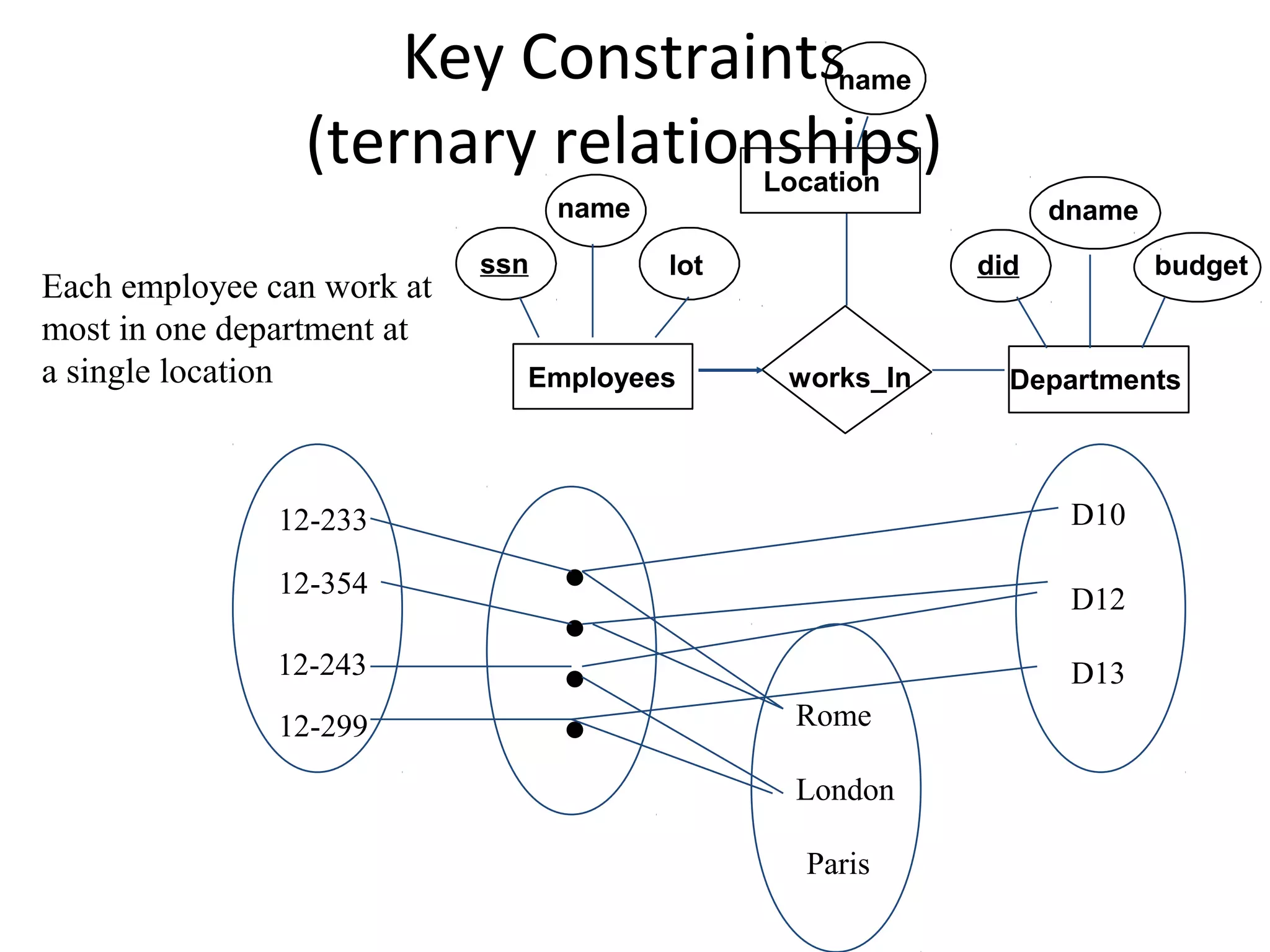
Each employee can work at
most in one department at
a single location
Participation Constraints
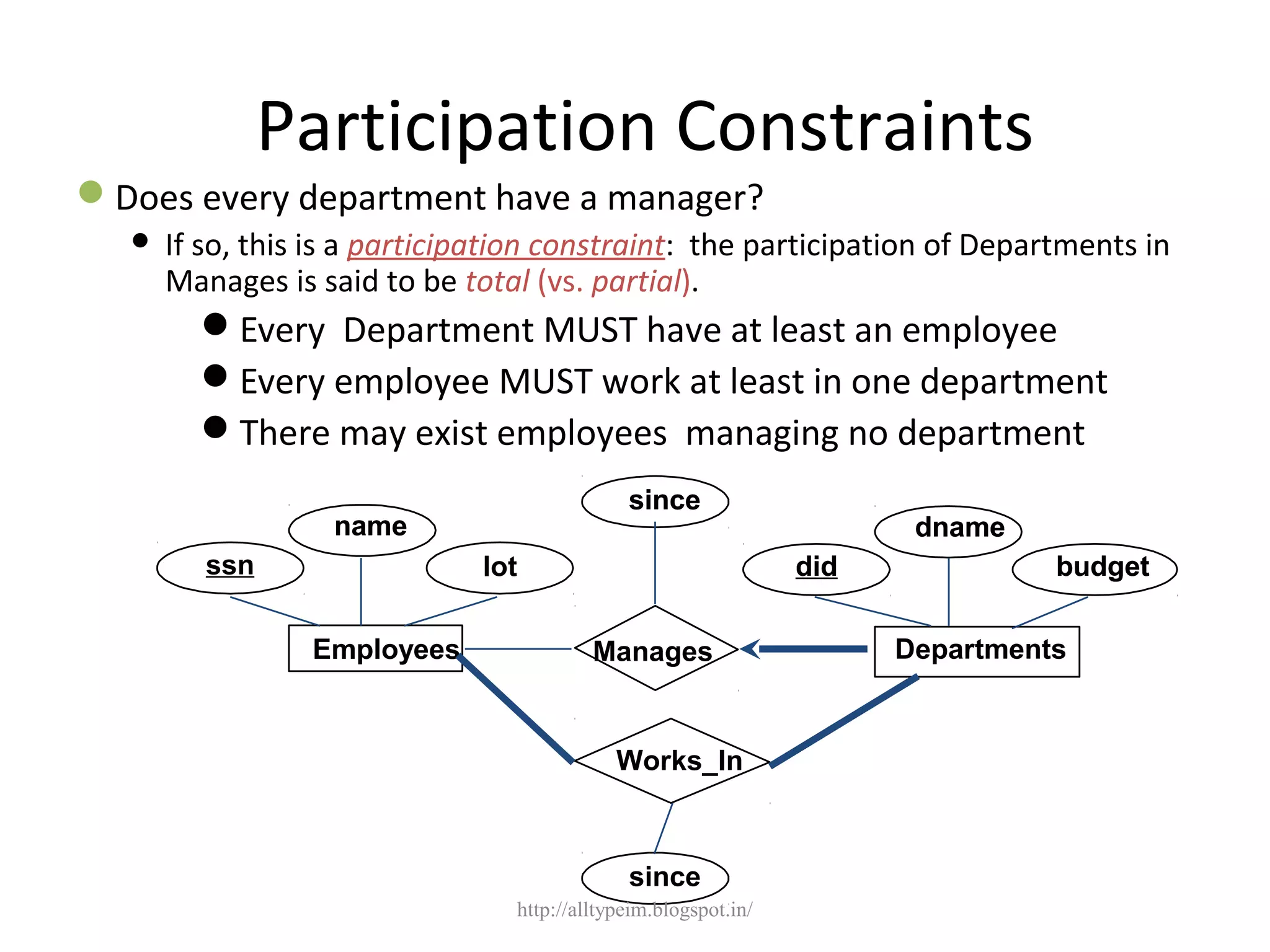
Does every department have a manager?
 If so, this is a participation constraint: the participation of Departments in
Manages is said to be total (vs. partial).
Every Department MUST have at least an employee
Every employee MUST work at least in one department
There may exist employees managing no department
lot
name dname
budgetdid
since
name dname
budgetdid
since
Manages
since
DepartmentsEmployees
ssn
Works_In
http://alltypeim.blogspot.in/
Weak Entities
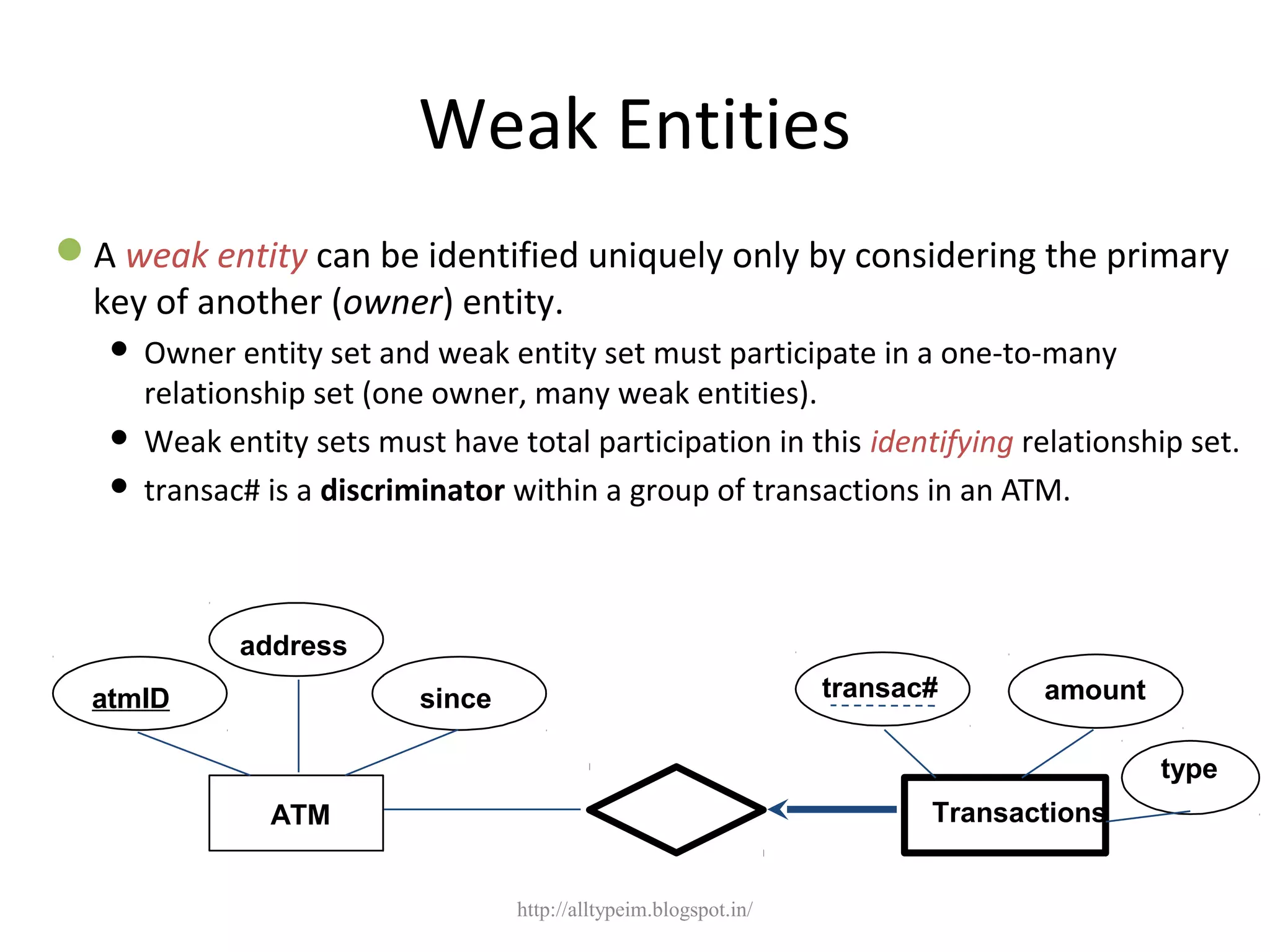
A weak entity can be identified uniquely only by considering the primary
key of another (owner) entity.
 Owner entity set and weak entity set must participate in a one-to-many
relationship set (one owner, many weak entities).
 Weak entity sets must have total participation in this identifying relationship set.
 transac# is a discriminator within a group of transactions in an ATM.
since
address
amounttransac#
TransactionsATM
atmID
type
http://alltypeim.blogspot.in/
ISA (`is a’) Hierarchies
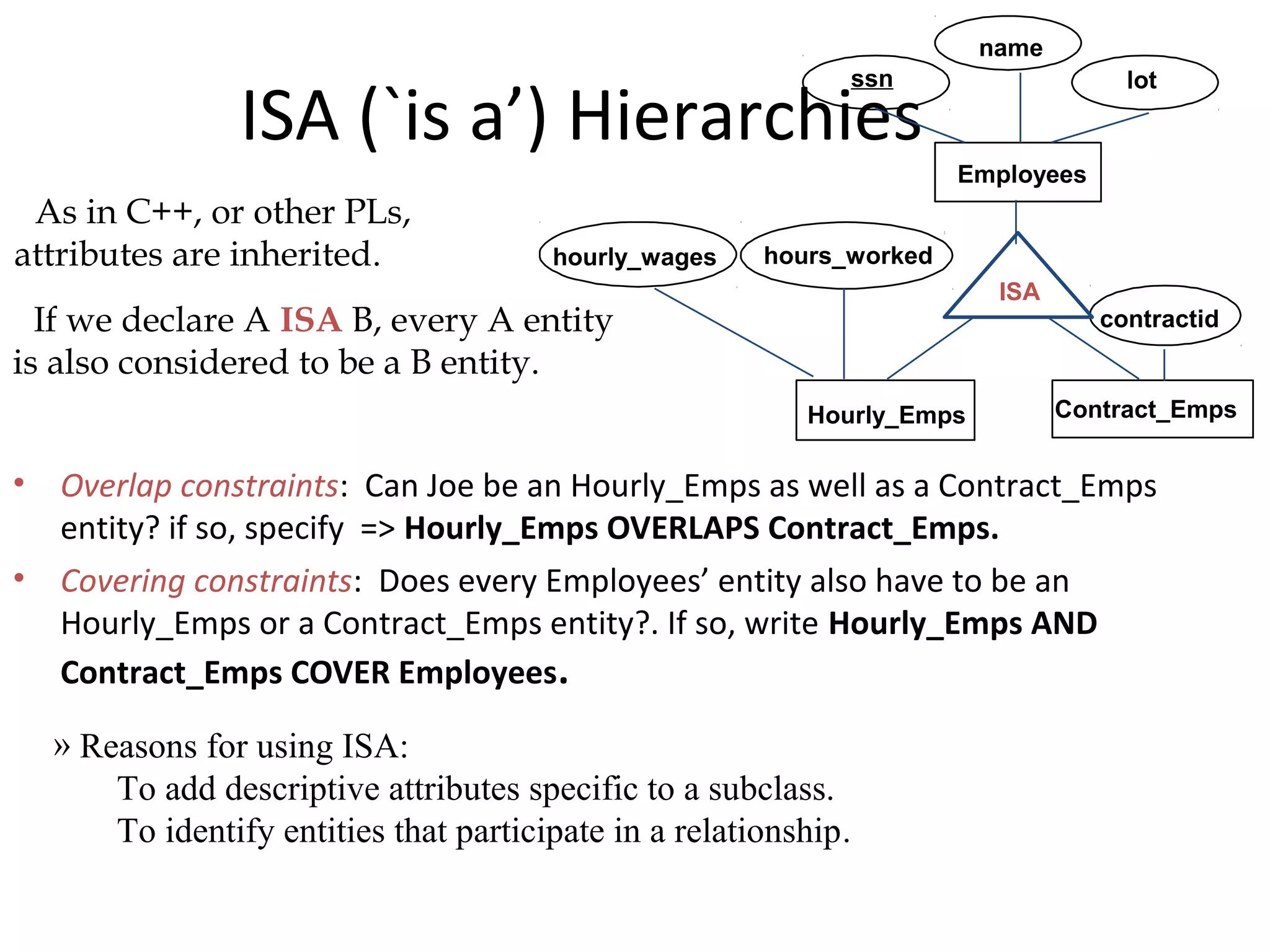
• Overlap constraints: Can Joe be an Hourly_Emps as well as a Contract_Emps
entity? if so, specify => Hourly_Emps OVERLAPS Contract_Emps.
• Covering constraints: Does every Employees’ entity also have to be an
Hourly_Emps or a Contract_Emps entity?. If so, write Hourly_Emps AND
Contract_Emps COVER Employees.
Contract_Emps
name
ssn
Employees
lot
hourly_wages
Hourly_Emps
contractid
hours_worked
As in C++, or other PLs,
attributes are inherited.
If we declare A ISA B, every A entity
is also considered to be a B entity.
» Reasons for using ISA:
To add descriptive attributes specific to a subclass.
To identify entities that participate in a relationship.
ISA
Aggregation
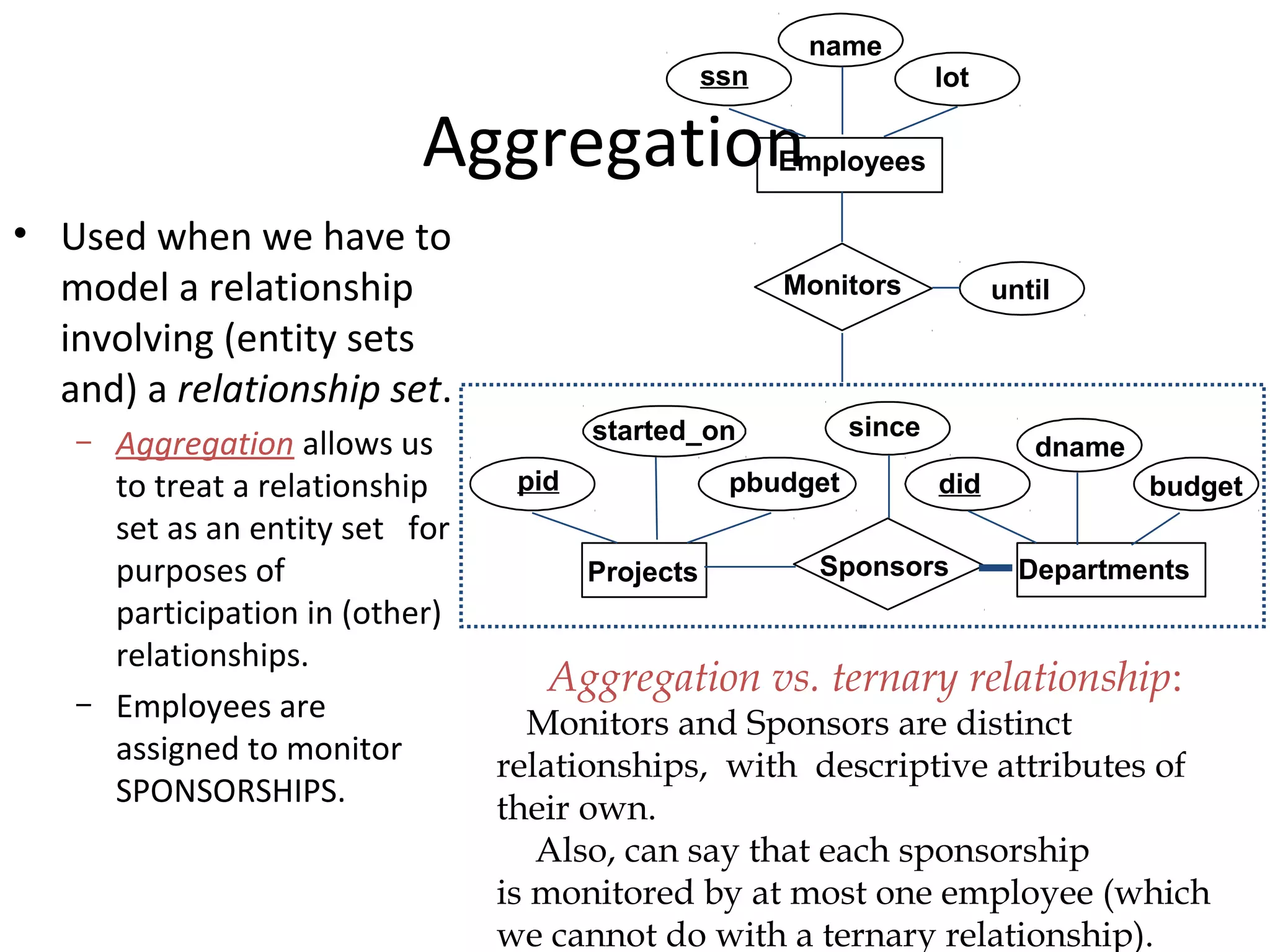
• Used when we have to
model a relationship
involving (entity sets
and) a relationship set.
– Aggregation allows us
to treat a relationship
set as an entity set for
purposes of
participation in (other)
relationships.
– Employees are
assigned to monitor
SPONSORSHIPS.
Aggregation vs. ternary relationship:
Monitors and Sponsors are distinct
relationships, with descriptive attributes of
their own.
Also, can say that each sponsorship
is monitored by at most one employee (which
we cannot do with a ternary relationship).
budgetdidpid
started_on
pbudget
dname
until
DepartmentsProjects Sponsors
Employees
Monitors
lot
name
ssn
since
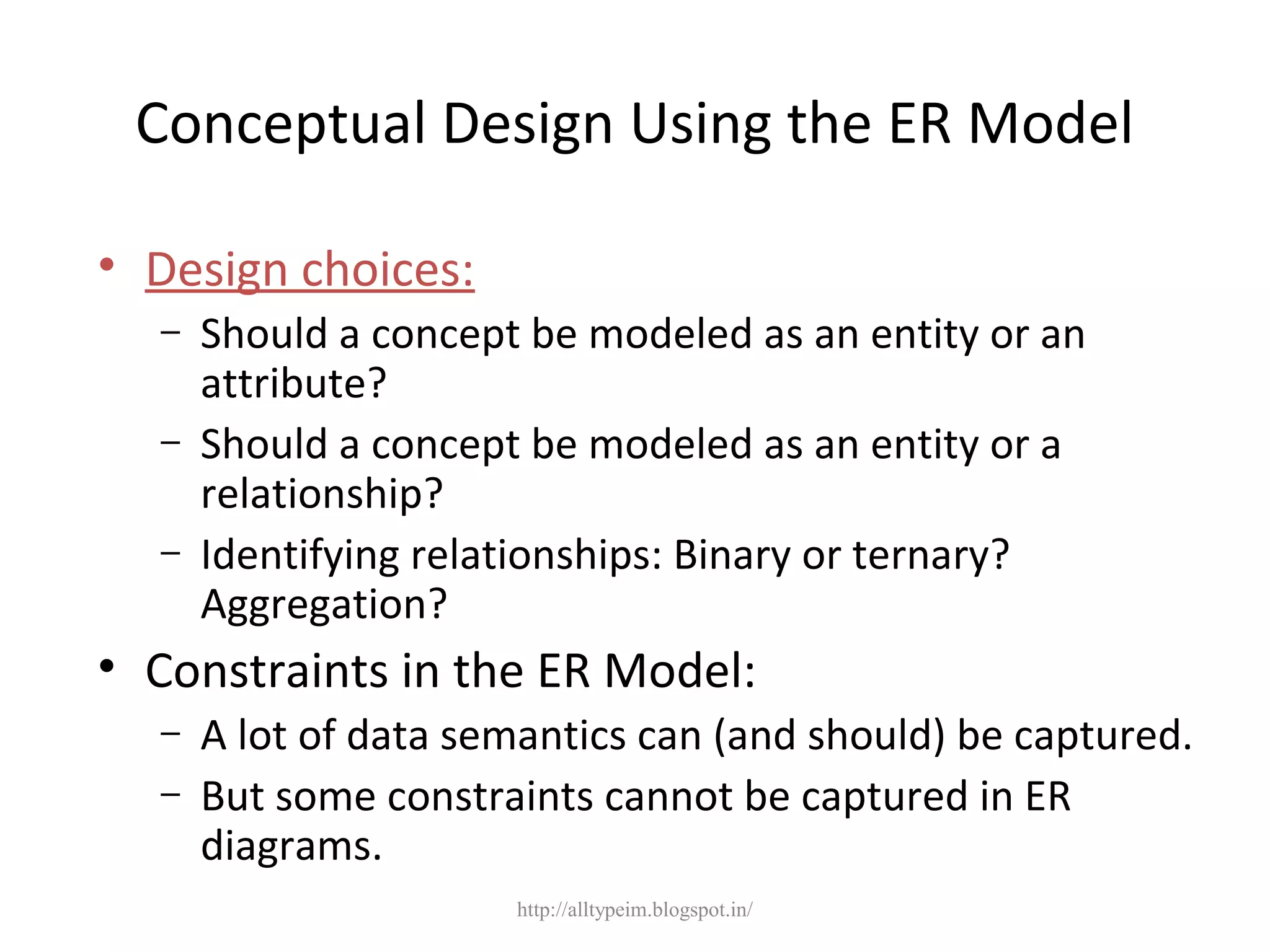
Conceptual Design Using the ER Model
• Design choices:
– Should a concept be modeled as an entity or an
attribute?
– Should a concept be modeled as an entity or a
relationship?
– Identifying relationships: Binary or ternary?
Aggregation?
• Constraints in the ER Model:
– A lot of data semantics can (and should) be captured.
– But some constraints cannot be captured in ER
diagrams.
http://alltypeim.blogspot.in/
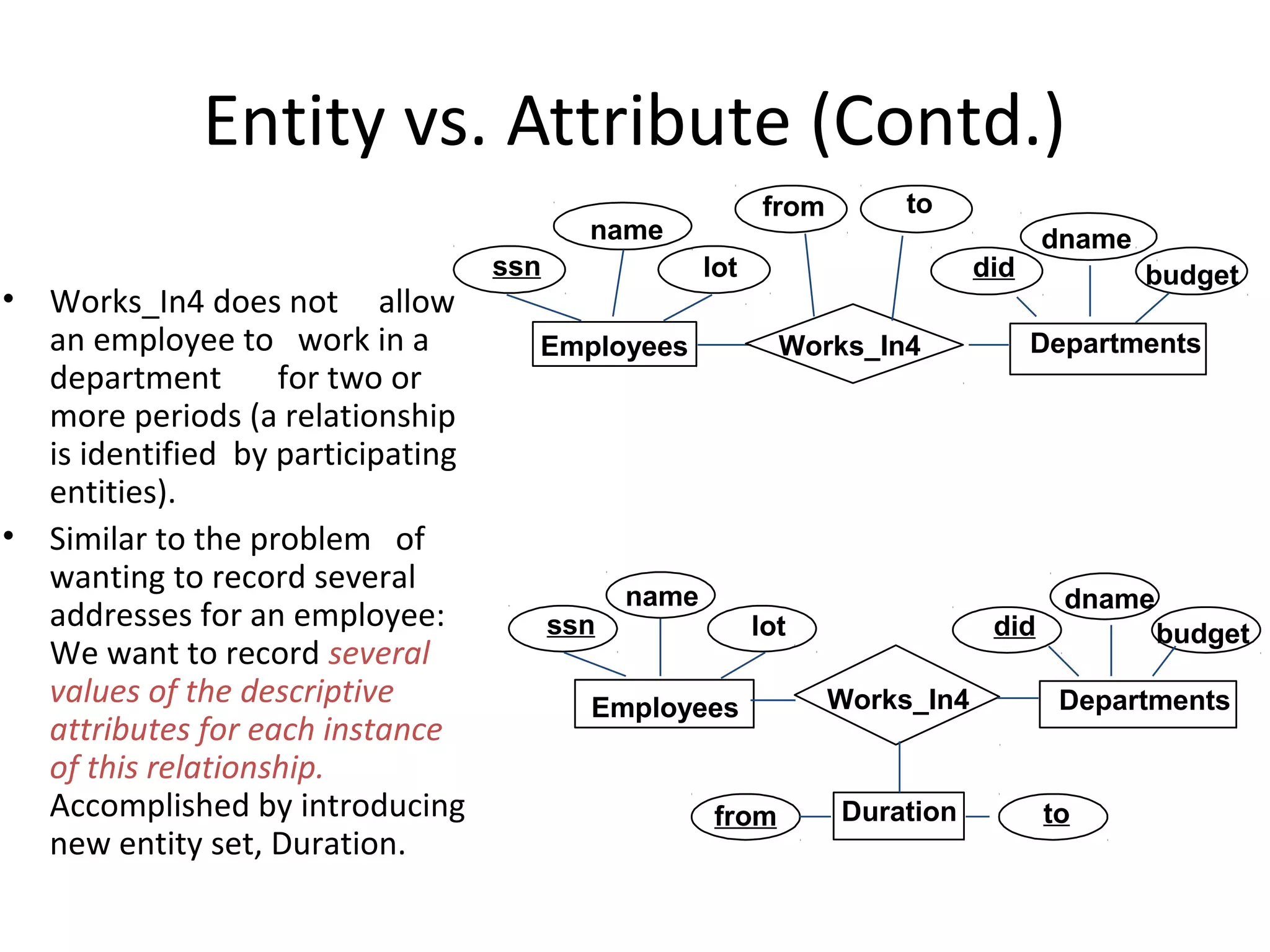
Entity vs. Attribute (Contd.)
• Works_In4 does not allow
an employee to work in a
department for two or
more periods (a relationship
is identified by participating
entities).
• Similar to the problem of
wanting to record several
addresses for an employee:
We want to record several
values of the descriptive
attributes for each instance
of this relationship.
Accomplished by introducing
new entity set, Duration.
name
Employees
ssn lot
Works_In4
from to
dname
budgetdid
Departments
dname
budgetdid
name
Departments
ssn lot
Employees Works_In4
Durationfrom to
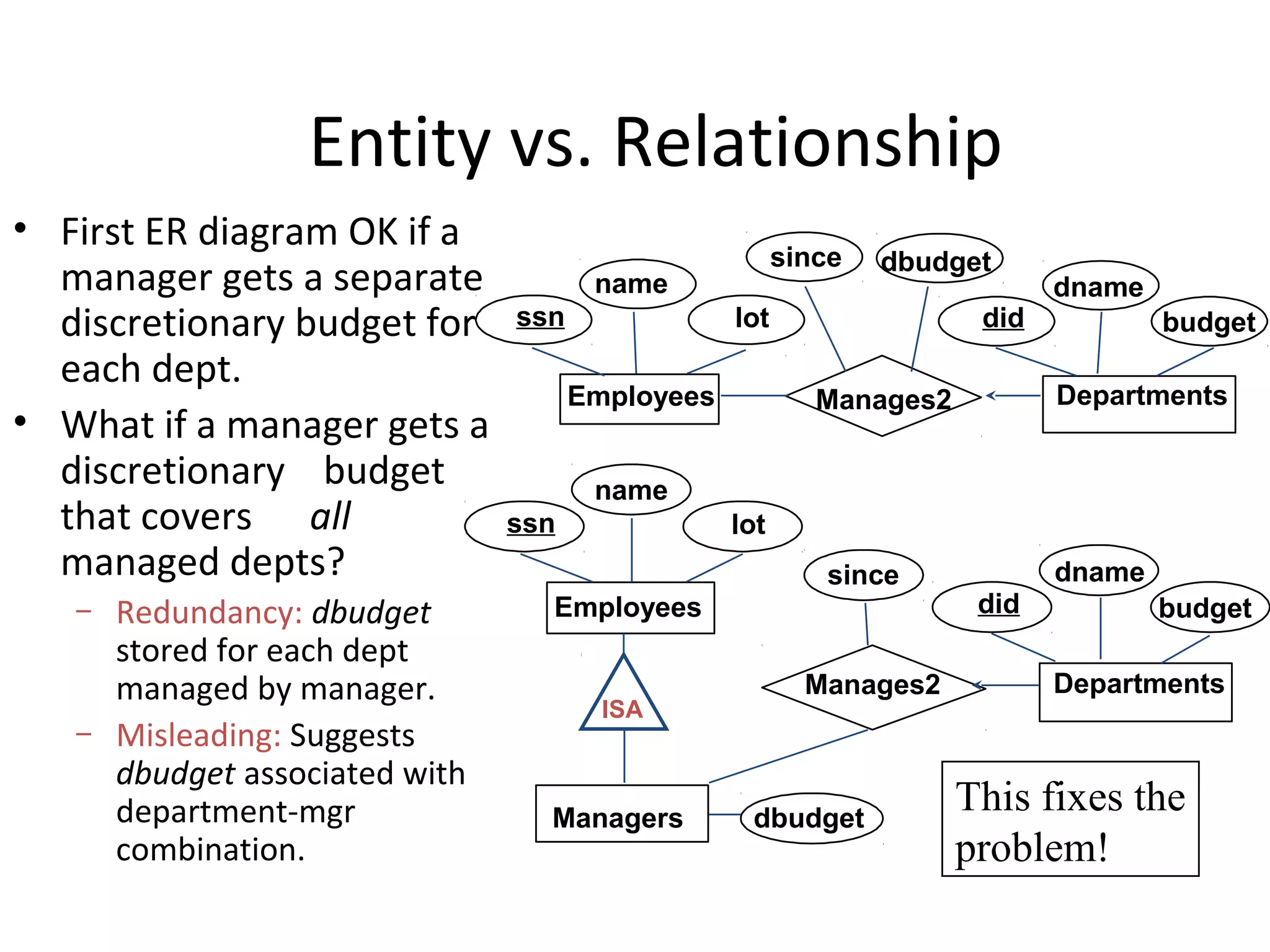
Entity vs. Relationship
• First ER diagram OK if a
manager gets a separate
discretionary budget for
each dept.
• What if a manager gets a
discretionary budget
that covers all
managed depts?
– Redundancy: dbudget
stored for each dept
managed by manager.
– Misleading: Suggests
dbudget associated with
department-mgr
combination.
Manages2
name dname
budgetdid
Employees Departments
ssn lot
dbudgetsince
dname
budgetdid
DepartmentsManages2
Employees
name
ssn lot
since
Managers dbudget
ISA
This fixes the
problem!
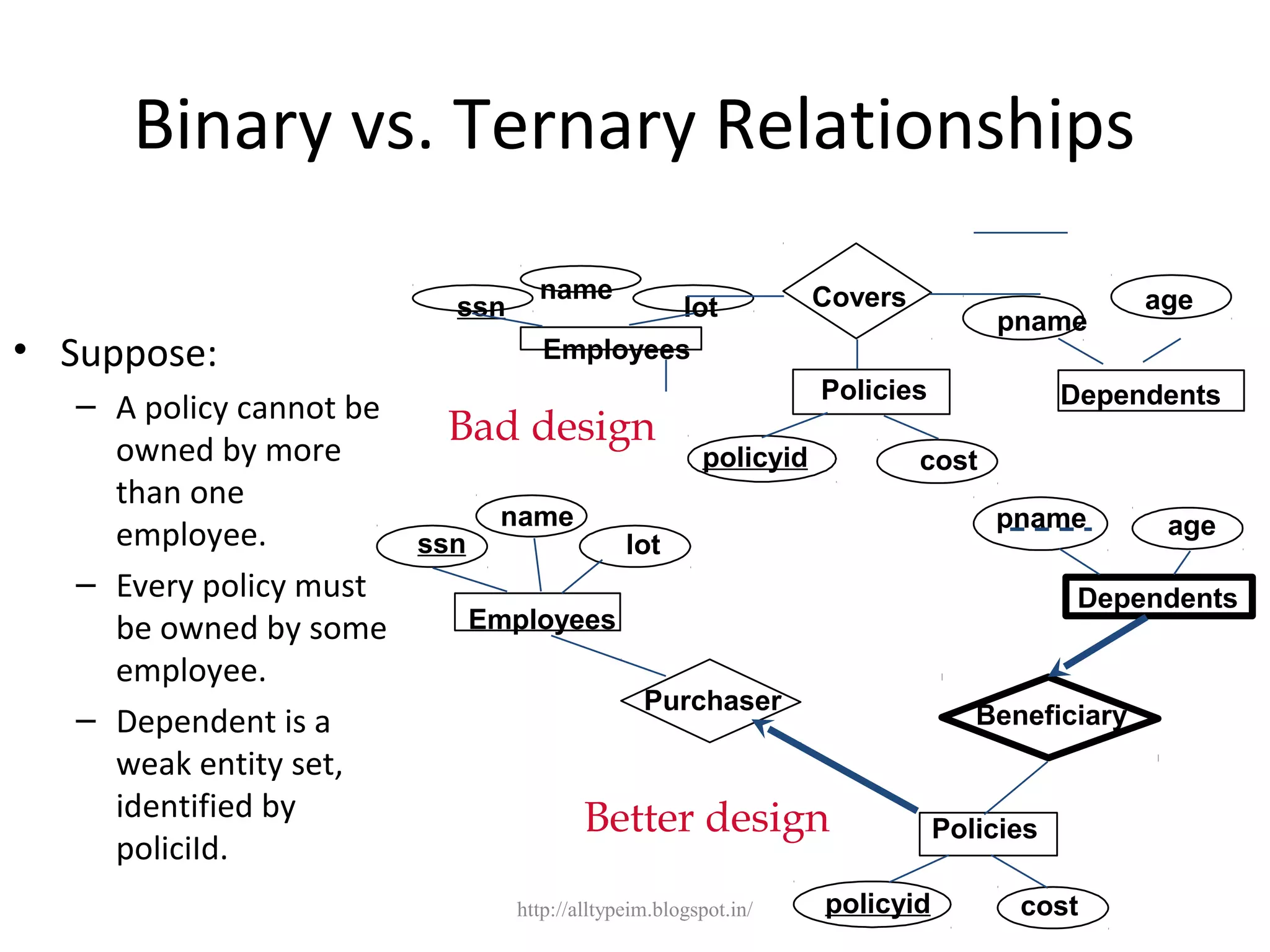
Binary vs. Ternary Relationships
• Suppose:
– A policy cannot be
owned by more
than one
employee.
– Every policy must
be owned by some
employee.
– Dependent is a
weak entity set,
identified by
policiId.
age
pname
Dependents
Coversname
Employees
ssn lot
Policies
policyid cost
Beneficiary
agepname
Dependents
policyid cost
Policies
Purchaser
name
Employees
ssn lot
Bad design
Better design
http://alltypeim.blogspot.in/
Binary vs. Ternary Relationships (Contd.)
• Previous example illustrated a case when two
binary relationships were better than one
ternary relationship.
• An example in the other direction: a ternary
relation Contracts relates entity sets Parts,
Departments and Suppliers, and has descriptive
attribute qty. No combination of binary
relationships is an adequate substitute:
– Although S “can-supply” P, D “needs” P, and D
“deals-with” S, all these do not imply that D has
agreed to buy P from S (because D could buy P from
another supplier).
http://alltypeim.blogspot.in/
Summary of Conceptual Design
• Conceptual design follows requirements analysis,
– Yields a high-level description of data to be stored
• ER model popular for conceptual design
– Constructs are expressive, close to the way people
think about their applications.
• Basic constructs: entities, relationships, and
attributes (of entities and relationships).
• Some additional constructs: weak entities, ISA
hierarchies, and aggregation.
• Note: There are many variations on ER model.
http://alltypeim.blogspot.in/
Summary of ER (Contd.)
• Several kinds of integrity constraints can be
expressed in the ER model: key constraints,
participation constraints, and overlap/covering
constraints for ISA hierarchies. Some foreign key
constraints are also implicit in the definition of a
relationship set.
– Some constraints (notably, functional dependencies)
cannot be expressed in the ER model.
– Constraints play an important role in determining the
best database design for an enterprise.
http://alltypeim.blogspot.in/
Summary of ER (Contd.)
• ER design is subjective. There are often many
ways to model a given scenario! Analyzing
alternatives can be tricky, especially for a large
enterprise. Common choices include:
– Entity vs. attribute, entity vs. relationship, binary or
n-ary relationship, whether or not to use ISA
hierarchies, and whether or not to use aggregation.
• Ensuring good database design: resulting
relational schema should be analyzed and
refined further. FD information and
normalization techniques are especially useful.
http://alltypeim.blogspot.in/

The entity relationship model

  • 1.
  • 2.
    ER Model BASIC •Entity: Real-world object distinguishable from other objects. An entity is described using a set of • attributes: An entity is described by its attributes, which are properties characterizing it. Each attribute has a value drawn from some domain • Entity Set: A collection of entities of the same kind. E.g., all employees. – All entities in an entity set have the same set of attributes. – Each entity set has a key(a set of attributes uniquely identifying an entity). – Each attribute has a domain. Employees ssn name lot http://alltypeim.blogspot.in/
  • 3.
    Key Constraints (a.k.a. Cardinality) ConsiderWorks_In (in previous slide): An employee can work in many departments; a dept can have many employees. In contrast, each dept has at most one manager, according to the key constraint on Manages. Many-to-Many1-to-1 1-to Many Many-to-1 dname budgetdid since lot name ssn ManagesEmployees Departments Constraints are IMPORTANT because they must be ENFORCED when IMPLEMENTING the database
  • 4.
    Key Constraints (ternary relationships) dname budgetdid name lot name ssn works_InEmployeesDepartments Location 12-233 12-243 12-354 12-299 Rome Paris London D10 D13 D12• • • • Each employee can work at most in one department at a single location
  • 5.
    Participation Constraints Does everydepartment have a manager?  If so, this is a participation constraint: the participation of Departments in Manages is said to be total (vs. partial). Every Department MUST have at least an employee Every employee MUST work at least in one department There may exist employees managing no department lot name dname budgetdid since name dname budgetdid since Manages since DepartmentsEmployees ssn Works_In http://alltypeim.blogspot.in/
  • 6.
    Weak Entities A weakentity can be identified uniquely only by considering the primary key of another (owner) entity.  Owner entity set and weak entity set must participate in a one-to-many relationship set (one owner, many weak entities).  Weak entity sets must have total participation in this identifying relationship set.  transac# is a discriminator within a group of transactions in an ATM. since address amounttransac# TransactionsATM atmID type http://alltypeim.blogspot.in/
  • 7.
    ISA (`is a’)Hierarchies • Overlap constraints: Can Joe be an Hourly_Emps as well as a Contract_Emps entity? if so, specify => Hourly_Emps OVERLAPS Contract_Emps. • Covering constraints: Does every Employees’ entity also have to be an Hourly_Emps or a Contract_Emps entity?. If so, write Hourly_Emps AND Contract_Emps COVER Employees. Contract_Emps name ssn Employees lot hourly_wages Hourly_Emps contractid hours_worked As in C++, or other PLs, attributes are inherited. If we declare A ISA B, every A entity is also considered to be a B entity. » Reasons for using ISA: To add descriptive attributes specific to a subclass. To identify entities that participate in a relationship. ISA
  • 8.
    Aggregation • Used whenwe have to model a relationship involving (entity sets and) a relationship set. – Aggregation allows us to treat a relationship set as an entity set for purposes of participation in (other) relationships. – Employees are assigned to monitor SPONSORSHIPS. Aggregation vs. ternary relationship: Monitors and Sponsors are distinct relationships, with descriptive attributes of their own. Also, can say that each sponsorship is monitored by at most one employee (which we cannot do with a ternary relationship). budgetdidpid started_on pbudget dname until DepartmentsProjects Sponsors Employees Monitors lot name ssn since
  • 9.
    Conceptual Design Usingthe ER Model • Design choices: – Should a concept be modeled as an entity or an attribute? – Should a concept be modeled as an entity or a relationship? – Identifying relationships: Binary or ternary? Aggregation? • Constraints in the ER Model: – A lot of data semantics can (and should) be captured. – But some constraints cannot be captured in ER diagrams. http://alltypeim.blogspot.in/
  • 10.
    Entity vs. Attribute(Contd.) • Works_In4 does not allow an employee to work in a department for two or more periods (a relationship is identified by participating entities). • Similar to the problem of wanting to record several addresses for an employee: We want to record several values of the descriptive attributes for each instance of this relationship. Accomplished by introducing new entity set, Duration. name Employees ssn lot Works_In4 from to dname budgetdid Departments dname budgetdid name Departments ssn lot Employees Works_In4 Durationfrom to
  • 11.
    Entity vs. Relationship •First ER diagram OK if a manager gets a separate discretionary budget for each dept. • What if a manager gets a discretionary budget that covers all managed depts? – Redundancy: dbudget stored for each dept managed by manager. – Misleading: Suggests dbudget associated with department-mgr combination. Manages2 name dname budgetdid Employees Departments ssn lot dbudgetsince dname budgetdid DepartmentsManages2 Employees name ssn lot since Managers dbudget ISA This fixes the problem!
  • 12.
    Binary vs. TernaryRelationships • Suppose: – A policy cannot be owned by more than one employee. – Every policy must be owned by some employee. – Dependent is a weak entity set, identified by policiId. age pname Dependents Coversname Employees ssn lot Policies policyid cost Beneficiary agepname Dependents policyid cost Policies Purchaser name Employees ssn lot Bad design Better design http://alltypeim.blogspot.in/
  • 13.
    Binary vs. TernaryRelationships (Contd.) • Previous example illustrated a case when two binary relationships were better than one ternary relationship. • An example in the other direction: a ternary relation Contracts relates entity sets Parts, Departments and Suppliers, and has descriptive attribute qty. No combination of binary relationships is an adequate substitute: – Although S “can-supply” P, D “needs” P, and D “deals-with” S, all these do not imply that D has agreed to buy P from S (because D could buy P from another supplier). http://alltypeim.blogspot.in/
  • 14.
    Summary of ConceptualDesign • Conceptual design follows requirements analysis, – Yields a high-level description of data to be stored • ER model popular for conceptual design – Constructs are expressive, close to the way people think about their applications. • Basic constructs: entities, relationships, and attributes (of entities and relationships). • Some additional constructs: weak entities, ISA hierarchies, and aggregation. • Note: There are many variations on ER model. http://alltypeim.blogspot.in/
  • 15.
    Summary of ER(Contd.) • Several kinds of integrity constraints can be expressed in the ER model: key constraints, participation constraints, and overlap/covering constraints for ISA hierarchies. Some foreign key constraints are also implicit in the definition of a relationship set. – Some constraints (notably, functional dependencies) cannot be expressed in the ER model. – Constraints play an important role in determining the best database design for an enterprise. http://alltypeim.blogspot.in/
  • 16.
    Summary of ER(Contd.) • ER design is subjective. There are often many ways to model a given scenario! Analyzing alternatives can be tricky, especially for a large enterprise. Common choices include: – Entity vs. attribute, entity vs. relationship, binary or n-ary relationship, whether or not to use ISA hierarchies, and whether or not to use aggregation. • Ensuring good database design: resulting relational schema should be analyzed and refined further. FD information and normalization techniques are especially useful. http://alltypeim.blogspot.in/

Editor's Notes

  • #2 The slides for this text are organized into chapters. This lecture covers Chapter 2. Chapter 1: Introduction to Database Systems Chapter 2: The Entity-Relationship Model Chapter 3: The Relational Model Chapter 4 (Part A): Relational Algebra Chapter 4 (Part B): Relational Calculus Chapter 5: SQL: Queries, Programming, Triggers Chapter 6: Query-by-Example (QBE) Chapter 7: Storing Data: Disks and Files Chapter 8: File Organizations and Indexing Chapter 9: Tree-Structured Indexing Chapter 10: Hash-Based Indexing Chapter 11: External Sorting Chapter 12 (Part A): Evaluation of Relational Operators Chapter 12 (Part B): Evaluation of Relational Operators: Other Techniques Chapter 13: Introduction to Query Optimization Chapter 14: A Typical Relational Optimizer Chapter 15: Schema Refinement and Normal Forms Chapter 16 (Part A): Physical Database Design Chapter 16 (Part B): Database Tuning Chapter 17: Security Chapter 18: Transaction Management Overview Chapter 19: Concurrency Control Chapter 20: Crash Recovery Chapter 21: Parallel and Distributed Databases Chapter 22: Internet Databases Chapter 23: Decision Support Chapter 24: Data Mining Chapter 25: Object-Database Systems Chapter 26: Spatial Data Management Chapter 27: Deductive Databases Chapter 28: Additional Topics
  • #3 The slides for this text are organized into several modules. Each lecture contains about enough material for a 1.25 hour class period. (The time estimate is very approximate--it will vary with the instructor, and lectures also differ in length; so use this as a rough guideline.) This covers Lectures 1 and 2 (of 6) in Module (5). Module (1): Introduction (DBMS, Relational Model) Module (2): Storage and File Organizations (Disks, Buffering, Indexes) Module (3): Database Concepts (Relational Queries, DDL/ICs, Views and Security) Module (4): Relational Implementation (Query Evaluation, Optimization) Module (5): Database Design (ER Model, Normalization, Physical Design, Tuning) Module (6): Transaction Processing (Concurrency Control, Recovery) Module (7): Advanced Topics