Bisection Method
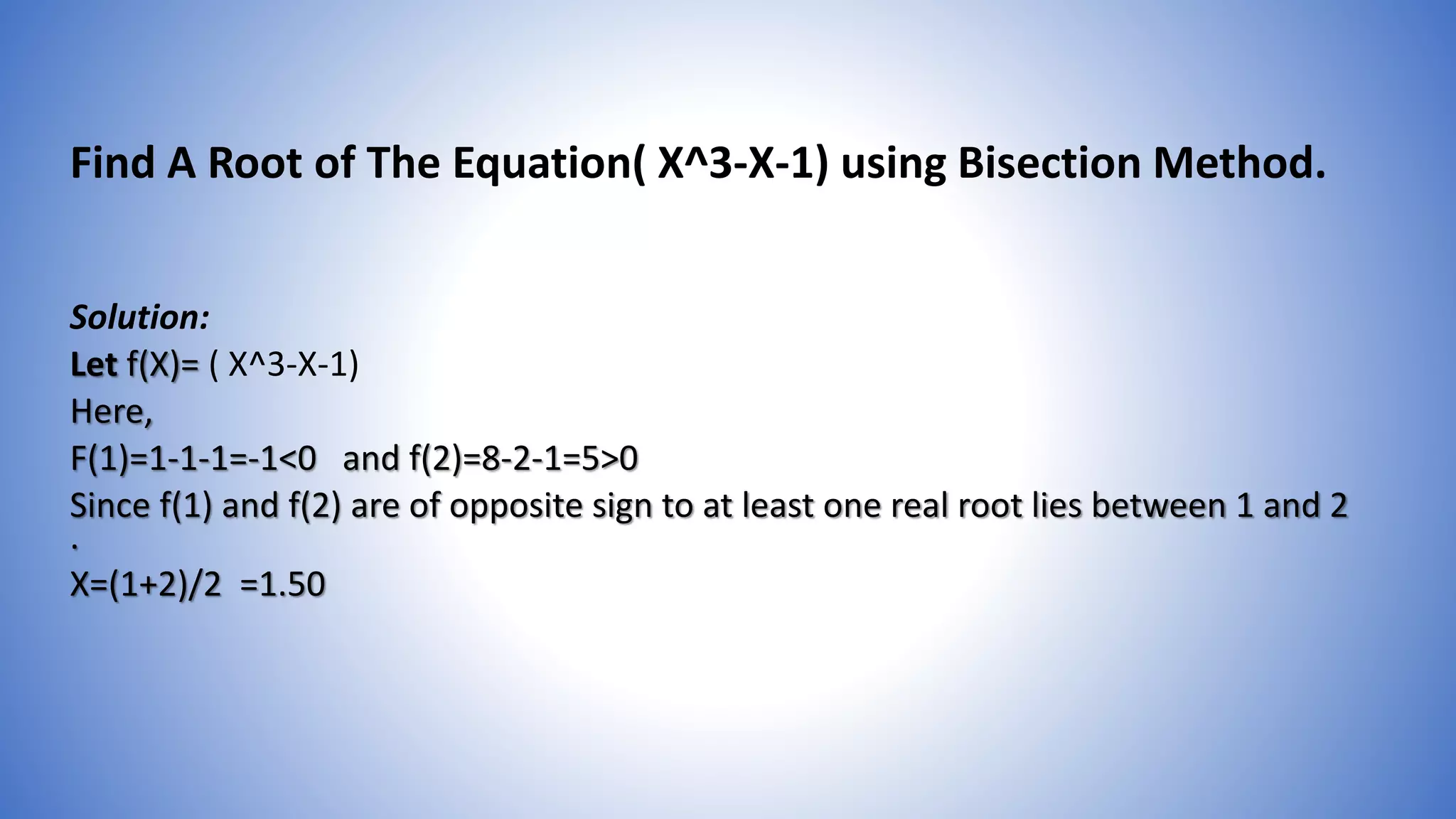
Find A Root of The Equation( X^3-X-1) using Bisection Method.
Solution:
Let f(X)= ( X^3-X-1)
Here,
F(1)=1-1-1=-1<0 and f(2)=8-2-1=5>0
Since f(1) and f(2) are of opposite sign to at least one real root lies between 1 and 2
.
X=(1+2)/2 =1.50
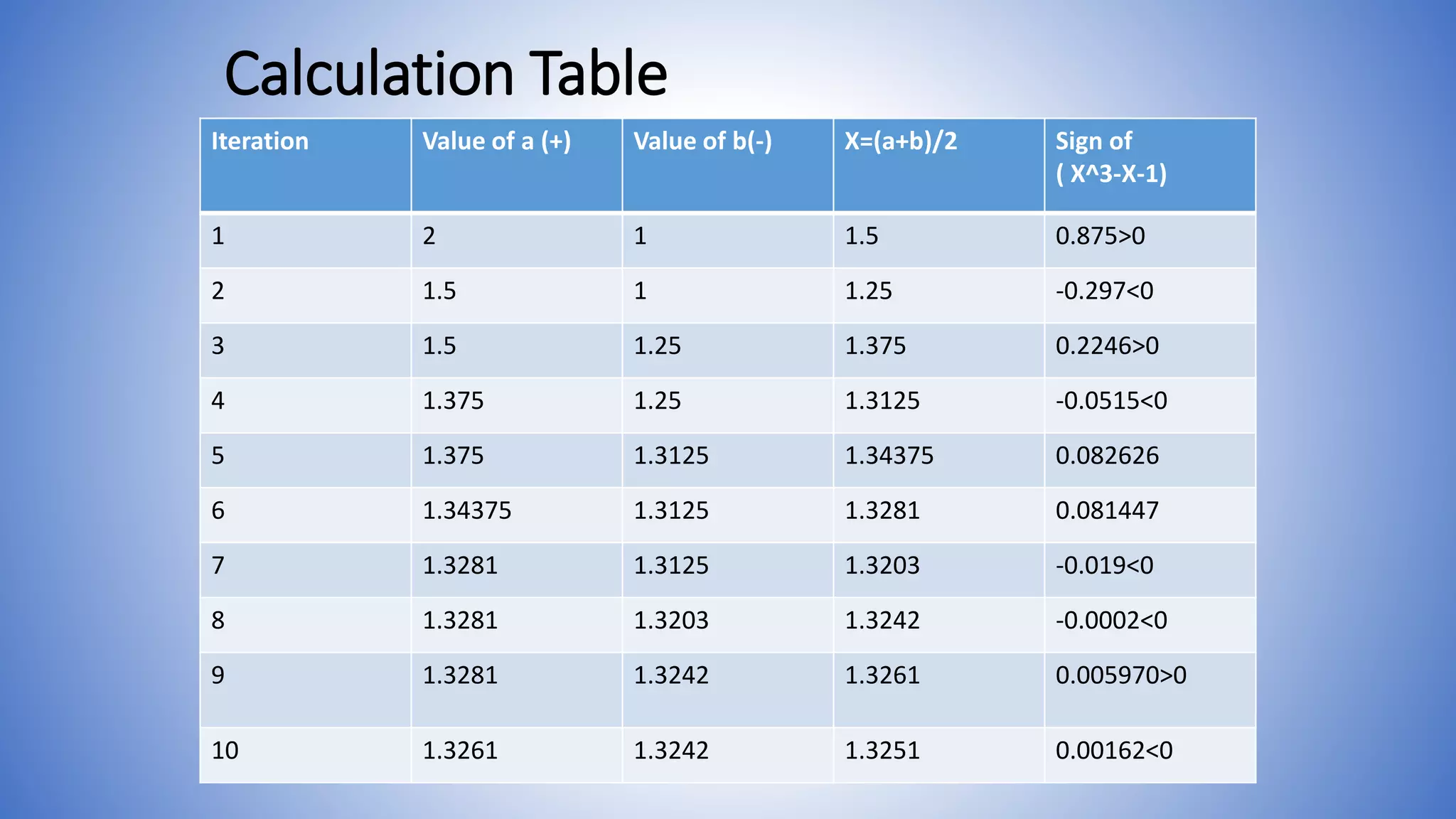
Calculation Table
Iteration Value of a (+) Value of b(-) X=(a+b)/2 Sign of
( X^3-X-1)
1 2 1 1.5 0.875>0
2 1.5 1 1.25 -0.297<0
3 1.5 1.25 1.375 0.2246>0
4 1.375 1.25 1.3125 -0.0515<0
5 1.375 1.3125 1.34375 0.082626
6 1.34375 1.3125 1.3281 0.081447
7 1.3281 1.3125 1.3203 -0.019<0
8 1.3281 1.3203 1.3242 -0.0002<0
9 1.3281 1.3242 1.3261 0.005970>0
10 1.3261 1.3242 1.3251 0.00162<0
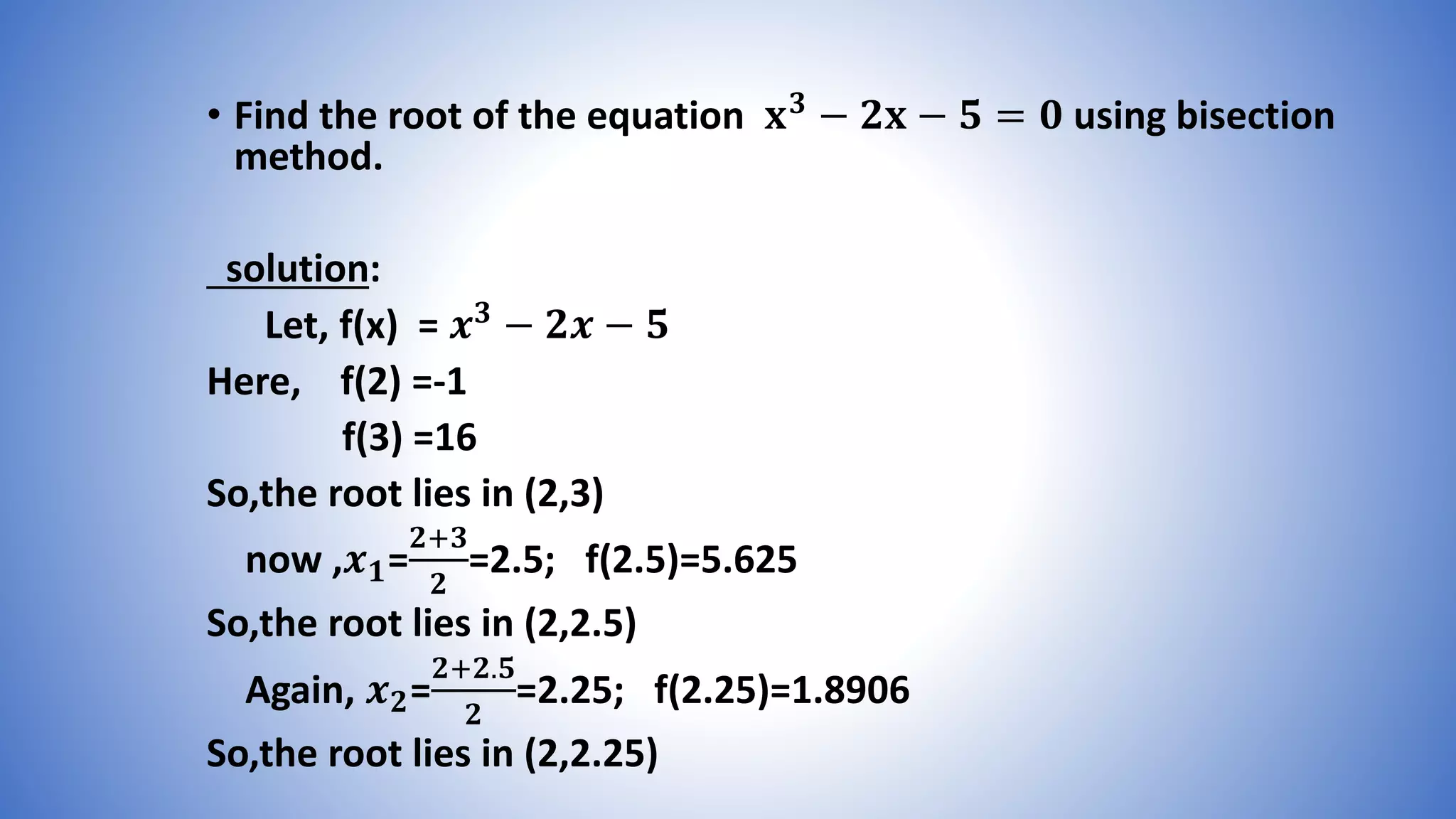
• Find the root of the equation 𝐱 𝟑 − 𝟐𝐱 − 𝟓 = 𝟎 using bisection
method.
solution:
Let, f(x) = 𝒙 𝟑 − 𝟐𝒙 − 𝟓
Here, f(2) =-1
f(3) =16
So,the root lies in (2,3)
now ,𝒙 𝟏=
𝟐+𝟑
𝟐
=2.5; f(2.5)=5.625
So,the root lies in (2,2.5)
Again, 𝒙 𝟐=
𝟐+𝟐.𝟓
𝟐
=2.25; f(2.25)=1.8906
So,the root lies in (2,2.25)
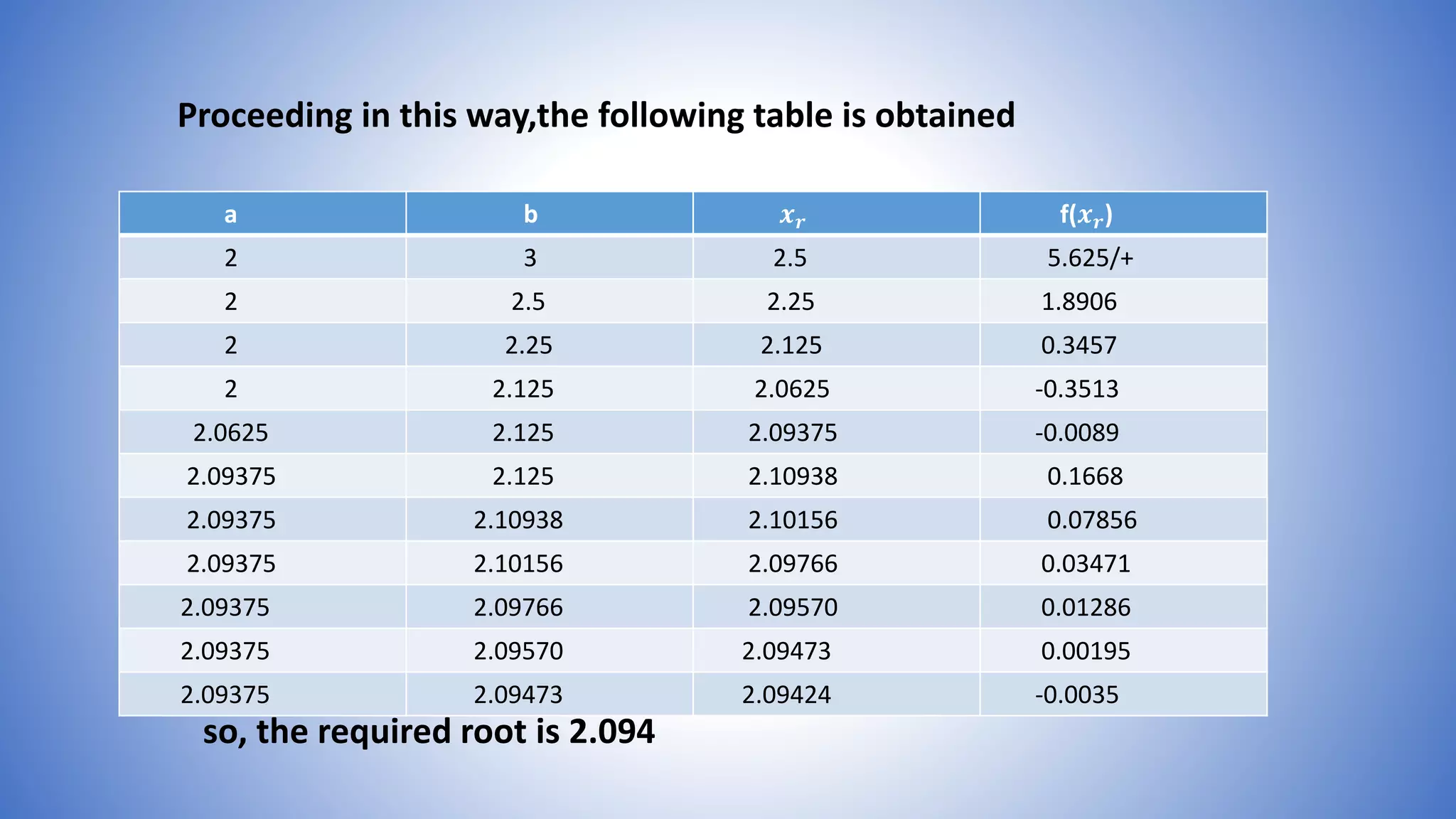
Proceeding in this way,the following table is obtained
so, the required root is 2.094
a b 𝒙 𝒓 f(𝒙 𝒓)
2 3 2.5 5.625/+
2 2.5 2.25 1.8906
2 2.25 2.125 0.3457
2 2.125 2.0625 -0.3513
2.0625 2.125 2.09375 -0.0089
2.09375 2.125 2.10938 0.1668
2.09375 2.10938 2.10156 0.07856
2.09375 2.10156 2.09766 0.03471
2.09375 2.09766 2.09570 0.01286
2.09375 2.09570 2.09473 0.00195
2.09375 2.09473 2.09424 -0.0035
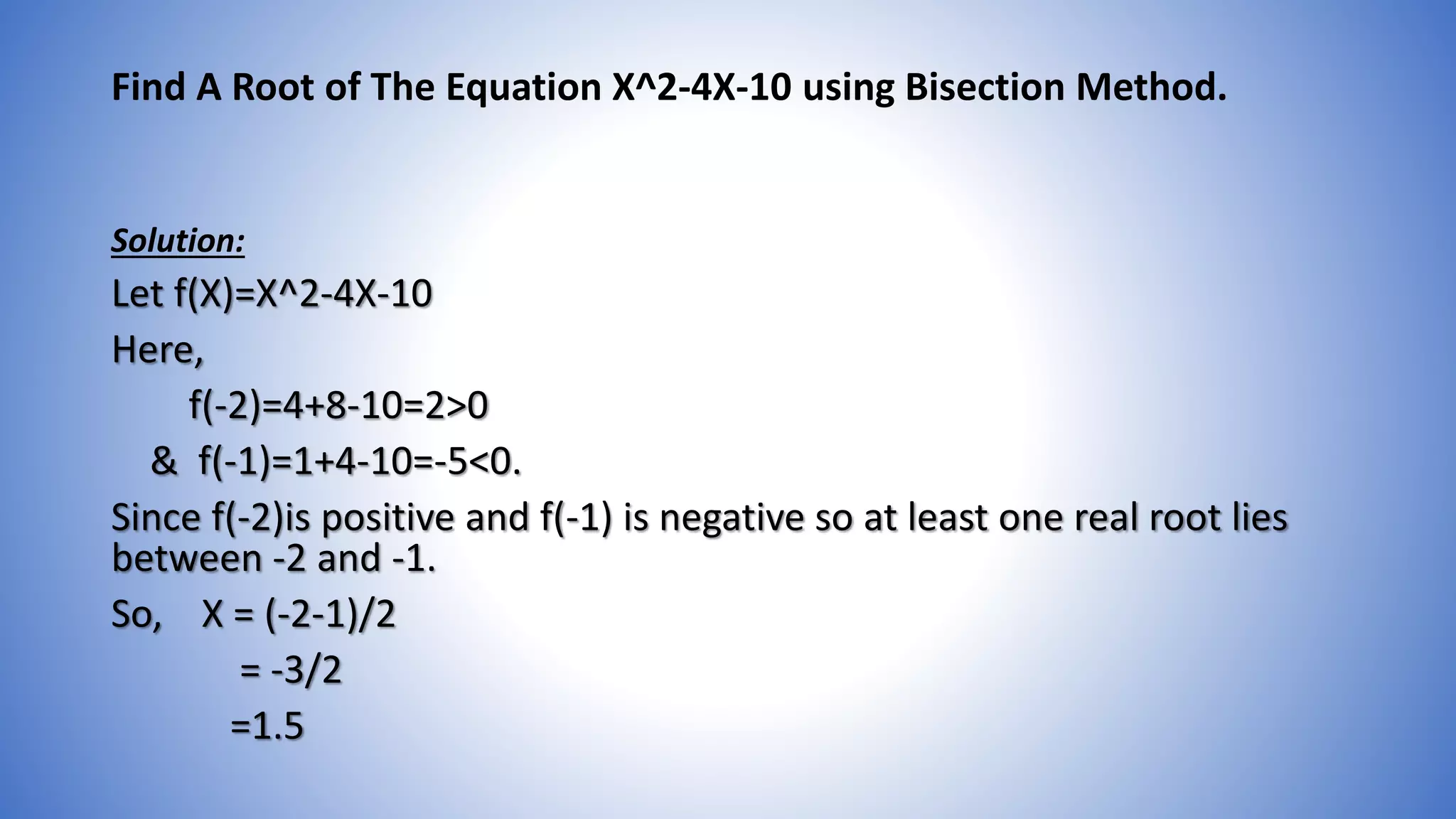
Find A Root of The Equation X^2-4X-10 using Bisection Method.
Solution:
Let f(X)=X^2-4X-10
Here,
f(-2)=4+8-10=2>0
& f(-1)=1+4-10=-5<0.
Since f(-2)is positive and f(-1) is negative so at least one real root lies
between -2 and -1.
So, X = (-2-1)/2
= -3/2
=1.5
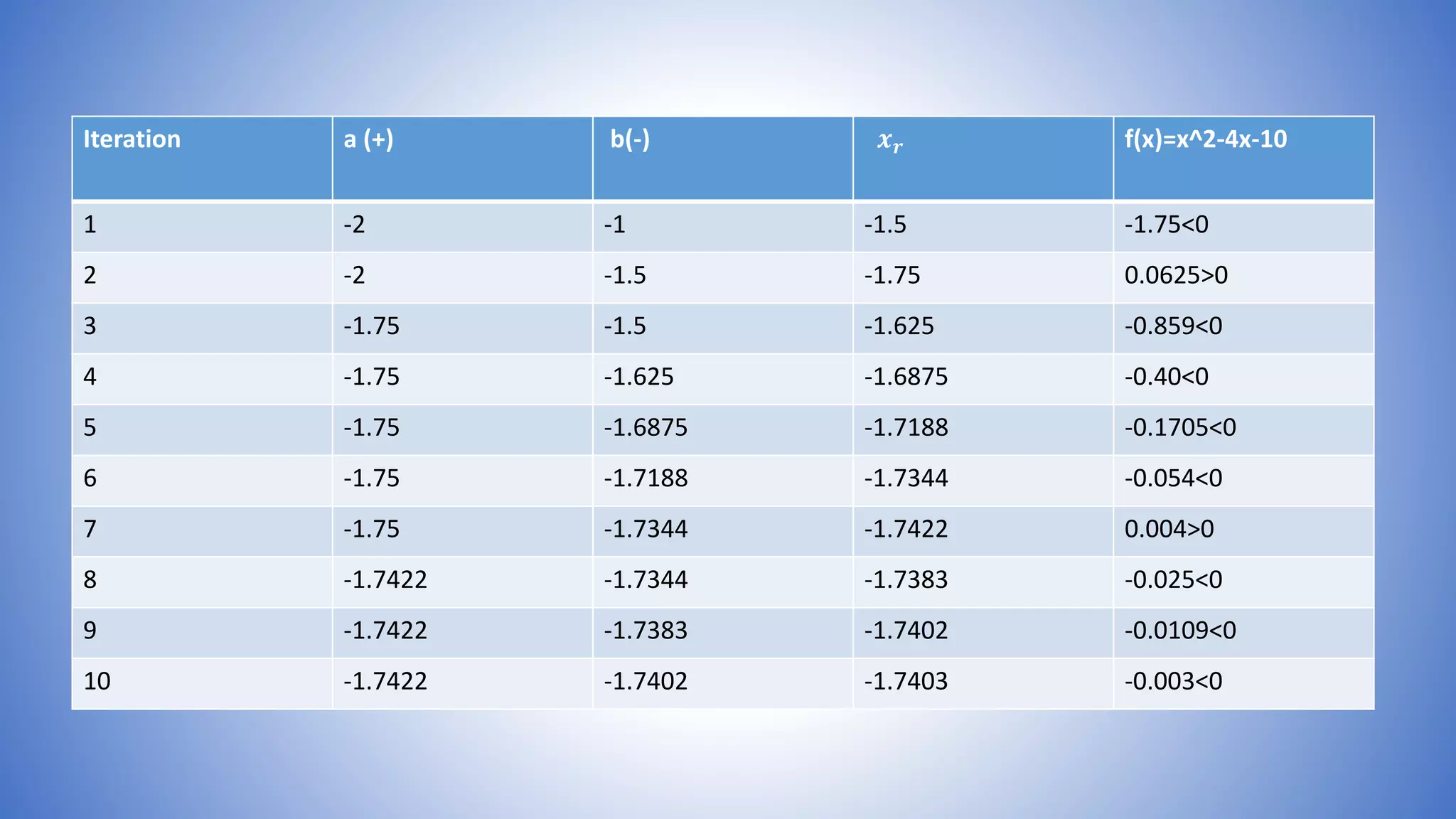
Iteration a (+) b(-) 𝒙 𝒓 f(x)=x^2-4x-10
1 -2 -1 -1.5 -1.75<0
2 -2 -1.5 -1.75 0.0625>0
3 -1.75 -1.5 -1.625 -0.859<0
4 -1.75 -1.625 -1.6875 -0.40<0
5 -1.75 -1.6875 -1.7188 -0.1705<0
6 -1.75 -1.7188 -1.7344 -0.054<0
7 -1.75 -1.7344 -1.7422 0.004>0
8 -1.7422 -1.7344 -1.7383 -0.025<0
9 -1.7422 -1.7383 -1.7402 -0.0109<0
10 -1.7422 -1.7402 -1.7403 -0.003<0
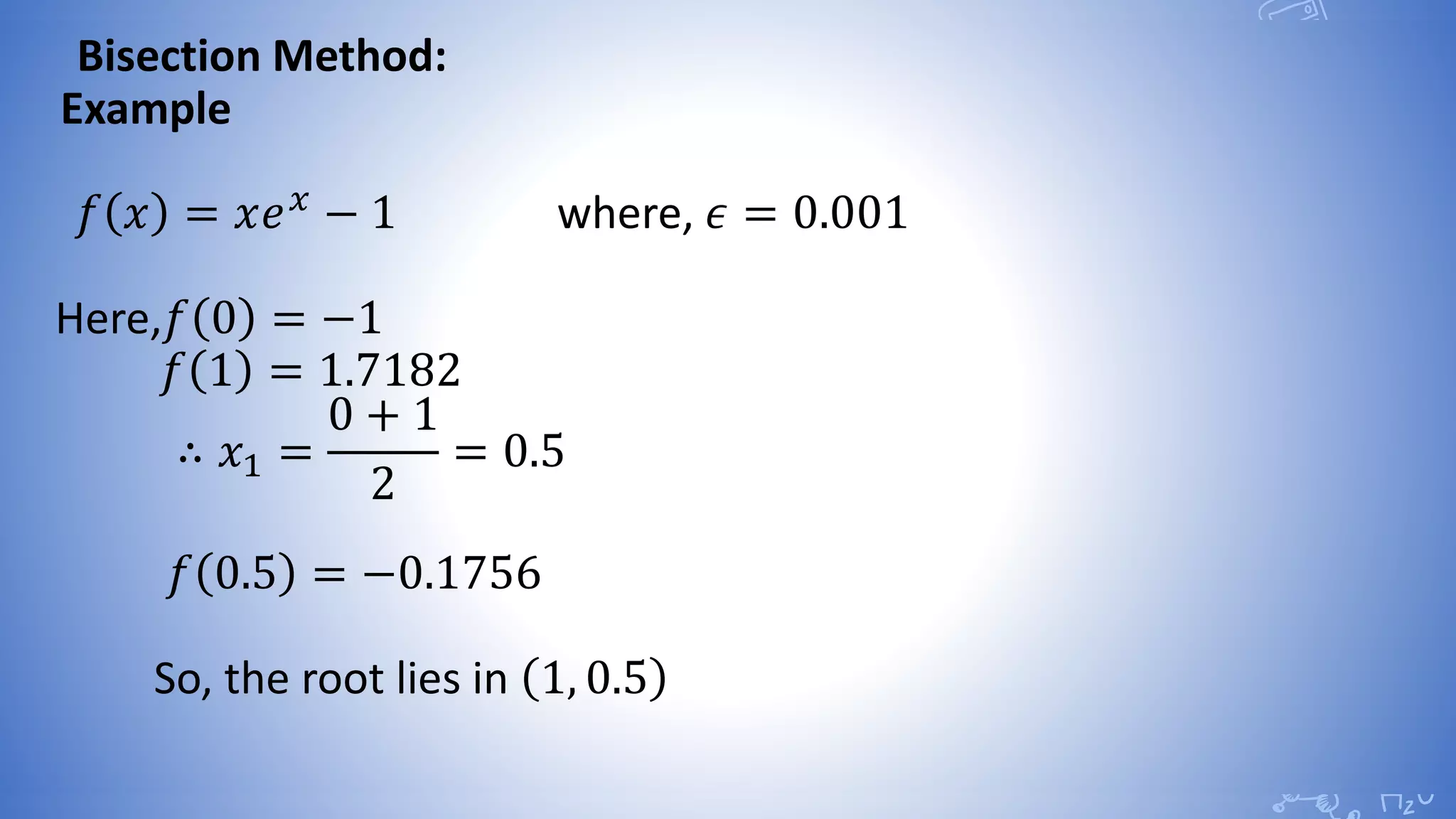
Bisection Method:
Example
𝑓 𝑥 = 𝑥𝑒 𝑥
− 1 where, 𝜖 = 0.001
Here,𝑓 0 = −1
𝑓 1 = 1.7182
∴ 𝑥1 =
0 + 1
2
= 0.5
𝑓 0.5 = −0.1756
So, the root lies in 1, 0.5
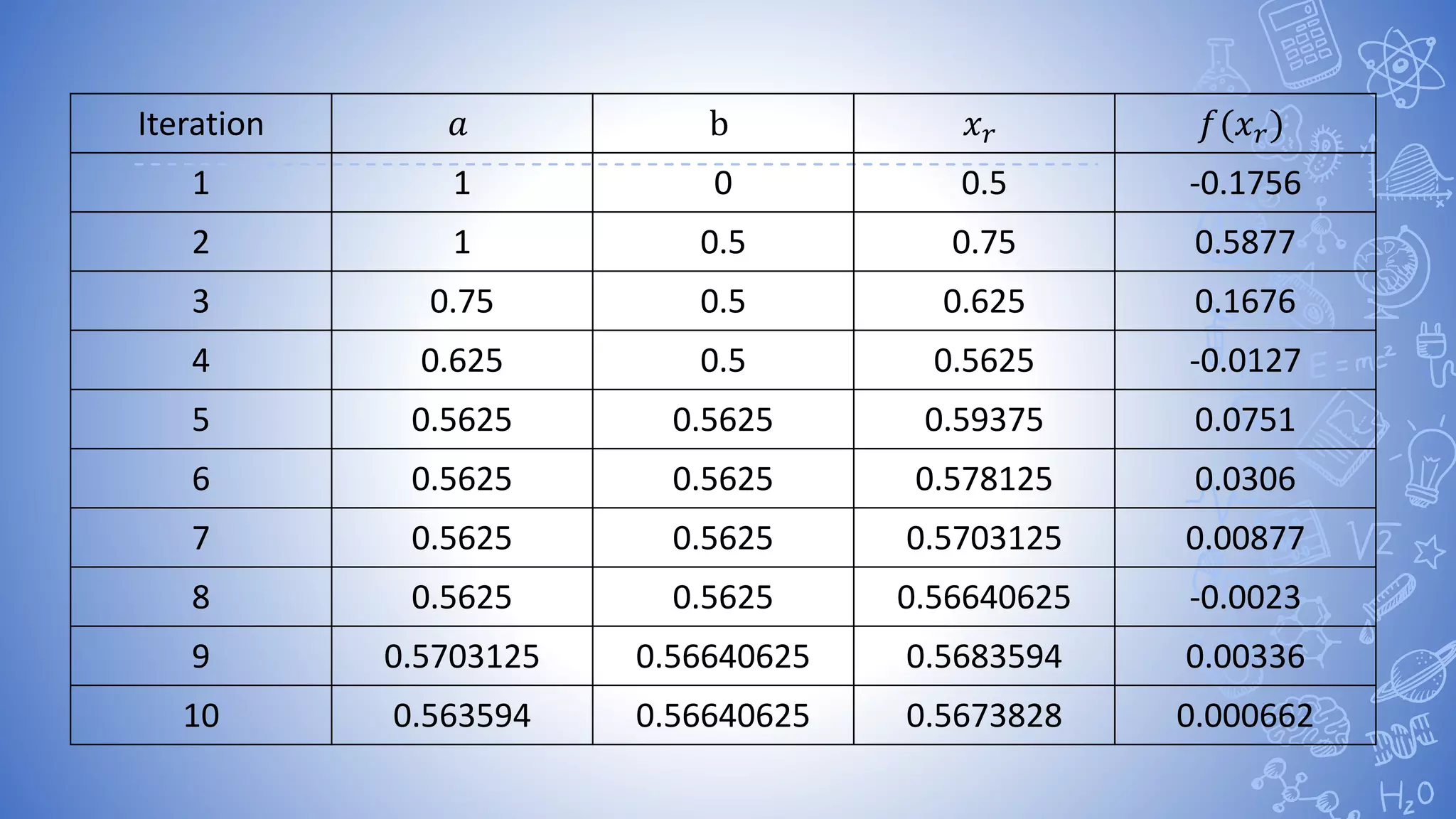
Iteration 𝑎 b 𝑥 𝑟 𝑓(𝑥 𝑟)
1 1 0 0.5 -0.1756
2 1 0.5 0.75 0.5877
3 0.75 0.5 0.625 0.1676
4 0.625 0.5 0.5625 -0.0127
5 0.5625 0.5625 0.59375 0.0751
6 0.5625 0.5625 0.578125 0.0306
7 0.5625 0.5625 0.5703125 0.00877
8 0.5625 0.5625 0.56640625 -0.0023
9 0.5703125 0.56640625 0.5683594 0.00336
10 0.563594 0.56640625 0.5673828 0.000662
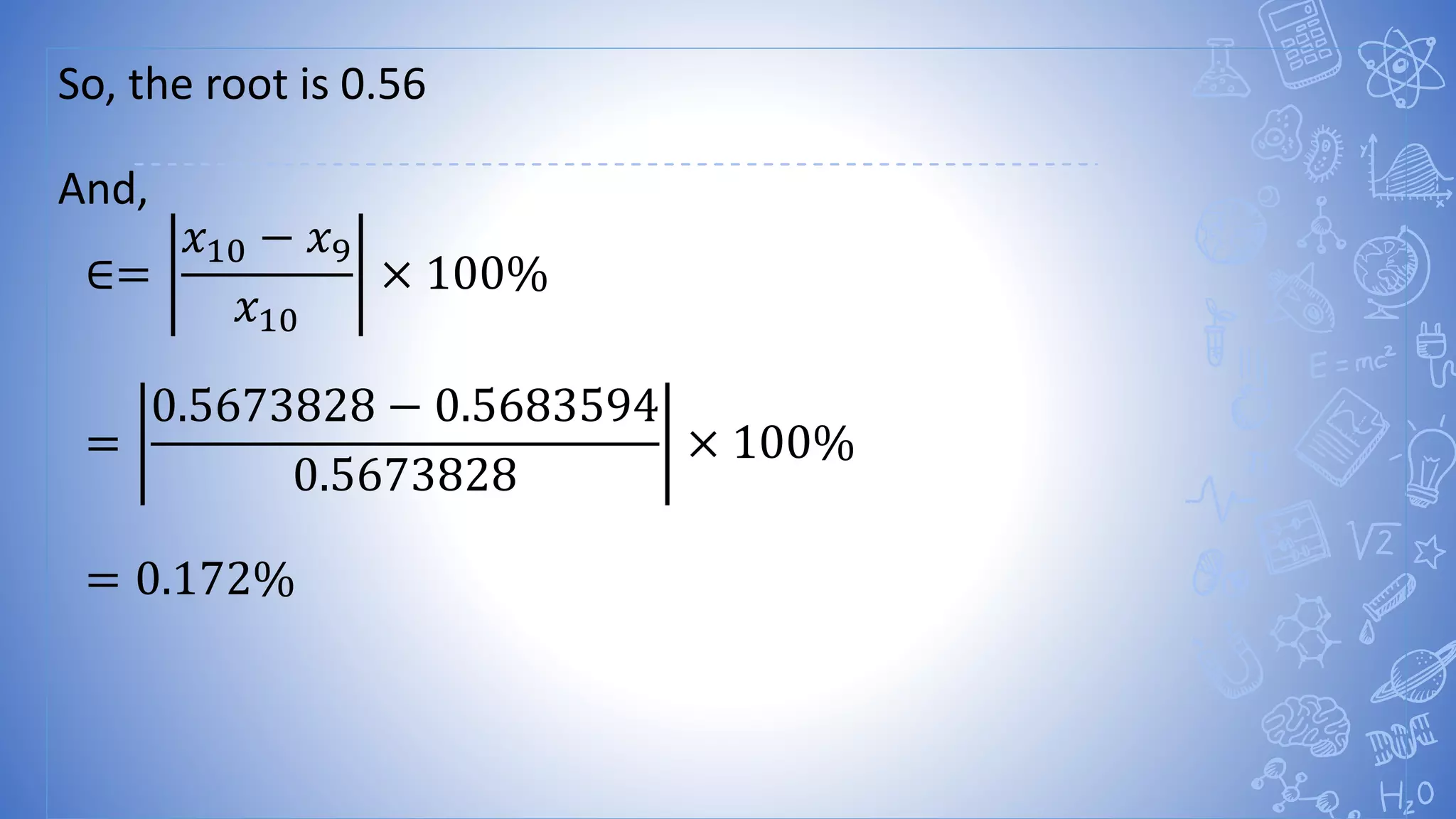
So, the root is 0.56
And,
∈=
𝑥10 − 𝑥9
𝑥10
× 100%
=
0.5673828 − 0.5683594
0.5673828
× 100%
= 0.172%
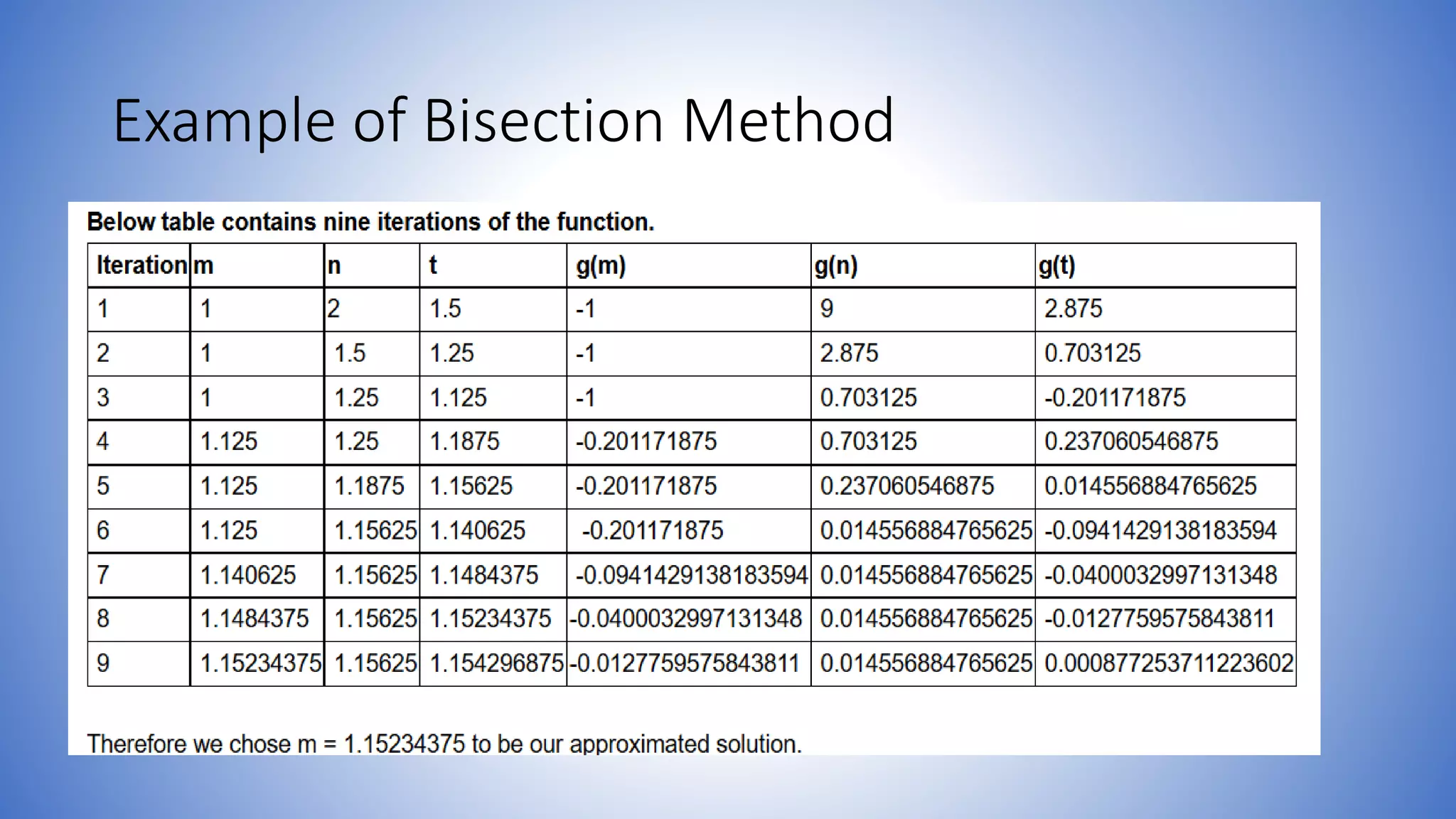
Example of Bisection Method
• Question:
• Find the root of the polynomial, g(x) = x3 - 5 + 3x using bisection
method. Where m = 1 and n = 2?
Solution: First find the value of g(x) at m = 1 and n = 2
g(1) = 13 - 5 + 3*1 = -1 < 0
g(2) = 23 - 5 + 3*2 = 9 > 0
Since function is continuous, its root lies in the interval [1, 2].
Example of Bisection Method
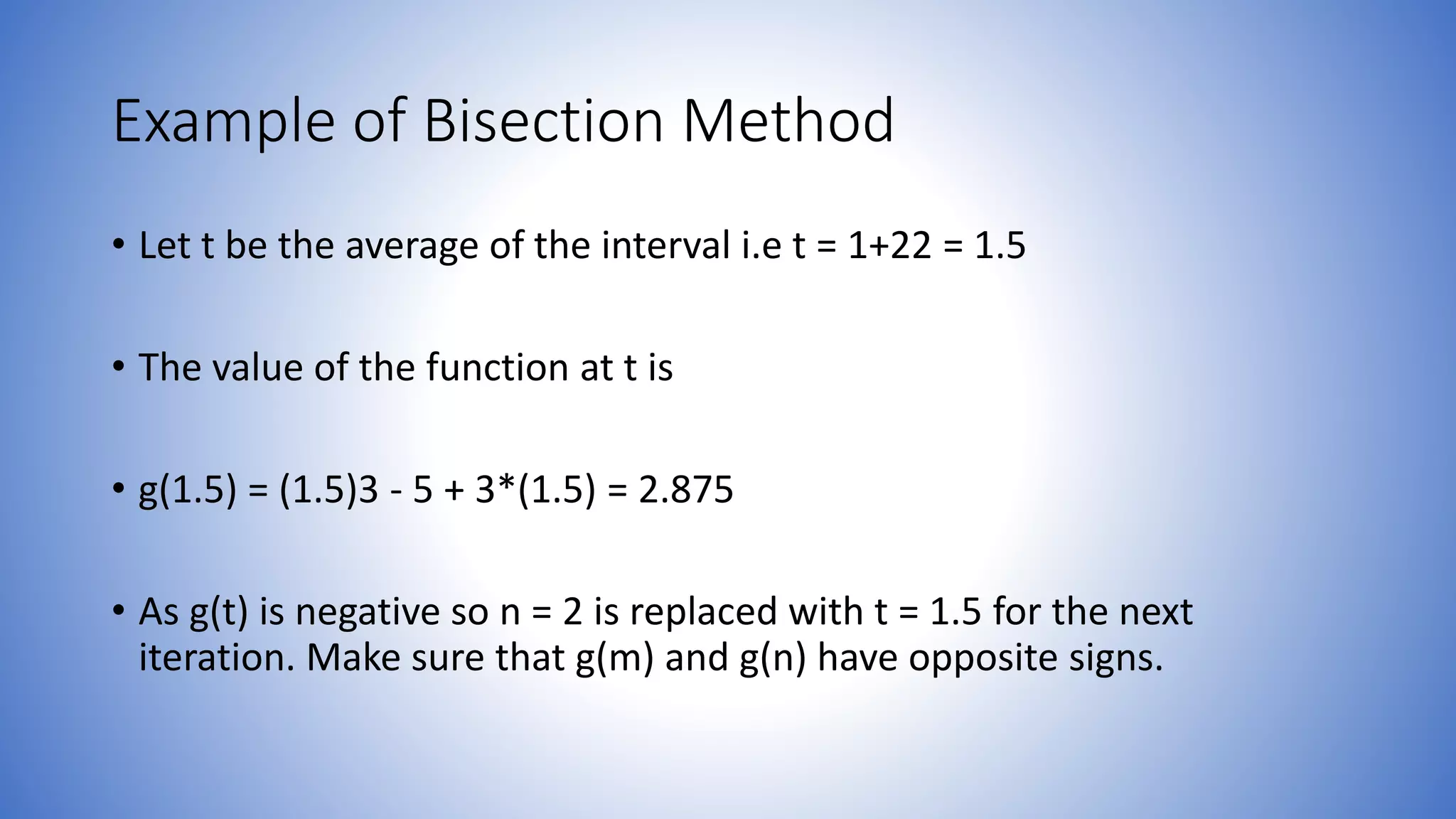
• Let t be the average of the interval i.e t = 1+22 = 1.5
• The value of the function at t is
• g(1.5) = (1.5)3 - 5 + 3*(1.5) = 2.875
• As g(t) is negative so n = 2 is replaced with t = 1.5 for the next
iteration. Make sure that g(m) and g(n) have opposite signs.
Example of Bisection Method
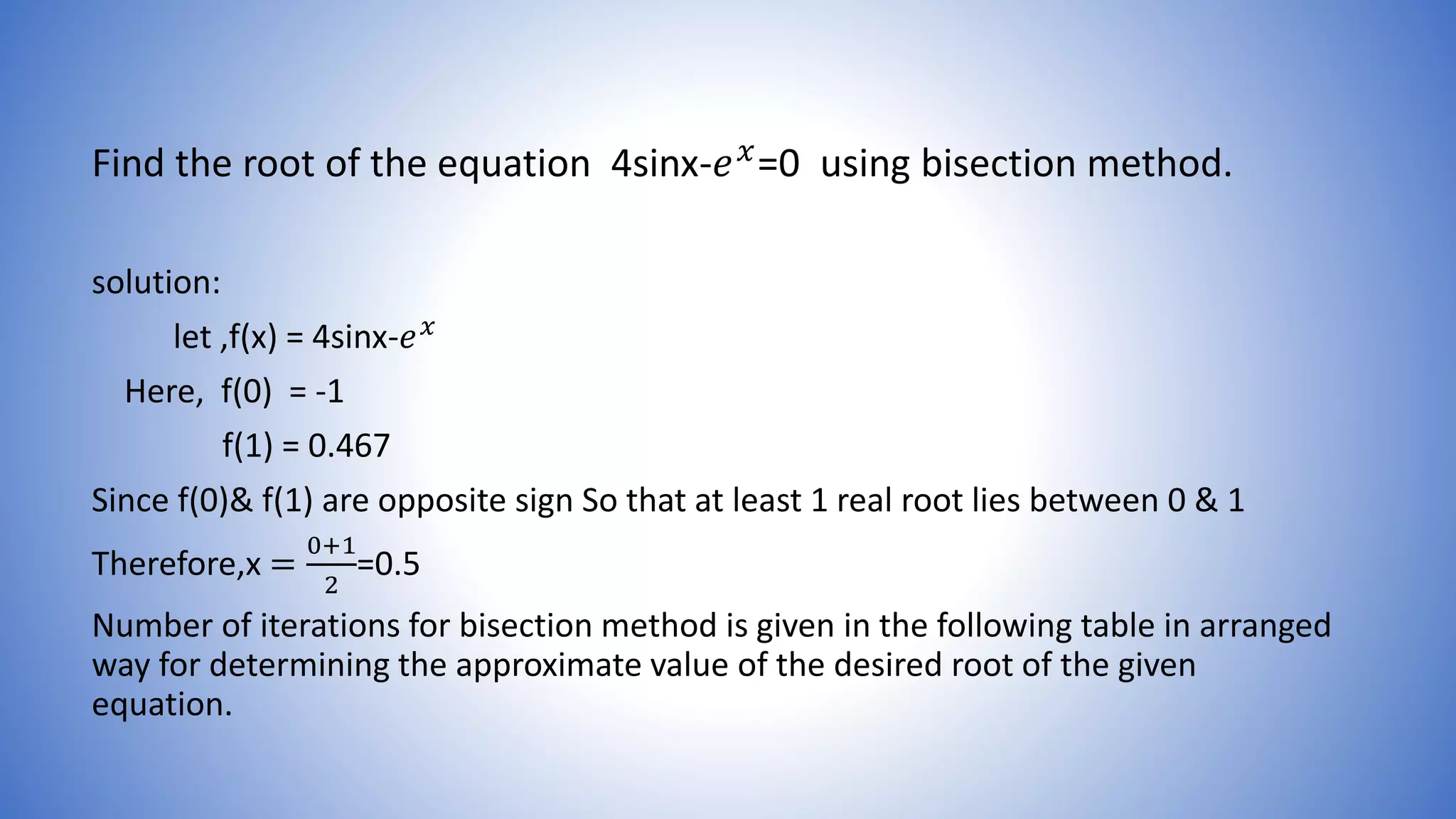
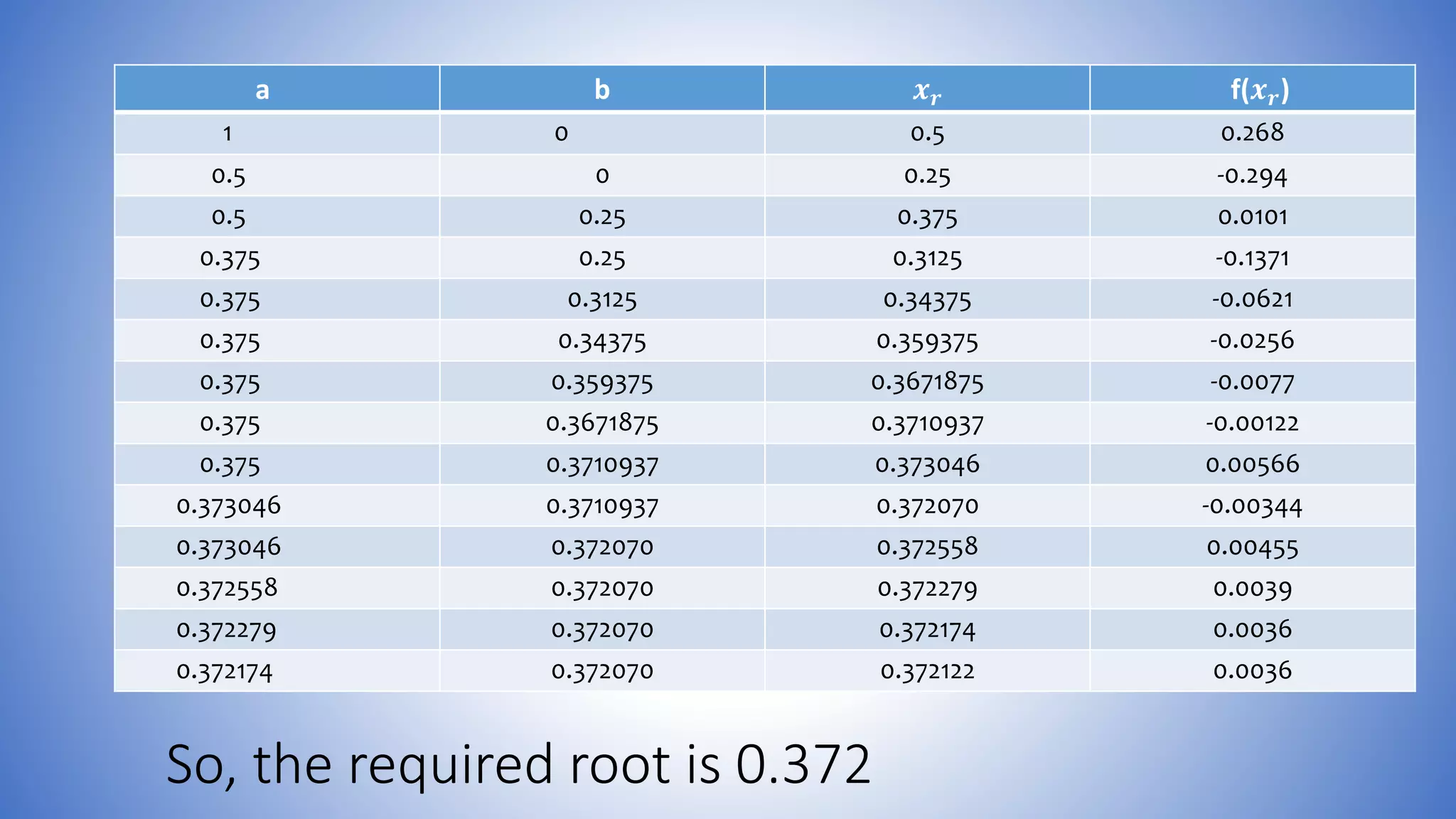
Find the root of the equation 4sinx-𝑒 𝑥=0 using bisection method.
solution:
let ,f(x) = 4sinx-𝑒 𝑥
Here, f(0) = -1
f(1) = 0.467
Since f(0)& f(1) are opposite sign So that at least 1 real root lies between 0 & 1
Therefore,x =
0+1
2
=0.5
Number of iterations for bisection method is given in the following table in arranged
way for determining the approximate value of the desired root of the given
equation.
So, the required root is 0.372
a b 𝒙 𝒓 f(𝒙 𝒓)
1 0 0.5 0.268
0.5 0 0.25 -0.294
0.5 0.25 0.375 0.0101
0.375 0.25 0.3125 -0.1371
0.375 0.3125 0.34375 -0.0621
0.375 0.34375 0.359375 -0.0256
0.375 0.359375 0.3671875 -0.0077
0.375 0.3671875 0.3710937 -0.00122
0.375 0.3710937 0.373046 0.00566
0.373046 0.3710937 0.372070 -0.00344
0.373046 0.372070 0.372558 0.00455
0.372558 0.372070 0.372279 0.0039
0.372279 0.372070 0.372174 0.0036
0.372174 0.372070 0.372122 0.0036
Bisection

Bisection

  • 1.
  • 2.
    Find A Rootof The Equation( X^3-X-1) using Bisection Method. Solution: Let f(X)= ( X^3-X-1) Here, F(1)=1-1-1=-1<0 and f(2)=8-2-1=5>0 Since f(1) and f(2) are of opposite sign to at least one real root lies between 1 and 2 . X=(1+2)/2 =1.50
  • 3.
    Calculation Table Iteration Valueof a (+) Value of b(-) X=(a+b)/2 Sign of ( X^3-X-1) 1 2 1 1.5 0.875>0 2 1.5 1 1.25 -0.297<0 3 1.5 1.25 1.375 0.2246>0 4 1.375 1.25 1.3125 -0.0515<0 5 1.375 1.3125 1.34375 0.082626 6 1.34375 1.3125 1.3281 0.081447 7 1.3281 1.3125 1.3203 -0.019<0 8 1.3281 1.3203 1.3242 -0.0002<0 9 1.3281 1.3242 1.3261 0.005970>0 10 1.3261 1.3242 1.3251 0.00162<0
  • 4.
    • Find theroot of the equation 𝐱 𝟑 − 𝟐𝐱 − 𝟓 = 𝟎 using bisection method. solution: Let, f(x) = 𝒙 𝟑 − 𝟐𝒙 − 𝟓 Here, f(2) =-1 f(3) =16 So,the root lies in (2,3) now ,𝒙 𝟏= 𝟐+𝟑 𝟐 =2.5; f(2.5)=5.625 So,the root lies in (2,2.5) Again, 𝒙 𝟐= 𝟐+𝟐.𝟓 𝟐 =2.25; f(2.25)=1.8906 So,the root lies in (2,2.25)
  • 5.
    Proceeding in thisway,the following table is obtained so, the required root is 2.094 a b 𝒙 𝒓 f(𝒙 𝒓) 2 3 2.5 5.625/+ 2 2.5 2.25 1.8906 2 2.25 2.125 0.3457 2 2.125 2.0625 -0.3513 2.0625 2.125 2.09375 -0.0089 2.09375 2.125 2.10938 0.1668 2.09375 2.10938 2.10156 0.07856 2.09375 2.10156 2.09766 0.03471 2.09375 2.09766 2.09570 0.01286 2.09375 2.09570 2.09473 0.00195 2.09375 2.09473 2.09424 -0.0035
  • 6.
    Find A Rootof The Equation X^2-4X-10 using Bisection Method. Solution: Let f(X)=X^2-4X-10 Here, f(-2)=4+8-10=2>0 & f(-1)=1+4-10=-5<0. Since f(-2)is positive and f(-1) is negative so at least one real root lies between -2 and -1. So, X = (-2-1)/2 = -3/2 =1.5
  • 7.
    Iteration a (+)b(-) 𝒙 𝒓 f(x)=x^2-4x-10 1 -2 -1 -1.5 -1.75<0 2 -2 -1.5 -1.75 0.0625>0 3 -1.75 -1.5 -1.625 -0.859<0 4 -1.75 -1.625 -1.6875 -0.40<0 5 -1.75 -1.6875 -1.7188 -0.1705<0 6 -1.75 -1.7188 -1.7344 -0.054<0 7 -1.75 -1.7344 -1.7422 0.004>0 8 -1.7422 -1.7344 -1.7383 -0.025<0 9 -1.7422 -1.7383 -1.7402 -0.0109<0 10 -1.7422 -1.7402 -1.7403 -0.003<0
  • 8.
    Bisection Method: Example 𝑓 𝑥= 𝑥𝑒 𝑥 − 1 where, 𝜖 = 0.001 Here,𝑓 0 = −1 𝑓 1 = 1.7182 ∴ 𝑥1 = 0 + 1 2 = 0.5 𝑓 0.5 = −0.1756 So, the root lies in 1, 0.5
  • 9.
    Iteration 𝑎 b𝑥 𝑟 𝑓(𝑥 𝑟) 1 1 0 0.5 -0.1756 2 1 0.5 0.75 0.5877 3 0.75 0.5 0.625 0.1676 4 0.625 0.5 0.5625 -0.0127 5 0.5625 0.5625 0.59375 0.0751 6 0.5625 0.5625 0.578125 0.0306 7 0.5625 0.5625 0.5703125 0.00877 8 0.5625 0.5625 0.56640625 -0.0023 9 0.5703125 0.56640625 0.5683594 0.00336 10 0.563594 0.56640625 0.5673828 0.000662
  • 10.
    So, the rootis 0.56 And, ∈= 𝑥10 − 𝑥9 𝑥10 × 100% = 0.5673828 − 0.5683594 0.5673828 × 100% = 0.172%
  • 11.
    Example of BisectionMethod • Question: • Find the root of the polynomial, g(x) = x3 - 5 + 3x using bisection method. Where m = 1 and n = 2? Solution: First find the value of g(x) at m = 1 and n = 2 g(1) = 13 - 5 + 3*1 = -1 < 0 g(2) = 23 - 5 + 3*2 = 9 > 0 Since function is continuous, its root lies in the interval [1, 2].
  • 12.
    Example of BisectionMethod • Let t be the average of the interval i.e t = 1+22 = 1.5 • The value of the function at t is • g(1.5) = (1.5)3 - 5 + 3*(1.5) = 2.875 • As g(t) is negative so n = 2 is replaced with t = 1.5 for the next iteration. Make sure that g(m) and g(n) have opposite signs.
  • 13.
  • 14.
    Find the rootof the equation 4sinx-𝑒 𝑥=0 using bisection method. solution: let ,f(x) = 4sinx-𝑒 𝑥 Here, f(0) = -1 f(1) = 0.467 Since f(0)& f(1) are opposite sign So that at least 1 real root lies between 0 & 1 Therefore,x = 0+1 2 =0.5 Number of iterations for bisection method is given in the following table in arranged way for determining the approximate value of the desired root of the given equation.
  • 15.
    So, the requiredroot is 0.372 a b 𝒙 𝒓 f(𝒙 𝒓) 1 0 0.5 0.268 0.5 0 0.25 -0.294 0.5 0.25 0.375 0.0101 0.375 0.25 0.3125 -0.1371 0.375 0.3125 0.34375 -0.0621 0.375 0.34375 0.359375 -0.0256 0.375 0.359375 0.3671875 -0.0077 0.375 0.3671875 0.3710937 -0.00122 0.375 0.3710937 0.373046 0.00566 0.373046 0.3710937 0.372070 -0.00344 0.373046 0.372070 0.372558 0.00455 0.372558 0.372070 0.372279 0.0039 0.372279 0.372070 0.372174 0.0036 0.372174 0.372070 0.372122 0.0036