WELCOMETO
MY
PRESENTATION
A Presentation on Definite Integral 1
PresentedTo Presented By
Md. Joni Alam
Lecturer
Department of Mathematics
Comilla University
Shaiful Islam
Student ID: 11904040
Department of Mathematics
Comilla University
CourseTitle: Integration Calculus
Course Code : MTH 122
Contents
2Topics: Definite Integral
 History of Integration
 Definition & Types of Integration
 Some Basic Properties of Definite Integral
 Application of Integration in Real Life
 Conclusion
Topics Introduction : Definite Integral 3
The process of finding anti-derivative is called Integration.
Thus if,
𝑑
𝑑𝑥
𝐹 𝑥 = 𝑓(𝑥)
Then integrating the function 𝑓(𝑥) of ( i) produce the anti-derivative is of the form 𝐹 𝑥 + c.
∫ 𝑓 𝑥 𝑑𝑥 = 𝐹 𝑥 + 𝑐
The expression ∫ 𝑓 𝑥 𝑑𝑥 is called the Indefinite Integral.
Integration :
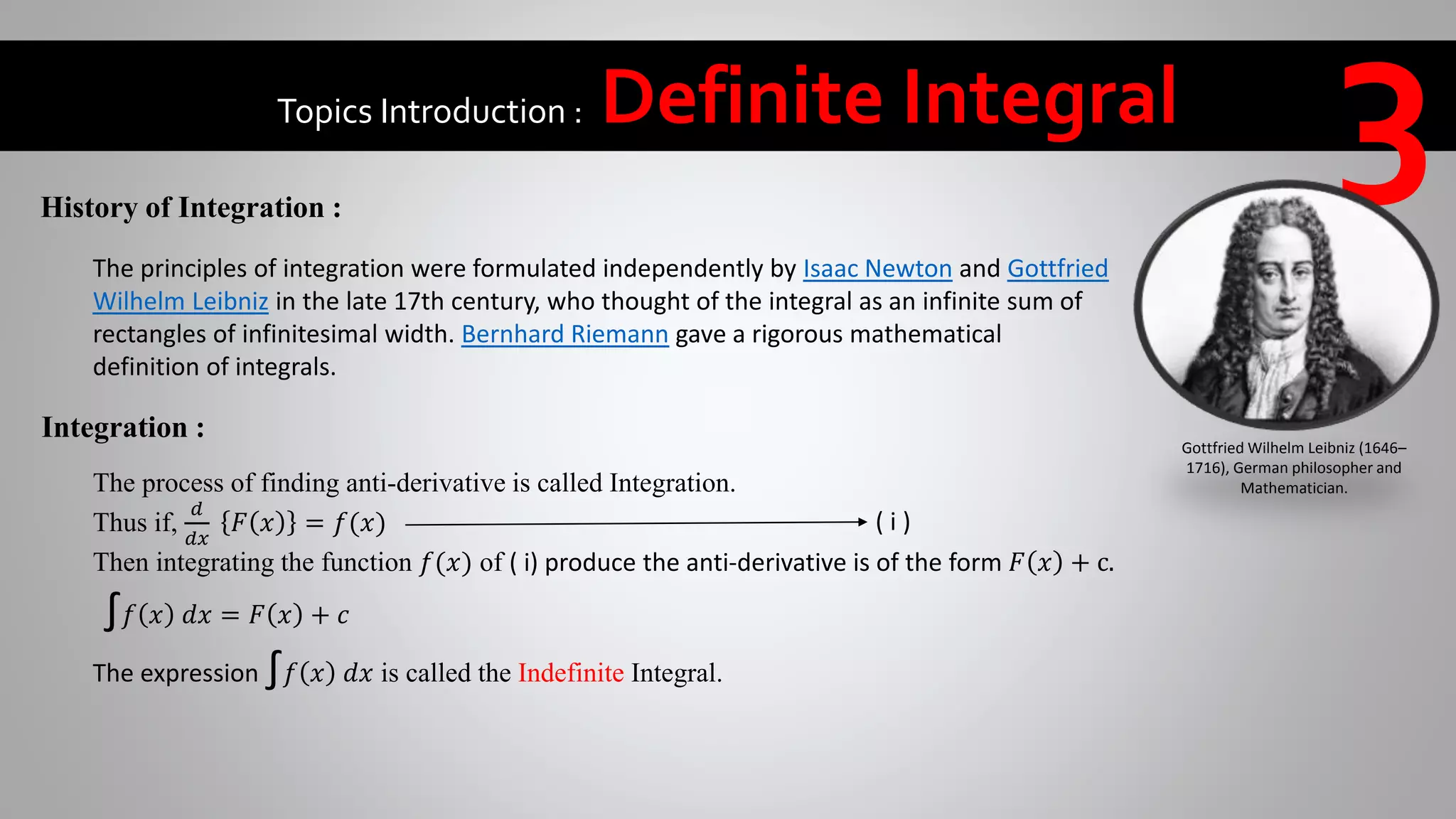
The principles of integration were formulated independently by Isaac Newton and Gottfried
Wilhelm Leibniz in the late 17th century, who thought of the integral as an infinite sum of
rectangles of infinitesimal width. Bernhard Riemann gave a rigorous mathematical
definition of integrals.
Gottfried Wilhelm Leibniz (1646–
1716), German philosopher and
Mathematician.
History of Integration :
( i )
Topics Brief : Definite Integral 4
Integration
Types :
Definite Integration
Indefinite Integration
Definite Integral
Given a function f(x) that is continuous on the interval [a,b] we divide the interval into n subintervals of
equal width h, and from each interval choose a point, xi. Then the definite integral of f(x) from a to b is,
𝑎
𝑏
𝑓(𝑥) 𝑑𝑥 = lim
𝑛→∞
𝑖=1
𝑛
𝑓(xi) . ℎ
−1
5
𝑥2
𝑑𝑥
𝑥2
𝑑𝑥
The number “a” that is at the bottom of the integral sign is called the lower limit of the integral and
the number “b” at the top of the integral sign is called the upper limit of the integral. Also, despite
the fact that a and b were given as an interval the lower limit does not necessarily need to be smaller
than the upper limit. Collectively we’ll often call a and b the interval of integration.
Ý́́́́́́́́
X́́́́́́́́́
X
x= a x= b
A B
C
D
y= f(x)
Y
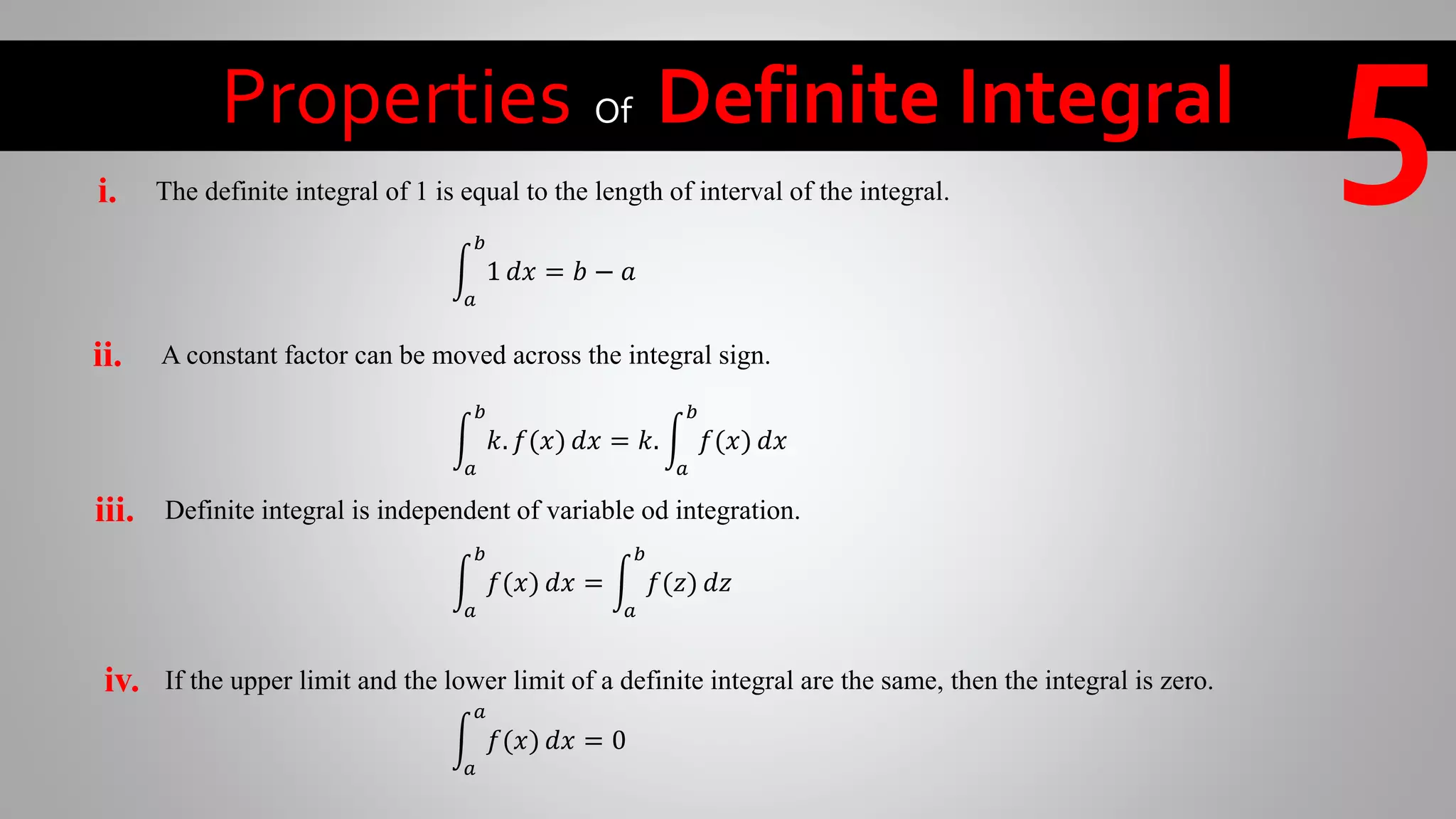
Properties Of Definite Integral 5
𝑎
𝑏
1 𝑑𝑥 = 𝑏 − 𝑎
The definite integral of 1 is equal to the length of interval of the integral.i.
A constant factor can be moved across the integral sign.ii.
𝑎
𝑏
𝑘. 𝑓(𝑥) 𝑑𝑥 = 𝑘.
𝑎
𝑏
𝑓(𝑥) 𝑑𝑥
Definite integral is independent of variable od integration.iii.
𝑎
𝑏
𝑓(𝑥) 𝑑𝑥 =
𝑎
𝑏
𝑓(𝑧) 𝑑𝑧
If the upper limit and the lower limit of a definite integral are the same, then the integral is zero.iv.
𝑎
𝑎
𝑓(𝑥) 𝑑𝑥 = 0
Properties Of Definite Integral 6Reversing the limit of integration change the sign of definite integral .v.
𝑎
𝑏
𝑓(𝑥) 𝑑𝑥 = −
𝑏
𝑎
𝑓(𝑥) 𝑑𝑥
The definite integral of the sum and difference is equal to the sum and difference of the integral respectively.vi.
𝑎
𝑏
𝑓 𝑥 ± 𝑔(𝑥) 𝑑𝑥 =
𝑏
𝑎
𝑓(𝑥) 𝑑𝑥 ±
𝑏
𝑎
𝑔(𝑥) 𝑑𝑥
Suppose that a point c belongs to the interval 𝑎, 𝑏 then the definite integral of the function f(x) over 𝑎, 𝑏 is equal
to the sum of integrals over 𝑎, 𝑐 and 𝑐, 𝑏 .
vii.
𝑎
𝑏
𝑓(𝑥) 𝑑𝑥 =
𝑎
𝑐
𝑓(𝑥) 𝑑𝑥 +
𝑐
𝑏
𝑓(𝑥) 𝑑𝑥
viii.
0
𝑎
𝑓(𝑥) 𝑑𝑥 =
0
𝑎
𝑓(𝑎 − 𝑥) 𝑑𝑥
Properties Of Definite Integral 7−𝑎
+𝑎
𝑓(𝑥) 𝑑𝑥 =
0
𝑎
𝑓 𝑥 + 𝑓(−𝑥) 𝑑𝑥
 If 𝑓 𝑥 = 𝑓 𝑥 or it is an even function then −𝑎
𝑎
𝑓 𝑥 𝑑𝑥 = 2 0
𝑎
𝑓(𝑥) 𝑑𝑥
 If 𝑓 𝑥 = −𝑓 𝑥 or it is an odd function then −𝑎
𝑎
𝑓 𝑥 𝑑𝑥 = 0
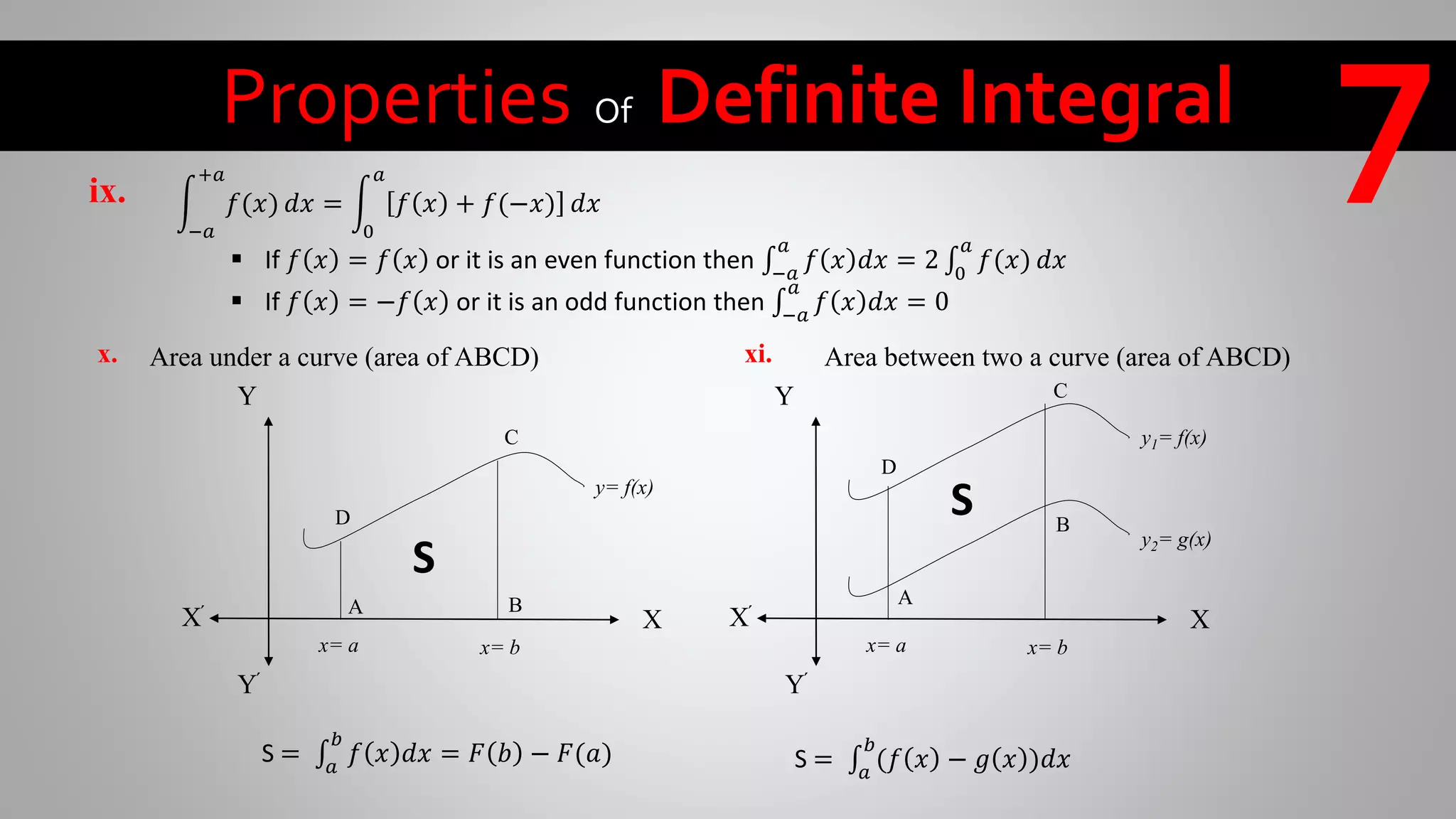
Area under a curve (area of ABCD) Area between two a curve (area of ABCD)
ix.
Y
Ý́́́́́́́́
X́́́́́́́́́
X
x= a x= b
A B
C
D
A
B
C
D
y= f(x)
y1= f(x)
y2= g(x)
xi.x.
Ý́́́́́́́́
X́́́́́́́́́
X
x= a x= b
Y
S
S
S = 𝑎
𝑏
𝑓 𝑥 𝑑𝑥 = 𝐹 𝑏 − 𝐹(𝑎) S = 𝑎
𝑏
(𝑓 𝑥 − 𝑔 𝑥 )𝑑𝑥
Applications
8There are numerous applications of integrals. Using technology such as computer software, internet
sources, graphing calculators and smartphone apps can make solving integral problems easier. Some
applications of integrals are:
1 Displacement: Displacement is thevector quantity that represents the difference between
the final position of an object and its initial position. In other words, how far it traveled from point A
to point B. Displacement is the integral of velocity, which looks like
𝑠 𝑡 = 𝑣(𝑡) 𝑑𝑡
2 Change of Velocity: The integral of acceleration is the change in velocity, which is
∆𝑣 = 𝑎 𝑡 𝑑𝑡
or, v f -v0 = 𝑎 𝑡 𝑑𝑡
3 Work: 𝑤 = 𝐹(𝑥) 𝑑𝑥
Applications
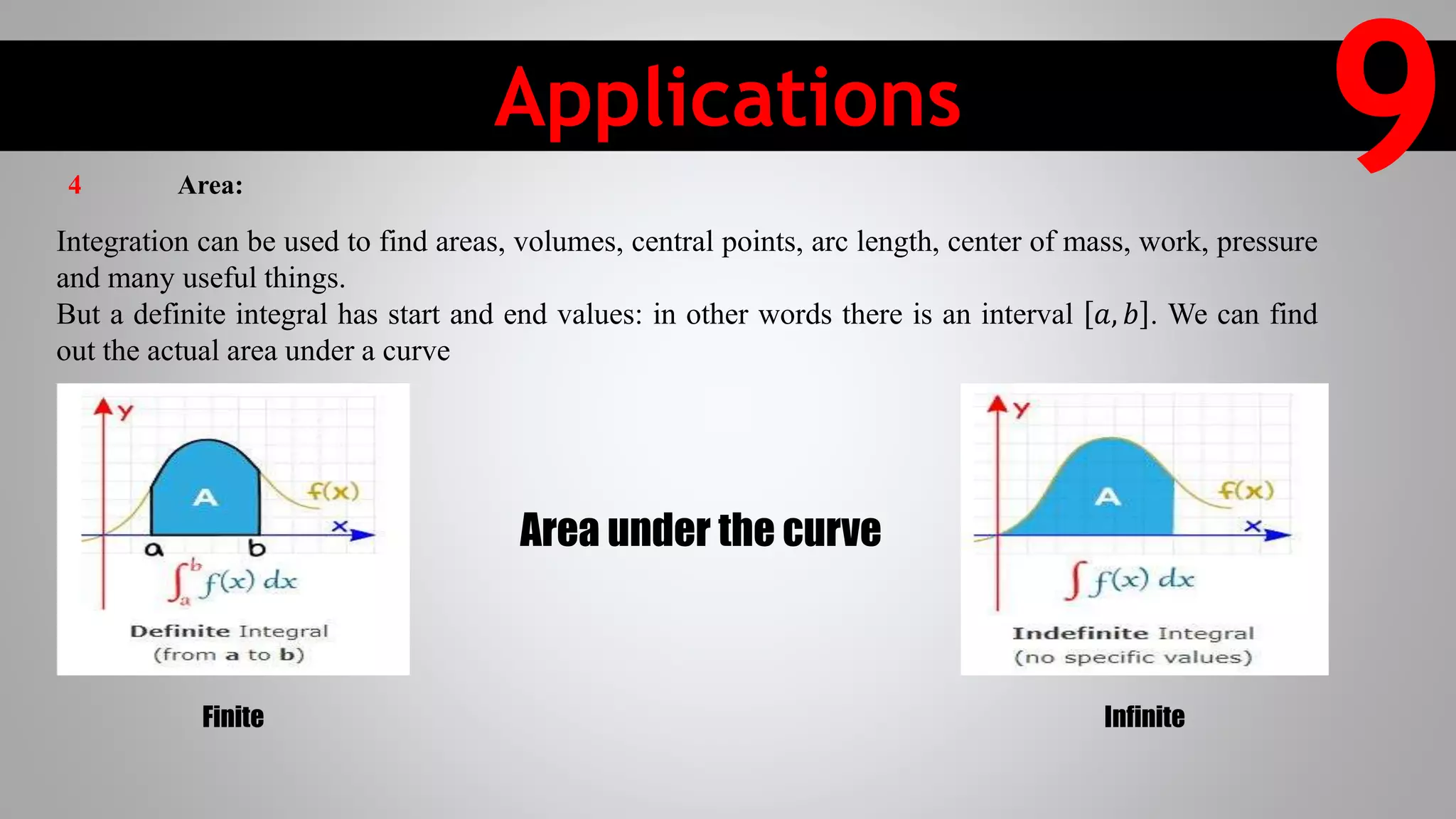
9Integration can be used to find areas, volumes, central points, arc length, center of mass, work, pressure
and many useful things.
But a definite integral has start and end values: in other words there is an interval 𝑎, 𝑏 . We can find
out the actual area under a curve
Area under the curve
Finite Infinite
4 Area:
Conclusion
10
A definite integral has upper and lower limits on the integrals, and it’s definite because,
at the end of the problem, we have a number – it is a finite answer.
THANKS A LOT

Definite Integral and Properties of Definite Integral

  • 1.
  • 2.
    A Presentation onDefinite Integral 1 PresentedTo Presented By Md. Joni Alam Lecturer Department of Mathematics Comilla University Shaiful Islam Student ID: 11904040 Department of Mathematics Comilla University CourseTitle: Integration Calculus Course Code : MTH 122
  • 3.
    Contents 2Topics: Definite Integral History of Integration  Definition & Types of Integration  Some Basic Properties of Definite Integral  Application of Integration in Real Life  Conclusion
  • 4.
    Topics Introduction :Definite Integral 3 The process of finding anti-derivative is called Integration. Thus if, 𝑑 𝑑𝑥 𝐹 𝑥 = 𝑓(𝑥) Then integrating the function 𝑓(𝑥) of ( i) produce the anti-derivative is of the form 𝐹 𝑥 + c. ∫ 𝑓 𝑥 𝑑𝑥 = 𝐹 𝑥 + 𝑐 The expression ∫ 𝑓 𝑥 𝑑𝑥 is called the Indefinite Integral. Integration : The principles of integration were formulated independently by Isaac Newton and Gottfried Wilhelm Leibniz in the late 17th century, who thought of the integral as an infinite sum of rectangles of infinitesimal width. Bernhard Riemann gave a rigorous mathematical definition of integrals. Gottfried Wilhelm Leibniz (1646– 1716), German philosopher and Mathematician. History of Integration : ( i )
  • 5.
    Topics Brief :Definite Integral 4 Integration Types : Definite Integration Indefinite Integration Definite Integral Given a function f(x) that is continuous on the interval [a,b] we divide the interval into n subintervals of equal width h, and from each interval choose a point, xi. Then the definite integral of f(x) from a to b is, 𝑎 𝑏 𝑓(𝑥) 𝑑𝑥 = lim 𝑛→∞ 𝑖=1 𝑛 𝑓(xi) . ℎ −1 5 𝑥2 𝑑𝑥 𝑥2 𝑑𝑥 The number “a” that is at the bottom of the integral sign is called the lower limit of the integral and the number “b” at the top of the integral sign is called the upper limit of the integral. Also, despite the fact that a and b were given as an interval the lower limit does not necessarily need to be smaller than the upper limit. Collectively we’ll often call a and b the interval of integration. Ý́́́́́́́́ X́́́́́́́́́ X x= a x= b A B C D y= f(x) Y
  • 6.
    Properties Of DefiniteIntegral 5 𝑎 𝑏 1 𝑑𝑥 = 𝑏 − 𝑎 The definite integral of 1 is equal to the length of interval of the integral.i. A constant factor can be moved across the integral sign.ii. 𝑎 𝑏 𝑘. 𝑓(𝑥) 𝑑𝑥 = 𝑘. 𝑎 𝑏 𝑓(𝑥) 𝑑𝑥 Definite integral is independent of variable od integration.iii. 𝑎 𝑏 𝑓(𝑥) 𝑑𝑥 = 𝑎 𝑏 𝑓(𝑧) 𝑑𝑧 If the upper limit and the lower limit of a definite integral are the same, then the integral is zero.iv. 𝑎 𝑎 𝑓(𝑥) 𝑑𝑥 = 0
  • 7.
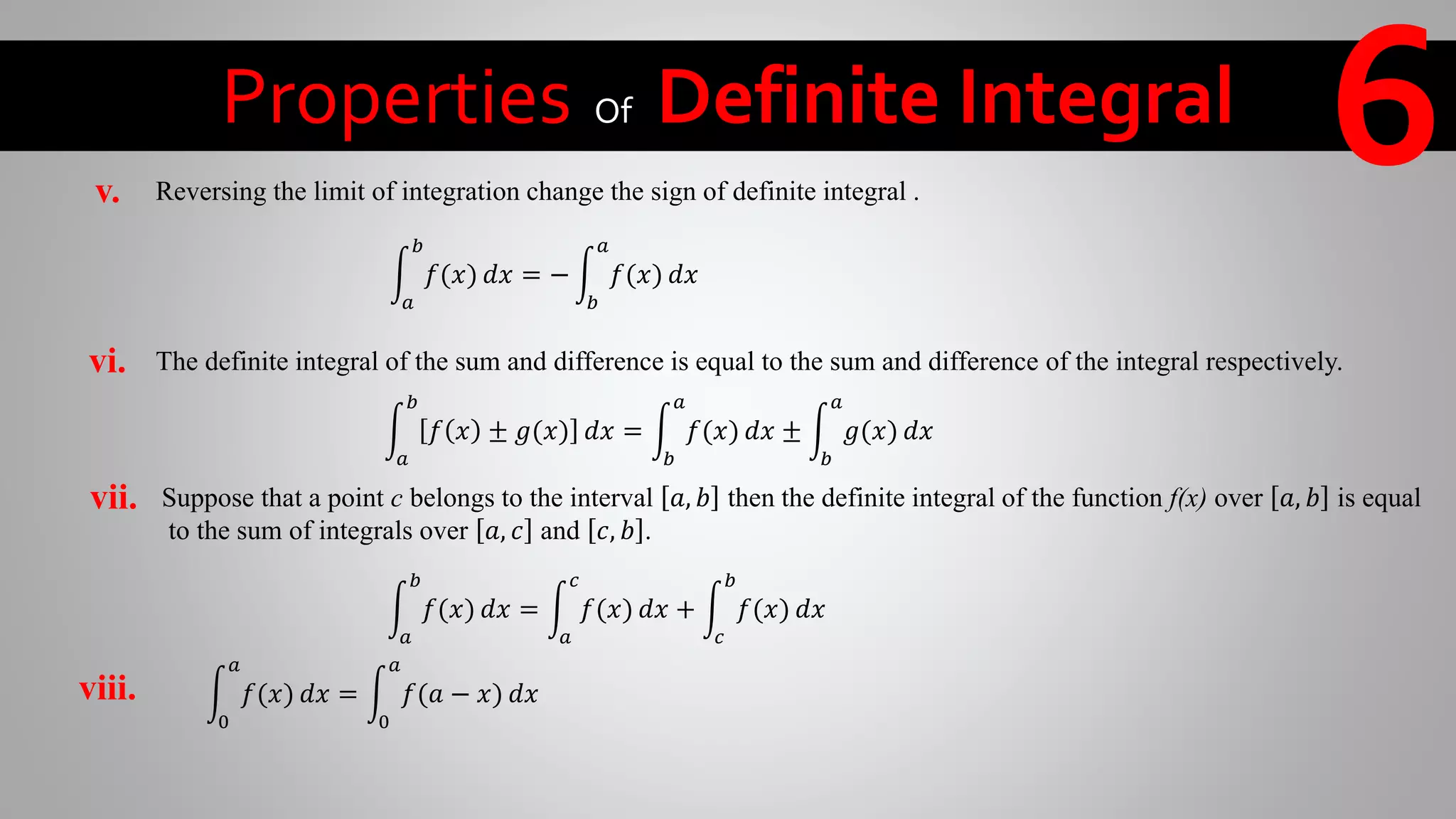
    Properties Of DefiniteIntegral 6Reversing the limit of integration change the sign of definite integral .v. 𝑎 𝑏 𝑓(𝑥) 𝑑𝑥 = − 𝑏 𝑎 𝑓(𝑥) 𝑑𝑥 The definite integral of the sum and difference is equal to the sum and difference of the integral respectively.vi. 𝑎 𝑏 𝑓 𝑥 ± 𝑔(𝑥) 𝑑𝑥 = 𝑏 𝑎 𝑓(𝑥) 𝑑𝑥 ± 𝑏 𝑎 𝑔(𝑥) 𝑑𝑥 Suppose that a point c belongs to the interval 𝑎, 𝑏 then the definite integral of the function f(x) over 𝑎, 𝑏 is equal to the sum of integrals over 𝑎, 𝑐 and 𝑐, 𝑏 . vii. 𝑎 𝑏 𝑓(𝑥) 𝑑𝑥 = 𝑎 𝑐 𝑓(𝑥) 𝑑𝑥 + 𝑐 𝑏 𝑓(𝑥) 𝑑𝑥 viii. 0 𝑎 𝑓(𝑥) 𝑑𝑥 = 0 𝑎 𝑓(𝑎 − 𝑥) 𝑑𝑥
  • 8.
    Properties Of DefiniteIntegral 7−𝑎 +𝑎 𝑓(𝑥) 𝑑𝑥 = 0 𝑎 𝑓 𝑥 + 𝑓(−𝑥) 𝑑𝑥  If 𝑓 𝑥 = 𝑓 𝑥 or it is an even function then −𝑎 𝑎 𝑓 𝑥 𝑑𝑥 = 2 0 𝑎 𝑓(𝑥) 𝑑𝑥  If 𝑓 𝑥 = −𝑓 𝑥 or it is an odd function then −𝑎 𝑎 𝑓 𝑥 𝑑𝑥 = 0 Area under a curve (area of ABCD) Area between two a curve (area of ABCD) ix. Y Ý́́́́́́́́ X́́́́́́́́́ X x= a x= b A B C D A B C D y= f(x) y1= f(x) y2= g(x) xi.x. Ý́́́́́́́́ X́́́́́́́́́ X x= a x= b Y S S S = 𝑎 𝑏 𝑓 𝑥 𝑑𝑥 = 𝐹 𝑏 − 𝐹(𝑎) S = 𝑎 𝑏 (𝑓 𝑥 − 𝑔 𝑥 )𝑑𝑥
  • 9.
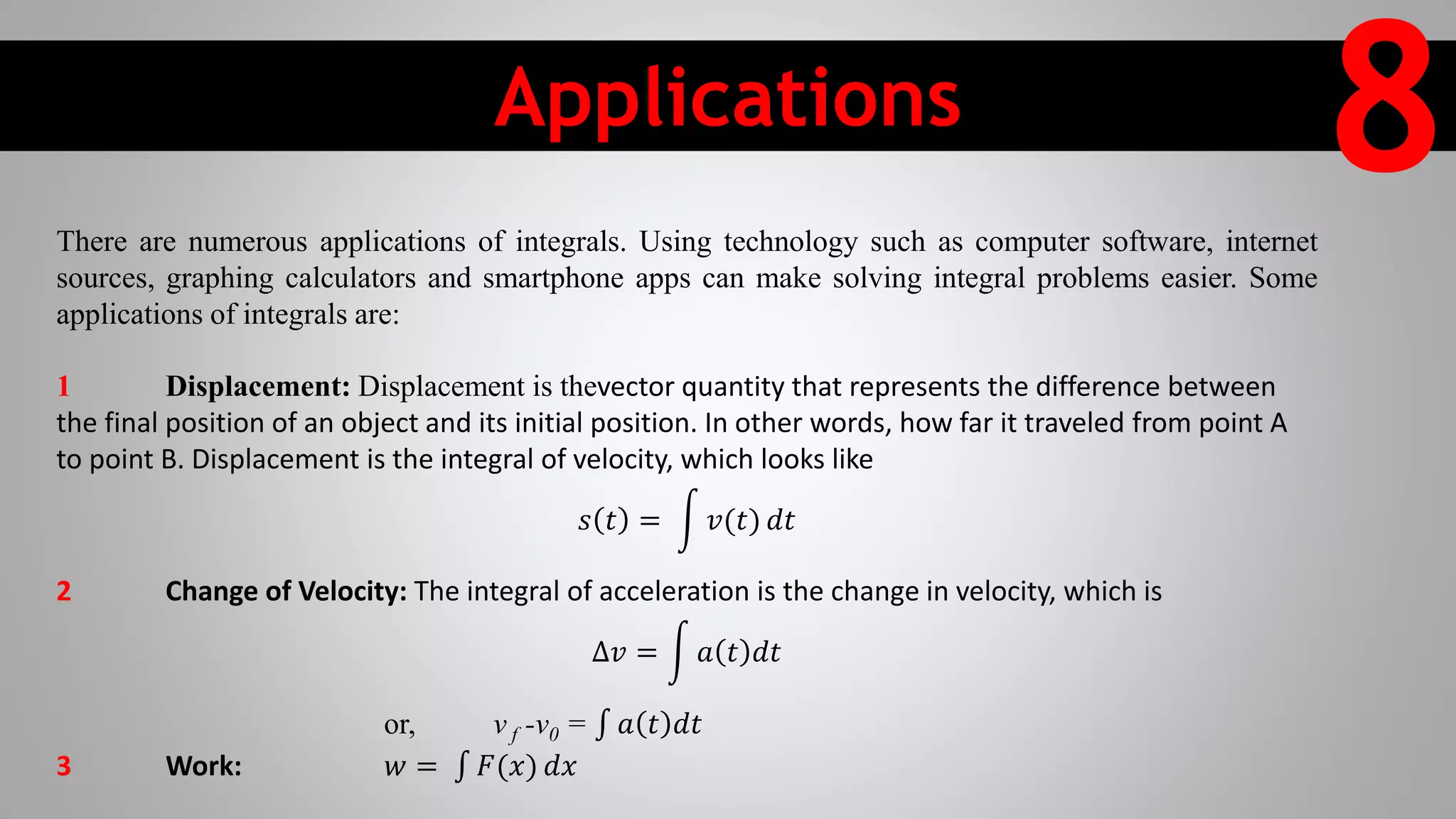
    Applications 8There are numerousapplications of integrals. Using technology such as computer software, internet sources, graphing calculators and smartphone apps can make solving integral problems easier. Some applications of integrals are: 1 Displacement: Displacement is thevector quantity that represents the difference between the final position of an object and its initial position. In other words, how far it traveled from point A to point B. Displacement is the integral of velocity, which looks like 𝑠 𝑡 = 𝑣(𝑡) 𝑑𝑡 2 Change of Velocity: The integral of acceleration is the change in velocity, which is ∆𝑣 = 𝑎 𝑡 𝑑𝑡 or, v f -v0 = 𝑎 𝑡 𝑑𝑡 3 Work: 𝑤 = 𝐹(𝑥) 𝑑𝑥
  • 10.
    Applications 9Integration can beused to find areas, volumes, central points, arc length, center of mass, work, pressure and many useful things. But a definite integral has start and end values: in other words there is an interval 𝑎, 𝑏 . We can find out the actual area under a curve Area under the curve Finite Infinite 4 Area:
  • 11.
    Conclusion 10 A definite integralhas upper and lower limits on the integrals, and it’s definite because, at the end of the problem, we have a number – it is a finite answer.
  • 12.