RANK OF A MATRIX 
(BY VARIOUS METHODS)
RANK OF A MATRIX 
Let A be any m n matrix. Then A consists of n column 
vectors a₁, a₂ ,....,a, which are m-vectors. 
DEFINTION: 
The rank of A is the maximal number of linearly 
independent column vectors in A, i.e. the maximal 
number of linearly independent vectors among {a₁, 
a₂,......, a}. 
If A = 0, then the rank of A is 0. 
We write rk(A) for the rank of A. Note that we may 
compute the rank of any matrix-square or not
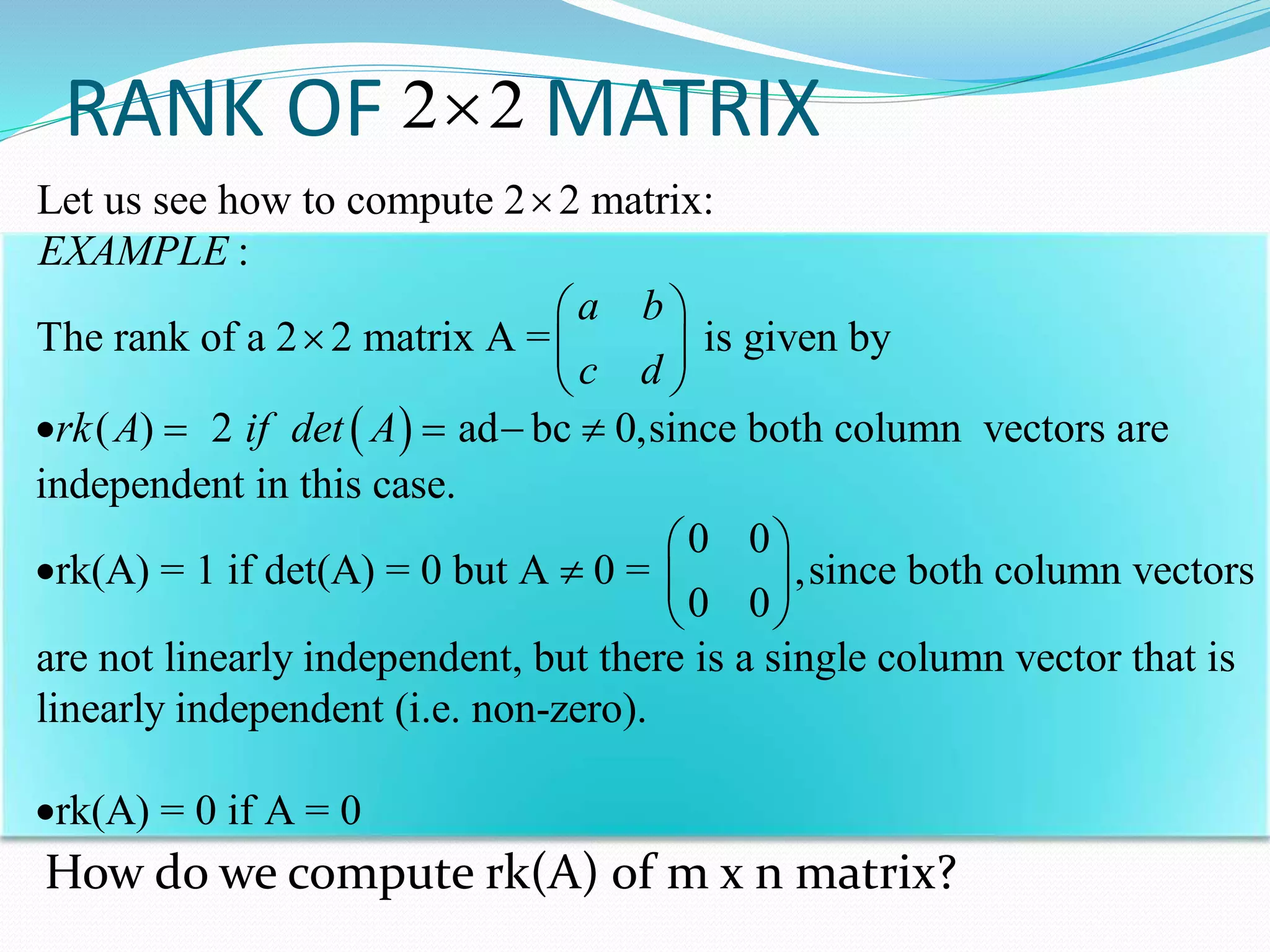
Let us see how to compute 2 2 matrix: 
  
  
: 
EXAMPLE 
The rank of a 2 2 matrix A = is given by 
( ) 2 ad bc 0, since both column vectors are 
independent in this case. 
rk(A) = 1 if det(A) 
a b 
rk A if det A 
c d 
 
 
    
 
 
 
 
  
0 0 
= 0 but A 0 = ,since both column vectors 
0 0 
are not linearly independent, but there is a single column vector that is 
linearly independent (i.e. non-zero). 
rk(A) = 0 if A = 0 
  
   
  
 
RANK OF 2  2 MATRIX 
How do we compute rk(A) of m x n matrix?
COMPUTING RANK BY VARIOUS 
METHODS 
1. BY GAUSS ELIMINATION 
2. BY DETERMINANTS 
3. BY MINORS 
4. BY MORMAL FORM
1. USING GAUSS ELIMINATION 
GAUSS ELIMINATION: 
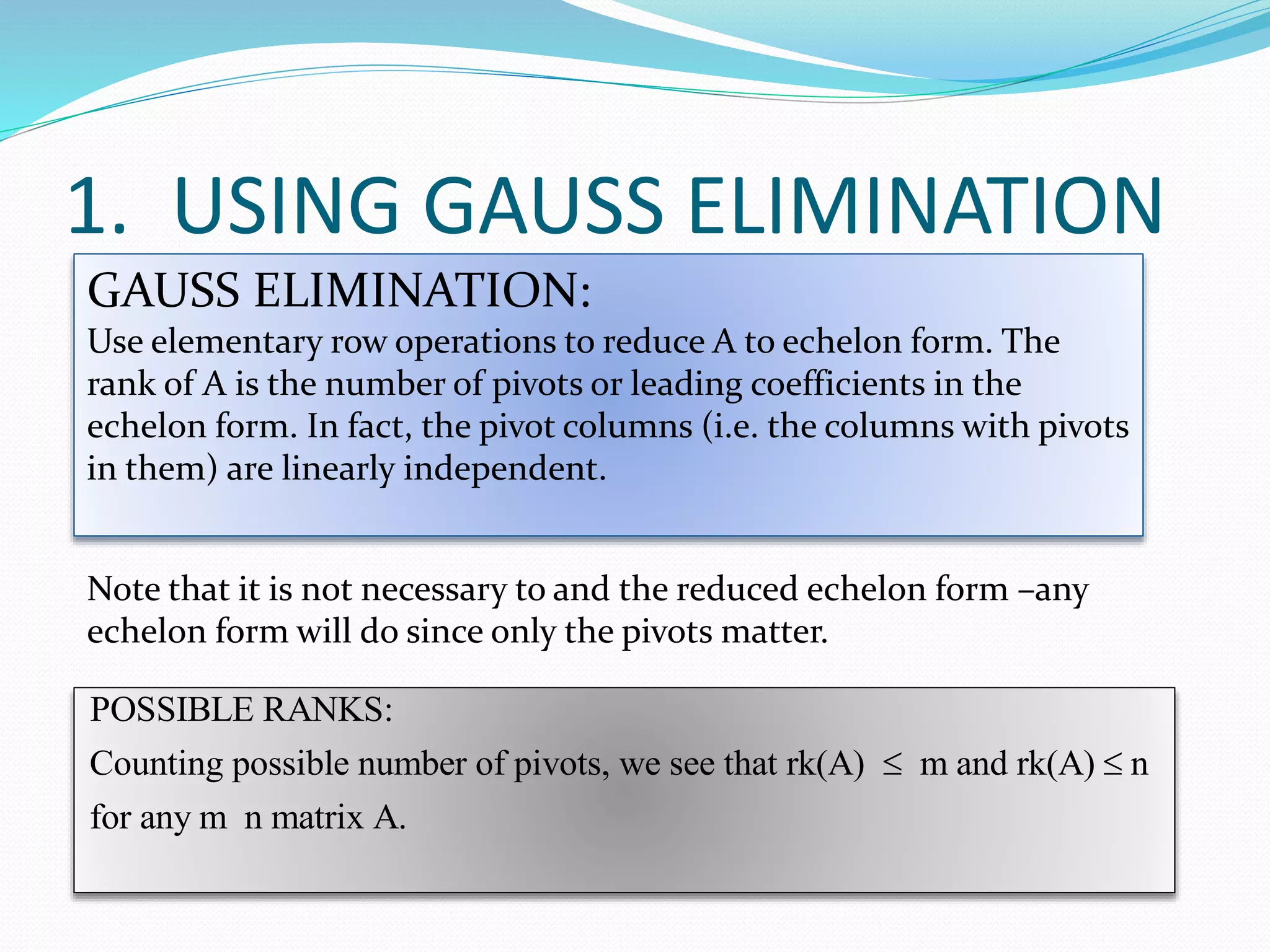
Use elementary row operations to reduce A to echelon form. The 
rank of A is the number of pivots or leading coefficients in the 
echelon form. In fact, the pivot columns (i.e. the columns with pivots 
in them) are linearly independent. 
Note that it is not necessary to and the reduced echelon form –any 
echelon form will do since only the pivots matter. 
POSSIBLE RANKS: 
Counting possible number of pivots, we see that rk(A) m and rk(A) n 
for any m n matrix A. 
 
EXAMPLE 
Gauss elimination: 
* Find the rank of a matrix 
 1 0 2 1 
 
  
  
  
  
A= 0 2 4 2 
0 2 2 1
SOLUTION: 
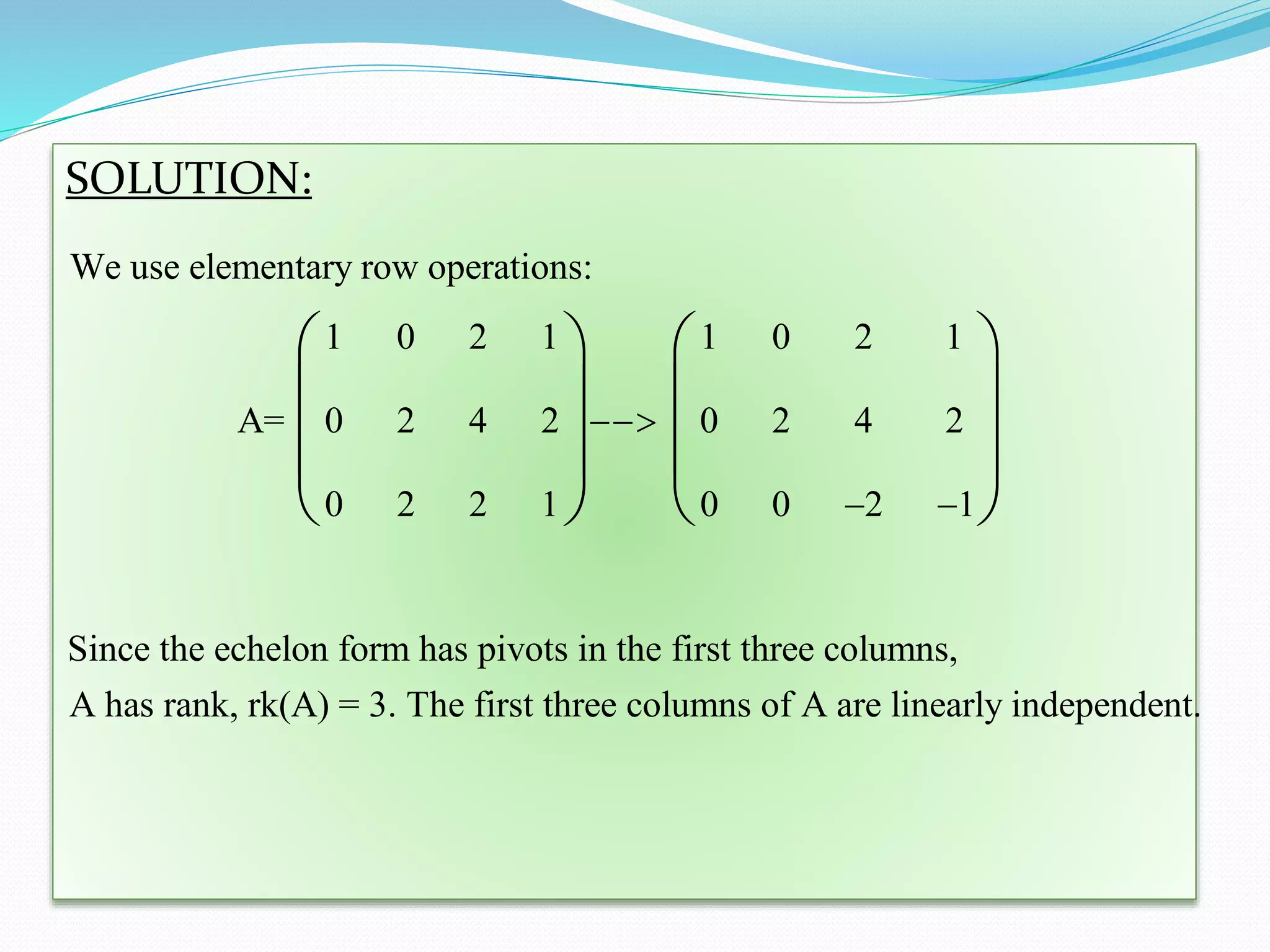
We use elementary row operations: 
1 0 2 1 1 0 2 1 
    
    
    
    
A= 0 2 4 2 0 2 4 2 
 
0 2 2 1 0 0 2 1 
  
Since the echelon form has pivots in the first three columns, 
A has rank, rk(A) = 3. The first three 
columns of A are linearly independent.
2. USING DETERMINANTS 
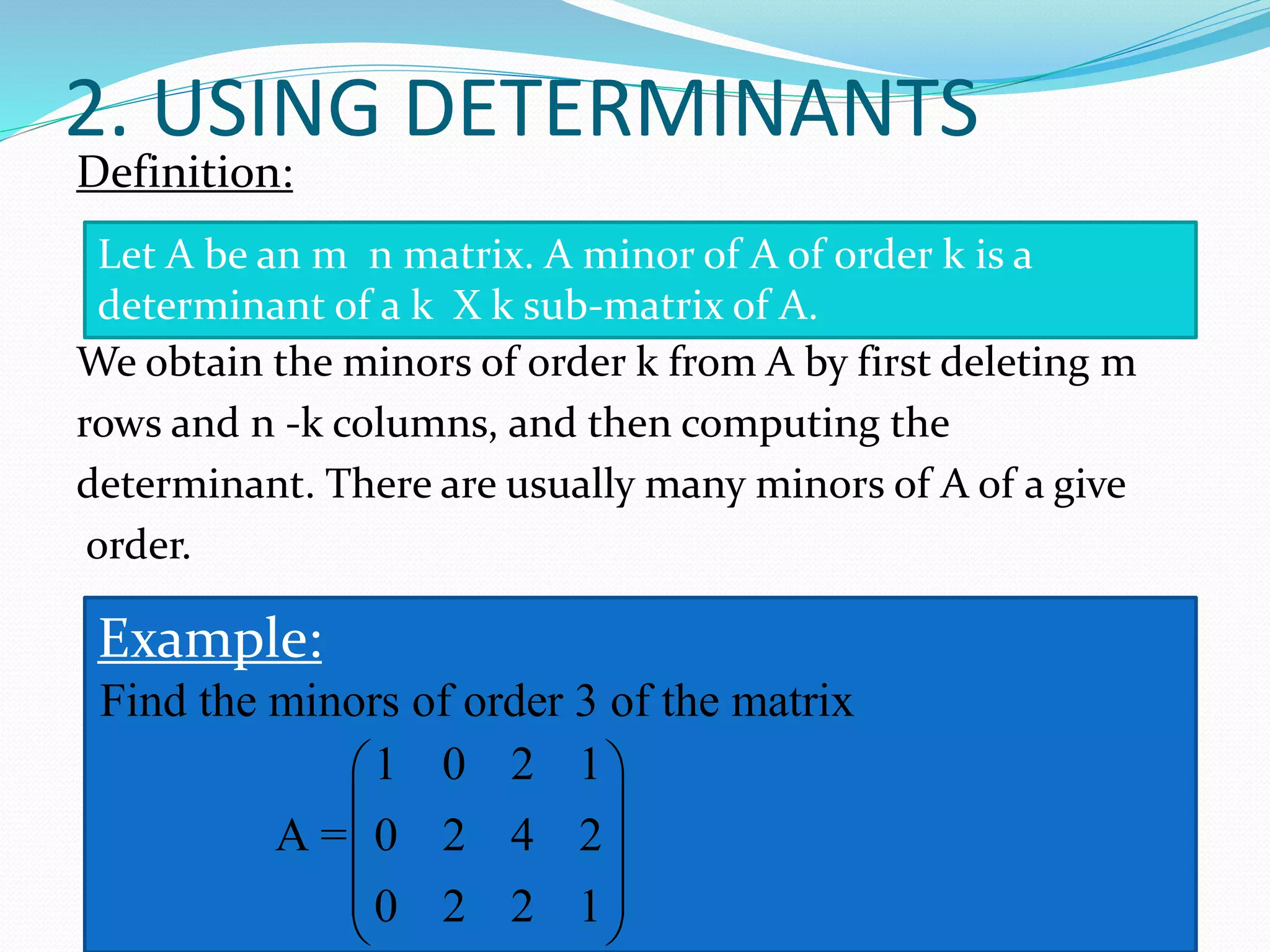
Definition: 
Let A be an m n matrix. A minor of A of order k is a 
determinant of a k X k sub-matrix of A. 
We obtain the minors of order k from A by first deleting m 
rows and n -k columns, and then computing the 
determinant. There are usually many minors of A of a give 
order. 
Example: 
Find the minors of order 3 of the matrix 
1 0 2 1 
  
  
  
  
  
A = 0 2 4 2 
0 2 2 1
EXAMPLE 
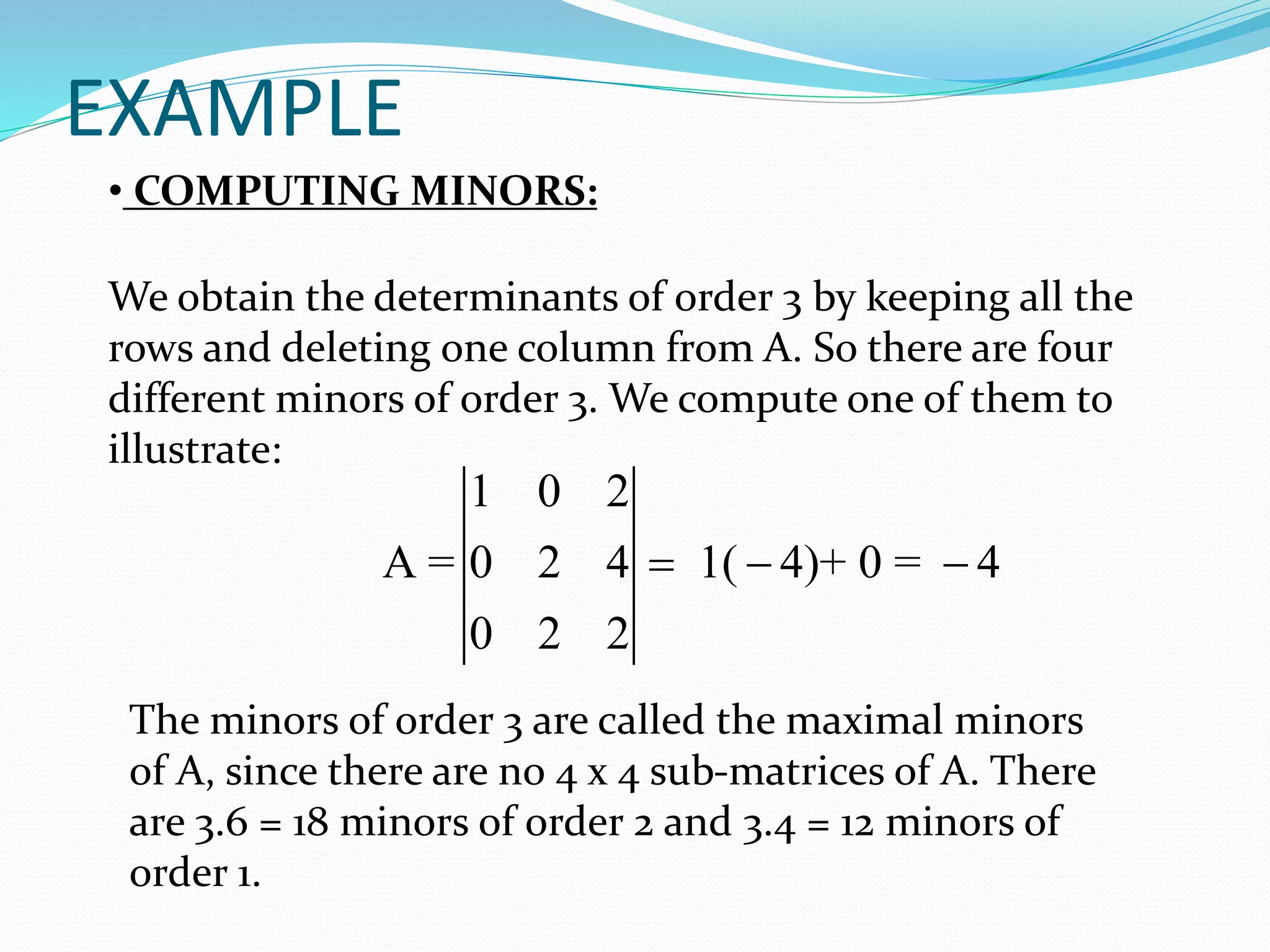
• COMPUTING MINORS: 
We obtain the determinants of order 3 by keeping all the 
rows and deleting one column from A. So there are four 
different minors of order 3. We compute one of them to 
illustrate: 
1 0 2 
A = 0 2 4 1( 4)+ 0 = 4 
   
0 2 2 
The minors of order 3 are called the maximal minors 
of A, since there are no 4 x 4 sub-matrices of A. There 
are 3.6 = 18 minors of order 2 and 3.4 = 12 minors of 
order 1.
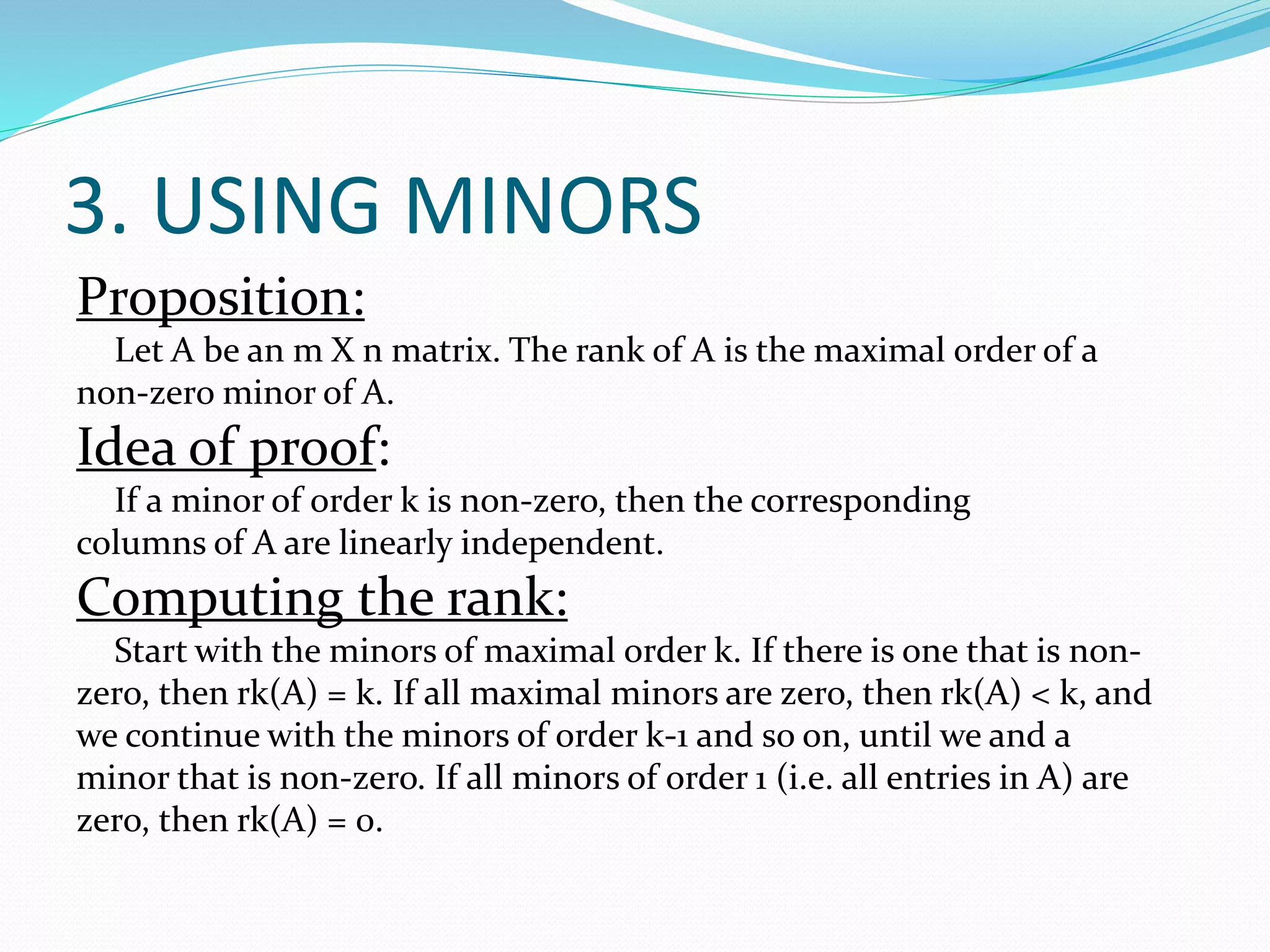
3. USING MINORS 
Proposition: 
Let A be an m X n matrix. The rank of A is the maximal order of a 
non-zero minor of A. 
Idea of proof: 
If a minor of order k is non-zero, then the corresponding 
columns of A are linearly independent. 
Computing the rank: 
Start with the minors of maximal order k. If there is one that is non-zero, 
then rk(A) = k. If all maximal minors are zero, then rk(A) < k, and 
we continue with the minors of order k-1 and so on, until we and a 
minor that is non-zero. If all minors of order 1 (i.e. all entries in A) are 
zero, then rk(A) = 0.
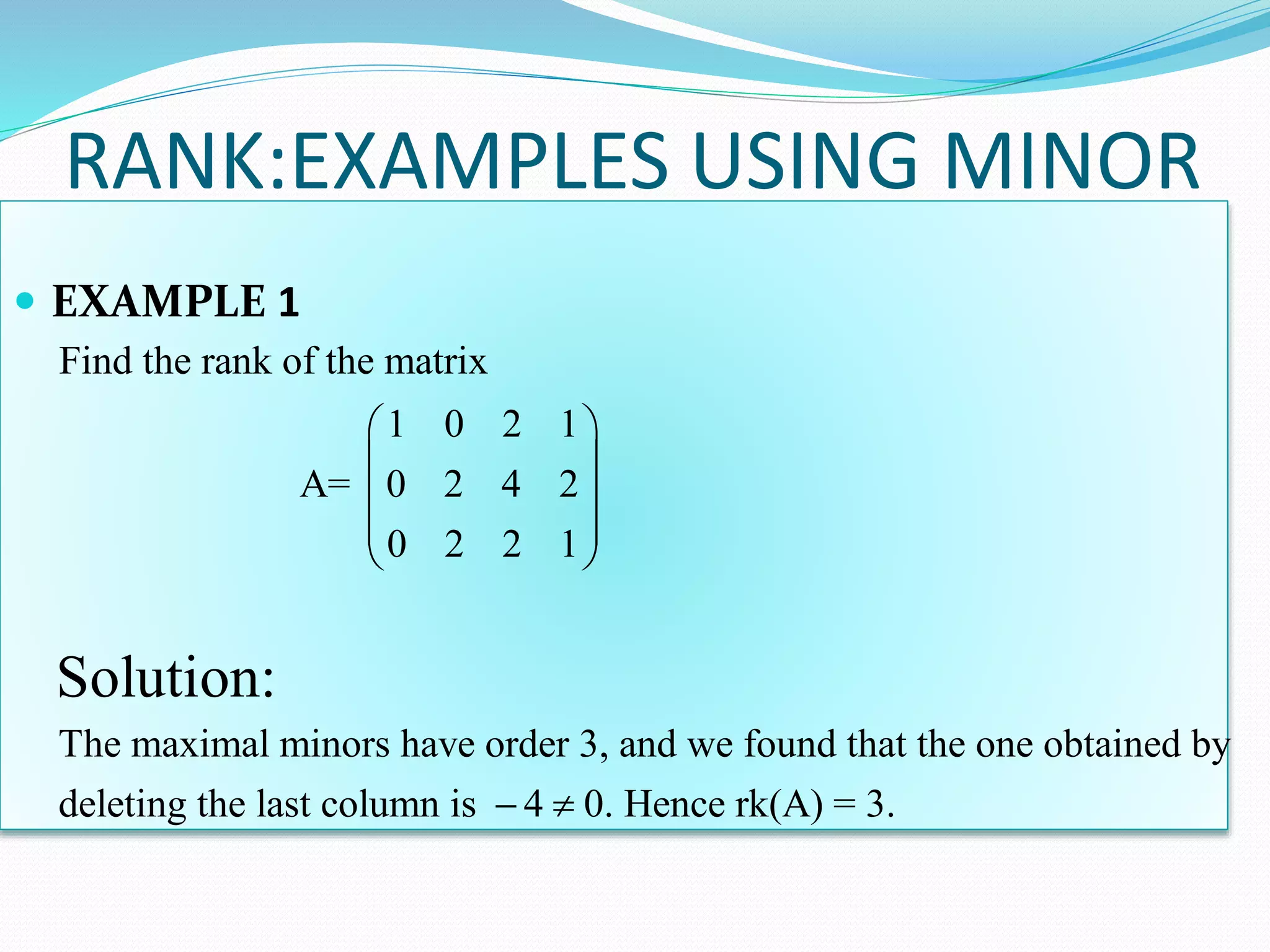
RANK:EXAMPLES USING MINOR 
 EXAMPLE 1 
Find the rank of the matrix 
1 0 2 1 
  
  
  
  
  
A= 0 2 4 2 
0 2 2 1 
Solution: 
The maximal minors have order 3, and we found that the one obtained by 
deleting the last column is  4  0. Hence rk(A) 
= 3.
 EXAMPLE 2: 
Find the rank of the matrix 
 1 2 1  1 
 
  
  
  
  
A= 9 5 2 2 
7 1 0 4
Solution: 
The maximal minors have order 3, so we compute the 4 minors of order 3. 
The first one is 
1 2 1 
9 5 2 =7.(  1)+(  1).(  
7)=0 
7 1 0 
The other three are also zero. Since all minors of 
order 3 are zero, the 
rank must be rk(A) < 3. We continue to look at the minors of order two. 
The first one is 
1 2 
= 5 18 = 13 0 
9 5 
   
It is not necessary to compute any more minors, a 
nd we conclude that 
rk(A) = 2. In fact, the rst two columns of A are linearly independent.
4. USING NORMAL FORM 
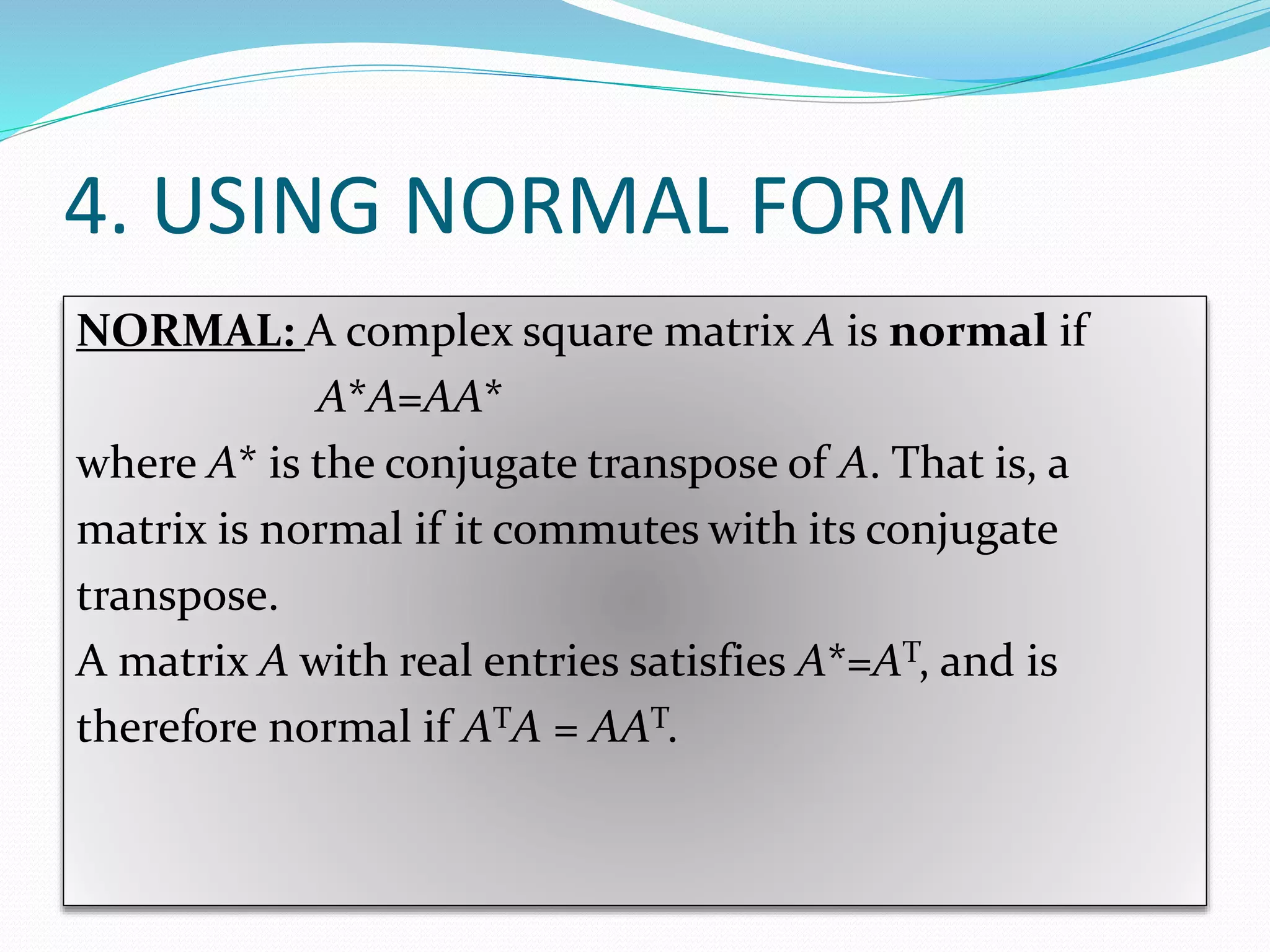
NORMAL: A complex square matrix A is normal if 
A*A=AA* 
where A* is the conjugate transpose of A. That is, a 
matrix is normal if it commutes with its conjugate 
transpose. 
A matrix A with real entries satisfies A*=AT, and is 
therefore normal if ATA = AAT.
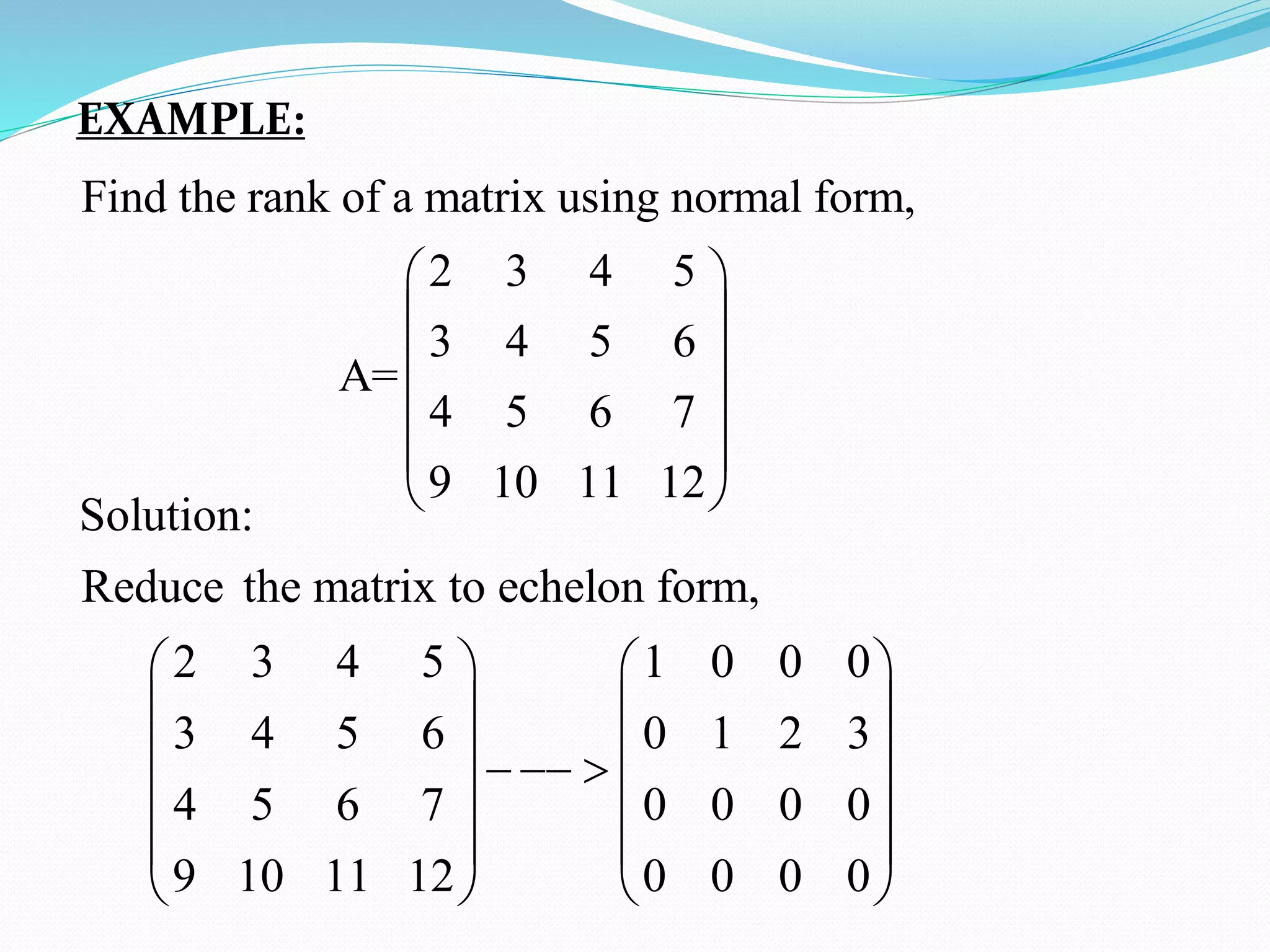
EXAMPLE: 
Find the rank of a matrix using normal form, 
2 3 4 5 
3 4 5 6 
A= 
  
  
  
 4 5 6 7 
 
  
 9 10 11 12 
 
Solution: 
Reduce the matrix to echelon form, 
2 3 4 5 1 0 0 0 
3 4 5 6 0 1 2 3 
4 5 6 7 0 0 0 0 
9 10 11 12 0 0 0 0 
    
    
       
    
    
   
Now,convert the reduced matrix to normal form by using row/column operations, 
1 0 0 0 1 0 0 0 
0 1 2 3 0 1 0 0 
0 0 0 0 0 0 0 0 
0 0 0 0 0 0 0 0 
1 0 0 0 
0 1 0 0 I 2 
0 
0 0 0 0 0 0 
0 0 0 0 
The 
    
    
       
    
    
    
  
  
           
  
  
given matrix is normal. 
Now the rank will be defined by the suffix of the identity matrix ie 2. 
rank(A)=2
Thank you!!

rank of matrix

  • 1.
    RANK OF AMATRIX (BY VARIOUS METHODS)
  • 2.
    RANK OF AMATRIX Let A be any m n matrix. Then A consists of n column vectors a₁, a₂ ,....,a, which are m-vectors. DEFINTION: The rank of A is the maximal number of linearly independent column vectors in A, i.e. the maximal number of linearly independent vectors among {a₁, a₂,......, a}. If A = 0, then the rank of A is 0. We write rk(A) for the rank of A. Note that we may compute the rank of any matrix-square or not
  • 3.
    Let us seehow to compute 2 2 matrix:     : EXAMPLE The rank of a 2 2 matrix A = is given by ( ) 2 ad bc 0, since both column vectors are independent in this case. rk(A) = 1 if det(A) a b rk A if det A c d             0 0 = 0 but A 0 = ,since both column vectors 0 0 are not linearly independent, but there is a single column vector that is linearly independent (i.e. non-zero). rk(A) = 0 if A = 0         RANK OF 2  2 MATRIX How do we compute rk(A) of m x n matrix?
  • 4.
    COMPUTING RANK BYVARIOUS METHODS 1. BY GAUSS ELIMINATION 2. BY DETERMINANTS 3. BY MINORS 4. BY MORMAL FORM
  • 5.
    1. USING GAUSSELIMINATION GAUSS ELIMINATION: Use elementary row operations to reduce A to echelon form. The rank of A is the number of pivots or leading coefficients in the echelon form. In fact, the pivot columns (i.e. the columns with pivots in them) are linearly independent. Note that it is not necessary to and the reduced echelon form –any echelon form will do since only the pivots matter. POSSIBLE RANKS: Counting possible number of pivots, we see that rk(A) m and rk(A) n for any m n matrix A.  
  • 6.
    EXAMPLE Gauss elimination: * Find the rank of a matrix  1 0 2 1          A= 0 2 4 2 0 2 2 1
  • 7.
    SOLUTION: We useelementary row operations: 1 0 2 1 1 0 2 1                 A= 0 2 4 2 0 2 4 2  0 2 2 1 0 0 2 1   Since the echelon form has pivots in the first three columns, A has rank, rk(A) = 3. The first three columns of A are linearly independent.
  • 8.
    2. USING DETERMINANTS Definition: Let A be an m n matrix. A minor of A of order k is a determinant of a k X k sub-matrix of A. We obtain the minors of order k from A by first deleting m rows and n -k columns, and then computing the determinant. There are usually many minors of A of a give order. Example: Find the minors of order 3 of the matrix 1 0 2 1           A = 0 2 4 2 0 2 2 1
  • 9.
    EXAMPLE • COMPUTINGMINORS: We obtain the determinants of order 3 by keeping all the rows and deleting one column from A. So there are four different minors of order 3. We compute one of them to illustrate: 1 0 2 A = 0 2 4 1( 4)+ 0 = 4    0 2 2 The minors of order 3 are called the maximal minors of A, since there are no 4 x 4 sub-matrices of A. There are 3.6 = 18 minors of order 2 and 3.4 = 12 minors of order 1.
  • 10.
    3. USING MINORS Proposition: Let A be an m X n matrix. The rank of A is the maximal order of a non-zero minor of A. Idea of proof: If a minor of order k is non-zero, then the corresponding columns of A are linearly independent. Computing the rank: Start with the minors of maximal order k. If there is one that is non-zero, then rk(A) = k. If all maximal minors are zero, then rk(A) < k, and we continue with the minors of order k-1 and so on, until we and a minor that is non-zero. If all minors of order 1 (i.e. all entries in A) are zero, then rk(A) = 0.
  • 11.
    RANK:EXAMPLES USING MINOR  EXAMPLE 1 Find the rank of the matrix 1 0 2 1           A= 0 2 4 2 0 2 2 1 Solution: The maximal minors have order 3, and we found that the one obtained by deleting the last column is  4  0. Hence rk(A) = 3.
  • 12.
     EXAMPLE 2: Find the rank of the matrix  1 2 1  1          A= 9 5 2 2 7 1 0 4
  • 13.
    Solution: The maximalminors have order 3, so we compute the 4 minors of order 3. The first one is 1 2 1 9 5 2 =7.(  1)+(  1).(  7)=0 7 1 0 The other three are also zero. Since all minors of order 3 are zero, the rank must be rk(A) < 3. We continue to look at the minors of order two. The first one is 1 2 = 5 18 = 13 0 9 5    It is not necessary to compute any more minors, a nd we conclude that rk(A) = 2. In fact, the rst two columns of A are linearly independent.
  • 14.
    4. USING NORMALFORM NORMAL: A complex square matrix A is normal if A*A=AA* where A* is the conjugate transpose of A. That is, a matrix is normal if it commutes with its conjugate transpose. A matrix A with real entries satisfies A*=AT, and is therefore normal if ATA = AAT.
  • 15.
    EXAMPLE: Find therank of a matrix using normal form, 2 3 4 5 3 4 5 6 A=        4 5 6 7     9 10 11 12  Solution: Reduce the matrix to echelon form, 2 3 4 5 1 0 0 0 3 4 5 6 0 1 2 3 4 5 6 7 0 0 0 0 9 10 11 12 0 0 0 0                           
  • 16.
    Now,convert the reducedmatrix to normal form by using row/column operations, 1 0 0 0 1 0 0 0 0 1 2 3 0 1 0 0 0 0 0 0 0 0 0 0 0 0 0 0 0 0 0 0 1 0 0 0 0 1 0 0 I 2 0 0 0 0 0 0 0 0 0 0 0 The                                               given matrix is normal. Now the rank will be defined by the suffix of the identity matrix ie 2. rank(A)=2
  • 17.