Basic Mathematics
Introductory Differentiation
R Horan & M Lavelle
The aim of this document is to provide a short,
self assessment programme for students who
would like to acquire a basic understanding of
elementary differentiation.
Copyright c 2004 rhoran@plymouth.ac.uk , mlavelle@plymouth.ac.uk
Last Revision Date: November 19, 2004 Version 1.0
Table of Contents
1. Rates of Change (Introduction)
2. Rates of Change (Continued)
3. The Derivative as a Limit
4. Differentiation
5. Quiz on Differentiation
Solutions to Exercises
Solutions to Quizzes
The full range of these packages and some instructions,
should they be required, can be obtained from our web
page Mathematics Support Materials.
Section 1: Rates of Change (Introduction) 3
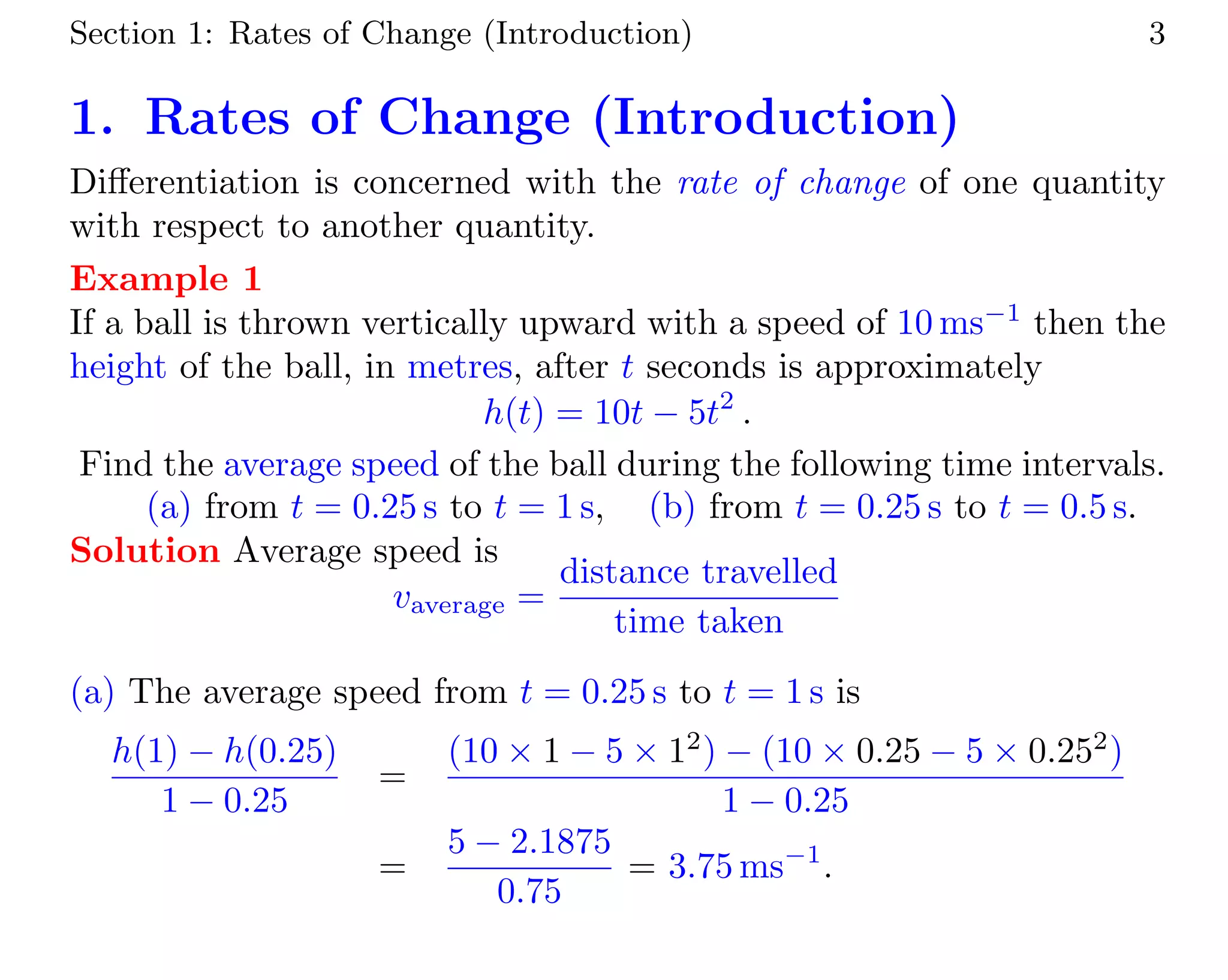
1. Rates of Change (Introduction)
Differentiation is concerned with the rate of change of one quantity
with respect to another quantity.
Example 1
If a ball is thrown vertically upward with a speed of 10 ms−1
then the
height of the ball, in metres, after t seconds is approximately
h(t) = 10t − 5t2
.
Find the average speed of the ball during the following time intervals.
(a) from t = 0.25 s to t = 1 s, (b) from t = 0.25 s to t = 0.5 s.
Solution Average speed is
vaverage =
distance travelled
time taken
(a) The average speed from t = 0.25 s to t = 1 s is
h(1) − h(0.25)
1 − 0.25
=
(10 × 1 − 5 × 12
) − (10 × 0.25 − 5 × 0.252
)
1 − 0.25
=
5 − 2.1875
0.75
= 3.75 ms−1
.
Section 1: Rates of Change (Introduction) 4
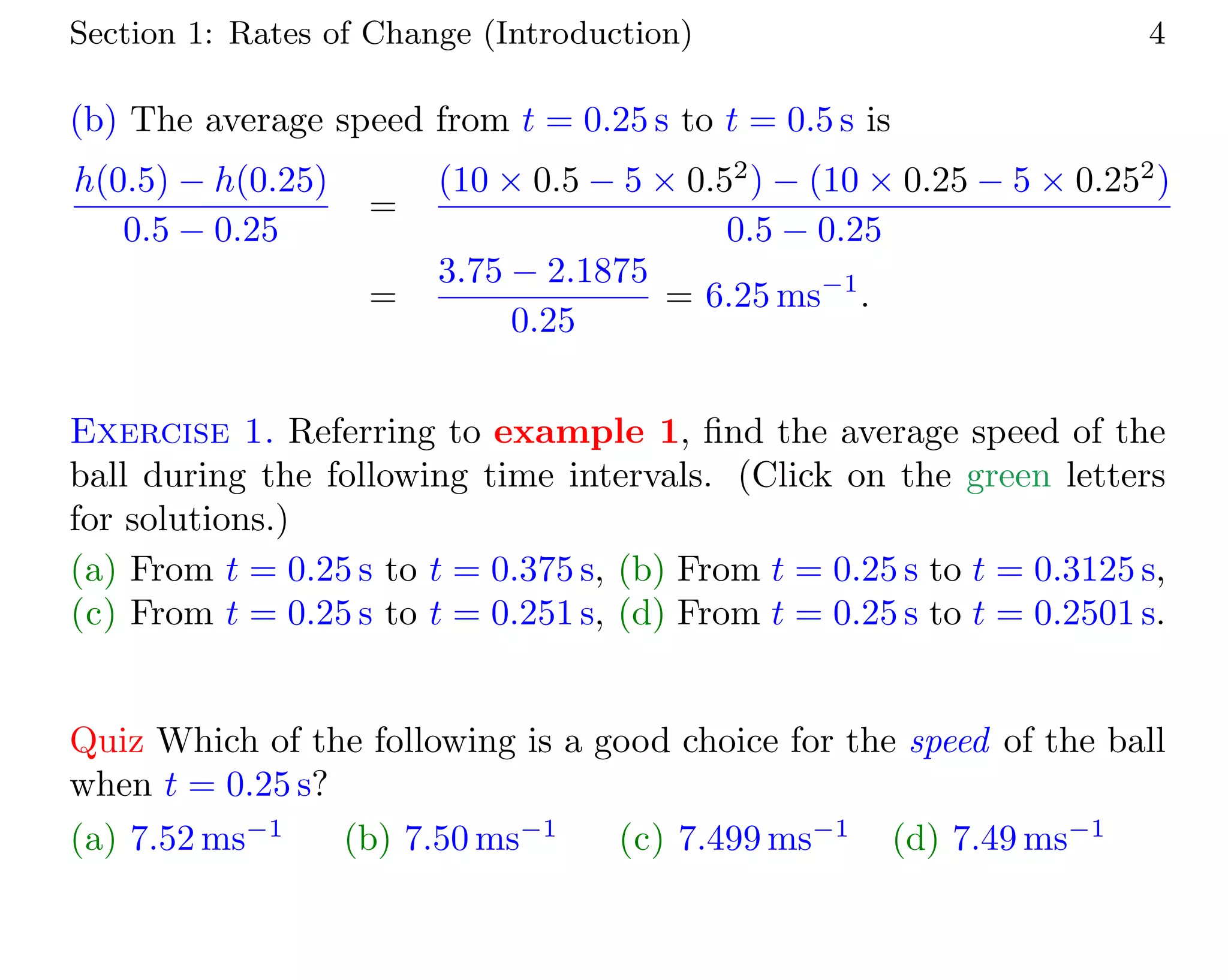
(b) The average speed from t = 0.25 s to t = 0.5 s is
h(0.5) − h(0.25)
0.5 − 0.25
=
(10 × 0.5 − 5 × 0.52
) − (10 × 0.25 − 5 × 0.252
)
0.5 − 0.25
=
3.75 − 2.1875
0.25
= 6.25 ms−1
.
Exercise 1. Referring to example 1, find the average speed of the
ball during the following time intervals. (Click on the green letters
for solutions.)
(a) From t = 0.25 s to t = 0.375 s, (b) From t = 0.25 s to t = 0.3125 s,
(c) From t = 0.25 s to t = 0.251 s, (d) From t = 0.25 s to t = 0.2501 s.
Quiz Which of the following is a good choice for the speed of the ball
when t = 0.25 s?
(a) 7.52 ms−1
(b) 7.50 ms−1
(c) 7.499 ms−1
(d) 7.49 ms−1
Section 2: Rates of Change (Continued) 5
2. Rates of Change (Continued)
In the previous section the speed of the ball was found at t = 0.25 s.
The next example gives the general solution to this problem.
Example 2
If, as in example 1, the height of a ball at time t is given by
h(t) = 10t − 5t2
, then find the following :
(a) the average speed of the ball over the time interval from t to t+δt,
(b) the limit of this average as δt → 0.
Solution
(a)The height at time t + δt is h(t + δt) and the height at time t is
h(t). The difference in heights is h(t+δt)−h(t) and the time interval
is δt.
h(t + δt) − h(t) = [10(t + δt) − 5(t + δt)2
] − [10t − 5t2
]
= [10t + 10δt − 5(t2
+ 2tδt + (δt)2
] − [10t − 5t2
]
= 10δt − 10tδt − 5(δt)2
= δt[10 − 10t − 5δt].
Section 2: Rates of Change (Continued) 6
The required average speed of the ball at time t is thus
h(t + δt) − h(t)
δt
=
δt[10 − 10t − 5δt]
δt
= 10 − 10t − 5δt ,
after cancelling the δt.
(b) As δt gets smaller, i.e. δt → 0, the last term becomes negligible
and the instantaneous speed at time t is v(t), where
v(t) = 10 − 10t is the speed of the ball at time t .
Exercise 2. Referring to the solution of example 2, find the speed
of the particle when t = 0.25 s. (Click on exercise 2 for the solution.)
To recap, the speed v(t) is obtained from the height h(t) as
v(t) = lim
δt→0
h(t + δt) − h(t)
δt
.
Section 3: The Derivative as a Limit 7
3. The Derivative as a Limit
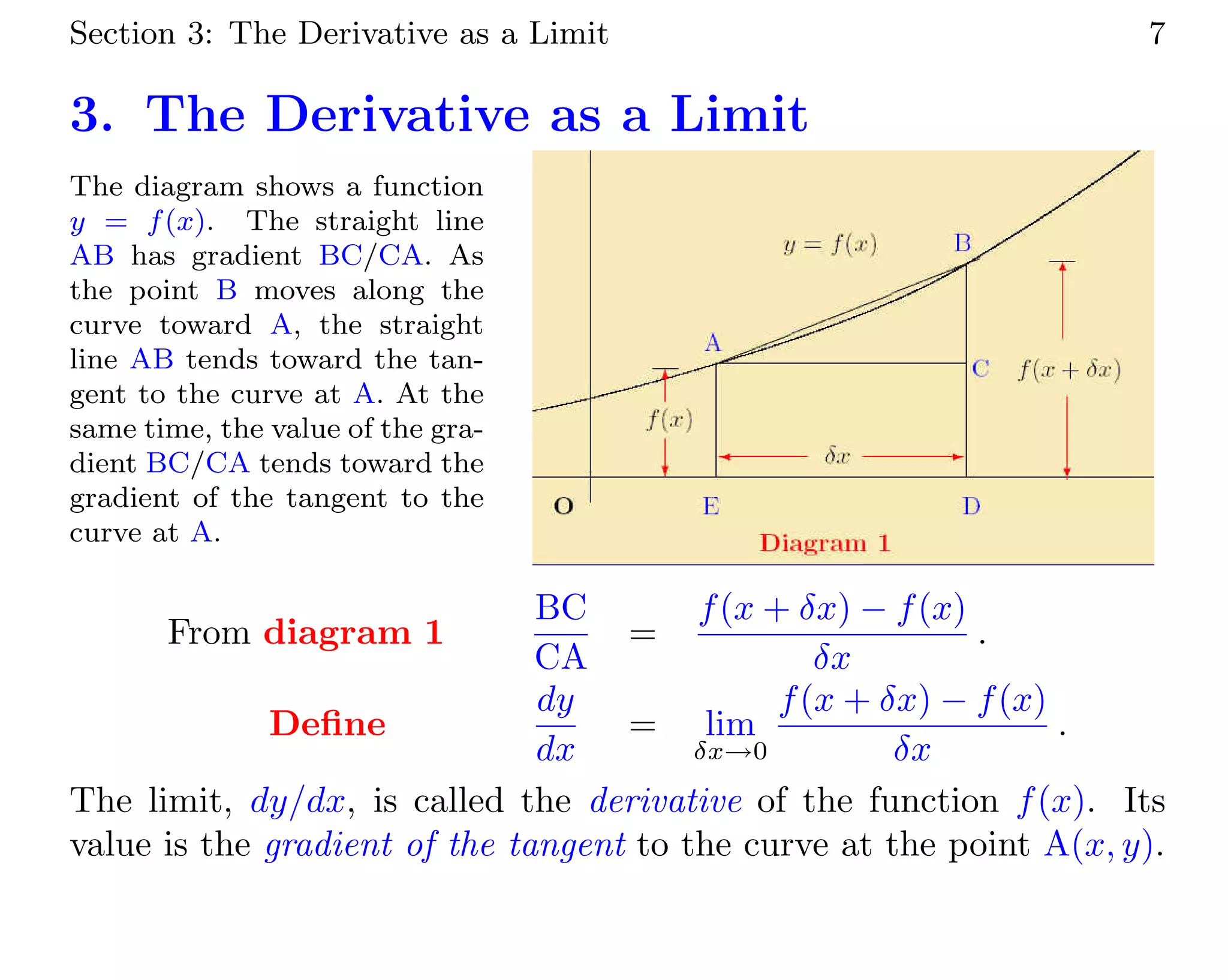
The diagram shows a function
y = f(x). The straight line
AB has gradient BC/CA. As
the point B moves along the
curve toward A, the straight
line AB tends toward the tan-
gent to the curve at A. At the
same time, the value of the gra-
dient BC/CA tends toward the
gradient of the tangent to the
curve at A.
From diagram 1
BC
CA
=
f(x + δx) − f(x)
δx
.
Define
dy
dx
= lim
δx→0
f(x + δx) − f(x)
δx
.
The limit, dy/dx, is called the derivative of the function f(x). Its
value is the gradient of the tangent to the curve at the point A(x, y).
Section 3: The Derivative as a Limit 8
Example 3
Find the derivative of the function y = x3
.
Solution
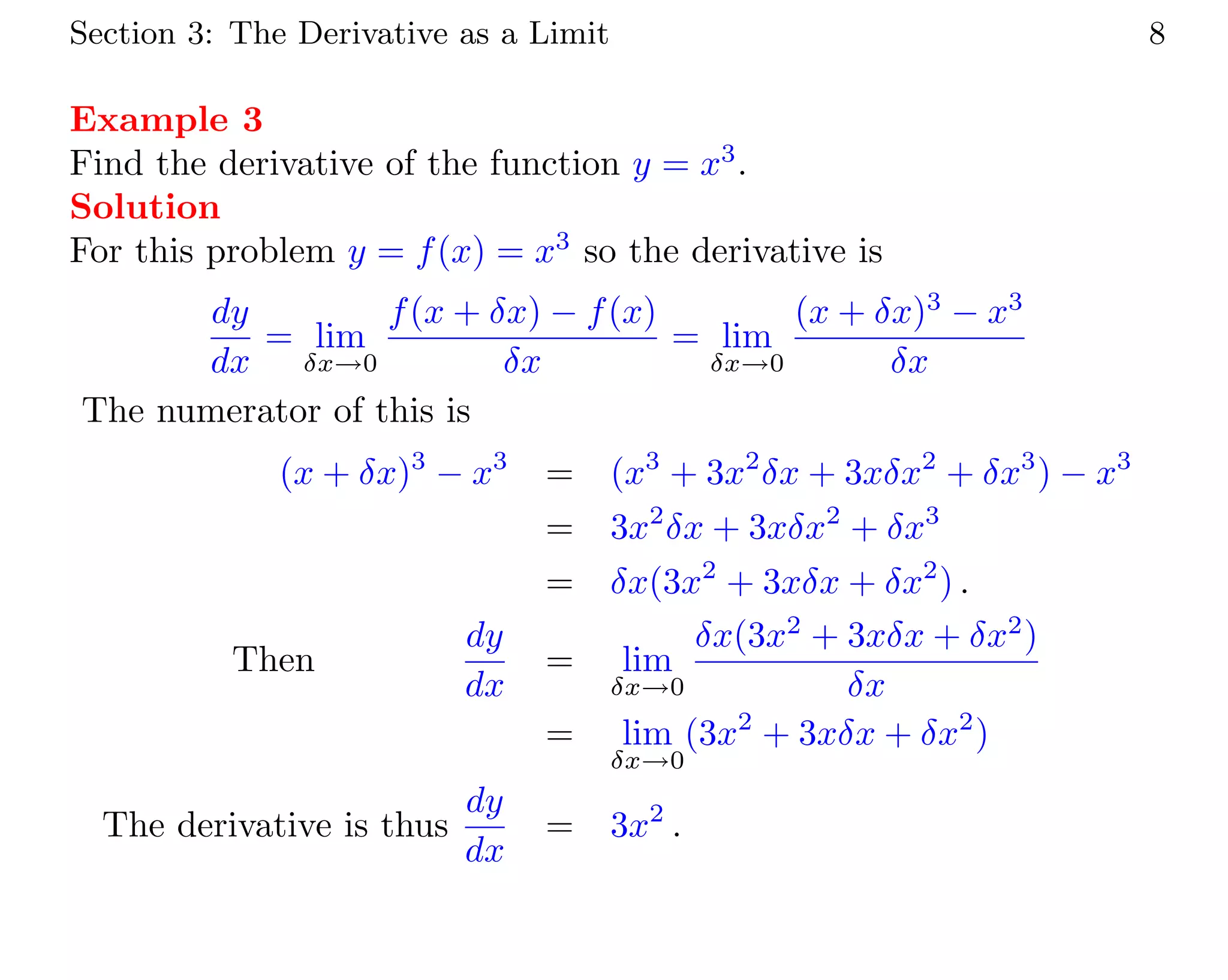
For this problem y = f(x) = x3
so the derivative is
dy
dx
= lim
δx→0
f(x + δx) − f(x)
δx
= lim
δx→0
(x + δx)3
− x3
δx
The numerator of this is
(x + δx)3
− x3
= (x3
+ 3x2
δx + 3xδx2
+ δx3
) − x3
= 3x2
δx + 3xδx2
+ δx3
= δx(3x2
+ 3xδx + δx2
) .
Then
dy
dx
= lim
δx→0
δx(3x2
+ 3xδx + δx2
)
δx
= lim
δx→0
(3x2
+ 3xδx + δx2
)
The derivative is thus
dy
dx
= 3x2
.
Section 3: The Derivative as a Limit 9
Exercise 3. For each of the following functions, use the technique of
example 3 to find the derivative of the function. (Click on the green
letters for solutions.)
(a) y = x, (b) y = x2
, (c) y = 1.
Example 4
Find the gradient of the tangent to the curve y = x3
at the point on
the curve when x = 2.
Solution
From example 3, the derivative of this function is
dy
dx
= 3x2
.
The gradient of the tangent to the curve when x = 2 is
dy
dx x=2
= 3(2)2
= 12 ,
where the symbol
dy
dx x=2
is the function
dy
dx
evaluated at x = 2.
Section 3: The Derivative as a Limit 10
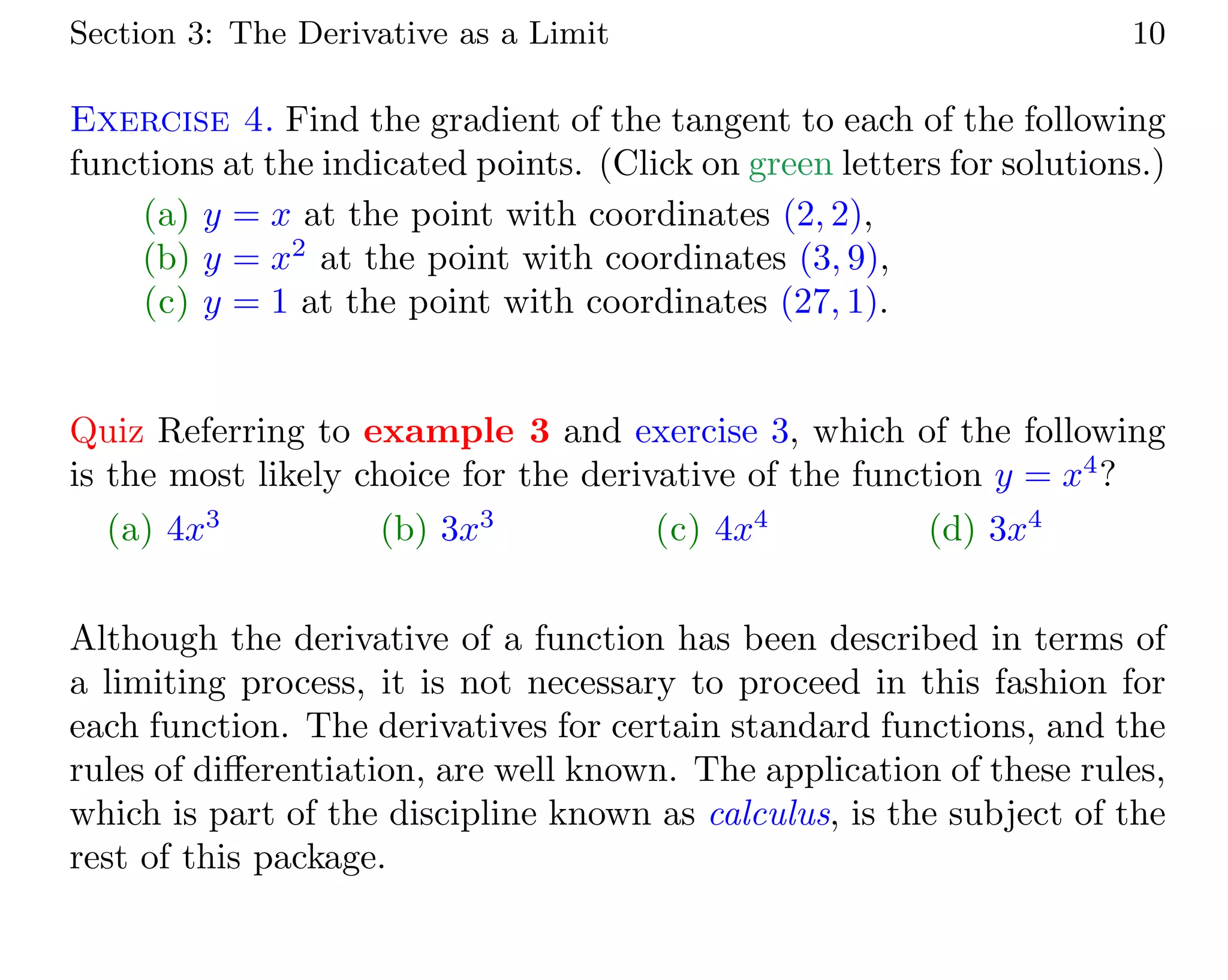
Exercise 4. Find the gradient of the tangent to each of the following
functions at the indicated points. (Click on green letters for solutions.)
(a) y = x at the point with coordinates (2, 2),
(b) y = x2
at the point with coordinates (3, 9),
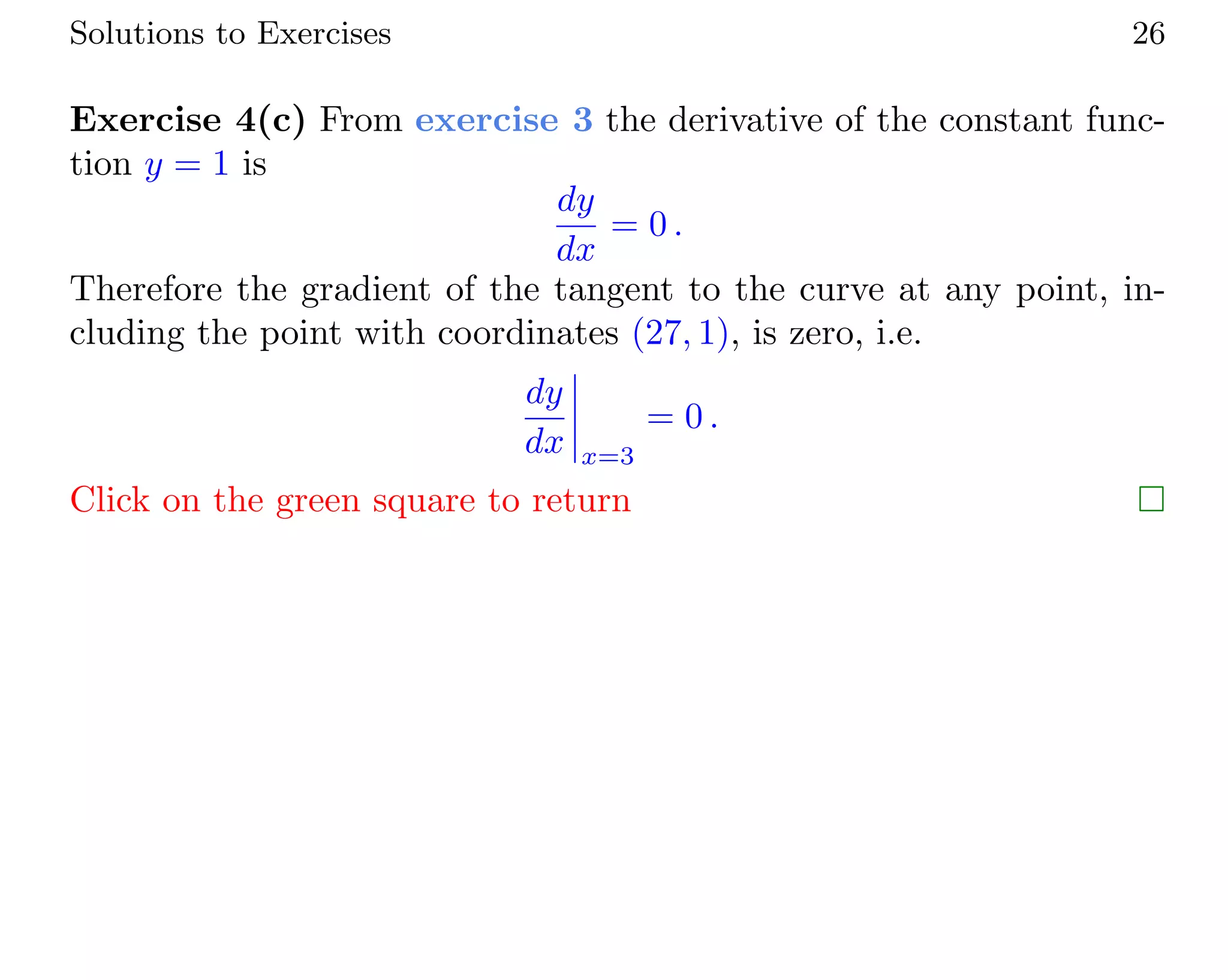
(c) y = 1 at the point with coordinates (27, 1).
Quiz Referring to example 3 and exercise 3, which of the following
is the most likely choice for the derivative of the function y = x4
?
(a) 4x3
(b) 3x3
(c) 4x4
(d) 3x4
Although the derivative of a function has been described in terms of
a limiting process, it is not necessary to proceed in this fashion for
each function. The derivatives for certain standard functions, and the
rules of differentiation, are well known. The application of these rules,
which is part of the discipline known as calculus, is the subject of the
rest of this package.
Section 4: Differentiation 11
4. Differentiation
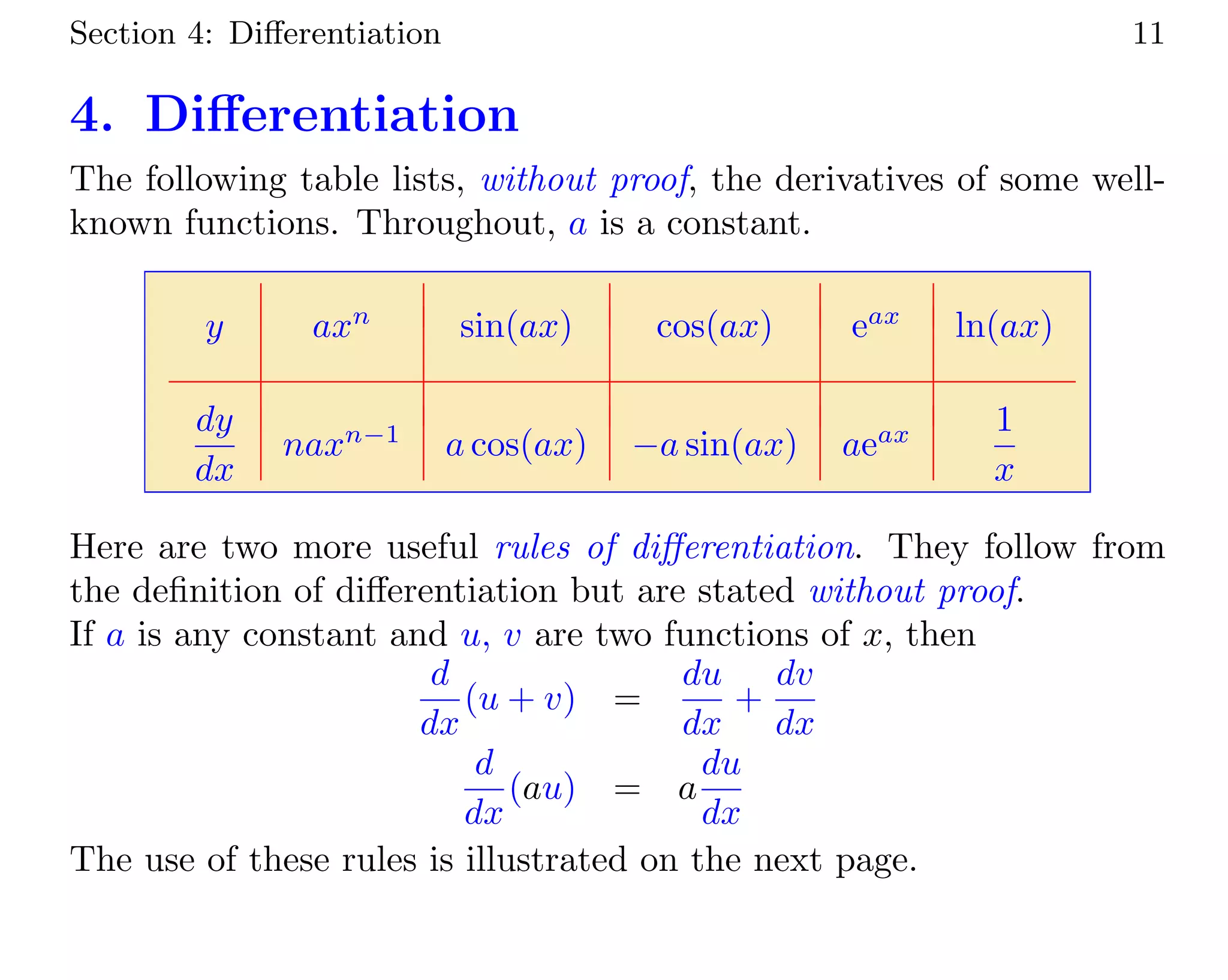
The following table lists, without proof, the derivatives of some well-
known functions. Throughout, a is a constant.
y axn
sin(ax) cos(ax) eax
ln(ax)
dy
dx
naxn−1
a cos(ax) −a sin(ax) aeax 1
x
Here are two more useful rules of differentiation. They follow from
the definition of differentiation but are stated without proof.
If a is any constant and u, v are two functions of x, then
d
dx
(u + v) =
du
dx
+
dv
dx
d
dx
(au) = a
du
dx
The use of these rules is illustrated on the next page.
Section 4: Differentiation 12
Example 5
For each of the following functions, find
dy
dx
.
(a) y = x2
+ 4x3
, (b) y = 5x2
+
1
x
, (c) y = 5
√
x +
3
x2
− 6x .
Solution
(a) Using the rules of differentiation
y = x2
+ 4x3
dy
dx
=
d
dx
(x2
) +
d
dx
(4x3
)
= 2x + 3 × 4x2
= 2x + 12x2
(b) Before proceeding, note that 1/x = x−1
(see the package on
powers). The function may now be written as
y = 5x2
+
1
x
= 5x2
+ x−1
and the rules can now be applied.
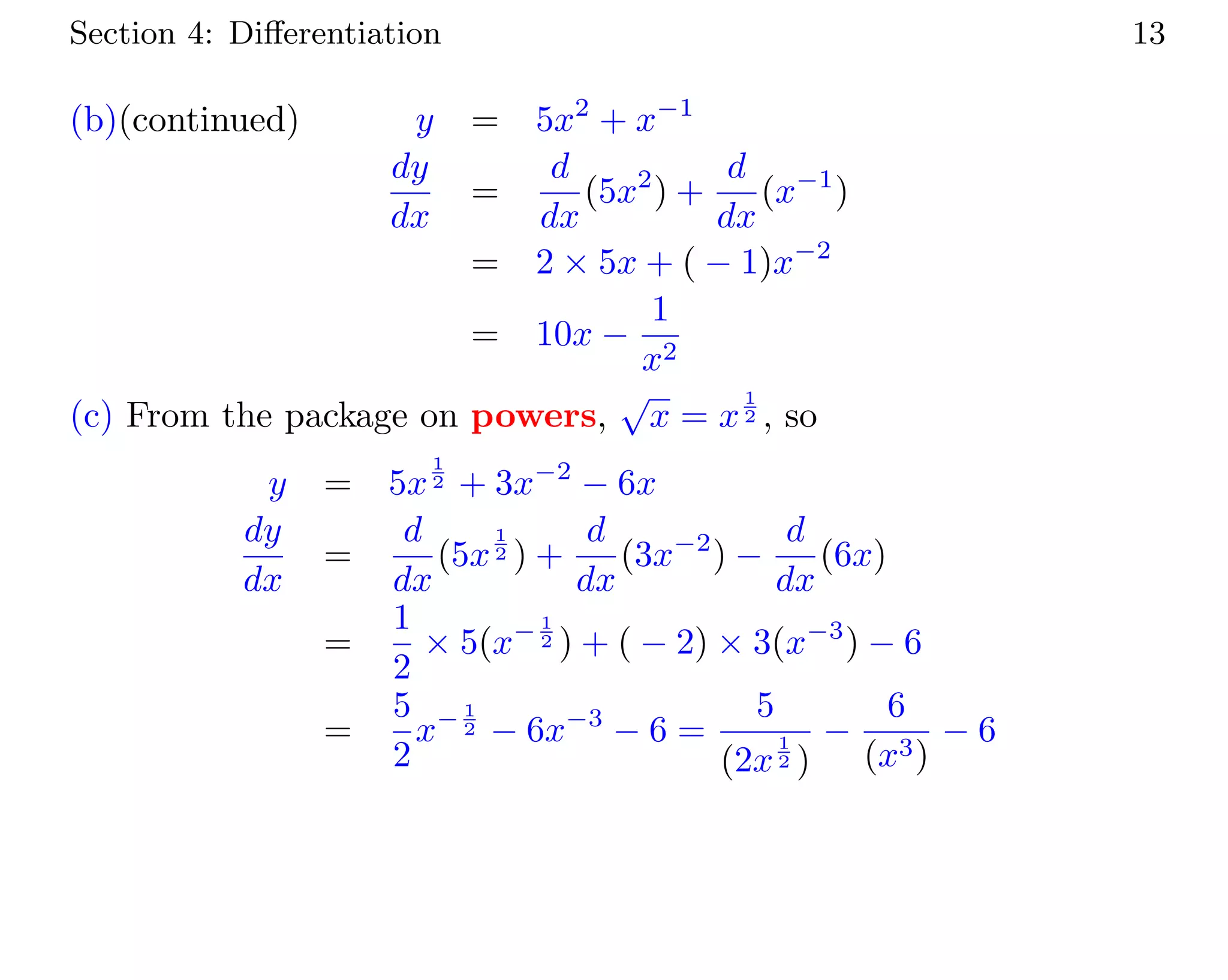
Section 4: Differentiation 13
(b)(continued) y = 5x2
+ x−1
dy
dx
=
d
dx
(5x2
) +
d
dx
(x−1
)
= 2 × 5x + ( − 1)x−2
= 10x −
1
x2
(c) From the package on powers,
√
x = x
1
2 , so
y = 5x
1
2 + 3x−2
− 6x
dy
dx
=
d
dx
(5x
1
2 ) +
d
dx
(3x−2
) −
d
dx
(6x)
=
1
2
× 5(x− 1
2 ) + ( − 2) × 3(x−3
) − 6
=
5
2
x− 1
2 − 6x−3
− 6 =
5
(2x
1
2 )
−
6
(x3)
− 6
Section 4: Differentiation 14
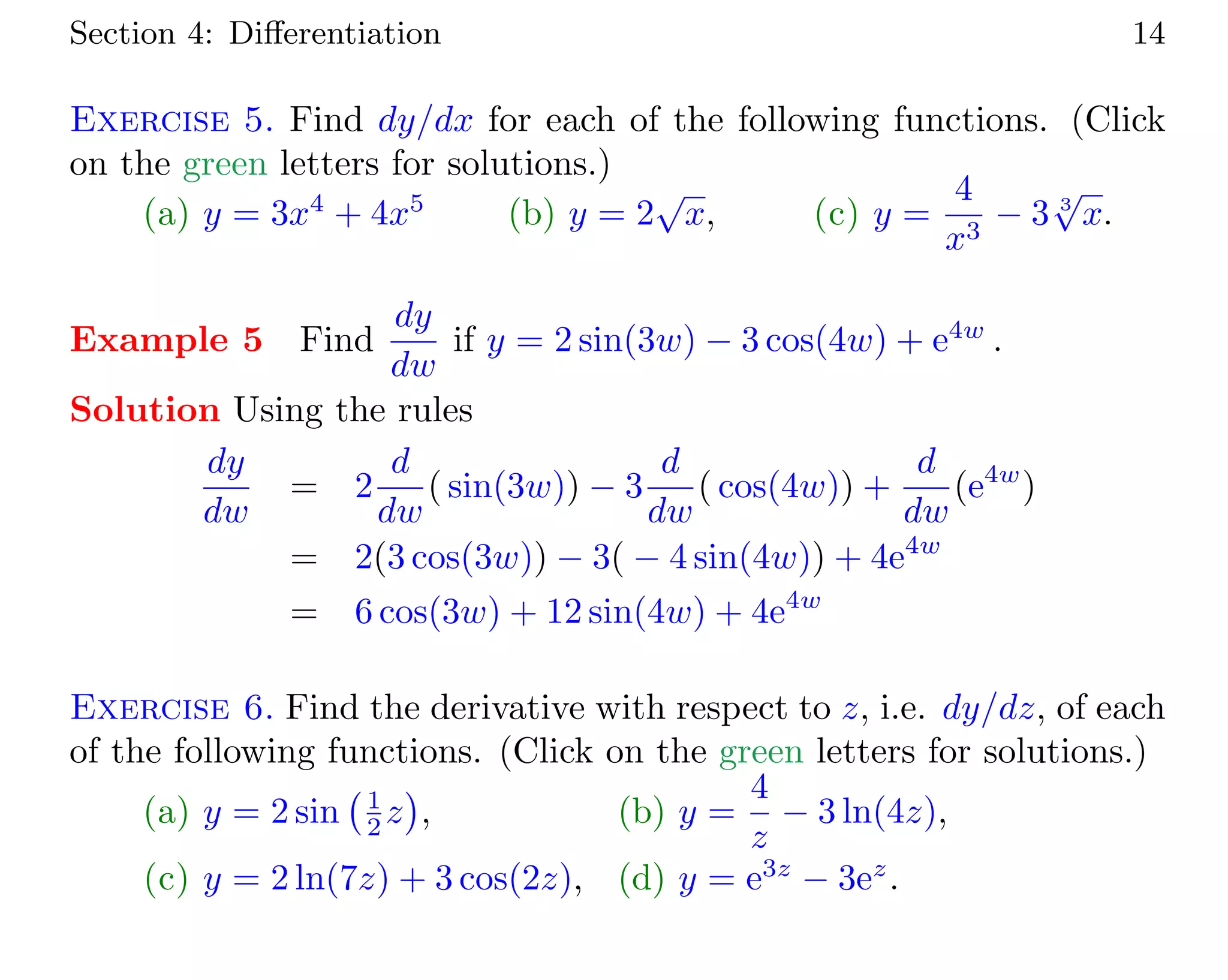
Exercise 5. Find dy/dx for each of the following functions. (Click
on the green letters for solutions.)
(a) y = 3x4
+ 4x5
(b) y = 2
√
x, (c) y =
4
x3
− 3 3
√
x.
Example 5 Find
dy
dw
if y = 2 sin(3w) − 3 cos(4w) + e4w
.
Solution Using the rules
dy
dw
= 2
d
dw
( sin(3w)) − 3
d
dw
( cos(4w)) +
d
dw
(e4w
)
= 2(3 cos(3w)) − 3( − 4 sin(4w)) + 4e4w
= 6 cos(3w) + 12 sin(4w) + 4e4w
Exercise 6. Find the derivative with respect to z, i.e. dy/dz, of each
of the following functions. (Click on the green letters for solutions.)
(a) y = 2 sin 1
2 z , (b) y =
4
z
− 3 ln(4z),
(c) y = 2 ln(7z) + 3 cos(2z), (d) y = e3z
− 3ez
.
Section 5: Quiz on Differentiation 15
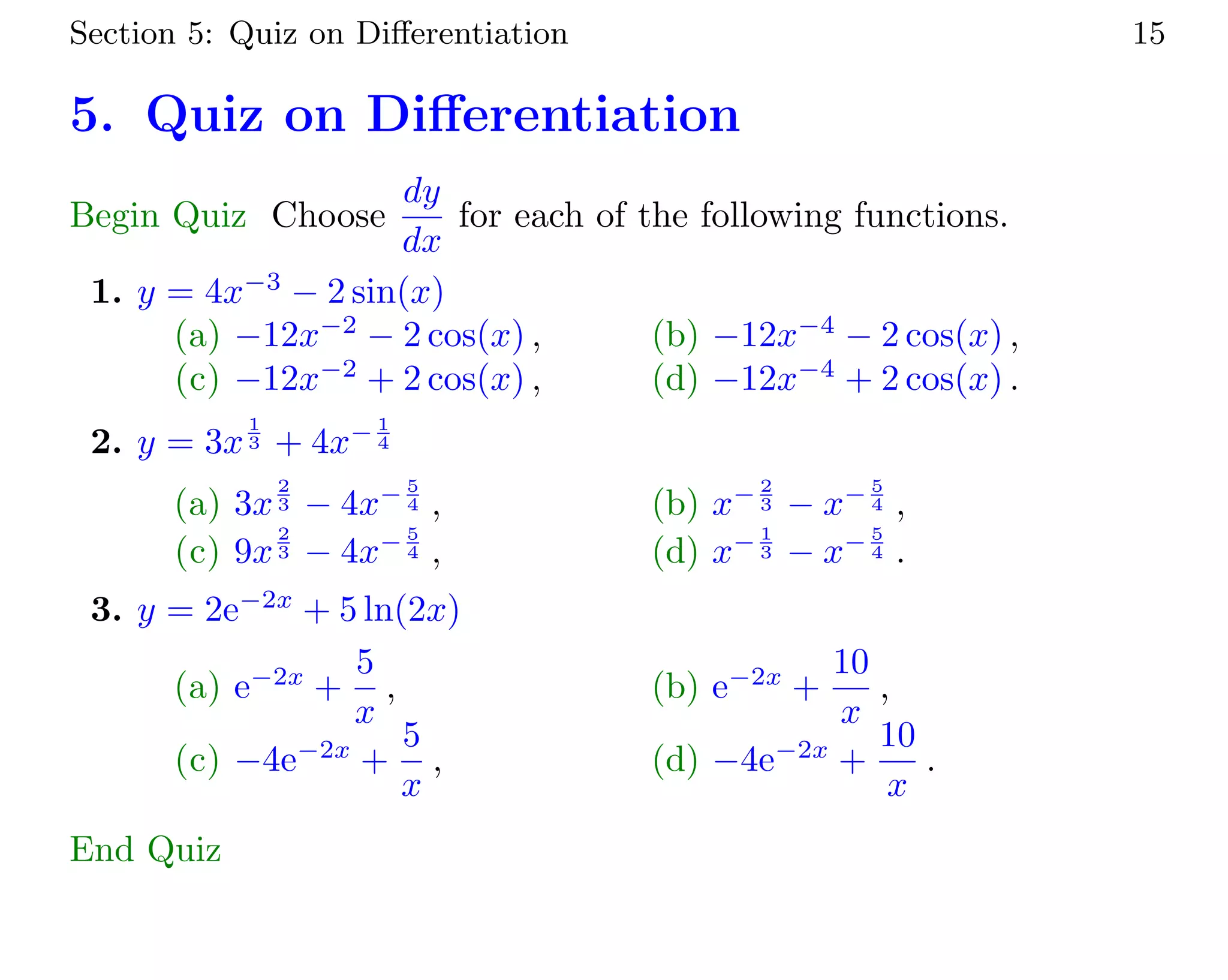
5. Quiz on Differentiation
Begin Quiz Choose
dy
dx
for each of the following functions.
1. y = 4x−3
− 2 sin(x)
(a) −12x−2
− 2 cos(x) , (b) −12x−4
− 2 cos(x) ,
(c) −12x−2
+ 2 cos(x) , (d) −12x−4
+ 2 cos(x) .
2. y = 3x
1
3 + 4x− 1
4
(a) 3x
2
3 − 4x− 5
4 , (b) x− 2
3 − x− 5
4 ,
(c) 9x
2
3 − 4x− 5
4 , (d) x− 1
3 − x− 5
4 .
3. y = 2e−2x
+ 5 ln(2x)
(a) e−2x
+
5
x
, (b) e−2x
+
10
x
,
(c) −4e−2x
+
5
x
, (d) −4e−2x
+
10
x
.
End Quiz
Solutions to Exercises 16
Solutions to Exercises
Exercise 1(a) The average speed from t = 0.25 s to t = 0.375 s is
h(0.375) − h(0.25)
0.375 − 0.25
=
=
(10 × 0.375 − 5 × 0.3752
) − (10 × 0.25 − 5 × 0.252
)
0.375 − 0.25
=
3.047 − 2.1875
0.125
= 6.875 ms−1
.
Click on the green square to return
Solutions to Exercises 17
Exercise 1(b) The average speed from t = 0.25 s to t = 0.3125 s is
h(0.3125) − h(0.25)
0.3125 − 0.25
=
=
(10 × 0.3125 − 5 × 0.31252
) − (10 × 0.25 − 5 × 0.252
)
0.3125 − 0.25
=
3.047 − 2.1875
0.0625
= 7.1875 ms−1
.
Click on the green square to return
Solutions to Exercises 18
Exercise 1(c) The average speed from t = 0.25 s to t = 0.251 s is
h(0.251) − h(0.25)
0.251 − 0.25
=
=
(10 × 0.251 − 5 × 0.2512
) − (10 × 0.25 − 5 × 0.252
)
0.251 − 0.25
=
3.047 − 2.1875
0.001
= 7.495 ms−1
.
Click on the green square to return
Solutions to Exercises 19
Exercise 1(d) The average speed from t = 0.25 s to t = 0.251 s is
h(0.2501) − h(0.25)
0.2501 − 0.25
=
=
(10 × 0.2501 − 5 × 0.25012
) − (10 × 0.25 − 5 × 0.252
)
0.2501 − 0.25
=
2.1882 − 2.1875
0.0001
= 7.4995 ms−1
.
Click on the green square to return
Solutions to Exercises 20
Exercise 2.
The speed is found by putting t = 0.25 into v(t) = 10 − 10t. The
resulting speed is
v(0.25) = 10 − 10×0.25 = 10 − 2.5 = 7.5 ms−1
.
This was precisely the value chosen in the earlier quiz, confirming
that the function v(t) = 10 − 10t is indeed the speed of the ball at
any time t. Exercise 2
Solutions to Exercises 21
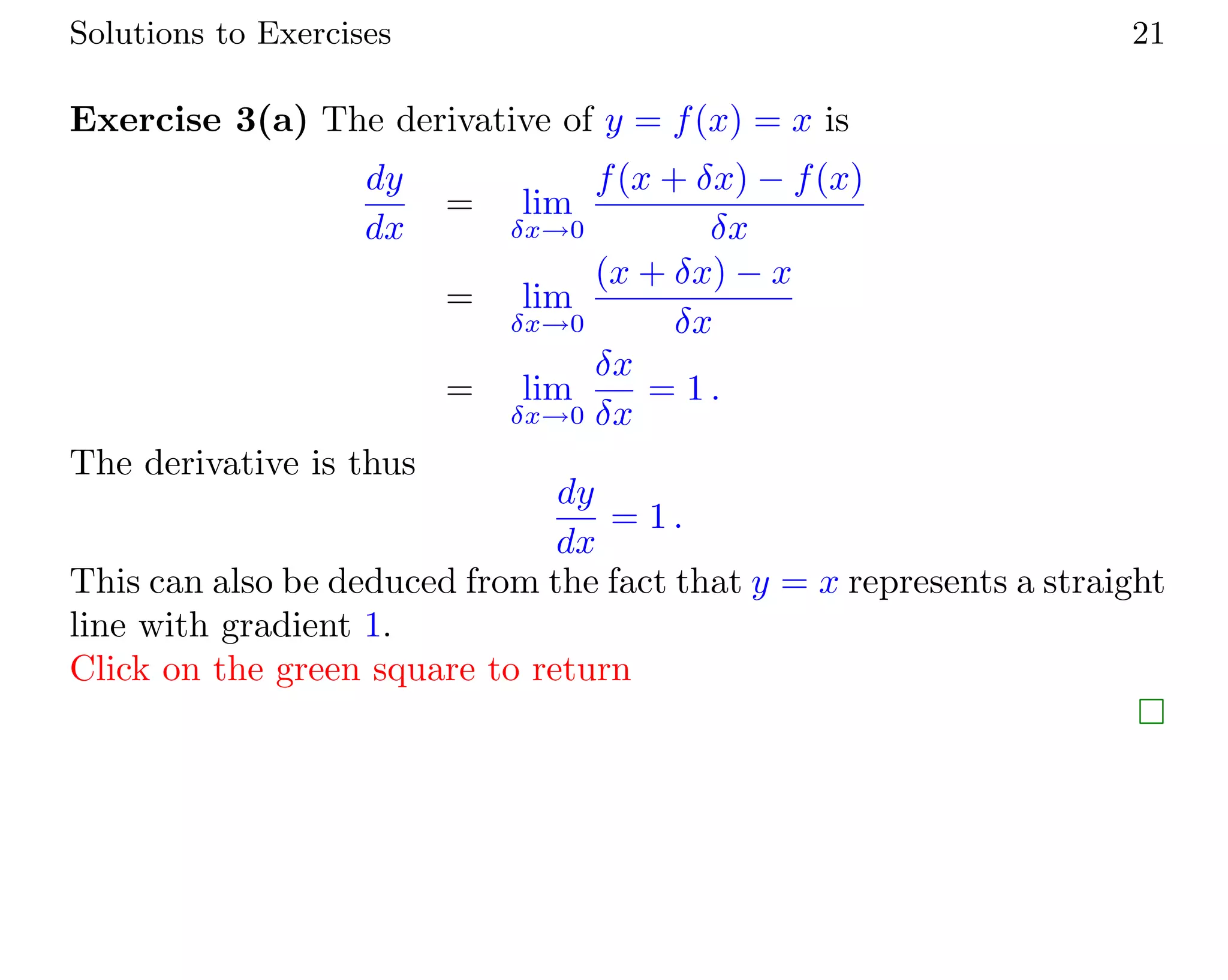
Exercise 3(a) The derivative of y = f(x) = x is
dy
dx
= lim
δx→0
f(x + δx) − f(x)
δx
= lim
δx→0
(x + δx) − x
δx
= lim
δx→0
δx
δx
= 1 .
The derivative is thus
dy
dx
= 1 .
This can also be deduced from the fact that y = x represents a straight
line with gradient 1.
Click on the green square to return
Solutions to Exercises 22
Exercise 3(b) The derivative of y = f(x) = x2
is
dy
dx
= lim
δx→0
f(x + δx) − f(x)
δx
= lim
δx→0
(x + δx)2
− x2
δx
= lim
δx→0
x2
+ 2xδx + (δx)2
− x2
δx
= lim
δx→0
2xδx + (δx)2
δx
= lim
δx→0
(2x + δx)δx
δx
= lim
δx→0
(2x + δx) = 2x .
The derivative is thus
dy
dx
= 2x .
Click on the green square to return
Solutions to Exercises 23
Exercise 3(c) The derivative of y = f(x) = 1 is
dy
dx
= lim
δx→0
f(x + δx) − f(x)
δx
= lim
δx→0
1 − 1
δx
= lim
δx→0
0
δx
= lim
δx→0
(0) = 0 .
The derivative of y = 1 is thus
dy
dx
= 0 .
This is a special case of the rule that the derivative of a constant is
always zero.
Click on the green square to return
Solutions to Exercises 24
Exercise 4(a) According to exercise 3 the derivative of the function
y = x is
dy
dx
= 1 .
Therefore the gradient of the tangent to the curve at the point with
coordinates (2, 2), i.e. when x = 2, is
dy
dx x=2
= 1 .
This is the gradient of the straight line y = x.
Click on the green square to return
Solutions to Exercises 25
Exercise 4(b) From exercise 3 the derivative of the function y = x2
is
dy
dx
= 2x .
Therefore the gradient of the tangent to the curve at the point with
coordinates (3, 9) is the value of
dy
dx
at x = 3, i.e.
dy
dx x=3
= 2 × 3 = 6 .
Click on the green square to return
Solutions to Exercises 26
Exercise 4(c) From exercise 3 the derivative of the constant func-
tion y = 1 is
dy
dx
= 0 .
Therefore the gradient of the tangent to the curve at any point, in-
cluding the point with coordinates (27, 1), is zero, i.e.
dy
dx x=3
= 0 .
Click on the green square to return
Solutions to Exercises 27
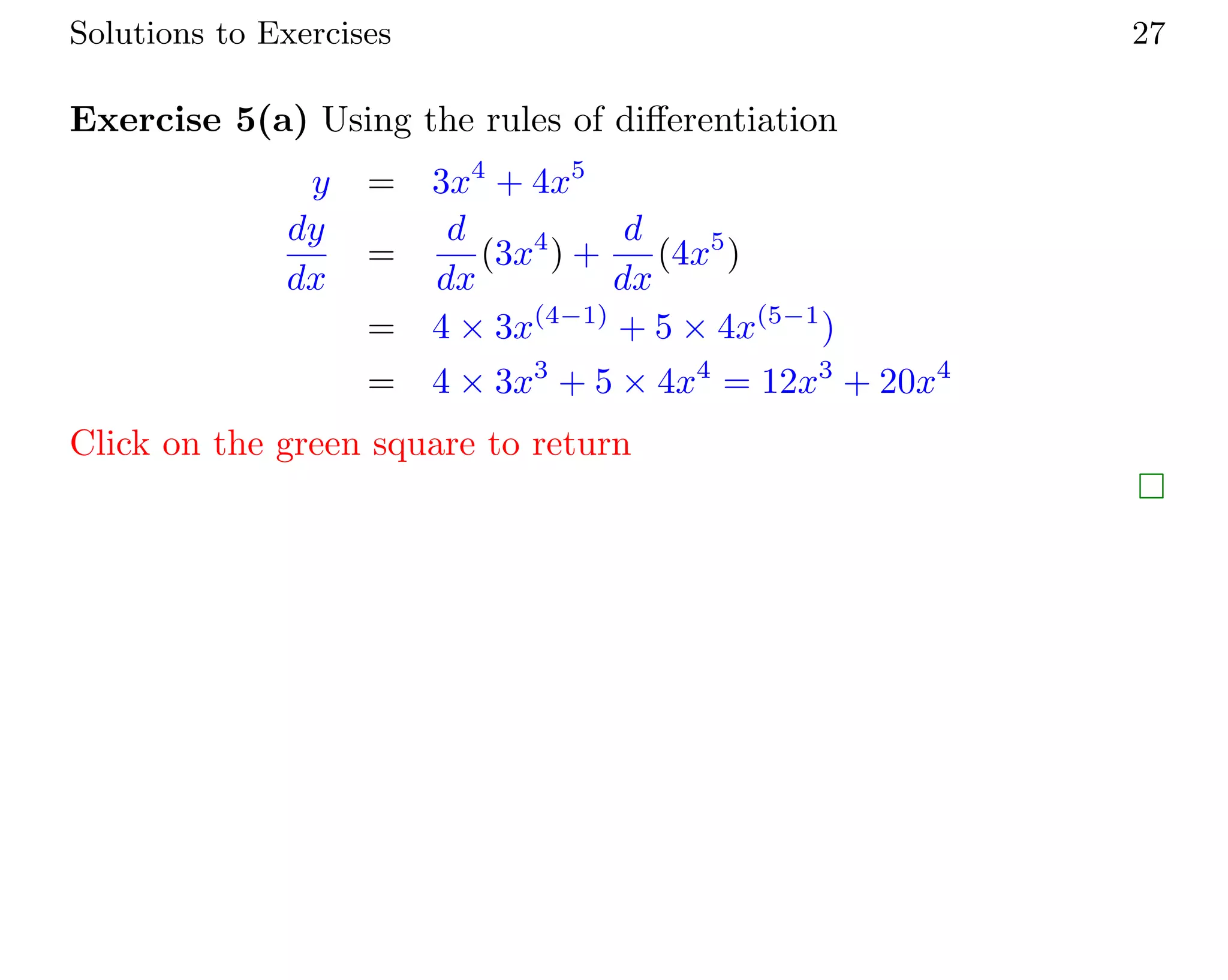
Exercise 5(a) Using the rules of differentiation
y = 3x4
+ 4x5
dy
dx
=
d
dx
(3x4
) +
d
dx
(4x5
)
= 4 × 3x(4−1)
+ 5 × 4x(5−1
)
= 4 × 3x3
+ 5 × 4x4
= 12x3
+ 20x4
Click on the green square to return
Solutions to Exercises 28
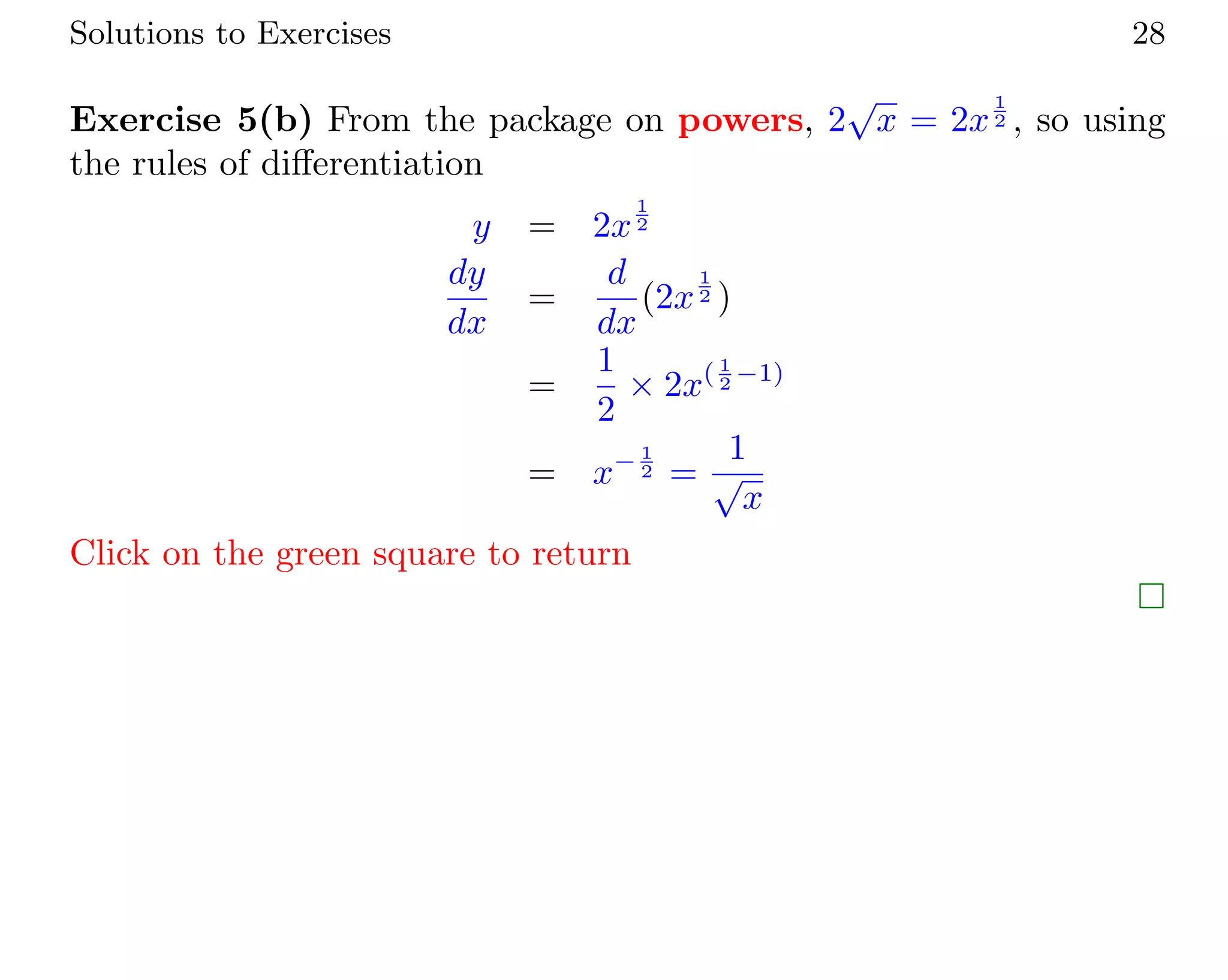
Exercise 5(b) From the package on powers, 2
√
x = 2x
1
2 , so using
the rules of differentiation
y = 2x
1
2
dy
dx
=
d
dx
(2x
1
2 )
=
1
2
× 2x( 1
2 −1)
= x− 1
2 =
1
√
x
Click on the green square to return
Solutions to Exercises 29
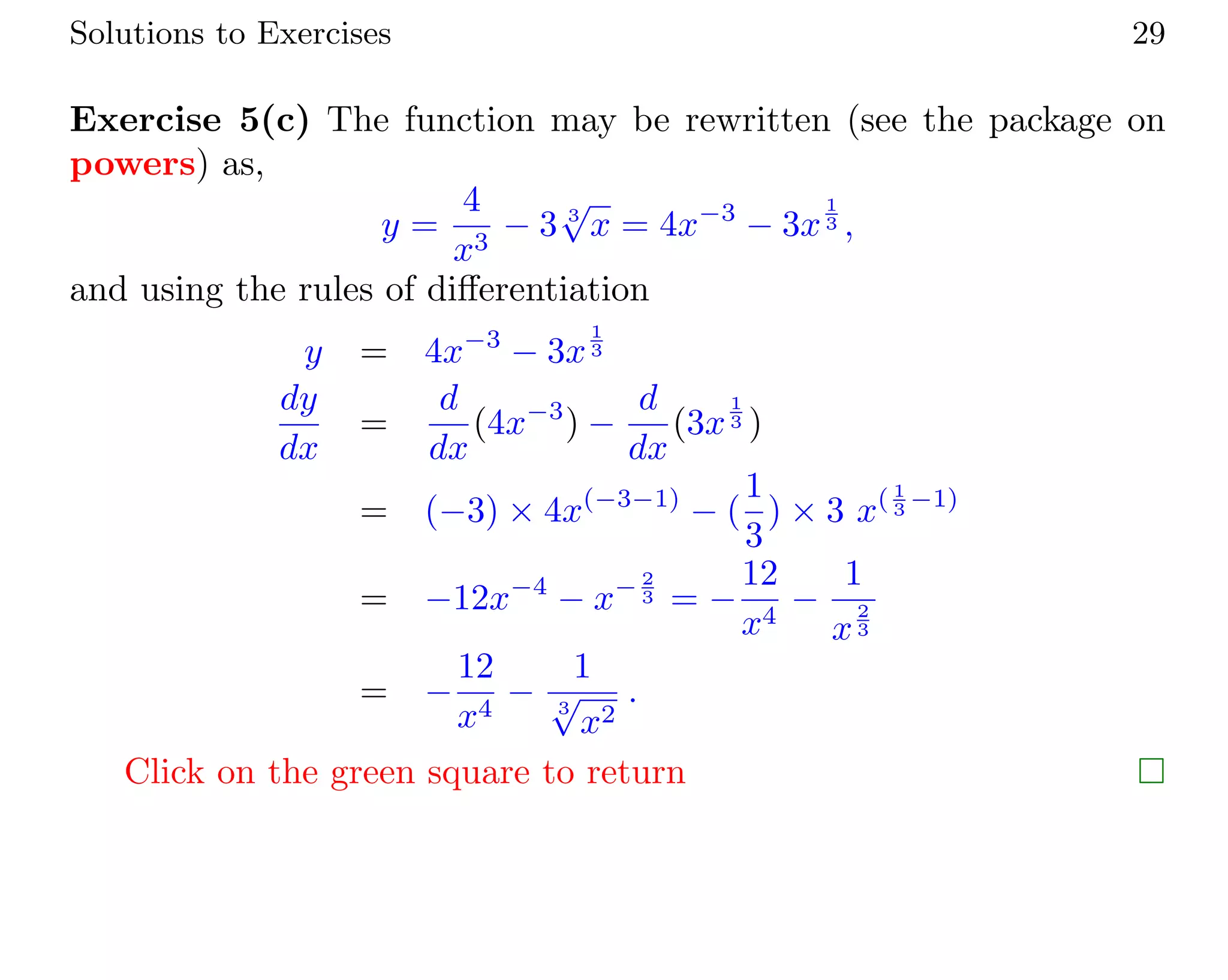
Exercise 5(c) The function may be rewritten (see the package on
powers) as,
y =
4
x3
− 3 3
√
x = 4x−3
− 3x
1
3 ,
and using the rules of differentiation
y = 4x−3
− 3x
1
3
dy
dx
=
d
dx
(4x−3
) −
d
dx
(3x
1
3 )
= (−3) × 4x(−3−1)
− (
1
3
) × 3 x( 1
3 −1)
= −12x−4
− x− 2
3 = −
12
x4
−
1
x
2
3
= −
12
x4
−
1
3
√
x2
.
Click on the green square to return
Solutions to Exercises 30
Exercise 6(a) Using the rules of differentiation and the table of
derivatives
dy
dz
= 2
d
dz
( sin
1
2
z )
= 2 ×
1
2
cos
1
2
z
= cos
1
2
z
Click on the green square to return
Solutions to Exercises 31
Exercise 6(b) Rewriting the function y =
4
z
− 3 ln(4z) as
y = 4z−1
− 3 ln(4z)
and using the table of derivatives
dy
dz
=
d
dz
(4z−1
) − 3
d
dz
( ln(4z))
= (−1) × 4z(−1−1)
− 3 ×
1
z
= −4z−2
−
3
z
= −
4
z2
−
3
z
Click on the green square to return
Solutions to Exercises 32
Exercise 6(c) Using the rules of differentiation and the table of
derivatives
dy
dz
= 2
d
dz
( ln(7z)) + 3
d
dz
( cos(2z))
= 2 ×
1
z
+ 3 × (−2 sin(2z))
=
2
z
− 6 sin 2z
Click on the green square to return
Solutions to Exercises 33
Exercise 6(d) Since
d
dz
(eaz
) = aeaz
,
dy
dz
=
d
dz
e3z
− 3
d
dz
(ez
)
= 3e3z
− 3ez
= 3(e3z
− ez
) .
Click on the green square to return
Solutions to Quizzes 34
Solutions to Quizzes
Solution to Quiz: The table below shows the details of the calcula-
tions that were done in example 1 and exercise 1.
Times distance measured (s) Time interval (s) Average speed (ms−1)
t = 0.25 to t = 1 0.75 3.75
t = 0.25 to t = 0.5 0.25 6.25
t = 0.25 to t = 0.375 0.125 6.87
t = 0.25 to t = 0.3125 0.0625 7.1875
t = 0.25 to t = 0.251 0.001 7.495
t = 0.25 to t = 0.2501 0.0001 7.4995
The difference in speeds is measured over decreasing intervals of time
staring at t = 0.25 s. As this interval of time decreases, so the av-
erage speed tends towards 7.5 ms−1
. This is then taken to be the
speed of the ball at the point when t = 0.25 s. This limiting process,
taking averages over smaller and smaller intervals, is at the heart of
differentiation.
End Quiz
Solutions to Quizzes 35
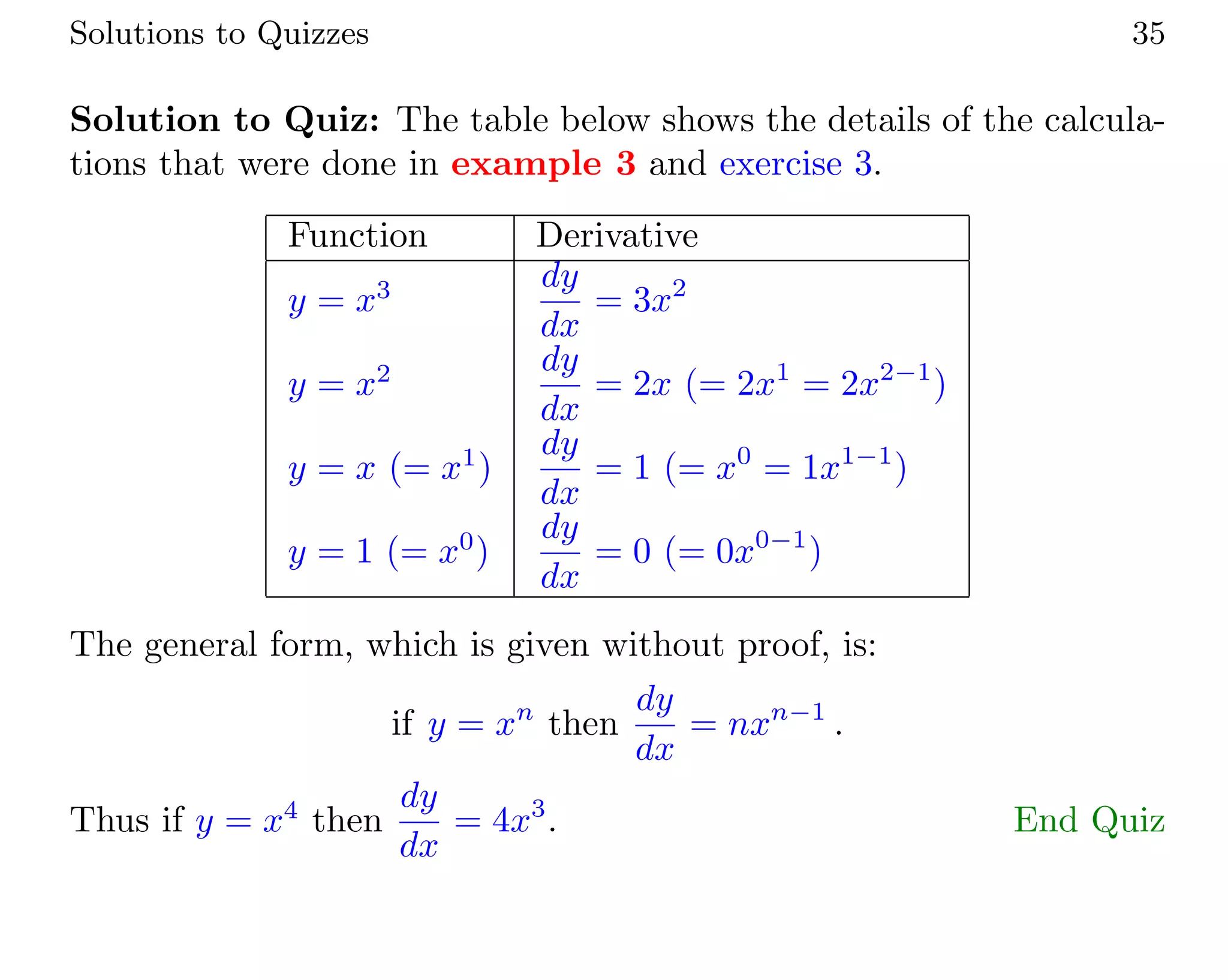
Solution to Quiz: The table below shows the details of the calcula-
tions that were done in example 3 and exercise 3.
Function Derivative
y = x3 dy
dx
= 3x2
y = x2 dy
dx
= 2x (= 2x1
= 2x2−1
)
y = x (= x1
)
dy
dx
= 1 (= x0
= 1x1−1
)
y = 1 (= x0
)
dy
dx
= 0 (= 0x0−1
)
The general form, which is given without proof, is:
if y = xn
then
dy
dx
= nxn−1
.
Thus if y = x4
then
dy
dx
= 4x3
. End Quiz

1520 differentiation-l1

  • 1.
    Basic Mathematics Introductory Differentiation RHoran & M Lavelle The aim of this document is to provide a short, self assessment programme for students who would like to acquire a basic understanding of elementary differentiation. Copyright c 2004 rhoran@plymouth.ac.uk , mlavelle@plymouth.ac.uk Last Revision Date: November 19, 2004 Version 1.0
  • 2.
    Table of Contents 1.Rates of Change (Introduction) 2. Rates of Change (Continued) 3. The Derivative as a Limit 4. Differentiation 5. Quiz on Differentiation Solutions to Exercises Solutions to Quizzes The full range of these packages and some instructions, should they be required, can be obtained from our web page Mathematics Support Materials.
  • 3.
    Section 1: Ratesof Change (Introduction) 3 1. Rates of Change (Introduction) Differentiation is concerned with the rate of change of one quantity with respect to another quantity. Example 1 If a ball is thrown vertically upward with a speed of 10 ms−1 then the height of the ball, in metres, after t seconds is approximately h(t) = 10t − 5t2 . Find the average speed of the ball during the following time intervals. (a) from t = 0.25 s to t = 1 s, (b) from t = 0.25 s to t = 0.5 s. Solution Average speed is vaverage = distance travelled time taken (a) The average speed from t = 0.25 s to t = 1 s is h(1) − h(0.25) 1 − 0.25 = (10 × 1 − 5 × 12 ) − (10 × 0.25 − 5 × 0.252 ) 1 − 0.25 = 5 − 2.1875 0.75 = 3.75 ms−1 .
  • 4.
    Section 1: Ratesof Change (Introduction) 4 (b) The average speed from t = 0.25 s to t = 0.5 s is h(0.5) − h(0.25) 0.5 − 0.25 = (10 × 0.5 − 5 × 0.52 ) − (10 × 0.25 − 5 × 0.252 ) 0.5 − 0.25 = 3.75 − 2.1875 0.25 = 6.25 ms−1 . Exercise 1. Referring to example 1, find the average speed of the ball during the following time intervals. (Click on the green letters for solutions.) (a) From t = 0.25 s to t = 0.375 s, (b) From t = 0.25 s to t = 0.3125 s, (c) From t = 0.25 s to t = 0.251 s, (d) From t = 0.25 s to t = 0.2501 s. Quiz Which of the following is a good choice for the speed of the ball when t = 0.25 s? (a) 7.52 ms−1 (b) 7.50 ms−1 (c) 7.499 ms−1 (d) 7.49 ms−1
  • 5.
    Section 2: Ratesof Change (Continued) 5 2. Rates of Change (Continued) In the previous section the speed of the ball was found at t = 0.25 s. The next example gives the general solution to this problem. Example 2 If, as in example 1, the height of a ball at time t is given by h(t) = 10t − 5t2 , then find the following : (a) the average speed of the ball over the time interval from t to t+δt, (b) the limit of this average as δt → 0. Solution (a)The height at time t + δt is h(t + δt) and the height at time t is h(t). The difference in heights is h(t+δt)−h(t) and the time interval is δt. h(t + δt) − h(t) = [10(t + δt) − 5(t + δt)2 ] − [10t − 5t2 ] = [10t + 10δt − 5(t2 + 2tδt + (δt)2 ] − [10t − 5t2 ] = 10δt − 10tδt − 5(δt)2 = δt[10 − 10t − 5δt].
  • 6.
    Section 2: Ratesof Change (Continued) 6 The required average speed of the ball at time t is thus h(t + δt) − h(t) δt = δt[10 − 10t − 5δt] δt = 10 − 10t − 5δt , after cancelling the δt. (b) As δt gets smaller, i.e. δt → 0, the last term becomes negligible and the instantaneous speed at time t is v(t), where v(t) = 10 − 10t is the speed of the ball at time t . Exercise 2. Referring to the solution of example 2, find the speed of the particle when t = 0.25 s. (Click on exercise 2 for the solution.) To recap, the speed v(t) is obtained from the height h(t) as v(t) = lim δt→0 h(t + δt) − h(t) δt .
  • 7.
    Section 3: TheDerivative as a Limit 7 3. The Derivative as a Limit The diagram shows a function y = f(x). The straight line AB has gradient BC/CA. As the point B moves along the curve toward A, the straight line AB tends toward the tan- gent to the curve at A. At the same time, the value of the gra- dient BC/CA tends toward the gradient of the tangent to the curve at A. From diagram 1 BC CA = f(x + δx) − f(x) δx . Define dy dx = lim δx→0 f(x + δx) − f(x) δx . The limit, dy/dx, is called the derivative of the function f(x). Its value is the gradient of the tangent to the curve at the point A(x, y).
  • 8.
    Section 3: TheDerivative as a Limit 8 Example 3 Find the derivative of the function y = x3 . Solution For this problem y = f(x) = x3 so the derivative is dy dx = lim δx→0 f(x + δx) − f(x) δx = lim δx→0 (x + δx)3 − x3 δx The numerator of this is (x + δx)3 − x3 = (x3 + 3x2 δx + 3xδx2 + δx3 ) − x3 = 3x2 δx + 3xδx2 + δx3 = δx(3x2 + 3xδx + δx2 ) . Then dy dx = lim δx→0 δx(3x2 + 3xδx + δx2 ) δx = lim δx→0 (3x2 + 3xδx + δx2 ) The derivative is thus dy dx = 3x2 .
  • 9.
    Section 3: TheDerivative as a Limit 9 Exercise 3. For each of the following functions, use the technique of example 3 to find the derivative of the function. (Click on the green letters for solutions.) (a) y = x, (b) y = x2 , (c) y = 1. Example 4 Find the gradient of the tangent to the curve y = x3 at the point on the curve when x = 2. Solution From example 3, the derivative of this function is dy dx = 3x2 . The gradient of the tangent to the curve when x = 2 is dy dx x=2 = 3(2)2 = 12 , where the symbol dy dx x=2 is the function dy dx evaluated at x = 2.
  • 10.
    Section 3: TheDerivative as a Limit 10 Exercise 4. Find the gradient of the tangent to each of the following functions at the indicated points. (Click on green letters for solutions.) (a) y = x at the point with coordinates (2, 2), (b) y = x2 at the point with coordinates (3, 9), (c) y = 1 at the point with coordinates (27, 1). Quiz Referring to example 3 and exercise 3, which of the following is the most likely choice for the derivative of the function y = x4 ? (a) 4x3 (b) 3x3 (c) 4x4 (d) 3x4 Although the derivative of a function has been described in terms of a limiting process, it is not necessary to proceed in this fashion for each function. The derivatives for certain standard functions, and the rules of differentiation, are well known. The application of these rules, which is part of the discipline known as calculus, is the subject of the rest of this package.
  • 11.
    Section 4: Differentiation11 4. Differentiation The following table lists, without proof, the derivatives of some well- known functions. Throughout, a is a constant. y axn sin(ax) cos(ax) eax ln(ax) dy dx naxn−1 a cos(ax) −a sin(ax) aeax 1 x Here are two more useful rules of differentiation. They follow from the definition of differentiation but are stated without proof. If a is any constant and u, v are two functions of x, then d dx (u + v) = du dx + dv dx d dx (au) = a du dx The use of these rules is illustrated on the next page.
  • 12.
    Section 4: Differentiation12 Example 5 For each of the following functions, find dy dx . (a) y = x2 + 4x3 , (b) y = 5x2 + 1 x , (c) y = 5 √ x + 3 x2 − 6x . Solution (a) Using the rules of differentiation y = x2 + 4x3 dy dx = d dx (x2 ) + d dx (4x3 ) = 2x + 3 × 4x2 = 2x + 12x2 (b) Before proceeding, note that 1/x = x−1 (see the package on powers). The function may now be written as y = 5x2 + 1 x = 5x2 + x−1 and the rules can now be applied.
  • 13.
    Section 4: Differentiation13 (b)(continued) y = 5x2 + x−1 dy dx = d dx (5x2 ) + d dx (x−1 ) = 2 × 5x + ( − 1)x−2 = 10x − 1 x2 (c) From the package on powers, √ x = x 1 2 , so y = 5x 1 2 + 3x−2 − 6x dy dx = d dx (5x 1 2 ) + d dx (3x−2 ) − d dx (6x) = 1 2 × 5(x− 1 2 ) + ( − 2) × 3(x−3 ) − 6 = 5 2 x− 1 2 − 6x−3 − 6 = 5 (2x 1 2 ) − 6 (x3) − 6
  • 14.
    Section 4: Differentiation14 Exercise 5. Find dy/dx for each of the following functions. (Click on the green letters for solutions.) (a) y = 3x4 + 4x5 (b) y = 2 √ x, (c) y = 4 x3 − 3 3 √ x. Example 5 Find dy dw if y = 2 sin(3w) − 3 cos(4w) + e4w . Solution Using the rules dy dw = 2 d dw ( sin(3w)) − 3 d dw ( cos(4w)) + d dw (e4w ) = 2(3 cos(3w)) − 3( − 4 sin(4w)) + 4e4w = 6 cos(3w) + 12 sin(4w) + 4e4w Exercise 6. Find the derivative with respect to z, i.e. dy/dz, of each of the following functions. (Click on the green letters for solutions.) (a) y = 2 sin 1 2 z , (b) y = 4 z − 3 ln(4z), (c) y = 2 ln(7z) + 3 cos(2z), (d) y = e3z − 3ez .
  • 15.
    Section 5: Quizon Differentiation 15 5. Quiz on Differentiation Begin Quiz Choose dy dx for each of the following functions. 1. y = 4x−3 − 2 sin(x) (a) −12x−2 − 2 cos(x) , (b) −12x−4 − 2 cos(x) , (c) −12x−2 + 2 cos(x) , (d) −12x−4 + 2 cos(x) . 2. y = 3x 1 3 + 4x− 1 4 (a) 3x 2 3 − 4x− 5 4 , (b) x− 2 3 − x− 5 4 , (c) 9x 2 3 − 4x− 5 4 , (d) x− 1 3 − x− 5 4 . 3. y = 2e−2x + 5 ln(2x) (a) e−2x + 5 x , (b) e−2x + 10 x , (c) −4e−2x + 5 x , (d) −4e−2x + 10 x . End Quiz
  • 16.
    Solutions to Exercises16 Solutions to Exercises Exercise 1(a) The average speed from t = 0.25 s to t = 0.375 s is h(0.375) − h(0.25) 0.375 − 0.25 = = (10 × 0.375 − 5 × 0.3752 ) − (10 × 0.25 − 5 × 0.252 ) 0.375 − 0.25 = 3.047 − 2.1875 0.125 = 6.875 ms−1 . Click on the green square to return
  • 17.
    Solutions to Exercises17 Exercise 1(b) The average speed from t = 0.25 s to t = 0.3125 s is h(0.3125) − h(0.25) 0.3125 − 0.25 = = (10 × 0.3125 − 5 × 0.31252 ) − (10 × 0.25 − 5 × 0.252 ) 0.3125 − 0.25 = 3.047 − 2.1875 0.0625 = 7.1875 ms−1 . Click on the green square to return
  • 18.
    Solutions to Exercises18 Exercise 1(c) The average speed from t = 0.25 s to t = 0.251 s is h(0.251) − h(0.25) 0.251 − 0.25 = = (10 × 0.251 − 5 × 0.2512 ) − (10 × 0.25 − 5 × 0.252 ) 0.251 − 0.25 = 3.047 − 2.1875 0.001 = 7.495 ms−1 . Click on the green square to return
  • 19.
    Solutions to Exercises19 Exercise 1(d) The average speed from t = 0.25 s to t = 0.251 s is h(0.2501) − h(0.25) 0.2501 − 0.25 = = (10 × 0.2501 − 5 × 0.25012 ) − (10 × 0.25 − 5 × 0.252 ) 0.2501 − 0.25 = 2.1882 − 2.1875 0.0001 = 7.4995 ms−1 . Click on the green square to return
  • 20.
    Solutions to Exercises20 Exercise 2. The speed is found by putting t = 0.25 into v(t) = 10 − 10t. The resulting speed is v(0.25) = 10 − 10×0.25 = 10 − 2.5 = 7.5 ms−1 . This was precisely the value chosen in the earlier quiz, confirming that the function v(t) = 10 − 10t is indeed the speed of the ball at any time t. Exercise 2
  • 21.
    Solutions to Exercises21 Exercise 3(a) The derivative of y = f(x) = x is dy dx = lim δx→0 f(x + δx) − f(x) δx = lim δx→0 (x + δx) − x δx = lim δx→0 δx δx = 1 . The derivative is thus dy dx = 1 . This can also be deduced from the fact that y = x represents a straight line with gradient 1. Click on the green square to return
  • 22.
    Solutions to Exercises22 Exercise 3(b) The derivative of y = f(x) = x2 is dy dx = lim δx→0 f(x + δx) − f(x) δx = lim δx→0 (x + δx)2 − x2 δx = lim δx→0 x2 + 2xδx + (δx)2 − x2 δx = lim δx→0 2xδx + (δx)2 δx = lim δx→0 (2x + δx)δx δx = lim δx→0 (2x + δx) = 2x . The derivative is thus dy dx = 2x . Click on the green square to return
  • 23.
    Solutions to Exercises23 Exercise 3(c) The derivative of y = f(x) = 1 is dy dx = lim δx→0 f(x + δx) − f(x) δx = lim δx→0 1 − 1 δx = lim δx→0 0 δx = lim δx→0 (0) = 0 . The derivative of y = 1 is thus dy dx = 0 . This is a special case of the rule that the derivative of a constant is always zero. Click on the green square to return
  • 24.
    Solutions to Exercises24 Exercise 4(a) According to exercise 3 the derivative of the function y = x is dy dx = 1 . Therefore the gradient of the tangent to the curve at the point with coordinates (2, 2), i.e. when x = 2, is dy dx x=2 = 1 . This is the gradient of the straight line y = x. Click on the green square to return
  • 25.
    Solutions to Exercises25 Exercise 4(b) From exercise 3 the derivative of the function y = x2 is dy dx = 2x . Therefore the gradient of the tangent to the curve at the point with coordinates (3, 9) is the value of dy dx at x = 3, i.e. dy dx x=3 = 2 × 3 = 6 . Click on the green square to return
  • 26.
    Solutions to Exercises26 Exercise 4(c) From exercise 3 the derivative of the constant func- tion y = 1 is dy dx = 0 . Therefore the gradient of the tangent to the curve at any point, in- cluding the point with coordinates (27, 1), is zero, i.e. dy dx x=3 = 0 . Click on the green square to return
  • 27.
    Solutions to Exercises27 Exercise 5(a) Using the rules of differentiation y = 3x4 + 4x5 dy dx = d dx (3x4 ) + d dx (4x5 ) = 4 × 3x(4−1) + 5 × 4x(5−1 ) = 4 × 3x3 + 5 × 4x4 = 12x3 + 20x4 Click on the green square to return
  • 28.
    Solutions to Exercises28 Exercise 5(b) From the package on powers, 2 √ x = 2x 1 2 , so using the rules of differentiation y = 2x 1 2 dy dx = d dx (2x 1 2 ) = 1 2 × 2x( 1 2 −1) = x− 1 2 = 1 √ x Click on the green square to return
  • 29.
    Solutions to Exercises29 Exercise 5(c) The function may be rewritten (see the package on powers) as, y = 4 x3 − 3 3 √ x = 4x−3 − 3x 1 3 , and using the rules of differentiation y = 4x−3 − 3x 1 3 dy dx = d dx (4x−3 ) − d dx (3x 1 3 ) = (−3) × 4x(−3−1) − ( 1 3 ) × 3 x( 1 3 −1) = −12x−4 − x− 2 3 = − 12 x4 − 1 x 2 3 = − 12 x4 − 1 3 √ x2 . Click on the green square to return
  • 30.
    Solutions to Exercises30 Exercise 6(a) Using the rules of differentiation and the table of derivatives dy dz = 2 d dz ( sin 1 2 z ) = 2 × 1 2 cos 1 2 z = cos 1 2 z Click on the green square to return
  • 31.
    Solutions to Exercises31 Exercise 6(b) Rewriting the function y = 4 z − 3 ln(4z) as y = 4z−1 − 3 ln(4z) and using the table of derivatives dy dz = d dz (4z−1 ) − 3 d dz ( ln(4z)) = (−1) × 4z(−1−1) − 3 × 1 z = −4z−2 − 3 z = − 4 z2 − 3 z Click on the green square to return
  • 32.
    Solutions to Exercises32 Exercise 6(c) Using the rules of differentiation and the table of derivatives dy dz = 2 d dz ( ln(7z)) + 3 d dz ( cos(2z)) = 2 × 1 z + 3 × (−2 sin(2z)) = 2 z − 6 sin 2z Click on the green square to return
  • 33.
    Solutions to Exercises33 Exercise 6(d) Since d dz (eaz ) = aeaz , dy dz = d dz e3z − 3 d dz (ez ) = 3e3z − 3ez = 3(e3z − ez ) . Click on the green square to return
  • 34.
    Solutions to Quizzes34 Solutions to Quizzes Solution to Quiz: The table below shows the details of the calcula- tions that were done in example 1 and exercise 1. Times distance measured (s) Time interval (s) Average speed (ms−1) t = 0.25 to t = 1 0.75 3.75 t = 0.25 to t = 0.5 0.25 6.25 t = 0.25 to t = 0.375 0.125 6.87 t = 0.25 to t = 0.3125 0.0625 7.1875 t = 0.25 to t = 0.251 0.001 7.495 t = 0.25 to t = 0.2501 0.0001 7.4995 The difference in speeds is measured over decreasing intervals of time staring at t = 0.25 s. As this interval of time decreases, so the av- erage speed tends towards 7.5 ms−1 . This is then taken to be the speed of the ball at the point when t = 0.25 s. This limiting process, taking averages over smaller and smaller intervals, is at the heart of differentiation. End Quiz
  • 35.
    Solutions to Quizzes35 Solution to Quiz: The table below shows the details of the calcula- tions that were done in example 3 and exercise 3. Function Derivative y = x3 dy dx = 3x2 y = x2 dy dx = 2x (= 2x1 = 2x2−1 ) y = x (= x1 ) dy dx = 1 (= x0 = 1x1−1 ) y = 1 (= x0 ) dy dx = 0 (= 0x0−1 ) The general form, which is given without proof, is: if y = xn then dy dx = nxn−1 . Thus if y = x4 then dy dx = 4x3 . End Quiz