
Biorefinery
S K Singh
Centre for Energy Studies
IIT Delhi
CONTENTS
● Introduction to Biorefinery
● Uses of Biorefinery
● Functioning of Biorefinery
● Types of Biorefineries
● Biorefinery Platforms and Feedstock
● Biorefinery Concept
● Gasification
● Types of Gasifiers
● Fermentation
● Fermentation of Lignocellulosic Feedstock
● References
Introduction to Biorefinery
● A biorefinery is a refinery that converts biomass to energy and other
beneficial byproducts such as chemicals.
● The International Energy Agency Bioenergy Task 42 defined biorefining as
"the sustainable processing of biomass into a spectrum of bio-based products
like food, feed, chemicals, materials and bioenergy like biofuels, power and/or
heat".
Uses of Biorefinery
● Contributes to national energy needs by producing a variety of fuels.
● Creation of new jobs, including rural areas
● Achieve the ultimate goal of reducing GHG emissions.
● Provides opportunity for economic growth for both the agricultural and forestry
sectors.
● Generates fuels, chemical commodities and bioproducts in an
environmentally sustainable manner.
Functioning of Biorefinery
● The biorefinery uses cellulose, hemicellulose, and lignin from agricultural,
forestry, and municipal waste sources and uses them as feedstocks for
producing a wide range of bio-products.
● These products are used in agri-business, energy production, transportation,
textiles, building products, pharmaceuticals, bioplastics and paper industries.
Types of Biorefineries
Biorefineries can be classified based on four main features:
● Platforms: Refers to key intermediates between raw material and final
products.
● Products: In this classification the main market must be identified.
● Feedstock : It refers to type of feedstock being used.
● Processes: Conversion process to transform biomass into a final product.
Biorefinery Platforms and Feedstock
● There are many type of Biorefinery platforms.
● Following are the major ones:
○ Thermochemical or syngas platform (for example- gasification)
○ Biochemical or sugar platform (for example- fermentation)
● The most important types of biomass feedstock for use in biorefineries are
sugar, starch and lignocellulosic materials.
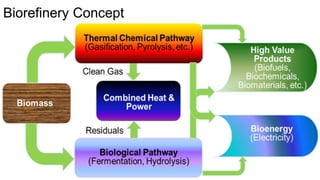
Biorefinery Concept
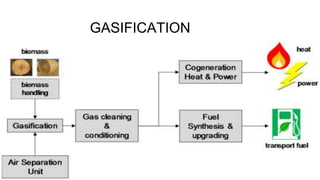
GASIFICATION
Types of Gasifiers
● There are three main types of Gasifiers:
○ Fixed Bed: Passing velocity of gasifying agents through a fixed bed is relatively low.
○ Fluidized Bed : Passing velocity of gasifying agents is high enough to fluidize a bed containing
a small fraction of biomass.
○ Entrained (or suspension) flow gasifiers: In these gasifiers small particles of feedstock are
entrained in a gasifying agent.
● Different gasifier types require different feedstock quality with respect to
moisture and particle size.
○ The fixed bed gasifier requires a coarse biomass feed.
○ In fludized bed gasifiers, the particle diameter is normally in the range 0.1- 5 mm.
○ Entrained flow gasifiers normally require dried material.
FERMENTATION
● The fermentation in a biorefinery concept offers a versatile possibility to
convert the sugar containing polymers, cellulose and hemicellulose, to a
range of products.
● The main step in the fermentation process is the fermentation step in which
microorganisms are used to convert the sugar to a specific product.
● Benefits of microbial sugar conversion is that the microorganisms act as
specific catalysts that can produce a range of products.
Fermentation of Lignocellulosic Feedstock
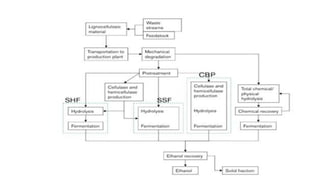
● Lignocellulosic feedstock can also be fermented in more advanced
fermentation concepts.
● For that it first needs to be converted to a monosaccharide solution.
● Following steps need to be taken:
○ The lignocellulosic material is first mechanically degraded to increase the surface area.
○ Than it is hydrolysed
○ Than finally fermented
● There are three different configurations of the enzymatic route:
○ SHF, separate hydrolysis and fermentation
○ SSF, simultaneous saccharification and fermentation
○ CBP, consolidated bioprocessing.
● In the fermentation process, it is of utmost importance that all sugar residues
are fermented with high product yield in order to use resources efficiently.
● After the fermentation step, the ethanol is recovered in a distillation step.
References
https://www.bioenergyconsult.com/biorefinery/
https://core.ac.uk/download/pdf/70603511.pdf
https://www.ctc-n.org/technologies/biorefinery
https://en.wikipedia.org/wiki/Biorefinery
Thank You

Biorefinery

  • 1.
    Biorefinery S K Singh Centrefor Energy Studies IIT Delhi
  • 2.
    CONTENTS ● Introduction toBiorefinery ● Uses of Biorefinery ● Functioning of Biorefinery ● Types of Biorefineries ● Biorefinery Platforms and Feedstock ● Biorefinery Concept ● Gasification ● Types of Gasifiers ● Fermentation ● Fermentation of Lignocellulosic Feedstock ● References
  • 3.
    Introduction to Biorefinery ●A biorefinery is a refinery that converts biomass to energy and other beneficial byproducts such as chemicals. ● The International Energy Agency Bioenergy Task 42 defined biorefining as "the sustainable processing of biomass into a spectrum of bio-based products like food, feed, chemicals, materials and bioenergy like biofuels, power and/or heat".
  • 4.
    Uses of Biorefinery ●Contributes to national energy needs by producing a variety of fuels. ● Creation of new jobs, including rural areas ● Achieve the ultimate goal of reducing GHG emissions. ● Provides opportunity for economic growth for both the agricultural and forestry sectors. ● Generates fuels, chemical commodities and bioproducts in an environmentally sustainable manner.
  • 5.
    Functioning of Biorefinery ●The biorefinery uses cellulose, hemicellulose, and lignin from agricultural, forestry, and municipal waste sources and uses them as feedstocks for producing a wide range of bio-products. ● These products are used in agri-business, energy production, transportation, textiles, building products, pharmaceuticals, bioplastics and paper industries.
  • 6.
    Types of Biorefineries Biorefineriescan be classified based on four main features: ● Platforms: Refers to key intermediates between raw material and final products. ● Products: In this classification the main market must be identified. ● Feedstock : It refers to type of feedstock being used. ● Processes: Conversion process to transform biomass into a final product.
  • 7.
    Biorefinery Platforms andFeedstock ● There are many type of Biorefinery platforms. ● Following are the major ones: ○ Thermochemical or syngas platform (for example- gasification) ○ Biochemical or sugar platform (for example- fermentation) ● The most important types of biomass feedstock for use in biorefineries are sugar, starch and lignocellulosic materials.
  • 8.
  • 9.
  • 10.
    Types of Gasifiers ●There are three main types of Gasifiers: ○ Fixed Bed: Passing velocity of gasifying agents through a fixed bed is relatively low. ○ Fluidized Bed : Passing velocity of gasifying agents is high enough to fluidize a bed containing a small fraction of biomass. ○ Entrained (or suspension) flow gasifiers: In these gasifiers small particles of feedstock are entrained in a gasifying agent. ● Different gasifier types require different feedstock quality with respect to moisture and particle size. ○ The fixed bed gasifier requires a coarse biomass feed. ○ In fludized bed gasifiers, the particle diameter is normally in the range 0.1- 5 mm. ○ Entrained flow gasifiers normally require dried material.
  • 11.
    FERMENTATION ● The fermentationin a biorefinery concept offers a versatile possibility to convert the sugar containing polymers, cellulose and hemicellulose, to a range of products. ● The main step in the fermentation process is the fermentation step in which microorganisms are used to convert the sugar to a specific product. ● Benefits of microbial sugar conversion is that the microorganisms act as specific catalysts that can produce a range of products.
  • 12.
    Fermentation of LignocellulosicFeedstock ● Lignocellulosic feedstock can also be fermented in more advanced fermentation concepts. ● For that it first needs to be converted to a monosaccharide solution. ● Following steps need to be taken: ○ The lignocellulosic material is first mechanically degraded to increase the surface area. ○ Than it is hydrolysed ○ Than finally fermented
  • 14.
    ● There arethree different configurations of the enzymatic route: ○ SHF, separate hydrolysis and fermentation ○ SSF, simultaneous saccharification and fermentation ○ CBP, consolidated bioprocessing. ● In the fermentation process, it is of utmost importance that all sugar residues are fermented with high product yield in order to use resources efficiently. ● After the fermentation step, the ethanol is recovered in a distillation step.
  • 15.
  • 16.