Production Planning and Control Introduction Coordination of materials with suppliers Efficient utilization of people and machines Efficient flow of materials Communication with customers
Production Planning and Control Introduction
Decision Making vs. Decision Support Authors claim that PPC system does not make decisions or manage the operations Managers perform these activities PPC system provides support for decision making
Decision Making vs. Decision Support (Cont’d) However, developing intelligent software is becoming increasingly feasible Software not only to support decision makers but also make (at least) some of the decisions Expert Systems, Neural Networks, Genetic Algorithms, Evolutionary Programming, Genetic Programming, Tabu Search, Simulated Annealing, etc. are available techniques
Activities Supported by PPC Materials Planning Purchasing Raw Material Inventory Control Capacity Planning Scheduling Machine and People WIP Inventory Control
Activities Supported by PPC (Cont’d) Coordinate Customer Orders Finished Goods Inventory Control
Costs and Benefits of PPC Systems PPC requires a large # of indirect people Companies with ineffective PPC system will have poor customer service, excessive inventories, low equipment and people utilization, high rate of part obsolescence, large number of expediters
Company Game Plan Overall direction for PPC is provided by a Company Game Plan Game Plan links various departments (engineering, finance, marketing, production) It should be consistent with strategic plans, budgets, and company’s capabilities
Hierarchical Planning Overall Manufacturing Planning Detailed Materials and Capacity Planning Execution of Plans
Production Planning and Control General Framework
1.Overall Manufacturing Planning Hierarchical Planning Cont’d Demand Management Forecasting Order Promising Order Processing Order Entry Spare Parts
1.Overall Manufacturing Planning Hierarchical Planning Cont’d Production Planning Monthly Plans for Product Families Master Production Scheduling (MPS) Weekly Plans for Individual Products MPS must sum up to Production Plan
PP – MPS Relation
Example Product Family: Markers Products: Red, Blue, Green Marker Note:Usually a period is one month and a  subperiod is one week (s=4).
Example (Cont’d)
1.Overall Manufacturing Planning Hierarchical Planning Cont’d Resource Planning Long-Range Capacity Requirements Number of Machines Number of Employees Overtime Shifts Plants
1.Overall Manufacturing Planning Hierarchical Planning Cont’d Rough-Cut Capacity Planning Capacity Requirements for Master Production Scheduling Overall Factor Capacity Bills Resource Profiles
2.Materials & Capacity Planning Hierarchical Planning Cont’d Materials Planning Production rates can be used in simpler manufacturing systems. Materials Requirements Planning (MRP) can be used in more complex systems. MRP determines time-phased requirements (period-by-period) for all purchased and manufactured parts such as raw materials, components, parts, subassemblies, etc.
2.Materials & Capacity Planning Hierarchical Planning Cont’d Detailed Capacity Planning Labor Hours Required Machine Capacity Required In an MRP environment, this task is accomplished by using the Capacity Requirements Planning (CRP) technique.
3. Execution of Plans Hierarchical Planning Cont’d Shop Floor Control Conventional Approach, Process Layout Similar machines are grouped into workcenters  Use workorders to schedule the jobs through workcenters / departments Schedule machine and other workcenters Determine start and completion times of orders Update the schedule
3. Execution of Plans Hierarchical Planning Cont’d Shop Floor Control (Cont’d) Recent Trend, Manufacturing Cells Similar parts are grouped into families Corresponding machine cells are formed Use production rates Use schedules to control production (Family Sequencing, Product Sequencing, Cell Loading, Cell Scheduling, etc.) Use Kanban System (Pull, Just-in-Time) to control production
3. Execution of Plans Hierarchical Planning Cont’d Purchasing Purchasing Plan Vendor Search Quotation Order Release Order Follow-up Vendor Capacity
Planning vs. Control Plans are made Results are compared with plans (control) Results are OK    Wait until next control period Results are not OK    Go to Step 1 (Revise plans)
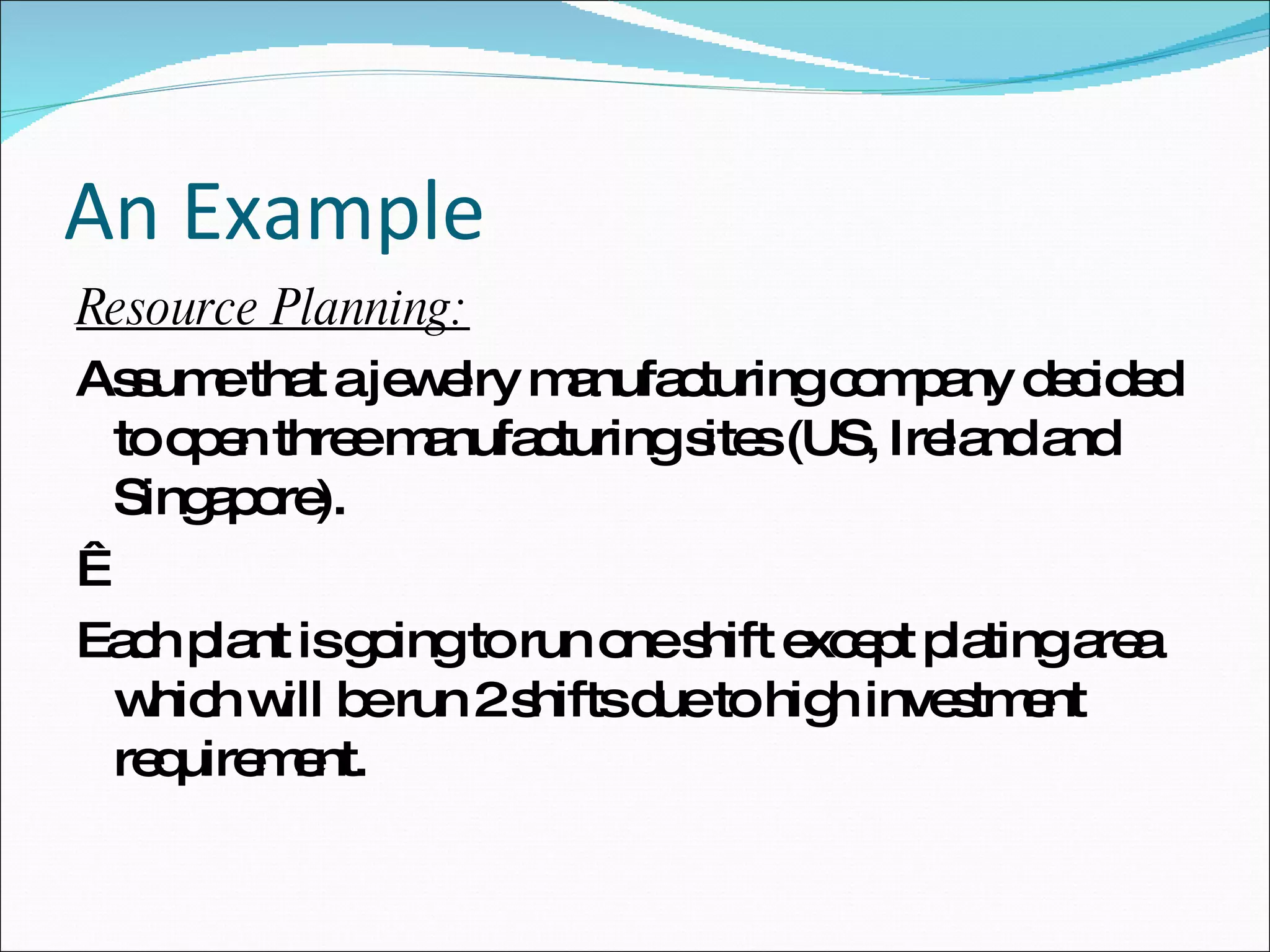
An Example Resource Planning: Assume that a jewelry manufacturing company decided to open three manufacturing sites (US, Ireland and Singapore).    Each plant is going to run one shift except plating area which will be run 2 shifts due to high investment requirement.
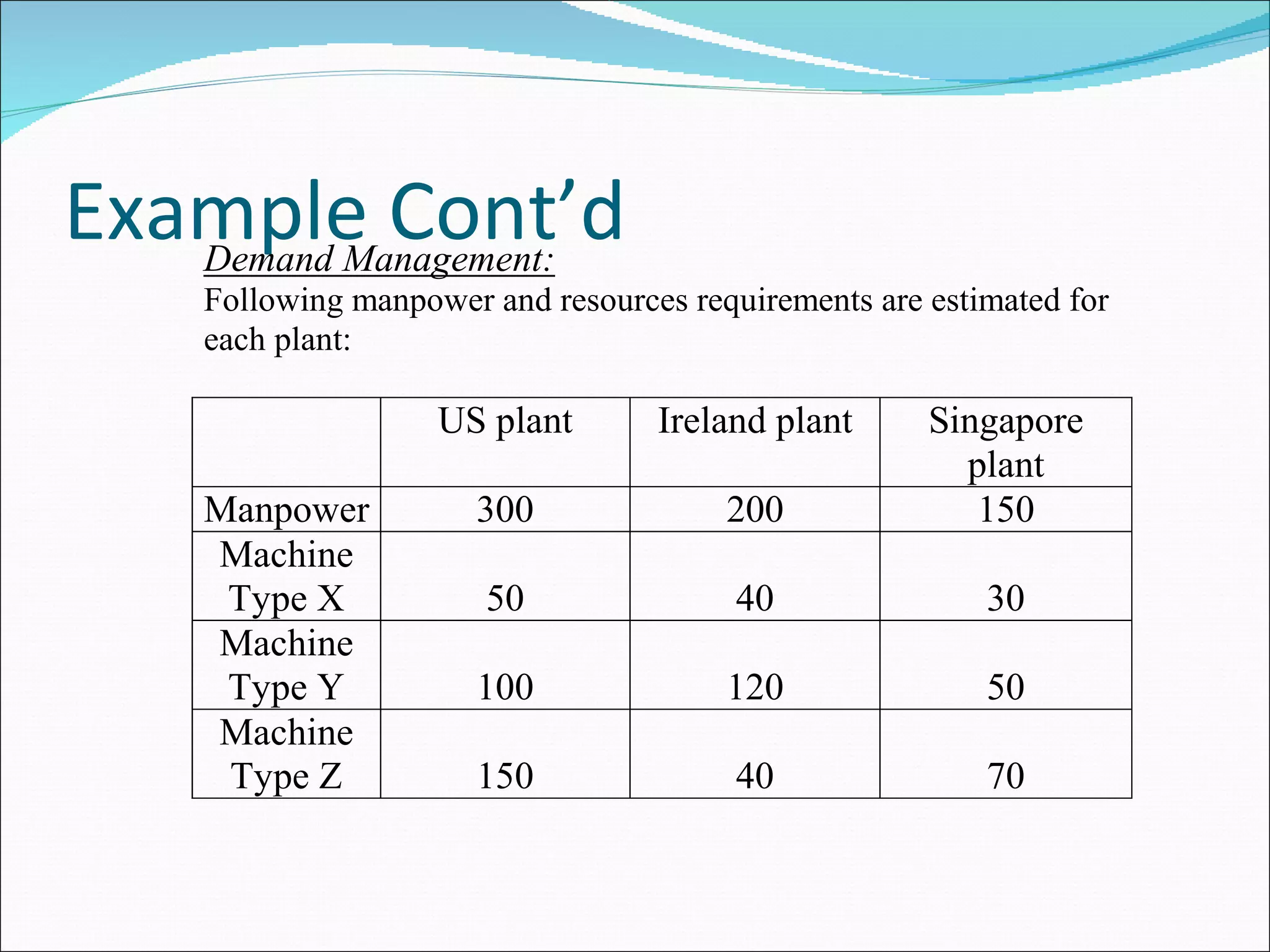
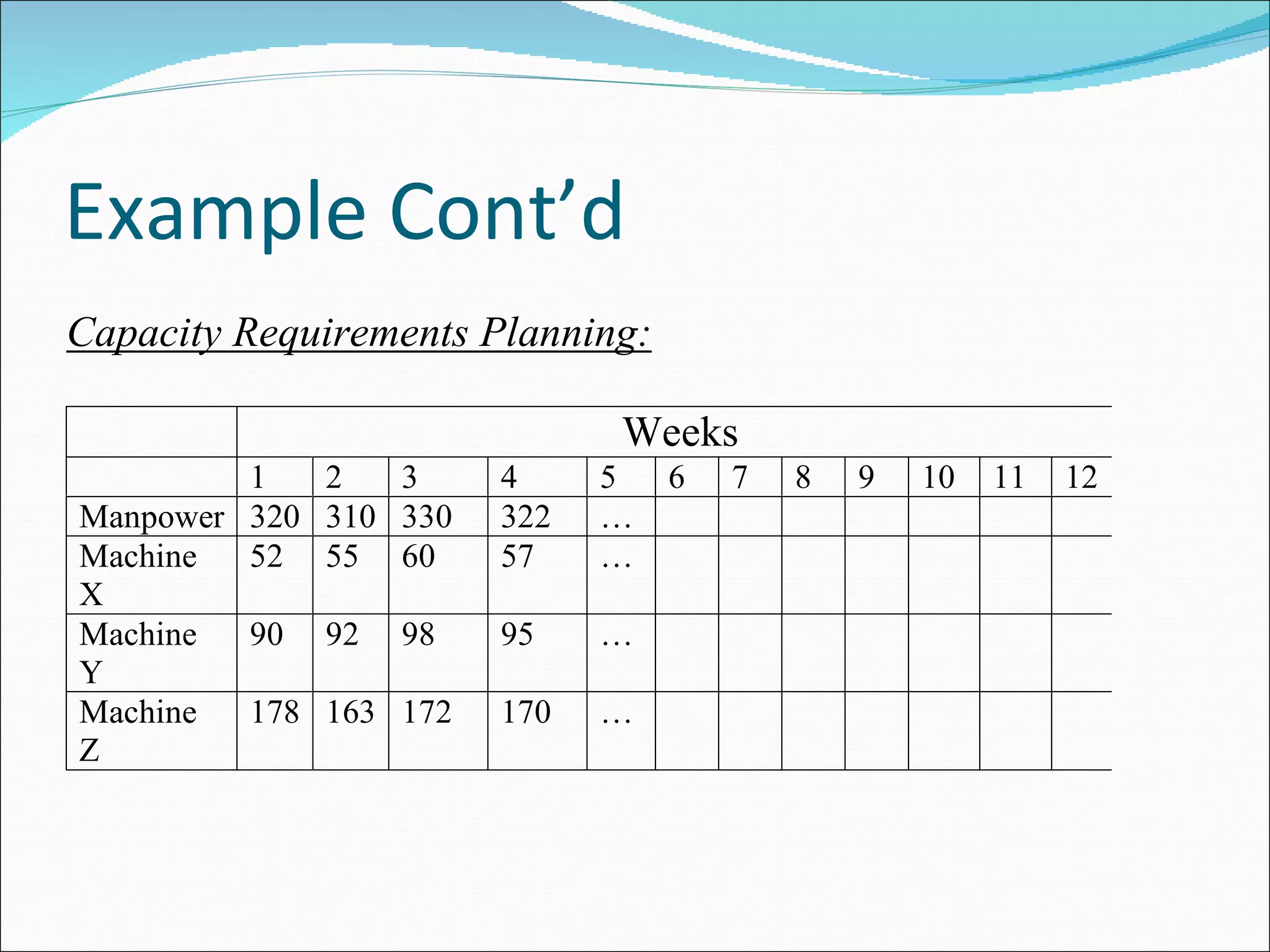
Example Cont’d
Example Cont’d
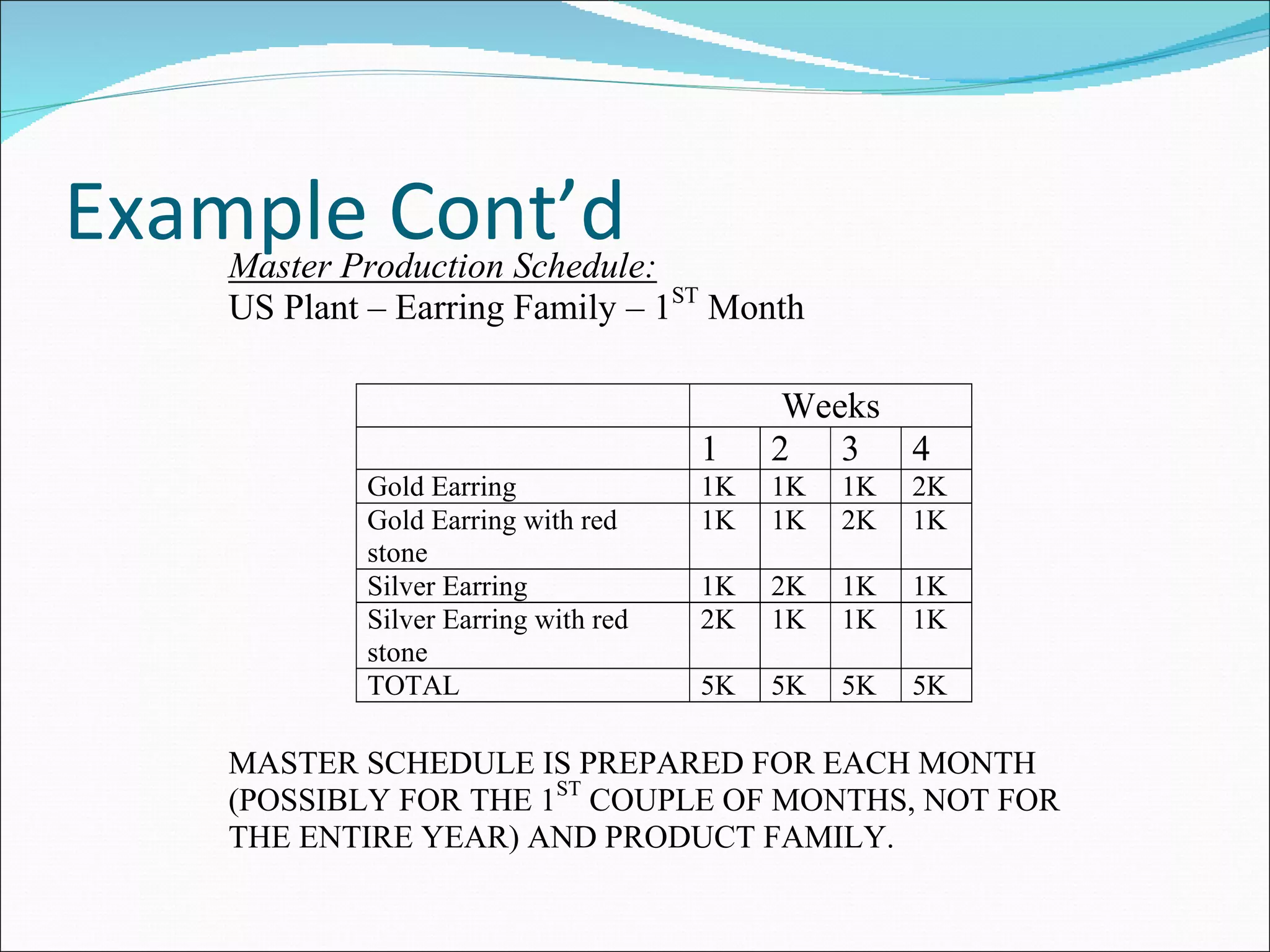
Example Cont’d
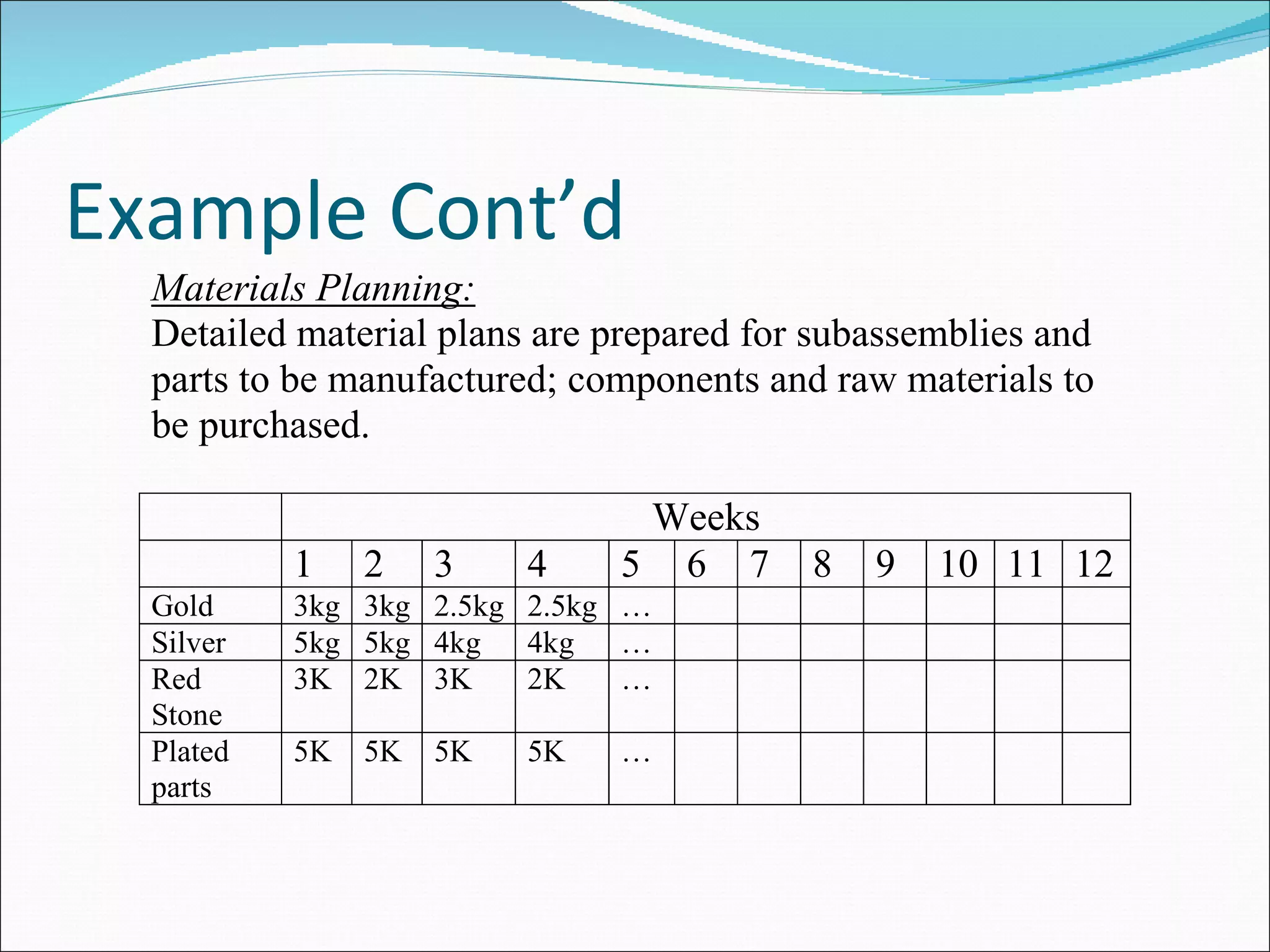
Example Cont’d
Example Cont’d
Example Cont’d
Example Cont’d
Example Cont’d
Planning vs. Control
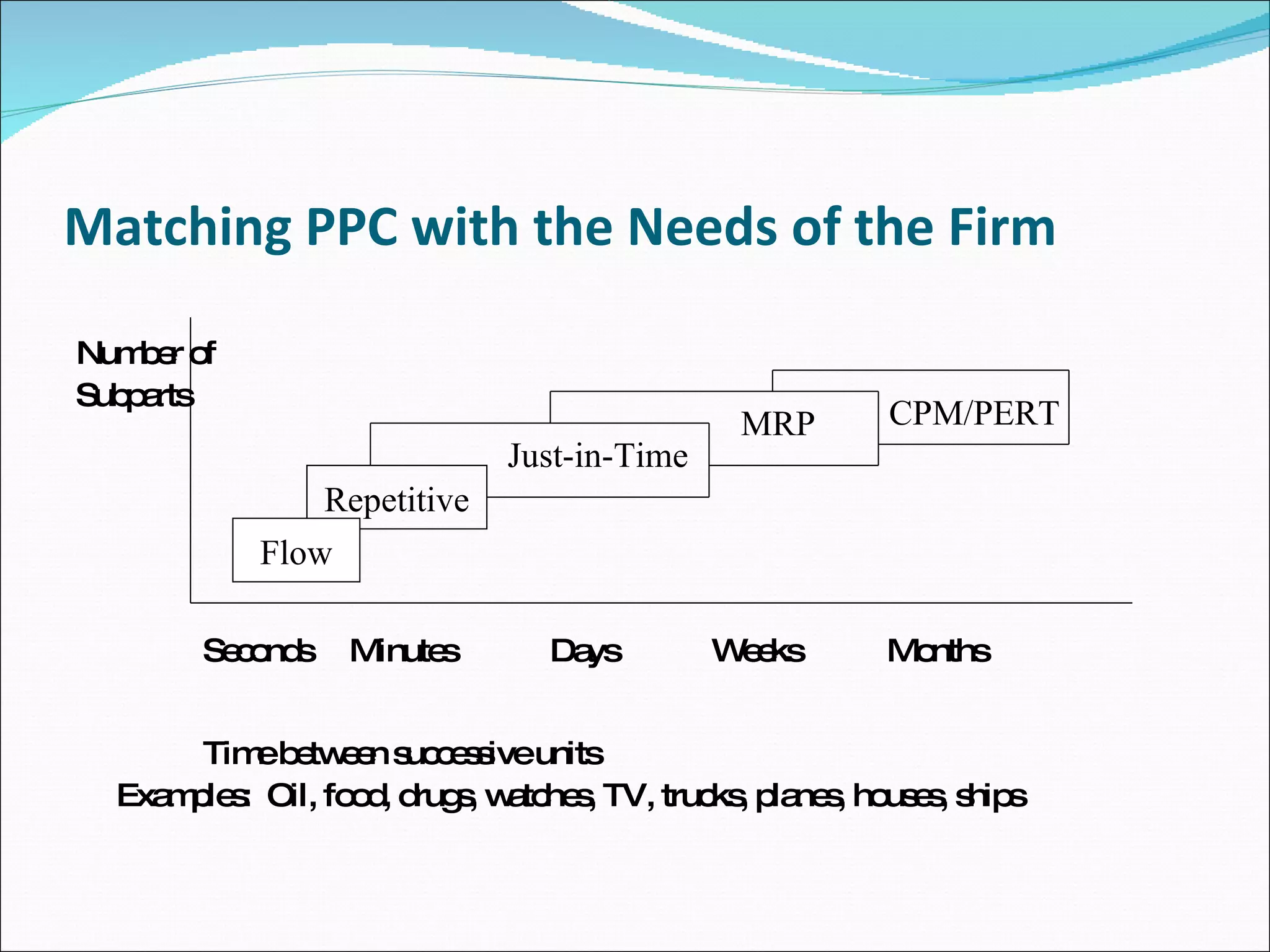
Matching PPC with the Needs of the Firm Number of Subparts   Seconds  Minutes  Days  Weeks  Months  Time between successive units  Examples:  Oil, food, drugs, watches, TV, trucks, planes, houses, ships Repetitive Flow Just-in-Time MRP CPM/PERT
Matching PPC with the Needs of the Firm Flow-Oriented Manufacturing Systems Very short time between successive units A few components needed Flow rate is the measure Ex: Chemical, food, petroleum
Matching PPC with the Needs of the Firm (Cont’d) 2. Repetitive-Nature Manufacturing Systems Short time between successive units Assemble similar products Flow Rate or Assembly Rate is the measure Ex: Televisions, Radios, Watches, Cars
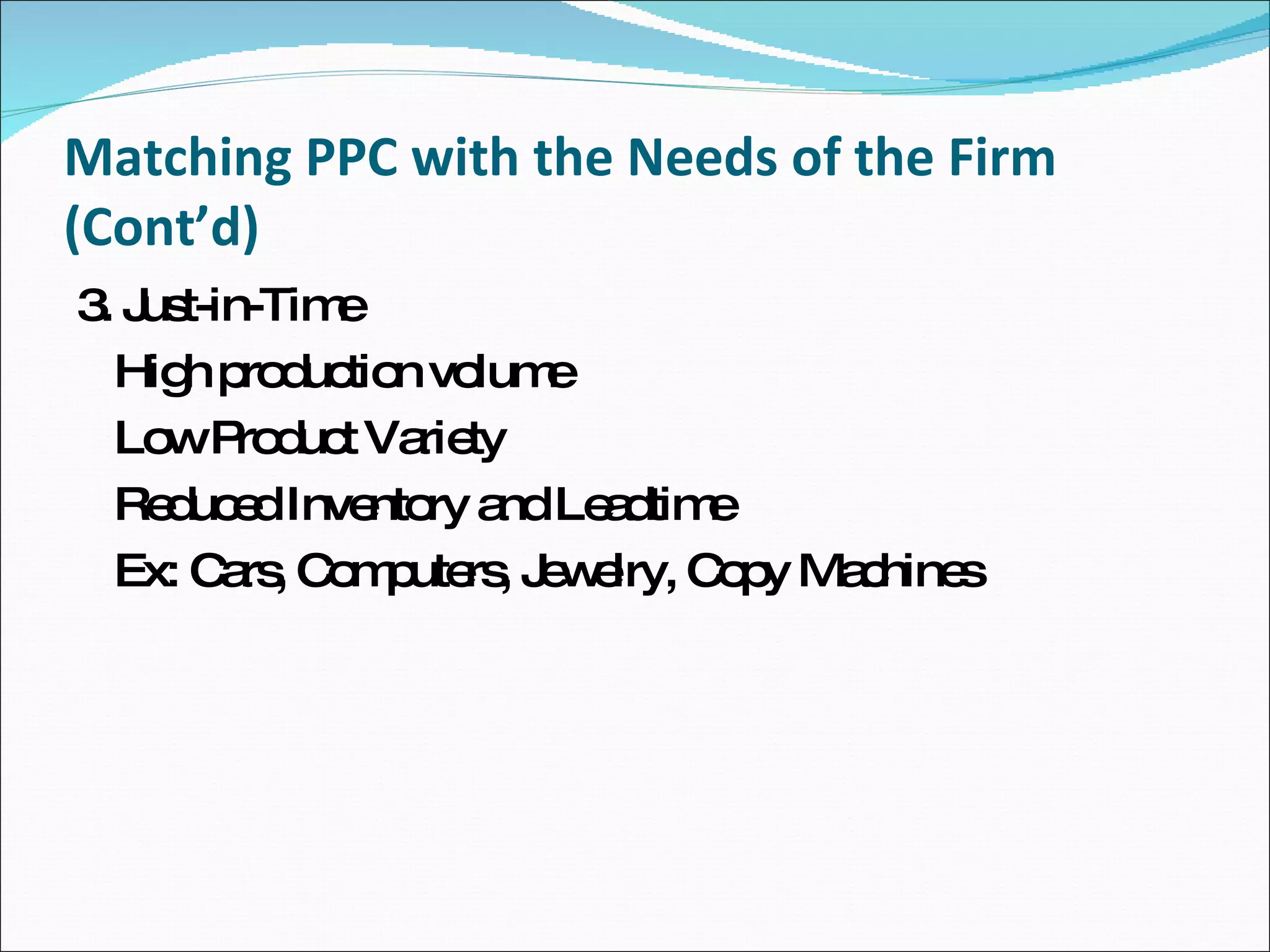
Matching PPC with the Needs of the Firm (Cont’d) 3. Just-in-Time High production volume Low Product Variety Reduced Inventory and Leadtime Ex: Cars, Computers, Jewelry, Copy Machines
Matching PPC with the Needs of the Firm (Cont’d) 4. Materials Requirements Planning (MRP) Batch production  High product variety Low production quantity  Ex: Electric Motors, Fans
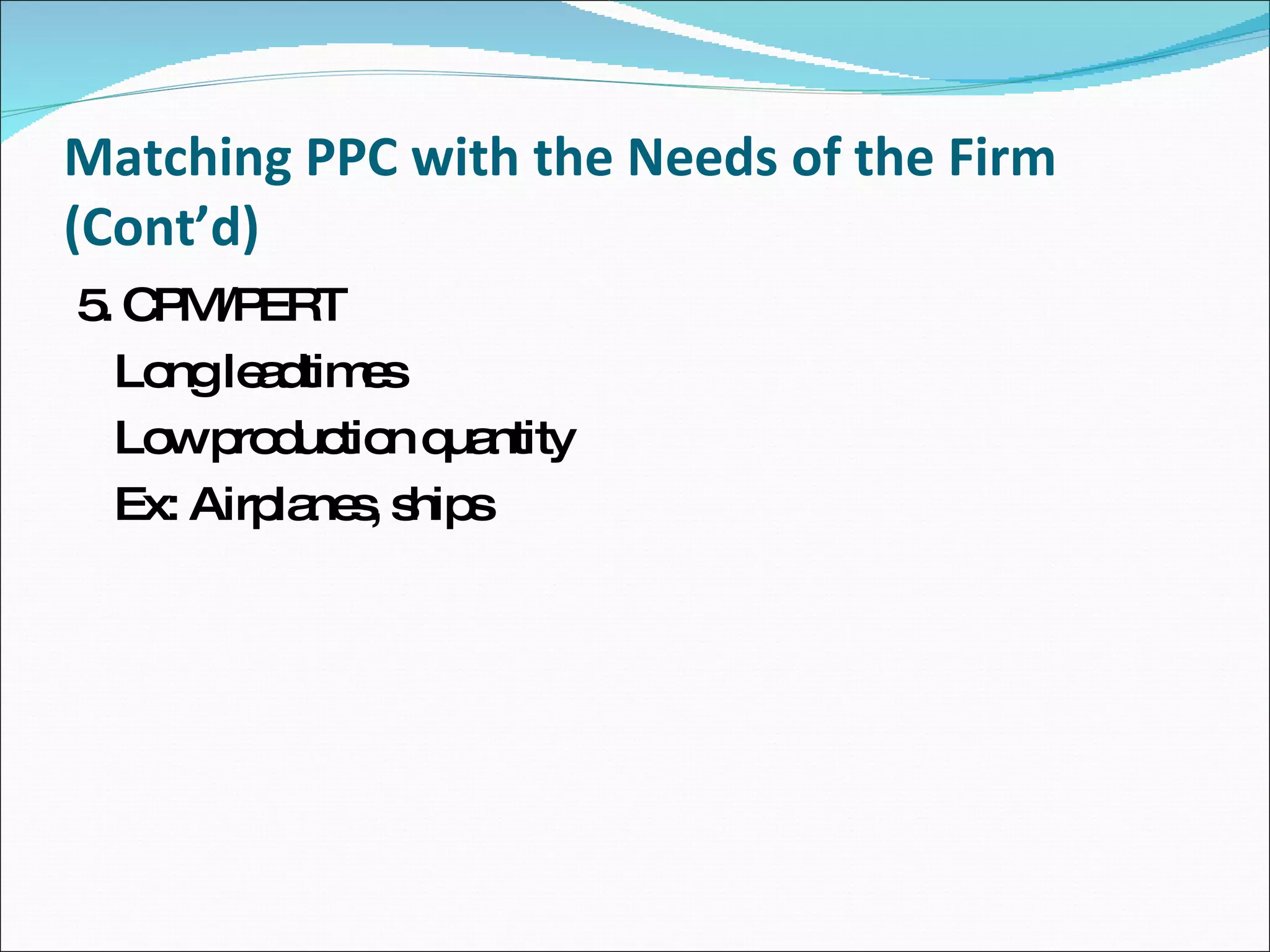
Matching PPC with the Needs of the Firm (Cont’d) 5. CPM/PERT Long leadtimes  Low production quantity  Ex: Airplanes, ships
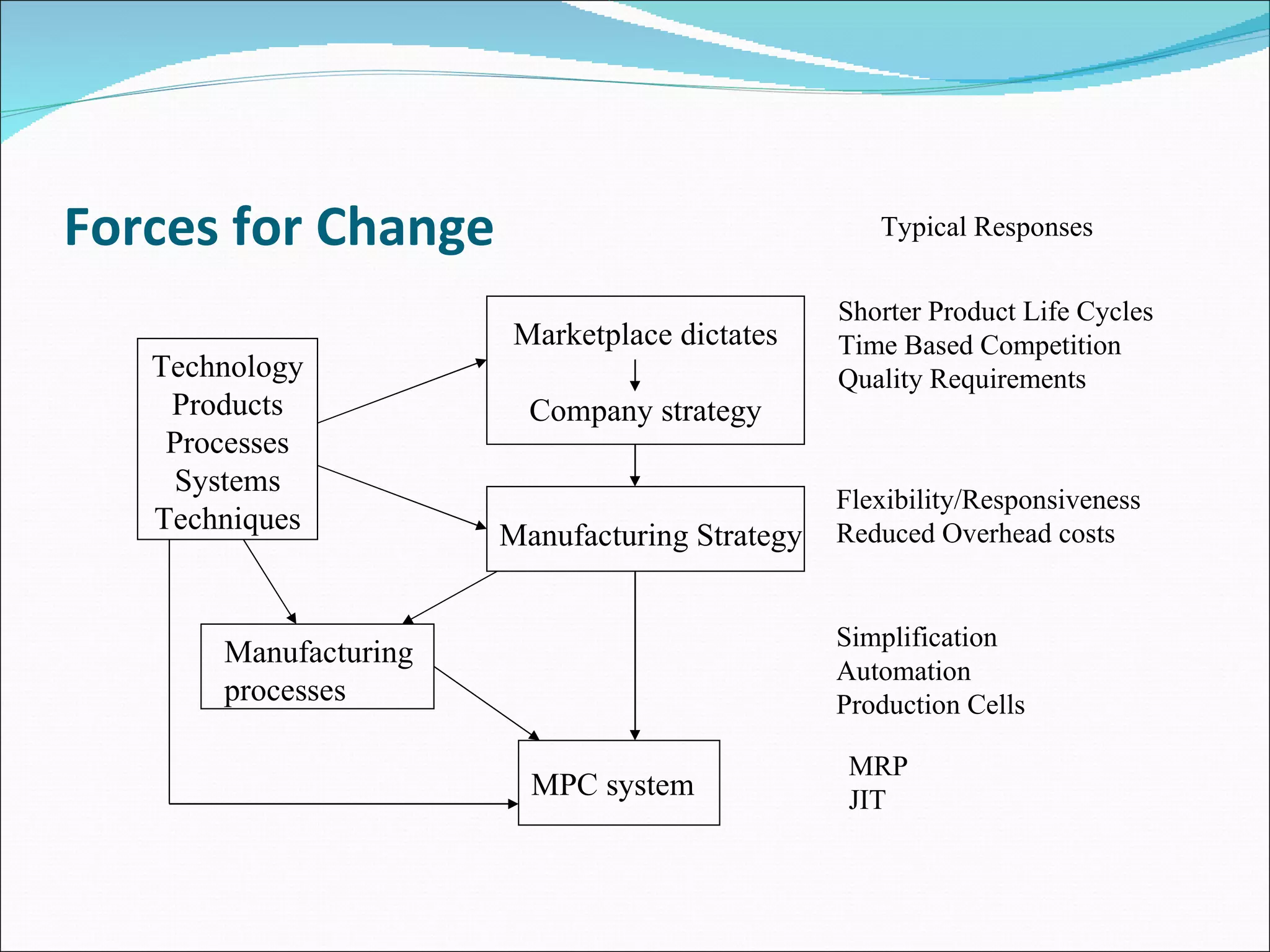
Forces for Change Technology Products Processes Systems Techniques Marketplace dictates Company strategy Manufacturing Strategy Manufacturing  processes MPC system Shorter Product Life Cycles Time Based Competition Quality Requirements Flexibility/Responsiveness Reduced Overhead costs Simplification Automation Production Cells MRP JIT Typical Responses

Ppc C1

  • 1.
  • 2.
    Production Planning andControl Introduction Coordination of materials with suppliers Efficient utilization of people and machines Efficient flow of materials Communication with customers
  • 3.
    Production Planning andControl Introduction
  • 4.
    Decision Making vs.Decision Support Authors claim that PPC system does not make decisions or manage the operations Managers perform these activities PPC system provides support for decision making
  • 5.
    Decision Making vs.Decision Support (Cont’d) However, developing intelligent software is becoming increasingly feasible Software not only to support decision makers but also make (at least) some of the decisions Expert Systems, Neural Networks, Genetic Algorithms, Evolutionary Programming, Genetic Programming, Tabu Search, Simulated Annealing, etc. are available techniques
  • 6.
    Activities Supported byPPC Materials Planning Purchasing Raw Material Inventory Control Capacity Planning Scheduling Machine and People WIP Inventory Control
  • 7.
    Activities Supported byPPC (Cont’d) Coordinate Customer Orders Finished Goods Inventory Control
  • 8.
    Costs and Benefitsof PPC Systems PPC requires a large # of indirect people Companies with ineffective PPC system will have poor customer service, excessive inventories, low equipment and people utilization, high rate of part obsolescence, large number of expediters
  • 9.
    Company Game PlanOverall direction for PPC is provided by a Company Game Plan Game Plan links various departments (engineering, finance, marketing, production) It should be consistent with strategic plans, budgets, and company’s capabilities
  • 10.
    Hierarchical Planning OverallManufacturing Planning Detailed Materials and Capacity Planning Execution of Plans
  • 11.
    Production Planning andControl General Framework
  • 12.
    1.Overall Manufacturing PlanningHierarchical Planning Cont’d Demand Management Forecasting Order Promising Order Processing Order Entry Spare Parts
  • 13.
    1.Overall Manufacturing PlanningHierarchical Planning Cont’d Production Planning Monthly Plans for Product Families Master Production Scheduling (MPS) Weekly Plans for Individual Products MPS must sum up to Production Plan
  • 14.
    PP – MPSRelation
  • 15.
    Example Product Family:Markers Products: Red, Blue, Green Marker Note:Usually a period is one month and a subperiod is one week (s=4).
  • 16.
  • 17.
    1.Overall Manufacturing PlanningHierarchical Planning Cont’d Resource Planning Long-Range Capacity Requirements Number of Machines Number of Employees Overtime Shifts Plants
  • 18.
    1.Overall Manufacturing PlanningHierarchical Planning Cont’d Rough-Cut Capacity Planning Capacity Requirements for Master Production Scheduling Overall Factor Capacity Bills Resource Profiles
  • 19.
    2.Materials & CapacityPlanning Hierarchical Planning Cont’d Materials Planning Production rates can be used in simpler manufacturing systems. Materials Requirements Planning (MRP) can be used in more complex systems. MRP determines time-phased requirements (period-by-period) for all purchased and manufactured parts such as raw materials, components, parts, subassemblies, etc.
  • 20.
    2.Materials & CapacityPlanning Hierarchical Planning Cont’d Detailed Capacity Planning Labor Hours Required Machine Capacity Required In an MRP environment, this task is accomplished by using the Capacity Requirements Planning (CRP) technique.
  • 21.
    3. Execution ofPlans Hierarchical Planning Cont’d Shop Floor Control Conventional Approach, Process Layout Similar machines are grouped into workcenters Use workorders to schedule the jobs through workcenters / departments Schedule machine and other workcenters Determine start and completion times of orders Update the schedule
  • 22.
    3. Execution ofPlans Hierarchical Planning Cont’d Shop Floor Control (Cont’d) Recent Trend, Manufacturing Cells Similar parts are grouped into families Corresponding machine cells are formed Use production rates Use schedules to control production (Family Sequencing, Product Sequencing, Cell Loading, Cell Scheduling, etc.) Use Kanban System (Pull, Just-in-Time) to control production
  • 23.
    3. Execution ofPlans Hierarchical Planning Cont’d Purchasing Purchasing Plan Vendor Search Quotation Order Release Order Follow-up Vendor Capacity
  • 24.
    Planning vs. ControlPlans are made Results are compared with plans (control) Results are OK  Wait until next control period Results are not OK  Go to Step 1 (Revise plans)
  • 25.
    An Example ResourcePlanning: Assume that a jewelry manufacturing company decided to open three manufacturing sites (US, Ireland and Singapore).   Each plant is going to run one shift except plating area which will be run 2 shifts due to high investment requirement.
  • 26.
  • 27.
  • 28.
  • 29.
  • 30.
  • 31.
  • 32.
  • 33.
  • 34.
  • 35.
    Matching PPC withthe Needs of the Firm Number of Subparts Seconds Minutes Days Weeks Months Time between successive units Examples: Oil, food, drugs, watches, TV, trucks, planes, houses, ships Repetitive Flow Just-in-Time MRP CPM/PERT
  • 36.
    Matching PPC withthe Needs of the Firm Flow-Oriented Manufacturing Systems Very short time between successive units A few components needed Flow rate is the measure Ex: Chemical, food, petroleum
  • 37.
    Matching PPC withthe Needs of the Firm (Cont’d) 2. Repetitive-Nature Manufacturing Systems Short time between successive units Assemble similar products Flow Rate or Assembly Rate is the measure Ex: Televisions, Radios, Watches, Cars
  • 38.
    Matching PPC withthe Needs of the Firm (Cont’d) 3. Just-in-Time High production volume Low Product Variety Reduced Inventory and Leadtime Ex: Cars, Computers, Jewelry, Copy Machines
  • 39.
    Matching PPC withthe Needs of the Firm (Cont’d) 4. Materials Requirements Planning (MRP) Batch production High product variety Low production quantity Ex: Electric Motors, Fans
  • 40.
    Matching PPC withthe Needs of the Firm (Cont’d) 5. CPM/PERT Long leadtimes Low production quantity Ex: Airplanes, ships
  • 41.
    Forces for ChangeTechnology Products Processes Systems Techniques Marketplace dictates Company strategy Manufacturing Strategy Manufacturing processes MPC system Shorter Product Life Cycles Time Based Competition Quality Requirements Flexibility/Responsiveness Reduced Overhead costs Simplification Automation Production Cells MRP JIT Typical Responses