Table of contents

 Introduction to biodiesel

 Applications of biodiesel

 Advantages & disadvantages of biodiesel

 Sources of biodiesel

 Future of biodiesel

 Case study on Iran

 Conclusions
Introduction to biodiesel

                        History
Rudolf diesel was the inverter of biodiesel, estimated 100
    years ago. It was developed in the year 1890s.


                What is biodiesel?
 Biodiesel is made up of monoalkyl esters of long chain
 fatty acids that come from vegetable oil or animal fats.
     After which, the feedstock is converted by trans-
               esterification, into biodiesel.
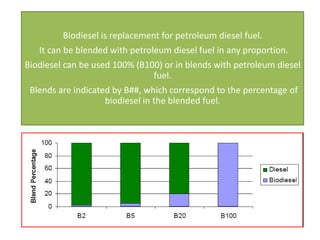
Biodiesel is replacement for petroleum diesel fuel.
   It can be blended with petroleum diesel fuel in any proportion.
Biodiesel can be used 100% (B100) or in blends with petroleum diesel
                               fuel.
 Blends are indicated by B##, which correspond to the percentage of
                    biodiesel in the blended fuel.
Applications of biodiesel


         Biodiesel has a wide variety of application in
         all the fields where fuel is used. To add on, it
         added advantages of efficiency improvement.


Examples includes:
Motorbikes, Airplanes, Mass transit (trains, buses)
Trucks & heavy equipment , Electrical generators
Farm equipments, Marine uses ,Biodiesel as lubricant & solvent
Biodiesel as lubricant and
               solvent
• Potential markets for biodiesel extend beyond the
  transportation and electrical-generation sectors.


                 Biodiesel can be used straight as
                      a machinery lubricant.


                  Biodiesel’s solvent properties
                  may be used to clean dirty or
                 greasy engine or other machine
                               parts.
Marine uses

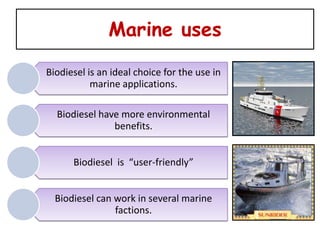
Biodiesel is an ideal choice for the use in
           marine applications.

  Biodiesel have more environmental
               benefits.


      Biodiesel is “user-friendly”


  Biodiesel can work in several marine
                factions.
Advantages of Biodiesel
 Renewable energy source         Can distribute through
                                existing diesel fuel pumps

       Less polluting
                                  Can use in existing oil
                                  heating systems and
  Extends life of catalytic          diesel engines
   converters & engines
                                   Can be mixed with
Utilizes excess production of    petroleum diesel at any
 soybeans for manufacture        concentration and time
Disadvantages of Biodiesel
          More expensive

Could harm rubber hoses in engines

        Requires energy to:

Produce biodiesel from soy crops &
    sow, fertilize and harvest

  Requires frequent filter changing

Requires improvement in distribution
           infrastructure
Sources of biodiesel

• Algal Biodiesel
• Fungus
• Used coffee grounds
• Exotic resources
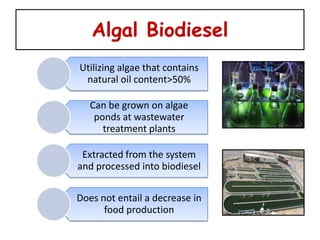
Algal Biodiesel
Utilizing algae that contains
 natural oil content>50%

   Can be grown on algae
    ponds at wastewater
      treatment plants

 Extracted from the system
and processed into biodiesel

Does not entail a decrease in
      food production
Fungus
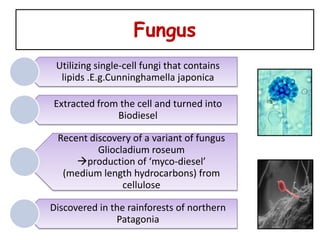
 Utilizing single-cell fungi that contains
  lipids .E.g.Cunninghamella japonica

Extracted from the cell and turned into
              Biodiesel

 Recent discovery of a variant of fungus
          Gliocladium roseum
     production of ‘myco-diesel’
  (medium length hydrocarbons) from
                cellulose

Discovered in the rainforests of northern
               Patagonia
Used coffee grounds

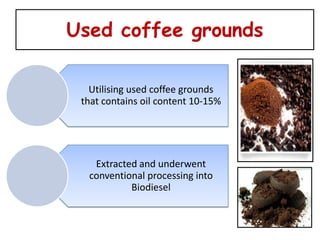
   Utilising used coffee grounds
 that contains oil content 10-15%


   Extracted and underwent
  conventional processing into
           Biodiesel
Exotic resources

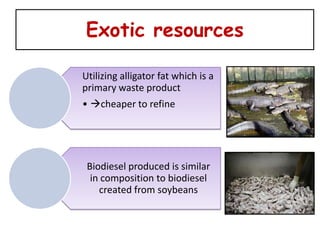
Utilizing alligator fat which is a
primary waste product
• cheaper to refine


 Biodiesel produced is similar
  in composition to biodiesel
    created from soybeans
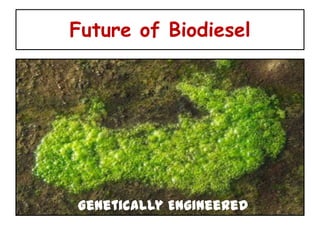
Future of Biodiesel


Genetically Engineered
     Microalgae
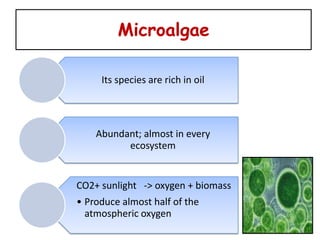
Microalgae

     Its species are rich in oil


    Abundant; almost in every
          ecosystem


CO2+ sunlight -> oxygen + biomass
• Produce almost half of the
  atmospheric oxygen
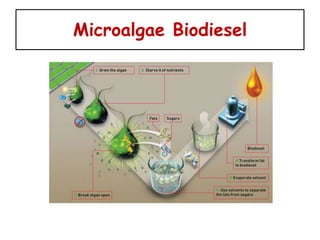
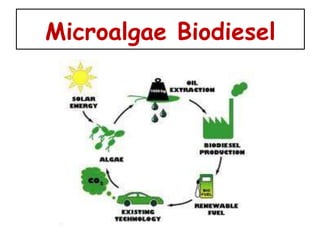
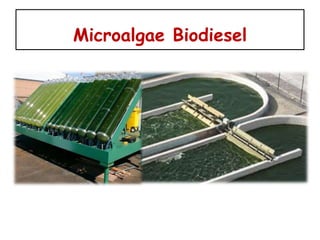
Microalgae Biodiesel

Under optimized condition, can produce up to 90%
                oil of dry weight


Potential production of oil higher than oil crops
• Use little land resource w/o causing potential
  biomass deficit


         Can grow in extreme environment


Cultivated only by using seawater, CO2 and sunlight
Microalgae Biodiesel
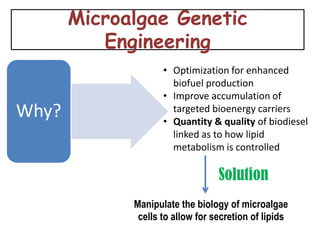
Microalgae Genetic
          Engineering
                    • Optimization for enhanced
                      biofuel production
                    • Improve accumulation of
Why?                  targeted bioenergy carriers
                    • Quantity & quality of biodiesel
                      linked as to how lipid
                      metabolism is controlled

                                  Solution
             Manipulate the biology of microalgae
              cells to allow for secretion of lipids
Case Study: Future of Bioenergy in
               Iran


                                          Extensive use & export of Iran’s crude
                                           oil and natural gas will be limited in
                                            the future. Thus renewable liquid
                                              fuels will be heavily needed to
                                          eventually totally replace petroleum-
                                             derived transport fuels which in
                                          addition, contributes to the emission
                                                   of greenhouse gases


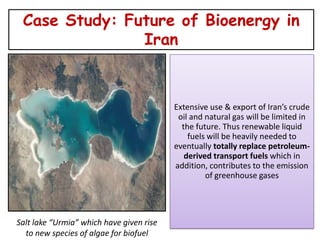
Salt lake “Urmia” which have given rise
  to new species of algae for biofuel
Case Study: Solution for Biodiesel
           Production
 Overcoming the challenge, two
 options
 • Managing the agriculture
   residues & energy production
   like bioethanol and biogas
 • Investing on non-food crops
   e.g. microalgae


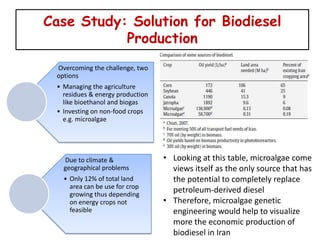
   Due to climate &               • Looking at this table, microalgae come
   geographical problems            views itself as the only source that has
   • Only 12% of total land         the potential to completely replace
     area can be use for crop
     growing thus depending
                                    petroleum-derived diesel
     on energy crops not          • Therefore, microalgae genetic
     feasible                       engineering would help to visualize
                                    more the economic production of
                                    biodiesel in Iran
Case Study: Project on
      microalgae
     Researches at Teheran’s Shiraz University carried a biofuel
                              project


    Microalgae were isolated during a screening program from
    soil & water
    • samples are collected from the paddy fields of Fars
      province and the Maharlu Salt Lake


       Has succeeded in producing green fuel from the algae
                         Chlamydomonas


     The researchers registered their findings at the National
    Center for Biotechnology Information (NCBI)which is based
                            in the USA
Case Study: Having potential of using
   microalgae genetic engineering

       Iran has a good potential and possibilities due to:

 Presence of saline lakes in
  Iran, containing various                      Good capacity building
   species of microalgae


 Establishing microalgae
 culture ponds in different               Gained experiences in plant genetic
 areas of Iran                            engineering within the last decade

 • Unlimited access to saline
   waters and sunlight
                                         Strong government support
                                         • Based on the law, production and
 Presence of highly efficient              release of transgenic organisms are
     genetic engineering                   free in Iran provided that they pass all
  technologies in the world                the biosafety requirements imposed
                                           by Iran’s National Biosafety Law (INBL)
Conclusions


Microalgae genetic engineering
have a very promising role in the
future as it has great potentials for
biofuel production.
References
    Introduction & applications of biodiesel
•   http://www.biodiesel.org/markets/mar/
•   http://alphabiofuels.sg/pages/bioOSR/osr_index.html
•   Title: Biodiesel- growing a new energy economy (second edition)
    Author: Greg Pahl foreword by Bill McKibben
    Advantages and disadvantages of Biodiesel
•   http://www.cpast.org/Articles/fetch.adp?topicnum=61
•   http://greenliving.lovetoknow.com/Advantages_and_Disadvantages_of_Biofuels
•   http://www.berkeleybiodiesel.org/advantages-and-disadvantages-of-biodiesel.html
    Current Research
•   http://web.archive.org/web/20060324084858/http://www.unh.edu/p2/biodiesel/article_alg
    e.html
•   http://mic.sgmjournals.org/content/154/11/3319
•   http://www.springerlink.com/content/c8l814q6064m0u75/
•   http://www.nytimes.com/2008/12/16/science/16objava.html
    Case study
•   http://www.greenprophet.com/2010/01/algae-biofuel-iran/
•   An article titled Renewable & Sustainable Energy Reviews from www.elsevier.com
The end & thank
you!

Biodiesel

  • 2.
    Table of contents Introduction to biodiesel Applications of biodiesel Advantages & disadvantages of biodiesel Sources of biodiesel Future of biodiesel Case study on Iran Conclusions
  • 3.
    Introduction to biodiesel History Rudolf diesel was the inverter of biodiesel, estimated 100 years ago. It was developed in the year 1890s. What is biodiesel? Biodiesel is made up of monoalkyl esters of long chain fatty acids that come from vegetable oil or animal fats. After which, the feedstock is converted by trans- esterification, into biodiesel.
  • 4.
    Biodiesel is replacementfor petroleum diesel fuel. It can be blended with petroleum diesel fuel in any proportion. Biodiesel can be used 100% (B100) or in blends with petroleum diesel fuel. Blends are indicated by B##, which correspond to the percentage of biodiesel in the blended fuel.
  • 5.
    Applications of biodiesel Biodiesel has a wide variety of application in all the fields where fuel is used. To add on, it added advantages of efficiency improvement. Examples includes: Motorbikes, Airplanes, Mass transit (trains, buses) Trucks & heavy equipment , Electrical generators Farm equipments, Marine uses ,Biodiesel as lubricant & solvent
  • 6.
    Biodiesel as lubricantand solvent • Potential markets for biodiesel extend beyond the transportation and electrical-generation sectors. Biodiesel can be used straight as a machinery lubricant. Biodiesel’s solvent properties may be used to clean dirty or greasy engine or other machine parts.
  • 7.
    Marine uses Biodiesel isan ideal choice for the use in marine applications. Biodiesel have more environmental benefits. Biodiesel is “user-friendly” Biodiesel can work in several marine factions.
  • 8.
    Advantages of Biodiesel Renewable energy source Can distribute through existing diesel fuel pumps Less polluting Can use in existing oil heating systems and Extends life of catalytic diesel engines converters & engines Can be mixed with Utilizes excess production of petroleum diesel at any soybeans for manufacture concentration and time
  • 9.
    Disadvantages of Biodiesel More expensive Could harm rubber hoses in engines Requires energy to: Produce biodiesel from soy crops & sow, fertilize and harvest Requires frequent filter changing Requires improvement in distribution infrastructure
  • 10.
    Sources of biodiesel •Algal Biodiesel • Fungus • Used coffee grounds • Exotic resources
  • 11.
    Algal Biodiesel Utilizing algaethat contains natural oil content>50% Can be grown on algae ponds at wastewater treatment plants Extracted from the system and processed into biodiesel Does not entail a decrease in food production
  • 12.
    Fungus Utilizing single-cellfungi that contains lipids .E.g.Cunninghamella japonica Extracted from the cell and turned into Biodiesel Recent discovery of a variant of fungus Gliocladium roseum production of ‘myco-diesel’ (medium length hydrocarbons) from cellulose Discovered in the rainforests of northern Patagonia
  • 13.
    Used coffee grounds Utilising used coffee grounds that contains oil content 10-15% Extracted and underwent conventional processing into Biodiesel
  • 14.
    Exotic resources Utilizing alligatorfat which is a primary waste product • cheaper to refine Biodiesel produced is similar in composition to biodiesel created from soybeans
  • 15.
    Future of Biodiesel GeneticallyEngineered Microalgae
  • 16.
    Microalgae Its species are rich in oil Abundant; almost in every ecosystem CO2+ sunlight -> oxygen + biomass • Produce almost half of the atmospheric oxygen
  • 17.
    Microalgae Biodiesel Under optimizedcondition, can produce up to 90% oil of dry weight Potential production of oil higher than oil crops • Use little land resource w/o causing potential biomass deficit Can grow in extreme environment Cultivated only by using seawater, CO2 and sunlight
  • 18.
  • 19.
  • 20.
  • 21.
    Microalgae Genetic Engineering • Optimization for enhanced biofuel production • Improve accumulation of Why? targeted bioenergy carriers • Quantity & quality of biodiesel linked as to how lipid metabolism is controlled Solution Manipulate the biology of microalgae cells to allow for secretion of lipids
  • 22.
    Case Study: Futureof Bioenergy in Iran Extensive use & export of Iran’s crude oil and natural gas will be limited in the future. Thus renewable liquid fuels will be heavily needed to eventually totally replace petroleum- derived transport fuels which in addition, contributes to the emission of greenhouse gases Salt lake “Urmia” which have given rise to new species of algae for biofuel
  • 23.
    Case Study: Solutionfor Biodiesel Production Overcoming the challenge, two options • Managing the agriculture residues & energy production like bioethanol and biogas • Investing on non-food crops e.g. microalgae Due to climate & • Looking at this table, microalgae come geographical problems views itself as the only source that has • Only 12% of total land the potential to completely replace area can be use for crop growing thus depending petroleum-derived diesel on energy crops not • Therefore, microalgae genetic feasible engineering would help to visualize more the economic production of biodiesel in Iran
  • 24.
    Case Study: Projecton microalgae Researches at Teheran’s Shiraz University carried a biofuel project Microalgae were isolated during a screening program from soil & water • samples are collected from the paddy fields of Fars province and the Maharlu Salt Lake Has succeeded in producing green fuel from the algae Chlamydomonas The researchers registered their findings at the National Center for Biotechnology Information (NCBI)which is based in the USA
  • 25.
    Case Study: Havingpotential of using microalgae genetic engineering Iran has a good potential and possibilities due to: Presence of saline lakes in Iran, containing various Good capacity building species of microalgae Establishing microalgae culture ponds in different Gained experiences in plant genetic areas of Iran engineering within the last decade • Unlimited access to saline waters and sunlight Strong government support • Based on the law, production and Presence of highly efficient release of transgenic organisms are genetic engineering free in Iran provided that they pass all technologies in the world the biosafety requirements imposed by Iran’s National Biosafety Law (INBL)
  • 26.
    Conclusions Microalgae genetic engineering havea very promising role in the future as it has great potentials for biofuel production.
  • 27.
    References Introduction & applications of biodiesel • http://www.biodiesel.org/markets/mar/ • http://alphabiofuels.sg/pages/bioOSR/osr_index.html • Title: Biodiesel- growing a new energy economy (second edition) Author: Greg Pahl foreword by Bill McKibben Advantages and disadvantages of Biodiesel • http://www.cpast.org/Articles/fetch.adp?topicnum=61 • http://greenliving.lovetoknow.com/Advantages_and_Disadvantages_of_Biofuels • http://www.berkeleybiodiesel.org/advantages-and-disadvantages-of-biodiesel.html Current Research • http://web.archive.org/web/20060324084858/http://www.unh.edu/p2/biodiesel/article_alg e.html • http://mic.sgmjournals.org/content/154/11/3319 • http://www.springerlink.com/content/c8l814q6064m0u75/ • http://www.nytimes.com/2008/12/16/science/16objava.html Case study • http://www.greenprophet.com/2010/01/algae-biofuel-iran/ • An article titled Renewable & Sustainable Energy Reviews from www.elsevier.com
  • 28.
    The end &thank you!

Editor's Notes

  • #4 -Biodiesel engine had become the engine of selection for reliability, power, and high fuel economy, worldwide. -Simply, the trans-esterification reaction means taking one type of ester and turning it into another. For example, taking vegetable oil and turning it into biodiesel.The alcohol used in the process can be either ethanol ( made from grains) or methanol ( made from wood, coal or natural gas) Methanol is usually preferred because it’s cheaper and tends to produce a more predictable reaction.-If biodiesel is produced with methanol, it is referred to as methyl esters and if it is made with ethanol it is referred to as ethyl esters. A more generic term, alkyl esters, refers to any alcohol-produced vegetable-oil esters.
  • #5 For example, a 20% blend of biodiesel with 80% diesel fuel is called B20. B20 is popular because it represents a good balance of cost, emissions, cold weather performance, materials compatibility, and ability to act as a solvent. B20 is also the minimum blend level that can be used for EPAct compliance for covered fleets. Pure Biodiesel (B100) can be used as a blending agent or as a pure fuel in diesel applications. B100 has the following key physical properties: It contains less than 15 ppm sulfur. It contains no aromatics. It has a high cetane level (47+). It is biodegradable. • It is non-toxic. • It has a high flashpoint (higher than 260° F). • It has a comparable BTU value (8% less than No. 2 diesel).
  • #7 Lubricant can also use on bearings and gears. A effective cleaning element called Bio-OSR (Bio-oil & sludge remover).Bio-OSR is a biodegradable and environmental friendly product.It uses organic ingredients that comes from vegetation therefore it is safe for handling and transportation.Therefore the properties of Bio-OSR ensure that it does not pose a negative impact on safety, health and environment.http://alphabiofuels.sg/pages/bioOSR/osr_index.html
  • #8 After Rudolf diesel’s engine was adapted for marine use as early as 1903. since then, diesel engine have spread to virtually every corner of the world’s marine environment. Unfortunately , diesel engine can cause considerable environmental damages, especially in the case of a petrol diesel fuel spill. Environmental fragility that makes marine use of biodiesel so attractive. Tests have shown that pure biodiesel is non-toxic, readily biodegradable and essentially free of sulfur and aromatics. Biodiesel degrades about four times faster than petroleum diesel fuel.(e.g.:when there is spilled in water, biodiesel will be 95% degraded after 28 days as compared with only 40% for petrol diesel in the same time period.)Biodiesel is not harmful to fish and marine life.Biodiesel is easier on humans. By using biodiesel and biodiesel blends have proven to change in exhaust odor. Therefore it will not cause eye irritation.Because biodiesel can replace or blend with petroleum diesel with little or no engine modifications. Categories in marine industry includes: recreational boats, cruise ships and the U.S. Coast Guard Fleet. http://www.biodiesel.org/markets/mar/
  • #17 During photosynthesis, algae and other photosynthetic organisms capture carbon dioxide and sunlight, and convert it into oxygen and biomass.  These fuels do not affect freshwater resources, can be produced using ocean and wastewater, are biodegradable and relatively harmless to the environment if spilled. Algae farms can be hooked onto existing power plants and be used as huge carbon sinks.