Hamdy Shaban Hamdy
Presented by:
outlines
 What is biodiesel?
 How we obtain biodiesel?
 Resources of biodiesel production
 Start biodiesel project…….
The beginning……
 Producing biodiesel from vegetable oils is not a new process.
 Dr. Diesel designed the original diesel engine to run on
vegetable oil.
 Dr. Diesel used palm oil to fuel one of his engines at the Paris
Exposition of 1900 .
““The use of vegetable oils for engine fuels may seemThe use of vegetable oils for engine fuels may seem
insignificant today. But such oils may become in courseinsignificant today. But such oils may become in course
of time as important as petroleum and the coal tarof time as important as petroleum and the coal tar
products of the present time”.products of the present time”.
Biodiesel and its Production:
(Transesterification)
o Biodiesel is briefly defined as the monoalkyl esters of
vegetable oils or animal fats of long-chain fatty acids.
o Diesel fuel can also be replaced by biodiesel made from
vegetable oils.
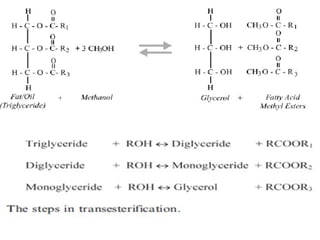
o Transesterification , also called alcoholysis, is a
chemical reaction of an oil or fat with an alcohol in
the presence of a catalyst to form esters and
glycerol.
o Among the alcohols that can be used in the transesterification
reaction are methanol, ethanol, propanol and butanol.
o A catalyst is usually used to improve the reaction rate and yield.
o Because the reaction is reversible, excess alcohol is used to shift
the equilibrium to the product side.
A variety of resources can be used to
produce biodiesel.
Fresh vegetable oil
Animal fats
non-edible oils
waste vegetable oil
Vegetable Oils and
Animal Fats
Vegetable oils have the potential to replace a fraction of the
petroleum distillates and petroleum-based petrochemicals in the
near future.
Vegetable oils and animal fats are triglyceride molecules in
which three fatty acid groups are esters attached to one
glycerol molecule .
The advantages of vegetable oils
• Ready availability
• Renewability
• Lower aromatic content
• Higher heat content
• Lower sulfur content
The disadvantages of vegetable oils
• Lower volatility
• Higher viscosity
• The reactivity of unsaturated hydrocarbon chains
Examples of Fresh vegetable oils
Corn sunflower soybean
Rapeseed Peanut Palm Fruit
Coconut cottonseed olive
Sesame safflower canola
Waste vegetable oils
Nonedible oils
JatrophaAlgae
Vegetable Oil Processing
Vegetable oil processing involves the extraction and processing
of oils and fats from vegetable and animal resources.
The extraction processes are generally mechanical.
Why the direct use of vegetable oils is generally
considered to be unsatisfactory and impractical for
diesel engines?
Use of Catalysts in Transesterification
 The catalysts used in the transesterification are broadly
divided into three types:
Base catalysts
Acid catalysts
Enzyme catalysts
Homogeneous Base Catalysts
NaOH & KOH catalysts.
Heterogeneous Base Catalysts
Alkaline earth metal oxides( BaO, CaO and MgO).
 Base Catalysts
Base catalysis is successful only when the free fatty acid (FFA)
is low (>3%).
The rate of the transesterification reaction becomes a thousand
times faster when a base catalyst is used instead of an acid
catalyst.
The base catalysts cause saponification when they react with
FFAs when the acid value of the feedstock is high.
 Acid Catalysts
Good results when the feedstock contains water and its acid
value(FFA <3%) is high.
Sulfuric acid, hydrochloric acid and phosphoric acid.
The problems associated with acid catalysts are:
• Higher reaction temperatures and pressures
• Slower reaction rates
• Reactor corrosion
During their use, soap is not formed; therefore there is no
problem of purification, washing, and neutralization.
 Enzyme Catalysts
The transesterification of vegetable oils or animal fats is also
possible by using enzyme catalysts or biocatalysts.
The reactions can be carried under at mild conditions.
Enzymatic catalysts can also be applied to feedstocks of
high FFA.
However, there are also problems associated with enzyme
catalysts like their higher cost.
Purification of Crude Biodiesel
Once the transesterification reaction is completed, two major
products exist: esters (biodiesel) and glycerol.
The glycerol phase is much denser than the biodiesel phase and
hence settles at the bottom of the reaction vessel, allowing it to
be separated from the biodiesel phase.
After separation from the glycerol phase, crude biodiesel may be
contaminated with residual catalyst, water, unreacted alcohol,
free glycerol, and soaps.
Acid is added to crude biodiesel to neutralize any remaining
catalyst and to remove any soap.
Unreacted alcohol should be removed with distillation
equipment.
Influence of the Different Parameters on
Biodiesel production
Reaction Temperature
A higher reaction temperature can decrease the viscosities of
oils and result in an increase in reaction rate.
Molar Ratio of oil to alcohol
The yield of alkyl ester increases when the molar ratio of oil to
alcohol increases.
Free Fatty Acid Content
FFAs can cause soap formation. The resulting soaps can induce
an increase in viscosity and make the separation of glycerol
difficult.
Reaction Time
Acid-catalyzed transesterification requires longer reaction time
than the base-catalyzed reaction because base catalysts usually
exhibit a higher reactivity than acid catalysts.
Advantages and disadvantages of
Biodiesel
Advantages
o Biodiesel is renewable energy resource.
o can be used in most diesel engines with no modifications.
o Used cooking oils and fat residues from meat processing may
be used as raw materials.
o Biodiesel contains no sulfur.
o Biodiesel is environmentally friendly because of its lower HC
emissions, lower CO emissions and reduced production of
greenhouse gases.
Disadvantages
o Lower heat content than diesel fuel.
o higher nitrous oxide (NOx) emissions than diesel fuel.
o Higher freezing point than diesel fuel.
o It is less stable than diesel fuel, and therefore long-term
storage (more than six months) of biodiesel is not
recommended.
Feedstocks for Food and/or Fuel?
? ?
 It must be noted that these disadvantages are reduced
when biodiesel is used in blends with diesel fuel.
 Pure biodiesel or 100% biodiesel is referred to as ‘B100’.
 Biodiesel blends are referred to as BXX. The XX indicates
the amount of biodiesel in the blend (i.e., a B90 blend is
90% biodiesel and 10% petrodiesel).
Thank you …….


Biodiesel

  • 1.
  • 3.
    outlines  What isbiodiesel?  How we obtain biodiesel?  Resources of biodiesel production  Start biodiesel project…….
  • 5.
    The beginning……  Producingbiodiesel from vegetable oils is not a new process.  Dr. Diesel designed the original diesel engine to run on vegetable oil.  Dr. Diesel used palm oil to fuel one of his engines at the Paris Exposition of 1900 .
  • 6.
    ““The use ofvegetable oils for engine fuels may seemThe use of vegetable oils for engine fuels may seem insignificant today. But such oils may become in courseinsignificant today. But such oils may become in course of time as important as petroleum and the coal tarof time as important as petroleum and the coal tar products of the present time”.products of the present time”.
  • 7.
    Biodiesel and itsProduction: (Transesterification)
  • 8.
    o Biodiesel isbriefly defined as the monoalkyl esters of vegetable oils or animal fats of long-chain fatty acids. o Diesel fuel can also be replaced by biodiesel made from vegetable oils.
  • 9.
    o Transesterification ,also called alcoholysis, is a chemical reaction of an oil or fat with an alcohol in the presence of a catalyst to form esters and glycerol.
  • 12.
    o Among thealcohols that can be used in the transesterification reaction are methanol, ethanol, propanol and butanol. o A catalyst is usually used to improve the reaction rate and yield. o Because the reaction is reversible, excess alcohol is used to shift the equilibrium to the product side.
  • 13.
    A variety ofresources can be used to produce biodiesel. Fresh vegetable oil Animal fats non-edible oils waste vegetable oil
  • 14.
    Vegetable Oils and AnimalFats Vegetable oils have the potential to replace a fraction of the petroleum distillates and petroleum-based petrochemicals in the near future.
  • 15.
    Vegetable oils andanimal fats are triglyceride molecules in which three fatty acid groups are esters attached to one glycerol molecule .
  • 17.
    The advantages ofvegetable oils • Ready availability • Renewability • Lower aromatic content • Higher heat content • Lower sulfur content The disadvantages of vegetable oils • Lower volatility • Higher viscosity • The reactivity of unsaturated hydrocarbon chains
  • 18.
    Examples of Freshvegetable oils Corn sunflower soybean Rapeseed Peanut Palm Fruit
  • 19.
  • 20.
  • 21.
  • 22.
    Vegetable Oil Processing Vegetableoil processing involves the extraction and processing of oils and fats from vegetable and animal resources. The extraction processes are generally mechanical.
  • 23.
    Why the directuse of vegetable oils is generally considered to be unsatisfactory and impractical for diesel engines?
  • 24.
    Use of Catalystsin Transesterification  The catalysts used in the transesterification are broadly divided into three types: Base catalysts Acid catalysts Enzyme catalysts
  • 25.
    Homogeneous Base Catalysts NaOH& KOH catalysts. Heterogeneous Base Catalysts Alkaline earth metal oxides( BaO, CaO and MgO).  Base Catalysts
  • 26.
    Base catalysis issuccessful only when the free fatty acid (FFA) is low (>3%). The rate of the transesterification reaction becomes a thousand times faster when a base catalyst is used instead of an acid catalyst. The base catalysts cause saponification when they react with FFAs when the acid value of the feedstock is high.
  • 27.
     Acid Catalysts Goodresults when the feedstock contains water and its acid value(FFA <3%) is high. Sulfuric acid, hydrochloric acid and phosphoric acid. The problems associated with acid catalysts are: • Higher reaction temperatures and pressures • Slower reaction rates • Reactor corrosion
  • 28.
    During their use,soap is not formed; therefore there is no problem of purification, washing, and neutralization.  Enzyme Catalysts The transesterification of vegetable oils or animal fats is also possible by using enzyme catalysts or biocatalysts. The reactions can be carried under at mild conditions.
  • 29.
    Enzymatic catalysts canalso be applied to feedstocks of high FFA. However, there are also problems associated with enzyme catalysts like their higher cost.
  • 30.
    Purification of CrudeBiodiesel Once the transesterification reaction is completed, two major products exist: esters (biodiesel) and glycerol. The glycerol phase is much denser than the biodiesel phase and hence settles at the bottom of the reaction vessel, allowing it to be separated from the biodiesel phase.
  • 31.
    After separation fromthe glycerol phase, crude biodiesel may be contaminated with residual catalyst, water, unreacted alcohol, free glycerol, and soaps. Acid is added to crude biodiesel to neutralize any remaining catalyst and to remove any soap. Unreacted alcohol should be removed with distillation equipment.
  • 32.
    Influence of theDifferent Parameters on Biodiesel production Reaction Temperature A higher reaction temperature can decrease the viscosities of oils and result in an increase in reaction rate. Molar Ratio of oil to alcohol The yield of alkyl ester increases when the molar ratio of oil to alcohol increases.
  • 33.
    Free Fatty AcidContent FFAs can cause soap formation. The resulting soaps can induce an increase in viscosity and make the separation of glycerol difficult. Reaction Time Acid-catalyzed transesterification requires longer reaction time than the base-catalyzed reaction because base catalysts usually exhibit a higher reactivity than acid catalysts.
  • 34.
  • 35.
    Advantages o Biodiesel isrenewable energy resource. o can be used in most diesel engines with no modifications. o Used cooking oils and fat residues from meat processing may be used as raw materials. o Biodiesel contains no sulfur.
  • 36.
    o Biodiesel isenvironmentally friendly because of its lower HC emissions, lower CO emissions and reduced production of greenhouse gases.
  • 37.
    Disadvantages o Lower heatcontent than diesel fuel. o higher nitrous oxide (NOx) emissions than diesel fuel. o Higher freezing point than diesel fuel. o It is less stable than diesel fuel, and therefore long-term storage (more than six months) of biodiesel is not recommended.
  • 38.
    Feedstocks for Foodand/or Fuel? ? ?
  • 39.
     It mustbe noted that these disadvantages are reduced when biodiesel is used in blends with diesel fuel.  Pure biodiesel or 100% biodiesel is referred to as ‘B100’.
  • 40.
     Biodiesel blendsare referred to as BXX. The XX indicates the amount of biodiesel in the blend (i.e., a B90 blend is 90% biodiesel and 10% petrodiesel).
  • 42.