BUSINESS PLANONBIODIESELJITESH KUMARROLL NO.31
NEED OF THE HOURIncrement in future demand for non-conventional    resources
Eco- friendly fuel
Reduction of dependence on oil from outside the country
Reduction in green house gas emission
Reduction in Public health risk
Reduction in Air pollutionThe prevailing MarketCurrent Market :The global markets for biodiesel are entering a period of rapid, transitional growth, creating both uncertainty and opportunity. The first generation biodiesel markets in Europe and the US have reached impressive biodiesel production capacity levels, but remain constrained by feedstock availability. In the BRIC nations of Brazil, India and China, key government initiatives are spawning hundreds of new opportunities for feedstock development, biodiesel production, and export" said Biodiesel 2020 author Will Thurmond.
SPECFIC MARKET: Tag of a developing country with a huge energy demand has forced India to depend on other countries for fuel (oil), increasing the risk exposure of the country to the volatility of crude oil prices in the international market. huge potential in terms of production, the Indian biofuel industry will prove to be a good option for biofuels producers, says "Emerging Biofuel Market in India”, a recent research report on the Indian biofuel industry.
…Ethanol dominates the world biofuel market and its production is expected to grow at a CAGR of around 6% during 2008-2017.
 Worldwide biodiesel production is expected to grow at a    CAGR  of over 5% from 2008 to 2017.
 Ethanol production of India is likely to attain a CAGR of   slightly over 2% during the period 2008-2017.…Increased ethanol use is expected to supersede the  production during the forecasted period.
 Domestic ethanol consumption in India is projected to expand at a CAGR of around 6.5% during 2008–2017.
 India’s total biodiesel requirement is projected to grow to 3.6 Million Metric Tons in 2011-12,SWOT        Analyse
StrengthsLarge , unexploited production potential of    agriculture and rural areas (resource of land and workers)
  No air pollution,
  Low price (Workers & Land)
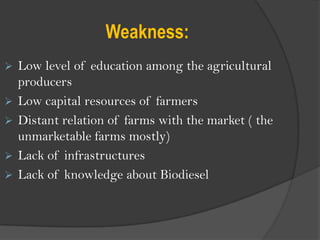
  Low costs of operating and keeping inWeakness:Low level of education among the agricultural   producers
Low capital resources of farmers
Distant relation of farms with the market ( the unmarketable farms mostly)
Lack of infrastructures
Lack of knowledge about BiodieselOpportunity:A Global Market Survey find that new developers, farmers, feedstock providers, producers, and investors who can meet growing demands for supply are expected to benefit from this emerging market.
Key advantages in the future will be available to producers and investors to supply future needs with new and improved technologies. yields such as jatropha and algae biodiesel; production scalability and…    flexibility options; supply chain, distribution and co-location strategies; innovative risk management strategies; and industry-friendly government targets and tax incentives committed to promoting the awareness and growth of the industry.
ThreatEnergy and fuel companies monopoly (controlled access to distribution channels).
Higher competitiveness of producers from other regions.
PRODUCT AND ITS DEVELOPMENTBio Diesel has Physical properties very similar to conventional diesel. Bio diesel’s Physical characteristic:               Specific gravity                0.87     to   0.89                Kinematic viscosity       40*c 3.7 to   5.8                Catane Number             46           to   70                Higher heating value    16928     to   17996                Sulfur, wt %                      0          to   0.0024
…                Cloud point                    *C -11    to   16                Pour point                      *C -15    to   13                Iodine Number                 60         to   135                Lower heating value       15,700    to  16,735
Biodiesel Production Process
Resource RequirementRaw Material (Jatropha seed and oil)Selection of improved germ-plasm material for quality and quantity of oil ; Selection of the bio-crop for production of Biodiesel i.e. Jatropha curcas & others; Developing agro-technologies for different agro-climatic regions; Total chemical analysis of all potential non-edible oils with special reference to Jatropha Curcas Oil.
Production Technology Research efforts for perfecting an efficient chemical/ catalyst conversion process ; Development of Bio-catalyst i.e. Lipase catalyzed esterification ; Development of Heterogeneous Catalyst i.e. use of smart polymers ; Alternate uses of by-products i.e. glycerol and meal cake.
Utilization as Fuel Data generation & Production of bio-diesel from all possible feed stocks; Response of different available additives and their dosages on the bio-diesel ; Effect of bio-diesel on elastomers, corrosion etc ; Stability of Bio diesel - Oxidation stability, Thermal Stability and Storage Stability; Engine Performance and emissions based on different feedstock based Bio-diesels ; Toxicological Studies and Tests to check Adulteration
Plants in operation/ under constructionDifferent technologies are currently available and used in the industrial production of bio-diesel, which is sold under different trademarks. For example, there are the Italian processes Novamont, and the French IFP. A number of units are manufacturing bio-diesel worldwide. These units are using sunflower oil, soybean oil, rapeseed oil, used-frying oil, Jatropha oil, etc. as a source of triglycerides. Additional capacities are expected in Japan and the palm oil producing countries, Indonesia and Malaysia. Actual    production grew from 10,000 tons in 1991 to 661,000 tons in 1997. France is the leading producer with 227,000 tons (in 1996).
Blendingof Esters & DieselBlending conventional Diesel Fuel (DF) with esters (usually methyl esters) of vegetable oils is presently the most common form of bio-diesel. The most common ratio is 80% conventional diesel fuel and 20% vegetable oil ester, also termed “B20,” indicating the 20% level of bio-diesel; There have been numerous reports that significant emission reductions are achieved with these blends and no engine problems were reported in larger-scale tests with B20. Another advantage of bio-diesel blends is the simplicity of fuel preparation, which only requires mixing of the components.
…Ester blends have been reported to be stable. One limitation to the use of bio-diesel is its tendency to crystallize at low temperatures below 0°C. causing problems in fuel pumping and engine operation. One solution to this problem may be the use of branched-chain esters, such as isopropyl esters. Another method to improve the cold flow properties of vegetable oil esters is to remove high-melting saturated esters by inducing crystallization with cooling, a process known as winterization.
Storage & handling of Bio-DieselAs a general rule blends of bio-diesel and petroleum diesel should be treated like petroleum diesel. Though the flash point of bio-diesel is high, still storage precautions somewhat like that in storing the diesel fuel need to be taken. Based on experience so far, it is recommended that bio-diesel can be stored up to a maximum period of 6 months. Bio-diesel vegetable methyl esters contain no volatile organic compounds that can give rise to poisonous or noxious fumes. There is no aromatic hydrocarbon (benzene, toluene, xylene) or chlorinated hydrocarbons. There is no lead or sulphur to react and release any harmful or corrosive gases. However, in case of bio-diesel blends significant fumes released by benzene and other aromatics present in the base diesel fuel can continue.
Engine Development & Modifications:The use of unrefined vegetable oil leads to poor fuel atomization due to high viscosity resulting in poor combustion and also more gum formation in fuel injector, liner etc. The results of emissions of using unrefined vegetable oils were unfavorable and were also accompanied by deposit formation . Therefore, it is necessary to esterify the vegetable oil for use in engines. However, these problems can be addressed by use of a suitable additives package. Engine oil dilution is a potential problem with biodiesel since it is more prone to oxidation and polymerization
…    than diesel fuel. The presence of biodiesel in engine could cause thick sludge to occur with the consequence that the oil becomes too thick to pump. Engine oil formulations need to be studied to minimize the effect of dilution with biodiesel. It must be noted that the light duty diesel engines are sufficiently different from heavy duty diesel engines in many aspects and one should not expect that the emission behavior of the two types of engines would be same. This fact should be kept in mind while transferring conclusions of studies done on one type of engine to other type of engines.
Quality ControlOne of our unique selling points will be quality control. We have appointed one of the worlds’ leading testing companies to oversee all of our quality control procedures.. Biodiesel Production India will oversee the implementation of the Laboratory to ensure compliance with best practice and the EN 14214 standard. Ensure that our Biodiesel is of the highest quality, and at all times satisfies the EN 14214 specification. Our Biodiesel will be sold as pure Biodiesel (B100), but there will be no visible product.
Sales and marketing strategyThe Company will target operators of fleet and transportation companies. Geographically, the company will initially concentrate car manufacturers. To insure rapid growth, the company plans to sell Biodiesel distributors at a small discount compared to regular diesel. In the first 3 years, the Company's output is expected to grow in accordance with the growth of the export market (around 30% yearly). The Company plans to start producing about 36 Klr month in the first 12 months of operation. This output will be increased by 5% in subsequent years
CompetitorOur major competitor is mainly foreign company, which is producing much more. In India the company as like ONGC, IOC, Reliance Petrochemical & Gas Etc, are our domestic competitor.
Marketing MixProduct:BiodieselPrice:Rs. 25/Ltr. Palace:Jamnagar (Gujarat)Promotion:Advertisement
Financial Details(A) Fixed Capital :Land  –        6,000 sq.mt @ Rs. 1,000/sq.mt = Rs. 6,000,000        Building        Plant  5,000 sq.mt @ Rs. 300/sq.mt                                                               = Rs.15,00,000        Office 1000 sq.mt @ Rs. 400/sq.mt                                                          = Rs 4,00,000Total = Rs. 79,00,000
Machinery & Equipment –Total = Rs. 1,000,000
Pollution Machinery:Total = Rs. 3,00,000
Others –       Electric Bill      = 20,000       Miscellaneous   = 10,000Total = Rs. 30,000
(B) Working Capital :Personnel—Total = Rs. 1,46,200

Buisness plan

  • 1.
  • 2.
    NEED OF THEHOURIncrement in future demand for non-conventional resources
  • 3.
  • 4.
    Reduction of dependenceon oil from outside the country
  • 5.
    Reduction in greenhouse gas emission
  • 6.
  • 7.
    Reduction in AirpollutionThe prevailing MarketCurrent Market :The global markets for biodiesel are entering a period of rapid, transitional growth, creating both uncertainty and opportunity. The first generation biodiesel markets in Europe and the US have reached impressive biodiesel production capacity levels, but remain constrained by feedstock availability. In the BRIC nations of Brazil, India and China, key government initiatives are spawning hundreds of new opportunities for feedstock development, biodiesel production, and export" said Biodiesel 2020 author Will Thurmond.
  • 9.
    SPECFIC MARKET: Tagof a developing country with a huge energy demand has forced India to depend on other countries for fuel (oil), increasing the risk exposure of the country to the volatility of crude oil prices in the international market. huge potential in terms of production, the Indian biofuel industry will prove to be a good option for biofuels producers, says "Emerging Biofuel Market in India”, a recent research report on the Indian biofuel industry.
  • 10.
    …Ethanol dominates theworld biofuel market and its production is expected to grow at a CAGR of around 6% during 2008-2017.
  • 11.
    Worldwide biodieselproduction is expected to grow at a CAGR of over 5% from 2008 to 2017.
  • 12.
    Ethanol productionof India is likely to attain a CAGR of slightly over 2% during the period 2008-2017.…Increased ethanol use is expected to supersede the production during the forecasted period.
  • 13.
    Domestic ethanolconsumption in India is projected to expand at a CAGR of around 6.5% during 2008–2017.
  • 14.
    India’s totalbiodiesel requirement is projected to grow to 3.6 Million Metric Tons in 2011-12,SWOT Analyse
  • 15.
    StrengthsLarge , unexploitedproduction potential of agriculture and rural areas (resource of land and workers)
  • 16.
    Noair pollution,
  • 17.
    Lowprice (Workers & Land)
  • 18.
    Lowcosts of operating and keeping inWeakness:Low level of education among the agricultural producers
  • 19.
  • 20.
    Distant relation offarms with the market ( the unmarketable farms mostly)
  • 21.
  • 22.
    Lack of knowledgeabout BiodieselOpportunity:A Global Market Survey find that new developers, farmers, feedstock providers, producers, and investors who can meet growing demands for supply are expected to benefit from this emerging market.
  • 23.
    Key advantages inthe future will be available to producers and investors to supply future needs with new and improved technologies. yields such as jatropha and algae biodiesel; production scalability and… flexibility options; supply chain, distribution and co-location strategies; innovative risk management strategies; and industry-friendly government targets and tax incentives committed to promoting the awareness and growth of the industry.
  • 24.
    ThreatEnergy and fuelcompanies monopoly (controlled access to distribution channels).
  • 25.
    Higher competitiveness ofproducers from other regions.
  • 26.
    PRODUCT AND ITSDEVELOPMENTBio Diesel has Physical properties very similar to conventional diesel. Bio diesel’s Physical characteristic: Specific gravity 0.87 to 0.89 Kinematic viscosity 40*c 3.7 to 5.8 Catane Number 46 to 70 Higher heating value 16928 to 17996 Sulfur, wt % 0 to 0.0024
  • 27.
    Cloud point *C -11 to 16 Pour point *C -15 to 13 Iodine Number 60 to 135 Lower heating value 15,700 to 16,735
  • 29.
  • 30.
    Resource RequirementRaw Material(Jatropha seed and oil)Selection of improved germ-plasm material for quality and quantity of oil ; Selection of the bio-crop for production of Biodiesel i.e. Jatropha curcas & others; Developing agro-technologies for different agro-climatic regions; Total chemical analysis of all potential non-edible oils with special reference to Jatropha Curcas Oil.
  • 31.
    Production Technology Researchefforts for perfecting an efficient chemical/ catalyst conversion process ; Development of Bio-catalyst i.e. Lipase catalyzed esterification ; Development of Heterogeneous Catalyst i.e. use of smart polymers ; Alternate uses of by-products i.e. glycerol and meal cake.
  • 32.
    Utilization as FuelData generation & Production of bio-diesel from all possible feed stocks; Response of different available additives and their dosages on the bio-diesel ; Effect of bio-diesel on elastomers, corrosion etc ; Stability of Bio diesel - Oxidation stability, Thermal Stability and Storage Stability; Engine Performance and emissions based on different feedstock based Bio-diesels ; Toxicological Studies and Tests to check Adulteration
  • 33.
    Plants in operation/under constructionDifferent technologies are currently available and used in the industrial production of bio-diesel, which is sold under different trademarks. For example, there are the Italian processes Novamont, and the French IFP. A number of units are manufacturing bio-diesel worldwide. These units are using sunflower oil, soybean oil, rapeseed oil, used-frying oil, Jatropha oil, etc. as a source of triglycerides. Additional capacities are expected in Japan and the palm oil producing countries, Indonesia and Malaysia. Actual production grew from 10,000 tons in 1991 to 661,000 tons in 1997. France is the leading producer with 227,000 tons (in 1996).
  • 34.
    Blendingof Esters &DieselBlending conventional Diesel Fuel (DF) with esters (usually methyl esters) of vegetable oils is presently the most common form of bio-diesel. The most common ratio is 80% conventional diesel fuel and 20% vegetable oil ester, also termed “B20,” indicating the 20% level of bio-diesel; There have been numerous reports that significant emission reductions are achieved with these blends and no engine problems were reported in larger-scale tests with B20. Another advantage of bio-diesel blends is the simplicity of fuel preparation, which only requires mixing of the components.
  • 35.
    …Ester blends havebeen reported to be stable. One limitation to the use of bio-diesel is its tendency to crystallize at low temperatures below 0°C. causing problems in fuel pumping and engine operation. One solution to this problem may be the use of branched-chain esters, such as isopropyl esters. Another method to improve the cold flow properties of vegetable oil esters is to remove high-melting saturated esters by inducing crystallization with cooling, a process known as winterization.
  • 36.
    Storage & handlingof Bio-DieselAs a general rule blends of bio-diesel and petroleum diesel should be treated like petroleum diesel. Though the flash point of bio-diesel is high, still storage precautions somewhat like that in storing the diesel fuel need to be taken. Based on experience so far, it is recommended that bio-diesel can be stored up to a maximum period of 6 months. Bio-diesel vegetable methyl esters contain no volatile organic compounds that can give rise to poisonous or noxious fumes. There is no aromatic hydrocarbon (benzene, toluene, xylene) or chlorinated hydrocarbons. There is no lead or sulphur to react and release any harmful or corrosive gases. However, in case of bio-diesel blends significant fumes released by benzene and other aromatics present in the base diesel fuel can continue.
  • 37.
    Engine Development &Modifications:The use of unrefined vegetable oil leads to poor fuel atomization due to high viscosity resulting in poor combustion and also more gum formation in fuel injector, liner etc. The results of emissions of using unrefined vegetable oils were unfavorable and were also accompanied by deposit formation . Therefore, it is necessary to esterify the vegetable oil for use in engines. However, these problems can be addressed by use of a suitable additives package. Engine oil dilution is a potential problem with biodiesel since it is more prone to oxidation and polymerization
  • 38.
    than diesel fuel. The presence of biodiesel in engine could cause thick sludge to occur with the consequence that the oil becomes too thick to pump. Engine oil formulations need to be studied to minimize the effect of dilution with biodiesel. It must be noted that the light duty diesel engines are sufficiently different from heavy duty diesel engines in many aspects and one should not expect that the emission behavior of the two types of engines would be same. This fact should be kept in mind while transferring conclusions of studies done on one type of engine to other type of engines.
  • 39.
    Quality ControlOne ofour unique selling points will be quality control. We have appointed one of the worlds’ leading testing companies to oversee all of our quality control procedures.. Biodiesel Production India will oversee the implementation of the Laboratory to ensure compliance with best practice and the EN 14214 standard. Ensure that our Biodiesel is of the highest quality, and at all times satisfies the EN 14214 specification. Our Biodiesel will be sold as pure Biodiesel (B100), but there will be no visible product.
  • 40.
    Sales and marketingstrategyThe Company will target operators of fleet and transportation companies. Geographically, the company will initially concentrate car manufacturers. To insure rapid growth, the company plans to sell Biodiesel distributors at a small discount compared to regular diesel. In the first 3 years, the Company's output is expected to grow in accordance with the growth of the export market (around 30% yearly). The Company plans to start producing about 36 Klr month in the first 12 months of operation. This output will be increased by 5% in subsequent years
  • 41.
    CompetitorOur major competitoris mainly foreign company, which is producing much more. In India the company as like ONGC, IOC, Reliance Petrochemical & Gas Etc, are our domestic competitor.
  • 42.
    Marketing MixProduct:BiodieselPrice:Rs. 25/Ltr.Palace:Jamnagar (Gujarat)Promotion:Advertisement
  • 43.
    Financial Details(A) FixedCapital :Land – 6,000 sq.mt @ Rs. 1,000/sq.mt = Rs. 6,000,000 Building Plant 5,000 sq.mt @ Rs. 300/sq.mt = Rs.15,00,000 Office 1000 sq.mt @ Rs. 400/sq.mt = Rs 4,00,000Total = Rs. 79,00,000
  • 44.
    Machinery & Equipment–Total = Rs. 1,000,000
  • 45.
  • 46.
    Others – Electric Bill = 20,000 Miscellaneous = 10,000Total = Rs. 30,000
  • 47.
    (B) Working Capital:Personnel—Total = Rs. 1,46,200