Basic Design Flow for FPGA
Usha Mehta
usha.mehta@nirmauni.ac.in
Selection of Target Device
• Selecting the right device impacts on
• Technical feasibility
• Schedule
• Cost
2
usha
mehta
08-12-2023
Clearly decide System Requirements
• External Interfaces
• PCIe, I2C, SPI4.2, Interlaken etc.
• Number of IO Pins
• Single ended, differential, Serdes etc.
• IO Standards
• LVCMOS 2.5V, LVDS,
• 3.3V, 2.5V, 1.8V etc.
• # of IO pins for each voltage level
• Max. frequency
• Functionality
3
usha
mehta
08-12-2023
• Hard Macros
• Ethernet MAC
• PCIe
• Serdes
• Processors
• # of clock pins, PLL, DLL, DCM, clock
buffers
4
usha
mehta
08-12-2023
Major Vendors
• Xilinx, Altera, Lattice, Actel, Silicon blue
etc.
• Study the device Product Table from
vendors and considering your
requirement, select the device.
• Tips:
• Keep the room for future expansion and bug
fixes
• Keep the utilization under 80%
5
usha
mehta
08-12-2023
Target Device
Which Programmable logic device?
• SPLD, CPLD or FPGA?
• When more FFs are required FPGA is a
better choice.
• It is better to decide before you start your
implementation
• The selected device is then called the
target device
6
usha
mehta
08-12-2023
Basic
Design Flow for Programmable Logic
1. Define the design requirements
2. Describe the design in HDL
“THINK THE SAME WAY AS SYNTHESIS TOOL
THINKS”
3./4. Simulate the source code
4./3. Synthesis, Optimize and fit the design
5. Download the bit stream file on target
device.
( PL. never dump on device or never burnt
your device)
7
usha
mehta
08-12-2023
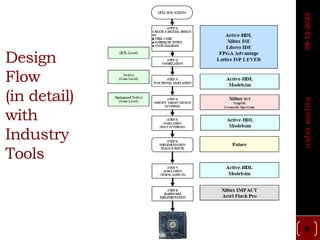
Design
Flow
(in detail)
with
Industry
Tools
8
usha
mehta
08-12-2023
Specifications
• Define
• Specific functionality
• Inputs, Outputs
• Target Device
• Speed
• Area
9
usha
mehta
08-12-2023
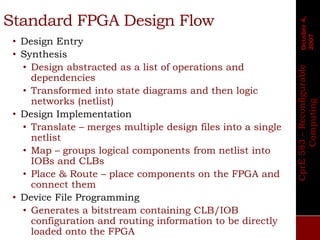
Standard FPGA Design Flow
• Design Entry
• Synthesis
• Design abstracted as a list of operations and
dependencies
• Transformed into state diagrams and then logic
networks (netlist)
• Design Implementation
• Translate – merges multiple design files into a single
netlist
• Map – groups logical components from netlist into
IOBs and CLBs
• Place & Route – place components on the FPGA and
connect them
• Device File Programming
• Generates a bitstream containing CLB/IOB
configuration and routing information to be directly
loaded onto the FPGA
CprE
583
–
Reconfigurable
Computing
October
4,
2007
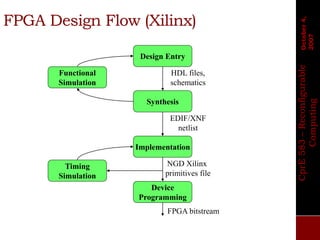
FPGA Design Flow (Xilinx)
CprE
583
–
Reconfigurable
Computing
October
4,
2007
Design Entry
Synthesis
Implementation
Device
Programming
Functional
Simulation
Timing
Simulation
HDL files,
schematics
EDIF/XNF
netlist
NGD Xilinx
primitives file
FPGA bitstream
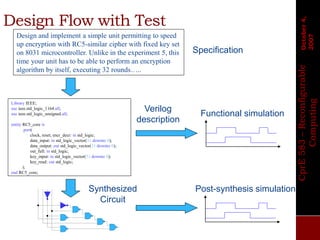
Design Flow with Test
CprE
583
–
Reconfigurable
Computing
October
4,
2007
Design and implement a simple unit permitting to speed
up encryption with RC5-similar cipher with fixed key set
on 8031 microcontroller. Unlike in the experiment 5, this
time your unit has to be able to perform an encryption
algorithm by itself, executing 32 rounds…..
Library IEEE;
use ieee.std_logic_1164.all;
use ieee.std_logic_unsigned.all;
entity RC5_core is
port(
clock, reset, encr_decr: in std_logic;
data_input: in std_logic_vector(31 downto 0);
data_output: out std_logic_vector(31 downto 0);
out_full: in std_logic;
key_input: in std_logic_vector(31 downto 0);
key_read: out std_logic;
);
end RC5_core;
Specification
Verilog
description
Functional simulation
Post-synthesis simulation
Synthesized
Circuit
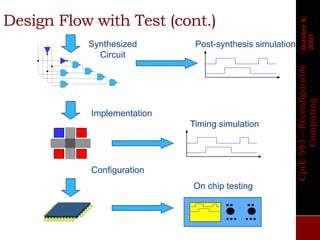
Design Flow with Test (cont.)
CprE
583
–
Reconfigurable
Computing
October
4,
2007
Implementation
Configuration
Timing simulation
On chip testing
Post-synthesis simulation
Synthesized
Circuit
Specifications
• Define
• Specific functionality
• Inputs, Outputs
• Target Device
• Speed
• Area
14
usha
mehta
08-12-2023
Design Entry
• Block Diagram/Schematic Capture
• State Diagram Entry
• HDL Code Entry
• IP core
HDL Coding
• Behavioural
• Structural
• Data Flow
• Mixed…. 15
usha
mehta
08-12-2023
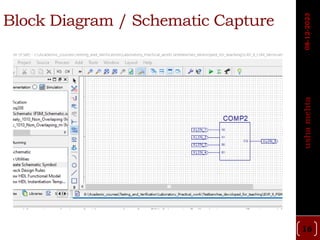
Block Diagram / Schematic Capture
16
usha
mehta
08-12-2023
Block Diagram/Schematic Capture
• A schematic circuit is literally “drawn” in an
appropriate graphical editor
• The EDA tool associated with this task is called
Schematic Capture Tool
• An electrical rule check (ERC) is usually run
• The main job of the ERC tool is to check for incorrect
electrical connections for example if a VCC pin of an
IC is accidentally shorted to ground, then the ERC
tool will point out such a discrepancy
• For this tool to be effective the IC pins have to be
earlier declared as power, ground, input, output,
bidirectional etc.
• After removing the ERC errors, a netlist is generated
by the editor
• A netlist is a text file showing the nets i.e. a set of
components connected together
• It is also possible to generate VHDL/Verilog netlist
17
usha
mehta
08-12-2023
State Diagram Entry
• Many designs are most effectively
described /designed by state diagram
approach.
• Effective for sequential designs
• The EDA tools provide a graphical
interface so that the designer can directly
make an entry of the state diagram and
generate the netlist.
• This method is preferred since it is a fast
way of creating the design
18
usha
mehta
08-12-2023
Hardware Description Using Language
• A designer can enter his /her design using a hardware
description language (HDL)
• The HDLs prominent in the industry are “VHDL” and “Verilog”
• There are another languages that is recently making ground
called as “System C” and “System Verilog”
• Being similar to C language gives it an advantage to be
more user friendly and comfortable to designers familiar
with C
• System Verilog provides a unified approach for design ,
verification etc.
• Using the code entry method is the most preferred one since it
offers:
• Design flexibility
• Code re-use
• Easy modification
• Tighter control over resources
• A netlist is again created by compiling the HDL code
19
usha
mehta
08-12-2023
• Add hardware-specific constructs to
existing languages
• SystemC
• Popular HDL
• Verilog, VHDL
• Synthesis-oriented HDL
• UDL/I ( Unified Design Language for
Integrated Circuits)
20
usha
mehta
08-12-2023
Thanks!
21
usha
mehta
08-12-2023

Basic Design Flow for Field Programmable Gate Arrays

  • 1.
    Basic Design Flowfor FPGA Usha Mehta usha.mehta@nirmauni.ac.in
  • 2.
    Selection of TargetDevice • Selecting the right device impacts on • Technical feasibility • Schedule • Cost 2 usha mehta 08-12-2023
  • 3.
    Clearly decide SystemRequirements • External Interfaces • PCIe, I2C, SPI4.2, Interlaken etc. • Number of IO Pins • Single ended, differential, Serdes etc. • IO Standards • LVCMOS 2.5V, LVDS, • 3.3V, 2.5V, 1.8V etc. • # of IO pins for each voltage level • Max. frequency • Functionality 3 usha mehta 08-12-2023
  • 4.
    • Hard Macros •Ethernet MAC • PCIe • Serdes • Processors • # of clock pins, PLL, DLL, DCM, clock buffers 4 usha mehta 08-12-2023
  • 5.
    Major Vendors • Xilinx,Altera, Lattice, Actel, Silicon blue etc. • Study the device Product Table from vendors and considering your requirement, select the device. • Tips: • Keep the room for future expansion and bug fixes • Keep the utilization under 80% 5 usha mehta 08-12-2023
  • 6.
    Target Device Which Programmablelogic device? • SPLD, CPLD or FPGA? • When more FFs are required FPGA is a better choice. • It is better to decide before you start your implementation • The selected device is then called the target device 6 usha mehta 08-12-2023
  • 7.
    Basic Design Flow forProgrammable Logic 1. Define the design requirements 2. Describe the design in HDL “THINK THE SAME WAY AS SYNTHESIS TOOL THINKS” 3./4. Simulate the source code 4./3. Synthesis, Optimize and fit the design 5. Download the bit stream file on target device. ( PL. never dump on device or never burnt your device) 7 usha mehta 08-12-2023
  • 8.
  • 9.
    Specifications • Define • Specificfunctionality • Inputs, Outputs • Target Device • Speed • Area 9 usha mehta 08-12-2023
  • 10.
    Standard FPGA DesignFlow • Design Entry • Synthesis • Design abstracted as a list of operations and dependencies • Transformed into state diagrams and then logic networks (netlist) • Design Implementation • Translate – merges multiple design files into a single netlist • Map – groups logical components from netlist into IOBs and CLBs • Place & Route – place components on the FPGA and connect them • Device File Programming • Generates a bitstream containing CLB/IOB configuration and routing information to be directly loaded onto the FPGA CprE 583 – Reconfigurable Computing October 4, 2007
  • 11.
    FPGA Design Flow(Xilinx) CprE 583 – Reconfigurable Computing October 4, 2007 Design Entry Synthesis Implementation Device Programming Functional Simulation Timing Simulation HDL files, schematics EDIF/XNF netlist NGD Xilinx primitives file FPGA bitstream
  • 12.
    Design Flow withTest CprE 583 – Reconfigurable Computing October 4, 2007 Design and implement a simple unit permitting to speed up encryption with RC5-similar cipher with fixed key set on 8031 microcontroller. Unlike in the experiment 5, this time your unit has to be able to perform an encryption algorithm by itself, executing 32 rounds….. Library IEEE; use ieee.std_logic_1164.all; use ieee.std_logic_unsigned.all; entity RC5_core is port( clock, reset, encr_decr: in std_logic; data_input: in std_logic_vector(31 downto 0); data_output: out std_logic_vector(31 downto 0); out_full: in std_logic; key_input: in std_logic_vector(31 downto 0); key_read: out std_logic; ); end RC5_core; Specification Verilog description Functional simulation Post-synthesis simulation Synthesized Circuit
  • 13.
    Design Flow withTest (cont.) CprE 583 – Reconfigurable Computing October 4, 2007 Implementation Configuration Timing simulation On chip testing Post-synthesis simulation Synthesized Circuit
  • 14.
    Specifications • Define • Specificfunctionality • Inputs, Outputs • Target Device • Speed • Area 14 usha mehta 08-12-2023
  • 15.
    Design Entry • BlockDiagram/Schematic Capture • State Diagram Entry • HDL Code Entry • IP core HDL Coding • Behavioural • Structural • Data Flow • Mixed…. 15 usha mehta 08-12-2023
  • 16.
    Block Diagram /Schematic Capture 16 usha mehta 08-12-2023
  • 17.
    Block Diagram/Schematic Capture •A schematic circuit is literally “drawn” in an appropriate graphical editor • The EDA tool associated with this task is called Schematic Capture Tool • An electrical rule check (ERC) is usually run • The main job of the ERC tool is to check for incorrect electrical connections for example if a VCC pin of an IC is accidentally shorted to ground, then the ERC tool will point out such a discrepancy • For this tool to be effective the IC pins have to be earlier declared as power, ground, input, output, bidirectional etc. • After removing the ERC errors, a netlist is generated by the editor • A netlist is a text file showing the nets i.e. a set of components connected together • It is also possible to generate VHDL/Verilog netlist 17 usha mehta 08-12-2023
  • 18.
    State Diagram Entry •Many designs are most effectively described /designed by state diagram approach. • Effective for sequential designs • The EDA tools provide a graphical interface so that the designer can directly make an entry of the state diagram and generate the netlist. • This method is preferred since it is a fast way of creating the design 18 usha mehta 08-12-2023
  • 19.
    Hardware Description UsingLanguage • A designer can enter his /her design using a hardware description language (HDL) • The HDLs prominent in the industry are “VHDL” and “Verilog” • There are another languages that is recently making ground called as “System C” and “System Verilog” • Being similar to C language gives it an advantage to be more user friendly and comfortable to designers familiar with C • System Verilog provides a unified approach for design , verification etc. • Using the code entry method is the most preferred one since it offers: • Design flexibility • Code re-use • Easy modification • Tighter control over resources • A netlist is again created by compiling the HDL code 19 usha mehta 08-12-2023
  • 20.
    • Add hardware-specificconstructs to existing languages • SystemC • Popular HDL • Verilog, VHDL • Synthesis-oriented HDL • UDL/I ( Unified Design Language for Integrated Circuits) 20 usha mehta 08-12-2023
  • 21.