Intro TDP Congestion HFNS Scan Chain Optimization
Placement
How to Plan your own chip
Ahmed Abdelazeem
Faculty of Engineering
Zagazig University
RTL2GDSII Flow, February 2022
Ahmed Abdelazeem ASIC Physical Design
Intro TDP Congestion HFNS Scan Chain Optimization
Table of Contents
1 Introduction
2 Timing Driven Placement
3 Congestion Driven Placement
4 High Fanout Synthesis (HFS)
5 Scan Chain Reordering
6 Placement Optimization
Ahmed Abdelazeem ASIC Physical Design
Intro TDP Congestion HFNS Scan Chain Optimization Place Flow
Table of Contents
1 Introduction
2 Timing Driven Placement
3 Congestion Driven Placement
4 High Fanout Synthesis (HFS)
5 Scan Chain Reordering
6 Placement Optimization
Ahmed Abdelazeem ASIC Physical Design
Intro TDP Congestion HFNS Scan Chain Optimization Place Flow
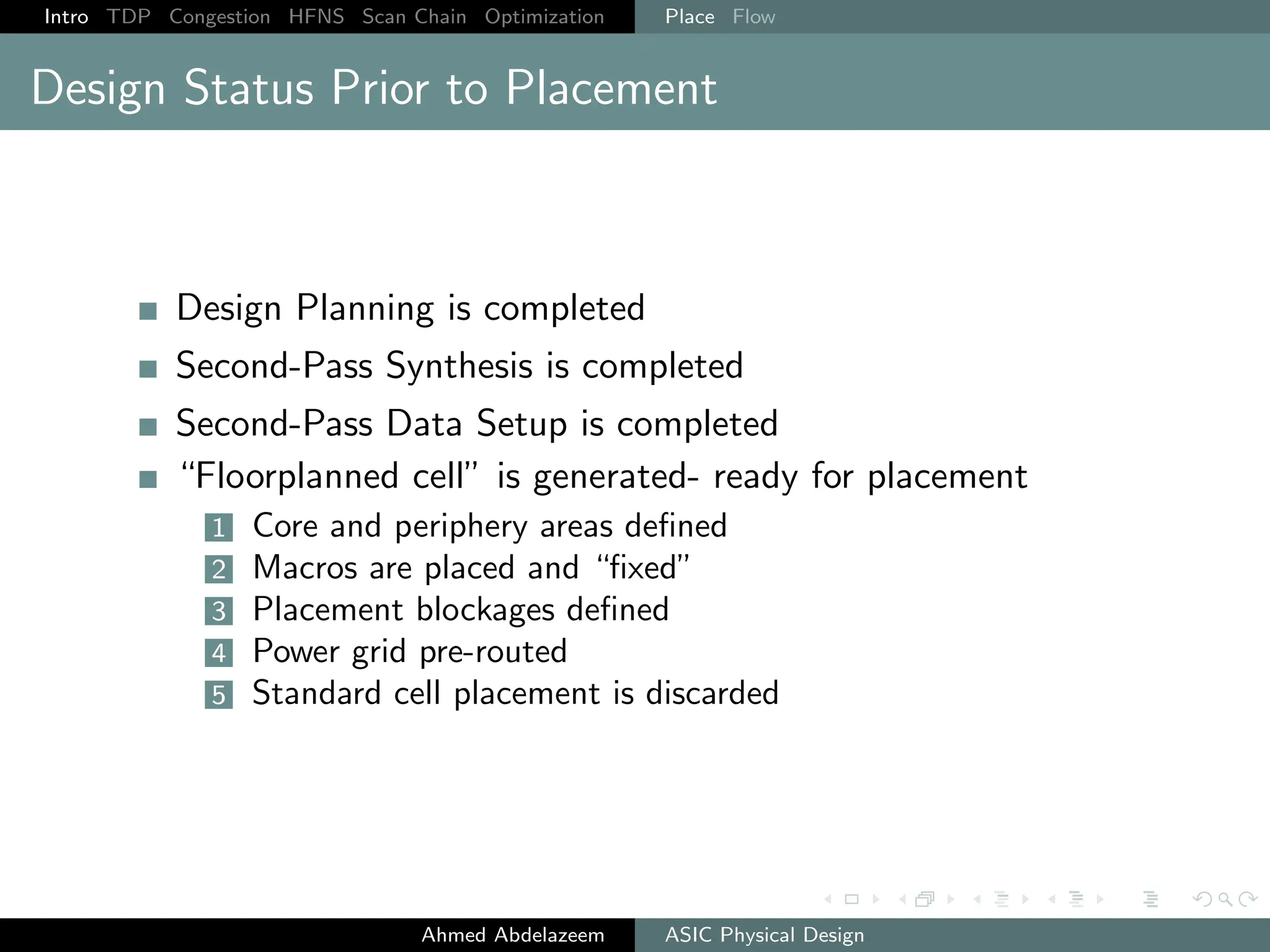
Design Status Prior to Placement
Design Planning is completed
Second-Pass Synthesis is completed
Second-Pass Data Setup is completed
“Floorplanned cell” is generated- ready for placement
1 Core and periphery areas defined
2 Macros are placed and “fixed”
3 Placement blockages defined
4 Power grid pre-routed
5 Standard cell placement is discarded
Ahmed Abdelazeem ASIC Physical Design
Intro TDP Congestion HFNS Scan Chain Optimization Place Flow
Placement Problem
The goal of placement is to minimize the total area and
interconnect cost.
The quality of the attainable routing is
highly determined by the placement.
Circuit placement becomes very critical in
65nm and below technologies.
Ahmed Abdelazeem ASIC Physical Design
Intro TDP Congestion HFNS Scan Chain Optimization Place Flow
Placement
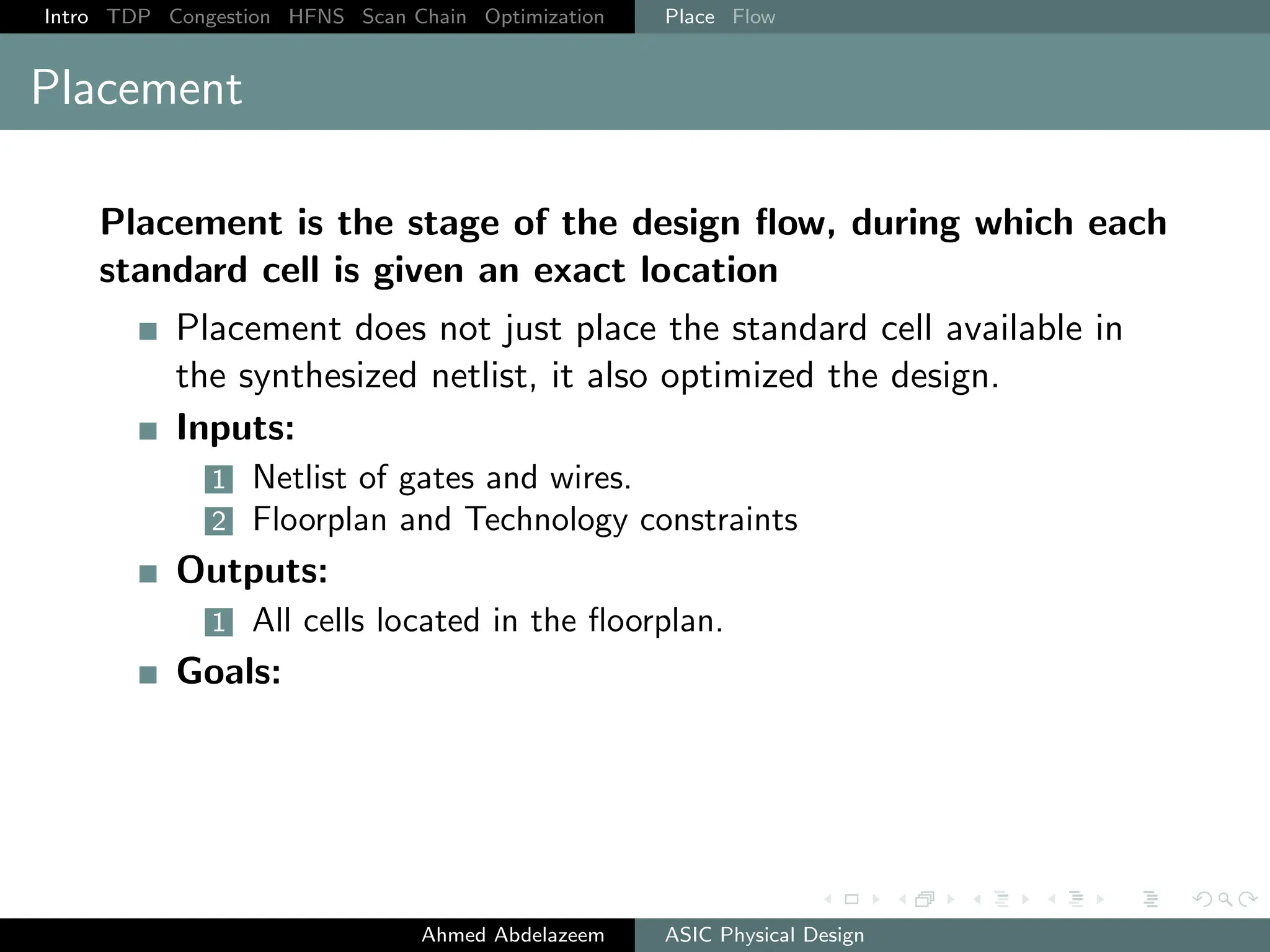
Placement is the stage of the design flow, during which each
standard cell is given an exact location
Ahmed Abdelazeem ASIC Physical Design
Intro TDP Congestion HFNS Scan Chain Optimization Place Flow
Placement
Placement is the stage of the design flow, during which each
standard cell is given an exact location
Placement does not just place the standard cell available in
the synthesized netlist, it also optimized the design.
Ahmed Abdelazeem ASIC Physical Design
Intro TDP Congestion HFNS Scan Chain Optimization Place Flow
Placement
Placement is the stage of the design flow, during which each
standard cell is given an exact location
Placement does not just place the standard cell available in
the synthesized netlist, it also optimized the design.
Inputs:
Ahmed Abdelazeem ASIC Physical Design
Intro TDP Congestion HFNS Scan Chain Optimization Place Flow
Placement
Placement is the stage of the design flow, during which each
standard cell is given an exact location
Placement does not just place the standard cell available in
the synthesized netlist, it also optimized the design.
Inputs:
1 Netlist of gates and wires.
2 Floorplan and Technology constraints
Outputs:
Ahmed Abdelazeem ASIC Physical Design
Intro TDP Congestion HFNS Scan Chain Optimization Place Flow
Placement
Placement is the stage of the design flow, during which each
standard cell is given an exact location
Placement does not just place the standard cell available in
the synthesized netlist, it also optimized the design.
Inputs:
1 Netlist of gates and wires.
2 Floorplan and Technology constraints
Outputs:
1 All cells located in the floorplan.
Goals:
Ahmed Abdelazeem ASIC Physical Design
Intro TDP Congestion HFNS Scan Chain Optimization Place Flow
Placement
Placement is the stage of the design flow, during which each
standard cell is given an exact location
Placement does not just place the standard cell available in
the synthesized netlist, it also optimized the design.
Inputs:
1 Netlist of gates and wires.
2 Floorplan and Technology constraints
Outputs:
1 All cells located in the floorplan.
Goals:
1 Provide legal location of entire netlist
2 Enable detailed route of all nets
3 Meet timing, area, and power targets
Ahmed Abdelazeem ASIC Physical Design
Intro TDP Congestion HFNS Scan Chain Optimization Place Flow
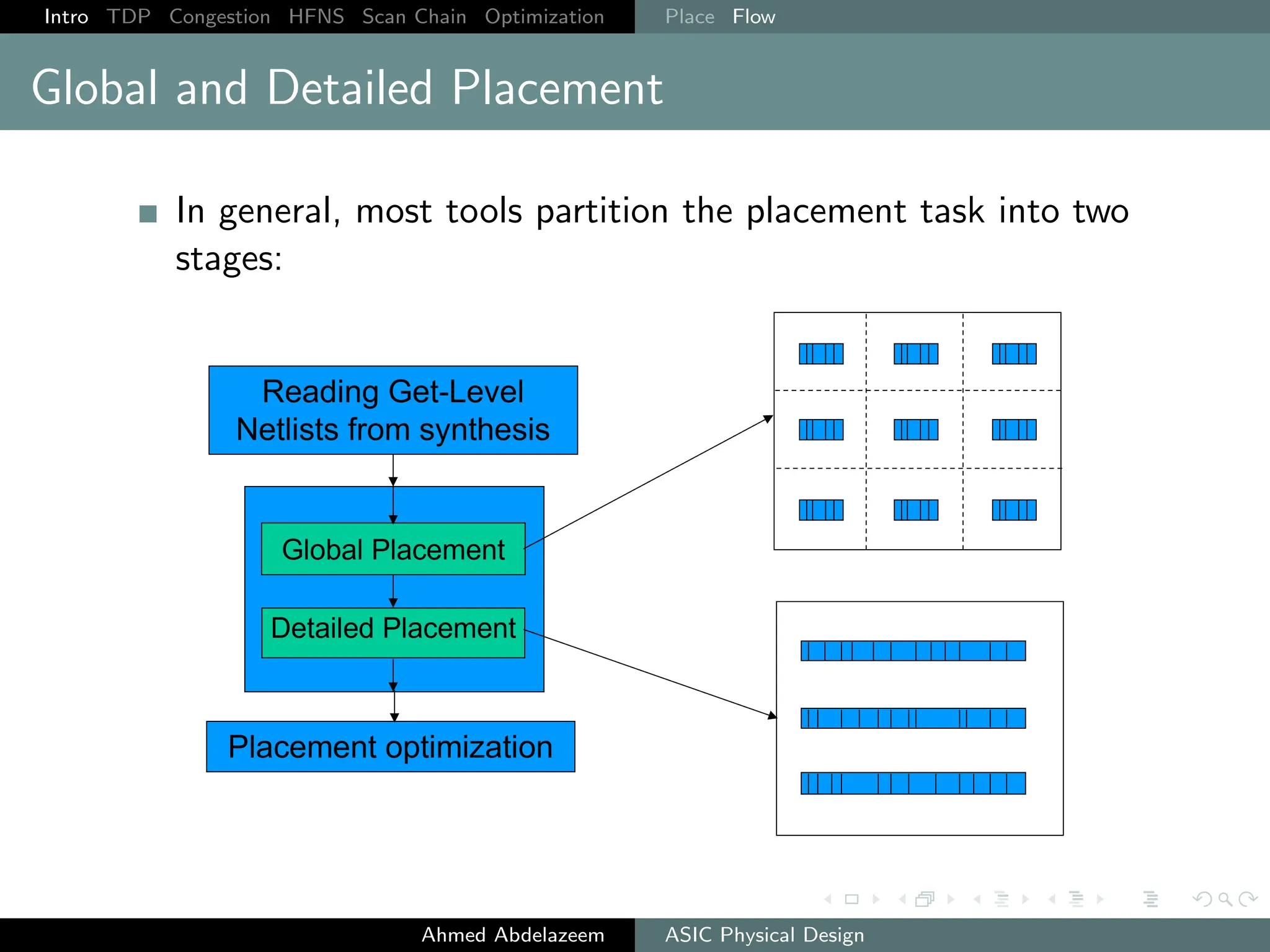
Global and Detailed Placement
In general, most tools partition the placement task into two
stages:
Ahmed Abdelazeem ASIC Physical Design
Intro TDP Congestion HFNS Scan Chain Optimization Place Flow
Global Placement
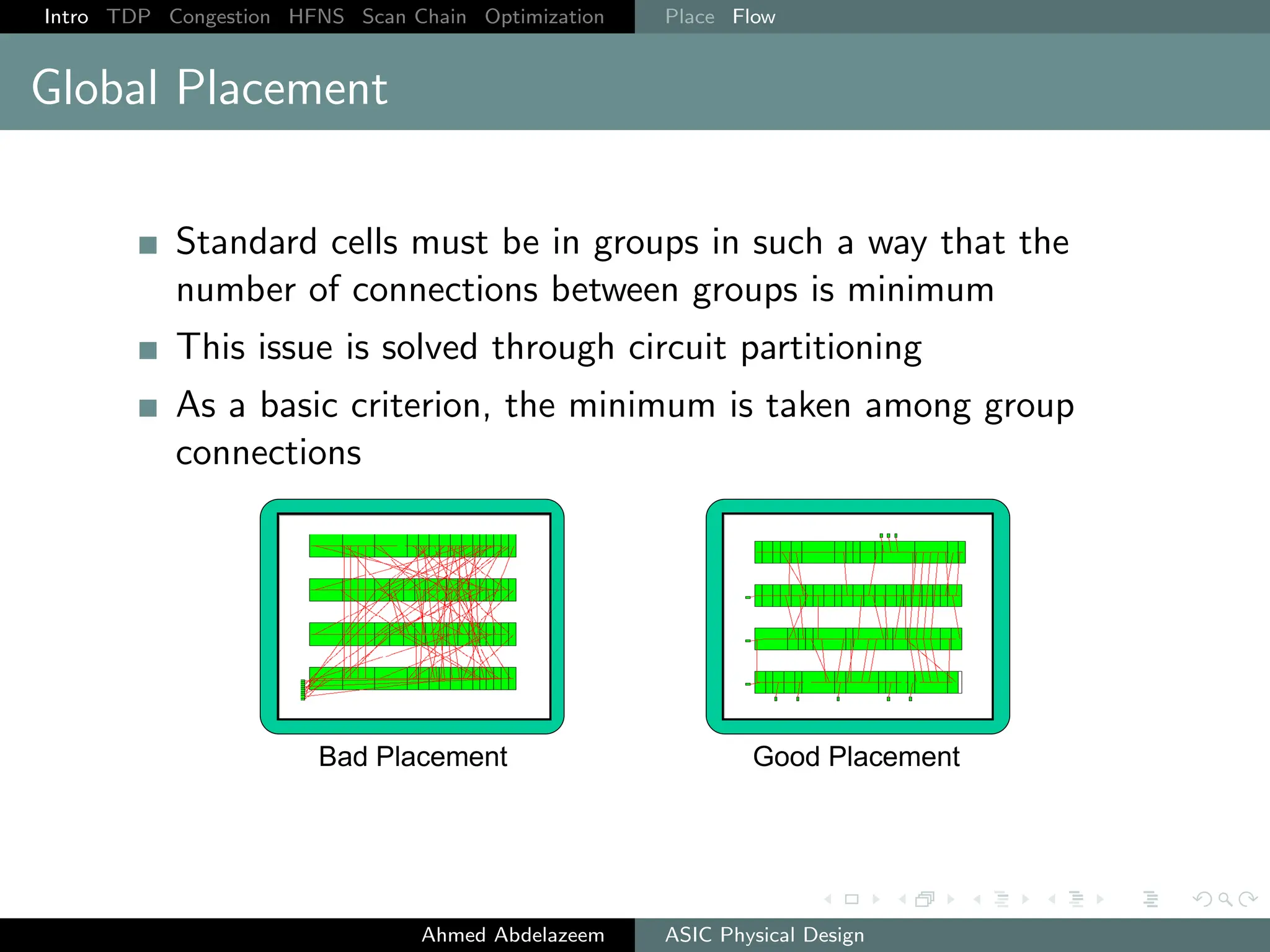
Standard cells must be in groups in such a way that the
number of connections between groups is minimum
Ahmed Abdelazeem ASIC Physical Design
Intro TDP Congestion HFNS Scan Chain Optimization Place Flow
Global Placement
Standard cells must be in groups in such a way that the
number of connections between groups is minimum
This issue is solved through circuit partitioning
Ahmed Abdelazeem ASIC Physical Design
Intro TDP Congestion HFNS Scan Chain Optimization Place Flow
Global Placement
Standard cells must be in groups in such a way that the
number of connections between groups is minimum
This issue is solved through circuit partitioning
As a basic criterion, the minimum is taken among group
connections
Ahmed Abdelazeem ASIC Physical Design
Intro TDP Congestion HFNS Scan Chain Optimization Place Flow
Detailed Placement
As a rule, detailed placemen
is solved in two stages:
1 Coarse placement
2 Legalization of cell
placement
Ahmed Abdelazeem ASIC Physical Design
Intro TDP Congestion HFNS Scan Chain Optimization Place Flow
Coarse placement
In a coarse placement all the cells are placed in the
approximate locations but they are not legally placed.
Cells overlap and are not on-grid.
Large cells (e.g. RAMs) form large placement blockages for
other smaller leaf cells.
Power routing forms routing layer blockages that will also be
checked and avoided if specified.
Ahmed Abdelazeem ASIC Physical Design
Intro TDP Congestion HFNS Scan Chain Optimization Place Flow
Legalize Cell Placement
Provide a legal placement for each instance with no overlap
Try and minimize wirelength (or other cost metrics)
Try to finish with uncongested design
Ahmed Abdelazeem ASIC Physical Design
Intro TDP Congestion HFNS Scan Chain Optimization Timing
Table of Contents
1 Introduction
2 Timing Driven Placement
3 Congestion Driven Placement
4 High Fanout Synthesis (HFS)
5 Scan Chain Reordering
6 Placement Optimization
Ahmed Abdelazeem ASIC Physical Design
Intro TDP Congestion HFNS Scan Chain Optimization Timing
Timing-Driven Placement (1)
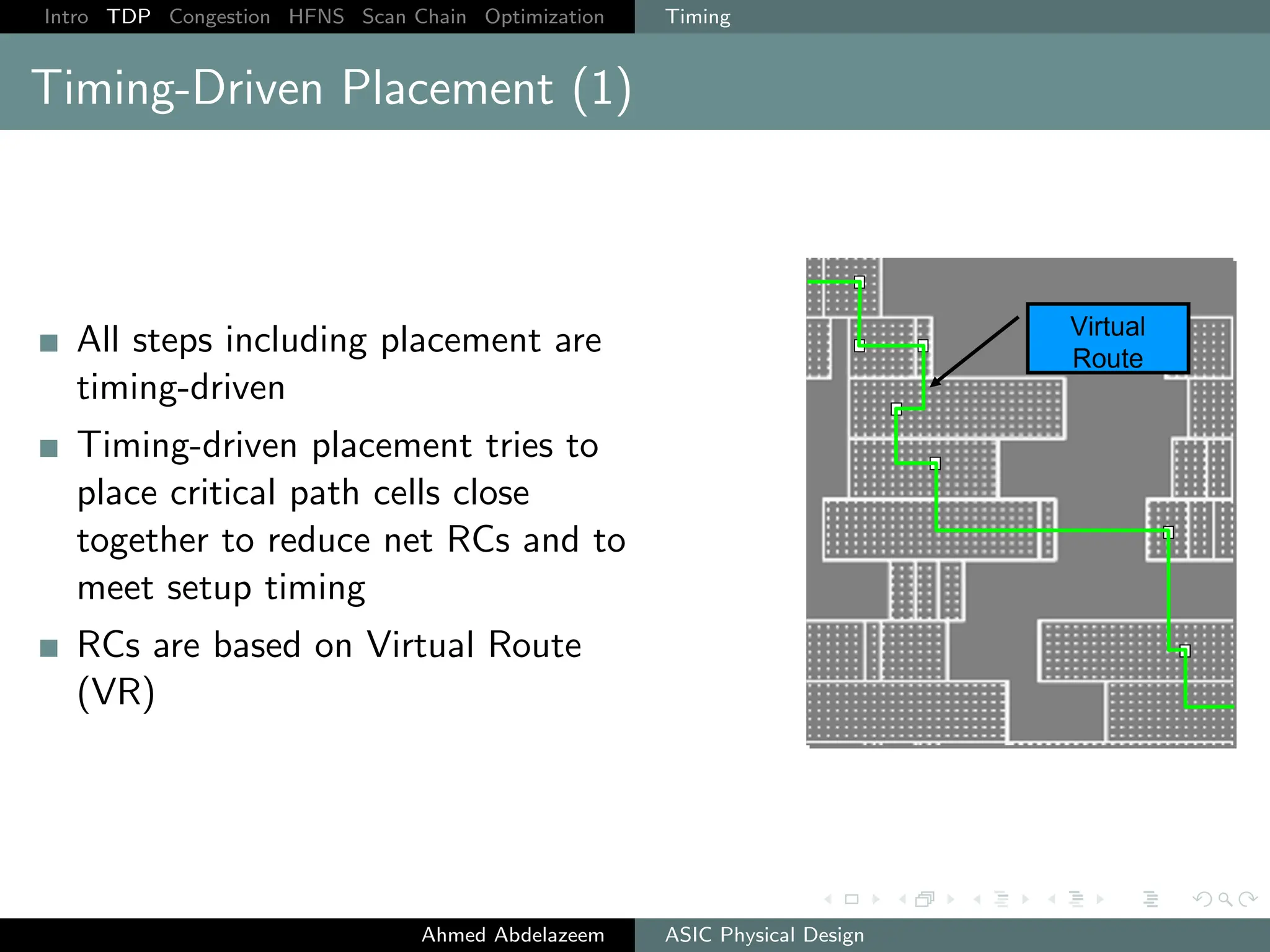
All steps including placement are
timing-driven
Timing-driven placement tries to
place critical path cells close
together to reduce net RCs and to
meet setup timing
RCs are based on Virtual Route
(VR)
Ahmed Abdelazeem ASIC Physical Design
Intro TDP Congestion HFNS Scan Chain Optimization Timing
Timing-Driven Placement (2)
Timing-driven placement
based on Virtual Route
Tries to place cells along
timing-critical paths close
together to reduce net
RCs and meet setup
timing
Net RCs are based on
Virtual Routing (VR)
estimates
Ahmed Abdelazeem ASIC Physical Design
Intro TDP Congestion HFNS Scan Chain Optimization Timing
Timing-Driven Placement (3)
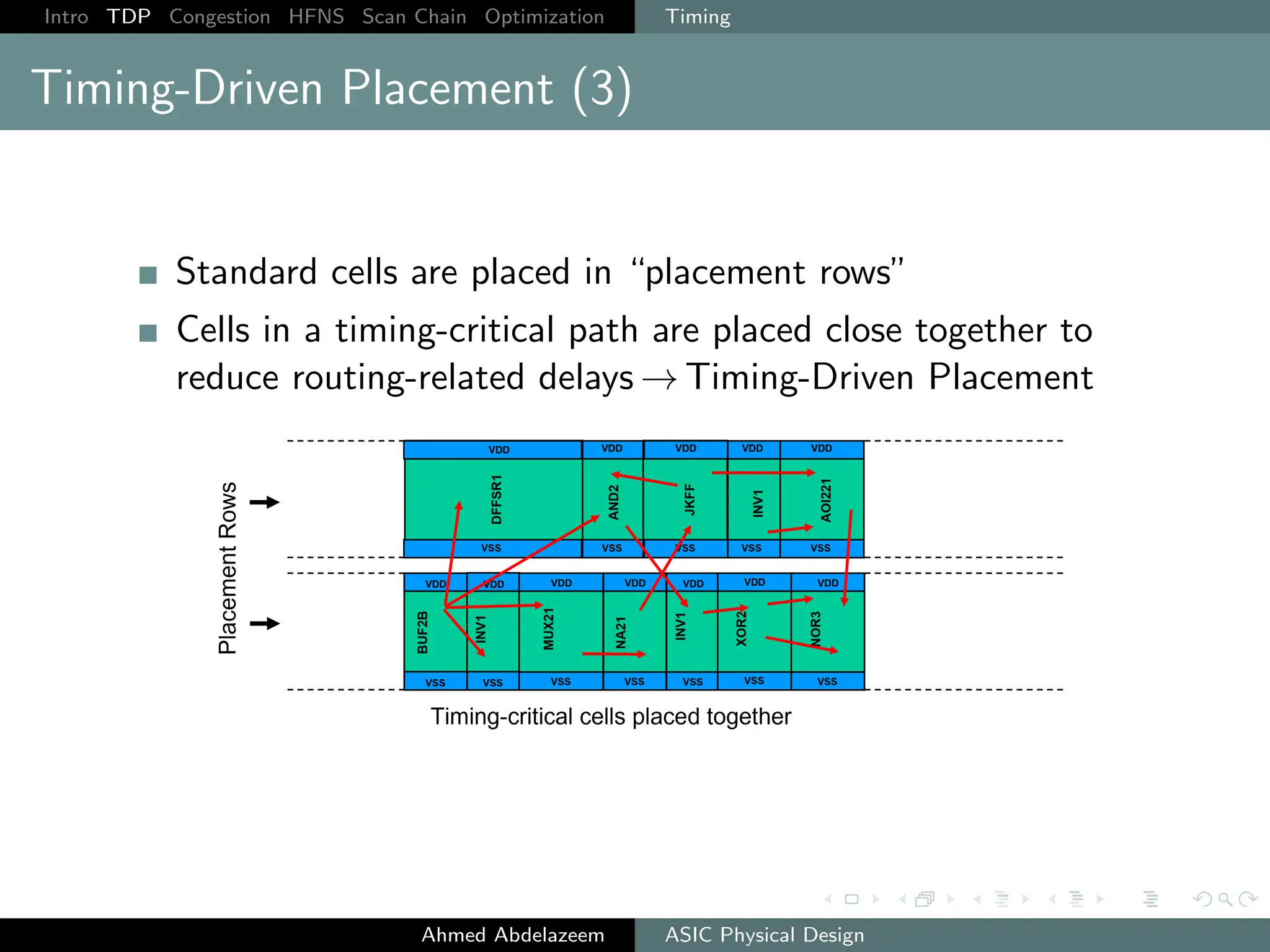
Standard cells are placed in “placement rows”
Cells in a timing-critical path are placed close together to
reduce routing-related delays → Timing-Driven Placement
Ahmed Abdelazeem ASIC Physical Design
Intro TDP Congestion HFNS Scan Chain Optimization Timing
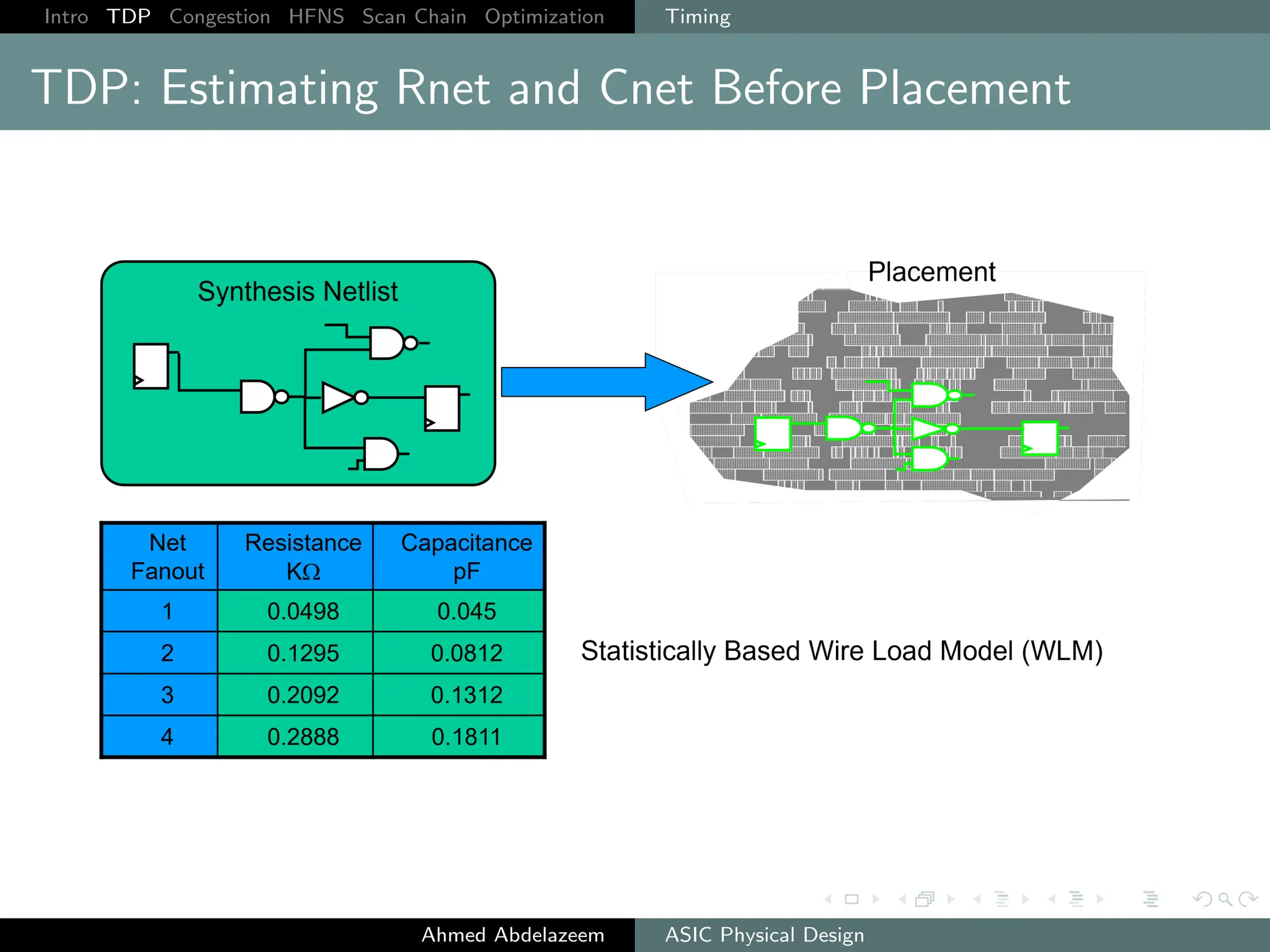
TDP: Estimating Rnet and Cnet Before Placement
Ahmed Abdelazeem ASIC Physical Design
Intro TDP Congestion HFNS Scan Chain Optimization Congestion Issues Solution
-
Ahmed Abdelazeem ASIC Physical Design
Intro TDP Congestion HFNS Scan Chain Optimization Congestion Issues Solution
Table of Contents
1 Introduction
2 Timing Driven Placement
3 Congestion Driven Placement
4 High Fanout Synthesis (HFS)
5 Scan Chain Reordering
6 Placement Optimization
Ahmed Abdelazeem ASIC Physical Design
Intro TDP Congestion HFNS Scan Chain Optimization Congestion Issues Solution
Congestion
Congestion occurs when the number of required routing tracks
exceeds the number of available tracks.
Congestion can be estimated from the results of a quick global
route.
Global bins with routing overflow can be identified
Ahmed Abdelazeem ASIC Physical Design
Intro TDP Congestion HFNS Scan Chain Optimization Congestion Issues Solution
Congestion Driven Placement: Routing resource
Ahmed Abdelazeem ASIC Physical Design
Intro TDP Congestion HFNS Scan Chain Optimization Congestion Issues Solution
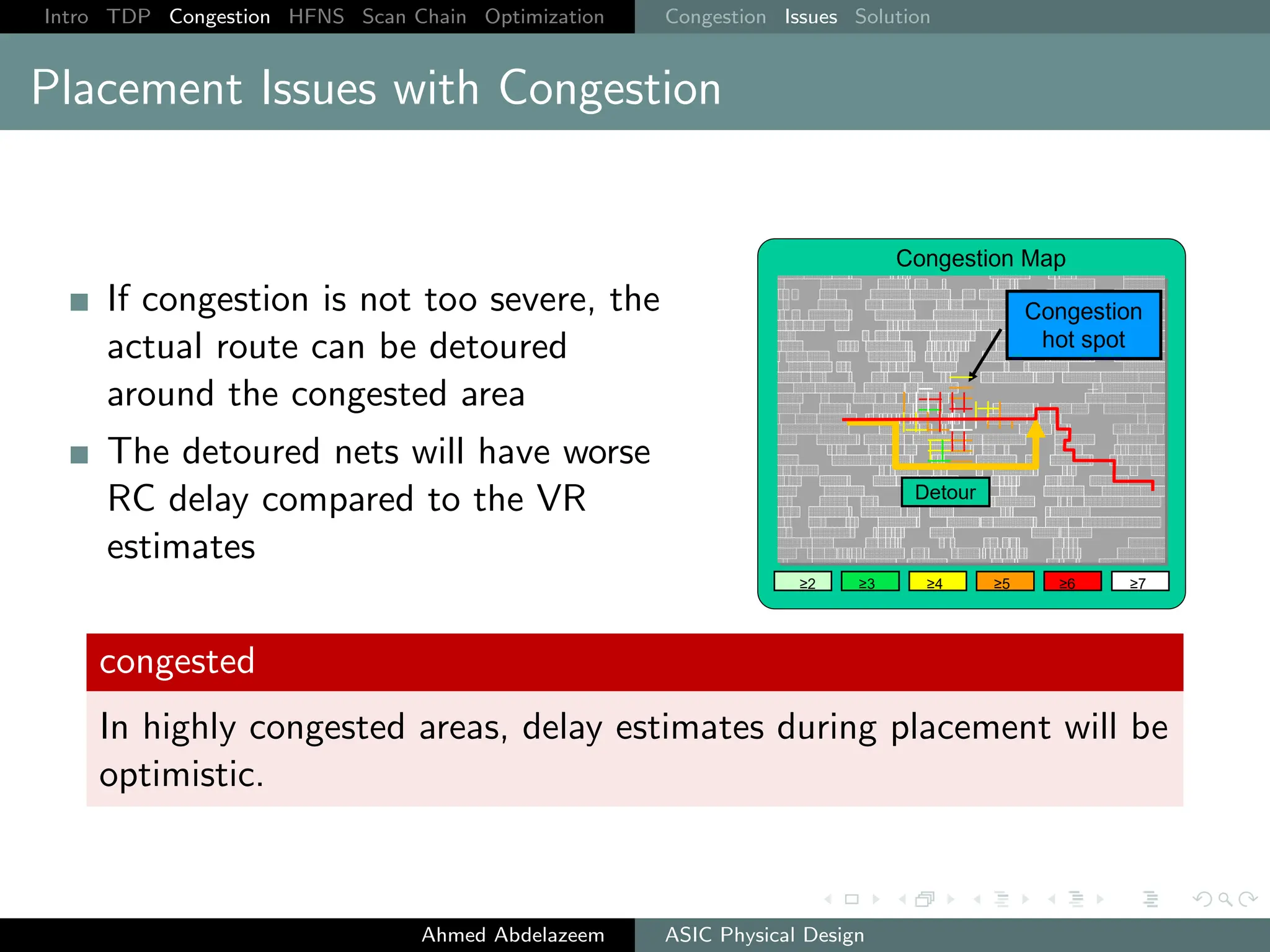
Placement Issues with Congestion
If congestion is not too severe, the
actual route can be detoured
around the congested area
The detoured nets will have worse
RC delay compared to the VR
estimates
congested
In highly congested areas, delay estimates during placement will be
optimistic.
Ahmed Abdelazeem ASIC Physical Design
Intro TDP Congestion HFNS Scan Chain Optimization Congestion Issues Solution
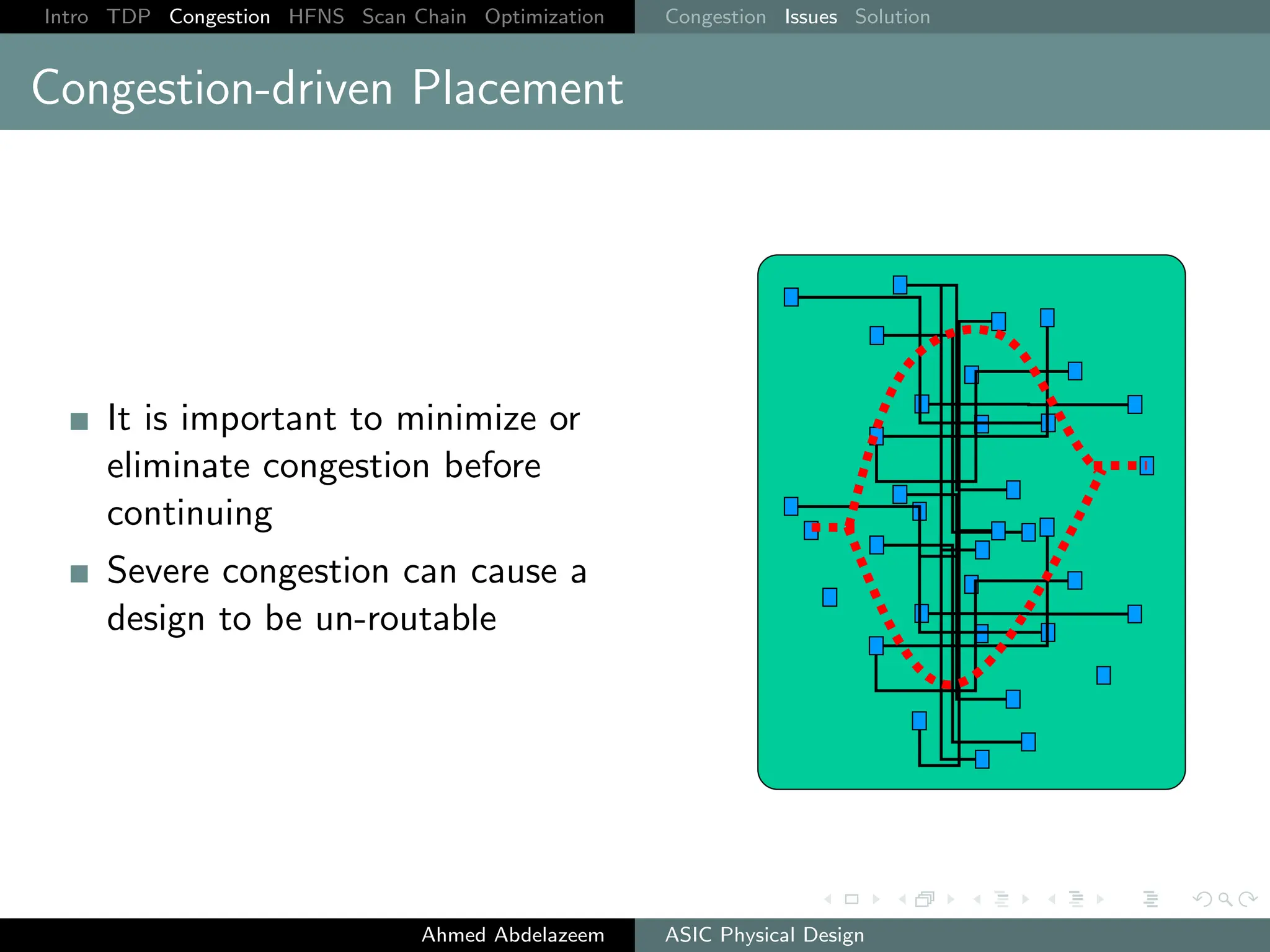
Non Routable on Severely Congested Design
It is important to minimize or
eliminate congestion before
continuing
Severe congestion can cause a
design to be un-routable
Ahmed Abdelazeem ASIC Physical Design
Intro TDP Congestion HFNS Scan Chain Optimization Congestion Issues Solution
Congestion Calculation
Ahmed Abdelazeem ASIC Physical Design
Intro TDP Congestion HFNS Scan Chain Optimization Congestion Issues Solution
Congestion-driven Placement
It is important to minimize or
eliminate congestion before
continuing
Severe congestion can cause a
design to be un-routable
Ahmed Abdelazeem ASIC Physical Design
Intro TDP Congestion HFNS Scan Chain Optimization Congestion Issues Solution
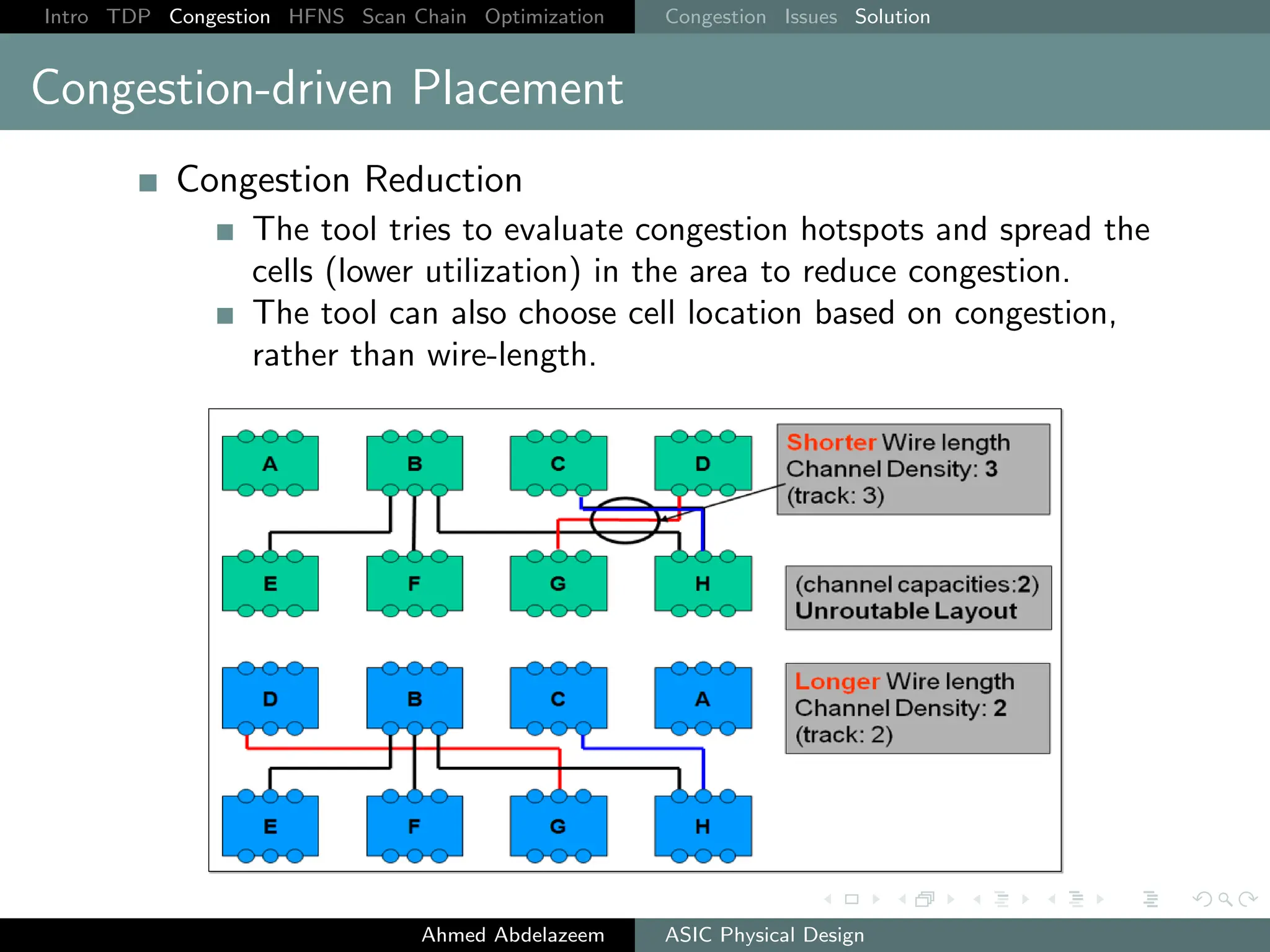
Congestion-driven Placement
Congestion Reduction
The tool tries to evaluate congestion hotspots and spread the
cells (lower utilization) in the area to reduce congestion.
The tool can also choose cell location based on congestion,
rather than wire-length.
Ahmed Abdelazeem ASIC Physical Design
Intro TDP Congestion HFNS Scan Chain Optimization Congestion Issues Solution
Congestion vs. Timing-Driven Placement
Ahmed Abdelazeem ASIC Physical Design
Intro TDP Congestion HFNS Scan Chain Optimization Congestion Issues Solution
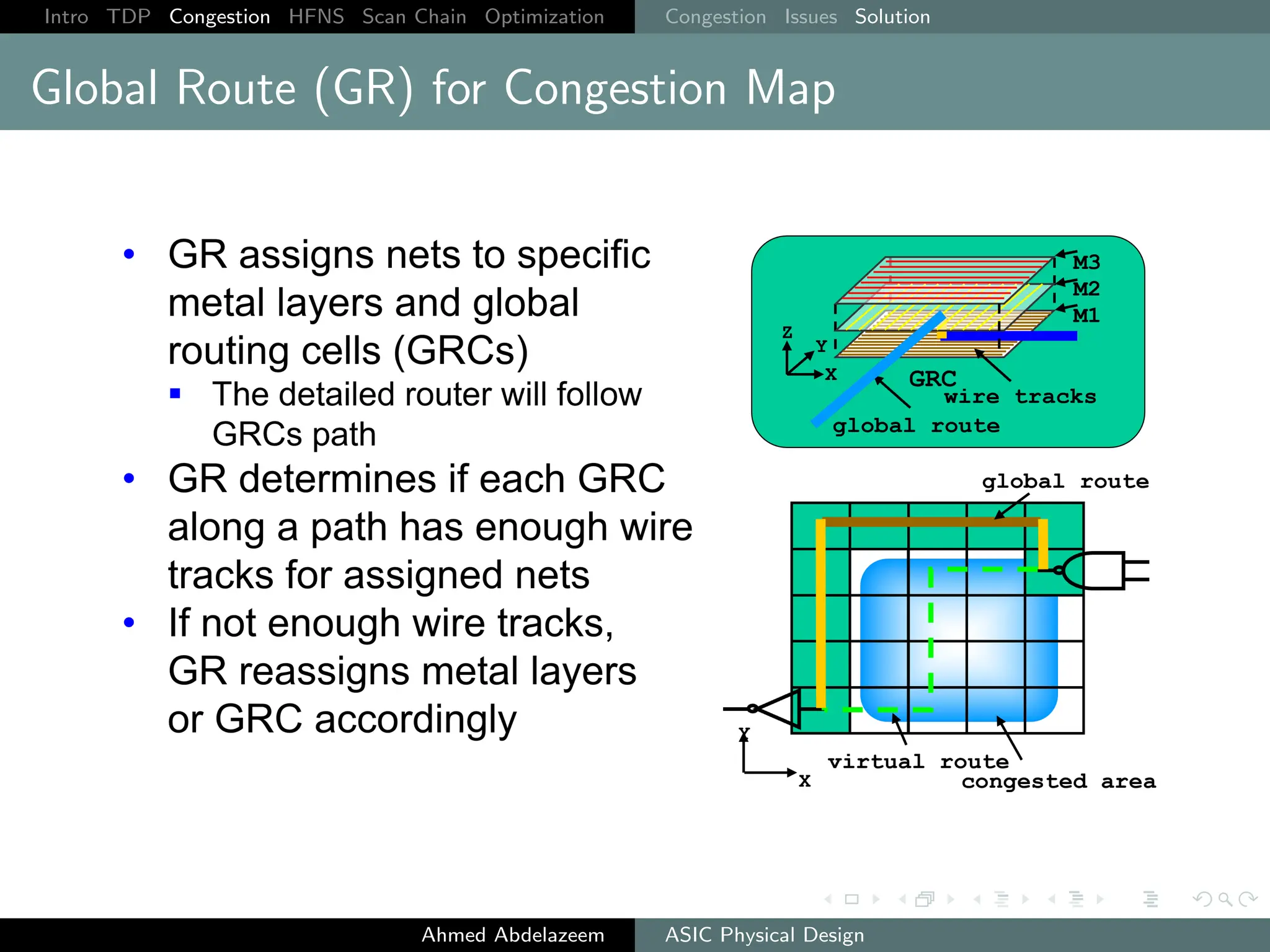
Global Route (GR) for Congestion Map
Ahmed Abdelazeem ASIC Physical Design
Intro TDP Congestion HFNS Scan Chain Optimization Congestion Issues Solution
Strategies to Fix Congestion
Modify the floorplan:
Mark areas for low utilization.
Top-level ports
Changing to a different metal layer
Spreading them out, re-ordering or moving to other sides
Macro location or orientation
Alignment of bus signal pins
Increase of spacing between macros
Add blockages and halos
Core aspect ratio and size
Making block taller to add more horizontal routing resources
Increase of the block size to reduce overall congestion
Power grid
Fixing any routed or non-preferred layers
Ahmed Abdelazeem ASIC Physical Design
Intro TDP Congestion HFNS Scan Chain Optimization HFNS
Table of Contents
1 Introduction
2 Timing Driven Placement
3 Congestion Driven Placement
4 High Fanout Synthesis (HFS)
5 Scan Chain Reordering
6 Placement Optimization
Ahmed Abdelazeem ASIC Physical Design
Intro TDP Congestion HFNS Scan Chain Optimization HFNS
High Fanout Synthesis (HFS)
Ahmed Abdelazeem ASIC Physical Design
Intro TDP Congestion HFNS Scan Chain Optimization HFNS
High Fanout Synthesis
What is fanout?
Fanout is the number of gate inputs to which the output can
be safely connected. i.e., The load that a gate output can
drive.
The maximum fanout of an output measures it’s load-driving
capability. Fanout belongs to the output.
What are High Fanout Nets(HFN) ?
High Fanout Nets are the nets which drive more number of
load. We set some max fanout limit by using the command
set max fanout
The nets which have greater than these limit are considered as
High Fanout Nets (HFN).
Generally clock nets, reset, scan, enable nets are High Fanout
Nets.
Ahmed Abdelazeem ASIC Physical Design
Intro TDP Congestion HFNS Scan Chain Optimization HFNS
What is High Fanout Net Synthesis (HFNS)?
High Fanout Net Synthesis (HFNS) is the process of buffering
the High Fanout Nets to balance the load.
To balance the load HFNS is perfomed.
Too many load affects delay numbers and transition times,
Because load is directly proportional to the delay.
Generally at placement step HFNS performed. HFNS can also
be performed at synthesis step using Design Compiler. But
it’s not good idea, Buffers will be removed during PD and
again HFNS is performed.
Care that should taken during HFNS:
1 Make sure an appropriate fanout limit is set using
set max fanout command
2 Verify the SDC used for PD should not have set ideal network
or set dont touch commands on High Fanout Nets.
3 Use ideal clock network – As clock nets are synthesized
separately during Clock Tree Synthesis (CTS) step, we set
clock network as ideal network.
Ahmed Abdelazeem ASIC Physical Design
Intro TDP Congestion HFNS Scan Chain Optimization Scan Chain
Table of Contents
1 Introduction
2 Timing Driven Placement
3 Congestion Driven Placement
4 High Fanout Synthesis (HFS)
5 Scan Chain Reordering
6 Placement Optimization
Ahmed Abdelazeem ASIC Physical Design
Intro TDP Congestion HFNS Scan Chain Optimization Scan Chain
Pre-Existing Scan Chains?
Ahmed Abdelazeem ASIC Physical Design
Intro TDP Congestion HFNS Scan Chain Optimization Scan Chain
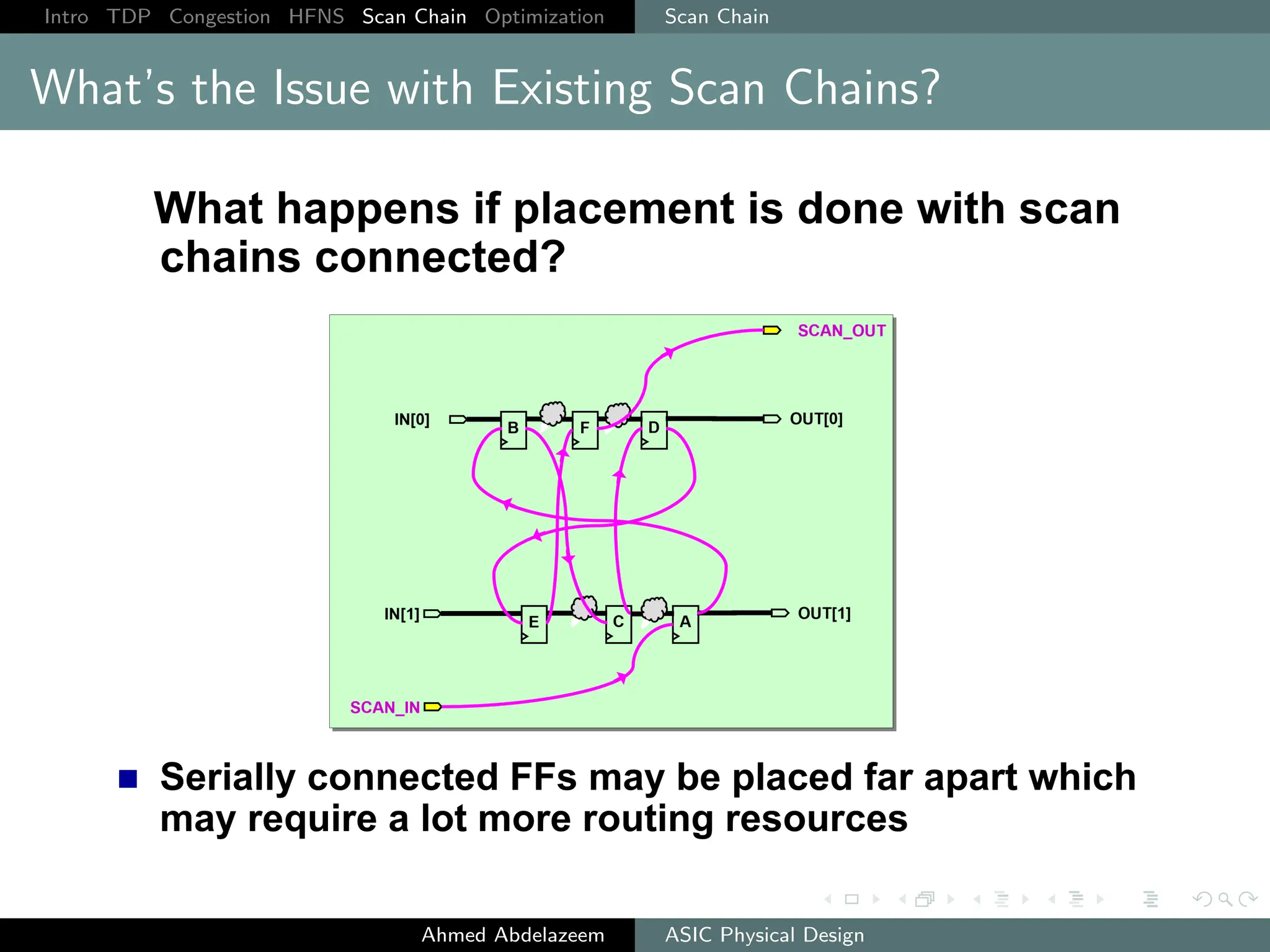
What’s the Issue with Existing Scan Chains?
Ahmed Abdelazeem ASIC Physical Design
Intro TDP Congestion HFNS Scan Chain Optimization Scan Chain
Placement Based Scan Chain Routing
Ahmed Abdelazeem ASIC Physical Design
Intro TDP Congestion HFNS Scan Chain Optimization Scan Chain
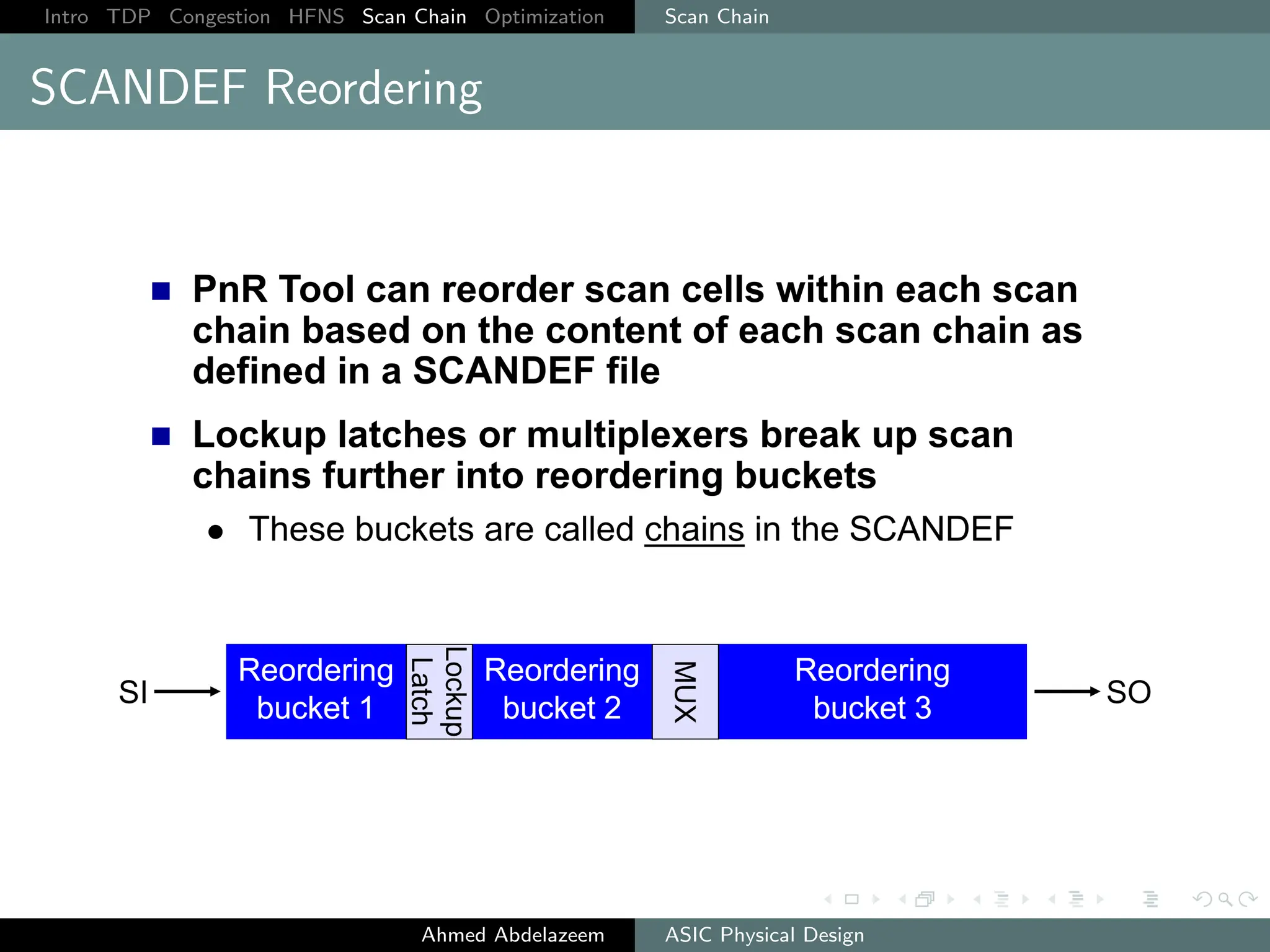
SCANDEF Reordering
Ahmed Abdelazeem ASIC Physical Design
Intro TDP Congestion HFNS Scan Chain Optimization Scan Chain
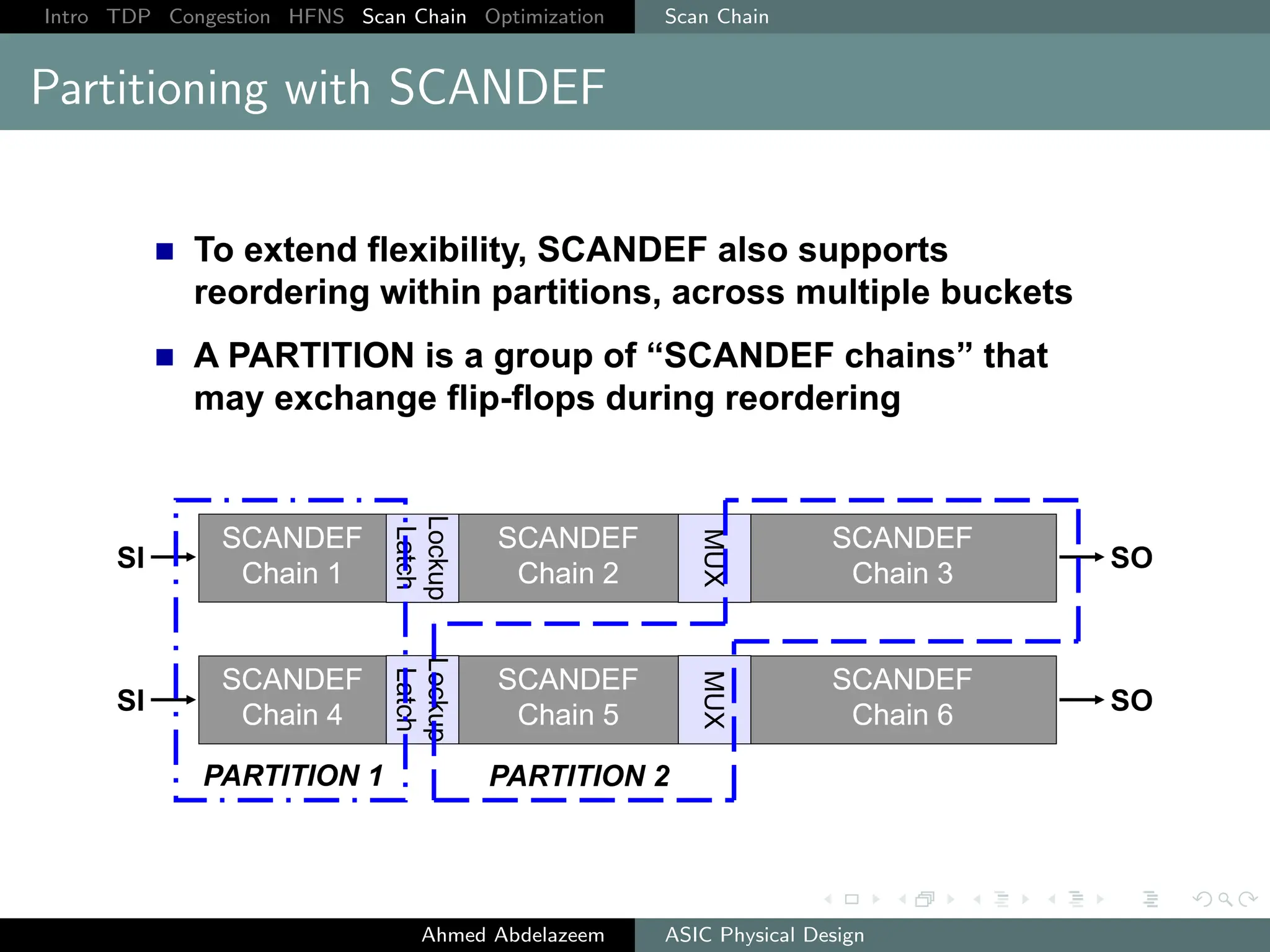
Partitioning with SCANDEF
Ahmed Abdelazeem ASIC Physical Design
Intro TDP Congestion HFNS Scan Chain Optimization Scan Chain
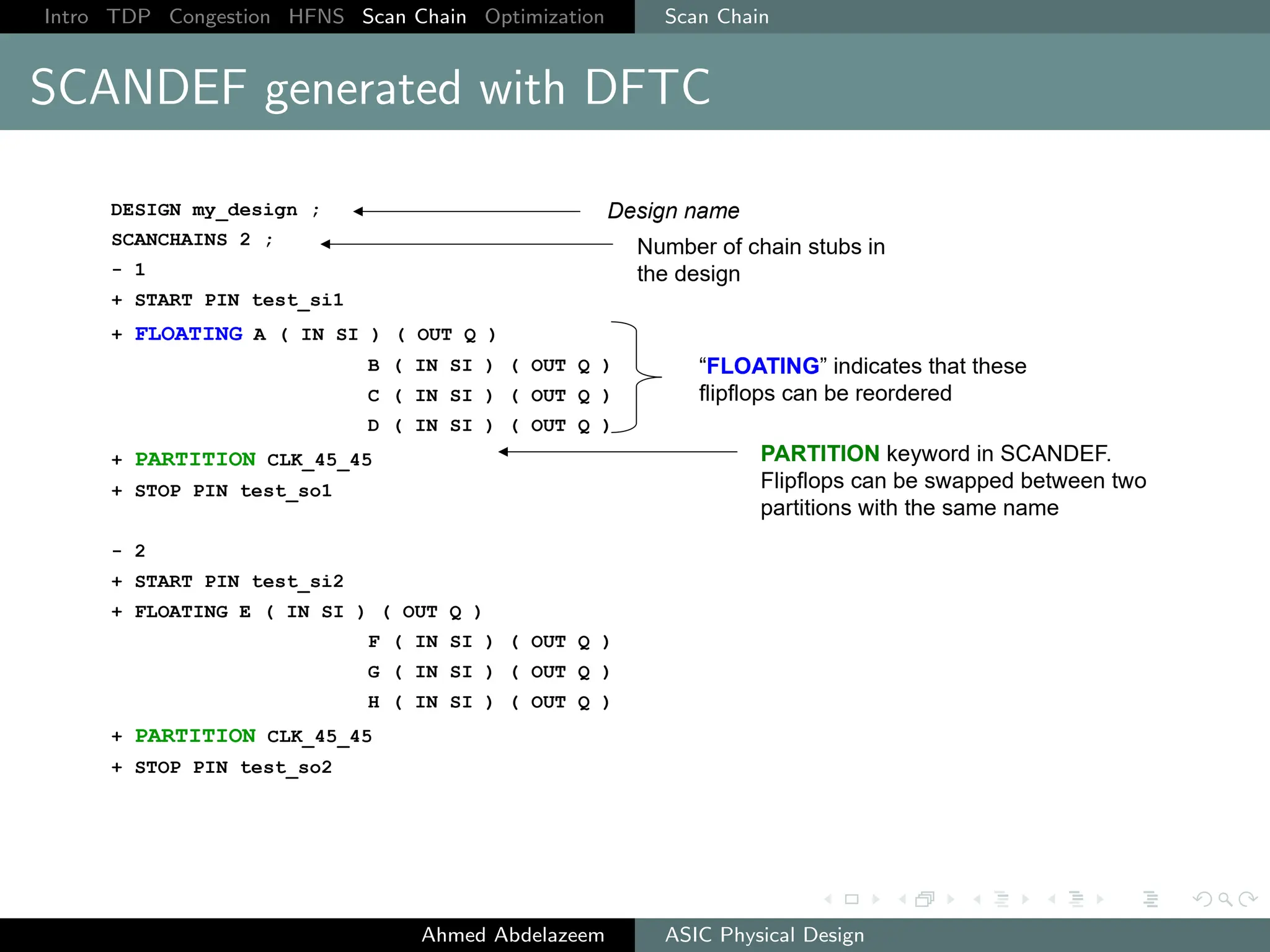
SCANDEF generated with DFTC
Ahmed Abdelazeem ASIC Physical Design
Intro TDP Congestion HFNS Scan Chain Optimization Scan Chain
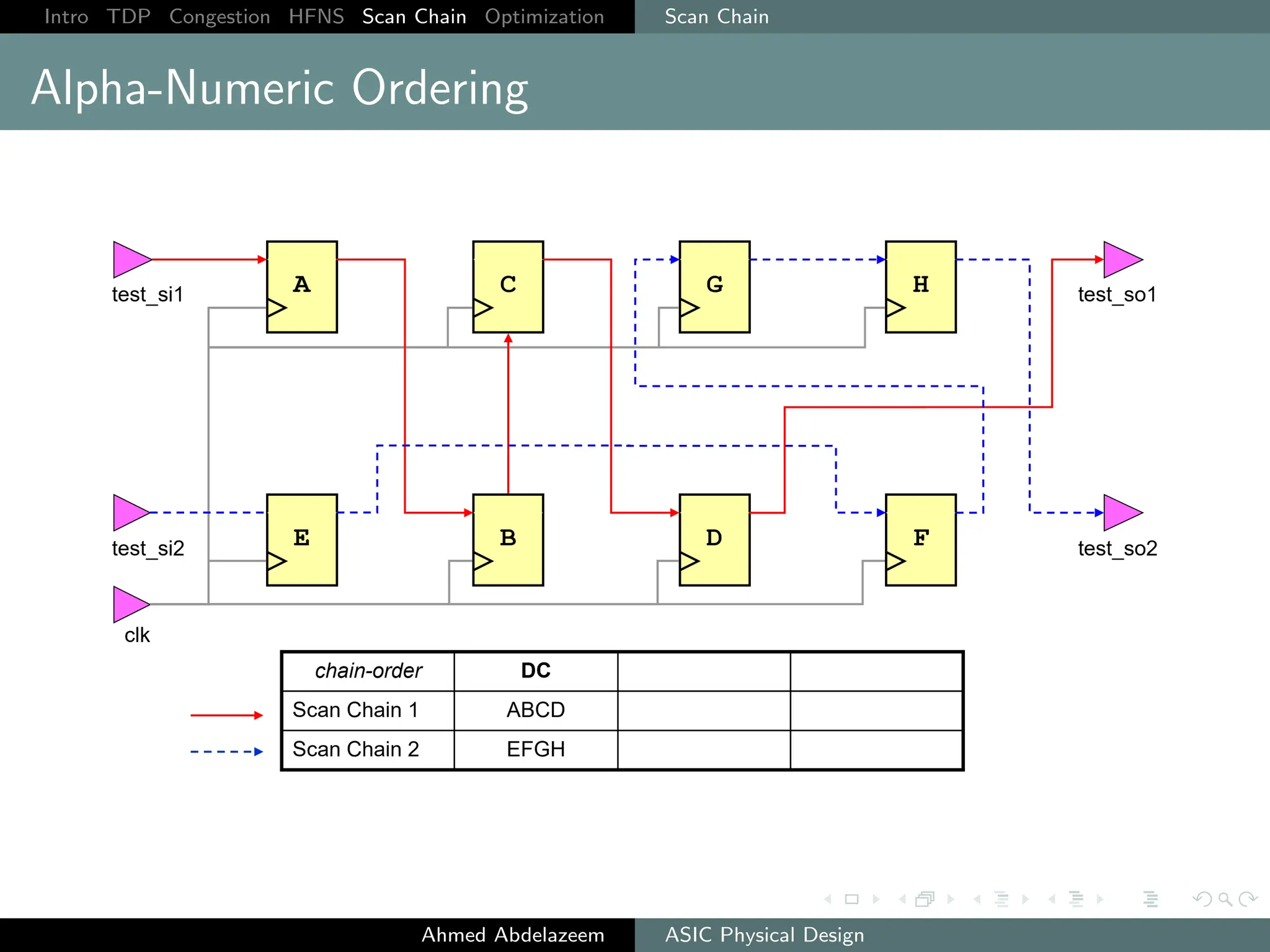
Alpha-Numeric Ordering
Ahmed Abdelazeem ASIC Physical Design
Intro TDP Congestion HFNS Scan Chain Optimization Scan Chain
Reordering Within Scan-Chain
Ahmed Abdelazeem ASIC Physical Design
Intro TDP Congestion HFNS Scan Chain Optimization Scan Chain
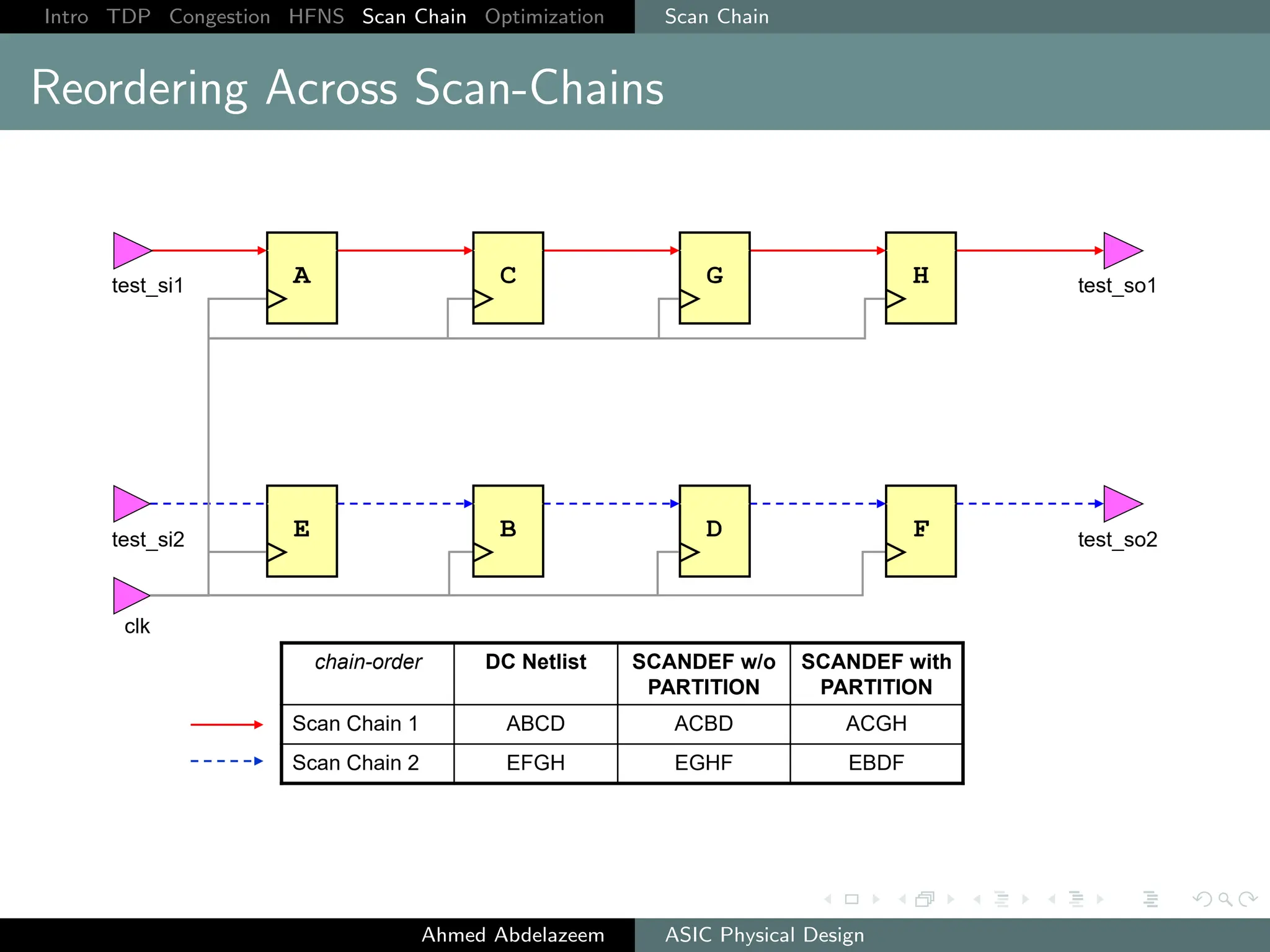
Reordering Across Scan-Chains
Ahmed Abdelazeem ASIC Physical Design
Intro TDP Congestion HFNS Scan Chain Optimization Optimization
Table of Contents
1 Introduction
2 Timing Driven Placement
3 Congestion Driven Placement
4 High Fanout Synthesis (HFS)
5 Scan Chain Reordering
6 Placement Optimization
Ahmed Abdelazeem ASIC Physical Design
Intro TDP Congestion HFNS Scan Chain Optimization Optimization
Optimization techniques
Ahmed Abdelazeem ASIC Physical Design
Intro TDP Congestion HFNS Scan Chain Optimization Optimization
Optimization techniques
Ahmed Abdelazeem ASIC Physical Design
Intro TDP Congestion HFNS Scan Chain Optimization Optimization
No Hold Time Fixing
By default place opt tries to fix only setup time violations -
No hold time fixing
Hold time will be addressed during clock tree synthesis
All timing calculations are based on ideal clocks (clock skew
= 0). Therefore, it is a common practice to give more
constrained timing to placement engine with:
1 Extra uncertainty
2 Frequency Overdrive
Ahmed Abdelazeem ASIC Physical Design
Intro TDP Congestion HFNS Scan Chain Optimization Optimization
....
ÕækQË@ áÔgQË@ éÊË@ Õæ„.
C

JÊ
¯ B

@ Õ

Ϊ

Ë@ áÓ Õ
æJKð@ AÓð
Ahmed Abdelazeem ASIC Physical Design

Placement

  • 1.
    Intro TDP CongestionHFNS Scan Chain Optimization Placement How to Plan your own chip Ahmed Abdelazeem Faculty of Engineering Zagazig University RTL2GDSII Flow, February 2022 Ahmed Abdelazeem ASIC Physical Design
  • 2.
    Intro TDP CongestionHFNS Scan Chain Optimization Table of Contents 1 Introduction 2 Timing Driven Placement 3 Congestion Driven Placement 4 High Fanout Synthesis (HFS) 5 Scan Chain Reordering 6 Placement Optimization Ahmed Abdelazeem ASIC Physical Design
  • 3.
    Intro TDP CongestionHFNS Scan Chain Optimization Place Flow Table of Contents 1 Introduction 2 Timing Driven Placement 3 Congestion Driven Placement 4 High Fanout Synthesis (HFS) 5 Scan Chain Reordering 6 Placement Optimization Ahmed Abdelazeem ASIC Physical Design
  • 4.
    Intro TDP CongestionHFNS Scan Chain Optimization Place Flow Design Status Prior to Placement Design Planning is completed Second-Pass Synthesis is completed Second-Pass Data Setup is completed “Floorplanned cell” is generated- ready for placement 1 Core and periphery areas defined 2 Macros are placed and “fixed” 3 Placement blockages defined 4 Power grid pre-routed 5 Standard cell placement is discarded Ahmed Abdelazeem ASIC Physical Design
  • 5.
    Intro TDP CongestionHFNS Scan Chain Optimization Place Flow Placement Problem The goal of placement is to minimize the total area and interconnect cost. The quality of the attainable routing is highly determined by the placement. Circuit placement becomes very critical in 65nm and below technologies. Ahmed Abdelazeem ASIC Physical Design
  • 6.
    Intro TDP CongestionHFNS Scan Chain Optimization Place Flow Placement Placement is the stage of the design flow, during which each standard cell is given an exact location Ahmed Abdelazeem ASIC Physical Design
  • 7.
    Intro TDP CongestionHFNS Scan Chain Optimization Place Flow Placement Placement is the stage of the design flow, during which each standard cell is given an exact location Placement does not just place the standard cell available in the synthesized netlist, it also optimized the design. Ahmed Abdelazeem ASIC Physical Design
  • 8.
    Intro TDP CongestionHFNS Scan Chain Optimization Place Flow Placement Placement is the stage of the design flow, during which each standard cell is given an exact location Placement does not just place the standard cell available in the synthesized netlist, it also optimized the design. Inputs: Ahmed Abdelazeem ASIC Physical Design
  • 9.
    Intro TDP CongestionHFNS Scan Chain Optimization Place Flow Placement Placement is the stage of the design flow, during which each standard cell is given an exact location Placement does not just place the standard cell available in the synthesized netlist, it also optimized the design. Inputs: 1 Netlist of gates and wires. 2 Floorplan and Technology constraints Outputs: Ahmed Abdelazeem ASIC Physical Design
  • 10.
    Intro TDP CongestionHFNS Scan Chain Optimization Place Flow Placement Placement is the stage of the design flow, during which each standard cell is given an exact location Placement does not just place the standard cell available in the synthesized netlist, it also optimized the design. Inputs: 1 Netlist of gates and wires. 2 Floorplan and Technology constraints Outputs: 1 All cells located in the floorplan. Goals: Ahmed Abdelazeem ASIC Physical Design
  • 11.
    Intro TDP CongestionHFNS Scan Chain Optimization Place Flow Placement Placement is the stage of the design flow, during which each standard cell is given an exact location Placement does not just place the standard cell available in the synthesized netlist, it also optimized the design. Inputs: 1 Netlist of gates and wires. 2 Floorplan and Technology constraints Outputs: 1 All cells located in the floorplan. Goals: 1 Provide legal location of entire netlist 2 Enable detailed route of all nets 3 Meet timing, area, and power targets Ahmed Abdelazeem ASIC Physical Design
  • 12.
    Intro TDP CongestionHFNS Scan Chain Optimization Place Flow Global and Detailed Placement In general, most tools partition the placement task into two stages: Ahmed Abdelazeem ASIC Physical Design
  • 13.
    Intro TDP CongestionHFNS Scan Chain Optimization Place Flow Global Placement Standard cells must be in groups in such a way that the number of connections between groups is minimum Ahmed Abdelazeem ASIC Physical Design
  • 14.
    Intro TDP CongestionHFNS Scan Chain Optimization Place Flow Global Placement Standard cells must be in groups in such a way that the number of connections between groups is minimum This issue is solved through circuit partitioning Ahmed Abdelazeem ASIC Physical Design
  • 15.
    Intro TDP CongestionHFNS Scan Chain Optimization Place Flow Global Placement Standard cells must be in groups in such a way that the number of connections between groups is minimum This issue is solved through circuit partitioning As a basic criterion, the minimum is taken among group connections Ahmed Abdelazeem ASIC Physical Design
  • 16.
    Intro TDP CongestionHFNS Scan Chain Optimization Place Flow Detailed Placement As a rule, detailed placemen is solved in two stages: 1 Coarse placement 2 Legalization of cell placement Ahmed Abdelazeem ASIC Physical Design
  • 17.
    Intro TDP CongestionHFNS Scan Chain Optimization Place Flow Coarse placement In a coarse placement all the cells are placed in the approximate locations but they are not legally placed. Cells overlap and are not on-grid. Large cells (e.g. RAMs) form large placement blockages for other smaller leaf cells. Power routing forms routing layer blockages that will also be checked and avoided if specified. Ahmed Abdelazeem ASIC Physical Design
  • 18.
    Intro TDP CongestionHFNS Scan Chain Optimization Place Flow Legalize Cell Placement Provide a legal placement for each instance with no overlap Try and minimize wirelength (or other cost metrics) Try to finish with uncongested design Ahmed Abdelazeem ASIC Physical Design
  • 19.
    Intro TDP CongestionHFNS Scan Chain Optimization Timing Table of Contents 1 Introduction 2 Timing Driven Placement 3 Congestion Driven Placement 4 High Fanout Synthesis (HFS) 5 Scan Chain Reordering 6 Placement Optimization Ahmed Abdelazeem ASIC Physical Design
  • 20.
    Intro TDP CongestionHFNS Scan Chain Optimization Timing Timing-Driven Placement (1) All steps including placement are timing-driven Timing-driven placement tries to place critical path cells close together to reduce net RCs and to meet setup timing RCs are based on Virtual Route (VR) Ahmed Abdelazeem ASIC Physical Design
  • 21.
    Intro TDP CongestionHFNS Scan Chain Optimization Timing Timing-Driven Placement (2) Timing-driven placement based on Virtual Route Tries to place cells along timing-critical paths close together to reduce net RCs and meet setup timing Net RCs are based on Virtual Routing (VR) estimates Ahmed Abdelazeem ASIC Physical Design
  • 22.
    Intro TDP CongestionHFNS Scan Chain Optimization Timing Timing-Driven Placement (3) Standard cells are placed in “placement rows” Cells in a timing-critical path are placed close together to reduce routing-related delays → Timing-Driven Placement Ahmed Abdelazeem ASIC Physical Design
  • 23.
    Intro TDP CongestionHFNS Scan Chain Optimization Timing TDP: Estimating Rnet and Cnet Before Placement Ahmed Abdelazeem ASIC Physical Design
  • 24.
    Intro TDP CongestionHFNS Scan Chain Optimization Congestion Issues Solution - Ahmed Abdelazeem ASIC Physical Design
  • 25.
    Intro TDP CongestionHFNS Scan Chain Optimization Congestion Issues Solution Table of Contents 1 Introduction 2 Timing Driven Placement 3 Congestion Driven Placement 4 High Fanout Synthesis (HFS) 5 Scan Chain Reordering 6 Placement Optimization Ahmed Abdelazeem ASIC Physical Design
  • 26.
    Intro TDP CongestionHFNS Scan Chain Optimization Congestion Issues Solution Congestion Congestion occurs when the number of required routing tracks exceeds the number of available tracks. Congestion can be estimated from the results of a quick global route. Global bins with routing overflow can be identified Ahmed Abdelazeem ASIC Physical Design
  • 27.
    Intro TDP CongestionHFNS Scan Chain Optimization Congestion Issues Solution Congestion Driven Placement: Routing resource Ahmed Abdelazeem ASIC Physical Design
  • 28.
    Intro TDP CongestionHFNS Scan Chain Optimization Congestion Issues Solution Placement Issues with Congestion If congestion is not too severe, the actual route can be detoured around the congested area The detoured nets will have worse RC delay compared to the VR estimates congested In highly congested areas, delay estimates during placement will be optimistic. Ahmed Abdelazeem ASIC Physical Design
  • 29.
    Intro TDP CongestionHFNS Scan Chain Optimization Congestion Issues Solution Non Routable on Severely Congested Design It is important to minimize or eliminate congestion before continuing Severe congestion can cause a design to be un-routable Ahmed Abdelazeem ASIC Physical Design
  • 30.
    Intro TDP CongestionHFNS Scan Chain Optimization Congestion Issues Solution Congestion Calculation Ahmed Abdelazeem ASIC Physical Design
  • 31.
    Intro TDP CongestionHFNS Scan Chain Optimization Congestion Issues Solution Congestion-driven Placement It is important to minimize or eliminate congestion before continuing Severe congestion can cause a design to be un-routable Ahmed Abdelazeem ASIC Physical Design
  • 32.
    Intro TDP CongestionHFNS Scan Chain Optimization Congestion Issues Solution Congestion-driven Placement Congestion Reduction The tool tries to evaluate congestion hotspots and spread the cells (lower utilization) in the area to reduce congestion. The tool can also choose cell location based on congestion, rather than wire-length. Ahmed Abdelazeem ASIC Physical Design
  • 33.
    Intro TDP CongestionHFNS Scan Chain Optimization Congestion Issues Solution Congestion vs. Timing-Driven Placement Ahmed Abdelazeem ASIC Physical Design
  • 34.
    Intro TDP CongestionHFNS Scan Chain Optimization Congestion Issues Solution Global Route (GR) for Congestion Map Ahmed Abdelazeem ASIC Physical Design
  • 35.
    Intro TDP CongestionHFNS Scan Chain Optimization Congestion Issues Solution Strategies to Fix Congestion Modify the floorplan: Mark areas for low utilization. Top-level ports Changing to a different metal layer Spreading them out, re-ordering or moving to other sides Macro location or orientation Alignment of bus signal pins Increase of spacing between macros Add blockages and halos Core aspect ratio and size Making block taller to add more horizontal routing resources Increase of the block size to reduce overall congestion Power grid Fixing any routed or non-preferred layers Ahmed Abdelazeem ASIC Physical Design
  • 36.
    Intro TDP CongestionHFNS Scan Chain Optimization HFNS Table of Contents 1 Introduction 2 Timing Driven Placement 3 Congestion Driven Placement 4 High Fanout Synthesis (HFS) 5 Scan Chain Reordering 6 Placement Optimization Ahmed Abdelazeem ASIC Physical Design
  • 37.
    Intro TDP CongestionHFNS Scan Chain Optimization HFNS High Fanout Synthesis (HFS) Ahmed Abdelazeem ASIC Physical Design
  • 38.
    Intro TDP CongestionHFNS Scan Chain Optimization HFNS High Fanout Synthesis What is fanout? Fanout is the number of gate inputs to which the output can be safely connected. i.e., The load that a gate output can drive. The maximum fanout of an output measures it’s load-driving capability. Fanout belongs to the output. What are High Fanout Nets(HFN) ? High Fanout Nets are the nets which drive more number of load. We set some max fanout limit by using the command set max fanout The nets which have greater than these limit are considered as High Fanout Nets (HFN). Generally clock nets, reset, scan, enable nets are High Fanout Nets. Ahmed Abdelazeem ASIC Physical Design
  • 39.
    Intro TDP CongestionHFNS Scan Chain Optimization HFNS What is High Fanout Net Synthesis (HFNS)? High Fanout Net Synthesis (HFNS) is the process of buffering the High Fanout Nets to balance the load. To balance the load HFNS is perfomed. Too many load affects delay numbers and transition times, Because load is directly proportional to the delay. Generally at placement step HFNS performed. HFNS can also be performed at synthesis step using Design Compiler. But it’s not good idea, Buffers will be removed during PD and again HFNS is performed. Care that should taken during HFNS: 1 Make sure an appropriate fanout limit is set using set max fanout command 2 Verify the SDC used for PD should not have set ideal network or set dont touch commands on High Fanout Nets. 3 Use ideal clock network – As clock nets are synthesized separately during Clock Tree Synthesis (CTS) step, we set clock network as ideal network. Ahmed Abdelazeem ASIC Physical Design
  • 40.
    Intro TDP CongestionHFNS Scan Chain Optimization Scan Chain Table of Contents 1 Introduction 2 Timing Driven Placement 3 Congestion Driven Placement 4 High Fanout Synthesis (HFS) 5 Scan Chain Reordering 6 Placement Optimization Ahmed Abdelazeem ASIC Physical Design
  • 41.
    Intro TDP CongestionHFNS Scan Chain Optimization Scan Chain Pre-Existing Scan Chains? Ahmed Abdelazeem ASIC Physical Design
  • 42.
    Intro TDP CongestionHFNS Scan Chain Optimization Scan Chain What’s the Issue with Existing Scan Chains? Ahmed Abdelazeem ASIC Physical Design
  • 43.
    Intro TDP CongestionHFNS Scan Chain Optimization Scan Chain Placement Based Scan Chain Routing Ahmed Abdelazeem ASIC Physical Design
  • 44.
    Intro TDP CongestionHFNS Scan Chain Optimization Scan Chain SCANDEF Reordering Ahmed Abdelazeem ASIC Physical Design
  • 45.
    Intro TDP CongestionHFNS Scan Chain Optimization Scan Chain Partitioning with SCANDEF Ahmed Abdelazeem ASIC Physical Design
  • 46.
    Intro TDP CongestionHFNS Scan Chain Optimization Scan Chain SCANDEF generated with DFTC Ahmed Abdelazeem ASIC Physical Design
  • 47.
    Intro TDP CongestionHFNS Scan Chain Optimization Scan Chain Alpha-Numeric Ordering Ahmed Abdelazeem ASIC Physical Design
  • 48.
    Intro TDP CongestionHFNS Scan Chain Optimization Scan Chain Reordering Within Scan-Chain Ahmed Abdelazeem ASIC Physical Design
  • 49.
    Intro TDP CongestionHFNS Scan Chain Optimization Scan Chain Reordering Across Scan-Chains Ahmed Abdelazeem ASIC Physical Design
  • 50.
    Intro TDP CongestionHFNS Scan Chain Optimization Optimization Table of Contents 1 Introduction 2 Timing Driven Placement 3 Congestion Driven Placement 4 High Fanout Synthesis (HFS) 5 Scan Chain Reordering 6 Placement Optimization Ahmed Abdelazeem ASIC Physical Design
  • 51.
    Intro TDP CongestionHFNS Scan Chain Optimization Optimization Optimization techniques Ahmed Abdelazeem ASIC Physical Design
  • 52.
    Intro TDP CongestionHFNS Scan Chain Optimization Optimization Optimization techniques Ahmed Abdelazeem ASIC Physical Design
  • 53.
    Intro TDP CongestionHFNS Scan Chain Optimization Optimization No Hold Time Fixing By default place opt tries to fix only setup time violations - No hold time fixing Hold time will be addressed during clock tree synthesis All timing calculations are based on ideal clocks (clock skew = 0). Therefore, it is a common practice to give more constrained timing to placement engine with: 1 Extra uncertainty 2 Frequency Overdrive Ahmed Abdelazeem ASIC Physical Design
  • 54.
    Intro TDP CongestionHFNS Scan Chain Optimization Optimization .... ÕækQË@ áÔgQË@ éÊË@ Õæ„. C JÊ ¯ B @ Õ Îª Ë@ áÓ Õ æJKð@ AÓð Ahmed Abdelazeem ASIC Physical Design